Audit Committee Chair: Duties, Skills and Time Needed

You're considering an audit committee chair seat, and the first conversation sounds reassuring: an established finance team, a familiar audit firm and a calendar of committee meetings. Then the papers arrive. There's an unresolved accounting estimate, an overdue control fix and a cyber update with no clear decision owner. The question isn't whether you understand the numbers. It's whether you can get the right people to resolve the right issues before reporting deadlines force the decision.
Table of Contents
- Core Responsibilities of the Audit Committee Chair
- Essential Expertise and How Boards Verify It
- Time Commitment and Workload Reality
- Oversight Priorities and Who Owns Each Risk
- How to Run Auditor and Reporting Oversight
- Worked Example of a Chair Facing Two Risks
- Decide Whether the Chair Seat Fits You
Core Responsibilities of the Audit Committee Chair
The audit committee chair runs the committee's agenda and leads oversight of financial reporting, the external auditor and internal controls, while the full board retains overall responsibility. The chair doesn't prepare the accounts or manage the audit. The job is to make sure the committee receives enough evidence to challenge management and act.
Think of a traffic controller. The chair doesn't fly the plane, but decides which issues land first, what information is missing and when a problem needs the full board's attention. Treating every paper as equally important defeats that purpose.
Turn responsibilities into recurring outputs
A useful description of the role names what the chair should produce, not just what the committee discusses.
| Duty area | What the chair does | Recurring output |
|---|---|---|
| Financial reporting oversight | Reviews significant judgments, estimates and reserves with management | Reviewed issues log and close sign-off |
| Auditor relationship | Oversees appointment, pay, performance and disputes with the external auditor | Auditor evaluation and pre-approval decisions |
| Internal controls | Tracks control deficiencies until management closes them with evidence | Deficiency tracker with dated remediation |
| Complaints | Confirms a confidential and anonymous channel reaches the committee | Reviewed complaint log and procedure |
| Committee operation | Presides, sets agendas and controls information flow | Agendas, papers and minutes |
| Board reporting | Escalates unresolved matters to the full board | Chair's report to the board |
The close sign-off in this table means the committee's documented review and recommendation within its delegated authority. It doesn't transfer management's responsibility for preparing financial statements to the chair.
Under the PCAOB's auditor communication standard, significant audit matters include difficult judgments, corrected and uncorrected misstatements, control deficiencies and auditor independence. Hearing those matters isn't enough. The chair should translate them into decisions, management actions and unresolved questions.
Preserve the boundary between oversight and management
Audit committee charters commonly place auditor appointment, compensation, retention, performance and management disputes within the committee's authority. Read the actual charter before accepting a seat, rather than assuming that a familiar title carries familiar powers.
For example, this SEC-filed audit committee charter gives the chair procedural authority to convene meetings, set agendas and determine information needs, subject to the board or committee. That authority matters when management's preferred presentation doesn't answer the committee's questions.
Practical rule: Ask for the evidence needed to make an oversight decision. Don't become the executive responsible for producing it.
When assessing board of directors positions, look beyond the seat description to these operating outputs. A candidate who can't name the recurring output of each duty area isn't yet ready to chair the committee.
Essential Expertise and How Boards Verify It
The chair must be able to read, challenge and support the committee's approval recommendation on financial statements, not merely hold a finance title. Technical knowledge matters, but boards need evidence that the candidate can use it under pressure.
Check eligibility before capability
The UK Corporate Governance Code 2024 says the board should satisfy itself that at least one audit committee member has recent and relevant financial experience; the earlier 2018 Code also stated that the board chair shouldn't be an audit committee member. A candidate who chairs the board therefore can't take this committee seat in a company governed by that separation requirement.
Check the company's applicable independence, membership and separation rules before applying. Relevant financial experience doesn't override an eligibility restriction.
The SEC's audit committee financial expert rules require disclosure of whether at least one expert serves, the expert's name and independence from management, or an explanation if there isn't one. They don't require every issuer to appoint such an expert.
The SEC definition covers understanding GAAP and financial statements, assessing its application to estimates, accruals and reserves, and experience with statements of comparable breadth and complexity. Relevant experience can come from being a CFO, chief accounting officer, controller, public accountant or auditor, or from actively supervising those functions or overseeing financial reporting.
Test what the candidate has actually done
Credentials establish a starting point. Decisions establish capability. Ask candidates to explain the information they received, what they challenged and how they knew the matter was resolved.
| Capability | Evidence a board can check | Why it matters |
|---|---|---|
| Financial reporting and GAAP | Prior CFO, controller, chief accounting officer or audit partner role | Shows whether the chair can read the statements and understand what the numbers depend on |
| Estimates, accruals and reserves | Record of challenging provisions, impairments or revenue judgments | Separates material estimates from routine policy questions |
| Internal controls | Led remediation of control deficiencies to verified closure | Tests whether fixes hold after the audit |
| External auditor oversight | Evaluated, retained or replaced an audit firm | Holds the auditor to account on quality and independence |
| Technology and cyber literacy | Oversaw IT risk, incident response or data governance | Tests management claims without needing to be the technical expert |
| Judgment and challenge | Documented cases of pushing back on management | Determines when to escalate and when to let management act |
A title alone can't prove any of these capabilities. A former CFO may have extensive transaction experience but little exposure to control remediation. A technology executive may understand systems well but struggle to connect an incident to reporting judgments.
Use the Board CV Grader as a prompt to replace responsibility lists with checkable examples. Preserve confidentiality by describing the issue, your decision and the evidence of resolution without disclosing protected documents.
The chair needn't be the deepest technical expert in the room. They must test assumptions, commission independent assurance and recognise when a specialist is needed. A senior finance title with no record of reviewing estimates or leading remediation is a weak signal, however impressive the employer.
Time Commitment and Workload Reality
A committee that meets five times a year can still concentrate most of its chair's effort into the weeks around year-end close. That is when the reporting control cycle runs: the close timetable, draft accounts, auditor findings, challenged estimates and sign-off. The seat is substantial but rarely full-time, and protecting capacity for the peak matters more than averaging hours across the calendar.
A peer-reviewed study of audit-report lag associated chairs' experiential and monitoring expertise with shorter delays between fiscal year-end and audit-report issuance, and linked compliance with core committee requirements, including regular meetings, to shorter lag as well. The study shows association; it does not prove that scheduling more meetings causes faster reporting.
The practical distinction is preparation. A chair who challenges the close timetable early can expose missing work before the reporting deadline. A chair who only attends the final meeting has fewer useful options.
The chair also controls how much work lands on the audit agenda at all. Pre-meetings with management and the auditor are where you decide which findings stay with the committee and which belong to the full board, and that allocation shapes the hours the seat demands.
Build a calendar-based estimate
Annual time commitment by activity
These are planning categories, not surveyed hour benchmarks. Confirm frequency against the charter and company calendar, then get realistic duration estimates from the outgoing chair and company secretary.
| Activity | Typical frequency |
|---|---|
| Scheduled committee meetings | According to the approved annual committee calendar |
| Chair pre-meetings with management and auditor | Before each meeting |
| Year-end audit and sign-off cycle | Once a year, peaking around close |
| Private sessions with the external auditor | At each scheduled meeting, with additional sessions when needed |
| Complaints, urgent issues and escalations | As they arise |
For each scheduled activity, multiply frequency by expected hours, including reading, calls and follow-up. Add the year-end peak separately and reserve capacity for urgent matters. Treat the result as a working estimate until someone has tested the assumptions against the company's actual reporting process.
Take the five-meeting committee again, with a February close. Its chair may carry most of the immediate reporting workload in January and February, even though a simple annual average makes the seat look manageable.
An available afternoon in the wrong month does not compensate for being unavailable during close.
Use the Board Time Commitment Calculator to structure your own estimate, then stress-test the busiest period. Ask what happens if a disputed estimate, an executive absence and an urgent complaint land in the same fortnight.
Total the hours you can realistically protect over the next twelve months. If the seat exceeds that capacity, the limiting factor is your other commitments rather than your skill.
Oversight Priorities and Who Owns Each Risk
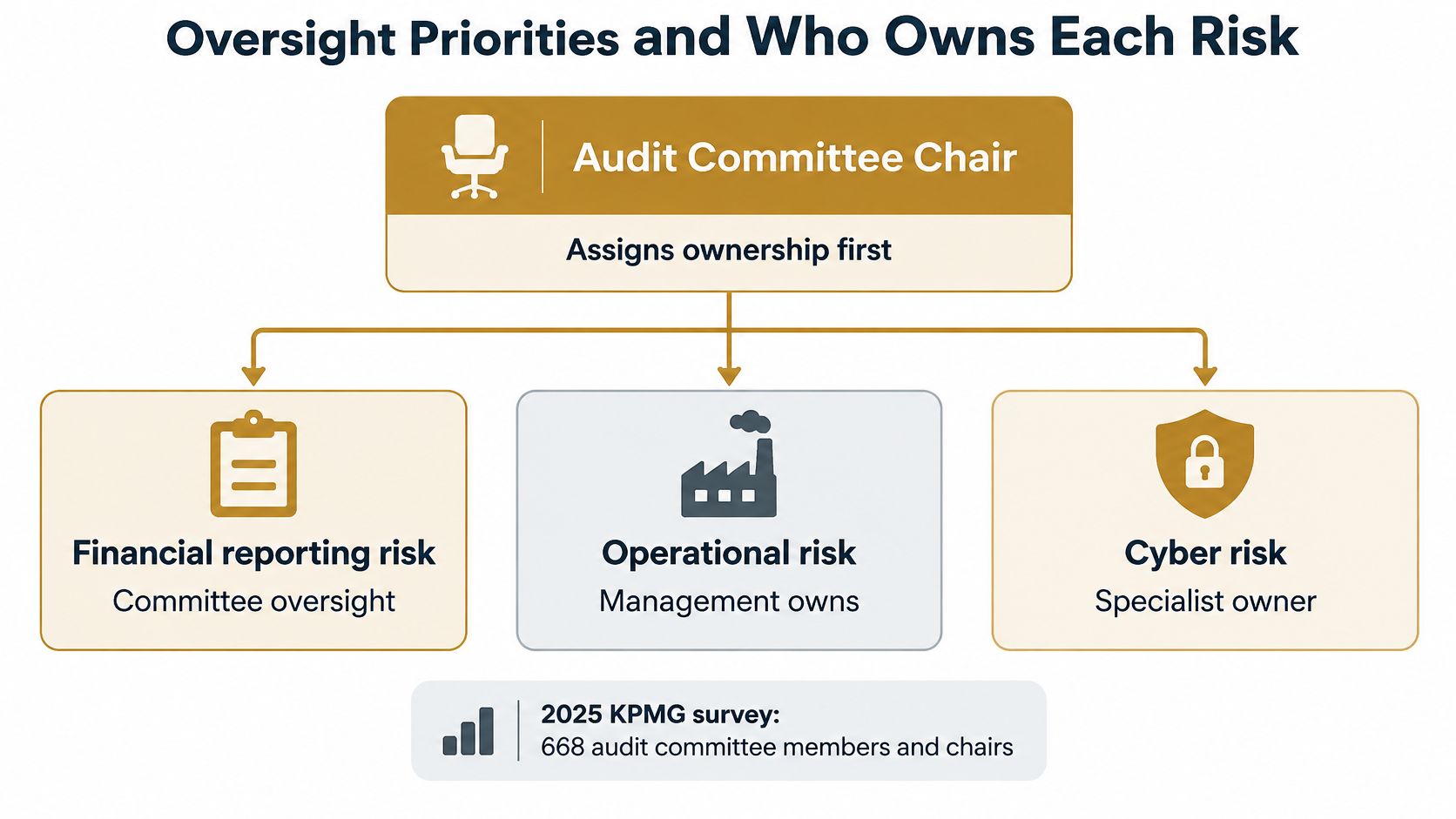
The chair's first job on risk is deciding ownership, not adding every emerging issue to the audit agenda. More meeting time won't repair an unclear division of responsibility.
The 2025 KPMG global survey of 668 audit committee members and chairs across 20 countries found significant oversight responsibilities extending into cyber and IT, enterprise risk, compliance and data governance, yet only 24% said their workload was appropriate and only 17% said boards were reallocating risk oversight.
The pressure is concrete: the Deloitte and CAQ 2025 survey announcement reported that 93% of respondents ranked cybersecurity among their committee's top three priorities, 50% called it the leading priority, and AI governance rose to 35% from 20% the prior year.
Assign an accountable oversight owner
Use the following allocation as a starting point, then align it with the company's charter and committee structure. Management remains responsible for running the business and managing risks; the table identifies board-level oversight.
| Risk area | Usually owned by | Escalate to full board when |
|---|---|---|
| Financial reporting and controls | Audit committee | Material restatement, misstatement or fraud involving senior management |
| Cybersecurity and IT risk | Technology or risk committee, with the audit committee reviewing control effects | Material breach or a disclosure decision |
| Enterprise risk management | Risk committee or full board, with the audit committee reviewing the framework | Risk exceeds the stated appetite |
| Legal and regulatory compliance | Audit or governance committee | Enforcement action or material regulatory finding |
| AI and data governance | Technology committee or full board | AI use affects material decisions, products or customer data |
| Supply chain and geopolitical risk | Full board or risk committee | Threat to going-concern status, supply continuity or strategy |
The distinction between management ownership and committee oversight should remain visible in every risk report.
Prevent duplicate review and unowned decisions
Unclear ownership creates two problems: committees repeatedly review the same presentation, while everyone assumes somebody else is considering its consequences. A cyber incident, for example, can involve operational recovery, financial controls and disclosure without requiring every committee to oversee every workstream.
Record the lead committee, accountable executive, assurance provider, and escalation trigger in a risk-ownership map. Amend the charter when responsibilities clearly change, rather than allowing repeated agenda additions to become an informal mandate.
For each new risk, ask:
- Reporting effect: Does it change the financial statements or controls?
- Evidence: Can management substantiate its assessment and remediation?
- Decision authority: Does it require a decision only the full board can make?
Those answers determine where the issue belongs and what the audit committee needs to receive.
How to Run Auditor and Reporting Oversight
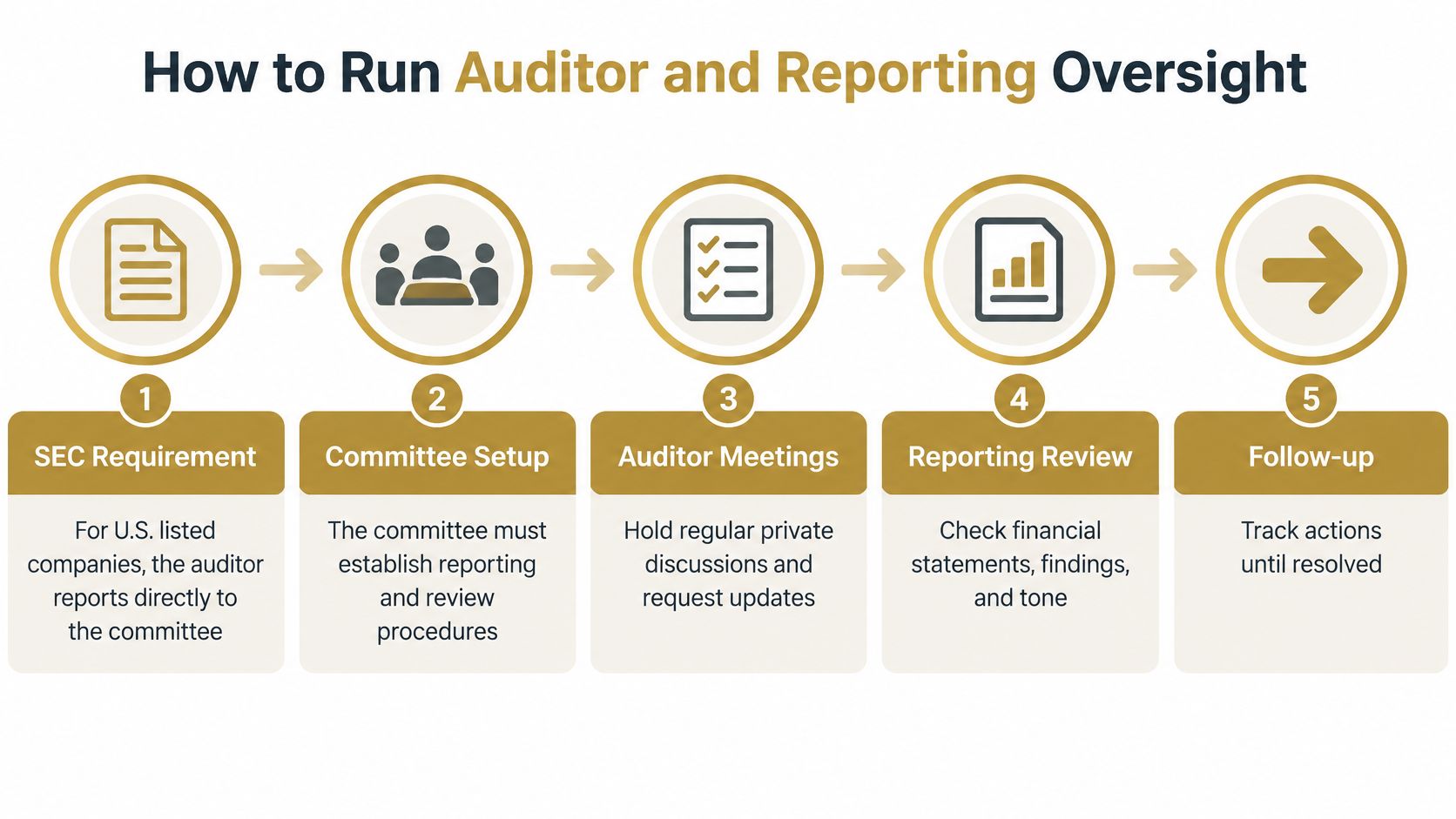
The gap that matters sits between hearing a concern and obtaining evidence that somebody has resolved it. An agenda can be full of auditor presentations while every finding stays open.
For U.S. listed companies, SEC audit committee rules place appointment, retention and oversight of the external audit firm directly with the committee, require the auditor to report directly to it, require accounting and auditing complaint procedures including confidential and anonymous employee submissions, and require appropriate funding for independent advisers. The chair should make those arrangements usable before a dispute or sensitive allegation arises, because the first test of the complaint channel should never be a live complaint.
The operating sequence connects direct access to documented follow-up.
Run a disciplined closure process
Build an issues log from every substantive auditor communication. Capture significant audit matters, corrected and uncorrected misstatements, control deficiencies and independence points. The common slip is recording the discussion in minutes without creating a trackable action.
Assign a named management owner. Record the individual accountable for delivery, even when several teams contribute. Naming “finance” or “IT” leaves the chair without someone who must explain a missed commitment.
Set an evidence-based closure date. Define the proof required, such as tested approvals, reconciliations or an independent validation report. A revised policy or management's green status indicator does not by itself prove a control operates.
Hold a private session with the external auditor, management absent, at least once or twice a year. Schedule additional sessions whenever restrictions, disagreements or reporting concerns arise. The slip is turning the session into a ceremonial invitation for comments after everyone is ready to leave.
Confirm that the complaint channel reaches the chair and test it annually. Make the test part of the committee's own operating procedure, including routing, access restrictions and retention. Handle sensitive allegations through the channel rather than circulating them broadly to show they were received.
Pre-approve audit and permitted non-audit services. Review the service's purpose and any relationships that could impair independence before work begins. Retrospective ratification is a poor substitute for a functioning approval process.
Adopt an escalation rule for repeated missed dates. A useful default is full-board escalation after two missed closure dates, with immediate escalation for a serious issue. The default should never delay action on suspected senior-management fraud or a material reporting concern.
Closure test: Could someone independent inspect the evidence and understand why the committee accepted the fix?
A healthy issues log shortens between meetings because management closes matters properly. A log that shrinks because the chair deletes uncomfortable entries signals a reporting culture problem. Keep rejected closure requests visible, together with the additional evidence required, and record which findings the committee kept on its own agenda and which it sent to the full board.
Worked Example of a Chair Facing Two Risks
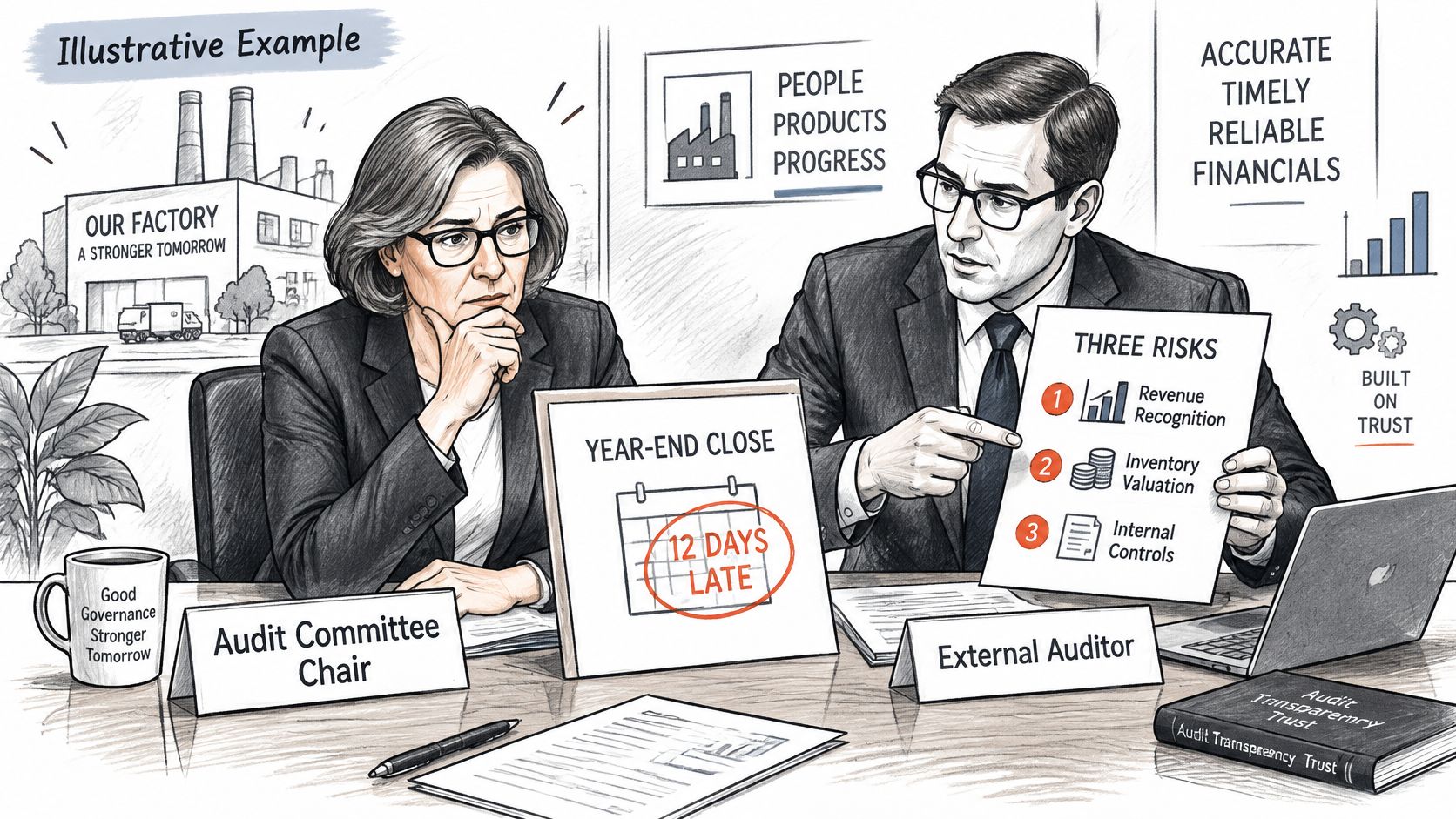
Consider an illustrative listed manufacturer whose year-end close is twelve days late. The chair faces two connected risk streams, financial reporting and technology, expressed through three auditor findings: an unresolved warranty reserve, a payment process where one person can approve and release funds, and an overdue access review following a minor security incident.
The meeting starts with unresolved decisions, not a request for another general update.
Separate the accounting judgment from the incident
The chair keeps the warranty reserve with the audit committee and asks the CFO for the close calendar, claims assumptions and sensitivity analysis. The controller becomes the named owner, with a dated submission for the auditor's review.
The payment-control gap also stays with the committee. Management must separate approval from release and provide evidence that the revised arrangement operates, rather than promising to change permissions.
For the security matter, the chair requests an evidence update from the technology lead and refers incident oversight to the risk committee. Because a disclosure decision may be necessary, the issue also goes to the full board with a named decision owner; the overdue access review remains on the audit committee's control tracker.
The following video provides additional context for the chair's oversight discussion.
Sequence the decisions
In a private session, the chair asks the auditor whether management has withheld information or whether the delayed estimate affects the audit timetable. The chair doesn't negotiate the reserve personally or direct the incident response.
In this hypothetical outcome, the reserve and payment-control items close within a month. The security matter reaches the board with an explicit decision owner, while the access review retains its fixed completion date and evidence requirement.
Before accepting a comparable seat, use the Board Offer Due Diligence Checklist to examine unresolved findings and reporting access. The chair's value lies in sorting and sequencing the issues, not solving every one personally.
Decide Whether the Chair Seat Fits You
A credible application starts with evidence that you can do this particular job at this particular company. Seniority alone won't answer the nomination committee's questions.
Run a practical self-check:
- Capability: Map your record against financial reporting, controls, auditor oversight, technology risk and judgment, with examples you could defend under questioning.
- Capacity: Calculate the hours you can protect over the next twelve months, including the close-period peak and unscheduled auditor or regulator calls.
- Fit: Identify which target-company risks belong with the audit committee and which require risk, remuneration, nomination or the full board.
The free Board Role Fit Checklist helps turn that review into a go or no-go decision before you invest in an approach. SeatSignal's program hand-picks relevant open board roles checked by a person, prepares a director-grade packet for each board, and provides board-specific interview preparation. Every plan includes pre-public matching across sectors, warm-path introductions when available, and placement-team review of what reaches you.
Make an informed approach
During onboarding, you state your sectors, expertise, committee interests, readiness and openness to paid, unpaid, equity or honorarium roles. SeatSignal is not a search firm and does not represent you to boards or negotiate on your behalf; you review, edit and send every approach in your own name.
Boards, nomination committees and recruiters make appointment decisions, so preparation improves the quality of your candidacy rather than guaranteeing an outcome. Complete the self-check, close the evidence gaps you can, and approach only where the seat's risk ownership matches your record.
SeatSignal combines hand-picked board opportunities with director-grade application materials and board-specific interview preparation. Visit SeatSignal to explore support for an audit committee chair search grounded in reporting expertise, available capacity and governance judgment.
Want a paid board role, done for you?
One handpicked, verified open board role every week, with a director-grade packet tailored for it.
Get Started