Board Committees and the Seats They Shape

You've been approached about a board seat. Your leadership experience seems relevant, your biography is polished, and the conversation feels promising. Then the chair asks which committee you could serve on, and what evidence shows you're ready for its work.
That question changes how you prepare. A credible board candidacy isn't just a summary of what you've managed. It's an explanation of the oversight you can contribute, the judgments you can test, and the questions you're qualified to ask.
Table of Contents
- Why a Board Seat Starts in a Committee
- How Board Committees Support the Full Board
- The Committees Most Boards Rely On
- What Committee Membership Rules Require
- When Risks Cross Committee Lines
- How to Choose Support for a Committee Role
- Your Next Step Toward a Committee Seat
Why a Board Seat Starts in a Committee
A board seat is usually decided in a small room before it reaches the big table. The committee a candidate could join shows the board where that person's accountability would sit.
A finance leader comes to discuss a directorship, ready to talk about growth, acquisitions, and the teams she has run. The chair asks whether she can examine a difficult accounting estimate, challenge an auditor, and spot an unresolved control problem. Her career is relevant. Her presentation has not shown where that relevance sits on the board's accountability map.
The question behind the invitation
For a first-time candidate, committee fit gives directors something concrete to test. A broad executive background asks them to guess. Linking specific experience to a specific oversight need gives them a standard.
A founder may have evaluated leadership succession. A people executive may have watched incentive design change management behavior. A finance professional may have challenged reporting assumptions while leaving preparation to management.
These are illustrations, and fit depends on the company's circumstances and each committee's mandate. Risk crosses boundaries too: a reporting problem can become a remuneration question, then a governance one. Boards favor candidates who see past their own remit and still own their part of it.
The committee is where the board's detailed questions get asked.
Reviewing board of directors positions involves more than checking sector, title, and remuneration. Look for the committee work the incoming director will support.
Preparation is part of the role
The OECD's work on board-level committees describes committees as bodies that support board decisions through monitoring, information, advice, and preparation. It also weighs skills, experience, and interests against each committee's objectives when members are chosen. Membership never moves fiduciary duty off the full board. What it shows is which part of that duty a new director can already carry.
For a candidate, that beats declaring general board readiness:
- Identify the mandate. Establish whether the opening calls for reporting, incentives, succession, risk, or another capability.
- Find relevant evidence. Select situations where you assessed uncertainty, challenged assumptions, or monitored corrective action.
- Explain your contribution. Distinguish what you personally examined from what your wider team delivered.
The shift is from attendance to accountable preparation. Evidence that you read, question, and form a view separates a credible candidate from a polished biography.
How Board Committees Support the Full Board
A board committee works like a specialist workshop attached to a larger studio. Its members inspect evidence, test assumptions, and prepare conclusions that colleagues can examine. The detailed work happens at the bench. The finished judgment still belongs to everyone.
The G20/OECD Principles of Corporate Governance recommend specialized committees, particularly audit committees, for disclosure, internal controls, and audit matters. Remuneration, nomination, and risk committees can also be appropriate where company size, complexity, structure, or risk profile justifies them.
New directors sometimes assume a committee seat moves legal responsibility to the members who sit there. Every director keeps the same fiduciary duty. Committees map who owns which work. The duty itself stays with the whole board.
Specialization without a responsibility gap
The practical advantage is depth. A smaller group can read technical material closely and challenge management before presenting its assessment to colleagues.
Take an audit committee examining the assumptions behind a reporting judgment. Its report should show what was tested, what remains uncertain, and what action is needed. Directors outside the committee deserve more than an unexplained assurance that everything is satisfactory.
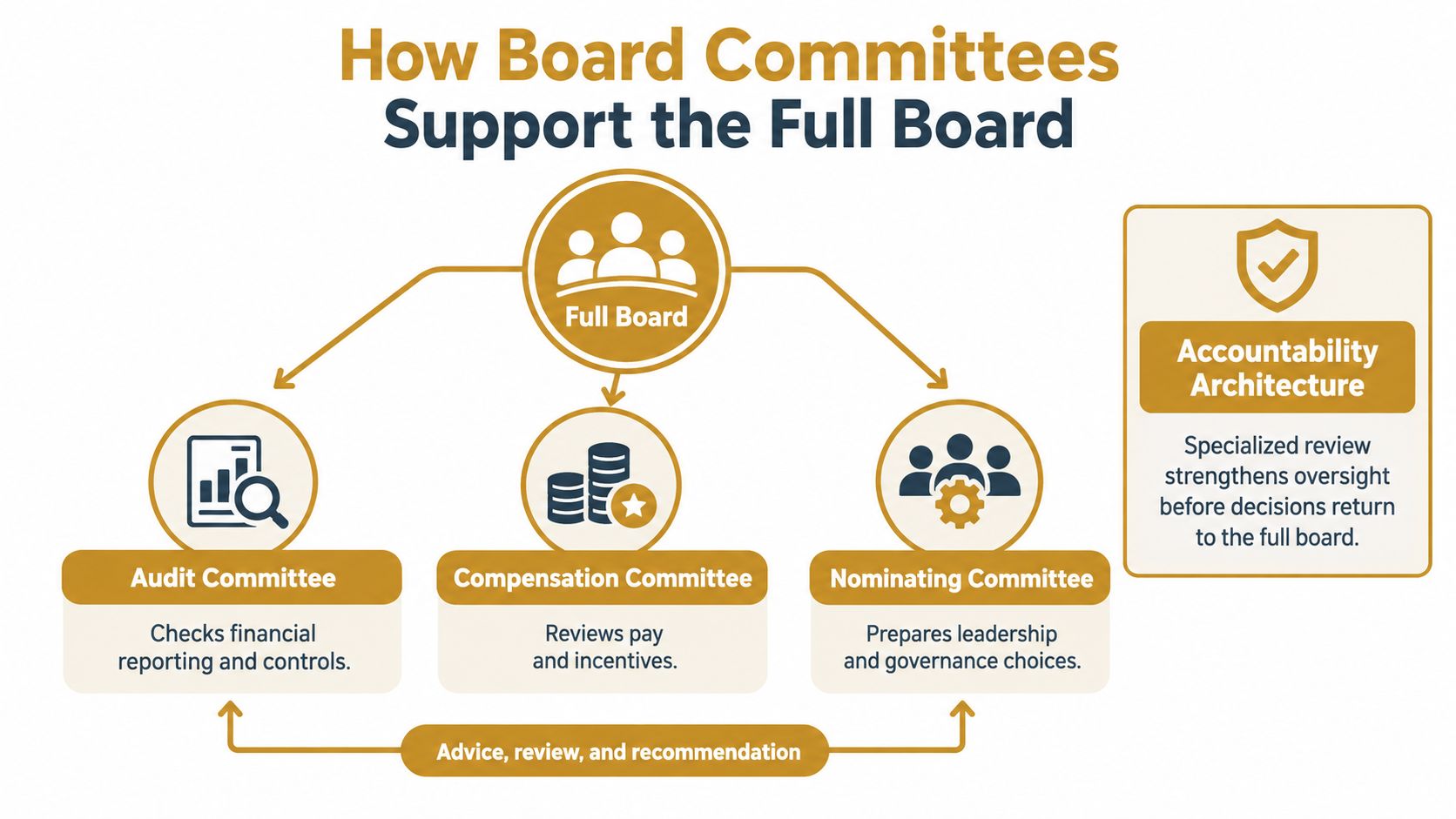
Committees form an accountability map across the board's workload. Some committee decisions do fall within expressly delegated or legally assigned authority, which makes clarity about authority matter even more.
Read the charter as an operating document
The OECD framework calls for clearly defined mandates, composition, procedures, and disclosed responsibilities. A strong charter turns those principles into working arrangements instead of naming a subject area and stopping there.
Check four mechanics:
- Authority and access. Can members obtain internal-audit information, question relevant personnel, and engage independent advisers?
- Independent discussion. Can the committee meet without management when necessary?
- Escalation and reporting. How are unresolved control deficiencies, decisions, and dissent reported to the board?
- Operating support. Are information rights, an appropriate budget, reporting arrangements, and performance evaluation established?
A charter can assign responsibility for controls yet say nothing about access to internal audit. The responsibility looks clear on paper. Members may lack the means to discharge it.
One further charter question reveals how the board handles shared territory: who owns a risk that sits between two committees? Cybersecurity can touch both audit and a risk committee, for example. A charter that names the owner of each seam keeps findings from falling between two groups that each assumed the other was watching.
For candidates, these mechanics also shape workload. Use a board time commitment calculator as a planning aid, then test your assumptions against the actual charter and expected preparation.
Executive seniority is a weak matching criterion. The stronger test is whether your experience equips you to work within this mandate, with this information, against this company's risks. Reading a charter closely is itself evidence of how you would serve.
The Committees Most Boards Rely On
Audit, compensation, and nominating and governance committees provide a useful starting comparison. Their names identify different kinds of scrutiny, not interchangeable places for experienced executives to sit.
In U.S. listed-company governance, committee design emphasizes independence and specialized oversight. The NACD's 2025 public-company boardroom benchmarking resource reports mean membership of 4 directors for audit, 3.8 for compensation, and 3.7 for nominating and governance. These are small working groups, not mini-boards.
Typical Listed-Company Committee Scale
The mean director counts below come from that NACD benchmarking resource; the independence column summarizes the U.S. listed-company framework.
| Committee | Mean directors | Independence posture | Core oversight |
|---|---|---|---|
| Audit | 4 | Independent members, including enhanced audit-independence requirements | Financial reporting, internal controls, external audit, related risk, and compliance |
| Compensation | 3.8 | Generally independent, subject to applicable exemptions | Executive pay and the incentives it creates |
| Nominating and governance | 3.7 | Generally independent, subject to applicable exemptions | Board composition, succession, and governance processes |
The Nasdaq framework requires at least three independent audit members, including enhanced independence under Rule 10A-3, while compensation and nomination arrangements generally emphasize independent directors, with exemptions including certain controlled companies, as summarized in the listed-company governance context accompanying the NACD resource above.
Match experience to the questions
Audit examines whether directors can rely on financial reporting and the controls supporting it. Its broad responsibilities help explain why its mean membership is slightly larger. A suitable candidate should be comfortable moving beyond the headline result to examine how management reached it.
For example, a strong reported outcome may still deserve questions about estimates, controls, or unresolved audit matters. Commercial success doesn't eliminate the need for reporting scrutiny.
Compensation tests whether executive incentives encourage the behavior the board wants. An illustrative question is whether a sales incentive promotes durable customer relationships or rewards transactions regardless of their quality. Relevant experience involves evaluating consequences, not merely having approved payroll.
Nominating and governance examines the board's own capacity to govern. Its work includes composition, succession, and governance processes. A candidate's experience developing leadership pipelines or assessing capability gaps may be useful if they can apply it to board needs rather than reproduce an executive hiring process.
A helpful distinction is between having encountered a topic and having exercised judgment about it. Attending compensation discussions isn't the same as testing incentive design. Receiving audit reports isn't the same as challenging an unresolved finding.
Your strongest fit is the committee whose questions you can address with specific, defensible examples, including the limits of what you know.
What Committee Membership Rules Require
A committee assignment works like being handed one district on a city map. You are accountable for that patch, but the council still answers for the whole city. Membership rules define who may hold the district and what they must prove before taking it, while fiduciary duty stays with the full board.
For audit committees at listed companies, those rules hardened considerably two decades ago. Following the Sarbanes-Oxley Act of 2002, SEC rules adopted in 2003 gave listed-issuer audit committees direct responsibility for appointing, compensating, retaining, and overseeing the external registered public accounting firm. The auditor reports directly to the committee. The same rules require procedures for accounting, internal-control, and audit complaints, including confidential and anonymous employee submissions, authority to engage independent counsel and advisers, and applicable director-independence standards.
Independence and capability are separate tests
Clearing a conflict-of-interest screen and being able to do the work are two different hurdles. A candidate may understand the business well yet have relationships that require an independence assessment. Another may be fully independent but lack the technical depth the role demands. Neither test substitutes for the other.
The checklist below summarizes the principal capability questions.
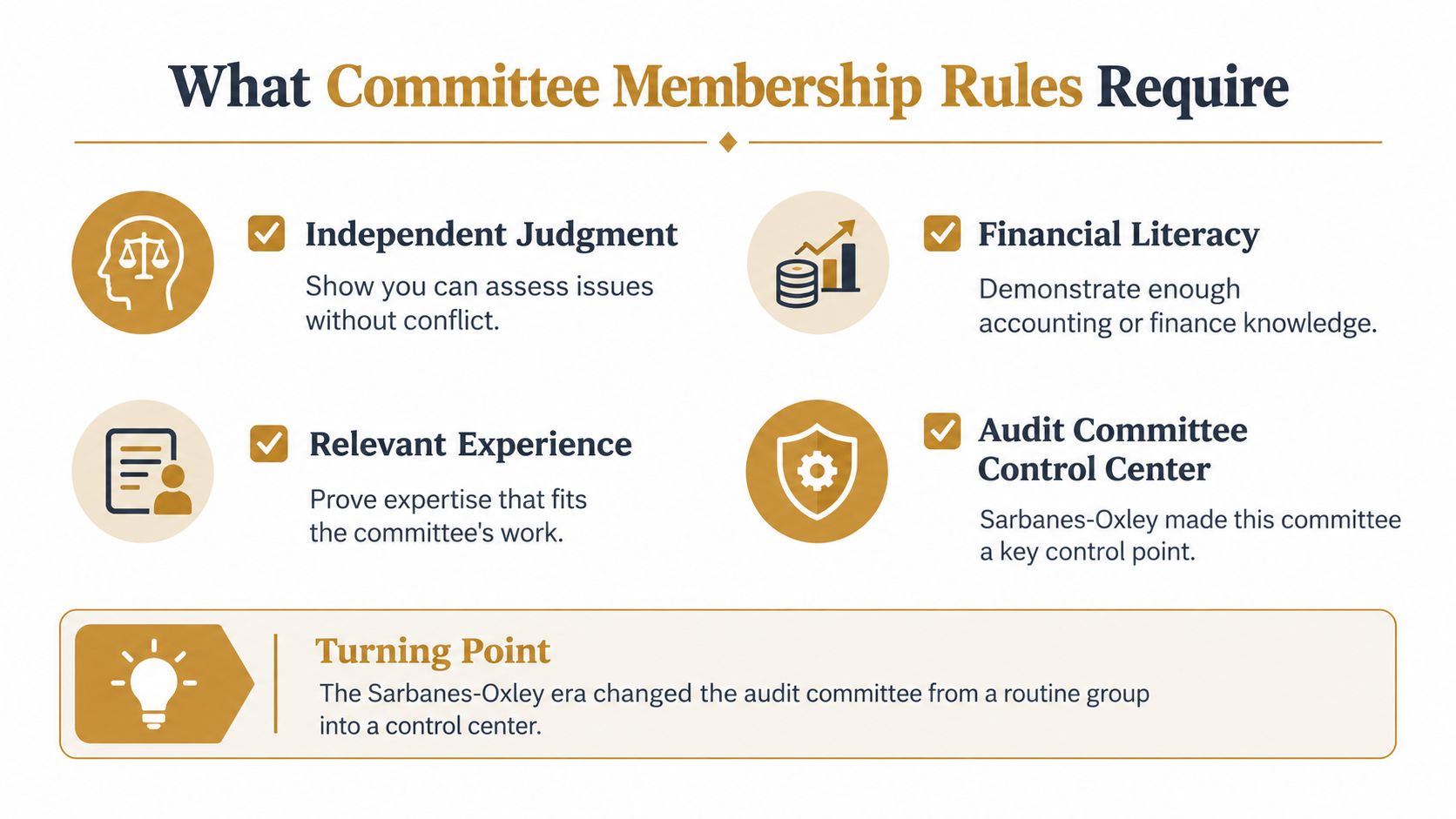
The financial-expert criteria reproduced in this SEC-filed audit committee charter cover understanding GAAP and financial statements, assessing estimates, accruals, and reserves, relevant experience with statements of comparable complexity, and understanding internal controls and financial-reporting procedures. Qualifying capability may come through senior finance, supervisory, oversight, or other relevant experience.
There isn't one global membership template
The UK Corporate Governance Code 2024 takes a different route to the same destination. It specifies at least three independent non-executive audit committee directors, or two for a smaller company, and excludes the board chair from membership. It also calls for at least one member with recent and relevant financial experience, alongside collective competence relevant to the company's sector. Under that Code, the committee monitors financial statements and formal financial-performance announcements and reviews significant reporting judgments. The framework operates on a comply-or-explain basis, so a departure calls for an explanation rather than automatic disqualification.
Whatever the jurisdiction, the board assessing you will ask the same underlying question: what evidence shows you can carry this district? Translate your background into examples it can test:
- Reporting judgment. Describe your involvement with estimates, revenue recognition, impairment, or liquidity.
- Assurance and challenge. Explain audit-firm interaction and how you tested significant assumptions.
- Control oversight. Identify controls testing, remediation, and oversight of reporting personnel.
“Strong financial acumen” leaves too much unexplained. You can check the presentation with a board CV grader, then verify every claimed capability yourself against the actual membership requirements. The credible candidate is the one whose evidence survives that second pass.
When Risks Cross Committee Lines
Cybersecurity, data privacy, AI, legal compliance, geopolitical exposure, supply chains, climate, and workforce risks don't necessarily fit neatly within a committee title. A technology failure, for example, could raise questions about operational resilience, financial reporting, legal obligations, and executive incentives.
The failure mode is fragmented oversight. Audit examines reporting effects, risk examines enterprise exposure, and a technology committee examines systems, but nobody knows who must resolve an issue that spans all those responsibilities.
More committees don't automatically mean better coverage
KPMG's 2025 board-agenda analysis reports that most audit-committee survey respondents were concerned about workload, yet only 17% said their boards were reallocating risk oversight responsibilities. KPMG identifies the practical challenge as defining remits, identifying overlaps, and establishing information-sharing processes.
The coordination problem is easier to see when the issue passes through several oversight touchpoints.
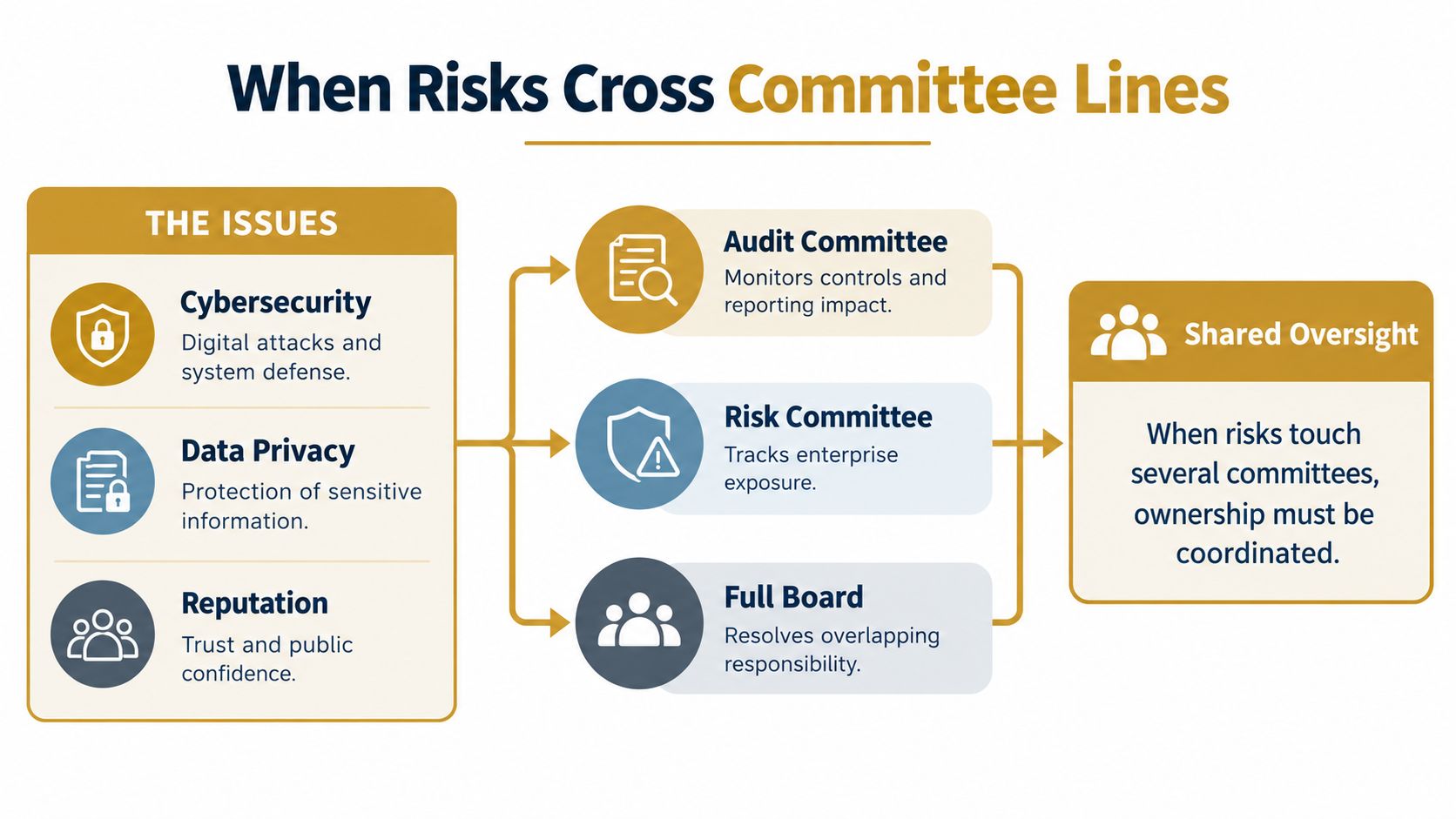
Practical rule: Adding a specialist committee can increase ambiguity unless the board also redraws responsibilities and reporting lines.
A useful approach is to assign different kinds of ownership explicitly. Shared interest shouldn't mean shared uncertainty about who acts next.
Build a usable risk map
For an illustrative AI deployment, a board could document:
- Primary oversight. Name the committee responsible for maintaining a coherent assessment and tracking unresolved questions.
- Advisory input. Identify where other committees contribute, such as reporting-control implications or workforce incentives.
- Management ownership. Specify the executive accountable for implementation and remediation. Directors oversee that work rather than run it.
- Escalation triggers. Define when unresolved disagreement, material exposure, or a strategic trade-off must reach the full board.
- Joint-session requirements. Bring committees together when separate reviews would prevent them from testing connected assumptions.
The exact allocation depends on the company, not a universal template. What matters is that directors can trace an issue from management reporting to committee scrutiny and, where necessary, full-board consideration.
In candidate diligence, ask who is primary, who advises, and what forces escalation. Then ask how the board records and follows up unresolved matters. Those questions reveal more than asking whether the company has a technology or risk committee.
How to Choose Support for a Committee Role
Preparing for a committee seat works like renovating a house. You can do the work yourself, hire each tradesperson separately, or pay one contractor to coordinate the job. All three routes can succeed, so the useful question is which tasks you want handled and which judgments stay with you.
Delegating search tasks mirrors what happens when a board delegates oversight to a committee: the work moves, the accountability stays. Your credibility still rests on committee evidence you can defend and a clear view of where you would sit on the board's accountability map.
The search itself involves several distinct activities.

Compare the work each route covers
| Route | What you handle | Main limitation to assess |
|---|---|---|
| Public vacancy lists | Search, targeting, documents, outreach, and preparation | Whether you can identify suitable opportunities beyond advertised openings |
| Separate writers and coaches | Selecting providers and coordinating their work | Whether everyone uses the same committee mandate and evidence |
| Integrated placement support | Approving targeting and materials, making decisions, and conducting diligence | Whether matching and preparation are genuinely role-specific |
Whatever the route, good support connects your experience, the board's composition, and the committee's mandate. It should also distinguish confirmed vacancies from forecast openings, rather than presenting anticipated changes as established opportunities.
SeatSignal is a board placement program that handles matching, application documents, and interview preparation as one coordinated service. Treating that objective as a promised outcome would be a mistake. The publisher's program information, cited earlier, states that appointments, interviews, matches, income, and completion within 60 days aren't guaranteed.
Check scope before subscribing
The publisher lists subscription choices of two months at $297, six months at $742.50, or one year at $1,188, with the same program in each plan. Coverage spans the United States, United Kingdom, Ireland, European Union, Canada, Australia, New Zealand, and Singapore, and there is no recruitment fee or retainer.
Before commissioning or approving materials, run a prospective role through the board role fit checklist to judge whether it deserves further attention. A polished application and a suitable appointment are different things, and only diligence tells them apart.
For another view of the search and preparation process, watch the accompanying video.
Your Next Step Toward a Committee Seat
A strong application starts with the mandate. If your record is built on reviewing audit findings and remediation plans, the audit committee is your natural first argument, even when another charter sounds more prestigious.
Choose the committee your evidence can serve now. Then write a short committee-fit statement in plain language: the mandate you could support, the experience behind that judgment, and any capability you would need to develop before accepting. One honest gap, named with a plan, reads better than a claim of universal readiness.
Keep the accountability map in view while you write. Committees prepare, recommend, and monitor, but fiduciary duty stays with the full board. Your statement should show you can strengthen the board's decision, rather than just staff a subcommittee.
Assemble proof you can defend
Committee evidence works like testimony. A candidate who cannot explain the record behind a claim is not ready to make it. Select three proof points that match your proposed contribution:
- A judgment you challenged. Explain how you questioned a financial estimate, incentive proposal, succession assumption, or risk assessment.
- An action you monitored. Describe how you followed a remediation or corrective response through to an evidenced conclusion.
- A boundary you respected. Show how you distinguished oversight from management execution, or recognized when independent expertise was needed.
For each example, record the context, your personal contribution, the evidence considered, and the outcome you can substantiate. Leave confidential details out of application materials.
Test the role before pursuing it
Read a target board's committee charters and mark where the committee leads, where it contributes, and where an issue should escalate. Risks rarely respect charter boundaries. If cyber oversight sits in audit while digital strategy sits in a technology committee, ask who owns the response when an incident crosses both mandates, and record unclear reporting lines as diligence questions rather than assuming they will resolve themselves.
Then review current opportunities against that fit. A board readiness assessment can help organize your preparation, while your own review determines which claims you approve and which roles you pursue.
This week, aim to finish with a defensible committee-fit statement, three supporting examples, and one target role worth investigating.
You still own the decision and the due diligence. A committee seat is an informed commitment to work you can perform, and the accountability that comes with it never fully leaves the boardroom.
SeatSignal combines board-opportunity matching, director materials, and role-specific interview preparation in one program, as noted earlier.
Want a paid board role, done for you?
One handpicked, verified open board role every week, with a director-grade packet tailored for it.
Get Started