Board Director Jobs: How to Find and Land a Seat

Only 26% of appointees to FTSE 350 boards in 2024 were first-time FTSE 350 directors, according to the UK board appointments analysis published by Treasury Today. That's the useful starting point for understanding board director jobs: you aren't entering an ordinary executive recruitment funnel.
A nomination committee needs confidence that you can exercise independent judgment alongside the existing directors. A polished CV helps establish that case, but access and timing determine whether the right people consider it. Your search needs a credible answer to both questions: why this seat, and why should this board trust you?
Table of Contents
- Board Director Jobs at a Glance by Board Type
- Channels That Surface Open Board Seats
- How to Write a Director CV That Shows Governance Fit
- Diversity Rules and Disclosure on Nasdaq Boards
- How to Approach Directors and Nomination Committees
- Interview Questions and Pitfalls That Cost Seats
- Start Your Board Search With One Target Seat
Board Director Jobs at a Glance by Board Type
Nine directors was the median board size across organizations surveyed in NACD's 2023–2024 compensation report. The report recorded medians of eight at micro-cap companies, nine at medium-size companies, ten at large companies, and twelve among the top two hundred organizations. Median total director compensation increased by 4% in the same report.
Those are small groups with substantial responsibilities, not executive teams with room to add another capable generalist. A candidate must fit the work that the board needs someone to perform.
Board size and seat types by board
The public-company size benchmarks below come from that NACD report. For other organizations, the governing documents or engagement terms set the size.
| Board type | Typical board size | Committees you may join |
|---|---|---|
| Micro-cap public company | Eight directors, median | Audit, compensation, nominating |
| Medium-size public company | Nine directors, median | Audit, compensation, nominating |
| Large public company | Ten directors, median | Audit, compensation, nominating, risk |
| Top two hundred public company | Twelve directors, median | Full committee structure |
| Private company or PE portfolio board | Set by governing documents and investor agreements | Audit and risk, sometimes ad hoc |
| Nonprofit board | Set by bylaws and applicable law | Finance, governance |
| Advisory board | Set by the advisory mandate | Usually none |
Choose the work before the title
Public-company seats require comfort with formal oversight, disclosure, and committee accountability. A larger board can distribute responsibilities across more committees, but it doesn't automatically create a suitable opening for you.
Private-company and private equity portfolio boards can require closer engagement with financing, performance, and an eventual ownership transition. Decisions may move quickly. Clarify whether the owners want independent challenge, specialist advice, or hands-on operating support, because those are different assignments.
Nonprofit and public-sector boards can build genuine governance experience, particularly through finance or committee leadership. Don't treat them merely as stepping stones: the responsibilities deserve commitment, and compensation shouldn't be assumed.
Advisory boards may offer fees, equity, or unpaid participation. They generally provide advice rather than exercise the governing board's authority, but you should confirm the actual duties and liability in the agreement.
Practical rule: Evaluate the committee assignment, preparation burden, compensation terms, and liability protections before you evaluate the prestige.
Mark the row that best matches your evidence. That's a more useful starting point than deciding you want any paid board seat.
Channels That Surface Open Board Seats
S&P 500 boards appointed 364 new independent directors in 2026, the lowest number since 2016, while 74% of Fortune 500 seats filled in 2025 went to people with prior public-board experience, according to the Spencer Stuart Board Index. The problem isn't just finding advertisements. It's entering a selective process in which committees can prefer an already-proven director.
Public listings give you visibility into an advertised requirement. Relationships can give you something different: context about a board's needs before the committee settles its candidate list.
These routes require different preparation.
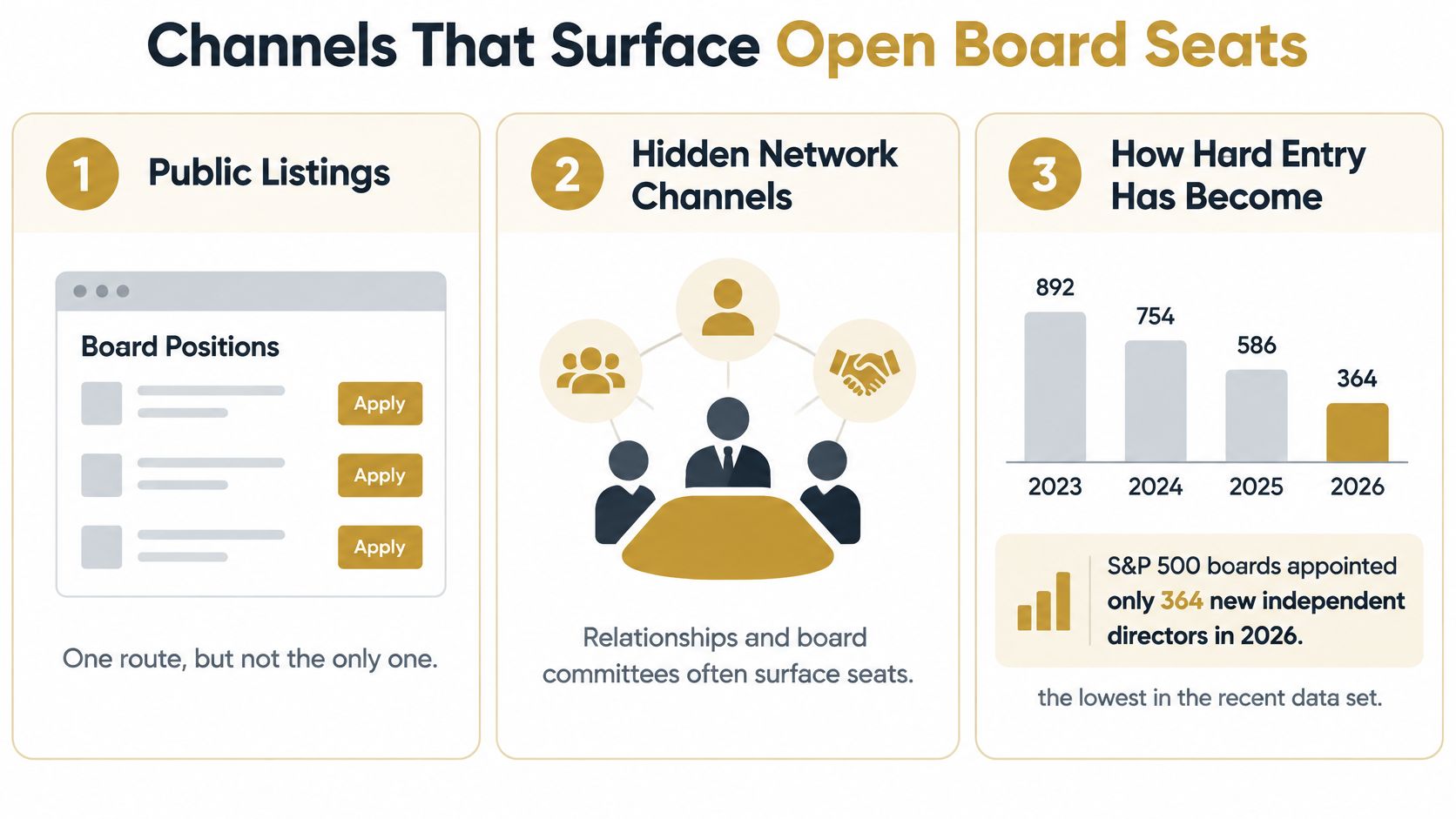
Board seat channels compared
| Channel | How the seat reaches you | Timing | What you need first |
|---|---|---|---|
| Public job boards | Posted listing open to all applicants | Once the vacancy is advertised | Strong written profile |
| Executive search firms | Retained search for a named seat | Mid to late in the search | Profile on file and a referral |
| Nomination committee contact | Direct approach to a chair or committee member | Before the search is formalised | Warm introduction and a clear value proposition |
| Personal network and shared boards | Introduction through a mutual director | Early, often before listing | Mapped connections |
| Pre-public seat signals | Expected departure or board refresh need | Months before a vacancy | Ongoing monitoring of board changes |
These timing descriptions are working expectations, not promises. A search firm can become involved early, and a board may never advertise externally. A forecast departure also isn't a confirmed vacancy.
Make a first appointment easier to defend
A first-time candidate needs credible proxies for director experience. Useful evidence includes chairing a nonprofit finance committee, participating in regulated-company oversight, presenting to investors or lenders, and serving on an advisory board with substantive responsibilities.
The quality of the work matters more than the label. Explain what you reviewed, which decisions you influenced, and how you handled disagreement or uncertainty. A current director's honest referral can then put that evidence in context.
Build those proxies before asking contacts to circulate your name. Next, map warm routes into suitable boards, while applying to relevant public listings in parallel.
If you're deciding where recruitment support fits, this comparison with executive search firms helps distinguish a candidate-led search from a firm's mandate to fill a particular client seat. Don't mistake inclusion in a recruiter's database for an active candidacy.
How to Write a Director CV That Shows Governance Fit
A chronological executive biography makes the nomination committee do the translation. Your director CV should make the connection between your achievements and the board's needs explicit, without upgrading management work into governance experience you haven't performed.
Sector relevance belongs near the top. 60% of new non-executive directors appointed to CSSBI 100 boards in 2025 had experience in the company's industry or an adjacent industry, according to the 2025 Canada Spencer Stuart Board Index.
Use the following process to select evidence before editing sentences.
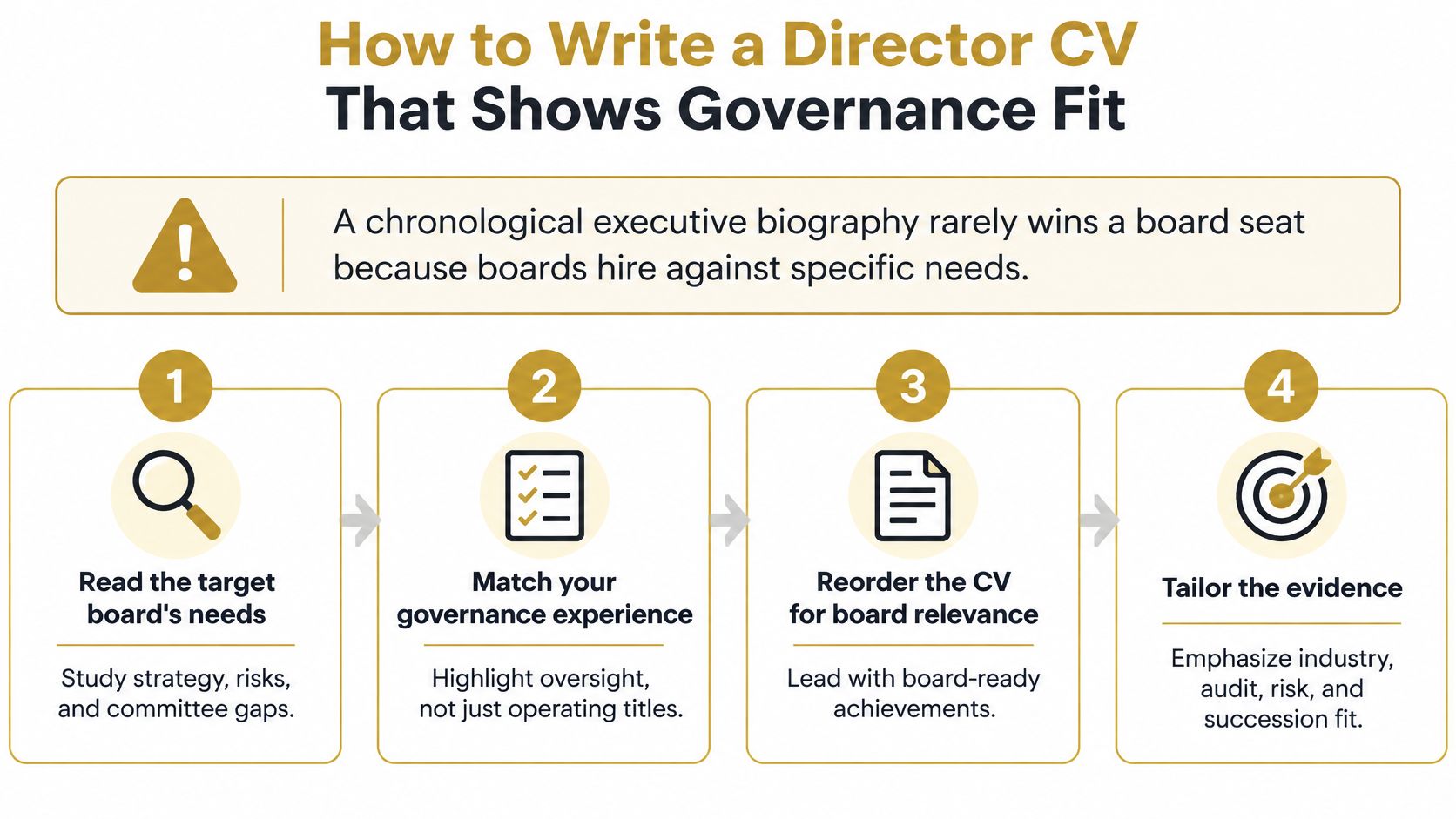
Build the evidence before writing
Read the target board's documents. Review the annual report, committee charters, and public skills matrix. Write down the strategic priorities, major risks, and committee workload that your experience could address.
Separate essential from desirable criteria. Distinguish the capability the board needs immediately from additional strengths that would be useful. The Mutual Fund Directors Forum recruitment toolkit recommends using a matrix to define criteria, compare candidates, structure interviews, and reassess finalists.
Assign a governance need to each achievement. An acquisition might demonstrate capital allocation, integration-risk oversight, or international expansion. Choose the interpretation your actual responsibilities support, rather than attaching every possible capability.
Code your evidence by skill category. Use strategy, oversight, risk, finance, technology, and human capital as working labels. This reveals whether your application demonstrates breadth or repeatedly describes the same functional strength.
Challenge weak evidence. Running a security team isn't the same as overseeing enterprise cyber risk. Look for incident governance, regulatory interaction, or board reporting, distinctions that matter when interpreting biography-based capability benchmarks such as NACD's public-company boardroom analysis.
Rewrite for scope and outcome. State what you were accountable for, the governance audience, and the decision or result. Keep job titles and chronology, but don't let them occupy the space needed for relevant proof.
A cybersecurity example
Illustrative before: Led a 40-person cybersecurity team across three regions.
Illustrative after: Oversaw enterprise cyber risk across three regions and reported incident exposure and remediation status to the audit committee each quarter.
The second version identifies scope, the governance audience, and the oversight activity. It's appropriate only if the candidate performed those duties; otherwise, retain the operating claim and describe the reporting contribution accurately.
Strong positioning makes relevant evidence easier to assess. It doesn't turn participation into authority.
Use the Board CV Grader as an additional review of the finished document. Your final check should still be whether each prominent claim answers a specific requirement of the target seat.
Diversity Rules and Disclosure on Nasdaq Boards
Treat Nasdaq's diversity framework as a rule-history check, not an assumed current appointment requirement. A federal court vacated the earlier approval, and Nasdaq's rule amendment materials effective February 4, 2025 address the resulting changes.
The earlier framework used a have-or-explain objective. For boards with more than five directors, it contemplated one female director and one underrepresented-minority or LGBTQ+ director; smaller reporting companies could use two female directors or that combination, while boards with five or fewer directors could meet the objective with one diverse director, as described in those amendment materials.
Check the applicable documents
- Listing-rule status. Confirm the current requirements through Nasdaq's rulebook or company counsel rather than relying on an older recruitment checklist.
- Composition disclosures. The earlier Nasdaq rule text described annual disclosure of voluntary self-identified characteristics in a standardized Board Diversity Matrix. Check whether a target company's published matrix is current, historical, or voluntary.
- Skills fit. Read composition information alongside the skills matrix. 80% of boards disclose a director skills matrix, according to Spencer Stuart's board-index review.
Disclose personal characteristics only if you're comfortable doing so. Your application should still explain the judgment, experience, and committee contribution you would bring, rather than treating any disclosure category as a substitute for governance fit.
How to Approach Directors and Nomination Committees
Say a former medical-device CFO wants a seat on a diagnostics board. She checks its public skills matrix before making contact, so her introduction can name the audit capability she offers. She then discovers that its audit chair serves on an industry association committee she previously chaired.
That's a relevant connection, not permission to ask for the seat. The preparation starts with finding someone who can make a credible introduction.
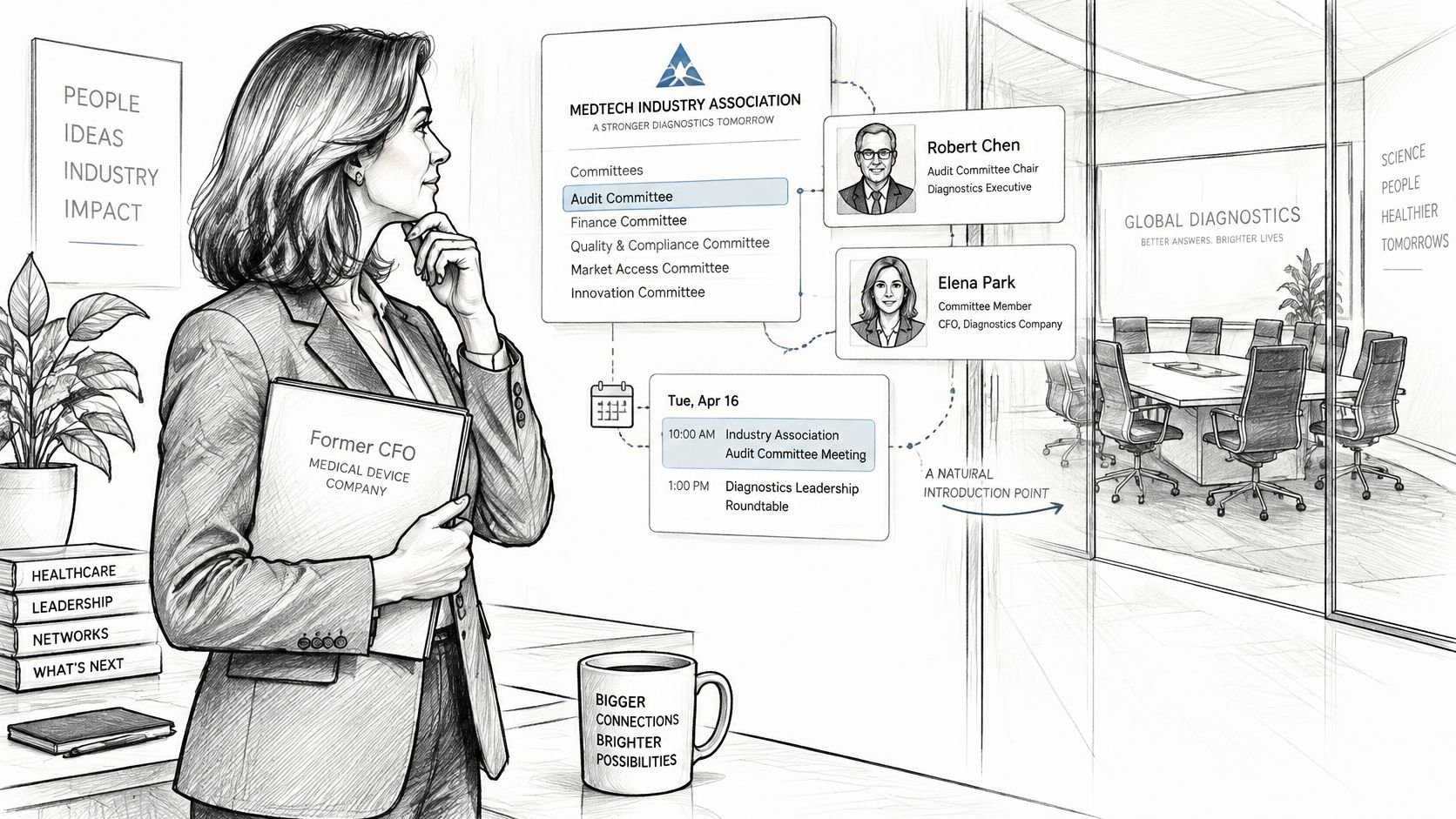
Make a narrow, credible request
Map shared professional history. For each target director, note shared boards, committees, employers, and professional associations. Record how well the intermediary knows the director.
Choose the warmest connection. Someone who has worked through difficult decisions with the director is generally a better introducer than someone connected only through a social platform. Use the warm-introduction approach to think in terms of credible shared work, not contact volume.
Give the intermediary a useful sentence. Explain your relevant experience and why the conversation would be worthwhile. In this scenario, the sentence might connect regulated-sector finance experience to audit oversight at the diagnostics company.
Request a short conversation, not a job. A focused conversation about the company's oversight challenges is easier to consider than an unsolicited appointment request. Don't imply that a vacancy exists unless it's confirmed.
Send a specific follow-up note. Refer to a substantive point the director raised, using only information appropriate to repeat. Explain briefly where your experience could contribute, without sending an unsolicited strategic diagnosis.
Follow up once, then stop. Leaving a couple of weeks before that reminder is a sensible working cadence. Silence isn't an invitation to approach several colleagues to pressure the same director.
For additional perspective on board-career conversations, watch the following video.
Keep the ethical boundary clear. Ask for an honest introduction, not private lobbying to bypass the nomination process, and never use confidential board discussions obtained through a contact to demonstrate how well informed you are.
Interview Questions and Pitfalls That Cost Seats
Why this board? Prepare for that question before polishing your career summary. A credible answer connects the company's situation, the board's responsibilities, and your own evidence without sounding as though you've arrived to run management's business.
Technical expertise alone won't settle the decision. In PwC's 2026 corporate-directors survey, 27% rated specialized expertise as very important when evaluating new directors, compared with 81% for cultural alignment. Cultural alignment shouldn't mean agreeing with everyone; your answers need to demonstrate constructive challenge and sound interpersonal judgment.
Rehearse decisions rather than speeches
Prepare for questions that expose how you think:
- Board relevance. Which gap in our skills matrix would you fill, and where is your evidence?
- Unfamiliar risk. How would you challenge management on an exposure you don't yet understand?
- Audit oversight. What would you ask about the risk register, control weaknesses, and unresolved remediation?
- Independence. How would you identify and handle a conflict involving an investor, supplier, or former employer?
- Capacity. Which commitments could collide with an urgent committee meeting or company crisis?
- Initial contribution. What would you prioritize during your first months without stepping into management's role?
A strong response to an unfamiliar-risk question starts with the decision the board must make. Identify the missing information, ask who owns the exposure, and explain when independent advice or escalation would be appropriate.
Don't answer by announcing the technical solution before you understand the company's risk appetite and constraints.
Interview pitfalls and fixes
| Pitfall | Why the board notices | Fix before the interview |
|---|---|---|
| Reciting an executive career | Answers don't link to a board need | Tie each answer to a committee mandate |
| Claiming a skill without board-level proof | Evidence sits at operations level | Show oversight, reporting, or challenge to management |
| Presenting as a functional advocate | Board sees a single-function view | Frame expertise as enterprise oversight |
| Vague answer on time commitment | Raises over-boarding concerns | State realistic seat capacity and available hours |
Use the Board Interview Question Bank to rehearse aloud, then have someone interrupt with follow-up questions. Memorized opening answers can conceal weak reasoning until the chair asks what you would do next.
Interview test: Can you disagree clearly, explain what evidence would change your mind, and leave management accountable for execution?
Bring your own diligence questions too. Ask about board information quality, unresolved committee work, expected availability, and how the chair handles dissent. You're evaluating an obligation, not merely competing for an offer.
Start Your Board Search With One Target Seat
Pick one board this week whose scale, committee workload, and composition fit your evidence. Write a short candidacy case before contacting anyone: the need you can address, the proof you can defend, and the relationship through which an introduction could reasonably happen.
Then complete the work in sequence. Confirm the board's requirements, tailor your director CV, map a warm route, and rehearse the questions that could expose weaknesses in your candidacy. Use the Board Readiness Assessment to identify preparation gaps before you send the application.
Get the preparation off your desk
SeatSignal is a Done-For-You board placement program. We're the only DFY board placement program that hand-picks ideal board matches, creates director-grade CVs for each role, and trains you specifically for each interview to ensure you land the seat.
Our team prepares a director-grade packet with a CV, cover letter aligned with the board charter and gap, fit memo, and independence attestation. We also map the warmest available route so your approach can arrive through a relevant name rather than a cold submission.
Treat 60 days as a working target for readiness and first contacts, not a promise of appointment. A credible search can take months, and you should keep evaluating fit rather than lowering your standards to meet a calendar deadline.
SeatSignal has a refund policy and a results disclaimer. Boards, nomination committees, and recruiters make appointment decisions; we support your search and don't guarantee a seat.
SeatSignal helps you identify suitable board director jobs, prepare board-specific application materials, and rehearse for the actual committee responsibilities. Visit SeatSignal to put a focused search around your experience, target boards, and strongest route to an introduction.
Want a paid board role, done for you?
One handpicked, verified open board role every week, with a director-grade packet tailored for it.
Get Started