Board Director Resume: How to Write One That Wins Seats
A striking shift explains why so many strong executives get overlooked for board seats. In the NACD 2025 governance outlook, 67% of directors surveyed by NACD said their boards were more likely to seek a candidate with specific expertise than someone with general business leadership experience. That's the test your Board Director Resume has to pass. It's not a polished chronology of titles, and it isn't your executive CV with a new headline. It's evidence mapped against one board's skills matrix, committee needs, and independence requirements.
I would start by forgetting seniority as your selling point. Chairs and nominating committees already assume candidates at your level can lead. What they need to know is narrower and harder to prove. Which capability gap do you fill, which committee can you strengthen, and what dated decision proves it? If your resume can't answer those three questions in the first half page, it's asking the reader to do your positioning work for you. Boards won't.
Table of Contents
- Skills Boards Look For and How Often They Appear
- How to Map a Board's Needs Before You Write
- Turning Executive Results into Governance Evidence
- Showing Technology Expertise Without Sounding Like a Specialist
- Format, Verify and Submit Your Board Resume
Skills Boards Look For and How Often They Appear
Leadership is the baseline, not the differentiator. Almost every credible candidate claims it, so it rarely decides a shortlist on its own. The Spencer Stuart US Board Index summary reports that leadership appeared in 91% of director biographies in NACD's Russell 3000 analysis. When nine in ten biographies say the same thing, the reader moves quickly to the rarer categories where a board may be thin.
Reading the Benchmark
Director biography coverage by skill category, NACD 2024 Russell 3000
| Skill category | Share of director biographies |
|---|---|
| Leadership | 91% |
| Finance | 65% |
| Technology | 44% |
| Global experience | 30% |
| Risk management | 15% |
| Cybersecurity | 8% |
| Digital skills | 3% |
Read this table from the bottom up. If you can document risk oversight, cybersecurity judgment, or digital transformation at enterprise scale, you're claiming ground few incumbents occupy. That doesn't make the claim automatically valuable. It makes it worth foregrounding only when the target board has that gap and you can attach scale, dates, and consequences to it. A rare skill with no decision behind it is just another keyword.
Demand also varies by appointment. In the 2016 Global Board of Directors Survey, based on responses from more than 4,000 male and female directors in 60 countries, 67% of respondents identified strategy as one of the most important areas of expertise for directors. Industry knowledge and financial or audit expertise ranked among the three most important skill categories, with risk management and international expertise also frequently named.
That combination is why a generic executive CV underperforms. Boards compare candidates against a defined matrix, and most now publish one. Pick the two or three categories you can prove with dated, specific examples, and name the committee each one supports, whether that's audit, risk, strategy, or technology oversight. If you're unsure where you stand, run the Board Readiness Assessment before you start rewriting, so you're building on an honest baseline rather than an optimistic one.
How to Map a Board's Needs Before You Write
Don't open your CV yet. Open the target company's disclosures instead, because that's where the board has already told you what it values.
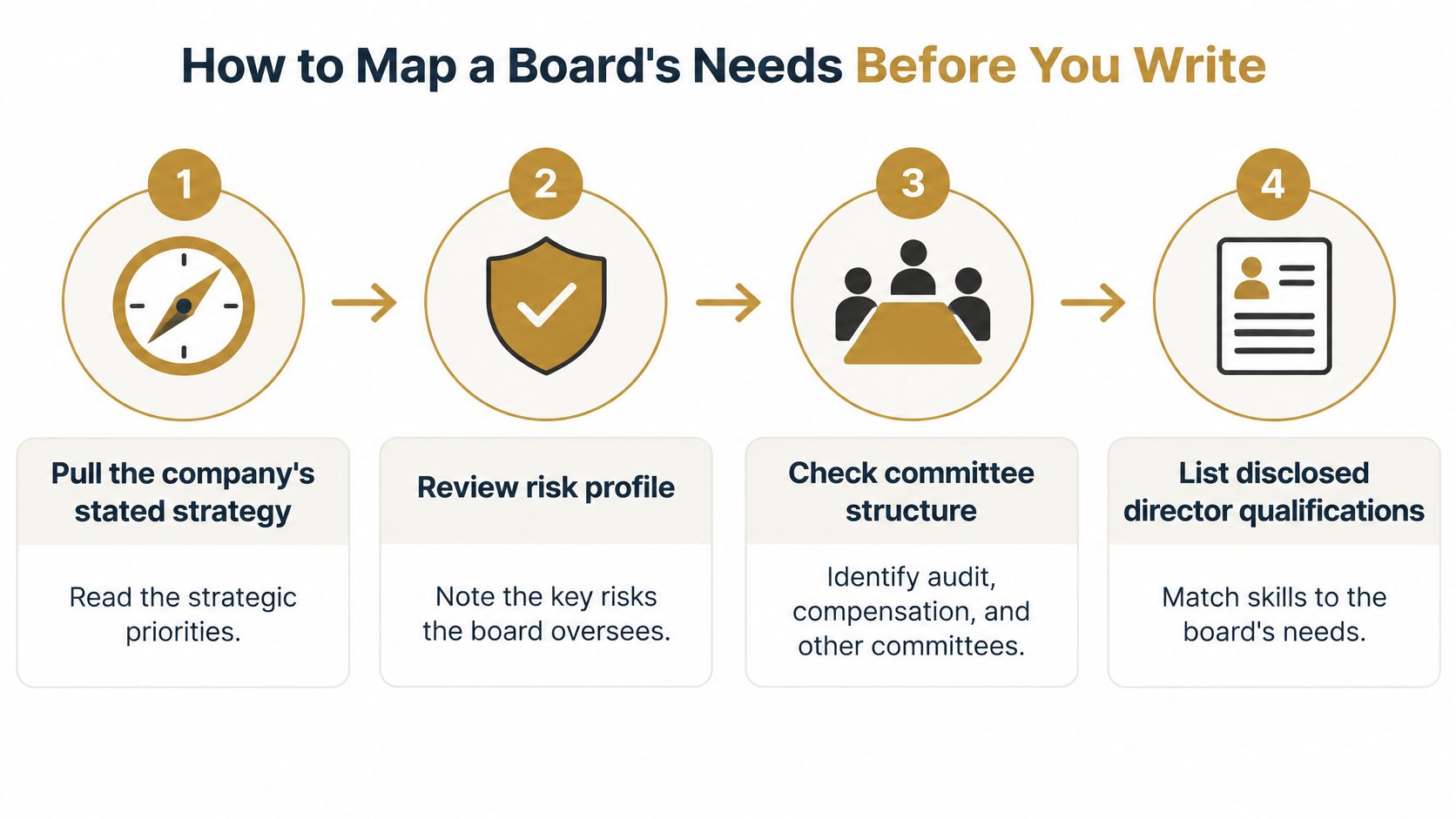
The four starting inputs are shown here, and each one feeds a different part of your resume.
Six Steps to a Target List
Pull the stated strategy, risk profile, committee structure, and disclosed director qualifications from the company website, annual report, and proxy statement. These documents tell you what the board thinks it's overseeing and how it justifies each nomination. If the strategy is international expansion and your opening profile leads with domestic cost control, you've already misaligned.
Map those requirements onto a skills matrix covering finance, audit, risk, technology, cybersecurity, regulatory, international, industry, and transformation experience. The National Association of Corporate Directors provides a skills-matrix framework for identifying board capability gaps, as noted in Nasdaq's governance materials. A matrix forces you to work category by category instead of relying on a general impression of fit.
Compare the matrix with current directors' disclosed backgrounds to find where the board is thin. Look for categories claimed by only one ageing director, or committees staffed by people whose biographies don't obviously match the remit. That's where a candidate becomes a solution rather than a duplicate.
Check the governance criteria for nominees, including professional background, independent judgment, time commitment, ethics, strategic leadership, financial and technology knowledge, and sound business judgment. These are screening conditions, not decoration. A brilliant profile that says nothing about independence or available time invites an avoidable question.
Select the three to five highest-priority needs and write them down as a target list. This is the trade-off most candidates resist. Claiming nine strengths means none of them gets enough evidence to be believed, so choose the few that match real gaps.
Build a master evidence inventory of every role, decision, and metric you could use, so each priority has candidate proof behind it. Include scale of P&L or balance sheet responsibility, regulated-market exposure, transactions, crises managed, and controls improved. You'll select from this inventory later rather than inventing bullets from memory.
Common failure: targeting too many boards at once and sending each a slightly edited version of the same document. The match dilutes, the evidence stays generic, and no single board sees itself in your profile.
A finished target list is short and specific. It names three to five needs, each tied to a committee, each with evidence waiting in your inventory. The Board Role Fit Checklist is a practical way to test whether a particular seat deserves that effort before you invest days in tailoring.
Turning Executive Results into Governance Evidence
Executive resumes list duties. Board resumes prove oversight value. Use this pattern for every bullet that matters: governance-relevant capability, then the situation, then the measurable consequence. "Responsible for financial reporting" tells a chair nothing. "Rebuilt month-end controls after a restatement risk across 14 entities, cutting the close from 15 days to 8" tells them what you assessed, decided, and changed.
Why Narrow Evidence Beats Seniority
Broad executive seniority is less persuasive than narrowly evidenced fit. The Deloitte analysis of BoardEx data, reviewing the six most recent roles held by Fortune 100 directors from 1998 through 2024, found that every Fortune 100 company had at least one director with chief executive experience. Finance and operations leadership were nearly as common, while technology leadership appeared at only 38 of the Fortune 100 companies and data-and-analytics leaders on just 28 boards. Translation: CEO, finance, and operations credentials are widely supplied, so they need sharper proof, while technology and analytics can differentiate you where a gap exists.
First-time candidates often underrate themselves here. Your career probably contains governance-relevant decisions that conventional bullets hide, such as presenting to directors, overseeing enterprise risk, or working through an IPO, restructuring, or regulatory intervention. The task isn't to invent board experience. It's to surface the decisions that already carry oversight weight. Working through the Board Value Proposition Builder can help you name that value before you draft.
Build an Evidence Matrix
| Required skill | Decision you influenced | Scale and consequence | Committee fit | Independence note |
|---|---|---|---|---|
| Audit oversight | Rebuilt month-end controls after a restatement risk | 14 entities, close cut from 15 days to 8 | Audit | Controls were a management role, so say so |
| Risk oversight | Set risk appetite limits for a lending book | Loss ratio held below 2% through a downturn | Risk | Show you owned the exposure, not only monitored it |
| Cybersecurity | Led incident response to a ransomware event | Services restored within 24 hours, no customer data lost | Risk or technology | Note any external advisers used |
| Compensation | Redesigned executive incentive plan around retention metrics | Retention rose in the target group within one year | Compensation | Disclose any personal stake in the plan |
These rows are illustrative. Replace every figure with your own verified results, and delete any row you can't substantiate in an interview.
Take the CFO in the first row. The weak version says she "improved risk management." The strong version names the risk domain (financial reporting controls), the decision authority (she owned the rebuild), the organisational scale (14 entities), and the measurable result (close cut from 15 days to 8). It also states plainly that controls were a management responsibility, not board oversight. That honesty matters, because chairs probe exactly that boundary and respect candidates who don't blur it.
Apply that four-part rule to every priority bullet. If a bullet names no domain, no authority, no scale, and no result, it isn't evidence yet.
Showing Technology Expertise Without Sounding Like a Specialist
Stacking technology keywords is the fastest way to look like a single-issue specialist. A board wants a director who can oversee risk, investment, ethics, resilience, and business consequences when technology decisions go wrong or run over budget. Jargon signals delivery experience. The skills matrix asks for judgment.
This is the reader you're writing for, a director scanning for oversight instinct rather than tool knowledge.

Demand is real, which is why candidates overshoot. Egon Zehnder's 2025 global study found that 41% of directors reported increased representation of subject-matter experts in areas such as AI or geopolitics over the prior five years. Specialist expertise remains hard to secure at board level, partly because demand for those same skills stays strong in executive roles.
Scarcity doesn't lower the bar. It raises the penalty for unsupported claims, because a board that can't easily replace expertise will interrogate yours carefully.
Frame Oversight, Not Delivery
Separate what you built from what you oversaw. Say a CIO led a payments platform migration. Presented to a risk committee, that becomes owning the vendor-concentration decision and the rollback plan, reporting outage minutes, and briefing the audit committee quarterly. Same career, different signal.
Name the committee where the expertise applies, quantify the risk or transformation outcome, and state where your knowledge runs deep and where the board would rely on external advisers. Naming the adviser reliance reads as honesty calibrated to that board's gaps, and it pre-empts the exact question a nominating committee would ask anyway.
The video below shows how board-level technology conversations sound. Watch it before you finalise your technology claims.
Every emerging keyword on the page needs evidence behind it, because a claim without decisions, accountability, or enterprise impact weakens the whole document. Apply one test: could you answer a chair's question on this topic in terms of risk and consequence rather than tools? If not, cut the keyword or downgrade it to informed oversight. Candidates targeting seats in the technology sector face this scrutiny most sharply, so I'd be strictest there.
Format, Verify and Submit Your Board Resume
Treat layout as an argument. Your headline and opening profile should foreground only the three to five priorities you selected for this board, not every strength you've accumulated over thirty years. Everything below that profile exists to support those claims.
Structure the Document
List existing directorships most recent first, with entity type, market capitalisation where relevant, committees, leadership roles, and dates served. Separate public, private, nonprofit, and advisory boards so the reader doesn't have to decode which roles carried fiduciary duties. Mixing them creates an impression problem even when your intent is innocent.
First-time candidates should add a Board-Relevant Expertise section instead of overstating board tenure. Cover presentations to directors, enterprise risk oversight, and involvement in restructuring, IPO, cybersecurity, or regulatory decisions. Describe your role precisely and don't imply fiduciary experience you don't have. "Advised the audit committee through remediation" is evidence; "board member" is not, if the seat was not fiduciary. Nominating committees would rather see honest board-facing evidence than inflated labels they'll dismantle in twenty minutes.
For positioning, Spencer Stuart's guidance on preparing for a board opportunity advises highlighting governance exposure, leadership scope, committee-specific expertise, special situations such as bankruptcy, spinoffs, or IPOs, international experience, and the type and scale of businesses led, and reports that 80% of S&P 500 boards disclosed a skills matrix in their most recent proxy. That is why your document has to map cleanly onto published categories. If the matrix says "capital allocation" and "risk oversight," those phrases should be easy to find in your profile, then proved lower down.
Run the Verification Checklist
Trace every claim. Confirm each headline and summary statement links to a dated role, decision, metric, or board interaction somewhere in the document. If a claim floats free, either evidence it or delete it.
Check the top three priorities against the target skills matrix and the named committees. If your strongest evidence points at a committee that isn't short-handed, reorder before you send.
Cross-check titles, dates, and committee roles against the latest proxy and your own public record. Inconsistent dates look careless at best and dishonest at worst, and they're trivially easy for a recruiter to catch.
State independence and time commitment where a nominee would be asked. Disclose shareholdings, supplier relationships, or personal stakes early rather than forcing the board to discover them.
Remove unsupported governance labels, keyword stuffing, excessive operational detail, and unexplained career gaps. Watch especially for claims that blur management accountability with fiduciary oversight, since chairs notice that instantly.
Read it as a chair would, quickly and sceptically, and cut anything that doesn't serve a priority. If a bullet wouldn't survive a direct question, it doesn't belong in the document.
When the resume is ready, pair it with a cover letter that makes the fit argument explicitly: name the committee gap, tie two pieces of evidence to it, and state why your independence holds. The Board Cover Letter Outline helps you structure that letter around the board's charter and gap rather than your biography.
If you'd rather not do this alone, SeatSignal's Done-For-You Board Placement hand-picks relevant open board roles, prepares a director-grade packet for each one, and includes board-specific interview preparation. The packet can include a CV, a cover letter aligned with the board charter and gap, a fit memo, and an independence attestation, with the warmest route mapped so you reach the board through a name rather than cold. Boards, nomination committees, and recruiters make appointment decisions, and no appointment is guaranteed.
Every claim in a board director resume must be traceable to a dated role, a named decision, a metric, or a board interaction. If you can't point to the evidence, the claim isn't ready.
Turn your executive record into a board director resume that maps directly onto a skills matrix, with materials and interview preparation built for each specific seat. Visit SeatSignal to start a profile; the placement team reviews roles and prepares materials for members to approve and send.
Want a paid board role, done for you?
One handpicked, verified open board role every week, with a director-grade packet tailored for it.
Get Started