Board Executive Search: How Boards Find and Pick Directors

S&P 500 companies appointed 374 new independent directors in the 2025 cycle, an 8% decline and the lowest total since 2016, according to the 2025 U.S. Spencer Stuart Board Index. Only 50% of those boards appointed at least one new independent director, down from 58% in 2024, and average turnover was 0.8 new directors per board. Of the people who did get in, 59% were retired executives, 30% had CEO backgrounds, 29% were financial experts, and the average age was 59.1.
A board executive search is a small matching exercise, not a volume hire. You're either a first-time candidate reading a closed market, or a nominating committee member filling one specific hole. Timing, eligibility, and who already trusts the name decide more seats than a polished biography.
Table of Contents
- How a Board Executive Search Runs From Start to Finish
- Defining the Capability Gap Before Anyone Is Named
- Spotting Board Openings Before They Are Advertised
- Independence Rules That Decide Eligibility
- Sourcing Candidates Through the Decision Network
- How Boards Narrow Finalists and Make the Appointment
- Build Your First Board Search Plan This Quarter
How a Board Executive Search Runs From Start to Finish
Boards aren't filling a class of roles. They're matching a handful of openings to leadership, financial, industry, and governance needs. First-time candidates feel that scarcity first. When boards favor people who have already sat in the chair, a general "board ready" story doesn't move the file. What moves it is director-relevant evidence around audit, risk, strategy, technology, succession, and committee work.
The work runs as one funnel. Many names enter at sourcing. A short list survives screening. A few people are interviewed. One appointment goes to the full board.
| Stage | Who leads it | Output |
|---|---|---|
| Define the need | Nominating committee and chair | Skills matrix and gap list, usually 2 to 4 weeks |
| Source candidates | Search lead and committee members | Shortlist with relationship routes, usually 4 to 8 weeks |
| Screen and verify | Search lead and general counsel | Independence and conflict memo, usually 1 to 3 weeks |
| Interview and assess | Chair and nominating committee | Ranked finalists, usually 3 to 6 weeks |
| Approve and appoint | Full board | Board resolution and offer terms, usually 1 to 2 weeks |
What each stage actually produces
Define the need. The nominating committee and the chair own this. The output you can point to is a skills matrix and a written gap list. If that page doesn't exist, later interviews drift into "do we like this person."
Source candidates. A search lead and committee members build a shortlist that records how each name would be reached. Cold names without a route rarely survive a chair who already has three trusted suggestions.
Screen and verify. The search lead and general counsel produce an independence and conflict memo before anyone is treated as a real finalist. Experience that fails this test wastes the chair's time.
Interview and assess. The chair and the nominating committee rank finalists against the same questions. A strong conversation is not the same thing as a fit for the open committee seat.
Approve and appoint. The full board passes a resolution and the parties agree offer terms. Until that vote, a warm conversation is not a seat.
Practical rule: Know which stage you're entering, and bring the evidence that stage asks for. A gap list won't help you in a final interview, and a charming biography won't fix a missing conflict memo.
Defining the Capability Gap Before Anyone Is Named
Start with a skills matrix, not a job title. Map each sitting director against what the board must oversee: audit and financial expertise, legal and governance duties, industry knowledge, strategic planning, capital markets, technology, and risk oversight. A gap is a capability nobody covers, or only one director covers. One person is a single point of failure the moment that director rotates off a committee.
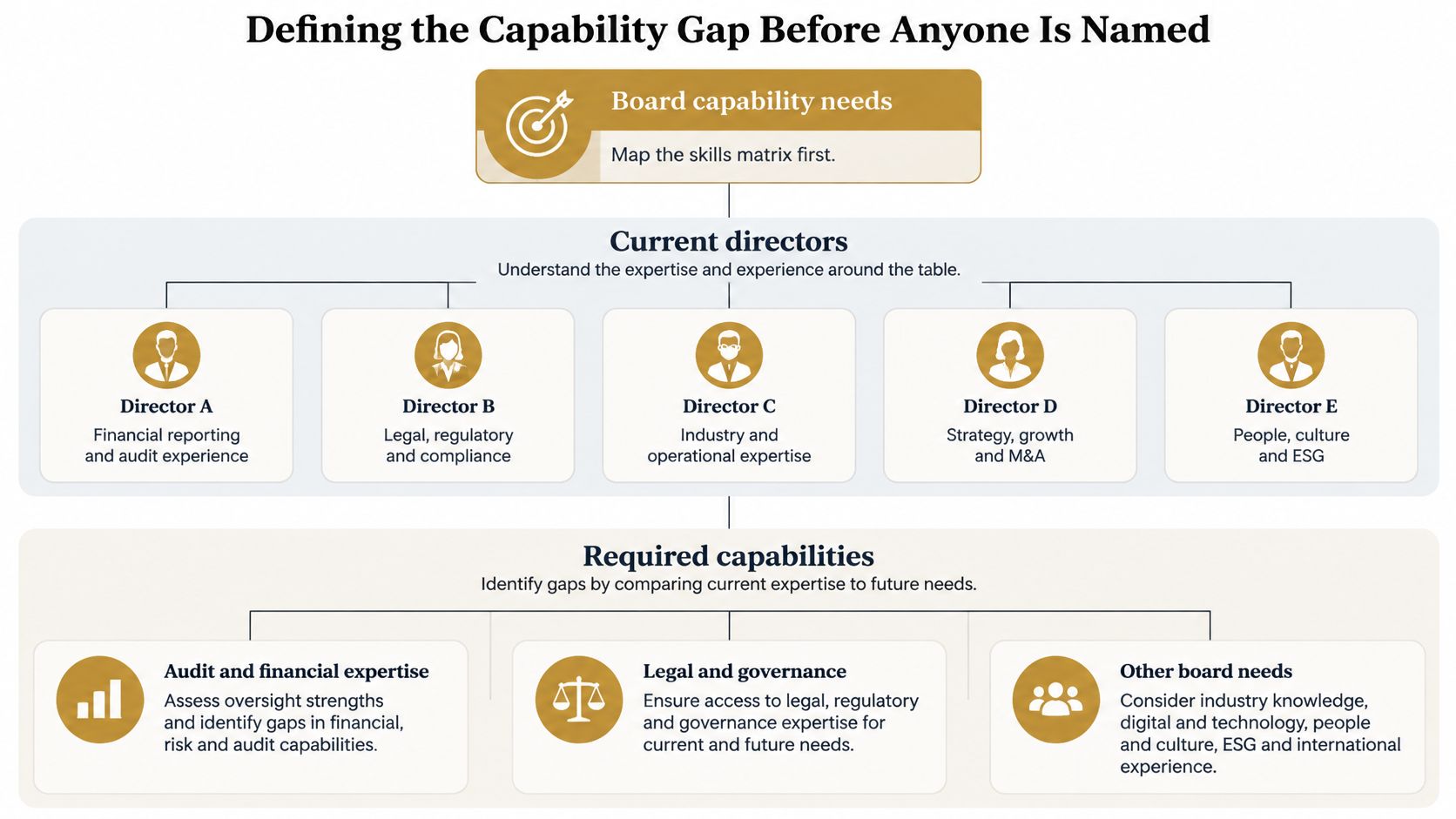
The largest gaps become tests a candidate can pass or fail in public. Prior audit-committee leadership, cybersecurity incident oversight, or scaling through a named regulatory regime are observable. An executive title is not. If the matrix says technology-risk oversight is thin, you test the candidate on decisions they supervised, not on a CIO label. Boards commonly weigh skill and experience, industry knowledge, technology fluency, cross-industry knowledge, and gender diversity, as the Broadridge global board governance survey frames the priorities directors already use.
Fewer than one-third of executives, 32%, believe their boards have the right mix of skills, and international expertise was the skill they most wanted added, yet only 8% of directors said their boards planned to add it in the coming year, in PwC's 2025 Annual Corporate Directors Survey. A stated matrix can reprint the incumbents. Compare strategy disclosures, risk factors, committee loads, tenure, and recent leadership changes before you treat the matrix as live demand.
| Capability | Committee it supports | Evidence to ask for |
|---|---|---|
| Audit and financial expertise | Audit | Audit committee service, CFO or controller background |
| Cybersecurity and technology risk | Audit or risk | Oversight of security reviews and incident response |
| Industry knowledge | Full board | Operating history in the sector and its regulation |
| Capital markets | Finance or compensation | Equity raises, debt financing, investor relations |
| Legal and governance | Nominating and governance | Board-level governance and regulatory duties |
| International markets | Strategy | Cross-border regulatory filings or market-entry results |
Say a company is entering the European Union and no director has overseen cross-border regulatory filings. The criterion isn't "international executive." It's a person who can show filings, market-entry results, and time for the strategy committee. The board role fit checklist is a plain way to line your proof up against that kind of gap before you write to anyone.
Finish with a gap-to-evidence memo: the missing capability, the candidate's directly comparable experience, the committee it supports, and any independence or conflict implication. That page gives the nominating committee an auditable reason to look past the personal referrals already on the table.
Spotting Board Openings Before They Are Advertised
A confirmed vacancy is a seat that is open or formally announced. Confidence is high because the board has already authorized the search. A forecast opening is a seat that signals suggest may open. Each signal moves confidence up or down, and none of them is an offer.
Boards often see these signals late themselves. Among directors whose boards had formal succession plans, only 29% looked three to five years ahead and just 8% planned a full five years out, while only 21% rated their board's CEO-succession process as excellent, according to Diligent's board succession planning briefing. Succession risk isn't confined to the director roster. A candidate who waits for a posting is waiting on a board that may not have planned the seat either.
| Signal | What it suggests | Confidence |
|---|---|---|
| Formal vacancy announced | Seat is open now | High |
| Director reaching a tenure or age limit | Seat likely to open | Medium |
| Committee chair rotation announced | A specific committee seat may open | Medium |
| Director's independence status changing | Seat may need replacing | Medium to low |
| CEO succession planned | Board refresh likely | Low to medium |
| Strategic pivot or new market entry | Skills gap may be created | Low |
How to use a signal without overclaiming
Track tenure, committee rotations, and leadership changes in proxy materials and news, then map each one to a capability the board is likely to need. A tenure limit on the audit chair is a medium-confidence signal for audit depth, not a reason to tell your network the seat is yours. A strategic pivot into a new market is low confidence. It may create a skills gap, or the board may decide the current directors can cover it.
You can build a pipeline before a role is authorized. Keep a short list of boards, the signal, the capability, and a confidence label. When timing slips, you stay credible because you never said an appointment was imminent. Current and emerging board of directors positions are easier to sort once you separate announced seats from probability-based ones.
A commercial history that gets you a meeting can later block an independent seat. Note the relationship when you log the signal, not after the chair calls.
Independence Rules That Decide Eligibility
A CFO can look like the obvious answer for an audit chair seat and still be disqualified by one consulting contract signed last quarter. Capability is the job description; independence is the license to hold that particular seat. The board may want the person's skills while the rules block the appointment.
Public-company searches follow listing standards, not preference. As the Weil public-company board requirements summary sets out, NYSE and Nasdaq both require majority-independent boards and independence controls around audit, compensation, and nominations, with detailed exceptions. Nasdaq's “interfere with independent judgment” language is the test for weighing one relationship. The board and committee rules decide who can sit where.
| Rule area | NYSE-listed companies | Nasdaq-listed companies |
|---|---|---|
| Board majority | Majority of directors independent | Majority of directors independent, subject to limited exceptions |
| Audit committee | Fully independent | Independent, at least three members |
| Compensation committee | Fully independent | Fully independent, subject to limited exceptions |
| Nominating or governance committee | Fully independent | Fully independent, subject to limited exceptions |
Checks to finish before you approach anyone
Employment. Current or recent employment by the company, a parent, or a subsidiary is the first screen. A clean résumé from a competitor does not clear a recent payroll tie.
Money. Consulting fees, supplier contracts, and other financial ties belong in the independence note even when the work was short. Record the counterparty, the service, the timing, and whether the company or an affiliate paid it.
Advisers and prior service. Law firms, audit firms, and banks that already advise the company create a second path to a conflict. A recent stint as an executive of the issuer does the same.
Committee qualifications. Audit seats need financial literacy on top of independence. Passing the experience test and failing the independence test still means no appointment.
Run the conflict check before outreach, write the result into an independence note, and tell the chair early if a relationship needs disclosure. The same commercial tie that earns a meeting can later block an independent seat or a committee role. If several board seats already fill the calendar, an over-boarding checker is the practical companion to that note, because time load and independence fail seats for different reasons.
Sourcing Candidates Through the Decision Network
A technically strong candidate can be right on paper and still never reach the people who vote. Director selection runs through a decision network: the board chair, the CEO, nominating committee members, current directors, and a few trusted intermediaries. The formal evaluation happens inside that network, and so does the informal sorting that decides whose materials get read carefully.

How formal that sorting is varies widely. In Clune, Hermanson, Tompkins, and Ye's nominating-committee study, interviews with 20 U.S. public-company nominating-committee members, including 16 chairs, found some committees relying on search firms and structured skills grids while others used those tools lightly, with continuing CEO influence over nominations whose degree differed by company. A candidate who maps only the posted process misses the informal half of the decision.
Two layers, then a rank
Layer one is a documented competency screen tied to the composition gaps. No introduction goes out for a person who doesn't match a named hole.
Layer two is a relationship graph: shared boards, former employers, investors, professional associations, and mutual contacts. Rank each route by relevance, access, recency, and conflicts. The size of your contact list is not the metric.
One former audit partner who shares a board with the chair outweighs forty loose contacts. The partner can speak to audit independence in a sentence the chair already trusts. The forty contacts can only forward a PDF. Outreach should name the governance need, audit independence or technology-risk oversight, so the intermediary has a credible reason to advocate rather than a favor to call in.
Before anything goes out, run four checks on each name. Does the competency screen match a live gap? Is the access recent, or a conference handshake from years ago? Is there a tie that could complicate an independent seat later? Can the intermediary explain the governance need without you in the room?
Open roles also move on a clock. NACD's 2025 Board Search Network promotes an open seat for 60 days through member channels, publications, chapter connections, and selected diversity-alliance organizations, with an estimated 100,000 or more impressions across membership exceeding 24,000, including more than 11,000 active directors, in the 2025 NACD Board Search Network package. Sixty days is a short window, which is why a ranked graph built before the listing beats another cold application sent after it. If you're weighing a retained firm against doing the map yourself, the comparison of board executive search versus executive search firms is worth reading before you commit to a fee for a process you may still have to feed.
SeatSignal prepares a director-grade packet, a CV, a cover letter tied to the board charter and the gap, a fit memo, and an independence attestation, and maps the warmest route in so you reach the board through a name rather than a cold email.
How Boards Narrow Finalists and Make the Appointment
Boards are hiring for a defined gap, not for general seniority. The 2025 NACD Trends and Priorities Survey found that 67% of respondents were more likely to seek a director with specific expertise than someone with general business leadership experience. Industry-specific expertise was the most frequently selected priority, cited by 42%, and approximately one-quarter identified technology expertise as a key focus. Your materials and your interview have to connect evidence to composition, sector, and committee, or the scorecard has nothing to hold.
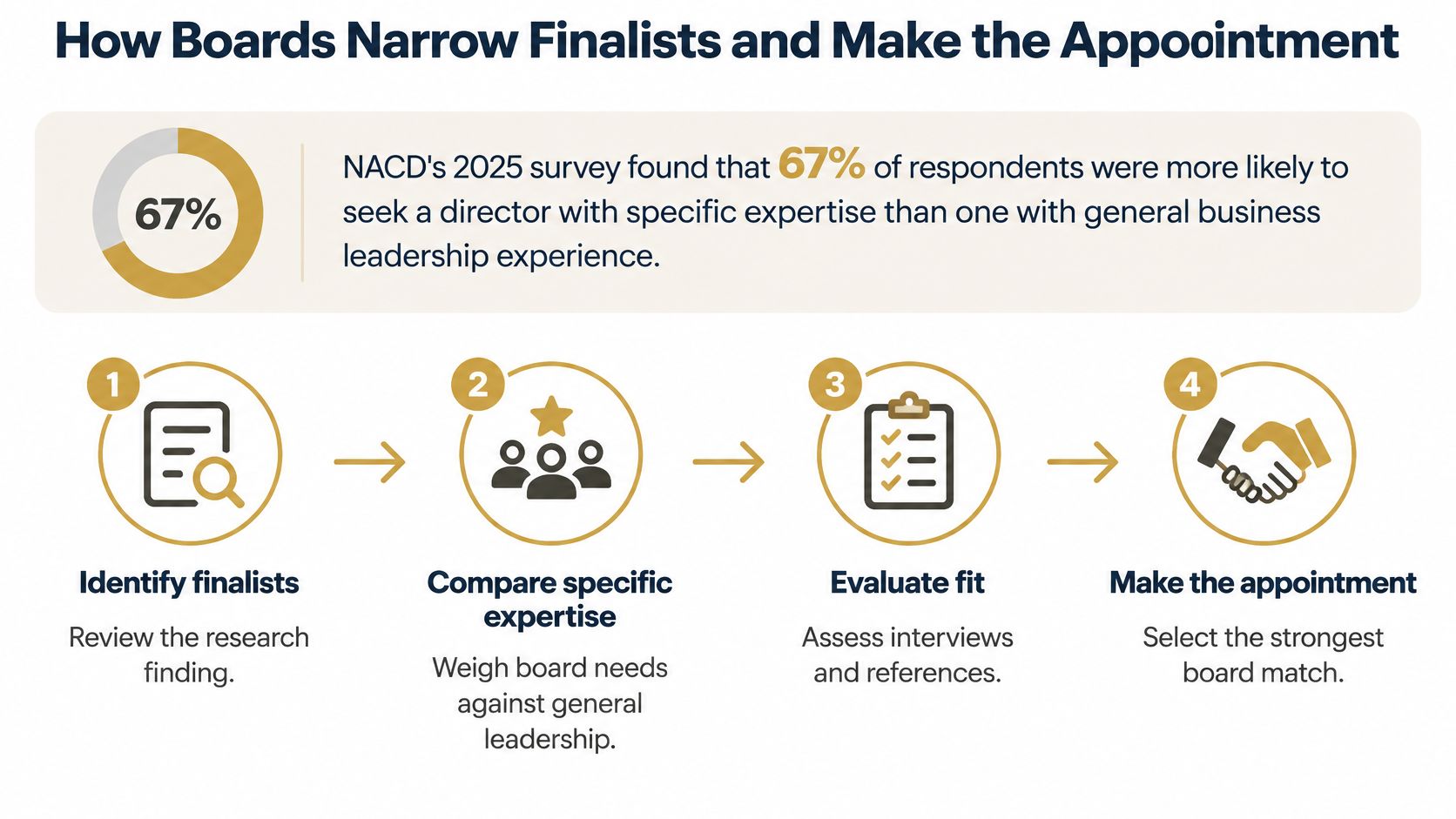
- Score the shortlist against the skills matrix. Each finalist gets the same criteria the gap memo already named. The slip is rescoring people on charm after the matrix was the reason they were invited.
- Run structured interviews with the chair and committee members. Ask the same questions of every candidate so the comparison is about evidence. A lively hour that never touches the open committee seat feels decisive and proves nothing. Rehearse from a board interview question bank built around that committee, not a generic leadership script.
- Check references and finish due diligence. Cover time commitment and over-boarding, not only reputation. The slip is calling the two people the candidate listed and treating that as a surround view.
- Confirm independence and conflicts in writing. Verbal comfort in the interview is not a memo general counsel can file. Skipping the written confirmation is the error that unravels an appointment after the press draft is written.
- The nominating committee recommends one candidate to the full board. The recommendation should cite the gap, the evidence, and the clear independence note. A split committee that sends two favorites forces the full board to redo the search in the boardroom.
- The board appoints, and the parties agree terms. Fees, equity, or an honorarium belong in that conversation, along with meeting load. Don't treat a handshake as acceptance of terms nobody has written down.
What you should hear along the way is specific. After scoring, a credible process tells you which gap you were scored against. After interviews, you hear whether you're still in a ranked set. After diligence, you hear that conflicts and time load are clear. After the vote, you receive terms, not a vague "the board is enthusiastic." If a stage goes quiet, ask which of those outputs is still open. Silence usually means the written conflict check or the committee recommendation, not a mystery about your leadership story.
Build Your First Board Search Plan This Quarter
A first search works like gap analysis in reverse: start from the capabilities a committee must evidence, then find boards whose composition, committee load and timing make that gap real. Keep the target set small enough that every name has proof, a route and an independence answer before outreach begins.
- Write a gap memo on yourself. List the capabilities you can prove and the committee each one supports. If you cannot attach a filing, an incident review or a capital raise to the line, it is still a claim, not evidence.
- Map openings and timing. Track confirmed vacancies separately from forecast changes, and note estimated opening windows where signals point to a seat before a listing appears.
- Build a relationship graph and rank it. Score each name on relevance, access, recency and conflicts. Drop the long list of people who would be happy to help but cannot reach a chair.
- Run the independence check before any approach. Include past consulting, employment and financial ties to each target company. A clean story discovered after the chair is interested is harder to unwind.
- Pick two or three boards and prepare one packet each. That means a governance-formatted CV, a cover letter tied to that board's charter and gap, a fit memo and an independence note. One generic CV sent three times reads as a job application.
- Prepare for the chair's likely questions. Rehearse from the role, the committee and the gaps found in that boardroom. If the question is cyber oversight, the answer is the incident review you supervised, not a technology slogan.
SeatSignal's Done-For-You Board Placement follows that sequence: pre-public seat matching across sectors, hand-picked roles checked by a person, warm-path introductions when available, a director-grade packet for each board including roles you find yourself, and interview preparation drawn from the likely chair questions. A placement team reviews what reaches you. SeatSignal is not a search firm, does not represent you to boards or negotiate on your behalf, and you send every approach in your own name. Boards, nominating committees and recruiters make appointment decisions.
SeatSignal identifies open and pre-public board seats, matches them to the capability gap a nominating committee can defend, and prepares the director-grade packet and interview work that a selective search rewards. If you're ready to treat your first paid seat as a gap, an eligibility check and a named route rather than a cold application, visit SeatSignal and see how the placement team runs that work with you.
Want a paid board role, done for you?
One handpicked, verified open board role every week, with a director-grade packet tailored for it.
Get Started