Board Member Biography: How to Write One
78% of Russell 3000 directors were born between 1946 and 1964, according to the National Association of Corporate Directors' 2024 boardroom report. That reframes the challenge of writing a board member biography: a long career isn't unusual in this company. Your biography must explain what your experience enables this particular board to oversee.
The strongest approach is a board-specific evidence note. Each sentence should support a capability the board needs, while distinguishing what you delivered as an executive from the judgment you exercised alongside, or on, a board.
Table of Contents
- What a Board Biography Must Prove
- Five Blocks a Chair Can Scan in a Minute
- How to Draft the Biography for One Board
- A Complete Audit-Committee Example
- Write to the Skills Matrix Without Faking Fit
- Lines That Still Sound Like a Résumé
- Retarget the Biography Before You Send It
What a Board Biography Must Prove
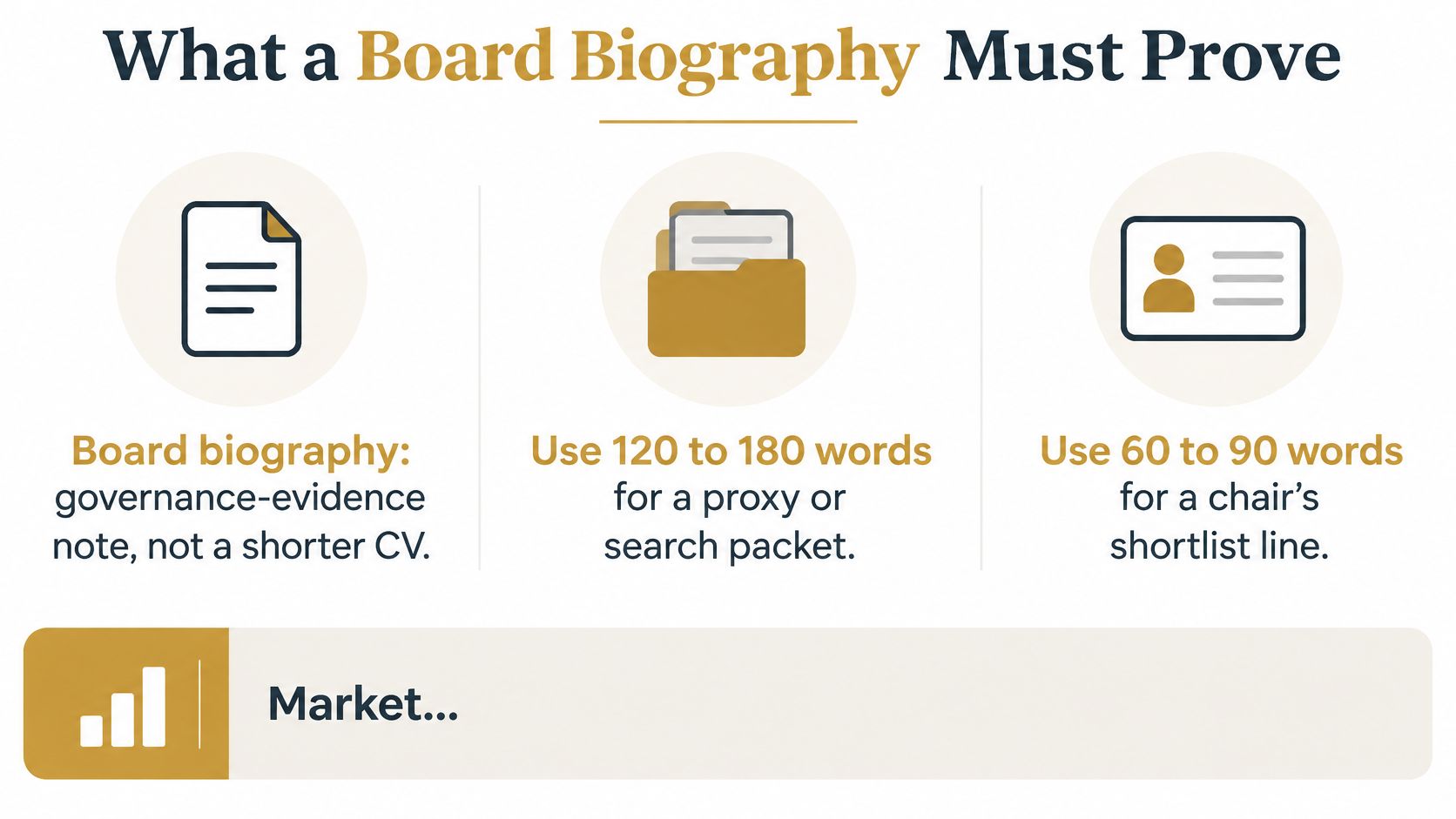
A board member biography is a governance-evidence note, not a shorter CV. As an editorial working limit, use 120 to 180 words for a proxy or search packet and 60 to 90 words for a chair's shortlist line, unless the recipient specifies otherwise.
Write for distinct readers:
- The proxy reader checks relevant skills, service history, and independence.
- The search firm checks enterprise scale, credible qualifications, and conflicts.
- The nominating chair asks whether you add something the current directors lack.
The appointment context makes generic career summaries particularly weak. According to the 2025 U.S. Spencer Stuart Board Index announcement, S&P 500 companies appointed 374 new independent directors in 2025, an 8% decline and the lowest total since 2016; only 50% of boards appointed at least one, and average turnover was 0.8 new directors per board. The same announcement puts incoming directors' average age at 59.1 years, with 59% retired executives, 30% current or former CEOs, and 29% financial experts.
Those credentials establish the competitive context. They don't tell a chair which candidate should fill a particular vacancy.
Governing rule: Every sentence must point to strategy, risk, a committee responsibility, or independence.
Use the Board Value Proposition Builder to frame the contribution before compressing your career. Start with the board's problem, then choose the evidence that earns space.
The document should contain governance identity, enterprise scale, committee expertise, selected outcomes, and availability or conflicts. Build those blocks through a seven-step drafting pass aimed at one board, rather than polishing an old biography.
Keep these length and purpose distinctions beside your draft.
Five Blocks a Chair Can Scan in a Minute
Five blocks of a board member biography
| Block | Question it answers | Include | Cut |
|---|---|---|---|
| Governance identity | Who is this director now? | Current role, independence, sectors | Origin story and early career |
| Enterprise scale | Can they handle this company's size? | Revenue, assets, employees, or regulated scope | Titles with no scale |
| Committee expertise | Which gap do they fill? | One committee skill plus a proof point | Strategic leader and similar labels |
| Selected outcomes | What changed under their oversight? | Decision, duty, and quantified consequence | Operating KPIs with no board decision |
| Availability and conflicts | Can they serve independently? | Other seats, time, and known conflicts | Hobbies and unrelated awards |
Fill these rows for one target board before writing sentences. Otherwise, you'll select the most impressive career facts rather than the most useful governance evidence.
Make the identity and scale legible
Governance identity means your position now, not your first promotion. State whether you're an executive, a serving director, or an executive seeking a first appointment. Don't describe yourself as an independent director if you haven't held that role, and don't assume independence at one company establishes it at another.
Enterprise scale gives a title context. A CFO title alone doesn't distinguish a complex regulated group from a small operating business. Choose the measure that helps the reader understand the responsibility: revenue, assets, workforce, geographic reach, or regulatory scope.
Consider this hypothetical contrast:
Weak: Strategic CEO who scaled a global technology business.
Stronger: Independent director and former CFO of a $2.4 billion regulated manufacturer; chaired audit through a controls remediation that reduced material weaknesses from three to zero.
The stronger version is appropriate only if the person chaired audit. An executive who led the remediation must say so instead.
Connect expertise to a responsibility
The disclosure gap is substantial: Labrador's director-skills analysis found that in 2025, only 44% of S&P 100 companies explained how each disclosed skill connected to strategy, while 48% identified skills separately and only 8% included member skills in committee descriptions. Its Russell 3000 analysis also records disclosed technology expertise rising from 15% in 2021 to 30% in 2025, and cybersecurity expertise from 8% to 17%.
A technology label isn't enough. Name the governance problem: resilience, investment discipline, reporting reliability, or accountability for emerging risks.
For selected outcomes, choose evidence that contains a decision, duty, and consequence. Explain whether you approved the investment, challenged management's assumptions, monitored remediation, or executed the work. Don't attribute board-level credit to an operating result just because you presented it at a board meeting.
Close with practical service information. Other seats, material relationships, and realistic availability help a committee decide whether further diligence is worthwhile. Keep detailed disclosures in the accompanying independence note, but don't omit an obvious relationship from the biography to make the paragraph cleaner.
How to Draft the Biography for One Board
Say you're a finance executive pursuing a first appointment on a regulated manufacturer's audit committee. The board has operating experience but needs stronger controls capability.
The Society for Corporate Governance's discussion of skills matrices describes their use in mapping expertise against collective board needs and supporting succession planning. Use that logic to select evidence, not merely keywords.
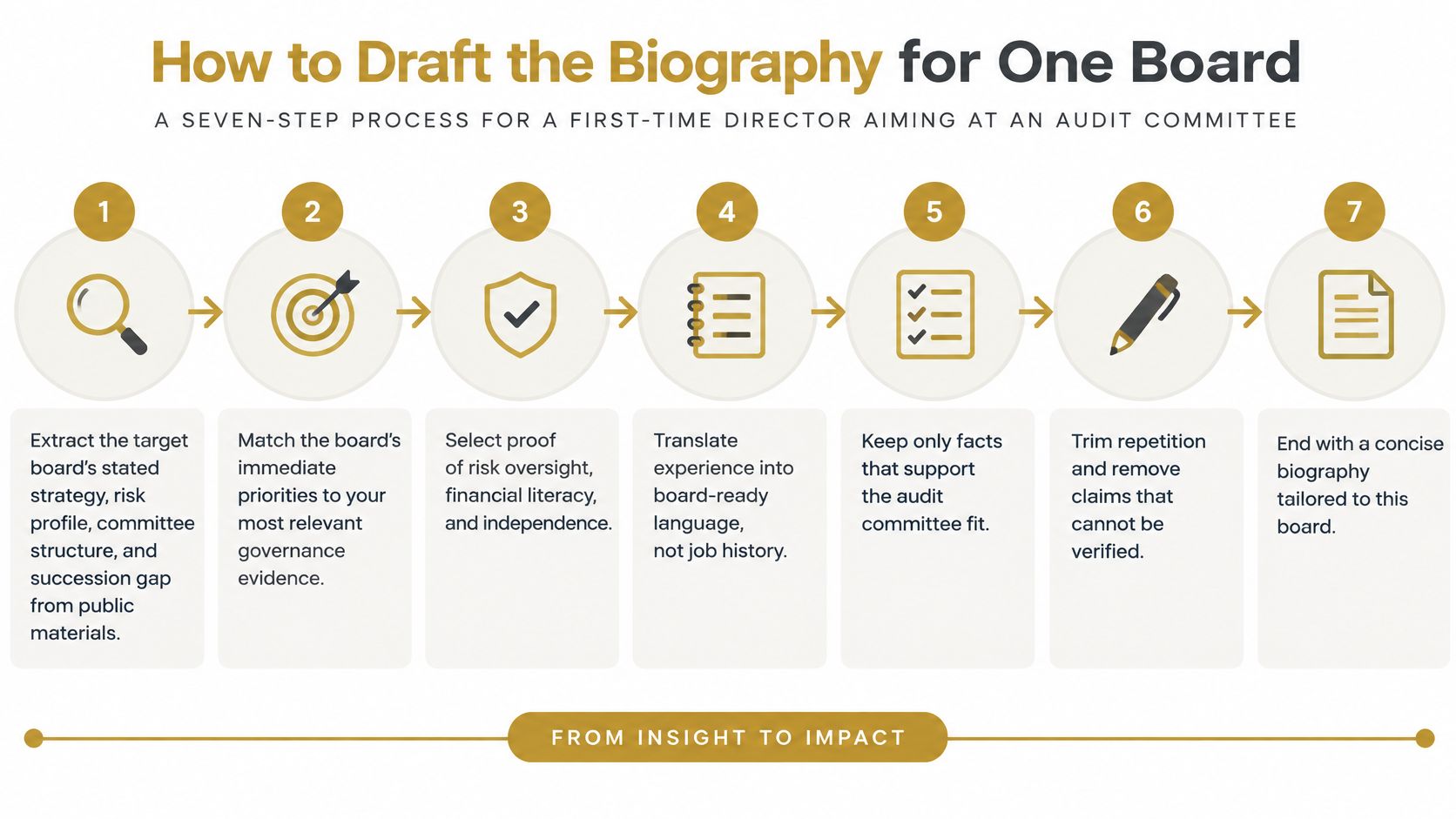
Keep the drafting sequence visible while you work.
Build the evidence before the paragraph
Extract the mandate. Read the proxy, audit committee charter, and vacancy note. Identify the manufacturer's reporting risks, strategic commitments, committee responsibilities, and stated succession need. Don't infer a controls failure merely because the board wants a finance director.
Choose the relevant categories. For this scenario, keep financial reporting, internal controls, and regulated-market experience. Set aside attractive achievements that don't address those needs. The board director positions page provides a starting point for identifying a role to examine.
Collect quantified proof. Select two examples per retained category for your working notes. For each, record the decision, your responsibility, and the consequence, including the baseline and reporting period where available.
Draft in block order. Introduce your current identity, establish scale, explain committee relevance, select outcomes, and finish with service constraints. Treat the allocation below as an editing budget, not a requirement to pad a short block.
Word budget for each block
| Block | Words at 180-word limit | Words at 90-word limit |
|---|---|---|
| Governance identity | 25 | 10 |
| Enterprise scale | 25 | 10 |
| Committee expertise | 60 | 30 |
| Selected outcomes | 50 | 30 |
| Availability and conflicts | 20 | 10 |
| Total | 180 | 90 |
Separate authority from execution
Label every proof. Use direct board experience, board-adjacent oversight, or management execution in the working draft. Leading a finance team is management execution; reporting its remediation to audit is board-adjacent. Neither becomes a fiduciary appointment through wording.
Compress the note. Cut repeated scale information, early career history, and statements another executive could use unchanged. Preserve the evidence that explains your audit contribution.
Test coverage. Mark the matrix capability supported by each sentence. Stop only when every priority capability has specific proof and no sentence implies authority you didn't hold.
Use the accompanying video as a drafting aid after assembling your evidence notes.
A Complete Audit-Committee Example
Consider a hypothetical regulated manufacturer whose directors have substantial CEO and operating credentials but limited controls experience. The candidate below is seeking a first public-company appointment and already holds a private-company directorship.
All names, figures, relationships, and availability statements below are illustrative. Replace them with verified facts. The bracketed name is a placeholder, while the proof labels are drafting annotations.
The full evidence note
Governance identity
[Name] is an independent director of a private company and former CFO of a regulated manufacturer, seeking an audit committee appointment.Enterprise scale
As CFO, held financial responsibility for a $2.4 billion business with 14 plants and regulated product lines [management execution].Committee expertise
Brings financial-reporting and internal-controls experience relevant to audit oversight, including evaluating control deficiencies, remediation priorities, reporting reliability, and external-audit findings.Selected outcomes
Led a controls remediation that reduced material weaknesses from three to zero within two reporting cycles [management execution]. Reported progress to the audit committee and agreed the external auditor's plan, giving the committee a basis to challenge milestones and assess closure [board-adjacent oversight].Availability and conflicts
Reports no supplier, customer, or shareholder relationship with the target company; holds one private board seat and has about 15 hours a month available for this appointment.
Notice the boundary: the candidate led the remediation as CFO. The audit committee retained oversight. Agreement on an audit plan must describe the candidate's actual coordination role, not imply management controlled the auditor's independent judgments.
The chair's shortlist version
[Name] is an independent private-company director and former CFO of a $2.4 billion regulated manufacturer. Brings financial-reporting and internal-controls experience relevant to audit committee service. As CFO, led remediation that reduced material weaknesses from three to zero within two reporting cycles [management execution]. Holds one private board seat, reports no supplier, customer, or shareholder relationship with the target company, and has about 15 hours monthly available.
The shorter version drops the plant count and audit-reporting outcome while retaining the committee contribution and conflict line. Before submission, remove the drafting labels only if the remaining verbs still make the distinction unmistakable.
Availability isn't a ceiling on responsibility. The candidate must also assess whether they can respond during reporting problems, transactions, or other exceptional demands.
Write to the Skills Matrix Without Faking Fit
A board can contain accomplished directors and still lack a particular capability. Your task isn't to demonstrate that you resemble its strongest members. It's to establish what you'd contribute that they don't already cover.
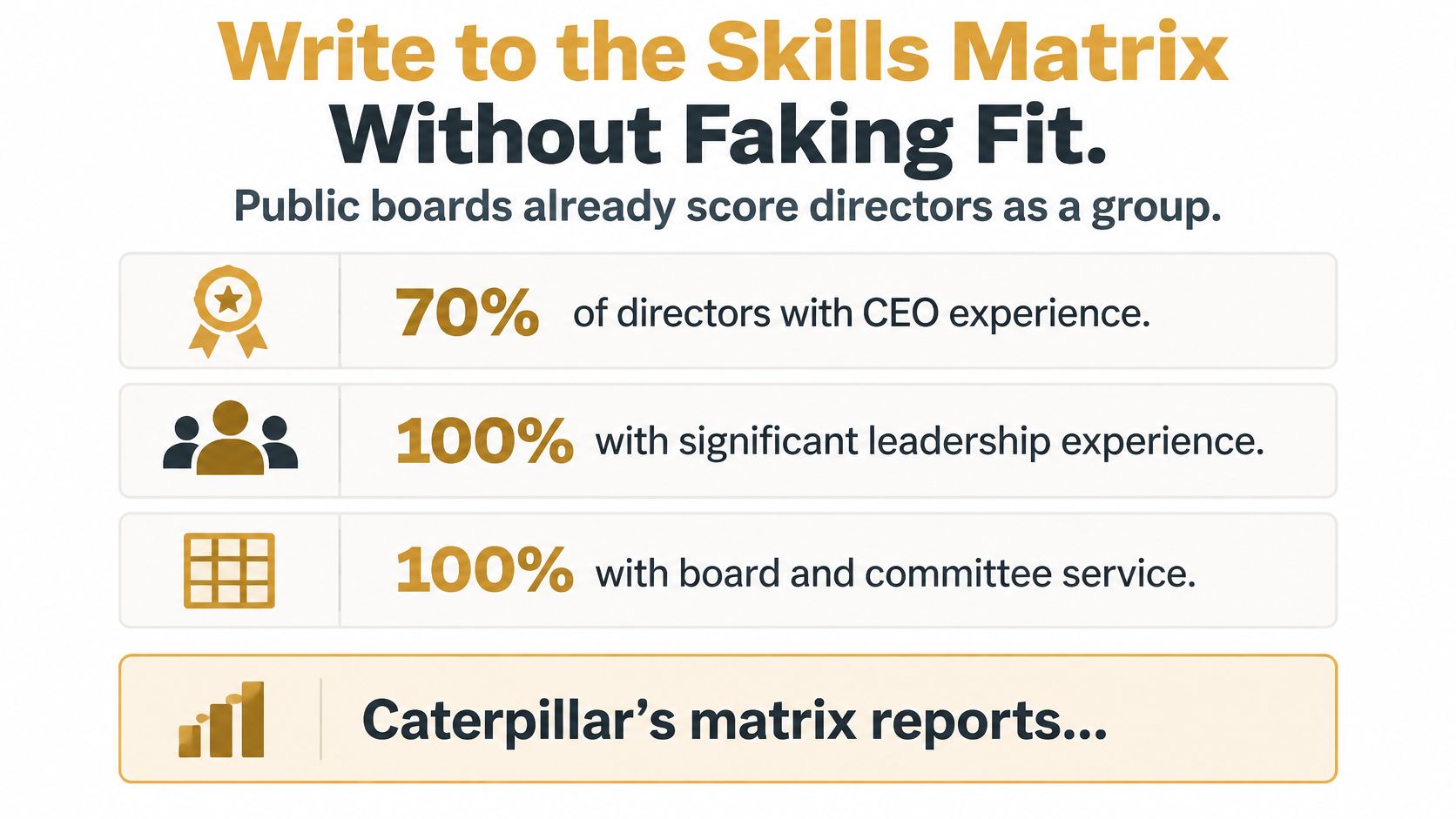
Caterpillar's disclosed matrix reports 70% of directors with CEO experience, 100% with significant leadership experience, 100% with business-development and strategy experience, and 50% with government or regulatory-affairs experience; its nominating committee reviews composition against strategic requirements without assigning a fixed weight to any single skill.
For a board with that kind of leadership depth, another executive title may add less information than substantiated regulatory, audit, or cyber experience. Start with the less-covered capability you can support.
Use the matrix as a comparison tool, not a checklist you must claim to satisfy completely.
Translate selection criteria into evidence
The UK Corporate Governance Code 2024 calls for formal, rigorous, transparent appointments based on merit and objective criteria, with nomination committees leading appointments and succession planning. It also addresses diversity, inclusion, equal opportunity, and the collective skills, experience, and knowledge of boards and committees.
Those duties require more than matching a sector label. A candidate should explain how they exercise judgment, handle disagreement, and respect the division between management and oversight.
Practical constraints belong beside technical qualifications. A 2025 SEC-filed proxy statement expressly includes integrity, character, business judgment, availability in light of other commitments, dedication, and conflicts among its nomination criteria.
Use the Board Role Fit Checklist to distinguish credible contribution from a qualification you merely hope to develop.
Use language that makes limits visible
These hypothetical sentence patterns demonstrate different kinds of evidence:
- Complement: The board's disclosed cyber coverage is one director; I chaired a breach-response review covering 40 markets.
- Boundary: Operating P&L sat with the CEO; my duty was oversight of the control remediation.
- Limit: I haven't chaired a listed audit committee; adjacent proof is six years as an audit-committee member of a private regulated subsidiary.
The complement statement needs accurate information about the existing board. The boundary statement needs a genuine oversight role. The limit statement is useful because it prevents the reader from mistaking related experience for a qualification the candidate doesn't hold.
A candid boundary is more credible than a larger claim that collapses under the chair's first follow-up question.
A CEO credential can establish authority without differentiating your contribution. Selection still requires evidence of collaboration, strategic judgment, and appropriate role boundaries.
One static biography can't serve different matrices equally well. Mark in the margin which existing capability each sentence adds to, rather than echoes. If you can't identify the addition, reconsider the sentence.
Lines That Still Sound Like a Résumé
A polished paragraph can still fail because it never names a governance problem. Strategic leader with a passion for growth gives a chair no decision to examine, responsibility to assess, or committee contribution to place.
Use the following table as a markup tool, not a vocabulary exercise. Replacing strategic with visionary changes nothing.
Biography lines that fail and the rewrite test
| Weak line | Why it fails | Rewrite test |
|---|---|---|
| Strategic leader with a passion for growth | No decision, scale, or committee | Name the decision and a number |
| Former CEO of a growth company | CEO status is common, not distinctive | State scale, risk owned, and outcome |
| Experienced in cybersecurity | Skill named, oversight not shown | One incident, control, or board report |
| Diverse global perspective | Identity slogan hides the evidence type | Separate verified fact from inferred skill |
| Serves on several boards | Time and overboarding left unstated | List seats and time left for this one |
Replace the claim, not just the adjective
These replacement sentences are templates. Bracketed fields require your own verified evidence.
- Growth: As a director, challenged the proposed expansion assumptions and approved a [verified transaction value] investment subject to staged risk reviews.
- CEO experience: Led a business with [verified revenue], held responsibility for [specific risk], and delivered [verified outcome].
- Cybersecurity: As risk committee member, reviewed the response to [documented incident] and monitored closure of the resulting control actions.
- Perspective: Worked in [verified markets], with responsibility for [documented cross-border decisions] relevant to the company's expansion.
- Commitments: Serves on [named boards and committees] and has assessed capacity for this appointment, including exceptional meetings and reporting periods.
Identity deserves particular care. The Conference Board's board-composition announcement reports that the share of Russell 3000 companies disclosing directors' racial or ethnic backgrounds fell from 85% to 45% in 2025. Missing disclosure isn't evidence of identity, and nationality isn't proof of international operating expertise.
Handle transitions without inflating the role
A first-time director shouldn't invent committee chairmanships to make an application sound mature. Identify management execution clearly, then explain the judgment involved, such as escalating a reporting concern or presenting a decision for board approval.
An exiting founder faces a different test: moving from owner control to collective oversight. Explain how you handled challenge and delegated authority, and disclose a continuing supplier, customer, or shareholder relationship where relevant.
Before submission, apply a verification audit consistent with Spencer Stuart's guidance on preparing for a board opportunity:
- Records: Dates, titles, fiduciary roles, and outcomes match authoritative documents.
- Coverage: Each priority capability has specific evidence.
- Constraints: Conflicts and other commitments are explicit.
- Consistency: The biography, director CV, cover letter, and interview examples agree.
Use the Board CV Grader to review the companion document. Finish with a marked-up draft in which every claim can survive a follow-up question.
Retarget the Biography Before You Send It
A biography should change with the board's needs. A note built around controls remediation may hide your fit for a people-and-culture vacancy, even when your experience is relevant.
Honeywell's proxy disclosure explains that its skills-and-experience matrix compares director capabilities with those needed to oversee current strategy and is evaluated against that strategy annually. Retarget your biography to the vacancy as it stands, not the opportunity you first had in mind.
Keep the evidence, change the emphasis
Keep a working proof bank of six to eight quantified oversight examples. For each, record the source, your role, the decision, and the outcome. Then select examples for the specific vacancy, adjusting the committee contribution and the sentence that explains how you complement the board.
Before sending, confirm:
- Capability match: Your lead skill addresses a thin cell in the board's matrix.
- Current disclosures: Independence information, relationships, and commitments remain accurate.
- Interview continuity: You can explain each example under detailed questioning.
Use the Board Cover Letter Outline to align the accompanying letter without repeating the biography.
For candidates who want targeting and preparation handled together, SeatSignal's Done-For-You Board Placement handpicks relevant open board roles and prepares a director-grade application for each opportunity. Interview preparation rehearses likely chair questions based on the role, committee, and gaps in the board's composition. You approve what is sent and complete your own diligence; appointments are not guaranteed.
Choose a live vacancy. Rewrite the committee and complement lines, check that the supporting facts still fit, and send the revised version instead of your master biography.
SeatSignal helps turn executive experience into board-specific application materials, supported by hand-picked opportunities and interview preparation. Visit SeatSignal to explore support for your next board application and build a biography that explains why you belong in that particular boardroom.
Want a paid board role, done for you?
One handpicked, verified open board role every week, with a director-grade packet tailored for it.
Get Started