Board Member Development: A Practical Governance Playbook
Sending directors on another governance course isn't a board development strategy. It's a training purchase. Unless the chair can explain what a director needs to do differently afterward, the board has bought attendance, not improved oversight.
Board member development should be a closed-loop performance system: diagnose the gap, match learning to the role, observe the director's contribution, and act on the results. For candidates seeking a paid seat, that same discipline provides something more persuasive than another credential: a clear explanation of the oversight they're ready to provide.
Table of Contents
- Why Most Board Development Falls Short
- Building a 12-Month Development Cycle That Sticks
- Matching Skills to Committees, Not to Job Titles
- A 30-60-90 Day Onboarding Playbook for New Directors
- Closing the Loop With Evaluation and Feedback
- Turning Development Into a Board Seat
- Your 90-Day Board Readiness Checklist
Why Most Board Development Falls Short
The popular prescription is more education. My recommendation is better diagnosis first. A director who struggles to challenge management may need deeper subject knowledge, but they might instead need better preparation, clearer information, or candid feedback about how they behave in meetings.
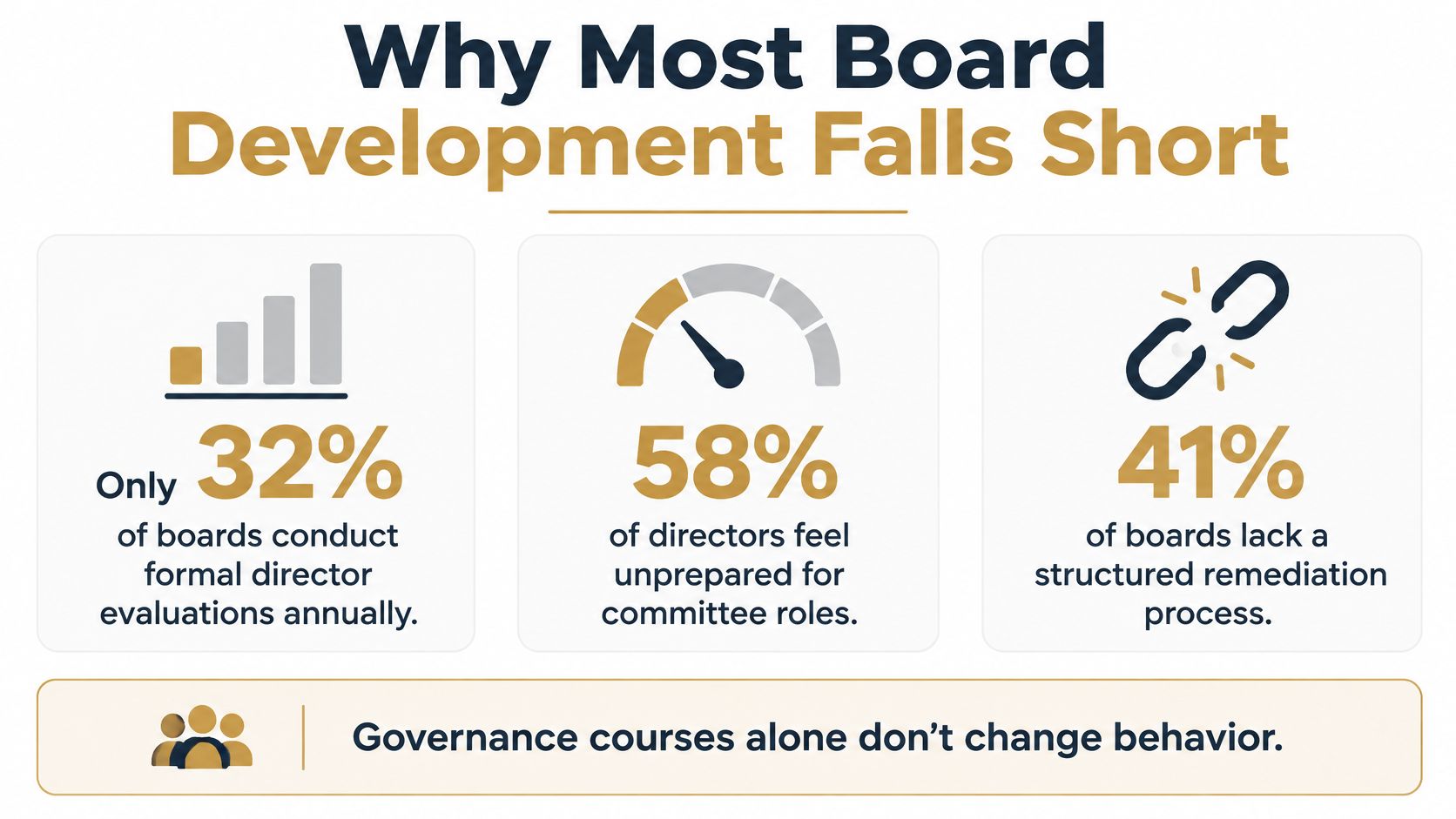
The historical evidence exposes both problems. A 2016 NACD survey found that 56% of public-company directors believed their boards devoted too little time to education and training, while only 41% of more than 600 respondents said their boards assessed individual directors; a related Stanford survey reported confidence of just 47% in technical knowledge, 18% in cybersecurity experience, and 16% in social-media expertise, as reported by the Journal of Accountancy.
Those are historical findings, not a current census. They nevertheless illustrate the distinction chairs should make: identifying a knowledge deficit isn't the same as understanding why an individual director isn't contributing effectively.
Diagnose the contribution, not just the credentials
Before approving training, ask what happened at the board table:
- Knowledge: Could the director explain the assumptions behind the proposal?
- Judgment: Did they distinguish a material oversight issue from an operational detail?
- Behavior: Did they challenge constructively, listen to the answer, and help the board reach a decision?
- Access: Did management provide the information needed to make an informed judgment?
These questions lead to different remedies. A briefing can address unfamiliar terminology. Mentoring may help an executive stop issuing operational instructions. Neither fixes a persistent refusal to prepare.
Practical rule: Don't prescribe a course until you can describe the behavior you want to change.
Governance education still matters. It supplies foundations and creates space to examine unfamiliar duties. But candidates comparing qualifications with placement support should examine the difference between director institutes and board placement programs, rather than expecting either to perform the other's job.
A certificate documents completion. Readiness requires evidence of judgment, preparation, and appropriate challenge. Chairs should demand that distinction, and candidates should build their development around it.
Building a 12-Month Development Cycle That Sticks
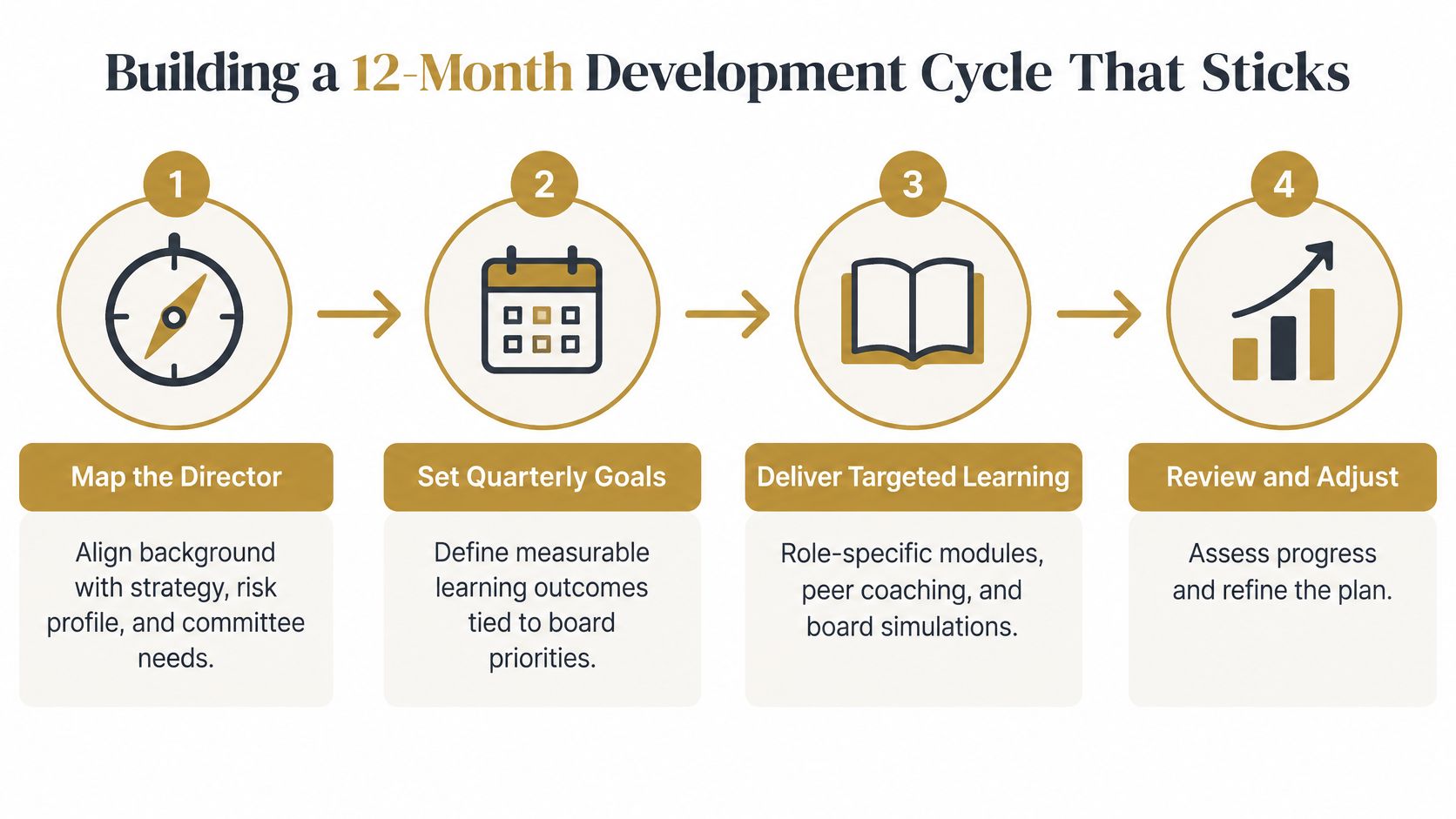
Treat the 12-month development cycle as a working agreement between the director and chair, not an induction calendar maintained by the company secretary. Write down the capability gap, the support required, the expected contribution, and who will review progress.
Use the cycle below to organize the work, while keeping the director's actual responsibilities at its center.
Start with the seat's requirements
Map the director against the mandate. Compare their background with the company's strategy, financial condition, risk profile, regulatory exposure, and committee responsibilities. Separate expertise they can contribute immediately from topics they need to understand before participating confidently.
Sequence the briefings. Cover the business model and financial position before expecting useful challenge on capital allocation. Connect cybersecurity and AI briefings to business dependencies, accountability, and risk appetite. Include succession and executive compensation where the director's responsibilities require them.
Arrange access deliberately. Schedule conversations with the chair, committee chairs, CEO, relevant senior executives, and external advisers. Give each meeting a purpose and capture unresolved questions, rather than treating introductions as proof of understanding.
Historical onboarding benchmarks demonstrate the importance of that access: the 2016–2017 NACD Public Company Governance Survey found that nearly three-quarters had formal onboarding, 84% rated it effective or very effective, and more than 97% met executive-team members, according to Heidrick & Struggles' analysis of director onboarding.
Make learning part of the workload
Assign a mentor or onboarding lead who can explain context without becoming a gatekeeper. Translate unresolved gaps into targeted education, adviser briefings, or scenario discussions, then review readiness after the first board cycle and annually.
Use the board time commitment calculator to pressure-test whether preparation, learning, and committee work fit alongside existing obligations. Don't accept a development plan that assumes the director has unlimited spare capacity.
Use the accompanying video as a discussion prompt alongside the written plan, not as evidence that onboarding is complete.
The chair's checkpoint should be practical: can this director interpret the relevant papers, identify unresolved assumptions, and explain when an issue requires escalation? Document readiness, not merely document delivery.
Matching Skills to Committees, Not to Job Titles
A senior title doesn't establish committee fit. A technology executive may understand product delivery but lack experience assessing enterprise risk appetite. A finance leader may know reporting thoroughly yet need development before scrutinizing incentive design.
The distinction matters. BDO's 2025 Board Survey found that 13% of directors and 12% of management teams lacked appropriate skills or experience to oversee emerging technology and cybersecurity, while only 41% of directors rated themselves highly effective at setting risk tolerance and appetite, including fraud risk, according to the published BDO survey analysis.
Disclosed expertise is also changing: technology expertise among Russell 3000 directors increased from 15% in 2021 to 30% in 2025, while cybersecurity expertise increased from 8% to 17%, according to the analysis of Russell 3000 and S&P 500 board composition. Candidates need to explain the substance behind those labels.
Translate experience into oversight evidence
Build a skills matrix that distinguishes executive delivery from board-level scrutiny.
| Committee need | Relevant experience to examine | Governance contribution to demonstrate |
|---|---|---|
| Audit | Financial reporting, controls, assurance | Assess significant judgments and challenge assurance coverage |
| Risk | Enterprise exposures, incident response | Test appetite, escalation thresholds, and mitigation assumptions |
| Technology | Investment decisions, architecture, digital change | Scrutinize dependencies, resilience, and strategic trade-offs |
| Remuneration | Incentives, talent, succession | Examine whether rewards support strategy without encouraging inappropriate risk |
These aren't automatic qualifications. They're prompts for gathering evidence.
A candidate should be able to describe what they personally did, what judgment the situation required, and where their expertise ends. For confidential examples, explain the decision process without disclosing protected information.
- Strong fit: Relevant experience, defensible examples, and clear understanding of the committee mandate.
- Developable fit: Adjacent experience with an identifiable learning gap.
- Poor fit: Interest in the sector without evidence supporting the oversight responsibilities.
Use the board role fit checklist before pursuing a vacancy. Rejecting an unsuitable opportunity is sound judgment, not lack of ambition.
Target the committee problem you can help solve. Don't ask a nominations committee to infer governance value from an impressive executive biography.
A 30-60-90 Day Onboarding Playbook for New Directors
You can join a board with a polished welcome pack and still lack the access needed to contribute. Don't mistake administrative completeness for effective onboarding.
InterSearch's Global Board Survey 2025 reported that just over half of organizations had an onboarding process and fewer than half said it properly prepared directors; 20% of new directors didn't meet the CEO, and 36% didn't meet senior leadership, according to its global board survey findings.
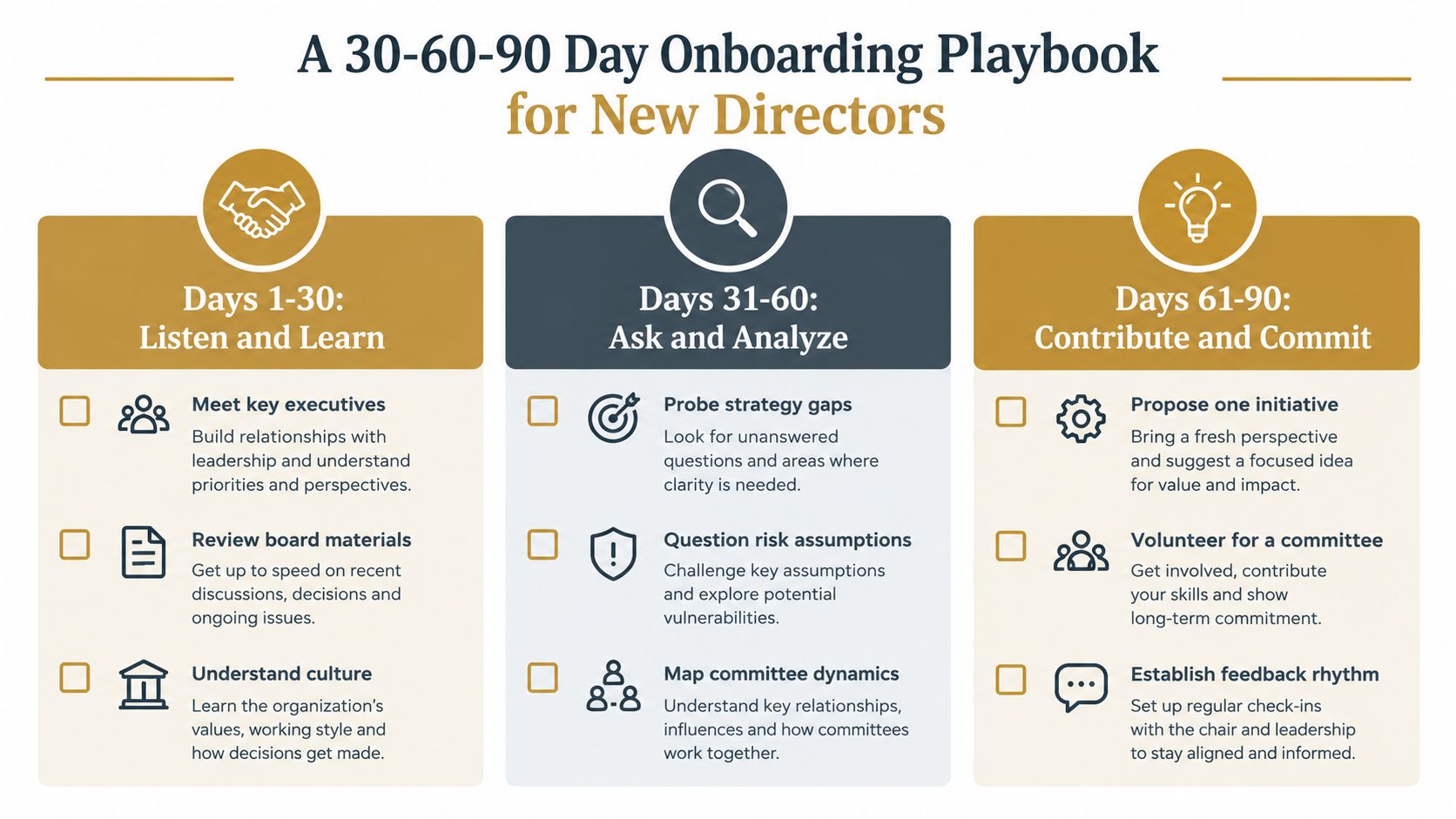
Days 1–30 establish access and boundaries
Ask the chair where they expect your contribution and how directors should request information. Ask the CEO which strategic assumptions deserve the board's closest attention. Ask general counsel about decision rights, conflicts, confidentiality, and the route for raising concerns.
Review recent papers, minutes, committee mandates, and the forward agenda through authorized systems. Map who recommends, who approves, and who must be consulted. Don't create informal reporting lines into management.
Days 31–60 test your understanding
Bring questions to the relevant committee chair before turning them into public challenges at a meeting. Ask where management's assurance is strongest, where independent assurance is needed, and which unresolved issues keep returning.
- Clarify assumptions: Identify what would have to remain true for the strategy to succeed.
- Understand dynamics: Notice whether directors can disagree without being dismissed or personalized.
- Resolve access gaps: Record missing information and agree an appropriate route and timing for obtaining it.
A delayed briefing may be a scheduling problem. Repeated refusal to provide material information, without a credible explanation or resolution route, deserves a different response. Raise that concern through the chair and appropriate governance or legal channels, not through unauthorized investigation.
Days 61–90 contribute within the mandate
Offer a focused improvement tied to an existing board priority, such as clearer risk reporting or a better committee agenda. Discuss committee participation with the chair rather than assuming an assignment.
Earn trust by explaining what you're trying to understand, not by pretending you already understand it.
Ask the chair whether your questions are landing at the right level. Protect confidential materials, acknowledge uncertainty, and use agreed channels. Constructive independence doesn't require an adversarial entrance.
Closing the Loop With Evaluation and Feedback
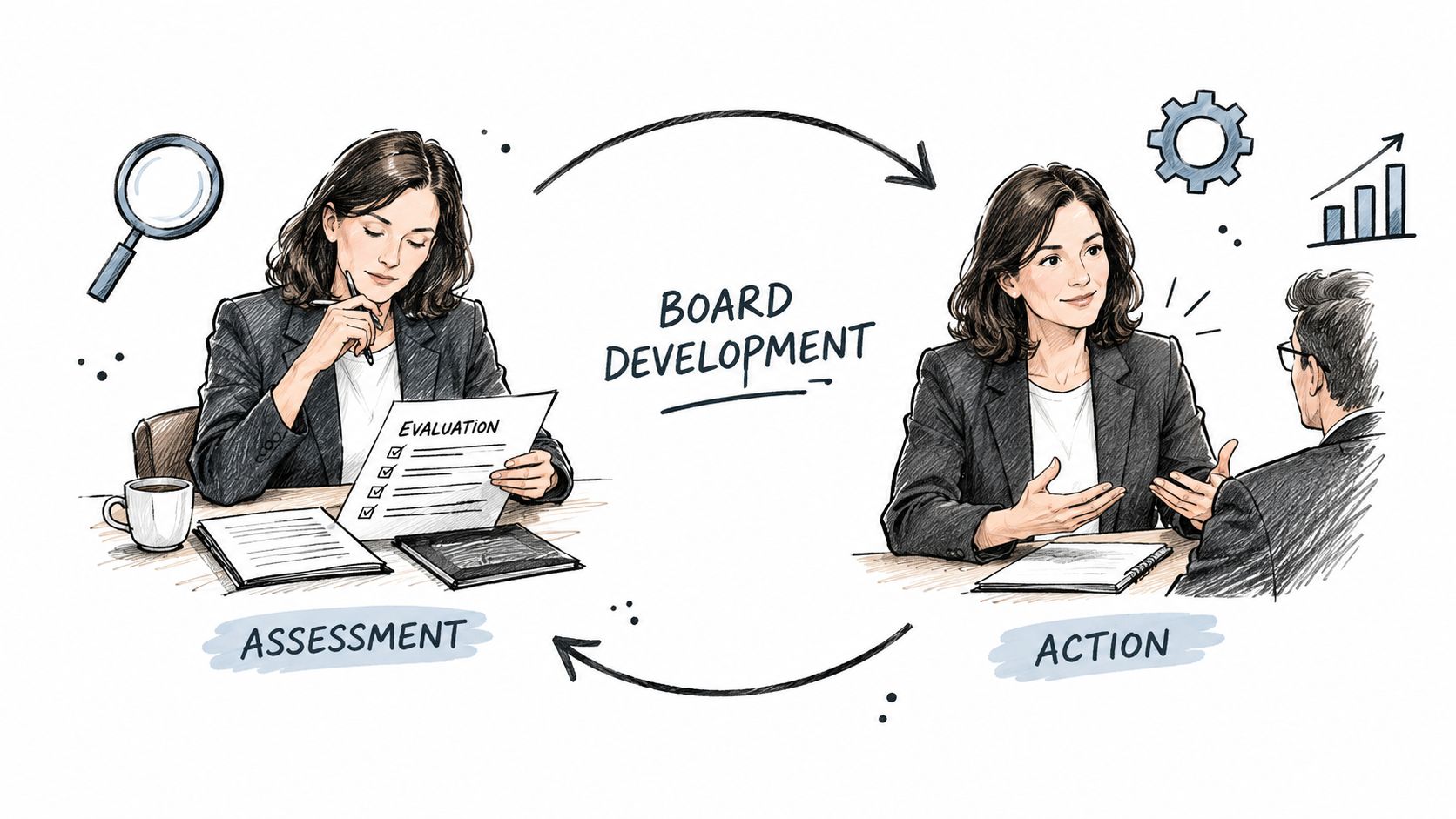
An evaluation that produces a report but no changed expectations is unfinished work. The chair should be able to identify what each director agreed to improve and whether colleagues have observed progress.
A 2024 Spencer Stuart survey of 326 U.S. public-company directors found that 62% reported individual director assessments and 83% of that subset conducted them annually, while only about 40% included director self- and peer evaluations, according to Spencer Stuart's individual director assessment findings. These measures shouldn't be treated as interchangeable: conducting an assessment doesn't tell you whose perspective it captures.
Define what colleagues should observe
Tie assessment criteria to strategy and committee mandates. Then gather confidential self, peer, chair, and committee feedback against those criteria. Ask for examples of contribution rather than general impressions of personality.
Compare the findings with the skills matrix. A board may possess the required expertise on paper but fail to use it because the relevant director receives information too late or cannot communicate concerns effectively.
Agree two or three development actions per director, with an owner, deadline, and support. Treat that as a recommended discipline, not an invitation to create a long remedial syllabus.
| Development issue | Action | Observable evidence |
|---|---|---|
| Questions drift into operations | Chair mentoring and agenda preparation | Questions address assumptions, accountability, and decision implications |
| Risk challenge lacks specificity | Targeted briefing and scenario discussion | Director tests thresholds and escalation responsibilities |
| Committee expertise isn't shared | Agree a concise reporting approach | Full board understands the committee's unresolved judgments |
Make consequences explicit
The chair should distinguish support needs from unwillingness to change. If a director lacks knowledge, provide development. If they repeatedly disregard preparation requirements or agreed conduct, another course isn't an adequate response.
Accountability test: If the same concern appears at the next review, identify what support failed, what behavior persisted, and what decision the board must now make.
Reassess annually and use appropriate check-ins between formal reviews. Evaluate whether decisions became better informed, risks were escalated appropriately, and contributions became clearer. Course attendance is an input, not the performance result.
Turning Development Into a Board Seat
Take a finance leader pursuing a first paid board appointment. Their executive CV shows responsibility for reporting, financing, and business performance, yet it never answers the question a nominations committee asks: why this board, and why now?
Stacking a generic governance paragraph on top changes nothing. The effective response is to select opportunities where the candidate's evidence matches the board's audit and risk needs, then close any material readiness gaps before claiming committee readiness.
Investor expectations reinforce the need for that clarity: 100% of surveyed U.S. investors expected proxy statements to explain how companies consider diversity in director nominations, and 94.1% expected board-skills disclosure, according to Glass Lewis's analysis of board composition. Those findings concern company disclosure, not candidate success rates. They still support a practical conclusion: nominations committees need an appointment rationale they can defend.
Build the appointment rationale
Titles describe responsibility. Committees appoint evidence. The finance leader's application should walk through the specific judgments they have made about reporting quality, controls, assurance, or financial resilience, without overstating personal involvement in any of them.
- Director-grade CV: Prioritize governance-relevant experience and defensible examples.
- Committee fit memo: Connect that evidence to the target committee's actual mandate.
- Interview preparation: Rehearse challenge, independence, conflicts, and the boundary between oversight and execution.
Run the draft through the board CV grader to check whether it communicates committee value rather than career progression. Then test every significant claim aloud. If an example collapses under a follow-up question, revise the claim or strengthen the preparation.
Prepare for the specific conversation
The same candidate should rehearse how they would question an uncertain forecast, handle disagreement with the chair, and recognize when specialist advice is necessary.
The goal is demonstrated reasoning, and polished answers memorized in advance fool no one who has interviewed directors before.
Formal qualifications, mentoring, and placement support serve different purposes. Where a candidate wants help executing the search itself, SeatSignal hand-picks board matches, drafts a director-grade CV suited to each role, and rehearses the candidate for the specific interview.
That describes the service's objective, not a guaranteed appointment. The credible candidate still owns the accuracy of their materials, their preparation, and their decision to accept a role.
Your 90-Day Board Readiness Checklist
Use the next 90 days as a proposed working period, not a promise of appointment. The objective is to produce a defensible readiness file that you can use with a chair, mentor, or nominations committee.
Establish your starting position
Begin with the board readiness assessment, then examine the answers against actual experience. Don't award yourself expertise because you supervised someone who possessed it.
- Name your committee contribution: Write a concise statement of the oversight responsibilities you can credibly support.
- Assemble supporting evidence: Select examples you can explain accurately without breaching confidentiality.
- Record your limits: Identify where you need education, specialist advice, or experience before accepting responsibility.
- Request candid feedback: Ask a trusted director or chair which parts of your positioning they would challenge.
Produce usable preparation
Your readiness file should help you make decisions, not just market yourself. Keep it specific enough to distinguish an attractive title from a suitable appointment.
- Identify target boards: Match business context, committee needs, independence requirements, and capacity.
- Complete focused learning: Address the gap most relevant to your target role and record how you would apply it.
- Prepare customized materials: Check that every application reflects the actual opportunity rather than a reusable aspiration.
- Rehearse difficult questions: Practice uncertainty, disagreement, conflicts, and decisions that require further assurance.
- Check practical capacity: Account for preparation, committee duties, learning, and exceptional demands.
Before accepting a role, investigate the organization's financial condition, governance arrangements, expectations, and relevant protections with appropriate professional advice. An invitation isn't a substitute for due diligence, and enthusiasm shouldn't override an unresolved concern.
Appointments, interviews, matches, income, and completion within 60 days aren't guaranteed. Members remain responsible for their decisions and due diligence.
Judge your progress by the quality of the opportunities you can assess and the contribution you can substantiate. A narrower, credible proposition is more useful than a broad claim of readiness for any board.
SeatSignal offers board opportunity matching, personalized director application materials, and role-specific interview preparation to help turn development into a focused board search. Visit SeatSignal to explore support for matching your evidence to the right committee needs and preparing for the appointment conversation.
Want a paid board role, done for you?
One handpicked, verified open board role every week, with a director-grade packet tailored for it.
Get Started