Board Membership Positions Explained for 2026

S&P 500 boards appointed just 374 new independent directors in 2025, the lowest total since 2016, according to Spencer Stuart's U.S. Board Index announcement. For an experienced executive, that changes the search: the decisive contest isn't who networks most broadly, but who can fill a documented committee gap and prove they're ready to exercise independent judgment.
Board membership positions are not senior jobs with fewer working days. They are governance appointments, with obligations that continue between meetings. Your best starting point is a precise target: an organization where your experience matters, a committee whose work you understand, and evidence that you can challenge management without becoming management.
Table of Contents
- What Board Membership Positions Really Are
- How Board Seats Differ by Organization
- The Duties Directors Cannot Delegate
- Committee Roles That Shape the Workload
- Routes That Actually Fill an Open Seat
- Bridge Seats for a First Board Role
- Match One Board Gap and Apply in Your Name
What Board Membership Positions Really Are
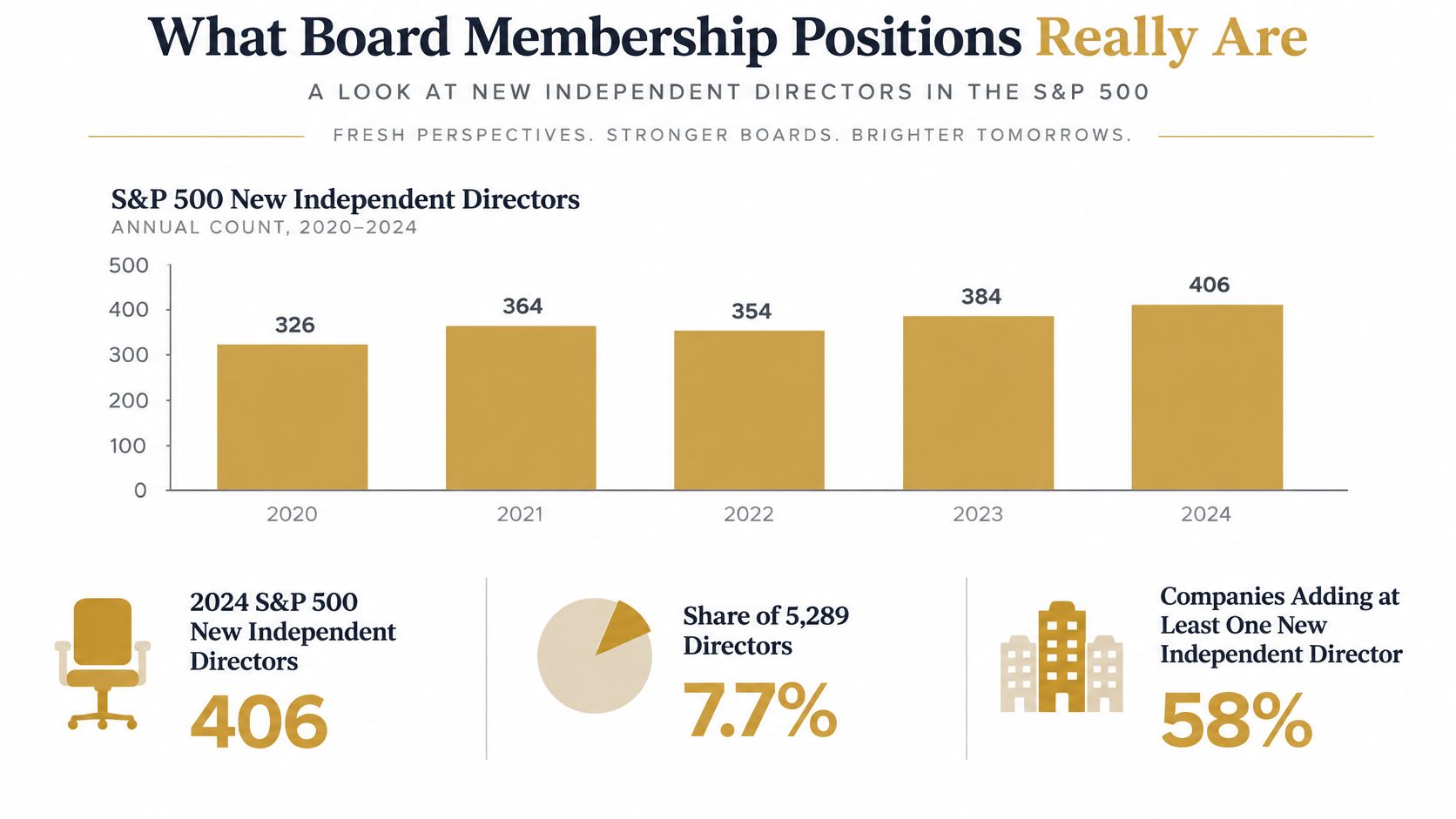
In 2024, S&P 500 companies appointed 406 new independent directors, representing 7.7% of the 5,289 directors serving on those boards, according to the 2024 U.S. Board Index published by Harvard Law School's corporate governance forum. The same index reports that 58% of companies added at least one new independent director, compared with 53% in 2023.
That's a recurring but selective appointment market, not an open jobs board. Even when companies recruit, they're usually filling a particular gap rather than adding another broadly accomplished executive.
The appointment picture makes that scarcity tangible.
Say a manufacturer wants to expand overseas. Its directors work on the bridge: they test the destination, financing, risks, and chief executive's plan. Managers run the engine room, negotiating contracts, hiring people, and executing the expansion.
Board seat labels and what they answer to
| Seat label | Answers to | Core duty |
|---|---|---|
| Independent non-executive director | The full board and shareholders | Challenges management without an executive role |
| Executive director | The full board | Sits on the board while running a function |
| Chair | The full board | Leads the board agenda and the chief executive relationship |
| Committee chair | The full board | Owns one committee's mandate and reporting |
| Nonprofit trustee | The mission and the members | Protects the mission and manages conflicts |
These are practical accountability labels, not substitutes for the organization's governing documents or applicable law. A nonprofit without members, for example, won't have member accountability in the same form as a membership organization.
An executive director has to distinguish their management responsibilities from their contribution to collective board decisions. An independent director must be able to question that executive without relying on management ties.
Pay, time, and liability follow the organization and mandate, not the title alone. Use the organization comparison as a decision tool before treating every director vacancy as an equivalent opportunity.
How Board Seats Differ by Organization
| Organization | Who sits | Appointment route | Pay pattern | Independence expectation |
|---|---|---|---|---|
| Public listed company | Independent non-executives, executives, chair, and committee chairs | Nomination committee, search firm, or shareholder proposal | Often cash plus equity; large U.S. seats commonly six figures | Formal tests; UK Code expects at least half the board excluding the chair to be independent |
| Private company | Founders, investor directors, and independents | Shareholder agreement and investor appointment rights | Fees, equity, honorarium, or unpaid while early-stage | Mostly contractual, with related-party disclosure |
| Nonprofit or charity | Trustees or directors, often with a chair and treasurer | Member election or appointment by the sitting board | Usually unpaid; some large charities pay where permitted | Loyalty to mission and conflict rules |
| Regulated subsidiary | Parent nominees plus local executives | Appointed by the parent | Often inside an executive package or a modest fee | Local regulation can still require independent voices |
| Advisory board | Invited advisers without a statutory seat | Management invitation | Honorarium or equity | No fiduciary vote and a different liability profile |
The UK composition expectation is specific: the guide to the UK Corporate Governance Code 2024 explains that at least half the board, excluding the chair, should comprise non-executive directors whom the board considers independent. Don't assume that expectation transfers unchanged to a private company, charity, or another jurisdiction.
The same candidate can fit different mandates
Consider a former CFO. For a listed-company audit committee, their strongest case combines financial-oversight outcomes with documented eligibility and independence. Having managed a finance department doesn't, by itself, establish suitability for independent audit oversight.
That person might enter a private-company board through an investor's appointment rights. The shareholder agreement can determine representation, reserved decisions, and information access, doing some of the practical work that listing requirements do elsewhere. The candidate still needs to understand whose interests they must serve when investors disagree.
A nonprofit treasurer faces a different loyalty test. The central question is whether they protect the mission and handle conflicts properly, not whether they maximize an investor's return.
A parent-appointed subsidiary director, meanwhile, may need to reconcile group strategy with local regulatory obligations. Appointment by the parent isn't permission to ignore responsibilities attached to the subsidiary.
Compensation isn't the whole comparison
An advisory seat is an invitation to advise without a fiduciary vote in that capacity. It can build access, familiarity with board discussions, and useful relationships, but it doesn't automatically demonstrate how you behave when personally accountable for a formal decision. Read the engagement terms because advisory work still creates contractual and professional obligations.
When assessing paid board positions, distinguish cash fees from equity, expenses, and compensation already included in an executive package. Equity is not the same as spendable income, and a prestigious title doesn't tell you whether the workload is manageable.
Selection rule: Circle the organization type you can credibly serve before comparing titles or fees.
Then inspect the actual appointment documents. Ask what decisions reach the board, what information directors receive, and what happens when the organization faces financial distress or a serious incident.
The Duties Directors Cannot Delegate
Directors can assign analysis and execution to management. They can't use that delegation as a reason to stop examining the decisions they're responsible for overseeing.
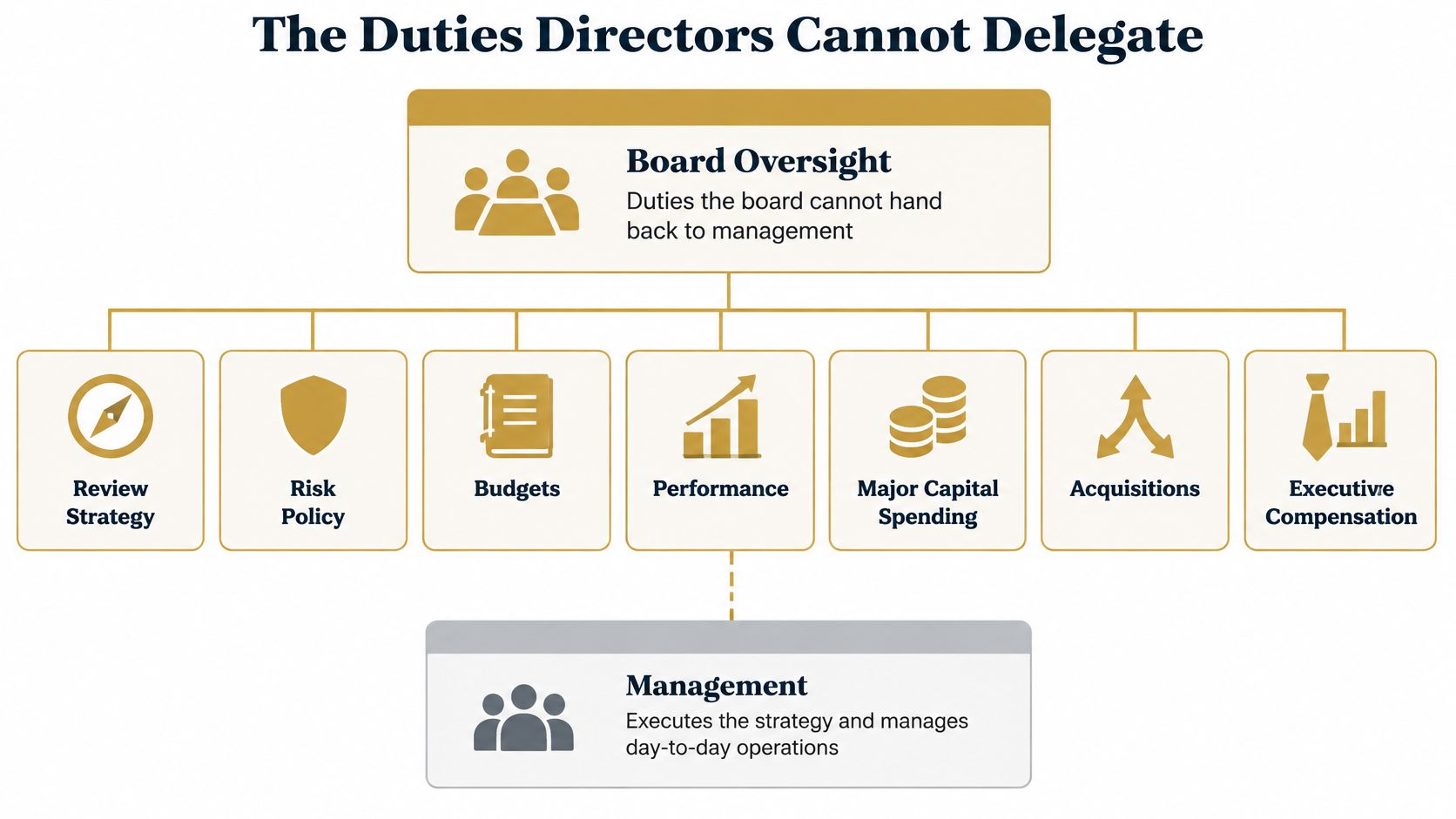
The G20/OECD Principles of Corporate Governance identify core responsibilities including reviewing strategy, risk policy, budgets, performance, major capital expenditure, acquisitions, and divestitures. For a candidate, each responsibility should translate into a question you can answer with evidence.
This overview separates board oversight from management execution.
Translate responsibilities into chair questions
- Strategy: Which assumption did you challenge, and what changed in the decision?
- Risk policy: What changed in risk appetite, and who authorized the change?
- Budgets and performance: Which forecast did you question, and what evidence contradicted it?
- Capital spending: Which investment was refused, delayed, or redesigned?
- Acquisitions and divestitures: How did you stop or reshape a weak transaction?
A strong answer identifies your role accurately. If you prepared management's recommendation, say so. Don't relabel operating experience as an independent board decision.
Challenge management's reasoning without taking over management's job.
Split your profile into whole-board contribution and committee qualification. The first explains your judgment across strategy, people, and risk. The second establishes technical relevance, such as control remediation, audit oversight, or incentive design.
U.S. listed-company audit committee membership also requires board membership and applicable independence. An impressive executive résumé can therefore fail the eligibility test before the board considers the candidate's broader accomplishments.
Independence needs a relationship inventory
The NACD guide to director independence identifies considerations including management connections, major shareholder or vendor affiliations, immediate family employment, and company payments beyond director fees. Disclose these relationships plainly rather than assuming that recusal resolves every eligibility issue.
For example, a technology founder whose business supplies the company should explain that commercial relationship before presenting themselves as an independent technology candidate. The board needs enough information to assess the actual role and committee requirements.
For another perspective on board responsibilities, watch the discussion below.
Before applying, identify a strategy decision you influenced, a risk you'd escalate, and a relationship that could impair independence. Support each with a concrete account, not a leadership adjective.
Liability is role- and jurisdiction-specific, but directors can face exposure for failures of oversight or conflicted decisions. Ask whether you could defend your reasoning, information requests, and vote before a regulator or court, and obtain legal advice on the appointment where necessary.
Committee Roles That Shape the Workload
In one longitudinal sample examined by the OECD's analysis of board-level committees, outside directors spent approximately 40% of annual board-related activity in committees at the beginning, rising to about 60% by the end. That isn't a universal time budget, but it explains why the committee assignment deserves as much attention as the director title.
Committee seats and what they demand
| Committee | Core mandate | Who fits | Time pattern |
|---|---|---|---|
| Audit | Reporting, internal controls, and the external auditor | Independent directors with financial-oversight evidence | Heavy: scheduled meetings plus reporting and incident work |
| Remuneration or compensation | Pay policy, incentives, and senior talent | HR, investor, or former CEO experience, not current management | Moderate, with spikes around pay decisions |
| Nominating and governance | Composition, succession, and independence | Directors who can judge board gaps without lobbying for allies | Spikes when a seat or chair is opening |
| Risk or technology | Material risk, including cyber and AI oversight | Operators who can challenge a function they do not run | Rising as specialist risks enter the board agenda |
Treat these time patterns as planning prompts, not promises about an individual seat. A compensation dispute can consume more attention than a routine audit cycle. A technology incident can disrupt an otherwise predictable calendar.
Before accepting, obtain the written committee mandate, reporting rules, information rights, budget, access to external advisers, and performance-review arrangements. A committee title without those supports can leave directors responsible for questions they can't properly investigate.
Specialist knowledge must become oversight
Say a cybersecurity executive joins a risk committee. Their contribution isn't to configure security systems or direct the incident-response team. It's to test management's account of material exposure, remediation priorities, reporting obligations, and recovery readiness.
The distinction becomes visible in the questions. Asking which vulnerabilities management has accepted, why, and with what escalation threshold demonstrates oversight. Personally choosing the security software pulls the director toward execution.
Write a committee-fit note that connects:
- The company's need: A strategy or material risk requiring board attention.
- The committee mandate: The formal responsibility that gives the issue a governance home.
- Your evidence: An outcome showing how you tested a decision, secured corrective action, or improved accountability.
Members should be selected for relevant skills, experience, and interests, not rewarded with a committee assignment as a courtesy. You should be equally selective about accepting one.
Budget for the unscheduled work
Ask for the annual meeting calendar and recent examples of additional meetings. Include preparation, travel, adviser discussions, site visits, training, and follow-up in your assessment, not just the time spent around the boardroom table.
Use the Board Time Commitment Calculator to make those assumptions explicit. Then test whether your executive role or other appointments would allow you to respond during a difficult period.
Decline a seat you can't properly carry. If the board won't provide adequate information, the meeting load exceeds your capacity, or the liability arrangements remain unclear, the title isn't sufficient compensation for the responsibility.
Routes That Actually Fill an Open Seat
A board appointment starts with an identifiable decision process. Knowing someone matters only if that relationship helps the right decision maker understand why you fit the opening.
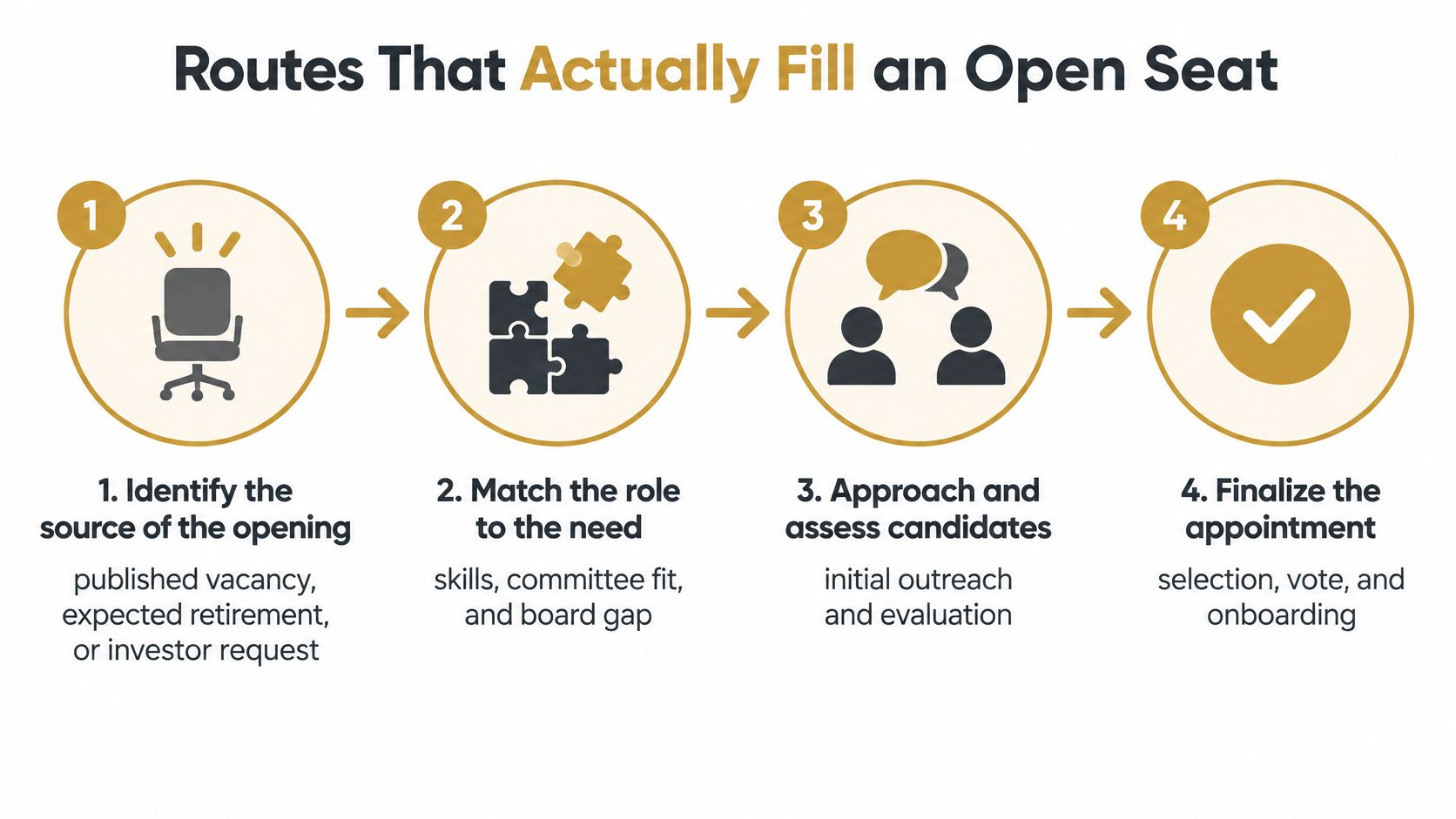
The process can be summarized visually before turning it into an application plan.
Follow the appointment authority
Identify the source of the opening. A published vacancy may sit with a nomination committee or search firm. An expected retirement usually calls for a conversation with the chair or nomination committee. Investor appointment rights lead to the relevant shareholder, parent appointments to the parent company, and nonprofit elections to the body authorized by the governing documents.
Name the decision maker. Establish who assesses candidates, who recommends them, and who formally appoints or elects them. A search consultant can manage the shortlist without having authority to award the seat. Don't confuse access to the process with control over its outcome.
Match evidence to the stated gap. If the board needs stronger audit oversight, lead with a relevant controls or reporting outcome. If it needs succession judgment, show how you evaluated leadership alternatives. A generic career narrative makes the reader do work you should have done.
Choose the entry route. Use a shared board, mutual colleague, or common work history when that relationship is genuine and relevant. Otherwise, send a direct application addressed to the specific mandate. Ask a mutual contact for context before asking them to endorse you.
Prepare for scrutiny. Expect questions about independence, conflicts, the committee charter, and how you respond when management resists challenge. Rehearse a disagreement in which you remained constructive without withdrawing the substantive concern.
Expect the formal finish. Selection may still require election or appointment, regulatory checks where applicable, disclosure, and induction. Don't treat an encouraging interview as authorization to describe yourself as a director.
Match quality matters more than application volume
Direct and cold applications remain part of the search, including approaches to boards without public adverts. But an unadvertised possibility isn't a confirmed vacancy, and an anticipated retirement isn't a guaranteed opening.
Understanding how board placement support differs from executive search firms helps clarify whom each party serves. A candidate's preparation process and a board's retained search mandate aren't interchangeable.
A useful introduction explains why this candidate belongs in this particular conversation.
If the response is that you need prior board service, don't expand the mailing list. Choose an appointment that can produce the missing governance evidence.
Bridge Seats for a First Board Role
Only 17.6% of newly elected S&P 500 directors in 2026 were serving on a public-company board for the first time, down from 27.8% in 2025, according to The Conference Board's report on fewer fresh faces entering boardrooms. The report also places turnover at 0.7 new directors per board, with appointments at their lowest level since 2016.
A strong executive résumé isn't a public-board passport. A credible bridge seat should create evidence you don't yet possess, rather than merely add the word director to your biography.
The doorway matters less than the decisions you'll be accountable for once inside.

Bridge seats by the governance proof they create
| Bridge seat | Governance signal it creates | Limit to state honestly |
|---|---|---|
| Smaller listed or regulated board | Recorded fiduciary votes | Smaller scale may not match a large public board |
| Nonprofit board | Stakeholder conflict handling and committee work, if outcomes are recorded | Unpaid mission proof, not a listed-company record |
| Subsidiary board | Oversight inside a group under parent strategy | Mandate is set by the group and local regulation |
| Private portfolio board | Independence from a former employer | Investor-set rights may do the work a listing rule would |
| Committee-only or advisory seat | Documented challenge to management, if recorded | Advisory seats carry no fiduciary vote |
Judge the evidence each seat could produce
Consider a CFO who joins a smaller board and oversees remediation of a control weakness. By documenting the questions asked, corrective milestones, and verified outcome, they can build a plausible audit-chair trajectory. The appointment alone doesn't establish that trajectory.
An exited founder might join a private portfolio board outside their former company. Their useful evidence could be a decision where they evaluated management objectively rather than applying founder authority. Independence must be demonstrated through the actual relationships and conduct, not inferred from the exit.
A nonprofit treasurer could document a conflicted related-party decision and subsequent clean audit. That may support a mission-adjacent corporate committee application, provided they explain the scale and context clearly and don't imply equivalence to listed-company reporting.
Write outcomes: risk oversight, succession judgment, cyber-incident review, audit challenge, or stakeholder-conflict resolution. Preserve confidentiality and distinguish your personal contribution from the board's collective decision.
Use the Board Readiness Assessment to identify which evidence is missing before choosing a bridge. A narrow search for a board with a visible capability gap gives you a clearer proposition than broad networking without a defined mandate.
Match One Board Gap and Apply in Your Name
A focused application connects one board's documented need to evidence you can support. Before applying, make sure you can explain the organization fit, the committee match, and the experience that qualifies you for this seat, including a bridge role if the board expects prior service.
Use the Board Role Fit Checklist to set out the board's requirements beside your evidence. A specific committee gap gives your application a clearer purpose than a broad claim about leadership.
Prepare for a board's decision, not a promised result
Boards, nomination committees, and recruiters make appointment decisions. No program can promise you a seat or income. You remain responsible for due diligence and for deciding whether to accept an offer.
SeatSignal's team handpicks relevant open board roles and prepares a director-grade application for each opportunity. The packet includes a CV, a cover letter written specifically for the board's charter and gap, a fit memo, and an independence note. Interview preparation draws on the role, committee responsibilities, and gaps in the board's composition. This preparation can clarify your fit, but it cannot ensure an appointment.
Keep ownership of the approach
Rehearse the questions the chair is most likely to ask, based on the role, committee, and identified gaps. Be ready to explain a difficult judgment and the evidence behind it, not just summarize your career.
SeatSignal does not apply on your behalf. You send each application in your own name, approve how you are represented, and retain ownership of any warm relationship used in the approach.
Before proceeding, write a short target statement that names the seat type, committee, and outcome demonstrating your capacity for independent oversight. If the statement relies on broad phrases such as “strategic leader” or “transformation expert,” sharpen the evidence before widening your search.
SeatSignal supports a focused search with hand-picked board opportunities, customized application materials, and board-specific interview preparation. Once you can name your target seat, committee, and strongest oversight evidence, explore SeatSignal as one option for pursuing that fit.
Want a paid board role, done for you?
One handpicked, verified open board role every week, with a director-grade packet tailored for it.
Get Started