Board of Directors Application: A Step-by-Step Guide
You have the operating record. Revenue, headcount, markets. A nomination committee still passes. They are not hiring another executive. They are filling a hole in oversight, and a board of directors application that reads like a promotion case gets set aside before anyone calls.
The appointment is not yours to award. Boards, nomination committees, and recruiters make that call. Your job is the case they can approve. I would sort the career into two piles before you write a word. Oversight is a control you changed, a launch you stopped, a conflict you declared. Management is the revenue line, the team size, and the title. Leave the second pile in executive language and it gets dismissed.
Table of Contents
- Application Stages and What Each Produces
- How to Find Board Seats Before They Are Advertised
- Check Eligibility and Your Fit Before You Apply
- How to Map Board Gaps to Your Evidence
- How First-Time Candidates Get Past the Experience Filter
- Write Director-Grade Materials That Show Oversight
- Prepare for the Chair's Questions Before You Submit
- Confirm Your Next Step Before You Apply
Application Stages and What Each Produces
| Stage | What You Produce | Who Makes the Call |
|---|---|---|
| Pick the seat | Shortlist of three to five boards with a one-line reason each | You |
| Check eligibility and fit | Go or no-go note covering conflicts, time and legal eligibility | You, with legal advice where needed |
| Map gaps to evidence | Gap map and one primary board thesis | You |
| Build the packet | Board CV, cover letter, committee-fit memo and independence note | You approve, then the committee reads |
| Open the route | Outreach note or warm introduction | The introducer, then the nominating committee |
| Interview | Answers to the chair's likely questions | Chair and nomination committee |
| Due diligence and appointment | Reviewed board papers and offer terms | Board, nomination committee or recruiter |
The first three stages are private work you control. Nobody is grading you yet. The packet is the first thing a committee reads. After that, an introducer decides whether your name goes forward, and the chair decides the interview.
Seats open slowly. The 2024 U.S. Spencer Stuart Board Index found that only 58% of S&P 500 boards appointed at least one new director during the proxy year, while overall turnover averaged just 0.83 new directors per board. A first seat can take many months of positioning, not a few weeks of applying.
Practical rule: Do not open a route until the gap map and the packet exist. A warm introduction with nothing behind it wastes the one path in.
How to Find Board Seats Before They Are Advertised
Job boards show the seat after the shortlist is often already forming. The documents below show the need earlier.
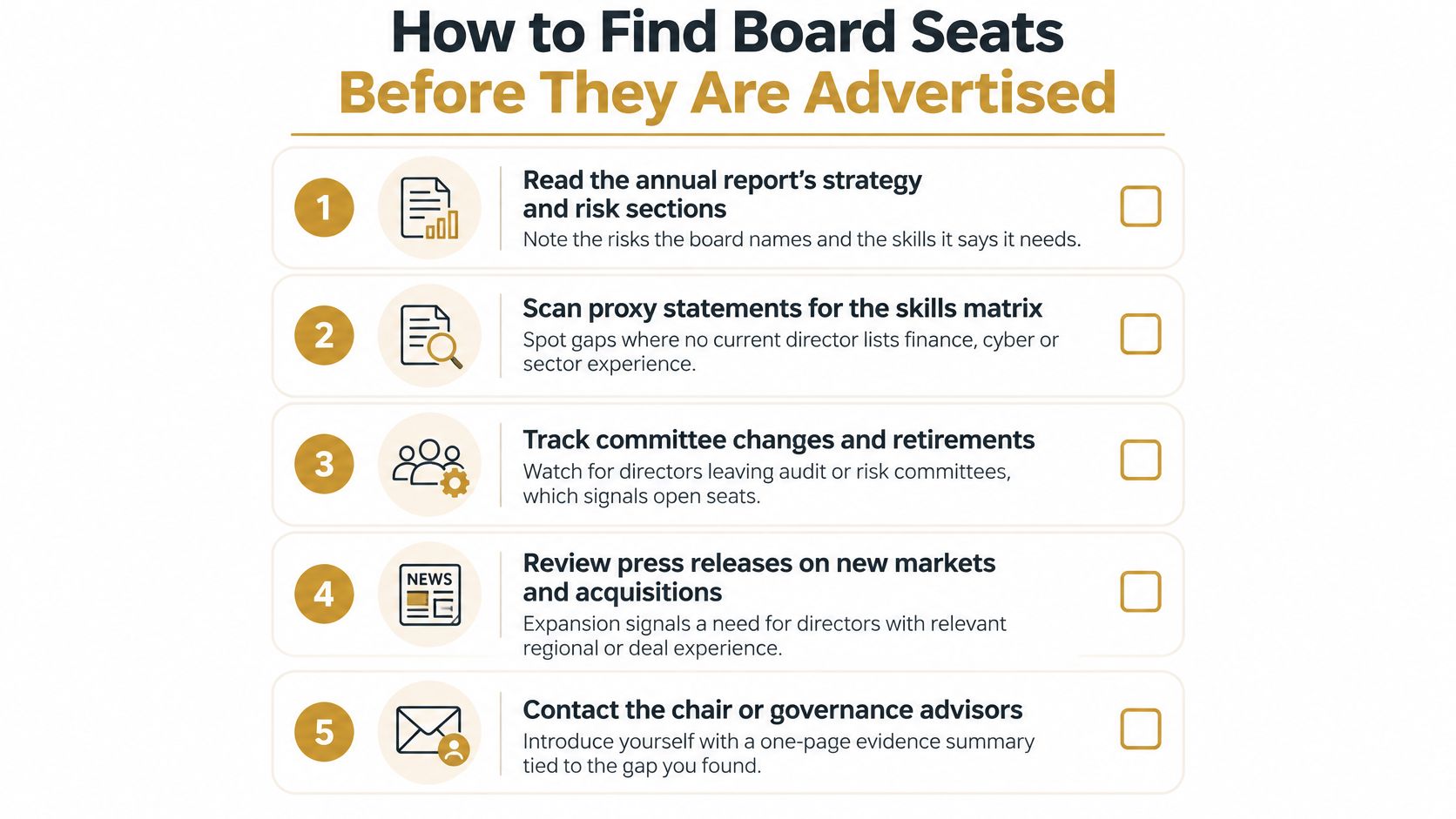
- Read strategy and risk. The annual report names priorities such as cyber resilience, capital allocation, or market entry. That is the board's own list.
- Pull the proxy or governance report. Note the skills matrix, committee rosters, and tenure. Mark what is already covered so you do not pitch a duplicate.
- Read the charter you want. Audit, risk, and remuneration duties are written out there. The charter tells you the work, not the title.
- Copy the nomination wording. Take stated director criteria off the governance page exactly, and note any open-seat notice.
- Scan public appointment portals. Government, crown-agency, and regulator boards publish windows and eligibility. A running view of board of directors positions helps you set those notices next to seats that are only expected.
- Check associations and nonprofits. Write down whether the seat pays a fee, an honorarium, or equity.
- Ask people near the board. Former colleagues and advisers often hear of a change before a notice exists.
Chairs talk about an opening long before a listing. This short briefing is worth a look before you write to anyone.
Keep three to five boards. Give each a one-line reason and a label, advertised or only expected.
Check Eligibility and Your Fit Before You Apply
Statutory eligibility is a stop, not a preference. Under Part 10 of the Companies Act 2006, a director must be a natural person who has reached age 16, and a disqualified person cannot be appointed. UK government guidance states a disqualification can last for up to 15 years. Other countries write their own rules, so confirm local company law and any sector regulator next.
| Filter | Test | Outcome if it fails |
|---|---|---|
| Statutory eligibility | Natural person aged 16 or older, not under a disqualification order | Stop: cannot be appointed |
| Other jurisdictions and regulators | Local company law and sector rules checked | Stop until confirmed |
| Time capacity | Meetings, committee load, travel and prep hours against current roles | No-go if the total exceeds capacity |
| Over-boarding | Seats already held against investor and proxy adviser limits | Stop, or resolve an existing seat first |
| Conflicts | Clients, suppliers, investors and former employers listed | Recusal list agreed before applying |
| Indemnity and insurance | D and O cover and indemnity terms confirmed | Ask before accepting |
| Pay type | Paid, unpaid, equity or honorarium | Accept only a type you have chosen |
| Governance fit | Contribution to composition, independence and committee capability | No-go if no stated gap matches |
Composition is part of that last filter. Across the jurisdictions in the OECD Corporate Governance Factbook 2025, women held an average of 29% of board positions in 2024, compared with 22% in 2019. Large listed companies were at 34.7%, while only 10% had a female board chair. If you do not change a stated gap, stop. Record the pass or fail on a board role fit checklist before you draft.
How to Map Board Gaps to Your Evidence
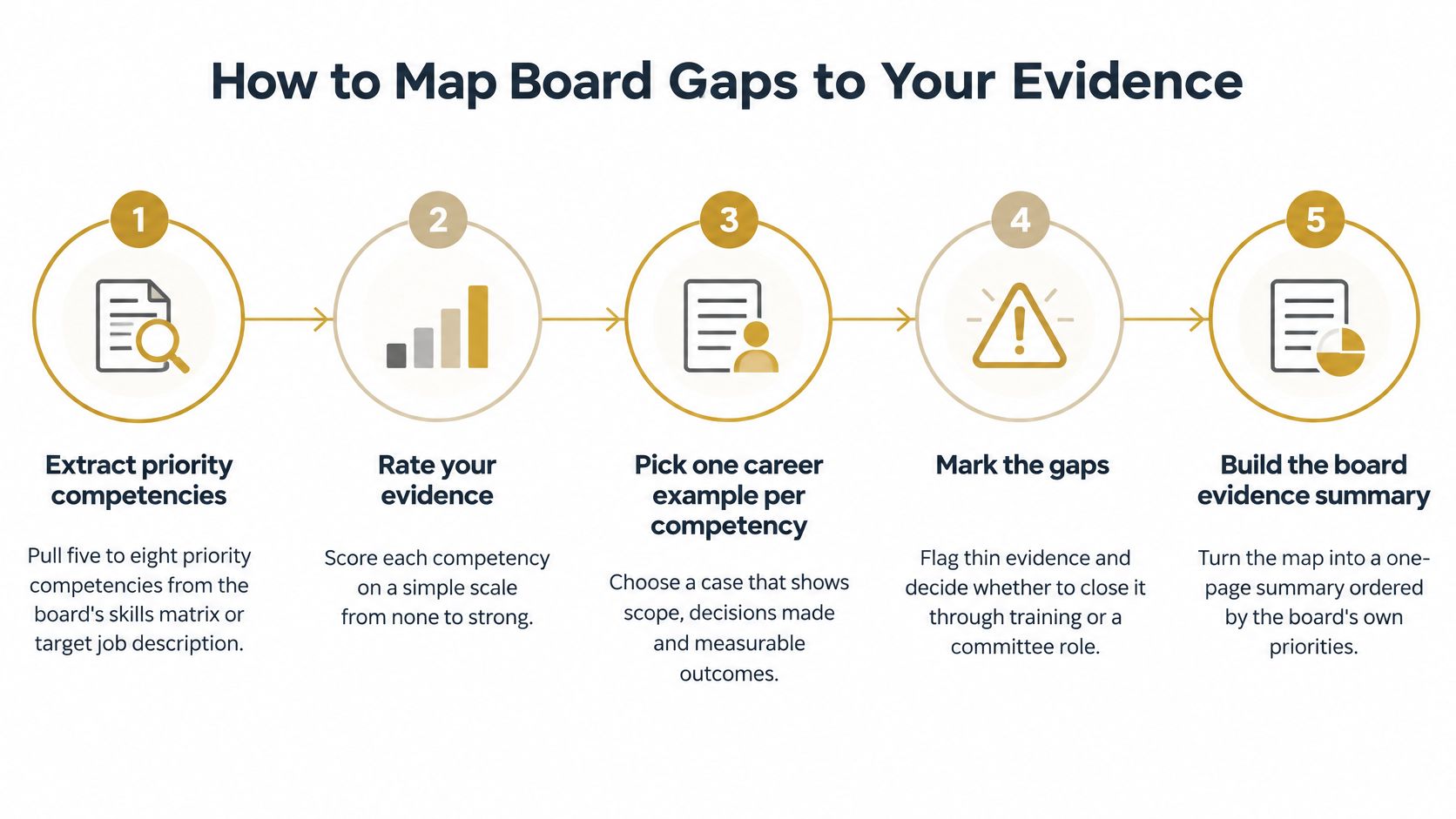
Build the board of directors application as a gap-to-evidence map. The 2023 Board Practices Report notes that more than two-thirds of surveyed boards or responsible committees use a skills matrix for director recruitment and succession planning.
- Extract five to eight priority competencies from strategy, the annual report, the proxy, and the charters.
- Mark each one demonstrated, adjacent, or absent.
- Choose one board-relevant proof point for every demonstrated capability.
- Turn operating results into oversight language. "Reduced losses 18% through controls" becomes evidence of risk and audit oversight.
- Place the strongest two or three matches in the opening profile and the cover letter.
Priorities move. In that survey, strategy, sustainability, international experience, diversity attributes, and IT were among the leading capabilities expected over the following one to two years. Accounting and legal backgrounds were comparatively less likely to be future priorities.
A CFO case for an audit seat
Say a CFO wants the audit committee. This map stays internal. Every line has to survive a question from the chair.
| Board Requirement | Your Status | Proof Point to Use | Where It Goes |
|---|---|---|---|
| Financial reporting oversight | Demonstrated | Reviewed and signed off quarterly reporting for a nine-entity group | Opening profile and cover letter |
| Internal controls | Demonstrated | Redesigned approval limits that cut audit exceptions in the following year | Competency section of the CV |
| Cyber-risk oversight | Adjacent | Sat on the steering group for an ERP security rollout and escalated vendor risks | Committee-fit memo |
| Independence and conflicts | Demonstrated | Recused from a vendor decision after declaring a related-party link | Independence note |
| Remuneration design | Absent | No claim made; covered by a reading plan and an interview answer | Interview preparation only |
Remuneration design stays off the paper. A reading plan and a straight interview answer are enough. Claiming it fails the first follow-up.
A director CV shows judgment, challenge, stewardship, risk appetite, succession, and committee contribution. Tie each line to a decision, a control, or an outcome.
Shape the two strongest matches with the board value proposition builder before the full packet.
How First-Time Candidates Get Past the Experience Filter
Boards ask for prior service, then fill open seats with people who already have it. That circle is the actual filter.
The 2026 Board Monitor US demographic data report indicates that 74% of Fortune 500 seats filled in 2025 went to people with prior public-board experience. Women held 31% of seats filled and non-white directors 19%, both well down from recent highs.
First-timers still land seats. The 2023 S&P 500 New Director and Diversity Snapshot reported 388 new independent directors, and 31% of those appointees were first-time directors.
- Enter where your record already counts. Nonprofit, association, and public-sector boards hire for fiduciary work you may have done. In 2023 the British Columbia Crown Agencies and Board Resourcing Office oversaw 956 public-sector appointments and reappointments, per the Office of the Auditor General of British Columbia.
- Take a committee or advisory role where you already work, so the output looks like oversight.
- Match one stated gap, and say you are a first-time director in the letter. Hiding it reads worse than owning it.
That first seat is the file the next application cites.
Write Director-Grade Materials That Show Oversight
Pick one primary thesis and one secondary differentiator. Audit-chair readiness, cyber-risk oversight, a regulated industry, international expansion, or post-founder governance. Test it against disclosed gaps, not the shine of your titles.
In the 2025 NACD Trends and Priorities Survey, 67% of respondents said their board would rather seek specific expertise than general business leadership, and industry-specific expertise was selected by 42%. Cyber-risk and digital innovation were the areas where most directors reported thin expertise, at 55% and 54%.
The CV opens on the thesis, then competencies, then roles that lead with a governance outcome. The committee-fit memo covers oversight decisions, independence and constructive challenge, and risks you can help the board interrogate. The letter is about one page, names the gap, and answers with two proof points. The independence note states relationships plainly.
| Executive Version | Director-Grade Version | What It Signals |
|---|---|---|
| Cut logistics costs 18% | Challenged the cost plan and approved a controls change that cut spend 18% with no service loss | Judgment and challenge of management |
| Managed a 40-person finance team | Owned financial controls for a 40-person function and reported findings to the audit committee | Oversight and reporting line |
| Led market entry into Germany | Set the risk limits for the Germany entry and halted two launches that failed the capital test | Risk appetite and discipline |
| Hired and developed the leadership team | Designed succession plans for three senior roles and reported readiness to the board | Succession responsibility |
| Launched a new ERP system | Oversaw ERP security and vendor risk during rollout, with escalations to the risk committee | Defined oversight scope |
Three packets fail the same way. "Cyber expertise" with no oversight scope. Management authority dressed up as independence. One generic set sent to every board. Grade a draft with the board CV grader before you approve it.
Prepare for the Chair's Questions Before You Submit
Write the answers before the packet leaves your desk. The prompts come from the role, the committee, and the gaps you mapped.
Conflicts. Name the relationship and the decision you would leave. Time. Add meetings, committee load, travel, and reading across seats you already hold. Crisis years add hours. Say so. Dissent. One disagreement, what you said, and what happened next. Fiduciary judgment. A moment you sided with the company against a management preference. The boundary. Where you stop steering and send the work back to executives.
Keep each answer to two to four sentences and one proof point from the map. Then write two questions for the chair about risks in the latest papers. Those questions show you read.
Rehearsal should use the questions that board's chair is most likely to ask, based on the role, the committee, and the gaps found. A board interview question bank holds that list so you are not inventing prompts the night before.
What leaves in your name
You review every draft and you approve it. You send the application yourself. A placement team can run the search and the drafting. You still review what they find, approve what they write, and send in your own name.
Log the date sent, the contact, the follow-up date, and the reference who agreed to speak. Brief that reference on this seat only. Their comments on your independent judgment should match the note you already filed.
If a reference cannot describe a time you challenged management, do not list them for this board.
Confirm Your Next Step Before You Apply
Apply when you can name the board's stated gap, two or three proof points from your career that a chair will read as oversight, a clean independence position, and the hours to serve. Hold when conflicts, over-boarding, or statutory eligibility are still open. An unresolved filter is a no, not a draft to send anyway.
This week, finish the eligibility note, build the gap map for your best-fit seat, and write a one-paragraph thesis on why your evidence answers that board's specific need. No outreach until those three exist. A premature application to a board you are not yet ready for does more damage than a month of quiet preparation, because nominating committees remember thin packets.
You can run that yourself, or use SeatSignal's placement program, which hand-picks relevant open board roles, drafts director-grade application materials for each one, and prepares you for each interview against the questions that board's chair is likely to ask. The program aims to land a paid board role within 60 days, but results are not guaranteed. SeatSignal has a refund policy and a results disclaimer, and boards, nomination committees, and recruiters make the appointment decision.
SeatSignal builds the director-grade packet for a specific board, from the CV and fit memo through interview rehearsal on that chair's likely questions. If you want the gap map turned into materials you approve and send yourself, start with SeatSignal. Bring one target seat and the proof points you can already defend.
Want a paid board role, done for you?
One handpicked, verified open board role every week, with a director-grade packet tailored for it.
Get Started