Board of Directors Target: How to Assess a Board Seat
You've updated your CV, identified companies you respect, and started asking contacts about board openings. Yet you still can't explain why a particular nomination committee would choose you over another accomplished executive. The missing piece may not be another credential. It may be a sharper board of directors target, defined by the work the board needs done rather than the prestige of the company.
Table of Contents
- What a Board of Directors Target Really Means
- Build a Board Target Scorecard
- Read Turnover and Refreshment Signals
- Check Independence and Committee Fit
- Spot Redundancy and Real Gaps on the Board
- Scoring an Audit Committee Seat Step by Step
- Confirm the Target Before You Approach a Board
What a Board of Directors Target Really Means
A board of directors target is a written, measurable description of the seat you want: which board, which committee, which capability gap, and what documented evidence makes you suitable.
Wanting to join an experienced board isn't a target. It gives you nothing to test against the company's strategy, existing directors, or committee responsibilities. Treat a potential vacancy less like a job advertisement and more like a question the board is asking. Your target is the answer, written in the board's language.
A target is a board's gap, matched to evidence you can prove.
Read the board at three levels
Start with composition. What expertise and perspectives do the existing directors bring, and what would your appointment add?
Then assess the seat itself, including committee responsibilities and likely timing. Finally, examine your proof, separating relevant accomplishments from claims you couldn't defend under questioning.
Consider a retired CFO targeting the audit committee of a mid-sized listed manufacturer whose audit chair is approaching the end of a long tenure. That's more useful than pursuing any board willing to consider a finance director. The target changes what the CV must demonstrate: financial reporting judgement, manufacturing economics, internal controls, and the ability to question management without taking over its work.
A board readiness assessment can help separate preparation needs from targeting mistakes. A strong candidate can still choose an unsuitable seat.
Before approaching anyone, establish the requirements, assess refreshment signals, check eligibility, and distinguish missing capabilities from expertise the board already has. The decision isn't whether you admire the company. It's whether you can make a defensible contribution in the seat that may become available.
Build a Board Target Scorecard
Board target scorecard: requirements, type, evidence and weight
| Requirement | Type | Evidence to Check | Weight |
|---|---|---|---|
| Audit committee financial expertise | Mandatory for audit roles | Finance, audit or controller track record and recognised accounting credential | 25 |
| Independence from management and major shareholders | Mandatory | No recent employment, material consulting or family ties with the company | 20 |
| Sector operating experience | Core preference | Scale, regulatory context and commercial model in the target sector | 20 |
| Cybersecurity or technology risk oversight | Strategic preference | Decisions on incident response, data governance or technology investment | 15 |
| International regulatory exposure | Differentiator | Cross-border operating, reporting or regulatory work | 10 |
| Committee workload capacity | Mandatory | Current board and committee seats against the time the role requires | 10 |
These weights are illustrative, not regulatory standards. Set them for each board, and confirm the actual financial-expertise and independence requirements before using the matrix.
Turn requirements into a decision
- Extract the requirements. Read the annual report, governance section, committee charters, and disclosed skills matrix. Record where each requirement comes from.
- Label each requirement mandatory, preferred, or differentiator. Don't turn a desirable credential into an eligibility rule without checking.
- Assign weights totalling 100. Give the greatest weight to the work the appointment must address, not the strengths that flatter your background.
- Score your documented evidence from 0 to 5 for each requirement. Treat unsupported claims as missing evidence.
- Calculate weighted points. Divide the evidence score by 5 and multiply by the weight. In this illustrative model, a score of 4 on a 20-point requirement earns 16 points.
A board becomes a serious target only when every mandatory requirement scores at least 3, whatever the total. That's a screening rule for this model, not a legal test. An unresolved eligibility issue can still stop the application.
Composition also deserves an explicit entry when the board has disclosed demographic or stakeholder-representation objectives. The Nasdaq listing document illustrates a standardised approach to board-diversity disclosure and composition objectives. Treat it as a document-specific example, not a substitute for checking currently applicable listing rules.
Your director CV should answer the matrix directly. Evidence of reporting oversight belongs beside the financial requirement; cross-border regulatory decisions belong beside international exposure. Use the Board CV Grader as a document check, not proof of eligibility.
A low total means your overall fit is weak. Pursue the seat only if your distinctive strength addresses a gap the board has stated, and the mandatory checks remain satisfied.
Read Turnover and Refreshment Signals
Director tenure benchmarks and what they signal
| Board Profile | Average Director Tenure | What It Signals for a Candidate |
|---|---|---|
| US technology boards, 2025 | 7.1 years | Up from 7.0 years in 2024, below 8.7 years in 2017 |
| S&P 500 average | 7.8 years | Broader comparison baseline, not a vacancy forecast |
| Market cap below $2 billion | 6.5 years | Investigate potentially more frequent refreshment |
| Market cap of $200 billion or more | 9.7 years | Investigate potentially slower turnover |
| Boards averaging five years or less | 33% of boards | Possible active refreshment or recent restructuring |
| Boards averaging 11 years or more | 14% of boards | Long-tenured composition; verify near-term succession plans |
These figures come from the 2025 U.S. Technology Spencer Stuart Board Index, including its broader S&P 500 comparator. The final rows report shares of technology boards, not average tenure. Compare technology companies within the same market-capitalisation band before drawing conclusions.
Use the visual benchmark to orient your review, not predict a departure.
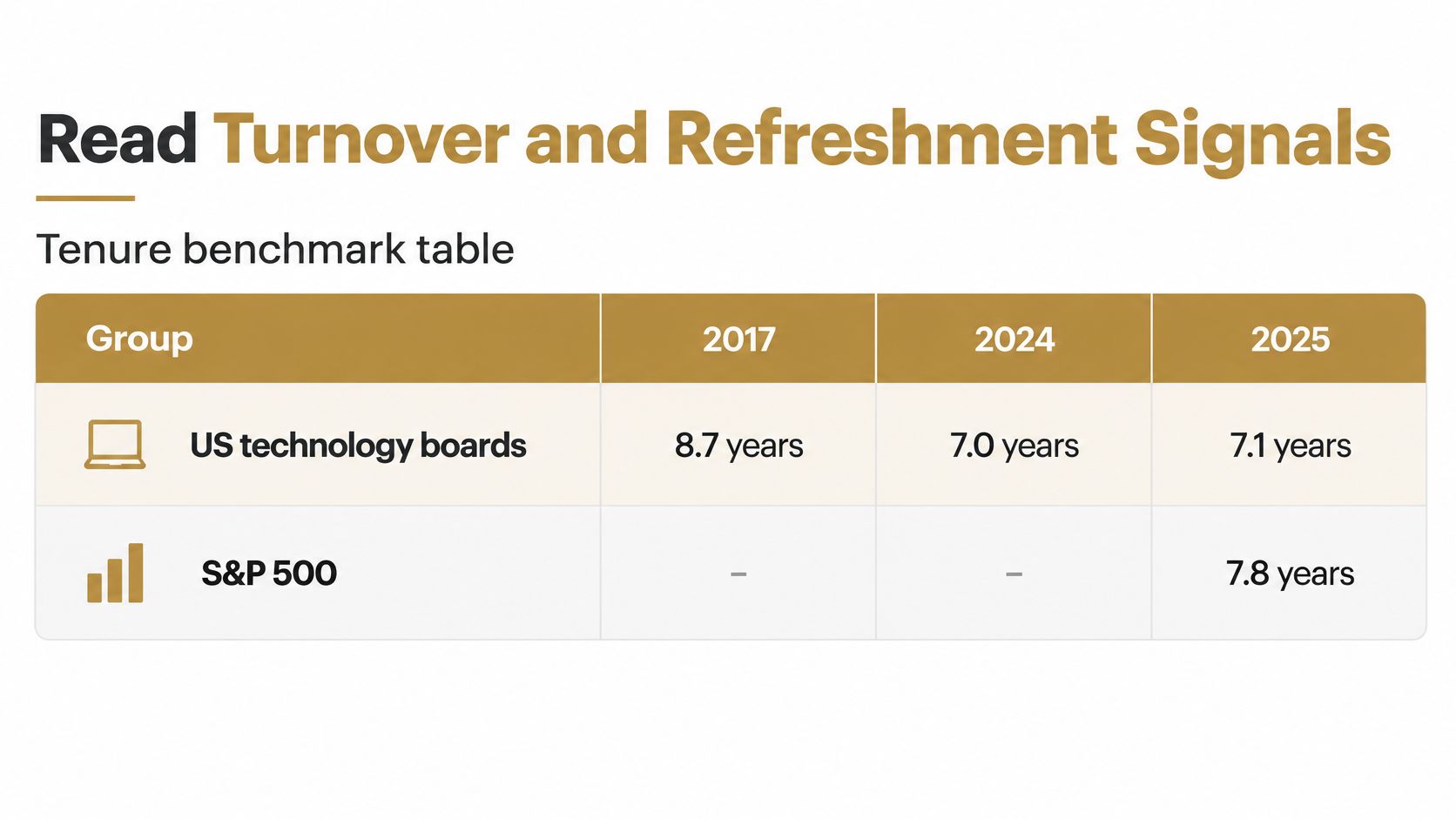
A long average tenure can mean limited near-term turnover. A short average can reflect recent appointments rather than more seats about to open. Neither establishes a vacancy.
Monitor the underlying signals
- Recent appointments: Check whether the board has already recruited the capability you offer.
- Age and tenure policies: Read the governance guidelines, including exceptions and extension provisions.
- Leadership changes: Track chair and committee-chair transitions separately from director departures.
- Refreshment statements: Look for explicit succession plans or commitments to update particular skills.
Maintain separate records for confirmed vacancies and forecast openings. Record the evidence, likely window, and uncertainty rather than describing an anticipated departure as an available seat.
Check workload alongside timing. The Over-Boarding Checker can support that review, but meeting schedules and committee demands still need direct examination.
This accompanying video provides another resource for your board-search preparation.
Don't wait solely for a public listing. Monitor the company's disclosures and succession signals while keeping a forecast clearly labelled as a forecast.
Check Independence and Committee Fit
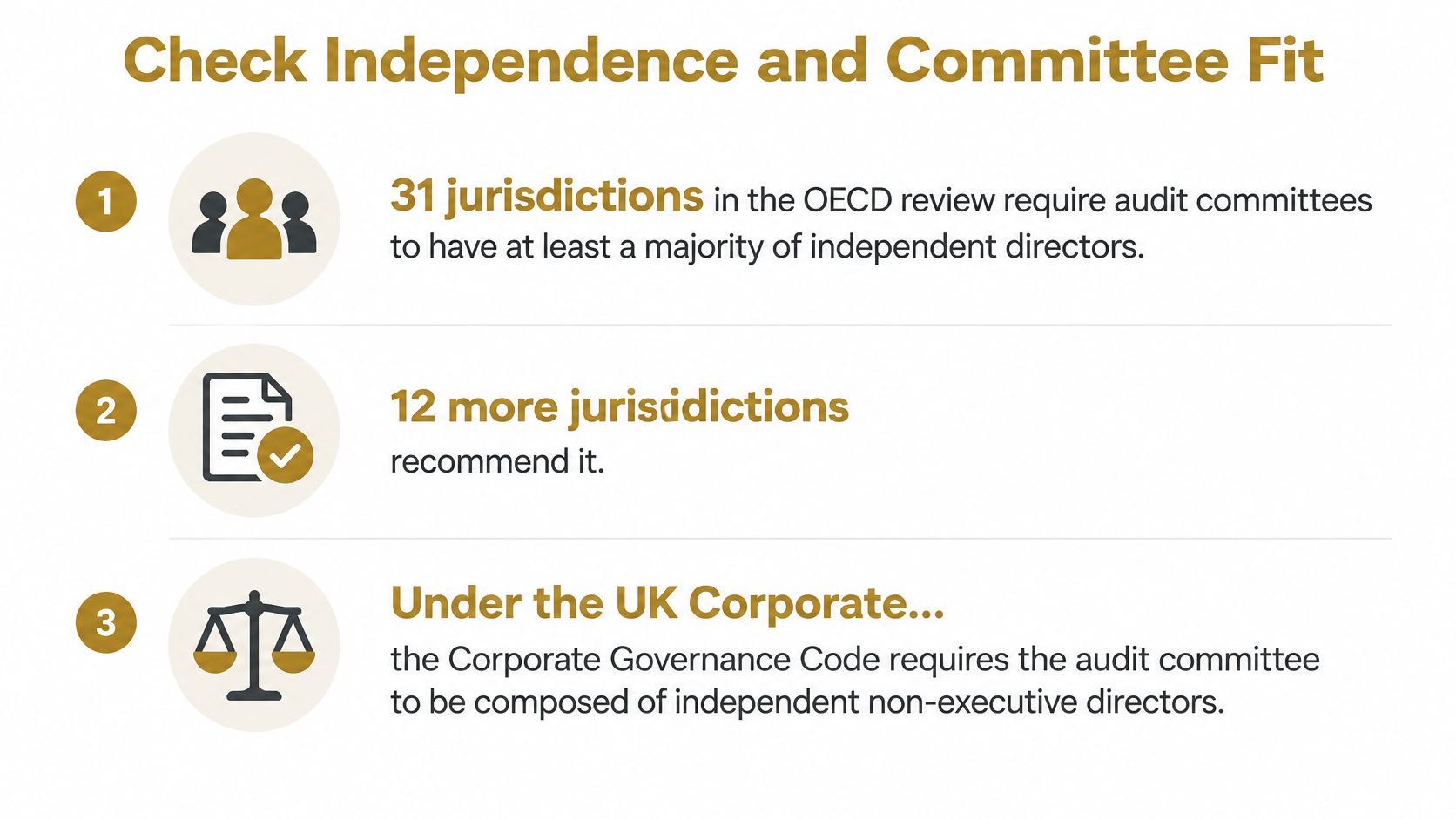
The OECD Corporate Governance Factbook identifies 31 jurisdictions requiring at least majority-independent audit committees and 12 more recommending that standard. Independence is therefore an eligibility question, not just a favourable description in your biography.
Under the UK Corporate Governance Code 2024, audit committees should normally comprise at least three independent non-executive directors, or two for smaller companies, and the board chair shouldn't be a member. Apply the relevant code's scope and definitions rather than assuming every listed company follows identical rules.
Committee independence rules by jurisdiction
| Rule | Requirement | Source |
|---|---|---|
| Jurisdictions requiring majority-independent audit committees | 31 | OECD Corporate Governance Factbook |
| Jurisdictions recommending majority-independent audit committees | 12 | OECD Corporate Governance Factbook |
| UK audit committee, listed company | Normally at least 3 independent non-executive directors | UK Corporate Governance Code |
| UK audit committee, smaller company | At least 2 independent non-executive directors | UK Corporate Governance Code |
| UK board chair on audit committee | Chair should not be a member | UK Corporate Governance Code |
Use these thresholds to identify the checks that determine whether the seat is open to you.
Complete the eligibility review
- Confirm the applicable rules and disclosed composition. Establish which jurisdiction, listing requirements, and company policies govern the committee.
- Check whether the board chair participates. Where that's inconsistent with the applicable framework, investigate the explanation and proposed composition rather than assuming another seat exists.
- Document your relationships. Review employment, shareholdings, consulting fees, and family connections involving the company, its auditor, and major shareholders. Disclose uncertainty rather than deciding privately that a relationship is immaterial.
- Compare your existing commitments with the role's actual workload. Include preparation, reporting cycles, site visits, and exceptional meetings.
- Match evidence to the remit. Read the charter for responsibilities involving risk management, internal controls, internal audit, and reporting to the board.
In an interview, explain how you would challenge management on an unresolved audit finding. Your answer should demonstrate independent judgement, escalation discipline, and respect for management's responsibilities, not reliance on the authority you held as an executive.
Spot Redundancy and Real Gaps on the Board
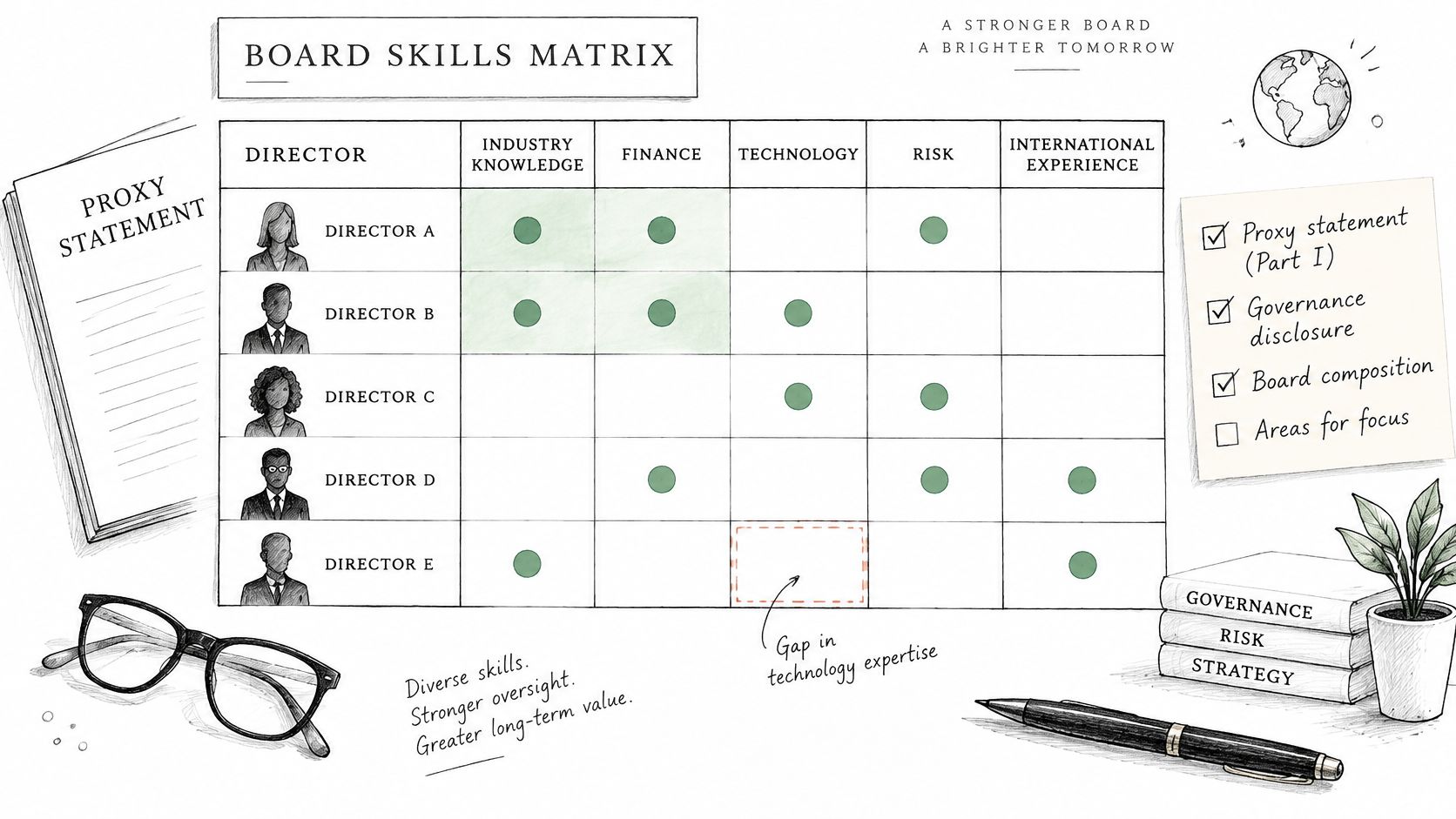
A skills matrix places directors against capabilities such as industry knowledge, finance, technology, risk, and international experience. Look for it in the proxy statement, annual report, or governance disclosures. Read the underlying biographies too, because a marked box doesn't establish depth or recent relevance.
In a hypothetical matrix, a skill shared by four directors indicates overlap. A committee-critical skill held by nobody suggests a gap. Overlap isn't automatically wasteful, but your appointment needs a reason beyond adding another version of an existing director.
The illustration highlights the distinction between broad coverage and a missing capability.
Board needs and planned additions, 2025
| Board need | Share | Measure |
|---|---|---|
| Industry knowledge | 34% | Planned additions |
| Financial acumen | 27% | Planned additions |
| Operational experience | 22% | Planned additions |
| Technology implementation | 31% | Leading need |
| Industry specialisation | 31% | Leading need |
| Corporate strategy | 30% | Leading need |
| Audit or finance | 27% | Leading need |
| Cybersecurity | 27% | Leading need |
The planned-addition figures are from PwC's 2025 Annual Corporate Directors Survey; the leading-need figures are from BDO's 2025 Board Survey. They describe different measures and shouldn't be combined into a single ranking.
Prove the incremental contribution
Say a consumer-goods board already has several former industry CEOs but lacks technology-risk oversight. A finance executive who has scrutinised cyber-risk investment and incident readiness may contribute more than another industry veteran. That remains a hypothesis until the board's strategy and committee needs support it.
Technology evidence must show governance judgement, not an inflated claim to technical mastery. Name the decision, the question you asked, and the relevant committee context. For example, describe challenging the assumptions behind a recovery plan or requiring clearer accountability for a technology investment.
Positioning test: Explain what the board could oversee more effectively with you present.
Use the Board Value Proposition Builder to sharpen that contribution. Replace labels such as AI expert with evidence you can explain under detailed questioning, including the limits of your expertise.
Scoring an Audit Committee Seat Step by Step
Consider this hypothetical candidate: a retired group financial controller with an accounting credential, 15 years in listed manufacturing, and no existing board seats. The target is a listed mid-cap manufacturer whose audit chair has served nine years and whose annual report signals a refresh of finance skills.
The tenure is a prompt to investigate, not proof that the chair will leave. Here's how the candidate would apply the illustrative model.
- List the requirements. Use the audit, independence, sector, technology-risk, international, and capacity categories. Confirm that they reflect this manufacturer's disclosed needs.
- Score the evidence. Award audit expertise 5, independence 4, sector experience 5, cybersecurity oversight 2, international regulatory exposure 3, and workload capacity 4. The independence score is provisional because a supplier relationship ended two years ago and needs disclosure and verification.
- Convert to weighted points. Apply the model's weights rather than treating all capabilities as equally important.
| Requirement | Evidence score | Weighted points |
|---|---|---|
| Audit expertise | 5 | 25 |
| Independence | 4, provisional | 16 |
| Sector experience | 5 | 20 |
| Cybersecurity oversight | 2 | 6 |
| International regulatory exposure | 3 | 6 |
| Workload capacity | 4 | 8 |
| Total | 81 out of 100 |
- Check the mandatory gates. Each mandatory category reaches the model's minimum score of 3. However, the independence review remains unfinished until the relationship has been assessed under the applicable rules.
- Choose the right seat. Target audit committee membership rather than the chair role. In this scenario, the chair position requires stronger evidence of cybersecurity and broader risk oversight than the candidate currently presents.
Keep the decision conditional
The candidate should prepare evidence of difficult reporting judgements and control remediation while seeking clarification on the supplier relationship. They shouldn't describe themselves as independent before that assessment is complete.
The score is a decision aid, not an appointment forecast. Verified evidence and the board's stated requirement matter more than an attractive total.
Confirm the Target Before You Approach a Board
Use this decision checklist before sending an introduction or application:
- Mandatory fit: Does every mandatory requirement score at least 3 under your chosen model?
- Stated need: Does the proposed appointment address a gap the board has identified?
- Eligibility: Is the independence assessment complete?
- Interview evidence: Can you name the decision you would have made and the question you would have asked?
Finalise a single-page target sheet covering the board, seat, contribution, scores, supporting evidence, and unresolved questions. Verify composition, committee rules, and forecast timing against at least two sources, such as the annual report and current committee charter. Use the Board Offer Due Diligence Checklist to organise further questions.
Choose an approach you can defend
Approach directly when the route is appropriate, seek a warm introduction when a genuine shared connection exists, or wait when the evidence for an opening remains weak. Don't manufacture urgency around an unconfirmed departure.
For hands-on support, we're the only DFY board placement program that hand-picks ideal board matches, drafts custom director-grade CVs for each role, and trains you specifically for each interview to ensure you land the seat. Our packet includes a CV, cover letter aligned to the board charter and gap, fit memo, and independence attestation; we also map the warmest route in. Done-For-You Board Placement starts at about $3.25 per day with yearly billing, with no recruitment fees or retainers.
Check current pricing, package contents, and our refund policy on the SeatSignal site. Appointments aren't guaranteed: boards, nomination committees, and recruiters make the decision.
SeatSignal combines board matching, role-specific application preparation, and interview rehearsal around the contribution you can prove. Visit SeatSignal to review the support available, then score your first target board and decide whether to pursue it or move on.
Want a paid board role, done for you?
One handpicked, verified open board role every week, with a director-grade packet tailored for it.
Get Started