Board of Directors Training That Changes Meetings
You've just opened your first board pack. The numbers look tidy, management sounds confident, and the meeting starts in an hour. Then a question lands. Is this forecast evidence, or is it a well presented hope? That moment is where Board of Directors Training either matters or doesn't. Good training doesn't leave you with a list of topics you attended. It changes what you ask, when you escalate, and how you challenge management without trying to run the company yourself.
Table of Contents
- Why Director Education Became a Governance Duty
- Board Training Formats and What Each One Does
- Governance Knowledge Training Is Meant to Build
- Meeting Behavior and the Cases That Show Training at Work
- Signals That Training Reached the Boardroom
- Match Training to the Seat You Want
Why Director Education Became a Governance Duty
Say a capable chief operating officer joins a listed company board. She's run factories, budgets, and large teams. In the first meeting, the chief executive presents a confident plan, the finance director walks through the forecast, and nobody asks what would happen if the central sales assumption is wrong. Her job has changed. She no longer owns delivery. She has to test whether management's account holds, in public, on the record, alongside people she barely knows.
That shift is easy to underestimate, and it's why informal learning wasn't enough.
The post-scandal turning point
Formal director education became part of the accountability wave after Enron and WorldCom and the Sarbanes-Oxley Act of 2002. On November 4, 2003, the New York Stock Exchange became the first U.S. authority to require formal disclosure of ongoing director education, as the National Association of Corporate Directors resource on educating boards describes. Through Section 303A of its Corporate Governance Listing Manual, NYSE-listed companies had to adopt and disclose governance guidelines describing their policies for director orientation and continuing education.
Read that rule carefully, because readers often misread it. It didn't set a universal number of training hours. It required each listed company to explain how it would prepare and update its own directors.
A disclosed policy is not a qualification. It is a promise that the company has a system for keeping its board capable.
That distinction still shapes good practice today. Training is a governance-system responsibility designed to fit the company's risks, strategy, industry, and committees, rather than a single standardized credential every director completes in the same way. A bank board, a hospital board, and a software board don't carry the same risk register, so they shouldn't run identical programs.
What that means for your choice
If you're comparing board of directors positions or deciding what training to take before applying, don't start by counting hours. Start by asking which gap the training closes. A new director may need fiduciary duties and the business model. An audit committee member may need reporting and controls. A confident operator may need practice at dissent.
The sections that follow work through that decision in order. You'll compare the main formats, see the knowledge each format is meant to build, test how training should change meeting behavior, and learn which observable signals tell you it worked. Match training to a documented gap, not to a certificate count.
Board Training Formats and What Each One Does
| Format | Who it serves | Typical owner | Knowledge it builds | Limit |
|---|---|---|---|---|
| New-director orientation | Newly appointed directors | Nominating and governance committee with management briefings | Fiduciary duties, business model, board process | One-time and quickly out of date |
| Live continuing education | Full board | Corporate secretary or general counsel, often with external advisers | ESG, cybersecurity, and governance updates | Attendance does not prove meeting behavior |
| Committee-specific modules | Audit, risk, or nomination members | Committee chair plus independent experts | Reporting, controls, resilience, or succession | Too narrow if only one specialist is trained |
| External certification | Individual directors | Director institutes such as NACD | Portable governance baseline | Not tailored to one company's risks or charter |
| Scenario simulation | New and experienced directors | Independent facilitators | When to challenge, escalate, and dissent | Useless without feedback on question quality |
Orientation and live updates
New-director orientation gives you the map before you're expected to serve. It should cover your fiduciary duties, how this company makes money, who the key executives are, how papers are prepared, and how decisions get recorded. It's essential, but it's also perishable. Strategy shifts, regulation changes, and a binder from your first month won't help you judge a new acquisition two years later.
Live continuing education is the workhorse format for the full board. A 2022 global survey of 226 governance professionals summarized by the Society for Corporate Governance found that 95% of respondents selected live delivery, either in person or online. In the same survey, 69% of U.S. respondents and 60% of global respondents assigned primary oversight of director education and training to the nominating and governance committee.
Who delivers it matters as much as the topic list. The corporate secretary or general counsel was the most common internal resource, cited by 95% of respondents in the United States and 77% globally, while 57% also used external advisers.
The subjects tell you where board responsibility has moved. During the prior year, 81% of organizations addressed environmental, social, and governance issues, 78% addressed cybersecurity, and 77% addressed corporate governance. Training is no longer only about welcoming new directors. It's about keeping the whole board current on expanding risk duties.
The weakness is obvious once you name it. Sitting through a live session proves attendance. It doesn't prove you'll ask a better question next month.
Committee modules, certification, and simulation
Committee-specific modules go deeper where a general update can't. Audit members need financial reporting, internal control, and auditor oversight. Risk members need cyber and operational resilience. Nomination members need succession and composition. The risk is narrowness. If only one specialist understands a cyber report, the rest of the board can't test the specialist's judgment, and collective oversight becomes delegation.
External certification serves a different purpose. It gives an individual director a portable governance baseline that travels between boards, which matters if you're building a portfolio career. But a generic program is not written to one company's charter, strategy, or risk register. If you're weighing that route, compare it against placement focused preparation using resources such as our comparison with director institutes, because a credential and interview readiness are not the same product.
Scenario simulations close the final gap. They put directors inside a weak forecast, a cyber incident, or a succession dispute and score how they respond. That's the only format in the table designed to rehearse dissent and escalation directly. Without feedback on the quality of the question, though, even a simulation becomes theatre.
Choose the format that closes your documented gap. Don't collect hours and call the collection competence.
Governance Knowledge Training Is Meant to Build
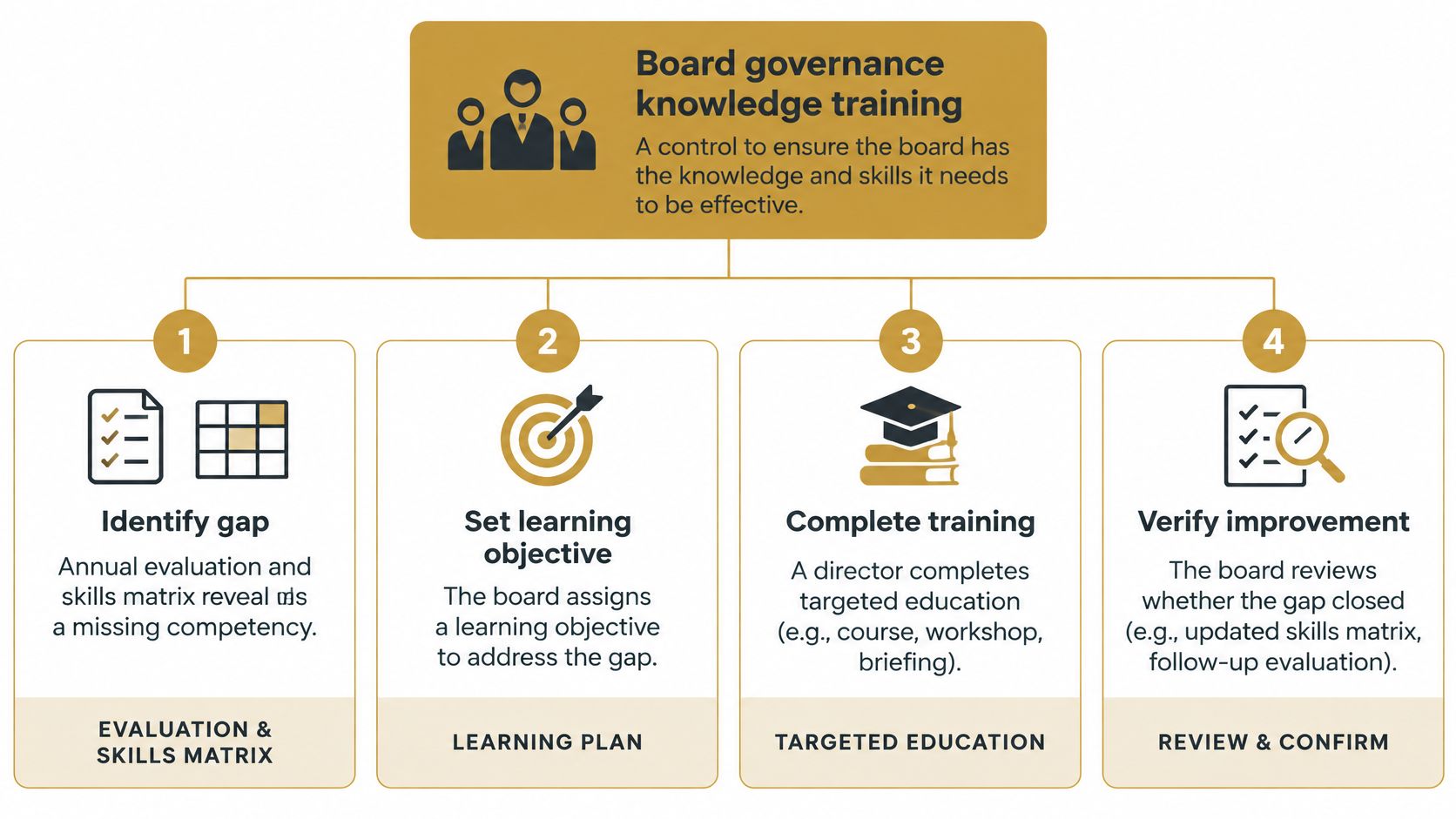
Treat training as a control, not a welcome binder. A control has an owner, an input, an output, and a check. For board of directors training, that loop is straightforward, and it's auditable.
The G20/OECD Principles of Corporate Governance 2023 recommend that boards regularly evaluate both their performance and the collective mix of competencies, then use training or other development measures to close identified gaps. The logic is operational. Appointment alone may leave directors without sector specific, regulatory, financial, digital, sustainability, or risk expertise. Targeted development builds the board's capacity to interpret management information, challenge assumptions, and oversee emerging risks.
The four step loop
- Identify the gap. The annual evaluation and skills matrix name the missing competency in plain words, for example, no director can interrogate revenue recognition.
- Assign a learning objective. The board states what the director should be able to do afterward, not merely attend.
- Practice on realistic material. The director works through a case that looks like a real board paper, with incomplete information and a decision attached.
- Reassess at the next evaluation. The board checks whether the gap narrowed and records the result.
Document the gap, the objective, the exercise, and the reassessment. If you can't write those four lines, you don't yet have a program. You have an event.
Three layers of knowledge
First, every director needs the foundation layer. That means fiduciary duties, how this specific company makes money, and how the board calendar, papers, minutes, and committee reports work. Without it, even a brilliant executive misreads the room.
Second, the whole board layer covers enough fluency to oversee the risks appointment didn't supply. Nobody needs to become the in house expert on everything. Every director does need enough sector, financial, digital, sustainability, regulatory, and risk literacy to recognize a weak answer.
Third, the committee layer goes to working depth. Audit members study financial reporting, internal controls, and auditor oversight. Risk members study cyber and operational resilience. Nomination members study succession planning and board composition.
A pilot's type rating serves as a good comparison. Years spent in the cockpit do not substitute for training on this aircraft's systems. Similarly, years managing a division do not replace training on this board's duties, committees, and risk profile.
Directors should also be able to obtain independent expertise rather than relying solely on executive briefings. Management's view is necessary. It isn't the only view a board should hear before deciding.
A four line test before you book anything
Before you pay for a course, answer four questions in writing. Which skills matrix gap does it close? Which committee owns that gap? What realistic case will you have to analyze? When will the board reassess whether it worked?
If you're not yet seated, use our Board Readiness Assessment to name your own gap first, then update training when new law arrives, the risk profile changes, or succession planning exposes a missing competency. Sequence matters. Diagnose first, train second.
Meeting Behavior and the Cases That Show Training at Work
A board can spend a year covering finance, risk, cybersecurity, and strategy, then still nod through a weak forecast. Training has done its job only when directors use what they learned to ask sharper questions, test assumptions, and follow up.
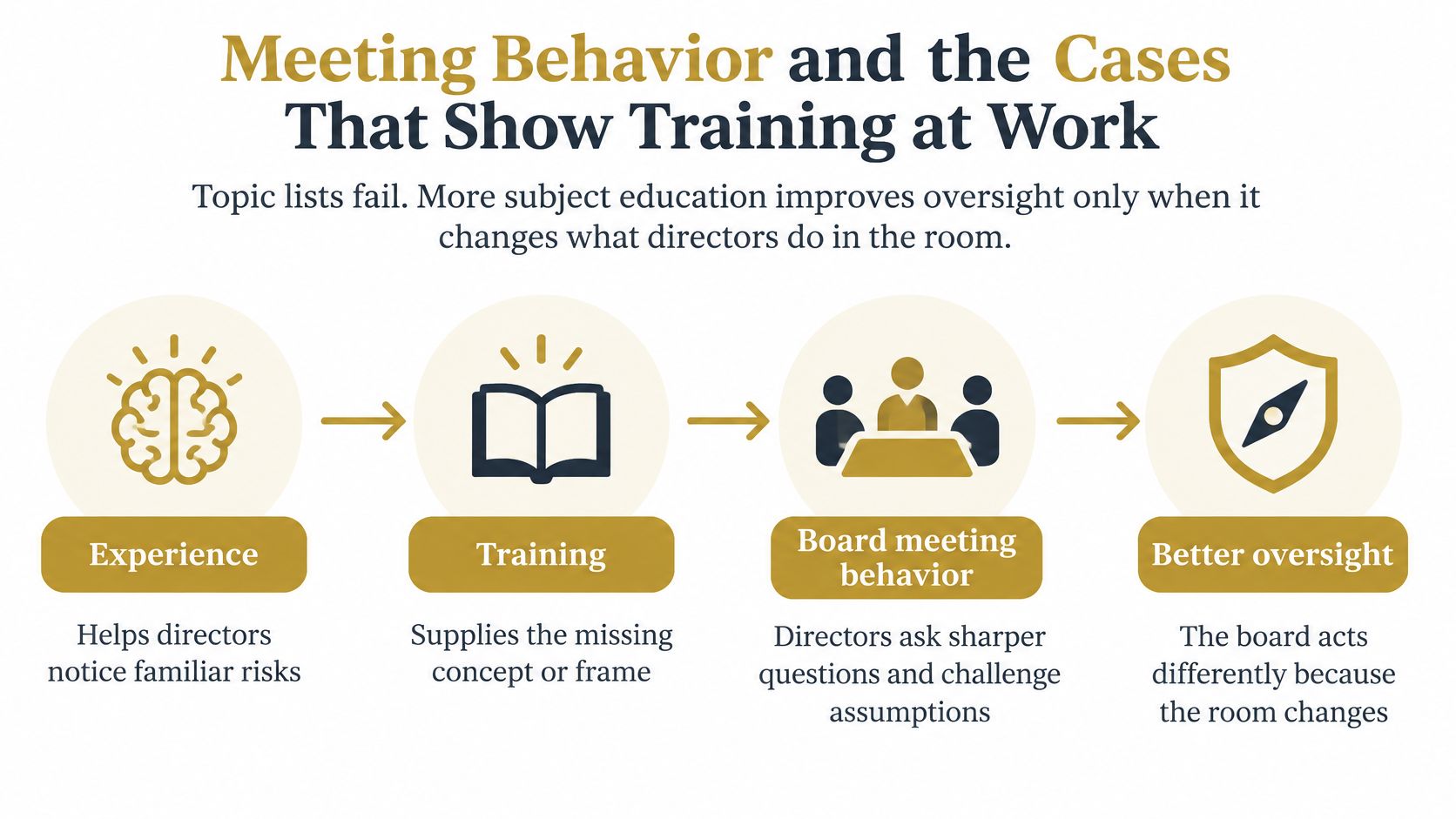
Experience helps directors recognize familiar patterns. A former chief financial officer may spot a weak point in a forecast; a former chief information officer may recognize a familiar failure mode. Training adds the boardroom skills those experiences alone may not provide: how to challenge, disagree, escalate uncertainty, and remain collegial without surrendering independence.
The behavioral split directors themselves report
PwC's 2025 Annual Corporate Directors Survey of 638 directors found that 45% of directors planned to seek additional education or training. Other improvement priorities included stronger relationships with fellow directors (33%), more diverse viewpoints or innovation (25%), and speaking up more during discussions (24%).
The figures point to two different training needs: knowledge and conduct. A director may understand cyber risk yet hesitate to interrupt a confident chief executive. In that moment, the gap is not a missing definition. It is the ability to raise a concern clearly and keep the discussion focused on oversight.
Practical rule: If training does not change the question you ask in the next meeting, it has not yet reached the boardroom.
Rehearse with realistic board materials. Ask a director to question management without taking over its work, then assess whether the director listens, expresses dissent, identifies when to escalate, and stays concise. Have the director revise one question until it tests an assumption rather than invites reassurance. The cases below show how that sounds.
Case one, a soft earnings forecast
“Are you comfortable with the guidance?” sounds polite, but invites a simple yes.
A stronger question names the assumption and asks who monitors it: “Which single assumption, if wrong, breaks this guidance, and who owns the early-warning metric that would tell us first?” The board now has something specific to track at its next meeting.
The director does not rebuild the forecast or direct the finance team's modelling. The question keeps the conversation at board level while exposing the forecast's weakest assumption.
Case two, an ambiguous cyber incident
Management reports suspicious activity, with no confirmed breach and an investigation under way. Asking whether the firewall is secure seeks reassurance. A better line of inquiry separates established facts from uncertainty:
“What do we know, what are we inferring, and what don't we know yet? At what point must customers or regulators be told, and which committee tracks remediation to closure?”
Those questions establish a decision timeline, a disclosure threshold, and an accountable owner. A calm briefing, by itself, does not show that an incident is under control.
Use this short video as a rehearsal prompt. Watch it, then note the first question you would ask.
Case three, an AI deployment decision
A glossary session may leave directors familiar with AI terms but unsure how to oversee a deployment. The 2025 global board culture and director behaviors study from Russell Reynolds Associates covered more than 1,000 directors across over 45 countries. Related findings reported that 35% of boards had incorporated AI into oversight and 38% of directors said they did not receive sufficient education on AI developments. These figures point to a need for board-wide fluency, not just a designated technology expert.
Before approving a material AI use, directors can ask for evidence in four areas:
- Data provenance. “Where did the training and input data come from, and do we have the right to use it for this purpose?”
- Model failure monitoring. “How will we know the model is wrong, how quickly will we know, and who can switch it off?”
- Privacy and cyber resilience. “What personal data does it touch, and what happens if the system is compromised?”
- Committee ownership. “Which risks sit with audit, which with risk or technology, and which remain with the full board?”
Connect training to a repeatable dashboard and refresh it as business use cases change. A one-time awareness session cannot prepare directors to question every later deployment. Scenario-based exercises can help the whole board practice asking for evidence, testing accountability, and deciding when an issue needs escalation.
Case four, a CEO succession disagreement
Succession discussions can become personal. Training helps directors return to criteria and evidence instead of defending a preferred candidate.
A useful question is: “What evidence would move this timeline forward or back, and how do we record dissent today without making the eventual appointment harder to support?” The first part tests the decision criteria. The second makes room for disagreement while keeping the board's process clear.
Directors preparing for an interview or meeting can rehearse with the Board Interview Question Bank. Practice questions aloud: board-level communication should be brief, specific, and calm, and rehearsal makes it easier to hear where a question needs work.
Across all four cases, attendance is not the measure of progress. The test is whether the director asks a sharper question and follows the answer through.
Signals That Training Reached the Boardroom
Finishing a course is the wrong scoreboard. Attendance is easy to count and almost meaningless. You need evidence that preparation, questions, and follow through changed.
Harvard Business School research on board effectiveness found that ratings of training for new directors were positively correlated with overall board effectiveness (ρ=0.40), strategy alignment (ρ=0.29), CEO evaluations (ρ=0.34), and CEO succession planning (ρ=0.31). The study also reported that director preparedness for meetings was significantly related to overall board effectiveness and asset stewardship effectiveness.
Say the limit plainly. These are correlations, not proof that training alone caused the results. Capable boards may both train well and govern well. Use the figures as a benchmark for what to observe, not as a promise.
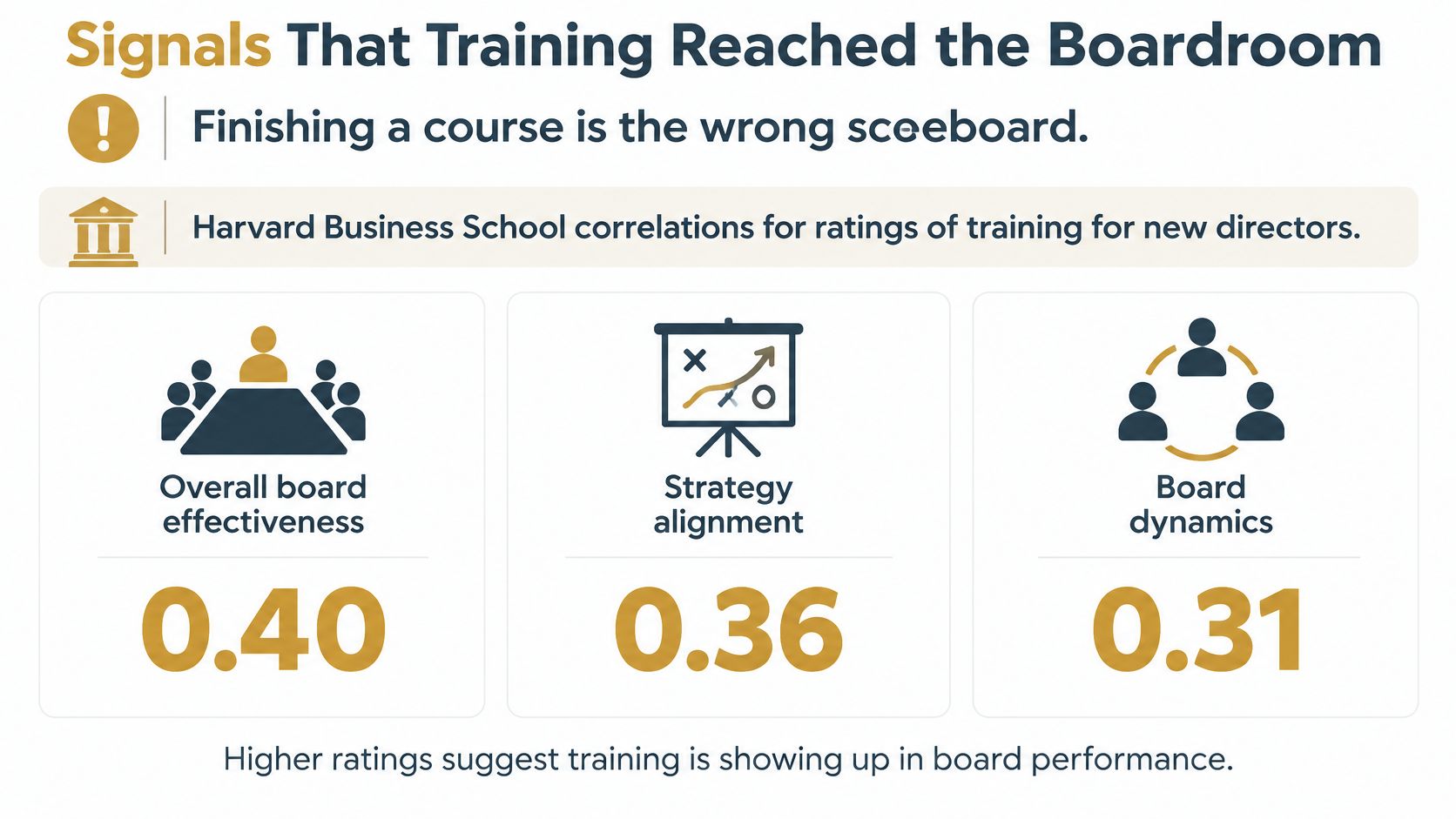
Convert each number into something you can see
| Board outcome | Correlation (ρ) | Observable signal to track |
|---|---|---|
| Overall board effectiveness | 0.40 | Director preparedness for meetings |
| Strategy alignment | 0.29 | Advance-read rates on strategy papers |
| CEO evaluation | 0.34 | Documented challenge to management assumptions |
| CEO succession planning | 0.31 | Unresolved risk items carried between meetings |
A corporate secretary can track every signal in that right hand column without new software. Count advance-read rates before the meeting. Sample the quality of questions from minutes and your own notes. List unresolved risk items that return meeting after meeting. Record where directors documented challenge to a management assumption and what changed as a result.
Build measurement into the program
A technically sound program runs a pre-training and post-training assessment and requires directors to analyze realistic board materials, not just answer quiz questions. Judge by role. New directors should show improvement in fiduciary duties, business model literacy, and board process. Experienced directors should show it on refreshers tied to regulation, technology, cyber risk, or sector disruption.
The classic design mistake is celebrating hours while the same risk item returns unexplained for a third quarter. If the item returned and nobody asked why, the training didn't transfer, whatever the attendance sheet says.
Propose a quarterly check with four lines only. One skills matrix gap, one learning objective, one case exercise, and one meeting behavior that either improved or did not.
That discipline is small enough to survive a busy board calendar and honest enough to catch failure early.
Match Training to the Seat You Want
A seat on an audit committee calls for different preparation than a first-time director role. Start by naming the board seat you want and the gap between its responsibilities and your current evidence. A Board Role Fit Checklist can help you identify the seat type and the areas to address.
If you're already seated
Use your latest board evaluation to choose one skills-matrix gap, then match it to a learning format. A new director may need orientation on board duties and meeting practice. An audit or risk committee member may need focused work on financial oversight or risk. If you understand the material but struggle to challenge management in the room, practice with a realistic case and feedback. Set a date to reassess the same behavior.
If you're seeking a first or next paid seat
Translate your experience into evidence a nomination committee can assess. An executive's operating record may be relevant, but the application should also show independence, fit with the committee's duties, and the ability to question management clearly. For an audit role, be ready to discuss financial oversight. For any seat, prepare to explain how you would contribute when information is incomplete or a recommendation carries risk.
SeatSignal offers a Done-For-You Board Placement program that hand-picks relevant open board roles and prepares director-grade applications matched to each opportunity. The packet includes a board CV, custom cover letter, fit memo, and independence note. Interview preparation rehearses likely chair questions based on the role, committee, and gaps in the boardroom. This is role-specific preparation, not a promise of appointment: boards, nomination committees, and recruiters make the decision.
Training helps when it changes what you can demonstrate. Choose a course, committee module, simulation, or interview rehearsal based on the gap between the seat's duties and your current readiness. Then prepare to show that learning through a clear application and considered answers in the boardroom.
If you have named the seat and the gap, SeatSignal can hand-pick relevant board roles, prepare an application for each opportunity, and support interview preparation matched to the role.
Want a paid board role, done for you?
One handpicked, verified open board role every week, with a director-grade packet tailored for it.
Get Started