Board Placement Services Compared: Models, Costs and Fit

Spencer Stuart's 2026 U.S. mid-cap board index counted 241 new independent-director appointments, a 6% turnover rate, and fewer than half of those boards added even one independent director (Spencer Stuart mid-cap board index). Only 15% added more than one.
Read that as a buyer rather than a spectator. The supply of paid seats is thin, most of it never reaches a job board, and the people filling it are making a judgment about fit under time pressure with incomplete information. That is why board placement services look so similar in their promises and so different in what they take off your desk.
The useful comparison isn't a feature grid or a price list. It's who does the work at each stage of a search, and where a search like yours stalls. Six models, four stages, one question to answer before you pay anyone.
Table of Contents
- Board Placement Models Side by Side
- Why Board Seats Move Through Networks
- Support Each Model Covers from Search to Interview
- Judging Whether a Seat Is Real Before You Invest
- Subscription Costs Compared by Plan Length
- Matching Your Candidate Profile to the Right Model
- Limits and What No Service Can Guarantee
- Choose the Placement Model Before You Commit
Board Placement Models Side by Side
| Model | Who runs the search | What you receive | How it is paid | Main limitation |
|---|---|---|---|---|
| Do it yourself | You | Public board information and direct applications | Your time only | Full control, slow access to seats |
| Board databases such as BoardEx | You | Searchable director and board data | A licence or subscription fee paid by the user | Data without placement or applications |
| Executive search firms | Search firm | Nominations on mandates from boards | Usually paid by the hiring board | Works for the board, not the candidate |
| Board coaches and CV writers | You, with the coach | Materials, coaching and rehearsal | An hourly or per-package fee paid by the candidate | Rarely sources vacancies |
| Director institutes (NACD, IoD, AICD) | Institute | Training, peer networks and courses | Membership and course fees | Training, not placement |
| SeatSignal done-for-you placement | Placement team, you approve | Matched seats, packets and interview preparation | A subscription starting at $297 for two months | Results and appointments not guaranteed |
Six rows, and no row wins outright. Each one answers a different question. Databases answer "what does the board look like and who sits on it". Search firms answer "who is the board already considering". Coaches answer "is my material credible in a governance room". Institutes answer "do I understand the job". Doing it yourself answers "can I keep total control". Done-for-you placement answers "will someone run the search with me".
That last distinction matters more than it sounds. A database, a course and a coaching package all hand the work back to you at some point, and the point where they hand it back is exactly where most searches die. SeatSignal isn't a job board or software you operate alone; the placement team does the work, from targeting through to interview preparation.
The practical way to use the table is to name your bottleneck first. If you can't see seats, the database or the placement team addresses it. If you can see seats but your CV reads like an operating résumé, the coach or the placement packet addresses it. If you can already reach a director at your target board, doing it yourself is not a compromise, it's the cheapest correct answer.
Filter before price: choose the model that removes your actual bottleneck, then compare what that one model charges. Comparing prices across models that solve different problems tells you nothing.
Shortlist two rows. The one that matches what you cannot currently do, and one backup. Everything else in this article is about testing whether the shortlisted model holds up.
Why Board Seats Move Through Networks
Start with the structural fact, because it explains why cold applications underperform even when the candidate is strong. A Harvard Law School Forum summary of research covering 9,923 director appointments between 2003 and 2014 found that a typical board had a first-degree connection to just over 0.5% of all directors listed in BoardEx, yet nearly 30% of newly appointed directors had exactly that kind of tie (Harvard Law School Forum on corporate governance).
Widen the lens to first- and second-degree relationships and more than 75% of new directors came from the incumbent board's network. Among S&P 500 companies, 94% of nominees were connected to the incumbent board through first- or second-degree relationships, even though those connected candidates represented only 26% of the wider director population. Just 6% of nominees came from unconnected directors, who made up roughly 74% of the available pool.

Put plainly, a cold application competes for a narrow slice of an already narrow market. That doesn't make it worthless. It makes it a low-probability route that gets more expensive in time the longer you rely on it alone.
Relationship mapping responds to this by working backwards from the board rather than forwards from your CV. The questions are concrete: which current directors share a former employer with you, which committees does your background speak to, who among your mutual contacts has met the chair in the last two years. A warm path only exists if a suitable connection exists, so the honest version of this work includes checking whether one does before anyone drafts an introduction. Warm-path introductions are worth having precisely because they are conditional, not because they are guaranteed.
Do this today: name three people in your network who sit on, or recently left, a board you want. For each, write the connection in one line (former colleague, shared nonprofit board, mutual contact at the company). If you can't write the line, you don't have a route yet.
The exercise is uncomfortable because it usually produces fewer than three. That gap is the starting position.
Support Each Model Covers from Search to Interview
| Support stage | Do it yourself | Board databases | Executive search firms | Coaches and CV writers | SeatSignal done-for-you |
|---|---|---|---|---|---|
| Finding open seats | Your own research | Searchable board data | Mandates they hold | Rarely | Live and pre-public seats checked by a person |
| Relationship routes | Your own network | Shared-board data | Client-board introductions | Rarely | Warm-path mapping where a suitable connection exists |
| Application materials | You write them | You write them | Not usually provided | Drafted by the coach or writer | Director CV, cover letter, fit memo and independence note |
| Interview preparation | Self-directed | None | Varies by mandate | Coaching sessions | Board-specific rehearsal on likely chair questions |
| Who does the search work | You | You | The search firm | The coach or writer | Placement team; you approve and send |
Two rows carry most of the workload gap, and both are easy to underestimate from the outside.
Relationship routes
A database will show you that two of your target directors served on the same subsidiary board in 2016. What it won't do is decide whether that's a route worth using, find the intermediary, or check that the director is still in seat and on speaking terms with the nomination committee. A placement team maps warm paths and confirms a suitable connection exists before any introduction is attempted, which is a different product from shared-board data you interpret alone.
That distinction is the whole difference between a lead and an approach. Leads are cheap and plentiful. Approaches depend on someone doing judgment work on your behalf.
Application materials
A coach typically drafts a CV you then adapt, role by role, and the adaptation is your job. A placement program produces the full packet per board: a director CV, a cover letter tied to that board's charter and gap, a committee fit memo, and an independence note.
The fit memo is where the substance lives. Harvard's governance guidance on director selection recommends ranking required skills by urgency, identifying gaps in the existing board, and linking those gaps to near-term succession (Harvard Law School Forum director selection matrix). That framework converts a CFO's controls, audit-committee, capital-raising and risk history into board-specific evidence, plus an honest note on what you don't cover. The UK Corporate Governance Code 2024 requires appointments to follow a formal, rigorous and transparent procedure based on merit and objective criteria, with boards maintaining an appropriate combination of skills, experience and knowledge. A packet written the same way for every board fails that test on the first read.
Interview preparation and the division of roles
Generic rehearsal asks what your leadership style is. Board-specific rehearsal assumes the chair will ask how you'd handle an audit committee that missed a covenant breach, and it's built for that board's committee structure, its disclosed gaps and the likely questions of its chair. Board-specific interview preparation is a different exercise from confidence coaching.
The division of labour holds throughout: our placement team runs targeting, mapping, drafting and preparation; you review what we find, approve what we draft, and send each application in your own name. The program moves through four steps, surfacing the seat early, mapping warm connections to get you inside, building the director-grade packet, and preparing you for the interview. Nothing here is a self-serve dashboard you're expected to operate.
Mark the one stage above where your last attempt stalled. That column is the model you should be pricing.
Judging Whether a Seat Is Real Before You Invest
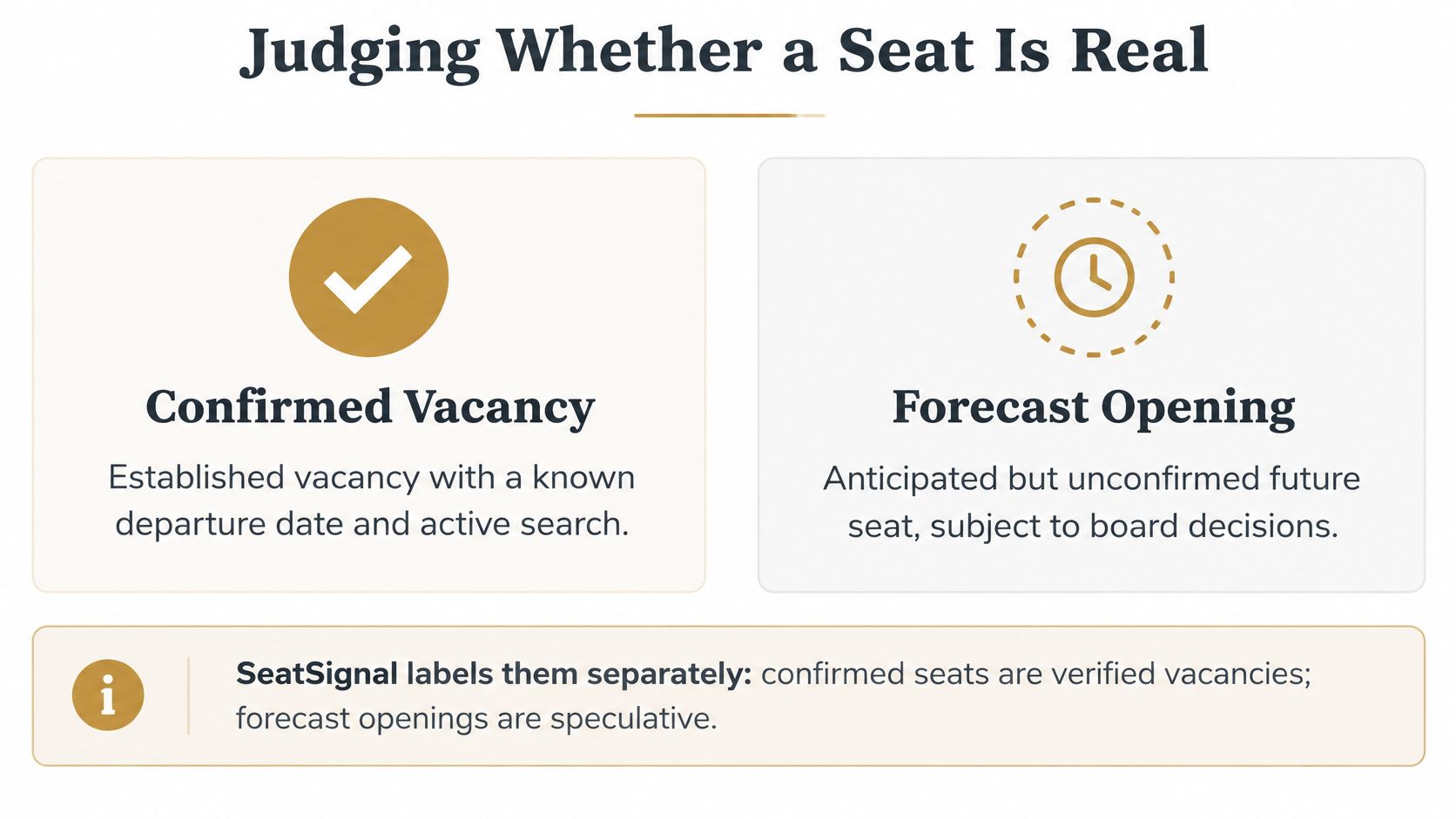
Services blur two very different things. A confirmed vacancy is an established opening with a known departure and an active search. A forecast opening is an anticipated seat that hasn't been approved, timed or budgeted. SeatSignal labels them separately: confirmed seats are verified vacancies, while forecast openings carry a confidence grade and a likely timing window. Pre-public signals come in two types, an opening forecast for a specific seat and a higher-departure-risk flag on a director across the boards they sit on.
The market gives you a reason to be strict. S&P 500 companies appointed 374 new independent directors in 2025, an 8% decline from the prior year and the lowest total since 2016, while incoming directors who identified as female, racial or ethnic minorities, and/or LGBTQ+ fell to 46% from 59% in 2024 and 68% in 2023 (Harvard Law School Forum 2025 U.S. Board Index). Fewer seats, more competition for each one.
Run this before you spend an hour on any application.
- Is it open, or only rumoured? A rumour has no process behind it, and process is what produces an appointment.
- Has succession been decided informally? Boards often know their next director months before a search is announced.
- Does the board credibly need your expertise? Read its disclosed composition and committee gaps. Composition rules can decide the answer first: France requires listed companies to keep at least 40% of each gender on boards, and Germany requires at least 30% women on supervisory boards (OECD Corporate Governance Factbook 2025).
- Is it independent, and does it fit your committee load? An interlocked seat creates conflicts and reputational cost.
- Is the fee appropriate for the workload? Compare the retainer and meeting count against your actual available hours.
- Has a person confirmed it's still live? Our team reviews the fit and live status of each role before it reaches you.
When a process goes quiet, resist the tidy explanation that your skills were wrong. Succession timing and network decisions drive most outcomes, and silence usually reflects the board's calendar rather than a verdict on you. Work through the board offer due diligence checklist when something does arrive, and apply the six questions above to one live opportunity this week, noting which item it fails.
Subscription Costs Compared by Plan Length
| Plan length | Total price | What changes |
|---|---|---|
| Two months | $297 | Shortest term, same placement program |
| Six months | $742.50 | Middle term, same placement program |
| One year | $1,188 | Four months free; saves $594 versus six two-month payments |
The monthly equivalents tell you what you're buying per month of search: about $148.50 on the two-month term, $123.75 on six months, and $99 on the year. The yearly plan includes four months free, saves $594 against six two-month payments totalling $1,782, and works out to roughly $3.25 per day.
Every plan includes the same placement program, which begins after checkout and onboarding. The difference between rows is duration, not features. There are no recruitment fees or retainers, which is a genuine structural difference from executive search, where the hiring board pays the fee and the candidate pays nothing because the firm doesn't work for the candidate.
Timing rule: the cheapest monthly rate is only the better deal if your search is likely to run most of a year. A reader with one specific seat already identified and a live route into it should not buy twelve months of runway.
Estimate your realistic timeline before choosing. A first board seat with no existing board experience and a thin network is a multi-quarter project. A serving director adding a third seat at a company where a former colleague chairs the nomination committee is a much shorter one. Match the term to the honest version of that estimate, not the optimistic one, and check the current SeatSignal plan pricing before you decide.
Matching Your Candidate Profile to the Right Model
Among 2025 first-time director appointments at Russell 3000 companies, 28.4% were gender-diverse appointments, down from 35% in 2024 (Glass Lewis). The direction matters for anyone entering the market now: the wider door of recent years is narrowing, so sharper evidence beats broader credentials.
That shift explains a second pattern. NACD's 2025 Governance Outlook found that 67% of directors say boards are more likely to seek a person with specific expertise than general business leadership experience, with industry-specific expertise the most sought-after category at 42%, while only 32% of executives believe their boards currently have the right mix of skills (NACD 2025 Governance Outlook). Boards are shopping for a gap, not a résumé.
Which model fits depends on what you're converting into evidence.
- First-time executives without a board CV. A done-for-you program earns its fee here, because the work is translation: turning operating history into governance evidence, committee by committee. A coach can improve the document; the packet has to argue a seat.
- Serving directors building a portfolio. Start with your own capacity. Check meeting load and over-boarding limits before applying, then ask whether the new seat fits the portfolio you already carry.
- CFOs, audit and risk leaders. Your asset is a committee fit memo that maps controls, audit-committee service and risk oversight to a specific board's disclosed gaps. Boards appoint this profile heavily: 59% of the 406 new independent directors appointed to S&P 500 boards in 2024 had chief-executive or financial expertise, and financial executives, CFOs, bankers, investors and accounting executives made up 35% of new first-time directors' professional backgrounds (Spencer Stuart 2024 new director snapshot).
- Founders and former CEOs. Relationship mapping carries most of the value, because your network already reaches boards. The gap is usually governance framing, not access.
- Technology, cybersecurity and transformation executives. Build a board-by-board skills-gap argument. A general leadership profile competes with everyone; a demonstrated oversight case for a specific risk area competes with almost no one.
- Nonprofit and public-sector board members. Translate committee work into corporate governance language, then confirm independence requirements before you assume your experience transfers cleanly.
A board reads its own composition when it reads your application. Our approach is to read that composition first and show exactly where you fit, evidenced rather than guessed, which is what the board role fit checklist helps you test on your own.
Limits and What No Service Can Guarantee

No provider can promise an appointment, an interview, a fee or completion inside 60 days. The program aims to land a paid board role within 60 days; boards, nomination committees and recruiters make the appointment decision, and no service controls that vote. We publish a refund policy and a results disclaimer for exactly this reason, and you should read both before paying anyone, including us.
The structural ceiling is the second limit. S&P 500 boards appointed 406 new directors in 2024, 7.7% of the 5,289 directors covered, and 58% of boards appointed at least one new independent director while 20% appointed more than one (Harvard Law School Forum 2024 U.S. Board Index). Annual turnover sat between 7% and 8% for the previous five years. A board that appoints one director a year can stall your search for months no matter how good the packet is.
Third, a placement service doesn't substitute for governance qualifications, and it doesn't take over your judgment. You still decide which seats to pursue, what you'll disclose, and whether an offer's terms, time commitment and liability exposure are acceptable.
Put this question to any provider: what do you guarantee in writing, and what do you leave to the board? If the answer to the first part is an appointment, the second part is being misrepresented.
Plan for a multi-month search even with a team behind you. Track matches, interviews and feedback as three separate measures, because weak interview conversion and weak match quality require opposite responses. Decide now what result would make you pause the subscription, and set that threshold before month two.
Choose the Placement Model Before You Commit
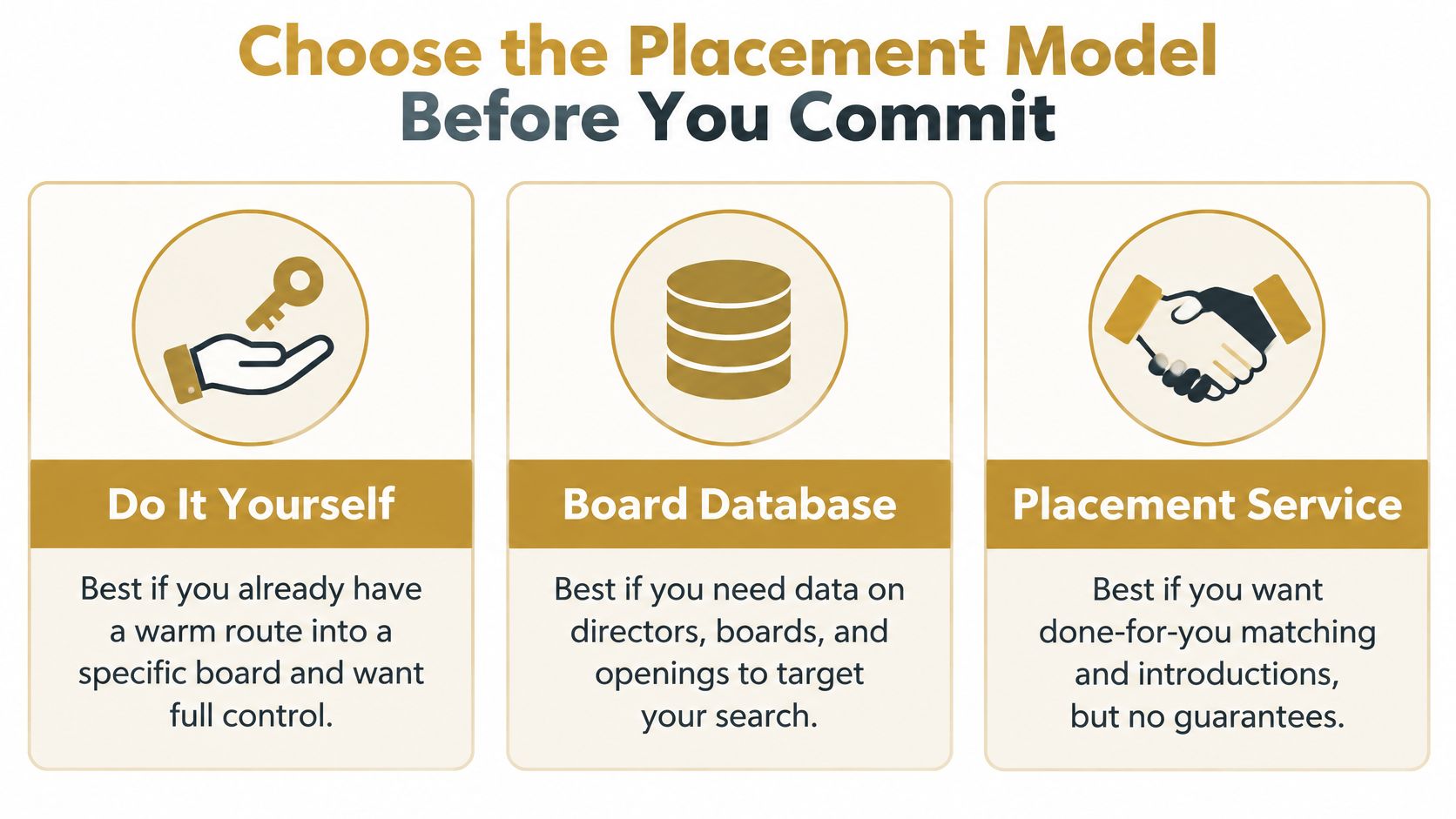
Choose based on where your search is stalling and who you want to do the work.
- Do it yourself if you already have a warm route into a specific board and want full control. You will handle targeting, connection mapping and application writing.
- Use a board database if you need information about directors and board composition before deciding whom to approach. You will still need to identify openings and manage outreach.
- Consider an executive search firm when a board's search mandate includes you as a candidate. Search firms work for the board, so they do not necessarily represent candidates who approach them.
- Hire a coach or CV writer if your materials or interview preparation need work, while access to relevant seats is already in place.
- Choose done-for-you placement if you want a team to run the search, check roles, map warm routes and prepare applications, while you approve the work and apply in your own name.
SeatSignal's done-for-you placement team handpicks relevant open board roles, prepares a director-grade packet for each opportunity and provides board-specific interview preparation. Every plan includes hand-picked roles checked by a person, pre-public seat matching across sectors, warm-path introductions when available, and a placement team reviewing what reaches you. You review what the team finds, approve what it drafts and send applications yourself. Boards and nomination committees make appointment decisions.
Use SeatSignal's free Board Readiness Assessment and Board Role Fit Checklist to identify where your search is getting stuck. The Board CV Grader and Over-Boarding Checker can help you review your materials and capacity; the Board Offer Due Diligence Checklist can help you assess an offer. Choose the model that addresses your actual bottleneck, rather than paying for support you do not need.
If access is the obstacle, SeatSignal's placement team surfaces live and pre-public seats, maps potential warm routes, prepares a role-specific packet and supports interview preparation. Start with the Board Readiness Assessment to assess which stage of your search needs attention.
Want a paid board role, done for you?
One handpicked, verified open board role every week, with a director-grade packet tailored for it.
Get Started