Board Readiness: How to Assess and Strengthen Your Fit
The most popular advice about board readiness is to polish your executive biography, network with directors and practise interview answers. Those steps help, but they don't establish whether you can perform the work of a director. A strong title and a fluent interview can't resolve an undisclosed conflict, an overcommitted calendar or a gap between your experience and the committee's responsibilities.
Board readiness is operational fitness for fiduciary work. It means you can show how your experience meets a particular board's needs, exercise independent judgement, commit the time and contribute to oversight without stepping into management's role. Assess all of that before applying, not just whether your CV sounds senior.
Table of Contents
- Score Your Readiness and Set Your Verdict
- Building Board Experience Before a Paid Seat
- Skills Boards Already Have and Which Are Scarce
- Turning Executive Results Into Governance Evidence
- Pre-Application Checks for Independence and Time
- Director-Grade Materials for Each Board Seat
- Interview Preparation for Chairs and Committees
- Choose Your Next Step and Start
Score Your Readiness and Set Your Verdict
Board readiness is a measurable fit between your verified capabilities and a specific board's composition gaps, committee needs and independence requirements. It isn't a seniority title or a long executive career. Score each area from 0 to 2 based on evidence you can show today: 0 means you lack evidence, 1 means you have relevant but incomplete evidence, and 2 means you can point to concrete, documented examples.
| Readiness area | Evidence a board accepts | Weak signal |
|---|---|---|
| Governance-relevant skills | Quantified outcomes tied to audit, risk, technology or capital markets | Broad leadership claims with no oversight example |
| Committee fit | Specific experience matched to the committee the target board needs | General seniority with no committee link |
| Board-level judgement | Examples of challenging management, overseeing a crisis or making a governance decision | Operational wins with no board-level decision |
| Independence and capacity | Completed conflicts review, counted outside seats and employer approval | Unchecked overlaps or time not budgeted |
| Board-specific positioning | Value proposition mapped to the board's skills matrix | The same CV sent to every board |
| Application materials | Director-grade CV, tailored cover letter, fit memo and independence note | An operating-company CV reused unchanged |
Add your scores for a total out of 12, then circle your lowest criterion. A score of 10–12 means you can apply now, beginning with seats that match your scarcest skill. A score of 6–9 means your next move is to close named gaps, prepare a diligence file and tailor your materials. Below 6, build governance experience through nonprofit, advisory or committee roles before targeting a paid seat.
Strategic thinking is a baseline, not a differentiator. In 2024, 95% of surveyed directors rated the ability to define and execute corporate strategy as a top board competency, according to the Harvard Law School Forum on Corporate Governance. Show how you think strategically, but make your case with the capabilities this particular board lacks.
The board's own succession planning matters, too. In 2025, 92% of 932 surveyed public- and private-company directors said a formal board succession strategy was at least somewhat important, according to the Society for Corporate Governance's summary of Spencer Stuart research. That makes it sensible to prepare before a vacancy appears. SeatSignal offers free tools including a Board Readiness Assessment, Board Role Fit Checklist and Board Value Proposition Builder. Every SeatSignal plan also includes hand-picked board roles checked by a person, pre-public seat matching across sectors, warm-path introductions when available, a director-grade packet for each board, board-specific interview preparation and a placement team reviewing what reaches you.
Building Board Experience Before a Paid Seat
If you scored below 6, don't try to make a thin record sound more impressive. Build evidence through work where governance decisions, committee responsibilities and accountability are real. These steps can also strengthen the case of a candidate who's already close to ready.
Take a formal governance seat. Look for a nonprofit, charity or community foundation board with defined responsibilities. These boards often need members who can contribute to finance, audit or risk oversight, which gives you a practical place to show judgement.
Seek committee work. Ask to serve on an audit, risk or remuneration committee when your experience fits. Committee work helps you demonstrate how you review information, ask questions and follow actions through, rather than just holding a board title.
Use advisory roles accurately. An advisory board or company advisory council can let you review strategy, risk or technology decisions without carrying director duties. Describe it as advisory service, not as a directorship; precision signals that you understand the difference.
Keep a board log. For each role, record the decision you influenced, the papers you reviewed and the outcome. This turns experience into evidence you can later use in a CV or interview, while helping you distinguish your own contribution from management's work.
Ask for a chair's review. Before applying, ask a current chair to assess your record and identify where your contribution is clearest or still unproven. A candid review can reveal whether you're ready to describe committee-level work with confidence.
Keep board and committee service under a separate heading in your CV. Plan for at least a year of documented service before a paid application, so you can show a track record of contribution rather than relying on a title alone.
Skills Boards Already Have and Which Are Scarce
A useful board profile isn't a list of everything you've done. It shows which of your capabilities the target board needs and what evidence supports the claim. The NACD's 2024 public-company boardroom research identifies skills from director-disclosed biographies. Percentages may vary because of rounding and methodology.
| Skill | Share of public-company directors (NACD 2024) | What it signals to a board |
|---|---|---|
| Leadership | 91% | Credibility baseline, rarely differentiating |
| Management or strategic vision | 71% | Expected at most boards |
| Finance | 65% | Common; audit chairs need more than this |
| Technology | 44% | Moderately scarce; show specific oversight |
| Investor experience | 34% | Useful for capital-markets decisions |
| Global experience | 30% | Differentiates for cross-border boards |
| Marketing and sales | 24% | Relevant to growth and consumer boards |
| Risk management | 15% | Scarce; strong case for a risk committee |
| Cybersecurity | 8% | Highly scarce; a clear differentiator when tied to a gap |
| Digital skills | 3% | Rarest listed; a major differentiator |
Leadership appears in 91% of directors' disclosed skills, while management or strategic vision appears in 71%. Both establish credibility, but common experience alone may not decide a particular appointment. Finance appears in 65%, so an audit-chair candidate needs evidence beyond a finance title, such as oversight of controls, reporting quality or enterprise risk.
The less prevalent skills offer a sharper case when they match a board's needs. Technology appears in 44% of directors' profiles, compared with risk management at 15%, cybersecurity at 8% and digital skills at 3%. Scarcity helps only when you can connect the expertise to a board decision or a specific oversight responsibility.
That gap may already be visible to the board. In 2024, only 28% of executives said their boards had the right combination of skills and experience, according to research summarized by the Harvard Law School Forum on Corporate Governance. Check the target company's skills matrix in its annual proxy or governance report, then match your strongest relevant evidence to a named gap.
Lead with the scarce skill that fills a gap. Use leadership as proof of credibility, not as the whole case.
Turning Executive Results Into Governance Evidence
An operating result becomes board evidence when you explain the decision it informed, the oversight you provided and the outcome. A technical credential or successful project may establish expertise, but a board needs to understand how you use that expertise in governance.
List three to five results from each role. Choose tangible work, such as a restructuring, system migration or regulatory review. Specific examples give you something a director can probe, unlike a broad claim about transformation or leadership.
Name the board decision each result informed. Connect the work to capital allocation, risk appetite, succession planning or another governance decision. This shows why the experience matters outside your operating remit.
Describe what you challenged, approved or monitored. Boards need judgement, not an activity log. Explain the question you raised or the control you insisted on, and distinguish your oversight contribution from management's execution.
Rewrite the evidence in committee language. Use terms such as internal controls, enterprise risk, remuneration design and cyber oversight where they accurately describe your work. The language should help a director see committee relevance, not disguise an operational role as a directorship.
Attach the governance outcome. Say what changed and how the board or committee monitored the result. For example, after an audit identified three control weaknesses, a CFO redesigned the month-end close and reported remediation to the audit committee until all three were closed.
PwC's corporate-director survey identifies a tension candidates need to handle: 71% of directors said AI was the leading capability their boards needed to strengthen, while 27% said specialized expertise such as AI or cybersecurity was very important when evaluating candidates, and 81% prioritized cultural alignment, according to PwC's survey. Technical depth alone may not make the case. Show how you translate it into board-level judgement, strategic relevance and constructive challenge.
Before: “Led digital transformation across three divisions.”
After: “Oversaw an illustrative ERP migration with monthly board-level risk reporting, delivered on schedule with controls verified by internal audit.” Use this as a model, not a claim: every figure and outcome in your own materials must come from your records.
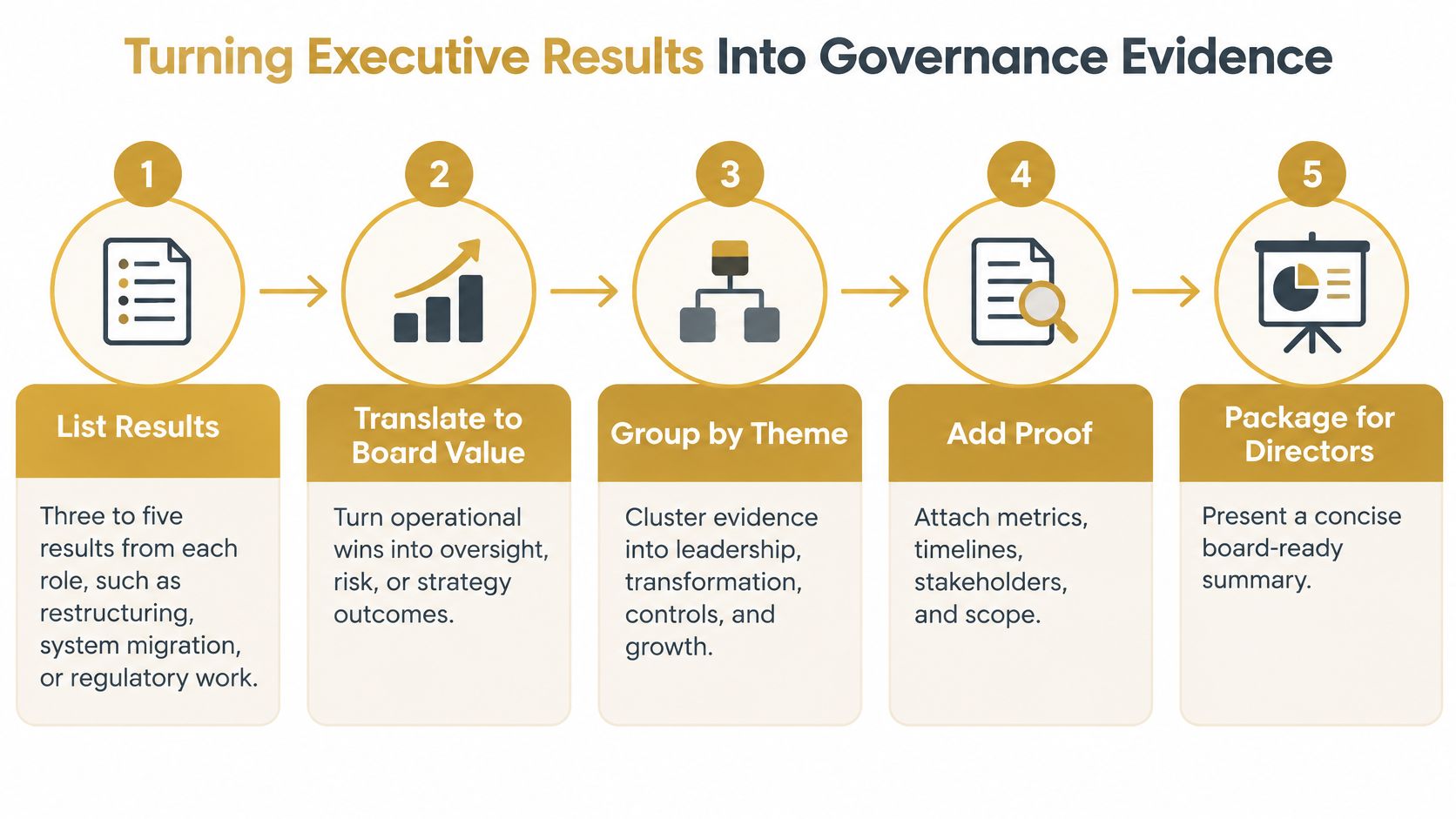
A structured Board Value Proposition Builder can help turn evidence into a concise statement of the contribution you'd make to a specific board.
Pre-Application Checks for Independence and Time
Boards treat independence and available time as conditions of service, not paperwork. A strong CV shows what you have done; these checks show whether you can do the work for this particular seat. A conflict you failed to disclose or a calendar that cannot absorb the preparation will surface during diligence, and a polished interview will not repair either one.
| Check | Question to answer | Stop signal |
|---|---|---|
| Conflicts | Do my current customers, suppliers or competitors overlap with this board? | Unresolved overlap with a material counterparty |
| Employer approval | Does my employer or contract require consent for outside board service? | Consent not obtained or refused |
| Capacity | Can I cover this seat plus my current roles and committee work for a full year? | Current commitments already fill my calendar |
| Committee competence | Can I show specific evidence for the committee I want? | Only general support, no committee-level work |
| Regulatory exposure | Has my past role involved enforcement, litigation or restatement that a board would probe? | Open matter I can't explain clearly |
Start with conflicts. Map overlapping customers, suppliers, competitors and shared directors, then decide what needs disclosure or resolution. For employer approval, read your contract and relevant policies before approaching a board, and get written consent where it is required. An informal conversation with a manager rarely settles the question.
Assess capacity across a full year, not a good month. Count your existing seats and committee duties, then estimate the preparation, meetings and travel each role requires across a typical quarter. SeatSignal's Board Time Commitment Calculator can help you organize that estimate into a realistic plan. The answer a nominating committee wants is a workable schedule, not a promise to make it work.
Then test committee competence against the work itself. A candidate for an audit seat should point to specific financial, controls, risk or regulatory oversight, and a governance committee candidate should show nominating or policy experience at the same level of specificity. General enthusiasm for the board's mission is not committee evidence.
Review regulatory exposure the way the board will. Any enforcement action, litigation or restatement connected to your past roles will draw questions, so prepare a clear account of what happened, your role in it and how it was resolved. A matter you cannot explain plainly is a reason to pause and prepare, not a reason to hope the question stays unasked.
Emerging-technology oversight raises the bar on all of this. Boards increasingly expect directors to carry AI and cybersecurity questions on top of the existing agenda, which adds preparation hours and lifts the competence threshold for technology-adjacent committees. Relevant expertise helps only if you can also show the capacity to carry that oversight load.
Keep the results in a one-page diligence file: conflicts mapped and resolved, consent obtained, a realistic time plan, committee evidence and a clear explanation for anything a board might probe. If a chair asks, you can hand it over.
Director-Grade Materials for Each Board Seat
A director-grade application makes the link between your record and a board's specific needs easy to evaluate. Prepare four documents, then review the whole packet as if you were a chair deciding whether the candidate can contribute to a particular committee.
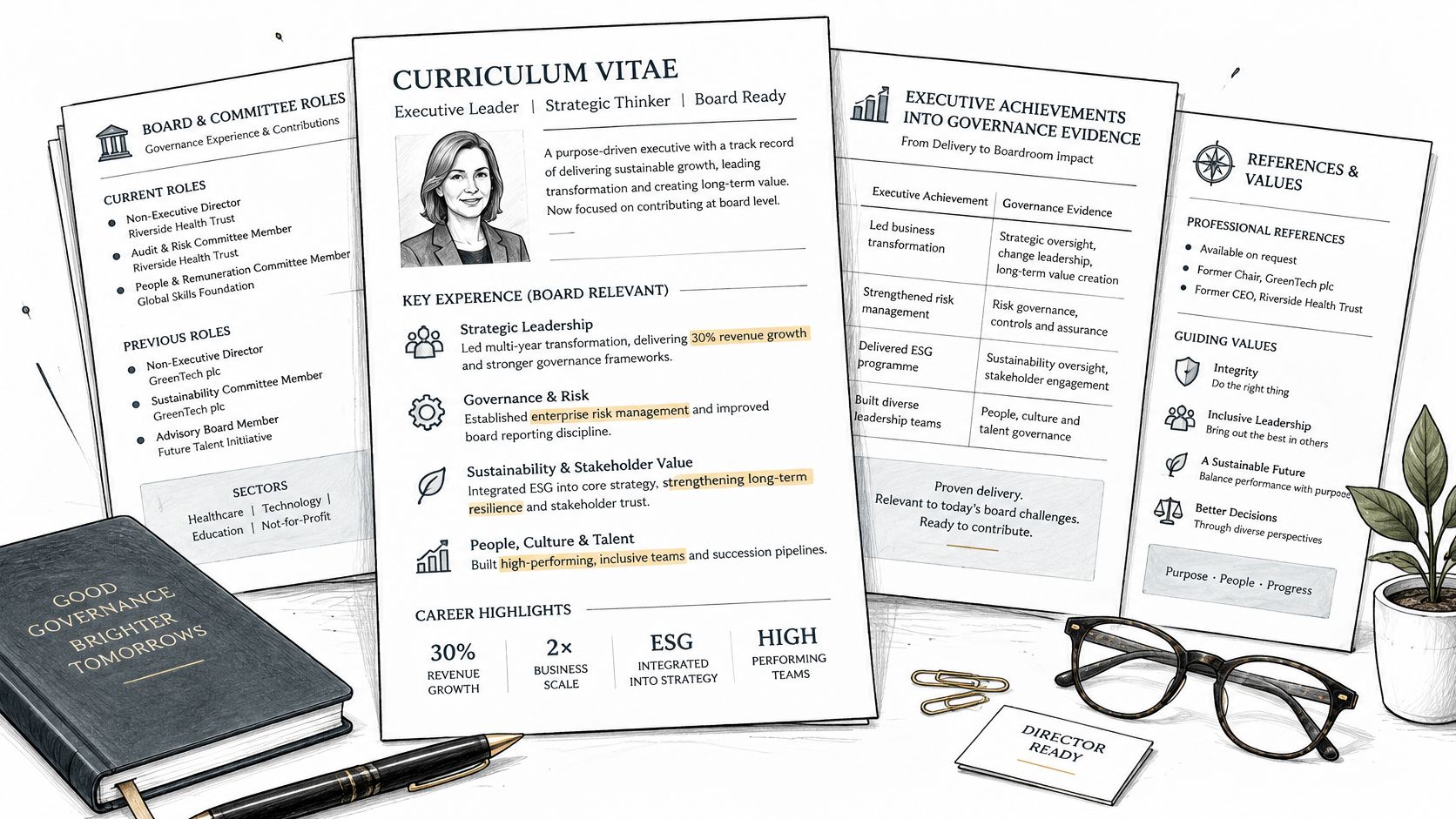
CV. Lead with board-relevant evidence and list board and committee roles clearly. Keep executive titles in context rather than letting them dominate the page; a concise, governance-focused CV is usually held to two pages. The Board CV Grader can help identify whether the document foregrounds governance evidence.
Cover letter. Address the board's charter and the particular gap you can help fill. A general statement about being interested in governance says little about why this seat is a fit.
Fit memo. Keep it to one page. Map your evidence against the board's skills matrix and name the committee where your experience is relevant. Use examples that show contribution, not a bare list of competencies.
Independence note. State relevant relationships, potential conflicts and outside roles. A clear account lets the board assess independence early instead of discovering a problem late in the process.
A worked rewrite shows the difference. Before: “Led digital transformation across three divisions.” After: “Oversaw an illustrative ERP migration with monthly board-level risk reporting, delivered on schedule with controls verified by internal audit.” That line is only appropriate if your records support each claim; never borrow its results or add a metric you can't substantiate.
Have your packet ready before a vacancy becomes public, so you can respond promptly when a suitable seat opens. Then review every document, especially any AI-assisted draft. SeatSignal users are responsible for reviewing, fact-checking and editing every AI-generated document before submitting it to a board or recruiter. One wrong figure in a director CV can undermine the credibility of everything else in the packet.
Interview Preparation for Chairs and Committees
| Question area | Example chair question | Strong answer shows |
|---|---|---|
| Why this board | Why this board, and why now? | Knowledge of its strategy and disclosed gaps |
| Gap you fill | Which gap on our skills matrix would you close first? | A specific gap and evidence behind the claim |
| Challenge | Tell me about a time you challenged your CEO. | Judgement and a constructive tone under pressure |
| Committee work | What would you ask management in your first audit committee meeting? | Committee-specific questions, not generic ones |
| Capacity | How many boards do you sit on, and how will you prioritise? | An honest, specific plan for time and conflicts |
Prepare a two-minute answer to each question, say it aloud and cut it until it fits. Start with why this board and why now. Refer to its strategy and public disclosures, then explain what you could contribute instead of reciting your general interest in board work.
For the gap question, name the one capability you'd add first and give the evidence behind it. A specific answer is stronger than claiming you can help in every area. For the challenge question, choose a real decision where you pushed back on a CEO or peer; describe the issue, how you raised it, and what happened without turning the story into a victory speech.
For committee work, prepare two or three questions you'd ask management at your first meeting. An audit candidate might focus on controls, reporting or remediation, while a technology candidate might ask how management tracks material risk and accountability. Make the questions specific to the committee's remit and the company's disclosed priorities.
Answer the capacity question directly. State your current roles and how you'd protect time for preparation, meetings and committee responsibilities. Don't offer a vague assurance that you'll manage; explain what you'd prioritize and how you'd handle a conflict.
SeatSignal's interview preparation includes rehearsal against the questions the chair is most likely to ask, based on the role, committee and gaps identified. Use the Board Interview Question Bank to organize practice, then rehearse with someone who'll challenge your assumptions. Practise tone as well as content: a sound challenge delivered without judgement can still come across as poor boardroom fit. Run one full rehearsal the day before the interview, then reread the board's composition.
Choose Your Next Step and Start
Pick the action your score can defend. At 10–12, pursue seats where your strongest scarce skill answers a documented gap in composition or committee work. At 6–9, treat readiness as operational fitness before you apply: confirm independence, protect preparation and meeting time, and finish the diligence file and customized materials. Below 6, build committee, advisory or nonprofit board experience first so fiduciary judgment is evidenced before compensation is attached.
Do not wait for a posting to get ready. Boards often discuss refreshment before a vacancy becomes public, and a candidate who can show where they fit has a better conversation than one who asks for a general introduction. Start with SeatSignal's Board Readiness Assessment and Board Role Fit Checklist, then pressure-test the result against independence, capacity and committee competence.
If a managed search fits your situation, review current paid board positions and compare them with your evidence, not your title alone. SeatSignal's Done-For-You Board Placement hand-picks relevant open roles, checks matches before delivery, prepares a director-grade packet for each opportunity and provides board-specific interview preparation. It is designed around a 60-day plan to get board ready and apply first. No placement is guaranteed; members approve and send materials themselves and remain responsible for decisions and due diligence.
Score the criteria today, circle the lowest one and choose one concrete action for this week. Readiness improves when the next step is specific.
SeatSignal provides board-opportunity matching, director-grade application materials and interview preparation for each role. If you're ready to make your board readiness practical, visit SeatSignal to see how the program works.
Want a paid board role, done for you?
One handpicked, verified open board role every week, with a director-grade packet tailored for it.
Get Started