Board Recruiting Firms in 2026: 10 Options Compared
Most board-search advice starts with the same instruction. Get in front of a retained search firm, polish the profile, play the long game. It isn't wrong, but it hides the constraint. In 2024, S&P 500 companies appointed 406 new independent directors out of a director population of 5,289, roughly 7.7% turnover, and only 58% of those boards appointed even one new independent director (Spencer Stuart's director tenure and retirement analysis). Fewer than one new director per board is a selection problem, not a volume problem.
Most lists of board recruiting firms treat every provider as a job board with a different logo. In practice, some firms are paid by organizations to find directors, while others sell candidates a subscription or coaching. That difference decides who represents you, what you receive, and whether a service can help you find a seat before it is advertised.
The ten options below are sorted by that question first: who pays, and who works for you. Each entry closes with a fit test covering sector, compensation expectations and readiness, so you can match a service to your situation instead of ranking providers by prestige.
Table of Contents
- 1. SeatSignal
- 2. Nurole
- 3. BoardProspects
- 4. JamesDruryPartners
- 5. African American Board Leadership Institute (AABLI)
- 6. Spencer Stuart
- 7. Odgers
- 8. Russell Reynolds Associates
- 9. Heidrick & Struggles
- 10. GLG Board Placements
- How the Board Recruiting Firms Differ by Who Pays and What Candidates Receive
- Matching Your Board Search to the Right Firm Type
1. SeatSignal
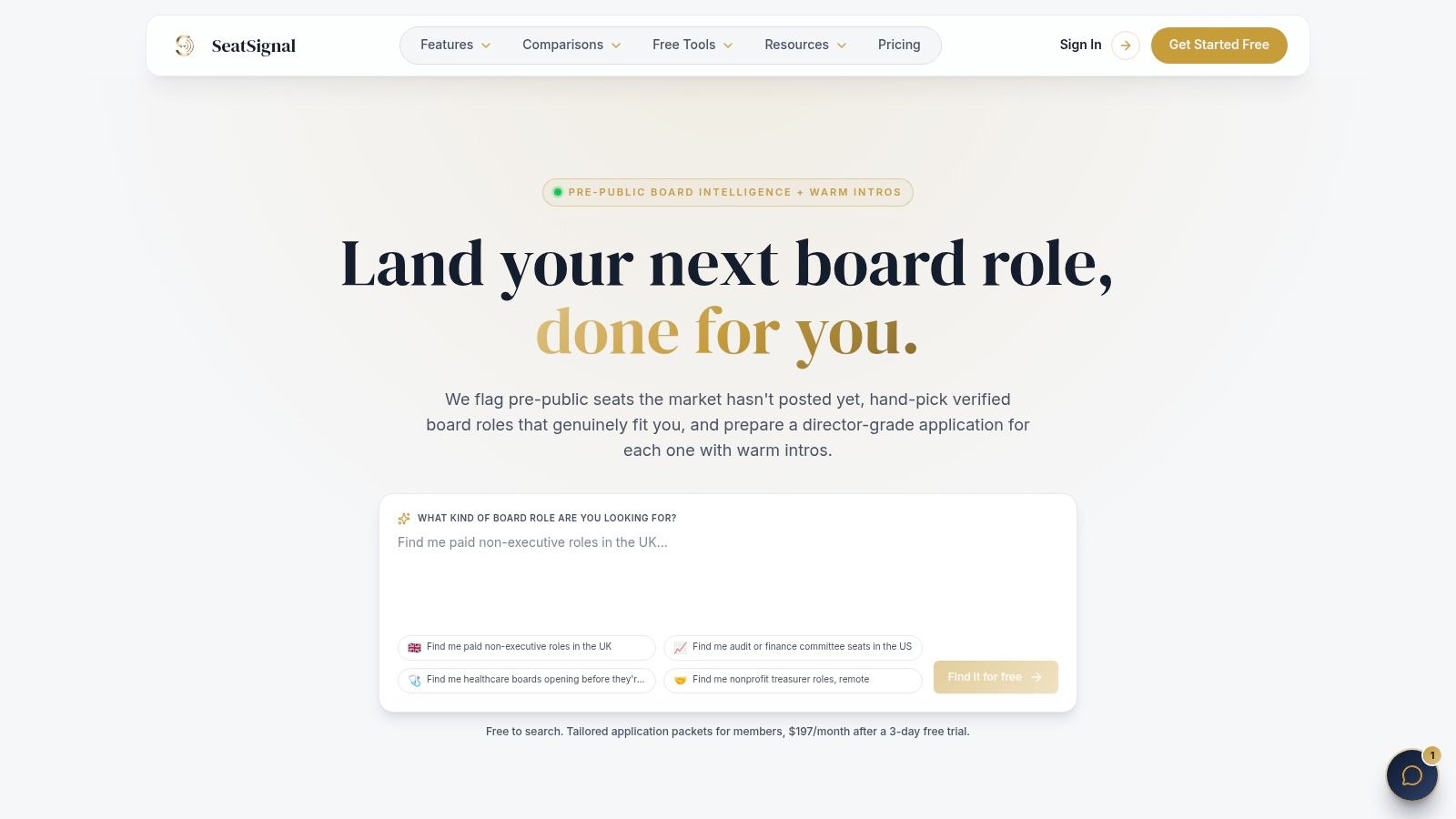
SeatSignal sells the candidate a placement service. Ever Capital Inc. owns it. You pay the subscription, and a placement team hand-picks open board roles, including seats it expects before a public listing, then prepares the application. You send every approach in your own name. SeatSignal is not a search firm, does not represent you to boards, and does not negotiate.
What the placement team does
The team runs the search, the targeting and the preparation. You are not left to operate a vacancy database on your own. Confirmed vacancies and forecast openings are labelled separately. Each forecast carries a confidence grade and an estimated opening window. Matching uses your experience, the board's composition and the committee requirement.
Relationship mapping looks for shared boards, mutual connections and common professional history, then suggests a route to directors. A warm introduction follows only when a suitable connection exists. Coverage is the United States, United Kingdom, Ireland, the European Union, Canada, Australia, New Zealand and Singapore, across sectors.
For a role that fits, the packet can include a governance-formatted director CV, a cover letter written to the board charter and the gap, a committee-fit memo and an independence note. The same packet can be prepared for a board role you found outside SeatSignal's inventory. Interview preparation rehearses the questions that chair is likely to ask, drawn from the role, the committee and the gaps in that boardroom. You approve the materials. Then you send them. A service that contacts a nomination committee before that review creates a diligence problem you cannot unwind.
Price and what it will not do
Plans run two months, six months or one year, at $297, $742.50 and $1,188. Yearly billing works out at about $3.25 a day. There is no recruitment fee and no retainer. The program aims to land a paid board role within 60 days. Appointment decisions stay with boards, nomination committees and recruiters. SeatSignal has a refund policy and a results disclaimer, and it does not replace a formal governance qualification.
One subscription covers pre-public signals, a person checking each role, and director-grade materials. No match, interview, appointment or income is promised, and due diligence stays with you.
Fit test: Sector-agnostic across those eight markets. Aimed at paid seats, and open to unpaid, equity or honorarium roles if you set that preference at onboarding. Best when you already have governance-relevant evidence, including a first board search, and you want the team doing the preparation while the signature stays yours.
2. Nurole

Nurole is a board-level search firm and recruitment platform covering non-executive director, chair and trustee mandates (nurole.com). Candidate registration is free for roles its search team is handling, which keeps the cost of entry low and leaves the odds untouched. The optional Enter the Boardroom membership, listed at £799 per year, adds board-CV review, interview preparation and peer networking. The platform reports more than 5,000 placements, which is a track record, not a forecast for you.
Look at the funnel those placements come from. In 2025, S&P 500 boards appointed 374 new independent directors, 8% fewer than in 2024 and the lowest total since 2016, while 51% of Russell 3000 companies made no new board appointments at all (2025 U.S. Board Index). A free profile in a shrinking market is a lottery ticket with good manners.
Registration also isn't shortlisting. Open hiring widens the pool, and a wider pool means the search team filters harder on sector, committee need and geography. If you're outside the market where the role sits, you'll watch good mandates close without a reply.
Best fit: UK-weighted commercial, public and nonprofit boards; compensation that ranges from unpaid trustee work to paid NED fees, so set your floor first; and candidates who already have a board-grade CV, since this platform rewards preparation rather than coaching. Compare SeatSignal and Nurole before paying for either.
3. BoardProspects
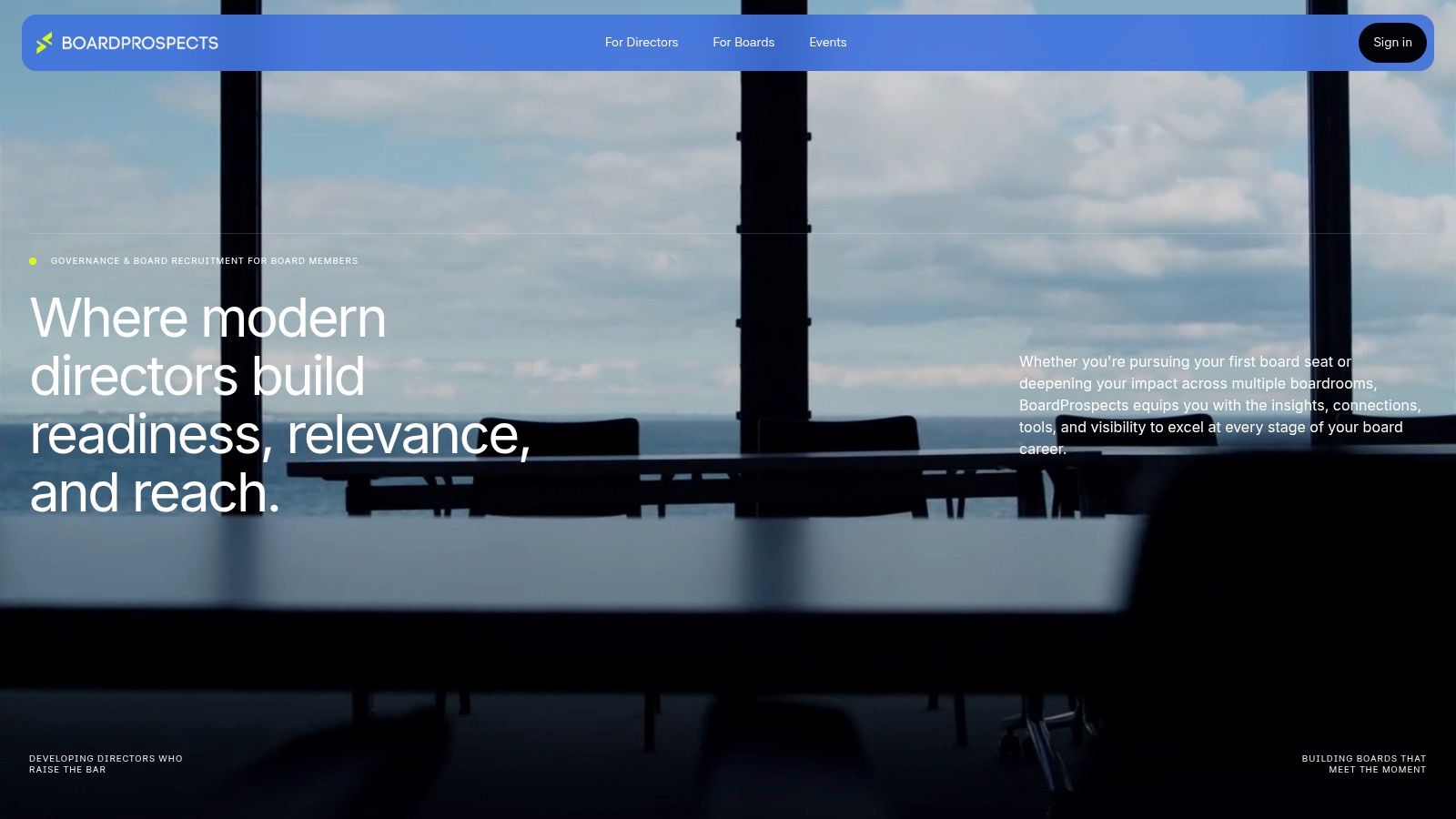
BoardProspects is a corporate-director community first and a recruitment platform second (boardprospects.com). Candidates build a profile that organizations can search, apply to posted roles, and use the community for events and peer discussion. A coached membership, listed at $999 per year, adds one-to-one candidacy feedback and interview support. Membership doesn't guarantee an interview or an appointment.
The mid-market shows how thin posted demand can be. The 2025 Spencer Stuart S&P 400 MidCap Board Index recorded 241 new independent directors, a 6% turnover rate and the lowest number recruited in seven years (Spencer Stuart MidCap 400 Board Index). When a whole index of companies hires that few directors, the number of posted openings at any moment is small.
A searchable profile is not representation. Nobody at the platform is calling a chair on your behalf, and the coaching tier improves your materials rather than your access. Budget your time for direct outreach to directors you already know.
- Sector: strongest for candidates who can serve commercial and nonprofit boards without a niche bias.
- Compensation: no reliable filter for paid seats, so expect unpaid and honorary roles in the mix.
- Readiness: suits a director with a finished board CV and patience for community work, not someone expecting to be marketed.
The BoardProspects comparison sets out where a platform ends and a placement service starts.
4. JamesDruryPartners
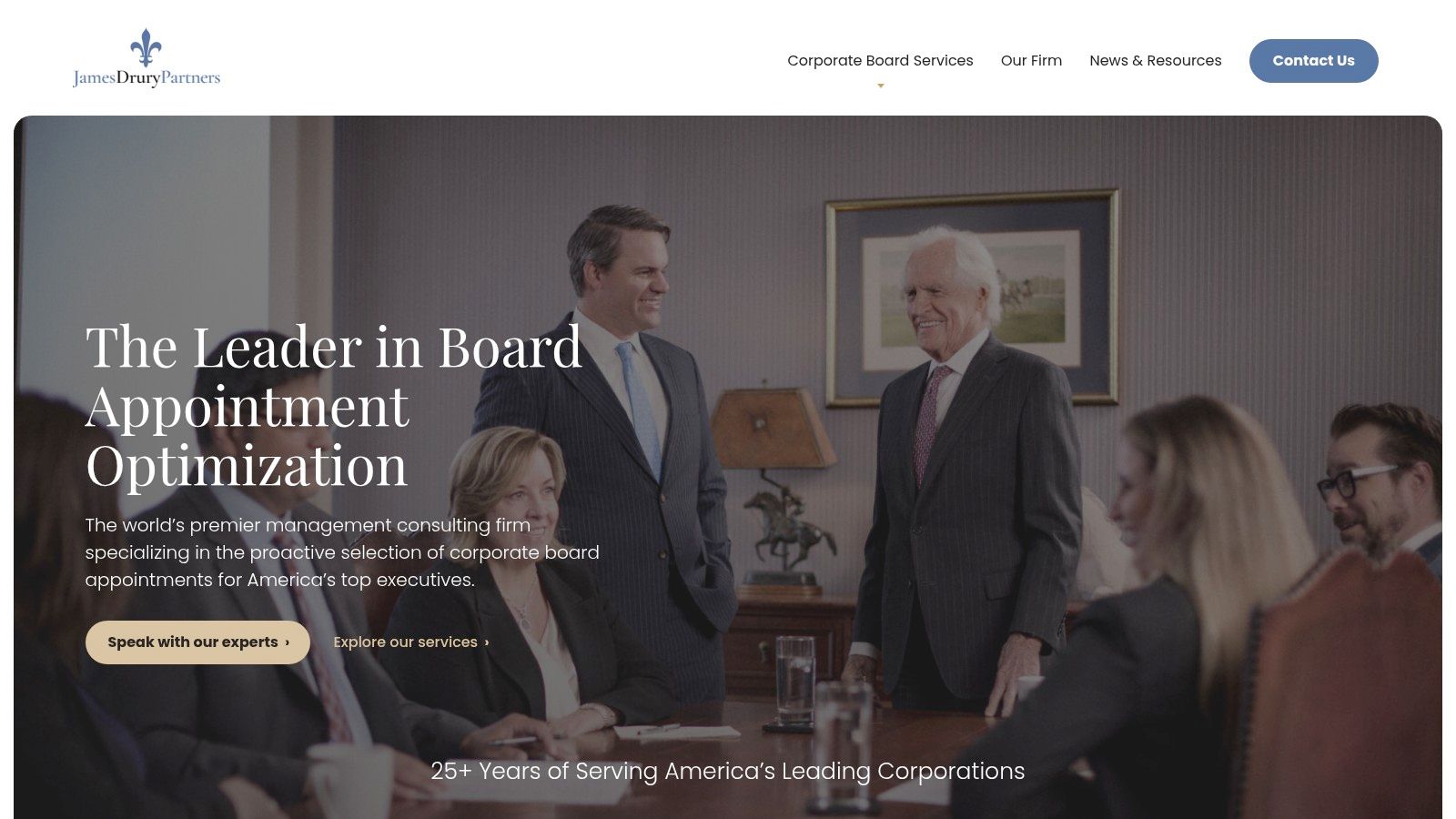
JamesDruryPartners runs BoardSelect®, a candidate-facing service for senior executives seeking board work (jdrurypartners.com). It builds a board specification around your experience, interests and goals, researches target boards, assesses fit and opportunity likelihood, then makes discreet outreach to chairs, CEOs or directors. The firm indicates research and assessment often take six to eight weeks before outreach begins. Fees and engagement terms aren't published, so expect a direct conversation.
That sequencing matches how seats open. In KPMG's survey of 707 directors worldwide, 89% named replacement of a retiring director as a likely reason for recruiting and 61% cited strategic necessity or staying competitive (KPMG boardroom diversity survey). Neither trigger appears as a public job posting. Both reward a candidate who arrives with a named target list.
The trade-off is speed and cost. A bespoke research cycle won't rescue a thin record, and the firm says outright that it serves accomplished senior executives. If your board case depends on a single functional achievement, fix the evidence before you commission the research.
Practical rule: approach five named boards with a researched rationale and you'll learn more about your market than a hundred generic applications will teach you.
The fit check: works for candidates targeting specific sectors where they have operating credibility, comfortable with premium bespoke fees, and ready to be assessed against a board specification rather than marketed broadly.
5. African American Board Leadership Institute (AABLI)
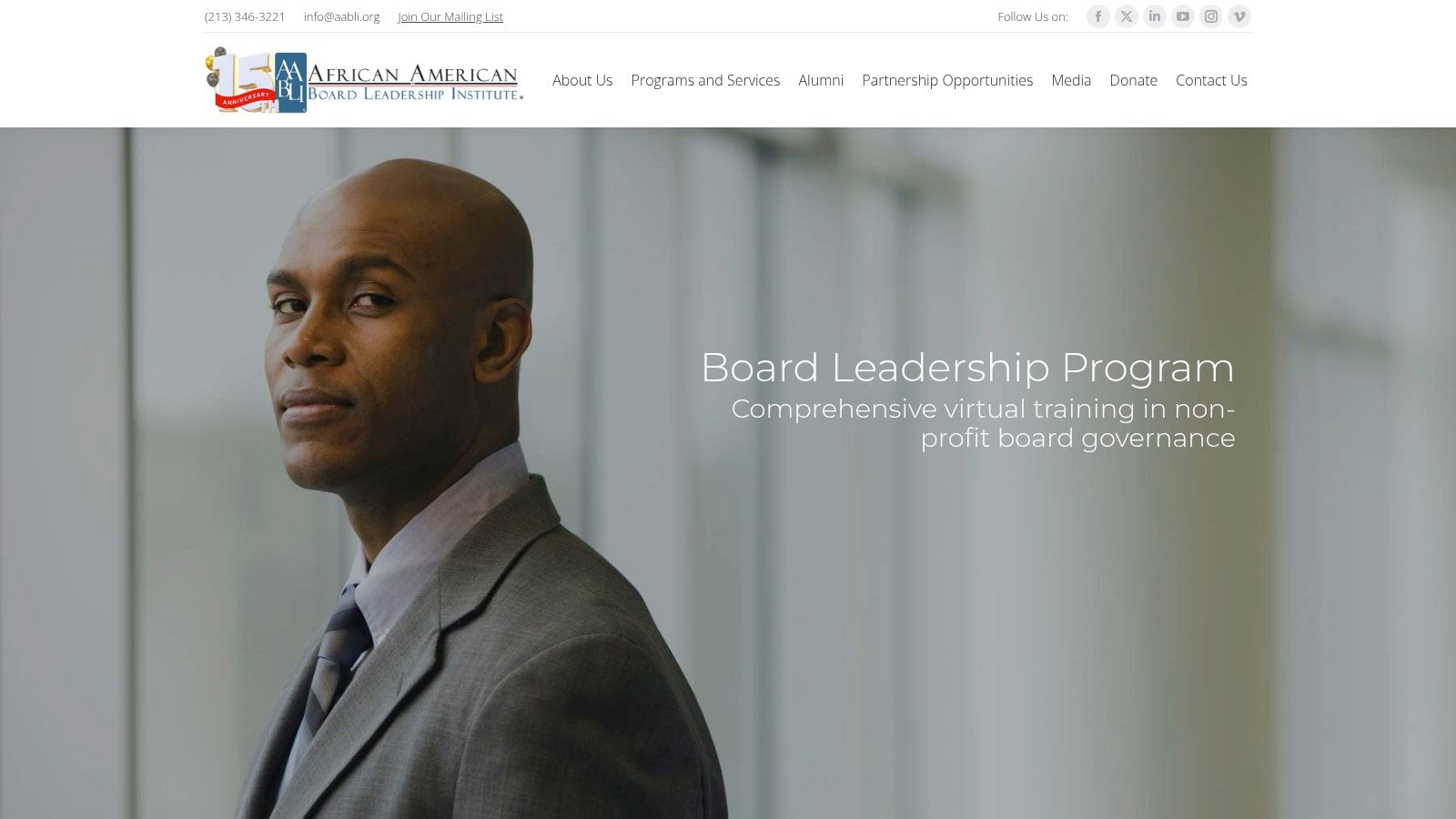
AABLI prepares African American professionals for board service through its Board Leadership Program and connects eligible graduates with partner organizations (AABLI). Matching is limited to program graduates. Introductions take account of skills, expertise, interests and location, but they do not guarantee appointment. The partner network includes nonprofits, foundations, commissions and corporate organizations.
The share of new director appointments going to diverse executives has shifted from year to year. For candidates, representation can help bring a profile into consideration, but boards also assess committee fit. Make the connection explicit: show how your experience addresses a board's needs in areas such as audit, risk, technology, cybersecurity, finance or sector expertise.
AABLI is a development and matching pathway, not a substitute for a clear board case. Identify the committees where you can contribute and support that claim with relevant experience.
- Sector: Nonprofits, foundations and public commissions are prominent in the partner network, alongside corporate organizations.
- Compensation: Some partner roles may be unpaid or honorarium-based. Candidates seeking paid corporate seats may need another route as well.
- Readiness: The program must be completed before matching begins.
Compare director institute pathways with AABLI's program before choosing. It suits candidates who want structured preparation, are open to the types of organizations in its partner network, and understand that completing the program and receiving an introduction do not assure a board appointment.
6. Spencer Stuart
The hiring organization is the client. Spencer Stuart's director-recruitment practice works for public, private, private-equity-backed, family-owned, startup and nonprofit boards (spencerstuart.com). It also advises on board composition and effectiveness and runs a development program for first-time non-executive directors. Registering puts you in a database the consultants can search when a mandate exists. It does not open a search for you.
Departures don't create seats on schedule either. Spencer Stuart's U.S. Board Index has reported appointments lagging director departures, so some departing seats are not refilled. A retirement can become a smaller board, a committee reshuffle, or a later search for a different skill set.
Treat a conversation with a consultant as intelligence gathering. Ask what composition gaps the practice is seeing, which committees are underserved, and what evidence would make you credible on a shortlist. Those questions get clearer answers than "will you put me forward."
A retained consultant writing a shortlist email needs one sentence about you. Write that sentence yourself and hand it over.
Does it fit you? Sector: best where the practice already runs mandates and you bring scale, sector depth, and public-company exposure. Compensation: fees sit with the client, so your pay target is not the constraint. Readiness: you need evidence a consultant can repeat in one line, not a general wish to join a board. I would register only when a live mandate matches that case. The retained executive search model shows why this setup rarely works for the individual.
7. Odgers
Odgers is paid by the hiring organization. A candidate pays nothing and controls nothing.
Odgers recruits board directors and chairs for public, private, private-equity-backed and nonprofit organizations (odgers.com). Assessment leans on board composition, governance and sector knowledge, and board and CEO advisory work often runs alongside the search. Your name only moves when a client has an active mandate and you match that brief. No mandate, no process.
The 2025 UK Spencer Stuart Board Index recorded 199 new board members and a 13% board-renewal rate (Spencer Stuart UK Board Index). Renewal rates differ from market to market, so one country's pace is a poor guide to another.
Geography is a strategy choice. If your market renews slowly, a second market where your sector experience still travels can produce more conversations than another CV rewrite in a stalled one. Odgers' nonprofit and public-sector depth makes that trade-off easier to judge on UK and European mandates than on a mid-cap US industrial board.
Where it fits: public, nonprofit and PE-backed boards, particularly UK and European mandates. Fees sit with the client, so compensation expectations are not your constraint, and neither is influence over the search. Readiness is judged on sector and governance evidence, not on how well you interview in the abstract.
8. Russell Reynolds Associates
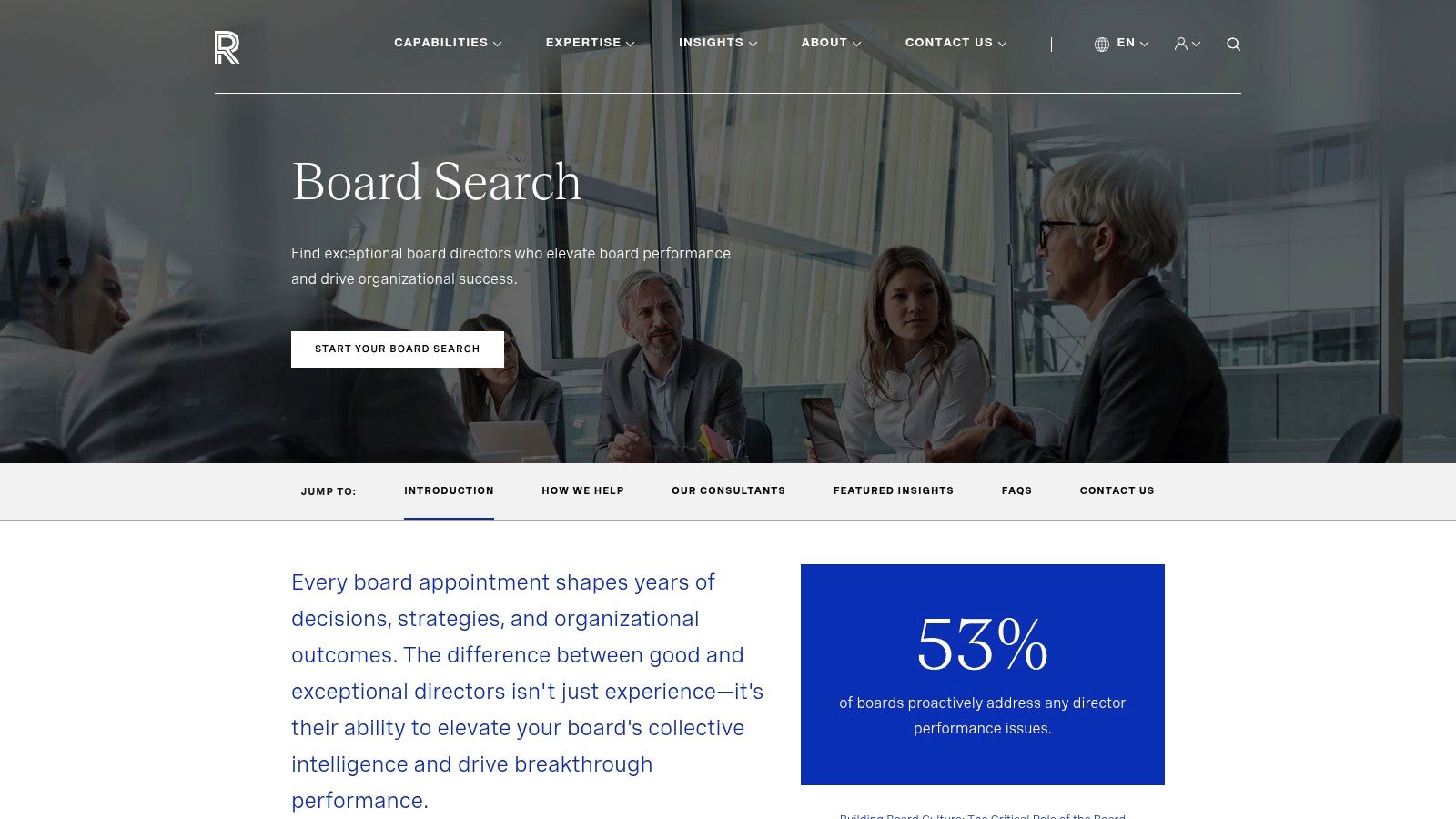
Russell Reynolds Associates runs employer-side searches for directors, chairs, committee chairs, executive directors and advisory-board members (russellreynolds.com). Its process can include defining board needs, sourcing and assessing candidates, and supporting onboarding. It also builds pipelines for anticipated vacancies, which is the closest thing to a forecast you'll find at a retained firm. Confidential mandates mean most of the work is invisible to candidates.
Search firms are part of the standard sourcing infrastructure, not a fringe channel. The 2024 Global Board Survey, covering 2,246 chairmen and directors across 78 countries and jurisdictions, found that 46% of boards use executive-search firms to help identify board candidates (Global Board Survey 2024). Nearly half the market routes through people you haven't met.
Committee-chair mandates are the ones worth chasing. A board that needs an audit chair is solving a compliance problem with a deadline, which is a far better conversation than a general "we'd like more sector diversity" brief. Say plainly which committee you can chair and what you've personally signed off on.
Fit check: suits candidates with multinational or regulated-sector experience; the board pays, so compensation discussions happen between the firm and the client; and readiness means a committee-level story, not a career summary. Confidential processes reward people already known to the firm.
9. Heidrick & Struggles
Heidrick & Struggles combines board and CEO search with succession planning, board assessment and effectiveness work through its CEO & Board of Directors practice (heidrick.com). A global consultant network and sector expertise support the assignments. The firm also publishes board-market research, including its Board Monitor reports.
The organization retains the firm. There is no individual candidate subscription for board placement, so the practice works for the board, not for you. You appear on a slate only when a retained brief already matches oversight you can document.
The skills gap behind those briefs is measurable. Fewer than one-third of surveyed executives say their boards have the right mix of skills (PwC 2025 Annual Corporate Directors Survey). Boards know they are short. They still will not accept a relabelled operating CV as governance expertise. Assessment tests the oversight you have exercised, not the function you used to run.
Translation rule: cybersecurity experience becomes risk oversight and incident preparedness. AI experience becomes model governance, regulatory exposure and capital allocation. A CFO record becomes audit, controls and financial reporting, not "finance leadership".
Fit test: strongest in sectors where the practice runs assessment-heavy mandates; the organization pays, so compensation expectations are not the filter; readiness means documented oversight, not advisory work described as oversight.
10. GLG Board Placements
GLG Board Placements focuses on private-equity firms and their portfolio companies, sourcing operators for independent-director and related mandates (glg.com). The pitch is sector fit and speed, with a client fee model described as pay-at-placement and terms set per engagement. GLG states an aim to introduce candidates within about a week of project kickoff. That's a client promise, not a candidate guarantee.
Public-company seats run on different machinery, and it's worth understanding before you chase one. A 2025 SEC-filed proxy states that a plurality of votes cast elects each nominee, that the nominating and corporate-governance committee will consider potential nominees properly submitted by shareholders, and that shareholder nominations can trigger obligations under Exchange Act Rule 14a-19 (SEC-filed proxy statement). Private portfolio boards skip all of it, which is why they move faster and why the seat can feel less secure.
PE boards reward operating credibility over governance polish. A former operator who has fixed a margin problem in a comparable company is a stronger candidate there than a career director with a spotless committee record.
Who it suits: PE portfolio boards in your operating sector; fees sit with the client, so no candidate cost; readiness means current operating or turnaround evidence, and public, nonprofit or public-sector searches are a different market. Before accepting anything, work through this board offer due diligence checklist.
How the Board Recruiting Firms Differ by Who Pays and What Candidates Receive
The brand does not tell you who a board recruiting firm works for. The payer does. Match sector, the pay you will accept, and how ready you are before you rank anyone by prestige.
| Item | Who Pays | Candidate Cost Listed | Best For |
|---|---|---|---|
| SeatSignal | Candidate | $297 for two months, $742.50 for six months, or $1,188 per year (about $3.25 per day). No recruitment fees or retainers. | Executives who want hand-picked roles and director-grade applications they review and send themselves |
| Nurole | Candidate pays only for optional membership | Free registration; optional membership £799/year | Candidates seeking board searches, with optional career support |
| BoardProspects | Candidate | Coached membership: $999/year | Candidates seeking board opportunities, networking, and coaching |
| JamesDruryPartners | Candidate; fees not published | Not published | Senior executives seeking bespoke board targeting and discreet outreach |
| African American Board Leadership Institute (AABLI) | Many partner roles are unpaid or honorarium-based | Program and partner fees are not published | Eligible program alumni seeking board training and partner introductions |
| Spencer Stuart | Hiring organization | No candidate price listed | Candidates suited to active, organization-led director searches |
| Odgers | Hiring organization | No candidate price listed | Executives whose experience matches an active board search |
| Russell Reynolds Associates | Hiring organization | No candidate price listed | Candidates suited to senior or complex board searches |
| Heidrick & Struggles | Hiring organization | No candidate price listed | Candidates considered for global board searches and succession needs |
| GLG Board Placements | Hiring organization | No candidate price listed | Experienced operators suited to private-equity portfolio boards |
Candidate-paid rows bill you whether or not a board appoints you. Organization-paid rows list no candidate price because the hiring board is the client, and you are in the pool only when your profile matches a live search.
Matching Your Board Search to the Right Firm Type
Prestige is a weak way to choose a board recruiting firm. Who pays, and who works for you, decides what you get.
Organization-paid search
Spencer Stuart, Odgers, Russell Reynolds, Heidrick & Struggles and GLG are paid by the hiring organization. They earn when a board fills a seat, so the incentive to complete a search is real. You are not the client. Be findable and specific. A one-page capability summary that names the committees you can chair, the sectors you know, and the risk you have owned gives a consultant one sentence for a shortlist email. A general CV does not.
Candidate-side platforms
Nurole, BoardProspects and AABLI sell access, coaching or training to the candidate. Membership revenue arrives whether or not you are appointed, so targeting, preparation and follow-up stay with you. Treat the fee as tuition plus access. Judge it by what you learn and who you meet.
Compensation is the next filter. Organization-paid searches point at paid seats, because the board is paying a fee to fill one. Candidate platforms mix paid, unpaid and trustee roles. Set your floor before you join. Done-for-you programs work best when that floor is already clear.
Done-for-you placement
A done-for-you service is paid by you and works on your targeting and materials. SeatSignal is a done-for-you board placement program that flags board seats before they are publicly posted, hand-picks verified live roles that fit the member, and prepares director-grade application packets with warm intros. Plans start at about $3.25 per day with yearly billing, with no recruitment fees or retainers. You approve and send every approach in your own name. SeatSignal is not a search firm and does not represent you to boards or negotiate for you.
Match the model to three facts: the sector you can govern, the pay you will accept (paid, unpaid, equity or honorarium), and whether you are ready to interview or still need materials and rehearsal. Stay specific and visible if you want a retained firm to find you. Budget for your own follow-up if you buy a platform. Choose candidate-paid placement if you want someone else to pick roles and write the packet, knowing you still send the approach.
Before you pay or sign, ask what you receive, who sends the approach, and what happens if nothing lands. Read the refund terms and the results disclaimer. Boards, nomination committees and recruiters still make the appointment.
Visit SeatSignal to see how its placement team reviews openings and prepares materials before you subscribe.
Want a paid board role, done for you?
One handpicked, verified open board role every week, with a director-grade packet tailored for it.
Get Started