Board Skills Matrix: How Boards Assess Gaps and Fit
Only 32% of executives believed their boards had the right mix of skills, according to PwC's 2025 Annual Corporate Directors Survey. That's the test a board skills matrix should address. Not whether every director has an impressive career, but whether the board has the capabilities needed to oversee the business.
A polished grid can conceal weak coverage just as easily as reveal it. Build yours around gaps, evidence and decisions, not generous checkmarks beside director biographies.
Table of Contents
- Skill Categories Most Boards Track Today
- How to Build the Matrix in Seven Steps
- Scoring Depth and Validating Claimed Skills
- Finding Gaps and Concentration Risk
- Committee Skills and Audit Expertise Requirements
- Match Your Experience to a Board Gap Before You Apply
Skill Categories Most Boards Track Today
A board skills matrix is a grid that places each director against the skills the board needs, with directors as columns and skills as rows. Its value comes from comparing required capabilities with demonstrated experience, not from counting how many boxes directors can fill.
A 2022 benchmarking summary of Spencer Stuart research reported that 78% of public companies used a matrix, compared with 22% of private companies; more than half of public companies disclosed theirs publicly, against just 5% of private companies. Those differences matter because public disclosure exposes the board's composition to scrutiny beyond the nomination committee.
Record capabilities that support decisions
Use the matrix for gap identification, investor communication and succession planning, not just recruitment. Each category should answer a board question, and each director's record should contain evidence that helps assess their contribution.
| Skill area | Question it answers | Evidence to record |
|---|---|---|
| Financial literacy and audit | Can the board read statements and challenge the auditor? | Audit committee service, CFO or controller experience |
| Cybersecurity and technology risk | Who can judge cyber resilience and technology spend? | Incident oversight, security program ownership |
| Digital transformation and AI | Can the board challenge technology strategy? | Transformation leadership, AI deployment and controls experience |
| Strategy and M&A | Can the board test strategic plans and transactions? | Deals led, strategy roles, integration results |
| Sector and operating experience | Does the board understand how the business earns money? | Operating roles in the sector, scope and tenure |
| Regulatory and legal | Who tracks regulatory exposure and compliance risk? | Regulated-industry leadership, legal or compliance roles |
| ESG and sustainability | Can the board oversee climate and sustainability reporting? | Sustainability reporting, climate risk governance |
| International and market expansion | Can the board judge foreign markets and entry risk? | Market entry, cross-border operating roles |
| Leadership and succession | Can the board assess CEO performance and succession? | CEO, chair or senior leadership tenure |
| Compensation | Can the board design pay and govern incentives? | Compensation committee service, pay design experience |
Treat these categories as a starting vocabulary, not a mandatory template. For a financial-services board, regulatory experience should identify the relevant business, supervisory environment and risk exposure, rather than merely recording that someone worked in banking.
Refresh the categories when obligations change
The categories themselves need scrutiny. A study of Germany's DAX companies found that 37 of the 38 companies studied included sustainability-related skills in their matrices following the governance-code update.
Traditional accounting and industry experience now sit beside climate, cyber and digital capabilities. Build the list from the company's strategy and risk profile. Don't preserve an outdated category because an incumbent director scores well against it.
How to Build the Matrix in Seven Steps
The matrix should be a strategy-to-capability control system, not a director biography. Start with what the company needs to accomplish, then establish whether the directors can oversee the decisions involved.
NYSE governance guidance recommends deriving the required skills profile from strategy, inventorying current directors' skills and diversity, and using the gaps to guide recruitment, refreshment, succession and committee-chair selection. That sequence prevents a familiar mistake: defining the ideal board as the board you already have.
Use this process to keep the assessment anchored to business needs.
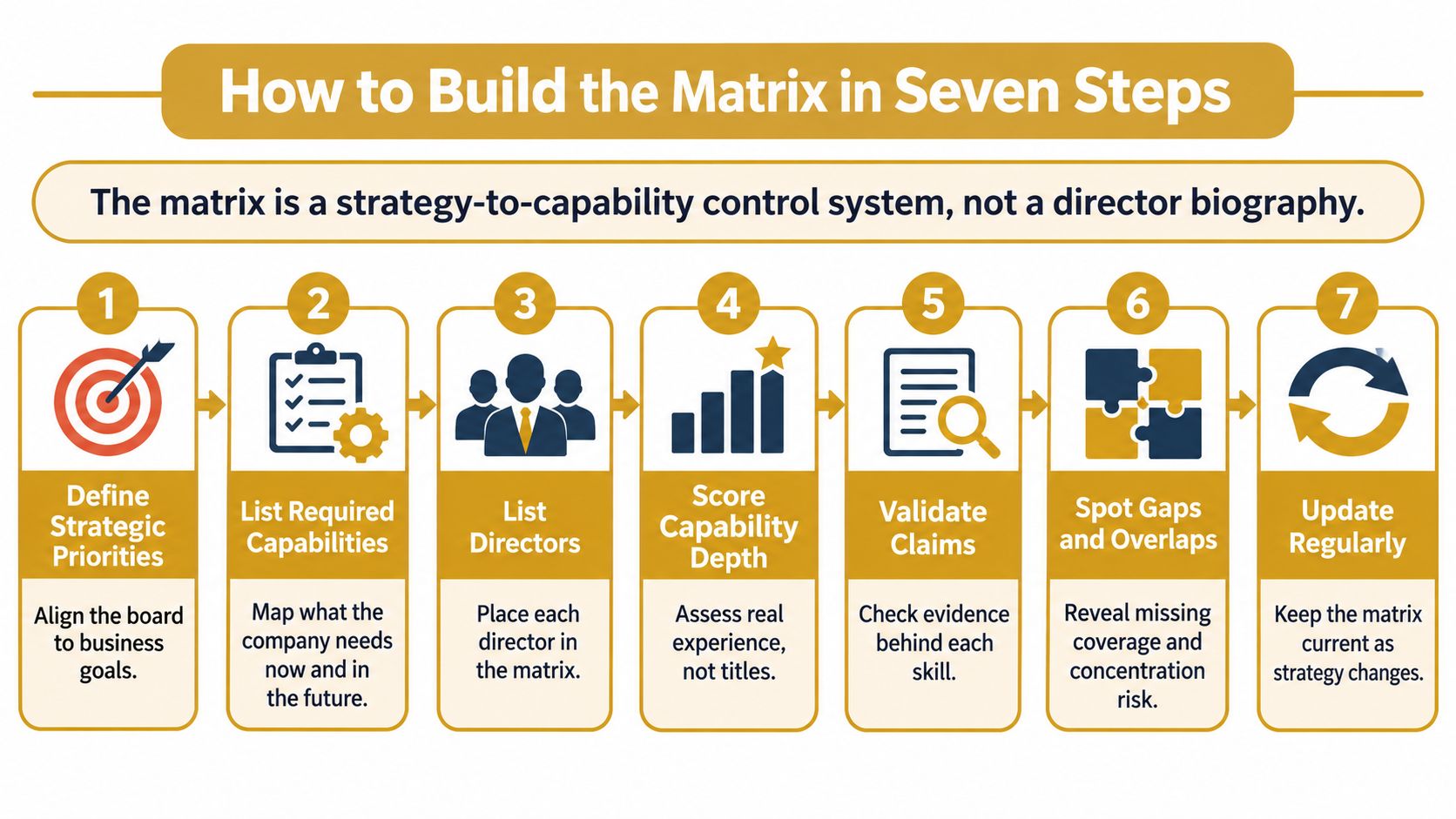
Build from strategy, then test the inventory
Write the strategic priorities and their risks. Describe the decisions ahead, including expansion, financing, transformation and leadership transitions. Copying last year's matrix before doing this work makes past appointments the starting assumption.
Translate priorities into named capabilities. A digital growth plan might require cyber oversight, customer-data governance and transformation experience. Avoid a broad technology label that conceals which decisions directors must challenge.
Inventory every current director. Place each director against every capability, with a row for each required skill. Don't let directors select only their strongest categories, because blank assessments obscure the board's actual coverage.
Score depth rather than presence. Apply consistent definitions to distinguish familiarity, practical delivery, executive ownership and committee expertise. A checkmark alone makes very different experiences look equivalent.
Attach evidence to every score. Record the role, period, scope and relevant responsibility, then have the governance committee challenge unsupported claims. A director biography can help locate evidence, but it isn't the evidence itself.
Compare the target with the inventory. Mark missing capabilities, useful redundancy and expertise held by a single director. Don't label all overlap wasteful, because continuity may require more than one credible holder.
Name the owner and review date. Assign maintenance to a named governance professional, with committee oversight and a clear update trigger. An ownerless spreadsheet becomes stale even when the original assessment was sound.
Make the result usable
Keep the working grid readable and store supporting records separately. Add fields for required depth, committee relevance, action owner and completion status so the nomination committee can distinguish a recruitment need from a development need.
For candidates assembling their evidence, a structured board biography should connect experience to governance responsibilities rather than reproduce an executive job history. Keep claims specific enough that a reviewer can test them.
Use the accompanying video as a discussion prompt when agreeing the board's assessment approach.
Completion test: A finished matrix is a grid in which every material gap has a named action, an accountable owner and a review point.
Scoring Depth and Validating Claimed Skills
A director who attended a cyber briefing and a director who ran a security function can both receive a technology checkmark. They don't provide equivalent oversight. Presence is not depth, and confidence is not evidence.
The difference is between being comfortable with a subject and being able to challenge consequential decisions about it.

Use an evidence-backed depth scale
Use the following scale as an assessment convention, not as a legal definition of expertise. Committee-level status must be supported by relevant service or designation, and it doesn't establish expertise in unrelated subjects.
| Depth level | What it means | Evidence required | Example |
|---|---|---|---|
| Awareness | Understands the topic and can ask basic questions | Briefing or training record | Completed a board briefing on cyber risk |
| Working knowledge | Has applied the skill in a supporting role | Project or team responsibility | Led a security awareness program for a team |
| Operational experience | Has run the function day to day | Role title, scope and results | Ran a regional finance function |
| Executive accountability | Owned outcomes and decisions at executive level | Budget, P&L or risk ownership and reporting lines | Owned the cyber budget and reported incidents to the CEO |
| Committee-level expertise | Has chaired a committee or been designated the expert | Committee chair or expert designation | Served as the audit committee financial expert |
Attach five fields to each record: competency definition, evidence source, recency, level of responsibility and related foreseeable risk. The OECD's guidance on board composition connects transparent disclosure of expertise and competencies with investors' ability to assess whether boards are fit for purpose, and recommends regular evaluation of the competence mix.
Adopt an explicit recency rule. Where the latest evidence is more than a few years old, lower the score one level until fresh evidence supports it, while allowing documented judgment for capabilities that change slowly. This is a conservative scoring policy, not a regulatory requirement.
Close each score with a short explanation, such as: Owned enterprise incident response, reported to the CEO and challenged recovery priorities following a material disruption. Candidates can use a board CV evidence review to identify claims that need stronger support.
Validate practical oversight ability
In the NACD survey on 2025 board trends, 41% of directors identified cybersecurity threats and 30% identified AI as leading business trends, yet only 28% said AI was a regular board-conversation topic, while 78% said their board-performance assessment didn't provide a complete picture of overall performance.
Validate claims through practical checks:
- Separate delivery from oversight. Establish whether the director operated the function, supervised its executive owner or challenged it as a non-executive.
- Confirm recency. Record when the experience occurred and what has kept the director current.
- Test difficult experience. Identify incidents, failed implementations or regulatory scrutiny they handled.
- Name the responsibility. Connect the skill to risk appetite, resilience, data governance or AI controls.
Refresh records quarterly when strategy, regulation, technology, or membership changes, with a formal annual review tied to succession and reporting. Ask whether emerging risks changed the target competencies and whether appointments closed the identified gaps.
Fewer labelled experts with stronger evidence and better challenge can outperform a board with an impressive collection of unsupported labels.
Finding Gaps and Concentration Risk
Consider a retailer moving sales online. No director scores above awareness in digital operations, and its only cyber expert serves on the audit committee without a defined route for bringing technology decisions to the full board.
A list of director names won't expose those weaknesses. Mapping capabilities against strategy and committee responsibilities will. The issue isn't just whether someone knows the subject, but whether the board can use that knowledge when making decisions.
Read across capabilities, not down biographies
A gap is a needed capability with no holder at a useful depth. Concentration risk arises when a capability rests with a single person or remains confined to a committee whose knowledge doesn't inform wider deliberations.
| Pattern | What it means | Action |
|---|---|---|
| Skill absent from the matrix | The board has no demonstrated capacity to oversee this risk | Add it to the recruitment brief or secure outside advice |
| Skill held by one director only | A single point of failure if that director leaves or becomes conflicted | Plan succession and add a second holder at the next appointment |
| Skill held by many, at awareness level | Breadth without depth; management's answers may go unchallenged | Target a director with operational experience |
| Skill held but not linked to a committee | Expertise exists but no one owns its oversight | Assign it to a committee charter and agenda |
| Skill concentrated in one committee | The full board lacks demonstrated capacity to challenge decisions in that area | Brief other directors and add cross-committee members |
Don't confuse committee assignment with collective readiness. EY's 2025 analysis of Fortune 100 cyber and AI disclosures found that 86% of the companies disclosed cybersecurity expertise and 78% assigned cybersecurity oversight to the audit committee. Those disclosures identify expertise and allocation, not whether the full board can challenge technology strategy.
Rank the gaps before choosing a remedy
Prioritize capabilities by strategic importance and speed of risk change. In a hypothetical business deploying AI into customer decisions, missing AI-controls oversight should outrank additional sector familiarity when the board already understands its established business.
Use a decision scenario to test the ranking. Ask who would challenge management on deployment conditions, escalation thresholds and stopping criteria. If everyone defers to the same director, the board needs both deeper shared understanding and a continuity plan.
A gap review should produce concrete outputs:
- Recruitment brief. State the missing capability, required depth and decisions the appointee must help oversee.
- Succession note. Identify expertise at risk of departure and the interim coverage.
- Development plan. Specify education, adviser support or committee changes for existing directors.
External advice can support judgment. It doesn't transfer the board's responsibility to the adviser.
Committee Skills and Audit Expertise Requirements
Audit is the clearest example of why a generic finance label isn't enough. For U.S. public-company audit committees, the applicable framework distinguishes financial literacy across the committee from deeper accounting or financial-management expertise.
The public-company board requirements guide describes the standard as every audit-committee member being financially literate at appointment or within a reasonable period afterward, with at least one member having accounting or related financial-management expertise. Check the applicable exchange rules and jurisdiction before treating this as a universal requirement.
Distinguish literacy from expert qualification
Financial literacy means more than having reviewed a budget. For deeper audit expertise, document understanding of financial statements and GAAP; experience preparing, auditing, analyzing or evaluating statements of comparable breadth and complexity; application of GAAP to estimates, accruals and reserves; and understanding of internal controls, reporting procedures and audit-committee functions.
The non-audit standards below are recommended capability baselines, not universal statutory requirements.
| Committee | Minimum standard | Evidence to record |
|---|---|---|
| Audit | Every member financially literate; at least one with accounting or financial-management expertise | Understanding of statements and GAAP, preparing or auditing statements of comparable complexity, applying GAAP to estimates and reserves, internal controls |
| Compensation | Members able to design pay and govern incentives | Pay design experience, incentive governance, executive evaluation |
| Risk and technology | Members able to oversee cyber resilience, data governance and AI controls | Incident oversight, data governance roles, AI controls experience |
| Nominating and governance | Members able to run board evaluation and succession | Board evaluation experience, succession planning roles |
Test committee coverage separately
Keep committee membership in a separate field in the underlying director register, then produce a committee-specific view. Verify that each committee has a credible capability lead, while checking requirements that apply to every member.
Make the practical test specific:
- Compensation. Can members challenge incentive measures that encourage excessive risk?
- Risk and technology. Can members interrogate recovery assumptions, data accountability and AI controls?
- Nominating and governance. Can members run a candid evaluation and act on succession weaknesses?
Candidates should prepare examples against the target committee's responsibilities, using board interview questions to rehearse the challenge they would bring. A finance career, legal qualification or technology title should begin the evidence discussion, not end it.
Match Your Experience to a Board Gap Before You Apply
A board skills matrix is useful only when it points to a decision: which capability is missing, and what evidence shows you can supply it? Listed companies may publish a matrix in their proxy materials or governance pages. Compare it with director biographies and committee memberships, since broad labels alone rarely reveal how much depth the board already has.
Name the gap precisely. “Technology” is too broad; oversight of enterprise technology risk, cross-border expansion, or integration after a strategic transaction gives a nomination committee a capability it can assess.
Apply where your evidence changes the board's coverage
Connect your achievements to governance outcomes. State what you owned, which trade-offs you judged, and how that experience would help directors challenge management. Executive responsibility is evidence to examine, not automatic proof of committee expertise.
Candidate decision: Apply when your evidence addresses a material need. If your strengths duplicate capabilities the board already has, target a board where your contribution adds coverage.
Use that test when reviewing current board of directors positions. A prestigious vacancy is not necessarily a credible match.
Put the fit analysis into the application
SeatSignal's Done-For-You Board Placement team handpicks relevant open board roles and prepares director-grade applications suited to each opportunity. Upload your board CV in Profile, set your sectors, regions, and pay preference, then save. The director profile gives the team your experience and constraints to work from.
The program aims to help members land a paid board role within 60 days. It follows four steps:
- Surface the seat early. Find relevant opportunities and assess their fit.
- Map warm connections. Identify credible routes to the board, with introductions when suitable connections exist.
- Build the application packet. Prepare a director-grade CV, customized cover letter, fit memo, and independence note.
- Prepare for the interview. Rehearse likely chair questions based on the role, committee responsibilities, and gaps in the board's composition.
SeatSignal's board intelligence shows where your experience fits the board's composition, supported by evidence. Appointments, interviews, and income are not guaranteed; members make their own decisions and conduct their own due diligence.
SeatSignal connects board-composition analysis with handpicked opportunities, refined application materials, and board-specific interview preparation. Visit SeatSignal to focus your search on the board gap you can credibly fill.
Want a paid board role, done for you?
One handpicked, verified open board role every week, with a director-grade packet tailored for it.
Get Started