CFO Career Path: Stages, Skills and Board Seats
You're a finance director who can explain every movement in the accounts, manage the forecast and handle a difficult audit. The next move seems obvious: become CFO. Then a recruiter asks about operating experience, a CEO asks how you'd allocate scarce capital, and a board chair asks what you could contribute beyond financial reporting.
Those questions point to the core challenge. Building a CFO career path means preparing for different kinds of responsibility, including the governance roles you may want after, or alongside, an executive career.
Table of Contents
- Why the CFO Path Is No Longer a Single Ladder
- The Five Stages of a CFO Career
- Technical Foundations Every CFO Path Needs
- Leadership Skills That Decide Who Gets the Chair
- Adjacent Paths Beyond the CFO Seat
- How CFOs Move Into Board and Committee Seats
- Plan Your Next Move Before Your Next Title
Why the CFO Path Is No Longer a Single Ladder
A finance director might expect to move from controllership into FP&A leadership and then take the CFO seat. But a vacancy opens, and the board chooses someone who has led a business unit, managed investor relationships and delivered an operational turnaround.
That candidate hasn't necessarily followed a better sequence. They've built evidence that matches the company's next problem.
According to Deloitte's CFO background findings, only 31% of CFOs described their background as primarily accounting and finance, 15% reported a broader mix of finance, operations and corporate functions, and approximately half had business experience. Accounting credibility still matters, but it's no longer a complete explanation of readiness.
Build breadth with a purpose
The path now branches. Treasury can develop financing judgment; investor relations can strengthen external communication; business-unit leadership can establish commercial credibility. None substitutes for financial competence, but each can address a different hiring concern.
The same logic applies beyond the CFO appointment. Running a company, advising management and overseeing management require different evidence, even when they draw on the same executive record.
A useful career map includes:
- Career stages: The assignments and proof points that support progression.
- Technical foundations: The finance responsibilities you must handle reliably.
- Leadership skills: The judgment and influence needed for enterprise decisions.
- Adjacent destinations: Operating roles beyond finance.
- Board opportunities: The evidence committees and directors test.
- Next moves: Practical assignments that close your most important gap.
The choices become clearer when you separate titles from the work behind them.
Find your current stage in the table below before deciding which title to pursue.
The Five Stages of a CFO Career
CFO career stages, typical timing and proof points
| Stage | Typical Role Titles | Typical Years | Proof Point to Advance |
|---|---|---|---|
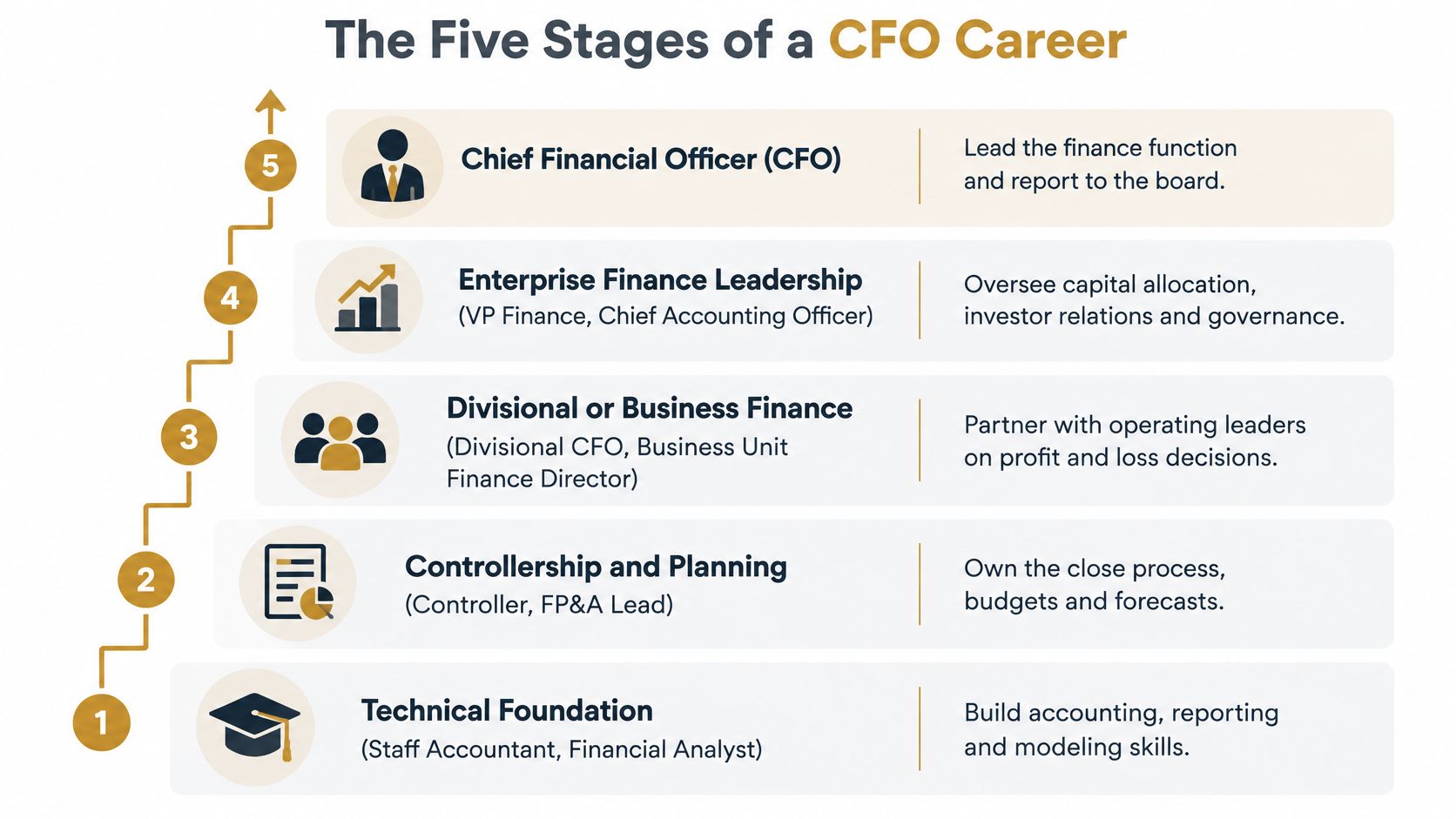
| Technical foundation | Staff accountant, financial analyst | Early career, until independent reporting ownership | Accurate close, reconciliations and sound GAAP fundamentals |
| Controllership and planning | Senior accountant, finance manager, controller, FP&A lead | Roughly years 4-10 as a planning guide, not a promotion deadline | Reporting integrity, budget and forecast ownership, audit relationships |
| Divisional or enterprise finance leadership | Finance director, divisional CFO, VP finance | After functional ownership, before enterprise accountability | Business-unit P&L, capital allocation, cross-functional planning results |
| Chief financial officer | CFO | Appointment and tenure benchmarks discussed below | Capital allocation, investor communication, risk posture, enterprise strategy delivered |
| Next-stage or portfolio | CEO, chief strategy or risk officer, another CFO, board or committee director | After demonstrated executive delivery, or alongside an approved outside appointment | Governance judgment and a measurable executive record |
Treat the timing column as orientation, not eligibility. Company size, organizational structure and the assignments available to you matter more than time served.
The visual below separates some pre-CFO responsibilities that employers may combine within a single position.
Read the stages as evidence gates
In its analysis of 1,000 executives who served as Fortune 250 CFOs, EY found a median appointment age of 48, median tenure of four years, approximately two-thirds moving into another full-time role after their first CFO position, and 9% entering full-time retirement; EY also found that between 2011 and 2023, appointments from business-unit CFO or investor-relations leadership became as common as those from controller or treasurer backgrounds.
These are large-company benchmarks, not a personal timetable. The practical lesson is to combine technical credibility with assignments that demonstrate commercial and enterprise leadership.
Find your row, check whether you can prove its outcome, and identify the missing evidence for the next stage. A controller who produces reliable accounts but hasn't influenced an investment decision needs broader accountability, not just a more senior reporting title.
Private companies and public-sector bodies may compress or reorder these stages. A small-company controller may already manage financing, planning and board reporting, while a divisional CFO may have limited exposure to external investors.
Practical rule: Compare the scope you've owned, not the seniority of your title.
Prepare for transitions while delivering results
An EY report summarizing its tenure analysis and Russell Reynolds Associates' global index reports that approximately 64% of Fortune 250 CFOs appointed between 2016 and 2020 had exited by their fifth year, against 47% appointed between 2001 and 2015; Russell Reynolds reported 15.1% global CFO turnover in 2024, above its 14.8% six-year average, with average tenure falling from 6.2 years in 2023 to 5.8 years in 2024.
A Fortune 250 appointment analysis summarized in the Tech CFO Survey recorded 45 CFO appointments in 2025, with 64% filled internally, while observing departing CFOs increasingly pursuing portfolio and advisory careers.
Build succession depth, retain a clear record of decisions and keep professional relationships active. For a possible portfolio transition, use the Board Fee Calculator to explore compensation assumptions without treating potential fees as dependable income.
This video offers another way to consider the progression toward CFO responsibility.
If your record doesn't demonstrate the next stage's proof point, make that your next assignment.
Technical Foundations Every CFO Path Needs
Technical experience is the foundation of a house. Visitors may barely notice it, and nobody buys the property for the foundation alone, but weaknesses underneath limit everything above it.
ACCA's CFO career-path research found that 95% of sitting CFOs considered experience in both financial accounting and management accounting important for future CFOs. You need to understand both what the organization reports and how managers use financial information to act.
Pair each rotation with an enterprise outcome
Use these responsibilities to audit your experience:
- Financial reporting: Own accounting judgments and explain unusual movements.
- Budgeting and forecasting: Connect operational assumptions to financial expectations.
- Cash-flow management: Understand collections, payments and working-capital constraints.
- Capital expenditure: Evaluate investment cases and review delivered benefits.
- Cost management: Distinguish sustainable efficiencies from deferred problems.
- Performance analysis: Explain the drivers behind business-unit results.
- Controls: Establish accountability, approvals and reliable reporting procedures.
Controller and finance-director positions are useful because they combine reporting integrity, planning cycles, audit relationships and team leadership. The title matters less than whether you actually own those responsibilities.
Your development record should pair each responsibility with a business consequence. A forecasting redesign should show how managers improved decisions; working-capital work should explain cash conversion; an ERP implementation should establish whether the close became faster and more dependable.
Record the starting condition, your decision, the outcome and the limits of your contribution.
Track forecast error, cash conversion, close-cycle days, liquidity headroom and covenant compliance where relevant. Keep definitions consistent so another executive can evaluate the result.
Technical breadth alone won't necessarily move you beyond controllership. Once you can produce dependable information, promotion increasingly turns on what you persuade the organization to do with it. List each rotation on your record and write its enterprise outcome beside it.
Leadership Skills That Decide Who Gets the Chair
Promotion to CFO rewards more than producing numbers. In Deloitte's 2024 survey of 200 CFOs from large North American organizations, 39% ranked strong communication, explaining results clearly and plainly, as the most valued quality when selecting the next CFO; the same career-development discussion cites IBM's finding that 76% of its highlighted leaders reported clarity about organizational risk appetite.
The challenge is to shape capital allocation, risk posture and organizational action without hiding uncertainty.
Show judgment through a real decision
Progress from reliable accounting and control into cross-functional planning and investment decisions. Then seek assignments where you must recommend a course of action despite incomplete information.
Consider a controller handling delayed customer payments. The underlying facts stay the same, but each audience needs a different decision:
- Audit committee: Explain the receivables reserve, accounting judgment and supporting evidence.
- Sales vice president: Compare tighter credit terms with the potential effect on customer retention.
- Board: Recommend a course of action, show the downside case and identify escalation triggers.
Good communication isn't simplifying away the risk. It's helping each audience understand its responsibility.
Practice disagreement, not just presentation
Leadership, communication, strategy and change management belong together. A polished slide deck won't compensate for avoiding an uncomfortable recommendation or failing to secure operating support.
Document judgment using return on invested capital, scenario coverage and transformation value delivered. Explain which assumptions changed and how you responded, not just whether the final result was favorable.
Practice with bad news: a missed forecast, a delayed integration or a liquidity constraint. Rewrite the update for each audience, then use the Board Bio Builder to test whether your career summary conveys judgment rather than a list of reporting duties.
Adjacent Paths Beyond the CFO Seat
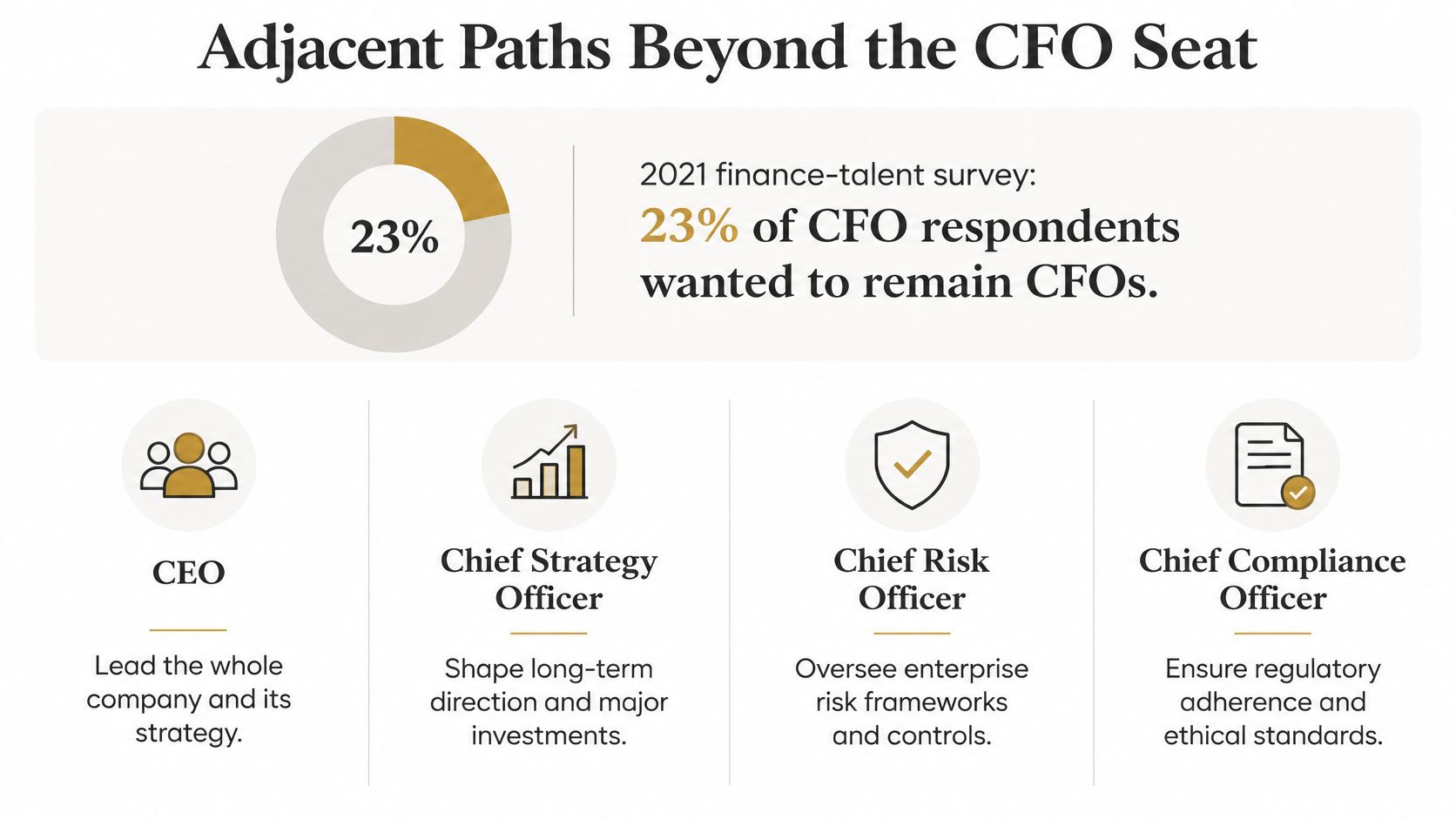
In a 2021 finance-talent survey, only a minority of CFO respondents said they wanted to remain CFOs, and CEO, chief strategy officer and chief risk or compliance roles appeared among the closest adjacent positions. That is a statement of aspiration, not a measure of how many executives make the move.
The transferable capabilities are clear: capital allocation, enterprise risk, strategy, performance management and stakeholder communication. The harder question is which responsibilities you actually want to own.
Compare destinations by the missing evidence
Each destination rewards the same foundation and then tests a different gap. Read the table as a gap analysis: the third column shows what a hiring board or chief executive will doubt, and the fourth shows what proof settles that doubt.
Adjacent CFO career destinations compared
| Destination | Strengths That Transfer | Gap to Close | Evidence to Show |
|---|---|---|---|
| Another CFO role | Capital markets, reporting, stakeholder management | Change of scale or sector | Reporting complexity and company scale delivered |
| Chief executive | Capital allocation, commercial judgment, enterprise view | Owning an operating P&L | Business-unit results, turnaround or growth record |
| Chief strategy officer | Planning, scenario modelling, M&A evaluation | Strategy ownership and operating credibility | Strategic initiatives with measured outcomes |
| Chief risk or compliance officer | Controls, audit relationships, risk appetite setting | Enterprise risk frameworks and regulatory depth | Control frameworks overseen and risk reporting delivered |
| Business-unit or operating leader | Cost and performance management, planning discipline | Commercial, customer and operations leadership | Operating P&L and turnaround results |
| Non-executive or committee seat | Financial oversight, controls judgment, structured challenge | Independence and distance from execution | Oversight decisions influenced, rather than reports produced |
A second CFO appointment can be a deliberate development move. A leader who has stabilized reporting might next seek acquisition integration, international operations or a different ownership structure.
Changing everything at once creates a harder case to prove. According to the 2025 Global CFO Pathways Report, summarized by HighRadius, 92% of CFO appointments in 2025 remained within the same sector. A sector switch therefore needs specific preparation around business economics, regulation and stakeholder expectations.
Separate operating ambition from oversight ambition
A CFO pursuing the CEO role needs evidence of operating P&L ownership. Advising a business-unit president is a different job from being accountable for pricing, customer retention, delivery and people decisions.
A business-unit assignment can close that gap, but examine the actual authority before accepting it. You need the ability to make operating decisions, not merely consolidate the results.
Chief strategy officer roles require similar scrutiny. Evaluating acquisitions demonstrates analytical strength; setting priorities, securing resources and changing operating behavior demonstrates strategy ownership.
Risk and compliance destinations have a different boundary. Audit and controls experience provides useful grounding, though it doesn't automatically establish expertise in enterprise risk frameworks, regulatory interpretation or compliance investigations.
Board and committee seats belong on this list as a designed stage of the path rather than a retirement afterthought. The evidence they test is distinct: directors are appointed for the quality of their challenge, their independence from management and their ability to govern through questions rather than decisions. A CFO who spent years being the person with the answer has to show they can now be the person testing it.
Pick the accountability first; the title follows.
If you enjoy building teams and making daily trade-offs, an operating path may fit. If you prefer evaluating management's proposals, challenging assumptions and contributing across several organizations at once, governance may be more attractive.
The trade-off is authority. Directors oversee and challenge; they don't become an extra executive team. An experienced CFO who cannot stop directing management may find board work frustrating.
Use the Board Role Fit Checklist to test whether oversight responsibilities match your preferences. Then answer one practical question: which capability gap do you most want to close over the next couple of years?
How CFOs Move Into Board and Committee Seats
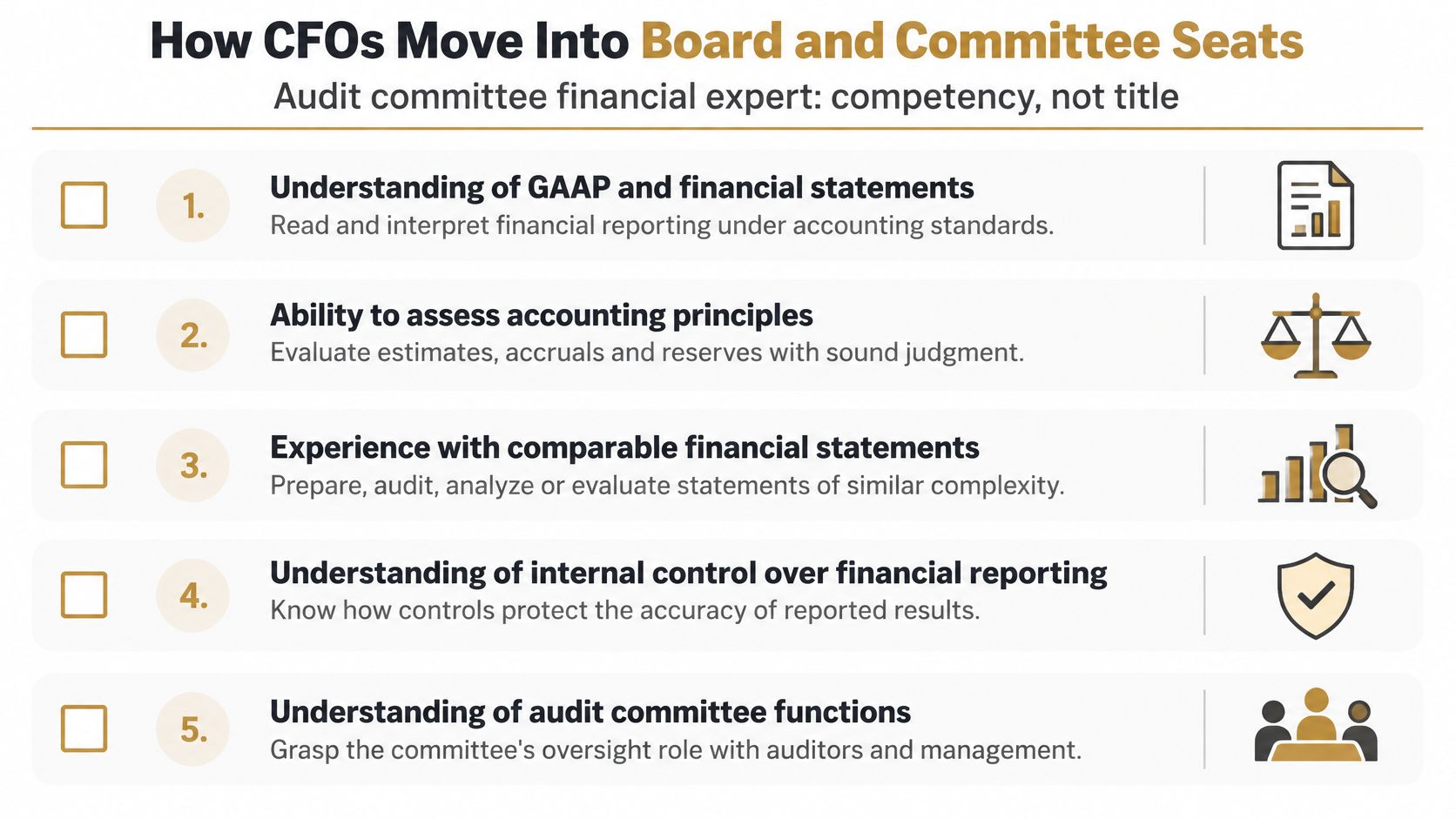
Under the SEC's audit committee financial expert rules, the test is competency, not job title: understanding GAAP and financial statements; assessing accounting for estimates, accruals and reserves; experience preparing, auditing, analyzing or evaluating statements of comparable breadth and complexity, or actively supervising that work; understanding internal controls and reporting procedures; and understanding audit-committee functions.
The SEC recognizes relevant experience gained as a principal financial officer, principal accounting officer, controller, public accountant, auditor, supervisor of those roles or through comparable experience. Holding the CFO title alone doesn't establish that the record meets the test.
Translate executive work into oversight evidence
Start with the reporting environment you handled in practice. Describe the business model, consolidation complexity, material judgments, control responsibilities and nature of your interactions with auditors.
Then explain the oversight judgment. A director-grade example should show how you evaluated competing explanations and recognized a weakness or established appropriate accountability, rather than just naming a project you managed.
Say you led a reporting remediation program. An executive CV might emphasize implementation; director materials should also explain how you assessed management's assurances, monitored unresolved deficiencies and determined what warranted escalation.
Keep confidential information out of application materials. Describe complexity and judgment without disclosing sensitive audit findings, customer details or unpublished financial information.
Prepare for different interviewers
Spencer Stuart's board-interview guidance explains that nominating and governance committees usually lead the process, interview multiple candidates for a seat, and often arrange finalist meetings with the CEO and independent board leader, sometimes including other independent directors.
Prepare examples around each interviewer's likely concern:
- Nominating and governance committee: Demonstrate committee fit, sound judgment and understanding of directors' responsibilities.
- CEO: Explain how you contribute strategically while respecting management's authority.
- Chair or lead director: Show independence, collegiality and the ability to challenge without dominating.
A chair may ask how you'd respond when management rejects your concern. Describe how you'd clarify the evidence, engage through the appropriate governance channel and remain constructive, rather than promising to take over the decision.
The distinction matters during informal conversations too. Directors assess whether they could work with you through disagreement, not just whether you know the subject.
Match your record to a defined board gap
A Harvard Law School Forum summary of director-selection practices identifies financial expertise, governance knowledge, directors' legal duties, industry experience, strategic planning and capital-markets expertise as relevant board capabilities, while discussing audit-committee independence requirements.
A broad finance background becomes more persuasive when matched to a specific vacancy. Compare board of directors positions by committee responsibilities and the contribution each board needs.
Board and committee seats and the evidence each one tests
| Board Seat | What It Tests | Evidence to Document |
|---|---|---|
| Audit committee chair or member | GAAP, estimates and reserves, internal controls, audit-committee functions | Scale of statements prepared or supervised and audit interactions |
| Risk committee member | Risk appetite, control frameworks, enterprise risk judgment | Risk frameworks overseen and scenario analysis delivered |
| Finance or capital committee | Capital structure, financing, investment policy | Financing decisions, covenant management and capital allocation results |
| Strategy or transformation director | Constructive challenge of management, transformation oversight | Programs supervised and measured outcomes |
| Nonprofit or public-sector finance committee | Budget oversight, reserves, fiduciary duty | Budgets governed, controls designed and reporting handled |
Don't present operational scope as proof of governance competence. Overseeing a technology budget, for example, is less informative than explaining how you assessed delivery risk, challenged benefits assumptions and monitored management's response.
For an independent public-company audit committee, a serving CFO generally cannot qualify as independent of the company they run. Before pursuing an outside seat, check independence, employer approval, commercial conflicts and available time, including periods when both organizations may face reporting pressure.
Plan Your Next Move Before Your Next Title
A CFO reaching the later stages faces a narrower question than “what title comes next”: do you want to keep running the numbers, or start judging how others run them? Choose an operating destination or an oversight destination this quarter. That choice decides whether your next assignment should add direct business accountability or committee-level judgment.
If a board seat is the design, not the afterthought, build evidence before you apply. A nonprofit or private-company finance or audit committee can be useful practice when you accept the fiduciary duty, prepare for papers and dissent properly, and treat the seat as work rather than a résumé line.
Turn the choice into assignments
- Map your outcomes. Write the enterprise result beside each finance rotation: cash released, risk reduced, decisions changed.
- Draft a targeted summary. Match your record to one named seat and committee need instead of calling yourself broadly board-ready.
- Identify missing competencies. Use the Board Readiness Assessment to see which financial-expert competencies your record does not yet demonstrate.
- Test fit in conversation. Book a short discovery call to discuss your experience, the roles you want and whether the service suits your needs.
At SeatSignal, our Done-For-You Board Placement program hand-picks relevant open board roles, prepares director-grade applications customized to each opportunity and provides board-specific interview preparation. Opportunities are checked by a person, with pre-public seat matching, warm-path introductions when available and a placement team reviewing what reaches you.
The input is your director profile: board CV, sectors, geographies and what you will and won't consider. The work follows four steps: surface the seat early, map warm connections, build the packet and prepare for the interview.
The packet contains a director CV, a cover letter written to the board charter and its gaps, a fit memo and an independence note, all drafted for that specific board. When a suitable connection exists, the route in runs through a name rather than a cold application.
Appointments, interviews and income aren't guaranteed. Members remain responsible for decisions, independence checks and due diligence.
SeatSignal helps finance leaders turn executive experience into targeted board applications through opportunity matching, director-grade materials and board-specific interview preparation. Visit SeatSignal to discuss the board or committee roles that fit your next career stage.
Want a paid board role, done for you?
One handpicked, verified open board role every week, with a director-grade packet tailored for it.
Get Started