Composition of the Board of Directors: How It Is Decided
You've got a strong operating record, a recruiter has floated a board seat, and the description reads like every other one: finance, strategy, leadership. Then the nomination committee asks a sharper question. Where do you change this board's ability to oversee the next risk, not the last one?
That question is what the composition of the board of directors is really about. It isn't a stack of impressive résumés, a quota box, or an independence label in a proxy. It's a capability system. The group has to be independent enough, skilled enough, and different enough to challenge management and still decide. Formal compliance is the floor. The gaps above that floor decide who is worth recruiting.
Table of Contents
- What Actually Decides Who Sits on a Board
- Formal Rules That Set the Minimum Board Shape
- How Independence Is Tested Beyond the Label
- Committee Seats and the Expertise Each One Needs
- Building a Skills Matrix Around Real Risk
- Matching the Board to Stage and Strategy
- Diversity Beyond Quotas and Headcounts
- Confirm the Composition Gap Before You Apply
What Actually Decides Who Sits on a Board
Think of a sports squad. The league sets who is eligible to play. The coach's plan decides which skills the side needs this season. Injuries, retirements, and a change of tactics force new signings. Boards are built the same way.

Five forces, in the order you should check them
- Legal and listing rules set the minimum number of independent directors and the shape of key committees.
- Committee mandates come next, because audit, remuneration, nomination, and risk seats each ask for different evidence.
- Capability needs follow from strategy and risk, not only from the company's industry.
- Diversity expectations and disclosure duties shape who can be shown to shareholders.
- The existing seat mix covers tenure, succession risk, and how many seats each director already holds.
Too little financial or risk expertise weakens oversight, because nobody in the room can test what management reports. Too much similarity of background encourages groupthink, because the same career path produces the same blind spots. Composition is judged collectively. No single director has to cover every skill.
Rules come first because they set the floor. Gaps come second because they decide who is worth recruiting above it.
The route into board of directors positions is where those forces become a seat. The nomination committee shortlists against the evidence each committee needs. The board appoints or recommends. Shareholders confirm at election. You have to clear the committee's bar before any vote.
Formal Rules That Set the Minimum Board Shape
Read the table as a floor, not a wish list. A mandatory threshold binds the board. A recommendation is a code expectation the board must explain if it misses it. Nine jurisdictions combine a legal minimum with a more ambitious voluntary target, so the code can sit above the statute.
| Rule | Where it applies | Requirement |
|---|---|---|
| Minimum independent directors | Almost all OECD jurisdictions surveyed, all except Luxembourg and the Slovak Republic | Minimum number or ratio required or recommended |
| Independence set by law, regulation, or listing rules | 21 jurisdictions | Mandatory |
| Two or three independent directors | 13 jurisdictions, the most common mandatory threshold | Fixed minimum count |
| At least one-third independent | 9 jurisdictions, the second most common threshold | Ratio floor |
| Majority-independent recommendation | Most common recommendation across OECD codes (2023) | At least 50% of directors independent |
| Audit committee majority independent | 55% of surveyed jurisdictions require it; 24% recommend it through codes | At least a majority independent |
| Nomination committee majority independent | Commonly recommended, 49% of jurisdictions | Majority independent |
| Remuneration committee majority independent | Commonly recommended, 47% of jurisdictions | Majority independent |
| UK audit committee for listed companies | UK Corporate Governance Code 2024, Provision 24 | Minimum three members, or two for a smaller company; board chair excluded |
| Independence benchmark | India, average 56% independent with about four per board | Benchmark, not a minimum |
The OECD Corporate Governance Factbook is the source for the jurisdiction counts and for India's average. The 2023 OECD Corporate Governance Factbook is the source for the audit, nomination, and remuneration committee shares. The UK Corporate Governance Code 2024 is the source for Provision 24.
Three ways to read a row
A listed company in a jurisdiction that requires at least one-third independent directors needs at least three independent members on a nine-seat board. Round up. Two independents on nine seats is 22%, and that fails the ratio even if both are excellent.
A UK-listed company's audit committee must be made up of independent non-executive directors, with a minimum of three, or two if the company is smaller, and the board chair should not sit on it. Count heads and check the chair exclusion before you accept an audit brief.
A majority-independent audit committee can still fail in practice if its members are conflicted, overloaded, or about to retire. The formal rule is a floor. It doesn't prove the committee can challenge the auditor.
India is a benchmark, not a minimum you can copy into another market. Independent directors there account for an average of 56% of board members, with about four independents per board.
Which document wins
Check the listing rule first, then the governance code, then the company's own charter. The strictest rule that applies to that company governs the seat. Unlisted private boards often have no legal threshold at all. They should still adopt a code voluntarily, especially where investors or regulators will later treat independence as assumed. On a financial services board, committee independence is usually the binding constraint, not the headline board ratio.
How Independence Is Tested Beyond the Label
A label isn't a test. A director can be listed as independent and still fail the relationship test the moment someone reads the ties.
The OECD's 2023 Corporate Governance Factbook reports that almost all surveyed jurisdictions require or recommend a minimum number or ratio of independent directors. The most common mandatory approach is two or three independent directors, or at least 30% of the board, while the most common recommendation is for at least 50% of directors to be independent. Those thresholds only tell you how many names must clear the test. They don't tell you whether you clear it.
What assessors actually check
Assessors look at relationships with the company and its group, with management, with the external auditor, and with substantial shareholders. They also look at compensation other than directorship fees. A monthly consulting retainer is compensation. A success fee tied to a transaction the board will approve is compensation. A standard board fee usually isn't.
Four cases that trip people up
The recent executive. A former CFO left eighteen months ago and now chairs the audit committee. Some codes would still treat that person as non-independent because the look-back after employment hasn't expired. Look-back periods differ between codes, so you have to read the code that governs this board, not the one you last served under.
The paid adviser. A director's consulting firm bills the company a monthly retainer. The board seat and the invoice are the same economic relationship, even if a different legal entity sends the bill.
The family tie. A candidate's spouse is a senior executive at a key supplier. The conflict isn't theoretical. Pricing, volume, and contract renewal will land on the board's agenda.
The interlock. A director also sits on the board of the CEO's own company. Each board is then judging a person who judges them back. That isn't a skills overlap. It's a loyalty problem.
A three-question self-test
Ask yourself three questions before you let anyone call you independent.
- Money: Has the company or its group paid me anything beyond board fees?
- Dependence: Do I depend on management for income, referrals, or access?
- Appearance: Would a reasonable shareholder question my judgment on a major decision?
Disclose early. Write the answers down. Expect the nomination committee to probe them before any interview, not after you've cleared the shortlist.
Committee Seats and the Expertise Each One Needs
The full board can look balanced while one committee is hollow. Each committee has its own evidence bar, and a broad "strategic leader" line on a CV doesn't clear any of them.
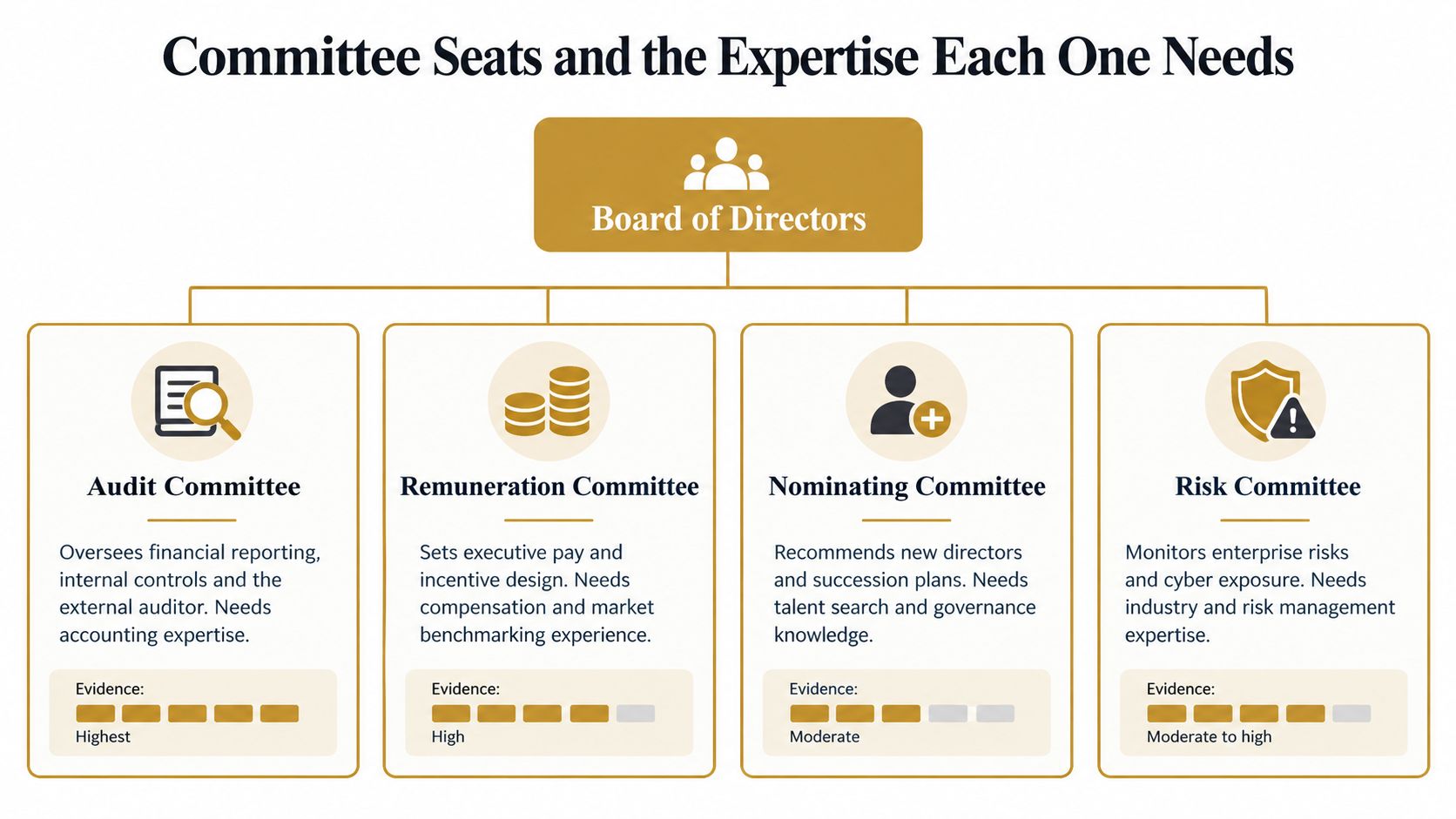
Audit oversees financial reporting, internal controls, and the external auditor. The evidence bar is the highest on the board. Accounting literacy is the minimum. A named financial expert, often a former CFO, controller, or audit partner, is what many mandates require. If you can't walk through a revenue-recognition judgment without asking management to translate, you aren't ready for this seat.
Remuneration designs pay and incentives. The useful evidence is benchmarking, performance metrics, and talent retention, not a general interest in "people." A director who has chaired a pay committee, or led senior HR through a long-term incentive redesign, can show that. A director who has only approved their own bonus cycle cannot.
Nomination manages board succession and the criteria for new candidates. The evidence is governance judgment and search discipline. Can you tell a credible gap from a fashionable one, and can you say no to a well-known name who doesn't close it?
Risk covers cyber, geopolitical, regulatory, and climate exposure. It suits directors from regulated industries or with real technology oversight. The test isn't whether you've read a risk register. It's whether you've overseen an incident, a licence review, or a control failure and can say what the board changed afterward.
The G20/OECD Principles of Corporate Governance recommend that boards establish committees for matters involving potential conflicts of interest, with a minimum number of members or a fully independent membership. In some jurisdictions an independent non-executive chair of that committee is treated as good practice. Audit is called out for disclosure, internal controls, and audit oversight. Remuneration, nomination, and risk committees depend on the company's size, structure, complexity, and risk profile. Mandates, composition, and procedures should be defined and disclosed.
When the mandate and the people diverge
Say a bank's audit committee drops to two members after a resignation, and its own mandate requires three. The board doesn't have a staffing inconvenience. It has a breach of its committee design, and it has to recruit quickly rather than stretch the remaining two across the year-end.
Overload is the mirror image. A director who holds three committee seats and chairs one has enough time to serve one committee well. Small companies often merge audit and risk into a single committee, which raises the evidence bar. That person needs both reporting literacy and risk judgment, not one or the other.
The full board keeps responsibility for the decisions. A committee gap is a board gap, even when the minutes say the committee "noted" the issue.
Building a Skills Matrix Around Real Risk
A skills matrix works like a coverage map. It shows whether the board, as a group, can see the company's real risks coming and interrogate management about them. The G20/OECD Principles say boards should periodically evaluate whether they have the right mix of backgrounds and expertise, explicitly including accounting, digitalisation, sustainability, risk management, and sector-specific knowledge. Independence sits in the matrix as a column of its own, because a director who cannot challenge management freely contributes less coverage than their CV suggests.
How to build the grid
Use one row per director. Use columns for capability, independence status, committee eligibility, tenure, succession risk, and evidence. Evidence means a role, a decision, or a committee outcome you can describe. "Digital native" is a label. "Chaired the board through a two-year core-system replacement and the related control failures" is evidence.
Then read the grid down each column, capability by capability. One audit-qualified director is thin cover if that person is conflicted, overloaded, or retiring within a year. Individual qualification and collective coverage are different tests, and the matrix fails when the only person who can challenge the auditor is the person about to leave.
A 2026 global survey of 3,416 chairs and directors across 84 countries found that demographic diversity improved while skills diversity wasn't keeping pace with boards' risk exposure. That is a coverage problem, and it is the gap a well-built matrix exists to expose.
| Capability | Risk it covers | Evidence a director can show | Gap signal |
|---|---|---|---|
| Financial reporting and audit | Misstatement and control failure | Audit committee service, CFO or controller background | No director can challenge the external auditor |
| Cyber resilience | Breach and operational disruption | Board-level incident oversight or security leadership | Cyber sits on the risk register with no director who has overseen it |
| AI governance | Model risk, regulatory exposure, misuse | Oversight of AI deployment, data governance, or AI policy | AI features in strategy but no director can test management's claims |
| Climate transition | Transition, regulatory, and asset risk | Sustainability reporting oversight, energy or carbon exposure | Net-zero targets with no director owning the plan |
| Regulated-industry knowledge | Licence, compliance, and enforcement | Regulator-facing roles or compliance committee service | Board learns of regulatory change only from management |
| International markets | Currency, sanctions, and entry risk | Operating or board experience in the target region | Expansion plan with no director who has run in that market |
| Remuneration and talent | Incentive misalignment and retention | Remuneration committee chair or senior HR leadership | Incentive plan approved without benchmarking |
| Transformation and M&A | Failed integration and capital misallocation | Integration leadership or deal committee service | Acquisitions approved without post-deal review |
Don't reflexively add a technology director
For fast-moving capabilities such as AI governance, cyber resilience, climate transition, and data regulation, few directors have long operating histories. Ask which judgment the board lacks: technical depth, regulated-industry experience, transformation oversight, or the ability to challenge management. Each answer points to a different fix. Recruitment, director education, external advisers, or a committee redesign solve different problems, and hiring is the slowest and most expensive of the four. A technology operator who can't oversee controls won't close an audit gap.
A credible application names one gap and shows the evidence that closes it. It doesn't list every function you've ever led.
Before you send that evidence, run the draft through a board CV grader so the page reads as governance proof a nomination committee can test.
Matching the Board to Stage and Strategy
Strategy decides which risks matter. Stage decides which committees must exist, and when. A seat that is perfect for a listed audit committee can be the wrong hire for a three-person founder board, and the reverse is just as true.
| Stage | Typical board shape | Priority seats | Composition risk |
|---|---|---|---|
| Founder-led, pre-revenue | Founders plus one or two advisers, few independents | Operating scale and finance discipline | Founders outvote any independent view |
| Venture-backed growth, Series A to B | Investor directors with founders and one independent | Independent chair or lead independent, finance | Investor agenda dominates decisions |
| Pre-IPO scale-up | Independents increasing, first audit committee forming | Audit, risk, and listing readiness | Audit committee built too late |
| Listed company | Majority independent with full committees | Audit, risk, remuneration, and nomination | Overboarded independents and thin committees |
| Nonprofit or public-sector | Mix of community, expert, and funder members | Financial oversight, fundraising, and mission | Conflicts from donors or funding bodies |
| Exiting founder moving into governance | Experienced operators seeking portfolio seats | Governance skills beyond the operating role | Operator bias toward management |
Three timing mistakes
A founder-led company planning a cross-border acquisition needs integration experience and someone who has operated in the target market before it needs a fourth general operator. The deal risk is specific. Another operator who knows the home market doesn't reduce it.
A venture-backed company approaching an IPO needs an audit committee and an independent majority before listing, not after the first earnings call. Investor-appointed directors represent shareholders, and on a small board they can outvote everyone else. An independent chair, or at least a lead independent, is the counterweight. Without that seat, the board is a shareholder meeting with minutes.
A listed company entering a new regulated market needs a director who has faced that regulator. Learning the regime from management's briefing pack leaves the board one step behind every enforcement letter.
The timing trap and the time trap
Boards that build the audit committee after the prospectus is drafted rush the search and accept weaker fits. The committee then spends its first year learning the company instead of testing the numbers. That's how listing-readiness slips from a design choice into a scramble.
Over-boarding is the stage risk that shows up once the committee load is real. A director can match every skill on paper and still lack the hours for the audit calendar, the remuneration cycle, and a crisis. Composition quality depends on available time, not on how many logos sit on the biography. Match the next seat to the next stage's risk, not only to today's stage. For a scaling software company, that often means reading a technology board against product, cyber, and listing risk together, rather than hiring a second founder-operator.
Diversity Beyond Quotas and Headcounts
Gender representation is now a measured part of board composition, and the spread between countries is wide enough that a single global average will mislead you.
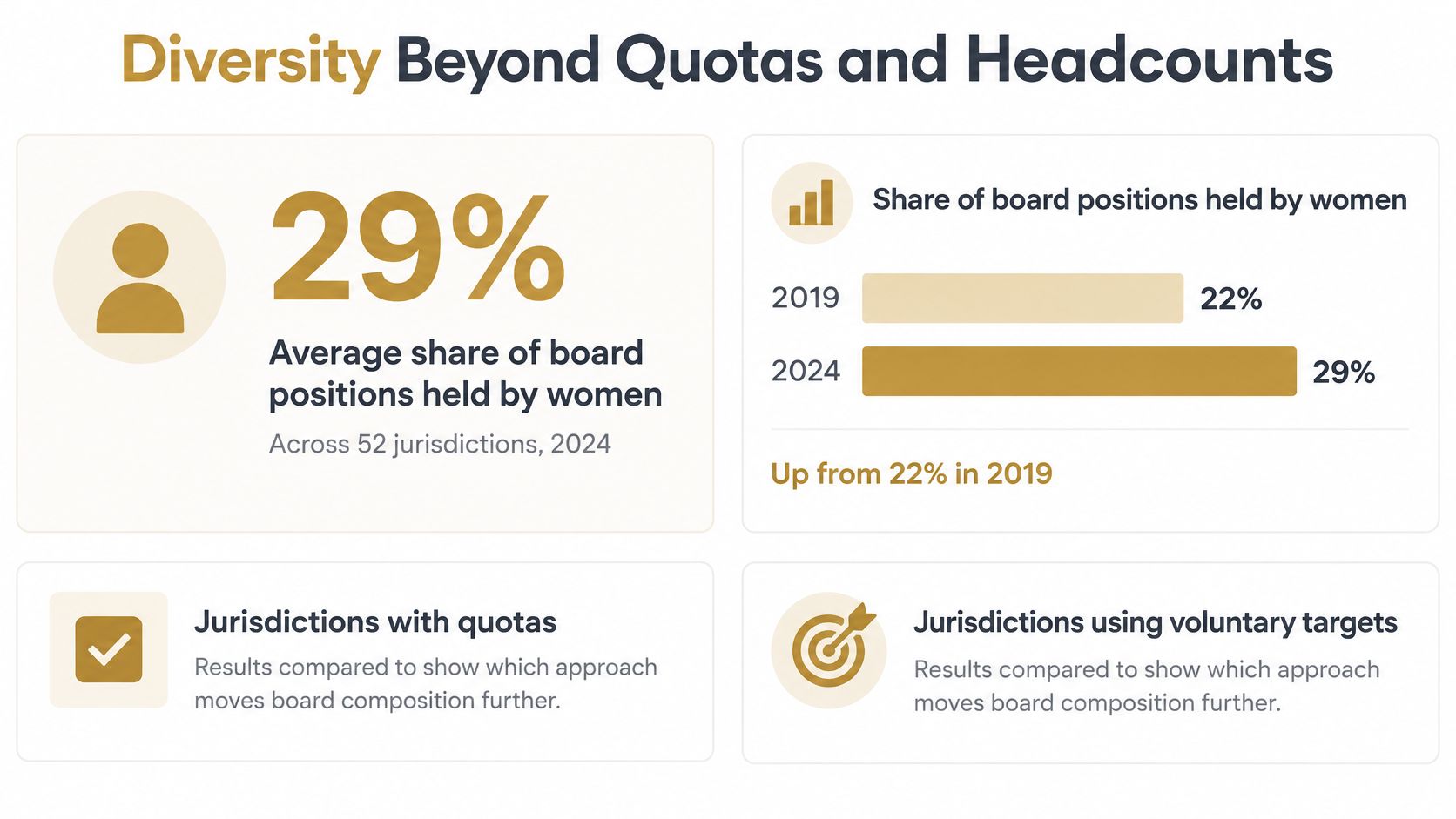
The OECD's 2025 Corporate Governance Factbook reports that women held an average of 29% of board positions across 52 jurisdictions in 2024, up from 22% in 2019. Jurisdictions with formal quotas and those using voluntary targets moved at a broadly similar pace. Average female representation in both groups rose from 26% in 2019 to approximately 33–34% in 2024. The rule design did not produce two different worlds. National starting points did.
| Country | Women's share of board positions, 2024 |
|---|---|
| Norway | 44.3% |
| Italy | 43.2% |
| United States | 33.7% |
| Chile | 24% |
| Japan | 20.5% |
| Korea | 17.2% |
| Average across 52 jurisdictions | 29% (22% in 2019) |
Why the national rules aren't interchangeable
France requires listed companies to ensure that at least 40% of board members are each gender. Germany requires at least 30% women on supervisory boards. Finland's rules requiring 40% representation of the under-represented sex on large listed-company boards entered into force in December 2024, with compliance due by June 30, 2026. If you sit on a French board and a Japanese board in the same year, you are not under one diversity regime. You are under two, and your own profile does not travel unchanged between them.
Other regimes skip the percentage and legislate the disclosure instead: publish standardized board-diversity statistics each year, and let shareholders judge whether the mix is acceptable. A comply-or-explain expectation and a statutory quota are different instruments aimed at the same behavior. Both force the nomination committee to show its working. Neither guarantees that the people in the room can collectively cover the risks in front of them.
The same Factbook records McKinsey's analysis of 1,265 companies across 23 countries. Companies in the top quartile for gender-diverse boards were 27% more likely to outperform financially than those in the bottom quartile, and companies in the top quartile for ethnic diversity were 13% more likely to outperform. Read that as correlation, not proof that adding a director causes the result. A board that is diverse and weak on audit will still be weak on audit. Diversity pays when it widens what the board can detect and decide together; a headcount alone does not.
A short briefing on how nomination committees talk about this mix is worth fifteen minutes before you write the application.
A board works like an investment portfolio: concentration in one background is concentration in one blind spot. For a candidate, the useful move is to pair representation with a decision-relevant difference. International-market experience, technology expertise, regulated-industry knowledge, or stakeholder insight gives the committee a reason that survives the disclosure table. Representation without a gap you close is a statistic. A gap you close, documented, is a seat.
Confirm the Composition Gap Before You Apply
A strong board application answers a problem the board already has. Before you write, treat composition as a coverage map: which risks the board must handle next, which capabilities are already around the table, and where that coverage is thin or about to change.
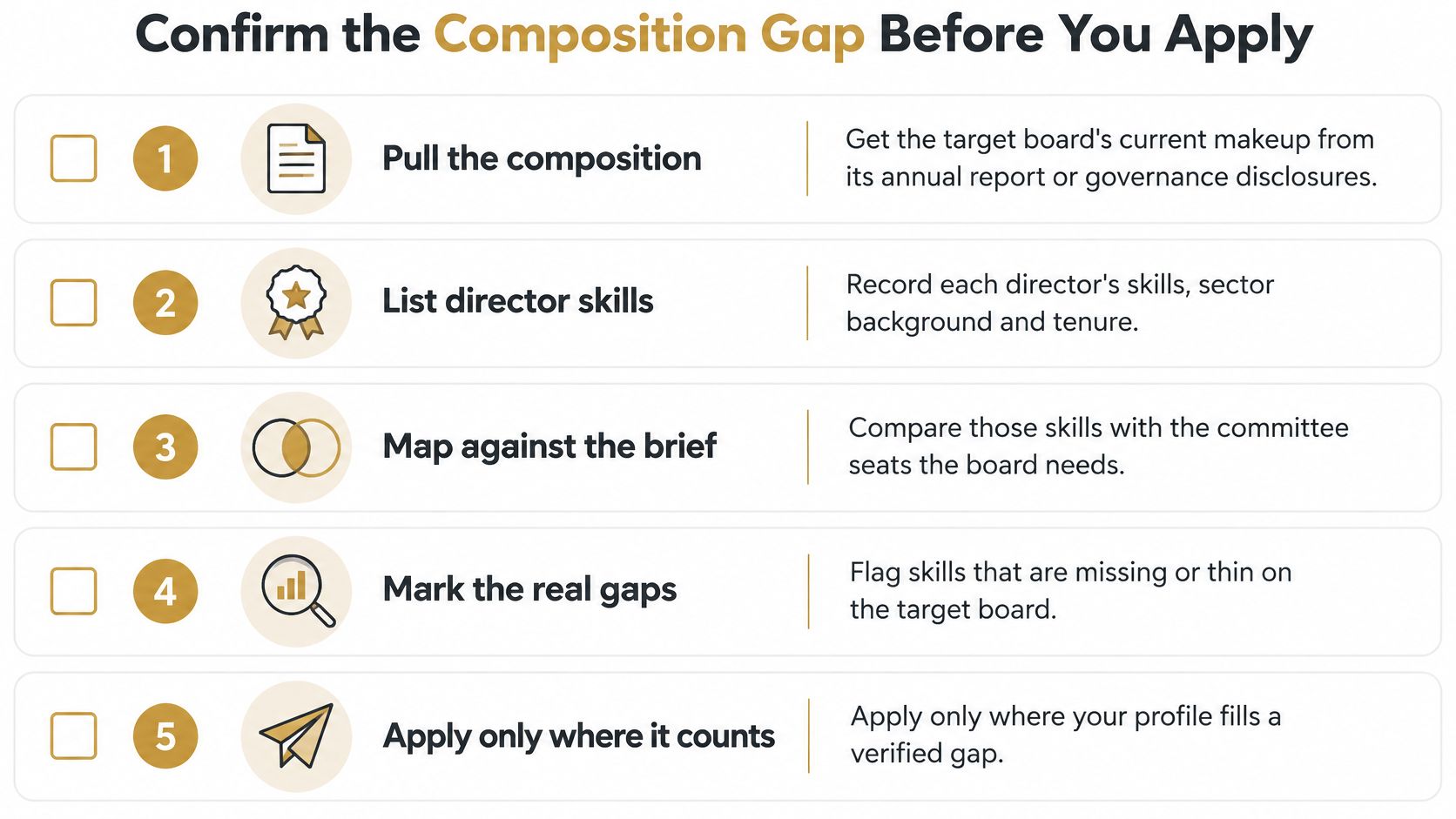
Five checks keep the packet tied to a real gap.
- Pull the current composition. Use the annual report, governance disclosures, or board charter. List each director's skills, committee seats, and tenure, then compare that coverage with the company's stage, strategy, and risk areas. You are looking for thin coverage and upcoming turnover, not for a prettier version of your own CV.
- Run the independence test on yourself. Use the relationship questions and the rule that governs that board's jurisdiction. If the answer is awkward, write it down now. A surprise at interview is worse.
- Name one or two gaps. Use what the board has disclosed or what the skills matrix shows. Define the gap in collective terms: "audit depth sits with one director nearing retirement" is more useful than "I have financial experience." A nomination committee can hold one clear gap. It cannot hold a catalogue.
- Count your own seats and hours before you accept another role. A free Board Time Commitment Calculator can sit alongside the fit check for this step, so you see meeting cycles, committee work, preparation, travel, and busy periods before you see the fee.
- Build a packet that proves the gap. That means a board CV, a cover letter, a fit memo, and an independence note. Each page should point to the same missing capability.
The Board Role Fit Checklist is the quick screen for step 3. If you cannot name the gap in a sentence, you are not ready to write the letter.
SeatSignal reads the board's composition, committee needs, and independence position so you can see where you fit, evidenced rather than guessed. Its team hand-picks relevant open board roles, prepares a director-grade packet for each opportunity, maps a warm route in when one exists, and rehearses you against the questions that board's chair is likely to ask.
No appointment is guaranteed. Boards, nomination committees, and recruiters make the decisions. Your job is to show a defined gap, clean independence, and evidence that survives a challenge. Their job is to choose.
If you're weighing a first paid seat or the next committee role, start from the board's real gaps rather than a generic director profile. SeatSignal reads composition, committee needs, and independence, then prepares the packet and the interview around that specific seat. Visit SeatSignal when you want that work done against a named board, not against a template.
Want a paid board role, done for you?
One handpicked, verified open board role every week, with a director-grade packet tailored for it.
Get Started