Corporate Board Member: Duties, Time and Path

The most popular advice for becoming a corporate board member is to polish your executive résumé and network harder. That advice skips the board's real question: What can you oversee that we can't adequately oversee today? A senior title may earn attention, but it doesn't establish independent judgment, committee readiness, or the capacity to serve when the company hits trouble.
A credible board candidacy starts with a specific capability gap and evidence that you can fill it. Before pursuing the title, understand the decisions you'll scrutinize, the work behind the meeting calendar, and the obligations you'll accept alongside any compensation.
Table of Contents
- What a Corporate Board Member Oversees
- Qualifications, Independence and Committee Evidence
- Time Commitment and the Risk of Too Many Seats
- What a Board Seat Pays and Carries
- How Corporate Board Seats Actually Open
- Decide Whether You Are Ready to Pursue a Seat
What a Corporate Board Member Oversees
A corporate board member is a director elected or appointed to oversee a company for its owners, not to run its daily operations. Think of an air-traffic system: executives fly the plane; directors establish the permitted corridor, watch the instruments, and can require the flight to stop. The image isn't a legal definition, but it captures the separation between execution and oversight.
That separation can frustrate accomplished executives. You may know exactly how you'd reorganize a sales team or replace an operating system, but your board contribution isn't to issue instructions to department heads. It's to determine whether management's approach is credible, properly controlled, and consistent with the company's direction.
The duty map
What a corporate board member oversees
| Duty area | Director tests | Management still owns | First forum |
|---|---|---|---|
| Strategy and performance | Whether plans, forecasts and KPIs rest on evidence | Running the business and hitting targets | Full board |
| Financial reporting | Integrity of statements, estimates, accruals and controls | Preparing the accounts | Audit committee |
| Risk and controls | Material risks, incidents and whether remediation is real | Operating the control system | Risk or audit committee |
| Executive pay | Pay and incentives versus performance and risk | Designing management packages | Remuneration committee |
| Succession | CEO and board refreshment against the skills the board lacks | Day-to-day talent processes | Nomination committee |
| Conflicts | Related-party deals and whether directors are truly independent | Proposing the transaction | Independent directors |
Read the last column as a practical starting point, not a universal allocation of authority. Review the company's committee charters and governing documents to establish who examines a matter, who recommends action, and who approves it.
The G20/OECD Principles of Corporate Governance identify objective judgment, monitoring management performance, preventing conflicts of interest, and maintaining the integrity of financial and other corporate reporting as central board responsibilities. They also emphasize independent handling of conflict-sensitive work and clearly defined committee responsibilities.
What you personally test in the meeting room
Strategy and performance require more than a persuasive presentation. Say management proposes an international expansion. Ask what customer evidence supports the forecast, which assumptions would invalidate it, and what indicators would trigger a reconsideration.
Management still chooses suppliers, recruits employees, and executes the approved plan. Your responsibility is to challenge the investment logic and monitor whether the agreed evidence supports continuing it. A revenue dashboard alone won't tell you whether growth is profitable, repeatable, or consuming cash faster than expected.
Financial reporting calls for judgment about the numbers, not just comfort with them. If earnings improve while cash collection weakens, ask management to reconcile the difference. Explore whether estimates, provisions, or changes in assumptions explain the reported performance.
You're not preparing the accounts or replacing the external auditor. You're testing whether the reporting process produces information the board can reasonably rely on. Ask what management and the auditor disagreed about, how the disagreement was resolved, and whether unresolved matters need attention.
Risk oversight means testing whether controls work in practice. A dashboard marked green isn't proof that a problem has been fixed. Ask who tested the remediation, what evidence they examined, and whether the original weakness can recur.
For example, management might report that access permissions have been corrected after a security incident. A useful board question is whether someone independently checked those permissions and tested the escalation process. Choosing the access-management software remains an operating decision.
Meeting-room test: Ask what evidence would cause management to change its recommendation. If nobody can answer, the board hasn't yet tested the proposal adequately.
Pay, succession and conflicts
Executive remuneration requires directors to examine what behavior the incentives encourage. A bonus proposal may reward revenue growth while overlooking deteriorating margins or excessive risk. Ask whether the performance measures reflect sustainable results and whether proposed exceptions are justified.
Management can develop package proposals and provide market information. The remuneration committee should scrutinize the logic without allowing the executives receiving the awards to control the judgment. An effective director can challenge the design without turning the discussion into a personal negotiation.
Succession is broader than having a replacement name in a folder. Ask whether potential CEO successors match the company's future needs and whether the board itself needs capabilities it currently lacks. Management owns everyday talent development; directors need enough evidence to judge whether the succession options are credible.
Conflicts require an equally direct approach. If the company proposes buying services from a business connected to a director or major shareholder, ask who benefits, how alternatives were assessed, and who can evaluate the proposal independently. Familiarity with the parties isn't a substitute for a defensible process.
Committees don't remove full-board responsibility
Audit, remuneration, nomination, and risk committees provide focused monitoring and advice. The full board retains responsibility for decisions unless applicable law provides otherwise, even when a committee has done the detailed examination.
That matters for a first-time director who expects to contribute only within a specialty. A technology background doesn't excuse disengagement from financial reporting, and a finance background doesn't remove the need to understand strategic or workforce risks.
Prepare before meetings, identify the assumptions that matter, and ask concise questions that help the board reach a decision. Afterward, make sure agreed follow-up has an owner and returns with evidence. Board effectiveness depends on sustained scrutiny, not the number of interventions you make.
Qualifications, Independence and Committee Evidence
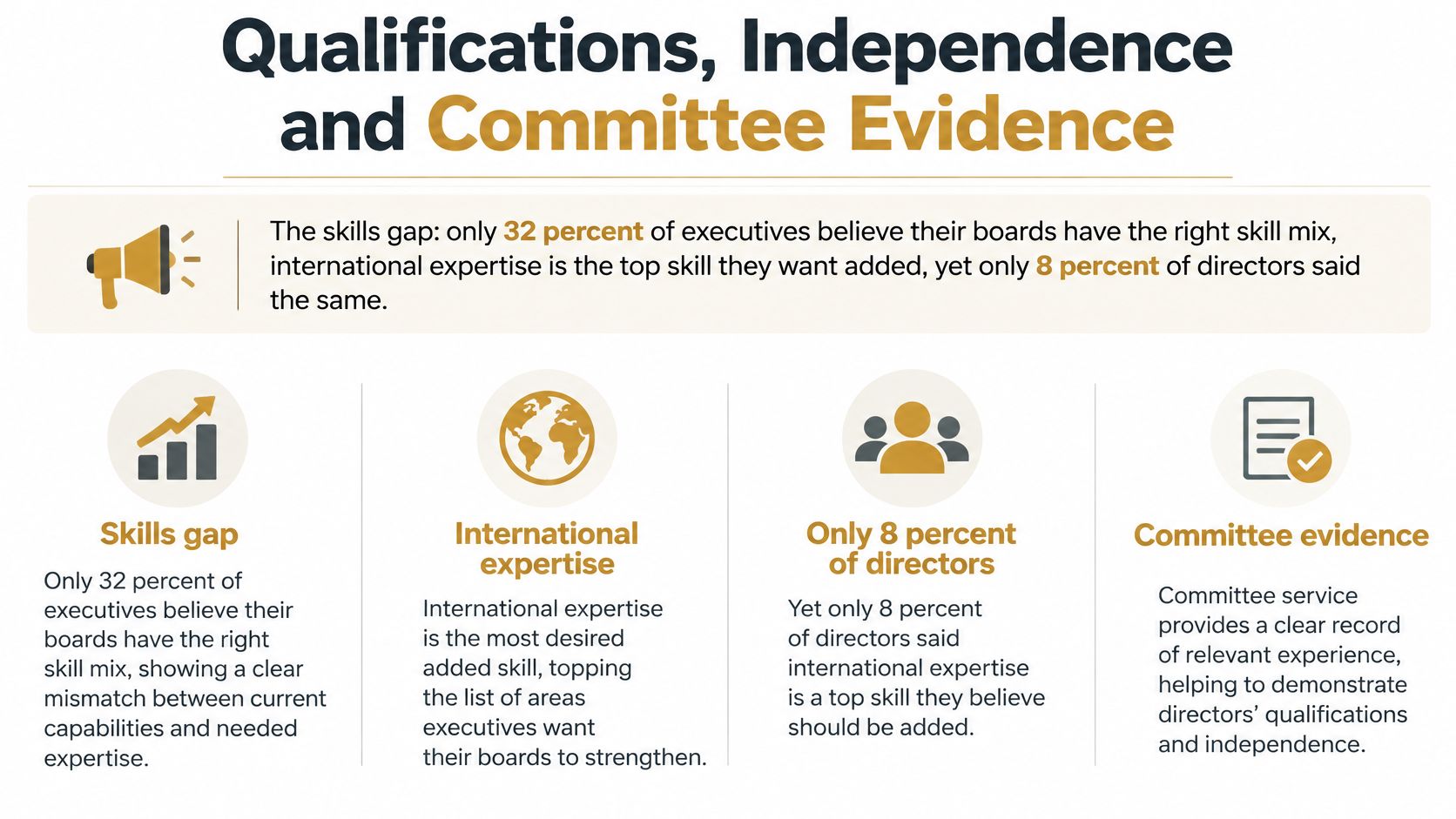
Seats go to candidates who close a specific gap in the boardroom, and the gap that matters is the one the board itself can name. Only 32% of executives believe their boards have the right mix of skills; executives ranked international expertise as the top desired addition, yet only 8% of directors said their boards planned to add it in the following year, according to PwC's Annual Corporate Directors Survey. What a board needs and what it plans to recruit aren't necessarily the same thing, so your evidence has to answer the vacancy that exists.
A scarce specialty can feel like a guaranteed route in. Information security ranks among the less common skills on large-company boards, yet rarity alone proves nothing. A candidate still has to connect the expertise to the company's actual exposure: which risks it would oversee, which committee would use it, and what could go wrong without it.
Build proof around the vacancy
Start with the board before your biography. Read director profiles, committee mandates, the annual report, and the company's own explanation of its strategy and principal risks. Separate the capabilities the board explicitly identifies from capabilities you merely assume it lacks. Then apply a practical proof method:
- Read the composition and mandates. Identify which directors bring relevant experience and which committee would use yours. A short public biography rarely describes everything an incumbent knows.
- Name the gap precisely. “International experience” is broad. Oversight of cross-border integration, regulatory exposure, or geographically concentrated suppliers gives the board something concrete to evaluate.
- Translate an operating achievement into an oversight story. Explain the assumptions you challenged, the alternatives considered, the controls you required, and the evidence used to judge the outcome.
- Demonstrate constructive challenge. Show how you questioned a proposal while leaving management's accountability for execution intact.
Say you led a major systems migration. An executive résumé would emphasize delivery, budget, and team size. A governance account explains how you evaluated business-continuity exposure, required independent assurance, set escalation triggers, and tested whether management was ready to proceed. The first version records what you delivered; the second shows a nomination committee what you would scrutinize across the hours the seat demands.
Be accurate about your authority. If you were the executive responsible for implementation, claiming the posture of an independent overseer will collapse under questioning. Describe what that operating experience taught you to test from the boardroom instead.
Independence is a separate gate
Expertise and independence answer different questions, and nomination committees screen them separately. Expertise concerns what you can evaluate; independence concerns relationships that could compromise your judgment or disqualify you under the applicable framework.
The OECD Corporate Governance Factbook describes commonly used independence tests covering relationships with the company, its group, management, the external auditor, and substantial shareholders, as well as compensation received beyond directorship fees. National definitions differ, so labeling yourself independent on a CV settles nothing.
Prepare a factual independence note for the particular company and jurisdiction. List relevant employment, advisory work, commercial relationships, payments, and shareholder connections, then give the corporate secretary or legal adviser enough detail to apply the applicable rules rather than offering your own unsupported conclusion.
- Separate status from conduct. Meeting a formal independence definition doesn't remove the duty to recognize and disclose a transaction-specific conflict.
- Disclose inconvenient facts early. A past consulting relationship is easier to assess before nomination than after an incomplete declaration surfaces.
- Keep the note current. New commercial work or other appointments can change the assessment.
Match committee claims to evidence
For a U.S. public-company audit seat, financial expertise has a defined meaning. The SEC's audit committee financial expert rules address understanding GAAP and financial statements, evaluating estimates, accruals and reserves, experience preparing, auditing, analyzing or evaluating comparably complex statements or actively supervising that work, and understanding internal controls and audit-committee functions.
A CFO title alone doesn't communicate that depth. Specify the reporting environment, the difficult accounting judgments you faced, the control weaknesses you worked through, and the decisions you made involving auditors or internal audit. Sitting in an audit meeting is a different claim from evaluating the issues raised in it.
Evidence each committee expects
| Committee | Evidence to show | Conflict sensitivity | Hidden time |
|---|---|---|---|
| Audit | GAAP judgment, estimates, reserves, controls, auditor dialogue | High for reporting and related parties | Filings, control issues, auditor sessions |
| Remuneration | Incentive design, performance metrics, retention | High because pay conflicts with management | Proxy season and investor questions |
| Nomination | Skills matrix, succession, refreshment, composition | High for appointments | Candidate reviews and matrix updates |
| Risk | Risk appetite, cyber, AI, concentration, crisis response | Elevated on oversight conflicts | Incident calls and scenario reviews |
Treat the remaining rows as preparation prompts: working questions that shape your evidence rather than universal legal qualification tests. For remuneration, bring an incentive-design example and explain the trade-offs you weighed between retention, performance, and risk. For nomination, show how you assessed future capability needs instead of helping recruit a familiar executive.
Risk candidates should discuss cyber incidents, AI adoption, concentration, and crisis response in business terms. Naming technical systems shows vocabulary. The stronger evidence is how you distinguished acceptable exposure from an issue that required escalation or a change in strategy.
Keep a competency record
Maintain a concise record with columns for capability, situation, your role, judgment exercised, outcome, and supporting evidence. Describe the decision and your contribution without disclosing restricted material; a reference that breaches confidence proves the opposite of what you intend.
Run the draft through the Board CV Grader as a formatting check, then inspect the substance yourself. A well-formatted document can still fail to explain why a nomination committee should trust your judgment.
Choose one committee story you can defend in detail. Be ready to explain what you initially believed, which evidence changed your view, and what you would scrutinize differently today. That kind of answer demonstrates more readiness for the oversight load than an uninterrupted list of successes.
Time Commitment and the Risk of Too Many Seats
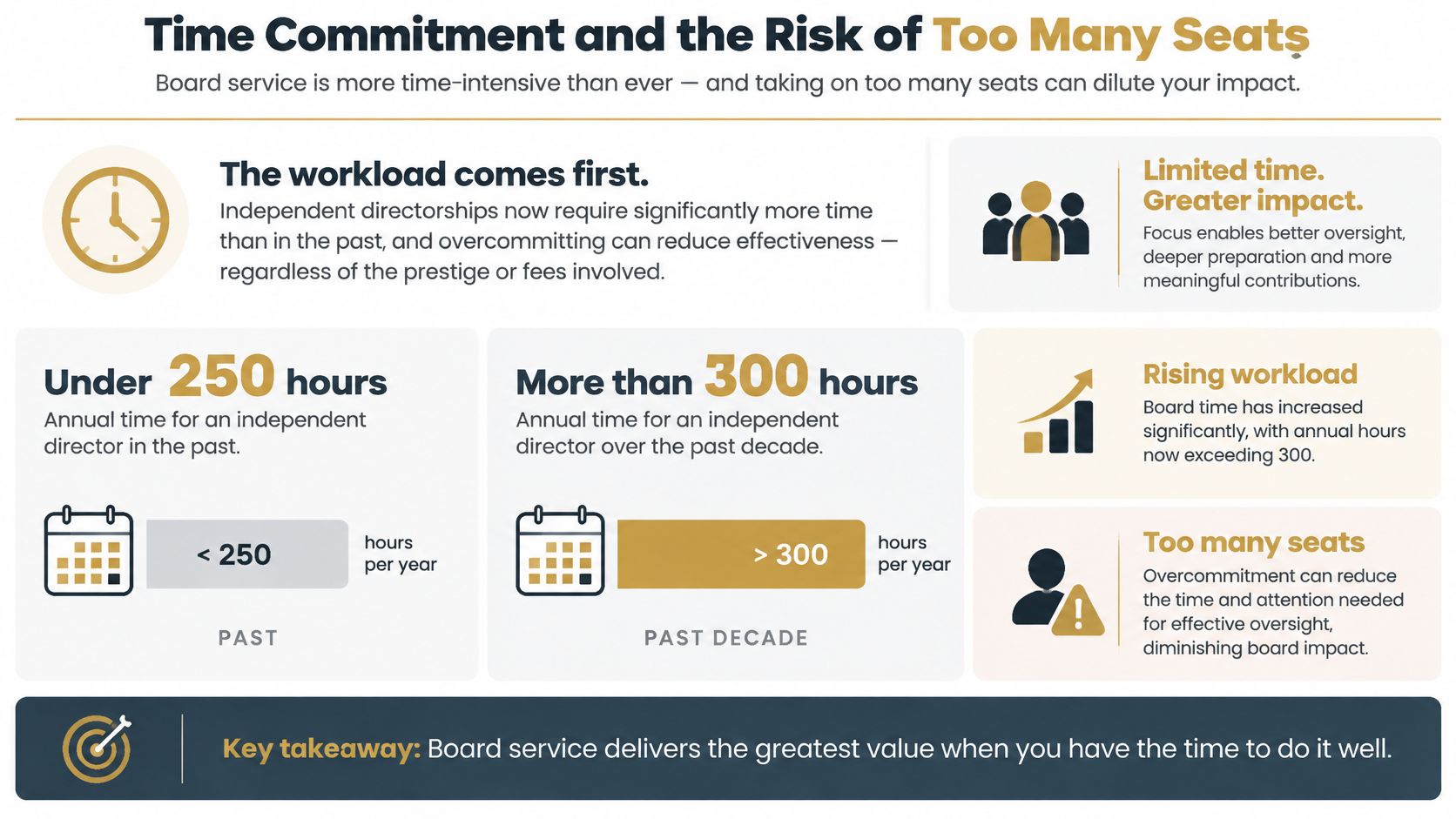
Annual independent-director time commitments have risen from under 250 hours to more than 300 hours over the past decade, according to NACD's public-company boardroom findings. Answer the workload question before considering prestige or fees: can you provide that attention without weakening your existing responsibilities?
The same NACD findings report that 48% of surveyed directors considered crisis-like disruptions more frequent than five years earlier and 52% considered them more severe. They also report that 77% discuss the material and financial implications of cyber incidents, up 25 percentage points from 2022, while AI is a routine topic for more than 60% of boards.
The scheduled calendar and the emergency calendar
The visible calendar includes board meetings, committee meetings, preparation, strategy offsites, continuing education, and investor scrutiny. Ask for the actual meeting cycle and expected reading load, not just the dates of formal meetings.
The emergency calendar is harder to reserve. A cyber incident, restatement, sudden CEO departure, or material transaction can require urgent calls and repeated document review. Those demands won't necessarily arrive when your executive job is quiet.
Use the Board Time Commitment Calculator to build a capacity estimate, then stress-test it against an incident at the least convenient point in your working year.
Test the portfolio, not just the new seat
Before accepting, examine the demands together:
- Preparation and committee work. Include reading, adviser sessions, follow-up, and any proposed chair responsibilities.
- Emergency availability. Identify which existing commitments you could move during a crisis.
- Conflicts and independence. Consider commercial overlap and whether another appointment could constrain participation.
- Concentrated exposure. Look for shared suppliers, technology dependencies, markets, and geopolitical risks across your boards.
- Personal liability. Review the company's condition and the protection available before committing.
A larger portfolio isn't automatically a stronger one. If several companies face the same disruption, you may receive urgent requests from every chair at once. Your nominal availability on separate calendars won't solve that problem.
Accept a seat only when its unscheduled crisis work still fits. Treat over-boarding as a performance risk, not a credential.
What a Board Seat Pays and Carries
Start with the target public company's annual proxy statement, particularly its director-compensation disclosure. Identify the annual retainer, meeting fees where used, committee or chair fees, and equity grants. Separate cash you can receive from equity subject to vesting, holding requirements, or restrictions.
Audit, risk, and remuneration chair responsibilities can carry additional fees, but use the company's disclosed schedule rather than assuming a premium. Nonprofit, private, and private-equity-backed boards may offer an honorarium, equity, cash, or no compensation. Request written terms before agreeing to serve.
Compare structure before headline value
Pull the three most recent proxy statements from comparable boards in your target sector. Compare how compensation is structured, what additional responsibilities attract fees, and whether disclosed totals include unusual awards.
Run the calculation using realistic hours:
Compensation check: Total annual compensation ÷ realistic annual service hours = an indicative gross hourly equivalent, not a salary or a measure of legal exposure.
Use the Board Fee Calculator to organize the comparison. Mark any undisclosed input as ? in your working sheet rather than inventing an estimate. Keep uncertain equity value separate from dependable cash compensation.
Review what you carry personally
Pay and protection belong in the same acceptance review. Ask legal counsel to examine the appointment terms and explain gaps in protection.
- Indemnification. Establish what the company agrees to cover and how defense costs are handled.
- Directors and officers insurance. Review the policy, limits, exclusions, and relevant claims provisions.
- Carve-outs and practical recovery. Understand circumstances where protection may not apply and whether the company can meet its obligations.
A generous retainer doesn't make an opaque appointment acceptable. Resolve missing documents and unclear obligations before you sign.
How Corporate Board Seats Actually Open
Say a company expects to expand overseas while an experienced director approaches retirement. The nomination committee may begin discussing the replacement profile before there's a public vacancy. A candidate who understands the strategic need can prepare a relevant approach; a candidate waiting for an advertisement may enter much later.
The service cycles are long. Among S&P 500 companies in 2024, average director tenure was 7.8 years, while departing directors had served 12.2 years, according to Spencer Stuart's tenure and retirement analysis. These aren't appointments to treat as short executive assignments.
Retirement policies aren't vacancy dates
Only 9% of S&P 500 companies, 43 boards, had formal tenure limits in 2024, up from 3% in 2014; where limits existed, 72% were set at 15 years or longer. Spencer Stuart also found that mandatory retirement-age disclosure fell from 73% in 2014 to 67% in 2024, while the average mandatory retirement age was 74.
Among boards with age limits, 60% set the threshold at 75 or older, compared with 30% in 2014. Those policies help explain gradual refreshment, but they don't establish that a particular director is leaving or that a search has begun.
Pursue the warmest credible route
Use this order of approach rather than treating every opportunity as a cold application:
- A known person in the boardroom. Ask for an informed conversation about the board's needs, not an endorsement your contact can't justify.
- A nomination or search brief. Show how your evidence answers the mandate instead of sending a general leadership biography.
- A committee-specific approach. Connect your audit or risk capability to an identifiable need.
- A public listing. Use the published requirements to build a precise application when an open route exists.
We map who the member already knows on every board, including shared boards and mutual professional history, so the approach can go through a name rather than a cold email. The relationship stays the member's. A shared connection is useful only if you can approach that person and explain why the conversation is relevant.
When reviewing board of directors positions, establish composition, committee need, and timing before sending your biography. Keep forecast openings separate from confirmed vacancies: an anticipated retirement is a signal to investigate, not permission to represent yourself as an applicant in an active search.
Decide Whether You Are Ready to Pursue a Seat
A board seat is proof against two things: a real gap in the boardroom's skills and an oversight load that runs to roughly 300 hours a year. Before you apply anywhere, test yourself against both. A candidate who can name the committee they would strengthen but cannot free the hours is not ready. Neither is a candidate with open capacity and no oversight story to tell.
Work through three checks before spending effort on any application:
- Committee proof. You have a specific oversight story matched to the committee where you expect to contribute, such as audit or risk experience tied to an identifiable need.
- Explainable independence. You can disclose relevant relationships for the company and country concerned, because a nomination committee will ask.
- Available capacity. You have room for the full weight of the role, including unscheduled calls when something goes wrong, not merely the meetings already in the calendar.
The Board Readiness Assessment shows which check needs work. If one fails, build the missing evidence first. Declining or delaying a seat you cannot serve is a better outcome than winning it.
Turn readiness into a selective search
Readiness narrows the search rather than widening it. State your sectors, geographies, committee interests, and which compensation structures you will accept (paid, unpaid, equity, or honorarium). Identify boards with a credible gap, approach through a known name where one exists, and prepare a governance CV, a board-specific cover letter, a fit memo, and an independence note.
SeatSignal's Done-For-You Board Placement program runs this process with you: roles are hand-picked and checked by a person, pre-public seats are matched across sectors, warm-path introductions are arranged when a connection exists, and the placement team reviews what reaches you. Director-grade packets are prepared for board roles members find anywhere, not only SeatSignal's own opportunities, and interview preparation rehearses the questions a chair is likely to ask, drawn from the role, the committee, and the gaps found in that boardroom.
Members approve what is sent. Boards, nomination committees, and recruiters make selection and appointment decisions, and no seat, interview, or income is guaranteed. Preparation supports a credible candidacy; it cannot substitute for qualifications, due diligence, or the appointing board's judgment.
Decision rule: Pursue a seat when you can explain both the value you will add and the obligations you are prepared to accept.
When your checks are honest and complete, visit SeatSignal to begin a board search built around your committee evidence, capacity, and fit.
Want a paid board role, done for you?
One handpicked, verified open board role every week, with a director-grade packet tailored for it.
Get Started