Corporate Executive Boards: Roles and Responsibilities

86% of state-owned-enterprise frameworks across 42 jurisdictions require boards to oversee accounting integrity, financial reporting and internal risk-control systems, according to the OECD's ownership and governance review. That's a useful corrective to the idea that a board seat is chiefly a prestigious title. A board is an accountability system, with directors expected to test decisions, demand evidence and act when management falls short.
The term corporate executive boards can blur different bodies. A board of directors governs, an executive team manages, and an executive committee may exercise authority delegated by the full board. Before pursuing a seat, establish which body you're joining, what authority it holds and what judgment you'll be expected to contribute.
Table of Contents
- Board Versus Executive Team at a Glance
- How the Board and the CEO Share Power
- The Committees That Do the Detailed Work
- Why Audit Oversight Is a Legal Duty
- Who Sits on Boards and Why Composition Matters
- How Boards Fill Scarce Seats
- Decide Which Board Role Fits Your Experience
Board Versus Executive Team at a Glance
The board of directors governs the company, holds management accountable, approves strategy and selects the chief executive; the executive team runs the business day to day. Think of the distinction as approving the destination and operating boundaries versus choosing the route and managing the journey.
An executive who becomes a director must change how they contribute. Instead of taking over a struggling project, they ask whether management has a credible recovery plan, sufficient resources and clear reporting obligations.
Board and executive team responsibilities compared
| Area | Board of directors | Executive team | Typical example |
|---|---|---|---|
| Strategy | Approves and reviews the long-term strategy | Proposes and delivers the strategy | In a hypothetical expansion, the board signs off a three-year plan that management then runs |
| CEO | Appoints, evaluates and can replace the CEO | Led by the CEO, who reports to the board | Board reviews CEO performance every year |
| Remuneration | Sets or oversees executive pay | Paid within approved frameworks | Remuneration committee approves an incentive plan |
| Risk and controls | Oversees risk appetite and internal controls | Designs and operates controls | Audit committee reviews the cyber incident response plan |
| Financial reporting | Oversees report integrity and the external auditor | Prepares the financial statements | Audit committee approves the auditor appointment |
| Daily operations | Does not run operations | Owns hiring, sales, product and budgets | CFO manages the budget cycle |
Find the boundary before acting
The examples describe a typical allocation, not a universal legal template. Company constitutions, committee mandates and local law determine the precise approval route, including whether shareholders also have an appointment role.
Budget oversight illustrates the distinction. Directors might reject an investment budget because its assumptions are unsupported, but they shouldn't start approving routine supplier invoices.
Decision test: Is this a governance call or an operating call, and who remains accountable after the decision?
Before accepting that accountability, estimate preparation, committee work and exceptional demands with the Board Time Commitment Calculator. Meeting attendance alone isn't a reliable measure of the commitment.
How the Board and the CEO Share Power
Power moves through information and decisions. Management circulates papers before meetings, directors challenge assumptions in committees and the full board, and minutes record the decision, its reasons and any dissent.
The workflow should make it possible to trace a proposal through to an accountable decision.
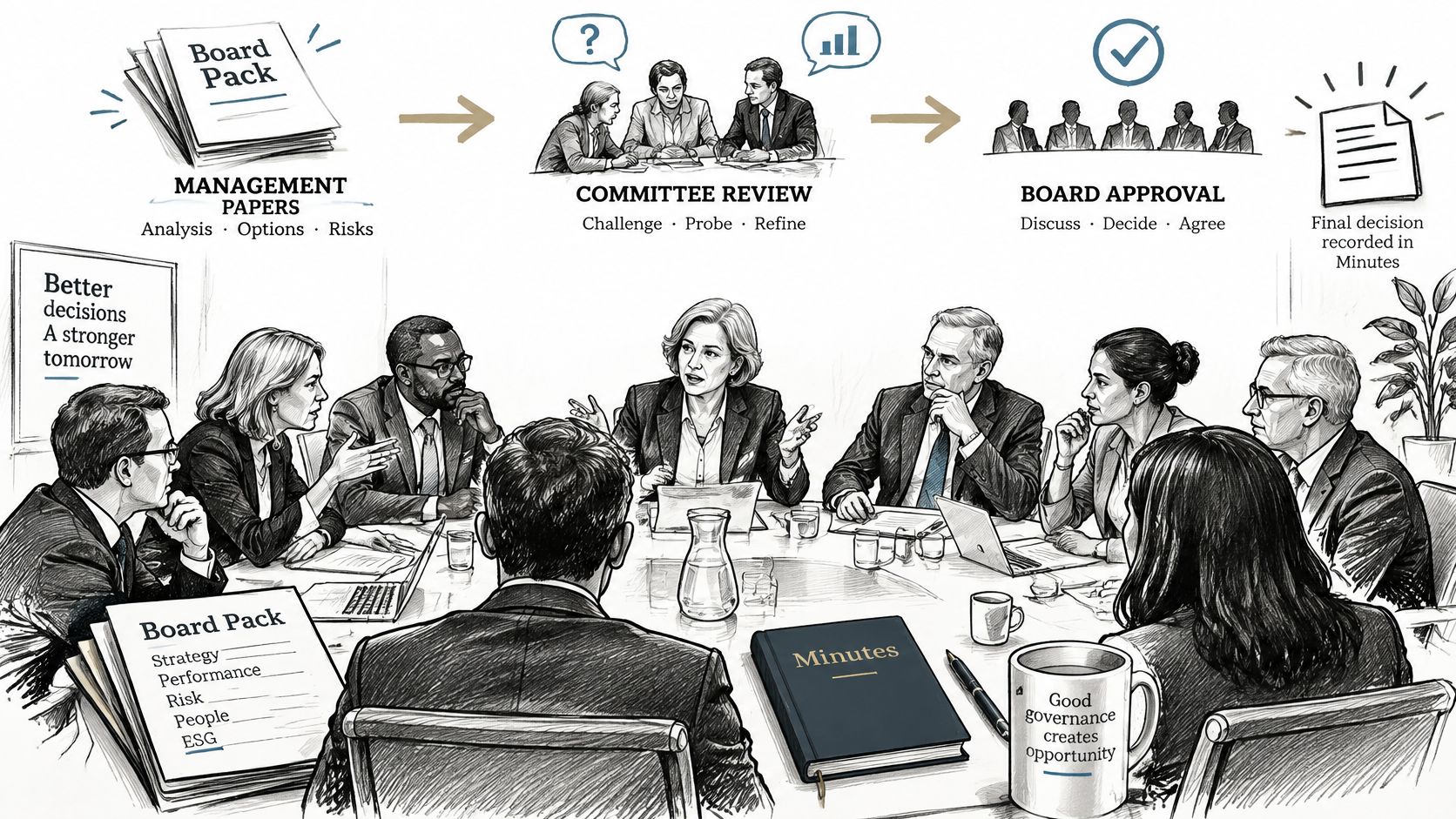
Follow an acquisition through the decision
Say a CEO proposes buying a competitor. The presentation promises new customers, lower costs and a stronger market position, but the board needs more than an attractive growth story.
- Strategy: Directors test the valuation against the approved plan. Would building the capability internally achieve the same objective with less exposure?
- Performance and succession: Who will run the combined business if the CEO leaves? Directors should examine integration leadership, not assume the deal sponsor is indispensable.
- Incentives: The remuneration committee ties rewards to integration milestones and durable results, rather than rewarding a larger company.
- Assurance: Audit or risk examines financing, reporting controls and integration risks, with a dated post-deal review and named management owners.
The board tests whether the acquisition serves the company's purpose and whether management can deliver it. Executives choose how to integrate systems, organize teams and retain customers within the approved boundaries.
That distinction doesn't justify passive approval. In 2025, only 35% of executives surveyed by PwC and The Conference Board rated their boards excellent or good overall, according to their board effectiveness survey.
The discussion below offers another way to consider board leadership and responsibility.
Replace ceremonial challenge with consequential judgment
Approving the deal after a polished presentation isn't enough. Ask management to model the loss of the target's main customer, including the effect on cash, debt obligations and integration spending.
In this scenario, that challenge could lead directors to require customer-retention conditions before completion. A separate challenge to the integration plan could secure a credible replacement leader before the company becomes dependent on the departing founder.
Independence is conduct, not a title. A director must be willing to ask the unwelcome question and stay with it until the answer is adequate.
More directors won't improve oversight unless someone owns the challenge. In 2025, 55% of directors surveyed by PwC said at least one fellow board member should be replaced, the highest level in its annual corporate directors survey.
An evaluation should therefore change who contributes, whose expertise is heard and how unresolved concerns reach the chair. Candidates can use the Board Offer Due Diligence Checklist to examine those practices before accepting a seat.
The Committees That Do the Detailed Work
Board committees, responsibilities and independence expectations
The independence figures below come from the OECD's review of board-level committees, covering audit majority-independence requirements in 58% of reviewed jurisdictions and recommendations in another 26%, plus full or majority independence requirements or recommendations for remuneration in 72% and nomination in 64%.
| Committee | Core responsibility | Independence expectation (OECD) |
|---|---|---|
| Audit | Financial reporting, external auditor oversight and internal controls | At least a majority independent in 58% of jurisdictions; recommended in another 26% |
| Remuneration | Executive pay and incentive design | Full or majority independence required or recommended in 72% of jurisdictions |
| Nomination | Board composition, director selection and succession | Full or majority independence required or recommended in 64% of jurisdictions |
| Risk | Enterprise, cyber and operational risk oversight | Check applicable law, listing rules and the committee charter; no comparable percentage reported here |
Committees perform much of the detailed examination, then report to the full board. They don't create a separate government within the company: the G20/OECD Principles of Corporate Governance emphasize clearly defined committee mandates while retaining full-board responsibility for decisions.
The reporting relationship is straightforward even when committee names differ.
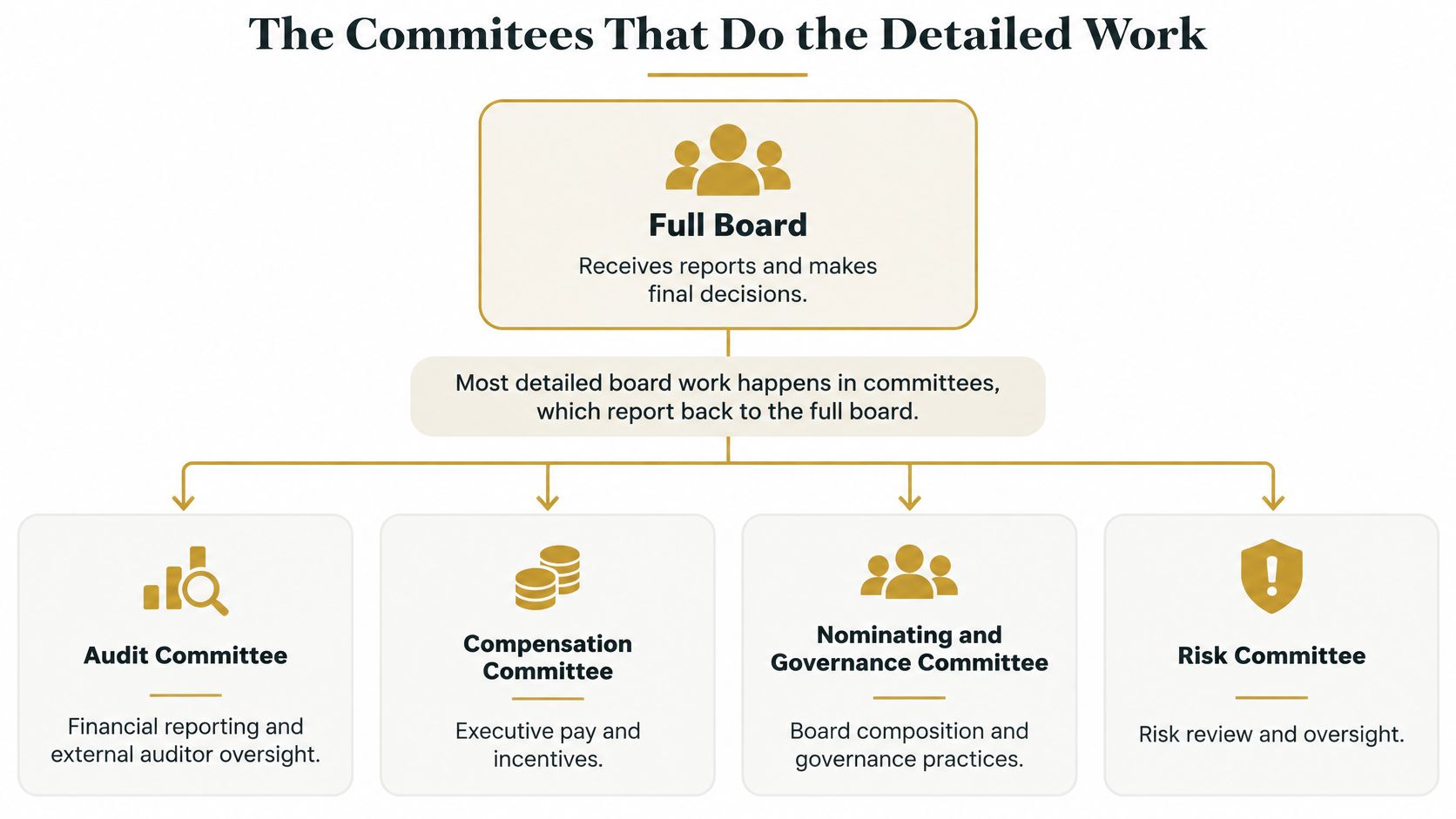
Independence and expertise answer different questions
Expertise asks whether you can contribute. Independence asks whether relationships or circumstances could compromise your judgment.
Typical tests examine whether you're company management or a group employee, have a material business relationship with the company, were recently associated with its external auditor, or exceed applicable tenure limits. Don't assume that leaving an executive role immediately resolves every independence question.
A former CFO with strong controls experience maps naturally to audit. Their evidence should explain how they identified a reporting weakness, challenged an assumption or ensured remediation, rather than merely listing responsibility for accounts.
A former chief people officer may fit remuneration through experience in incentive design, executive succession and talent risk. The relevant judgment is whether a pay arrangement encourages the behavior the company needs.
Read the mandate, not just the committee name
Risk oversight may sit in a dedicated committee or be combined with audit, particularly on a smaller board. A technology executive should establish whether the mandate covers cyber resilience, data governance, technology investment or all of these.
List each committee you could credibly join. Alongside it, write the evidence you'd offer and the independence question you'd need to answer.
Why Audit Oversight Is a Legal Duty
A US public-company audit committee does more than advise the finance team. The Sarbanes-Oxley Act of 2002 requires independent audit committee members and makes the committee directly responsible for appointing, compensating and overseeing the external auditor. The auditor answers to the committee, not to the executives whose books it examines.
The Act works like a building code that assigns fire inspections to a named inspector: oversight stops depending on goodwill and becomes an allocated duty. The reforms also require procedures for accounting and auditing complaints, including confidential and anonymous employee submissions. Committees can retain independent advisers and must receive appropriate funding, so management can't control scrutiny by withholding resources.
What the responsibility requires
The same reforms created the Public Company Accounting Oversight Board and established management assessment of internal controls, with auditor attestation under Section 404 where applicable. Together these provisions turn audit oversight into an assigned legal responsibility rather than an optional board custom.
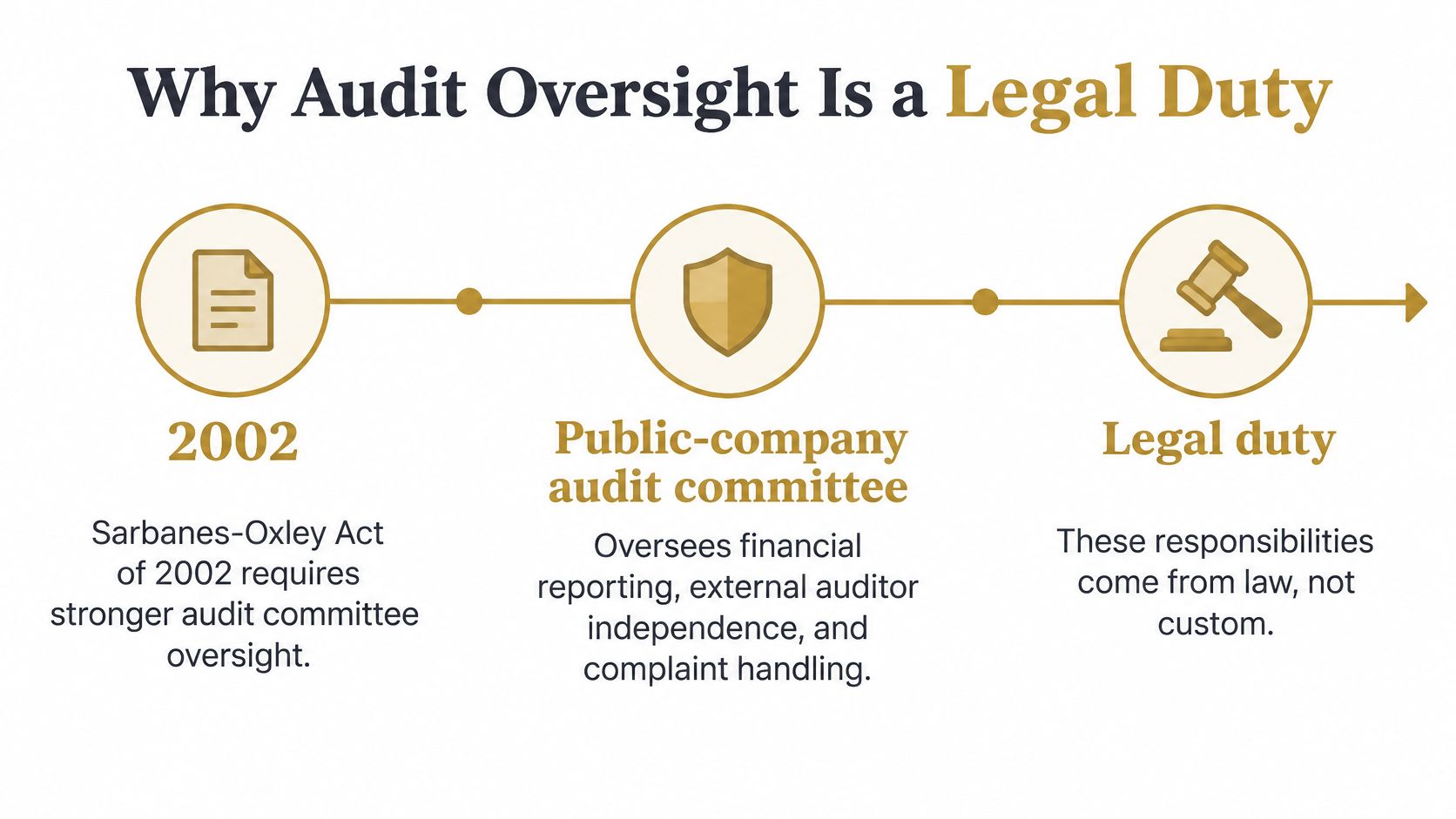
The Act did not appear from nowhere. Earlier reform efforts had already pressed for audit committees drawn from outside directors and for directors detached from management and its conflicts. The practical lesson matters more than the chronology: financial-reporting, audit, risk and compliance knowledge must support active questioning.
Control example: If the same employee can create a supplier and authorize its payment, ask who independently verifies the supplier and reviews exceptions.
A director doesn't need to operate the payment system. They do need to ask the auditor about the weakness, establish whether complaints can bypass implicated managers, and understand management's assessment of its reporting implications. The duty sits with the committee, but every member carries part of it. The law names the seat, and the person in it must arrive prepared to challenge.
Evidence a candidate should bring
Prepare an example showing how you distinguished a process weakness from a potentially material reporting problem. Explain the evidence you requested, the specialist advice you used and how you verified that corrective action worked. An audit seat rewards judgment under pressure, so show the moment you pressed a point others wanted to close.
The accountability chain runs in one direction here. Statute assigns the duty, the committee discharges it, and each director's record shows whether they exercised it. Audit service isn't an advisory courtesy; the seat carries oversight, independence, reporting and accountability obligations.
Who Sits on Boards and Why Composition Matters
Women held an average of 29% of board positions in the OECD jurisdictions covered in 2024, up from 22% in 2019, yet only 10% of large listed companies had a female board chair in 2024, according to the OECD Corporate Governance Factbook, which also reports the country figures below.
Women's share of board positions by country
| Country | Women's share of board positions (2024) |
|---|---|
| United Kingdom | 44.3% |
| United States | 33.7% |
| Japan | 20.5% |
| Korea | 17.2% |
These figures concern board positions at large listed companies, not every company or every leadership role. They show why gaining a seat and gaining influence shouldn't be treated as the same achievement.
Composition is more than a headcount
A nomination committee must consider how directors' backgrounds work together. Relevant questions include whether the board understands its markets, can scrutinize its financial model and has enough depth to staff its committees.
For a candidate, general seniority isn't the whole case. A board preparing for international expansion may need geographic experience; another may need restructuring judgment or a credible successor to its audit chair.
Read governance statements, director biographies and disclosed composition priorities together. Look for a missing capability, but don't assume that a demographic characteristic determines someone's expertise or perspective.
Ask about the path to responsibility
A seat doesn't guarantee access to committee leadership or the chair. Ask how committee assignments are made, how leadership successors are developed and whether newer directors receive substantive responsibilities.
- Identify the gap: Name the missing sector, geography, skill or committee capability.
- Choose persuasive evidence: Select an achievement, qualification or governance example that directly supports that need.
- Check your capacity: Use the Over-Boarding Checker to examine existing commitments before pursuing additional responsibilities.
The strongest application explains what the board can scrutinize more effectively with you in the room. It shouldn't leave the nomination committee to translate an impressive career into a specific governance contribution.
How Boards Fill Scarce Seats
Board access is partly a supply problem. In 2025, S&P 500 companies appointed 374 new independent directors, an 8% decline and the lowest total since 2016; only 50% appointed at least one, down from 58% in 2024, with average turnover of 0.8 new directors per board, according to Spencer Stuart's US Board Index announcement, which also reports that 99% conduct evaluations and 80% disclose a skills matrix, more than twice the share five years earlier.
Scarcity changes the standard. A nomination committee is assigning accountability across audit, compensation, nominating and risk work, so the winning file reads like a coverage plan: which legal duty you can evidence, which committee needs that evidence, and which gap disappears because you are in the room.
Skills needs don't automatically determine selection
Boards may say they want technology, cyber or international depth, then still choose the director whose judgment they trust in a contested meeting. Treat skill as the entry ticket and judgment as the deciding test. The useful question is narrower: what decision will this board face, what exposure sits underneath it, and what have you already decided under comparable pressure?
Cultural fit should mean constructive participation, not agreement with whoever already holds power.
Say you challenged an AI proposal because management couldn't explain responsibility for unreliable outputs. Your board-level evidence would describe the exposure, the decision rights you clarified and the approval conditions you recommended, rather than the technology you deployed.
Become credible before a vacancy is public
Cyber expertise has a clear financial context: 77% of directors surveyed by NACD in 2025 said their boards discussed the material and financial implications of cyber incidents, a 25-percentage-point increase from 2022, according to its board priorities announcement.
Build relationships around a relevant contribution before a formal search begins. Keep confirmed vacancies separate from anticipated openings, because a likely retirement or strategic shift isn't an available seat. For two target boards, write down the matrix gap, the committee that owns it and your cultural proof: an episode showing you challenged firmly, listened carefully and helped a group decide. Review board of directors positions against those criteria rather than applying wherever the title looks attractive.
Decide Which Board Role Fits Your Experience
A board seat is an accountability assignment, not a title. Each role carries committee duties, legal obligations and a real time cost, so fit is a question of evidence rather than ambition. Run this checklist before committing to an application:
- Match your evidence. Connect your strongest judgment example to a committee responsibility or a specific gap in that board's composition.
- Check independence. Examine employment history, commercial relationships, auditor connections and applicable tenure rules.
- Test capacity. Allow for preparation, committee duties and unexpected events alongside existing seats and your executive workload.
- Choose acceptable compensation. Decide whether you'll consider paid, equity, honorarium or unpaid roles.
- Prepare the case. Name the missing capability and develop an example that demonstrates it. Use the Board CV Grader to assess whether your CV makes that contribution clear.
A supported route with clear limits
SeatSignal runs a done-for-you board placement program. Every plan includes hand-picked board roles checked by a person, pre-public matching across every sector, warm-path introductions when available, a director-grade packet for each board, board-specific interview preparation and a placement team reviewing what reaches you. The packet covers a cover letter, board CV, fit memo and independence note, and it can be prepared for any role you find, including openings outside SeatSignal's inventory.
During onboarding, you upload your board CV and set sectors, regions and pay preferences. You also share expertise, committee interests and readiness, then review checked opportunities and approve and send each application yourself.
Placements, appointments and income aren't guaranteed. Boards, nomination committees and recruiters make appointment decisions, and members remain responsible for their choices and due diligence.
Run the checklist on two target boards and compare the results. Favor the role where you can demonstrate a useful contribution, meet the independence requirements and sustain the responsibility through a full term.
SeatSignal offers hand-picked board opportunities, personalized director-grade application materials and preparation for the specific boardroom you're seeking to join. Visit SeatSignal to turn your executive experience into a focused board search built around committee fit, independence and evidence of judgment.
Want a paid board role, done for you?
One handpicked, verified open board role every week, with a director-grade packet tailored for it.
Get Started