Director Independence Explained: Tests, Limits and Checks
You're preparing for a board conversation when the chair asks whether you qualify as independent. You haven't worked for the company, but you've advised a supplier, know the founder socially, and hold investments through a family vehicle. A referee with a stake in a team can't inspire confidence in the calls. For a prospective director, the harder question is which connections create that stake, and whether you can demonstrate objective judgment when management wants your agreement.
Table of Contents
- What Director Independence Means and Why Boards Check It
- Relationships That Can Impair a Director's Independence
- How Much Independence a Board Needs
- Audit and Compensation Committee Tests in the United States
- Tenure and Behavioral Judgment Beyond the Checklist
- Matching Independence to the Board Risk You Face
- Confirm Your Independence Before You Apply
What Director Independence Means and Why Boards Check It
Director independence means that no relationship with the company, its executives or its controlling shareholders would reasonably compromise a director's objective judgment. It's a working governance definition, not a substitute for the particular legal, listing or code test that applies to an appointment.
The purpose is practical. Directors must scrutinize strategy, executive pay, financial reporting and succession when management's preferences may diverge from shareholders' interests. An independent director should be able to ask for uncomfortable evidence without worrying about losing an executive position, consulting income or a valuable commercial relationship.
The risk is easier to recognize when influence is made visible.

Eligibility and judgment are different questions
The formal UK framework began with the 1992 Cadbury Committee code, the first UK Corporate Governance Code, and the 2003 Combined Code later incorporated the Higgs Review and Smith Report recommendations, as the Financial Reporting Council's governance materials explain.
That framework makes relationships assessable. It doesn't make sound judgment automatic.
Say management proposes an acquisition supported by an optimistic integration forecast. A director without disqualifying ties might still approve it without probing the assumptions. Another might ask for downside scenarios, seek independent advice and defer approval until management resolves the gaps.
Practical rule: A clean relationship record establishes eligibility. Evidence of objective challenge establishes credibility.
Independence also isn't permanent opposition. A director who challenges assumptions and then supports a well-evidenced proposal can exercise better judgment than someone who objects reflexively.
What a prospective director should establish
When evaluating board of directors positions, distinguish the questions a nomination committee needs answered:
- Relationships: Is anything capable of compromising your judgment?
- Composition: Does your appointment satisfy the applicable board and committee requirements?
- Conduct: Can you demonstrate constructive challenge under pressure?
- Documentation: Can the board explain its determination using reliable evidence?
The useful conclusion isn't that you're independent. It's that you qualify for this particular appointment, have disclosed the relevant connections, and can contribute judgment suited to the company's risks.
Relationships That Can Impair a Director's Independence
Relationships that can impair independence and the test applied
| Relationship | Test the board applies | Why it matters |
|---|---|---|
| Recent employment by the company | Current or recent executive or employee | May preserve management loyalties and assumptions |
| Material business relationship | Material commercial relationship within the previous three years | Creates a financial stake in board decisions |
| Additional remuneration | Pay or fees beyond standard board fees | Can create dependence on the company |
| Close family ties | Family relationship with directors or senior managers | Can weaken objective challenge |
| Cross-directorships | Reciprocal board seats with executives | Creates mutual loyalty |
| Significant shareholder representation | Nominated or closely tied to a major shareholder | May prioritize one shareholder block |
| Long service | Service exceeding nine years | Familiarity can erode challenge |
These UK Code indicators call for a substantive assessment, not merely a declaration that the candidate has no conflict today. The board should investigate the connection, determine how it affects judgment and document the reasoning behind its conclusion.
Apply the tests to the person, not the job title
Say a former finance director of a supplier joins the buyer's board. The supplier contract is small relative to the buyer's expenditure, but the candidate still receives deferred compensation from the supplier and maintains close relationships with its leadership.
The board shouldn't dismiss the connection because the contract is small. It should investigate the candidate's continuing financial exposure, involvement in the commercial relationship and ability to scrutinize procurement decisions objectively. A relationship's significance to the candidate can matter even when its significance to the company appears modest.
Equally, former employment at a supplier doesn't automatically establish a disqualifying relationship. The board needs the facts before deciding whether the connection is material or otherwise capable of impairing independence.
Build an evidence file
Use documents rather than recollection to establish the position:
- Employment records: Confirm start dates, departure dates, continuing benefits and retained advisory responsibilities.
- Payment statements: Identify consulting fees, deferred remuneration and other arrangements beyond ordinary director compensation.
- Ownership disclosures: Record direct holdings, relevant investment vehicles and links to a significant shareholder.
- Family disclosures: Identify relevant relationships with directors and senior management without circulating unnecessary personal information.
- Board overlap records: List shared directorships and reciprocal appointments involving executives.
Don't treat the end of a formal look-back period as proof that influence disappeared. A longstanding commercial dependency or personal loyalty may remain relevant to the board's broader judgment.
Disclosing a relationship is the beginning of the assessment, not evidence that the relationship is harmless.
Flag connections that meet a named indicator, remain factually uncertain or could reasonably affect an appointment decision. The board can then determine what requires further review, explanation or disclosure under its applicable framework. Use the Board Offer Due Diligence Checklist to organize questions about how the company reaches and records that determination.
How Much Independence a Board Needs
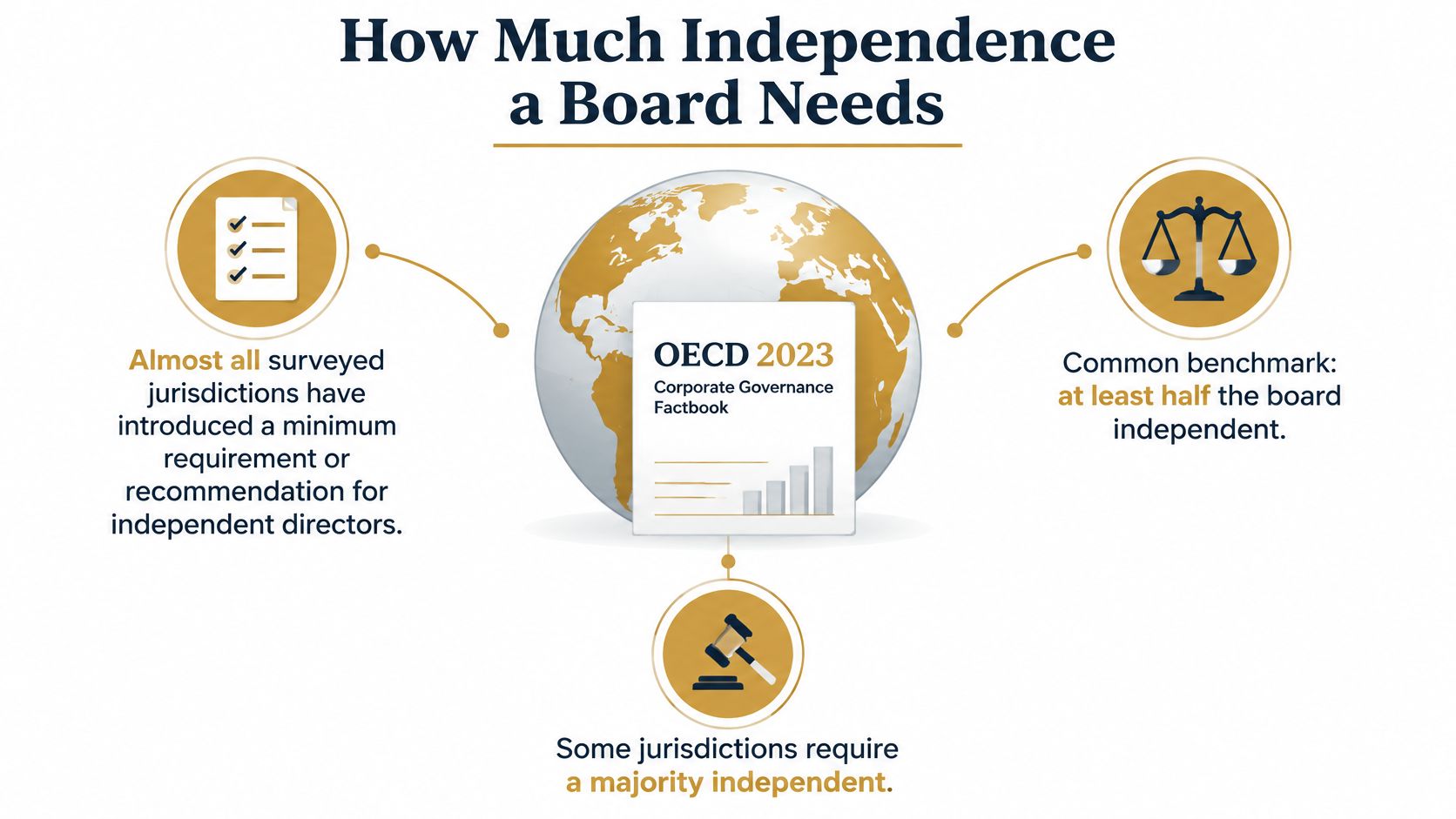
A five-person board facing an at-least-half independence standard needs three independent directors if the rule applies to the full board. The same board could meet a fixed minimum of two with only two. The required number depends on the governing regime, the board's size and which directors count toward the threshold.
The OECD's 2025 Corporate Governance Factbook board comparison describes common minimum benchmarks of two to three independent members or at least 30% of the board, alongside stronger recommendations of at least 50%. These are reference points, not universal rules: the issuer's jurisdiction and listing requirements determine which thresholds apply.
Independence benchmarks by regime
| Benchmark | Threshold or count | Source |
|---|---|---|
| Common minimum requirement or recommendation | Two to three independent members or at least 30% of the board | OECD 2025 Corporate Governance Factbook |
| Stronger recommendation | At least 50% of the board | OECD 2025 Corporate Governance Factbook |
| UK Code standard | At least half the board, excluding the chair, as non-executive directors considered independent | UK Corporate Governance Code |
| Jurisdictions requiring independence by law, regulation or listing rules | Requirements vary by jurisdiction | OECD 2025 Corporate Governance Factbook |
| Jurisdictions relying on governance-code recommendations only | Requirements vary by jurisdiction | OECD 2025 Corporate Governance Factbook |
| Independent directors at U.S.-listed companies covered by Glass Lewis | 77.5% in the 2025 proxy season, up from 77.1% in 2024 | Glass Lewis board composition analysis |
| Independent board chair at S&P 500 companies | 39% in 2024 | 2024 U.S. Board Index |
The benchmarks show why percentage alone can mislead. A fixed minimum and a percentage threshold produce different seat counts, while a comply-or-explain recommendation may call for an explanation rather than determine legal eligibility.
Calculate the seats, not just the percentage
For a hypothetical nine-person board, a fixed minimum of two requires two independent directors. An at-least-half requirement applied to the entire board requires five, since four would fall below half.
Check the denominator. A rule that excludes the chair produces a different calculation from one that covers every director. Also establish whether the proposed appointment expands the board or replaces an existing member.
In the United States, controlled-company status may permit exemptions from certain majority-independence, compensation and nomination requirements under the applicable exchange framework. It should not be assumed to remove audit-committee obligations. The relevant calculation begins with the issuer's jurisdiction, listing venue, ownership classification, applicable exemptions and committee vacancies.
Audit and Compensation Committee Tests in the United States
U.S. committee independence and composition requirements
| Committee or test | Minimum requirement | What it means for a candidate |
|---|---|---|
| Audit committee | At least three members under the Nasdaq framework | Each member must pass exchange and Rule 10A-3 independence tests |
| Audit look-back | No participation in preparing the company's or a current subsidiary's financial statements in the preceding three years | Can exclude recent finance staff |
| Audit fees | No consulting, advisory or other compensatory fees from the issuer, apart from permitted board or committee compensation | Advisory income can disqualify a candidate |
| Financial literacy | Ability to read a balance sheet, income statement and cash-flow statement | Must be evidenced, not assumed from seniority |
| Compensation committee | Solely independent directors, or determination or recommendation by a majority of independent directors under the applicable framework | Governs CEO and executive pay |
| Nominations | Majority of independent directors or wholly independent committee | Governs director selection |
Nasdaq's governance rules generally require an audit committee of at least three directors, financial-statement literacy and no participation in preparing the company's or a current subsidiary's financial statements during the preceding three years.
The audit-fee and affiliation restrictions arise from Exchange Act Rule 10A-3; the SEC's exchange-rule approval document also explains the independent-director arrangements for executive compensation and nominations. Read the table as a screening framework, not as a claim that every U.S. exchange uses identical committee architecture.
Why a board-qualified candidate can fail the audit test
General board independence and audit-committee eligibility are separate determinations. Under the federal audit standard, a member generally cannot receive consulting, advisory or other compensatory fees from the issuer beyond permitted board or committee service, or be an affiliated person of the issuer or its subsidiaries.
Consider an experienced CFO who now consults for the target company. Strong financial credentials don't neutralize the consulting-fee restriction. Likewise, familiarity with the accounts isn't enough if the candidate's recent involvement in preparing them creates a separate eligibility problem.
Financial literacy needs its own evidence. Identify responsibilities involving financial-statement review, accounting judgments, reporting controls and discussions with external auditors. Don't expect a senior title to demonstrate every required competency.
Treat exceptions as exceptions
A SEC-filed audit-committee charter illustrates a limited framework allowing one otherwise non-independent director where the federal independence test is satisfied, the person isn't a current officer, employee or such a person's family member, and the board documents and discloses its shareholder-interest rationale.
That isn't a general permission to waive independence. The issuer must establish that the relevant exception applies.
Write the candidate's independence note in distinct parts: general board eligibility, audit eligibility, compensation eligibility and nomination eligibility. For each, identify the applicable standard, supporting facts and unresolved questions. That structure lets the nomination committee assess the actual vacancy rather than infer committee readiness from a broad assertion.
Tenure and Behavioral Judgment Beyond the Checklist
A director's independence questionnaire is clean. No employment, no material fees, no family tie to management. Once service has run long, the nomination committee still has a harder test: does that director use what they know to challenge management, or has familiarity become a reason to protect it?
The OECD's analysis of board composition describes how many jurisdictions set maximum-tenure rules for independent directors, with typical limits that differ widely. Service often lasts long enough for institutional memory and close working relationships to grow side by side.
Those rules do not show that keeping or replacing a particular director causes better results. They support a narrower conclusion: tenure should trigger structured scrutiny, not an automatic behavioral verdict.
Separate institutional knowledge from entrenched loyalty
One long-serving director remembers why an earlier strategy failed and recognizes the same forecasting error in a new plan. Another has grown reluctant to press the executive team that has supported every reappointment.
Look for the difference in recorded conduct.
Minutes or appropriately shareable records should show a substantive concern, not merely attendance. The director should be able to explain how they questioned a dominant CEO or founder without making the dispute personal. Committee decisions should show scrutiny of reporting, remuneration or risk rather than routine endorsement. Disclosure, withdrawal and follow-up should show how competing interests were handled. Constructive access to management should still leave room for uncomfortable questions.
Match the example to the decision in front of the board. A repeated strategy needs the earlier failure named. A pay or reporting item needs committee work that went past endorsement. A conflict needs the record of disclosure, withdrawal and what happened afterward. A passed relationship test does not answer any of those questions.
Long service can provide context. The board must still test whether the director uses that context to scrutinize management or excuse it.
Review reappointment scrutiny, committee rotation, private-session practices and access to independent advice alongside tenure. These are practical places to see whether board relationships still permit challenge.
Use the Board Role Fit Checklist to connect your experience with the target board's needs. Prepare two or three examples of independent judgment, recording dates, participants, the issue challenged and the outcome. Respect confidentiality: describe your contribution accurately without sharing restricted minutes or privileged material.
Matching Independence to the Board Risk You Face
A listed manufacturer loses a major customer. Guidance still assumes the lost volume returns within two quarters. Two directors both clear the formal independence tests. One asks which contracts support that recovery and what a miss does to covenants. The other accepts the forecast because no disqualifying relationship appears on the form.
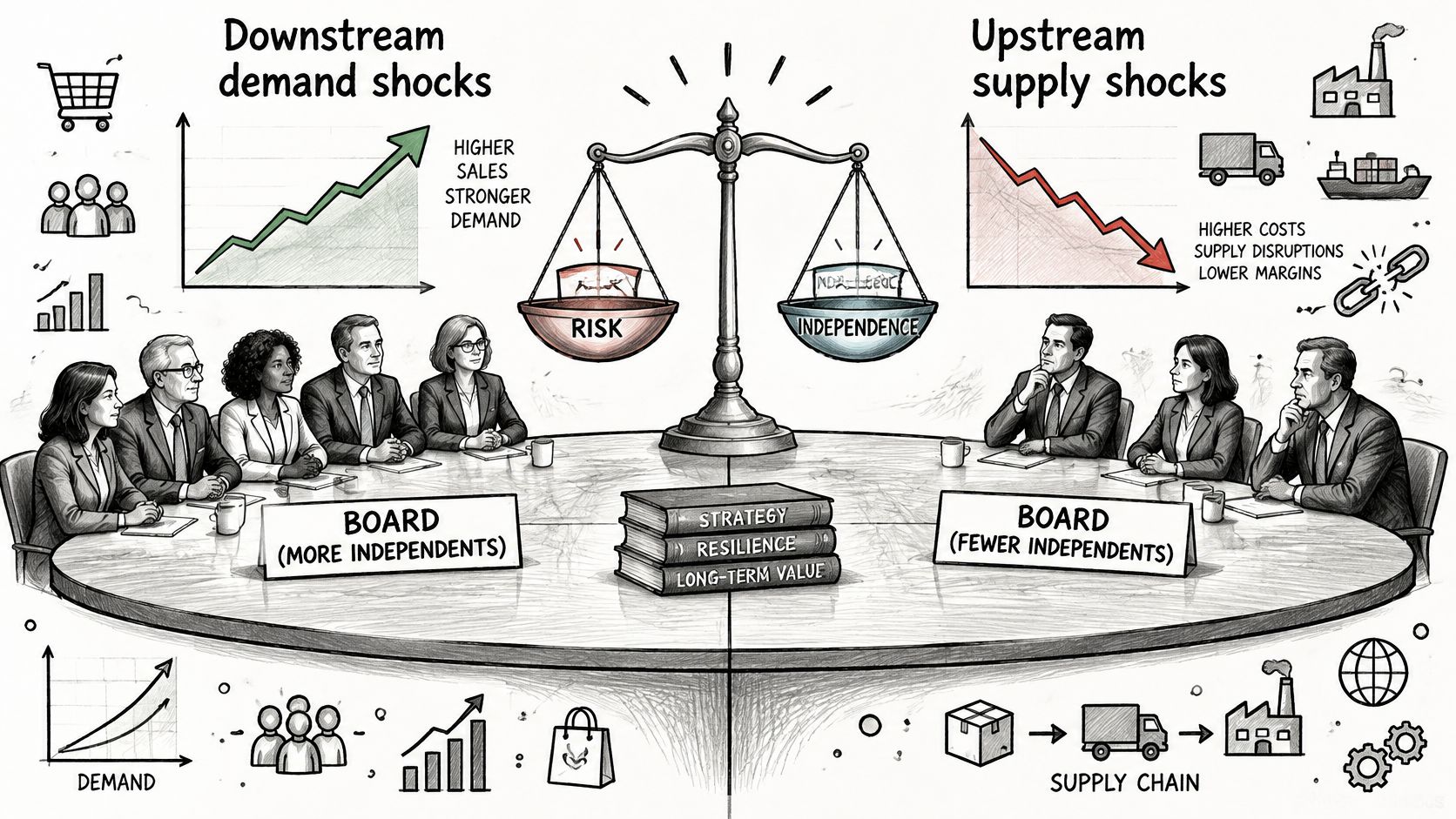
Independence is a monitoring capability. It does not, by itself, predict financial performance. A study of downstream demand shocks found a positive association between board independence and performance when firm-specific product demand declined, stronger among smaller, high-growth firms and companies with more volatile stock returns. The practical reading is conditional. Independent monitoring is most relevant when the board must test management under adverse conditions, not as a standing claim that more independent directors produce better results in every setting.
Routine advice and monitoring answer different problems. A board that mainly needs sector judgment will look for a different record from a board facing weak controls or a strained capital plan.
Bring evidence for the actual risk
Board risk problems and the independence evidence to show
| Board risk problem | Independence evidence to show | Why it matters |
|---|---|---|
| Demand shock or downturn | Recorded challenge to optimistic forecasts | Tests management assumptions under adverse conditions |
| Crisis oversight | Documented escalation and intervention | Shows willingness to act under stress |
| Capital allocation | Questions on investment cases and hurdle rates | Helps scrutinize weak large commitments |
| Control weaknesses | Pressure for remediation of audit findings | Shows follow-through on unresolved control gaps |
| Stable routine operations | Sector expertise and advisory contribution | Demonstrates useful contribution beyond formal eligibility |
These are selection criteria, not promises of performance. A candidate who challenged an investment case should name the assumptions tested, the hurdle rate in dispute, and the decision that followed. Dissent by itself does not establish that the challenge improved the outcome.
For paid board positions, read the risks already visible in the company's disclosures, strategy, and committee remit before you choose which examples to offer. A cyber specialist and a restructuring CFO may both qualify as independent and still supply very different oversight. One is relevant where control findings keep recurring. The other is relevant where liquidity, covenants, or a restructuring timetable dominate the agenda.
Use the video as a prompt for how that oversight looks once a specific risk is on the table, rather than as a general lecture on independence.
Name the target board's most pressing risk problems, then select the evidence that addresses them. A clean independence test shows you are eligible to monitor. It does not show that you have monitored the problem this board faces.
Confirm Your Independence Before You Apply
A nomination committee can set aside a strong candidate when the independence note says "eligible" and the file does not show why. Prepare an evidence-backed independence note before you make an unqualified statement in an application. Keep factual disclosure separate from the board's eventual determination, and mark unresolved questions clearly. A relationship that clears a bright-line test still has to be shown as conduct: what you reviewed, whom you challenged, and which decisions you would decline because of a conflict.
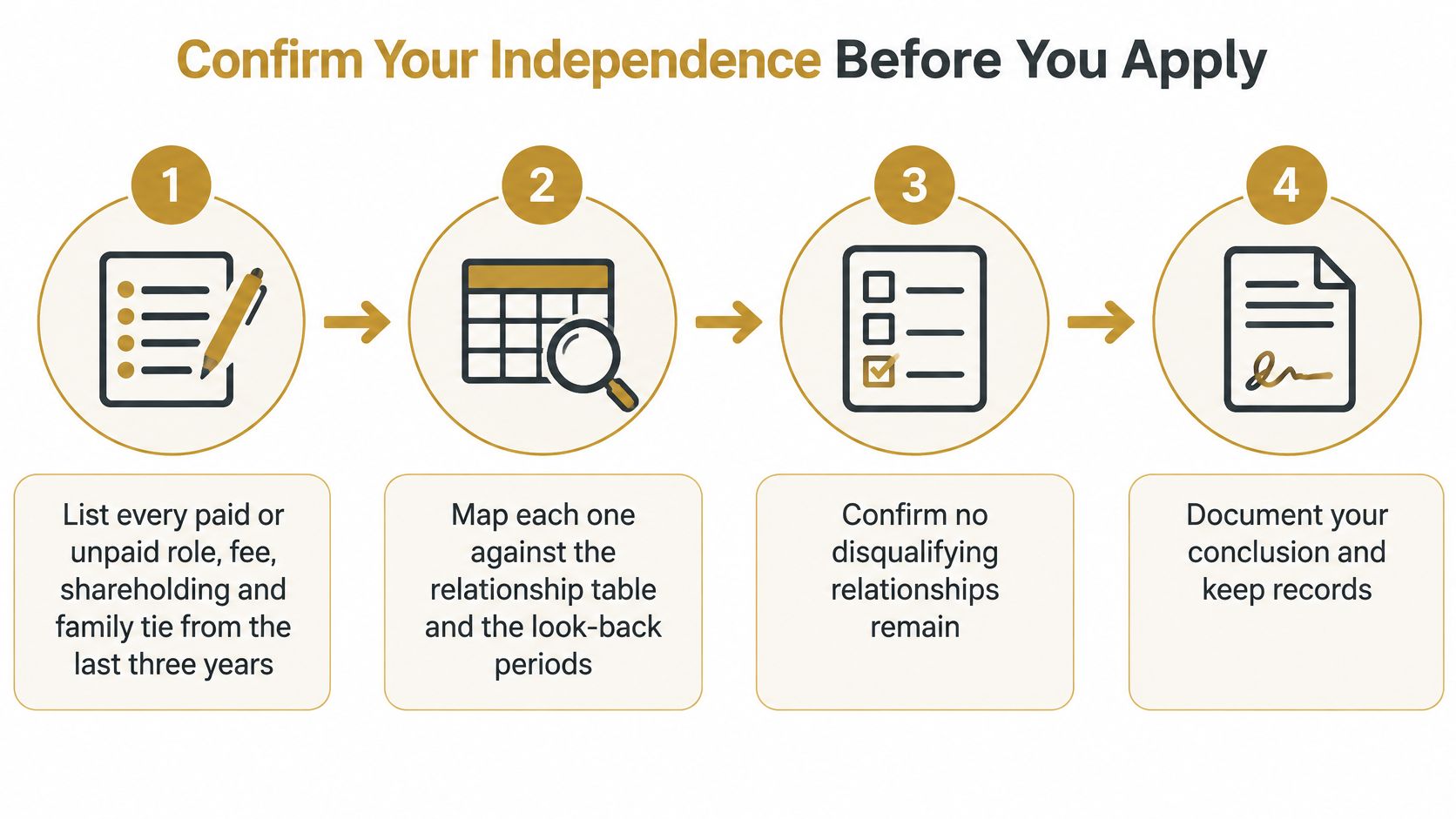
- List your connections. Start with every paid or unpaid role, fee, shareholding and relevant family tie from the last three years. Extend the history wherever the applicable rule requires a longer period. This initial inventory is not a universal legal look-back.
- Map each connection to a test. Record the relationship, relevant dates, supporting document and applicable restriction. Do not leave an uncertain answer hidden behind a general declaration.
- Check the target board's composition. Confirm its jurisdiction, listing regime, proportion requirement and tenure provisions. Establish which committee the appointment is intended to serve.
- Write separate conclusions. Distinguish the general board test from each committee test. State the facts supporting eligibility and identify matters requiring issuer or legal review.
- Attach behavioral evidence. Pair claims about objective judgment with dated examples, outcomes and participants. Match those examples to the risk in the charter and the committee remit. Use references or permitted summaries where original records are confidential.
- Flag matters requiring review. Identify relationships needing disclosure, clarification or resolution before appointment. Do not describe a potentially disqualifying connection as cleared until the appropriate assessment is complete.
The visual summarizes the documentation workflow, but the applicable rules determine whether a relationship is disqualifying.
Turn the assessment into application materials
SeatSignal's placement program flags pre-public board seats, hand-picks open roles that fit the member, and prepares director-grade application packets, with warm-path introductions when suitable connections exist. Each packet includes a board CV, a cover letter aligned with the board charter and gap, a fit memo, and an independence note or attestation. The same materials can be prepared for a role the member finds outside SeatSignal's inventory.
The placement team runs each stage and maps the warmest route in. Members review and approve what is drafted, then send applications in their own name. A completed note gives the committee a record it can test. It does not decide the appointment.
Use the free Board Role Fit Checklist and Board Offer Due Diligence Checklist to test suitability before committing, and the Board Readiness Assessment to identify preparation gaps. Complete the six checks this week and bring the resulting relationship inventory and evidence summary to your first board conversation.
SeatSignal connects board opportunity matching with application preparation, including an independence note that addresses the target role's governance requirements. Visit SeatSignal to build a board search around your eligibility, committee fit and evidence of independent judgment.
Want a paid board role, done for you?
One handpicked, verified open board role every week, with a director-grade packet tailored for it.
Get Started