Directors at Large: Duties, Authority, and Board Fit

A director at large is a full voting board member who represents the whole organization rather than a specific constituency or officer portfolio, carrying the same fiduciary duties as every other director. The seat carries a single vote, not a smaller share of responsibility.
The advice to treat an at-large appointment as an easy entry into governance is misleading. A seat without a named portfolio can require especially broad judgment because the director must contribute across the organization's agenda, not retreat behind a particular specialty.
For an executive considering an appointment, the important question isn't whether the title sounds senior. It's what accountability you're accepting, what authority you have, and why the board needs your judgment.
Table of Contents
- What a Director at Large Actually Is
- How At-Large Directors Differ from Constituency Directors
- Core Responsibilities and Limits of Authority
- How Board Composition Shaped the At-Large Role
- Real-World Examples of Directors at Large
- How to Position Yourself for an At-Large Seat
- Key Takeaways and Your Next Step
What a Director at Large Actually Is
At large describes the scope of the seat, not its rank. Think of the distinction between a representative elected by a particular district and someone elected across the whole community. The latter has no smaller mandate because no district appears beside their name.
Organizations use different appointment arrangements, so don't assume every at-large director is elected by the full membership. An at-large director may be elected or appointed under the governing documents. The central idea is organization-wide responsibility without a designated officer portfolio.
The defining features
The role has several connected characteristics:
- Full voting membership. The director participates in collective board decisions with the same single vote as other directors.
- No designated officer portfolio. The title doesn't, by itself, make the person chair, secretary, or treasurer.
- Shared governance accountability. Strategic, financial, and fiduciary responsibilities still apply.
These distinctions are reflected in TotalHOA's explanation of the director-at-large role, including the difference between board membership and authority to act individually.
The concept map below separates the seat's broad mandate from the mistaken idea that it's a junior appointment.
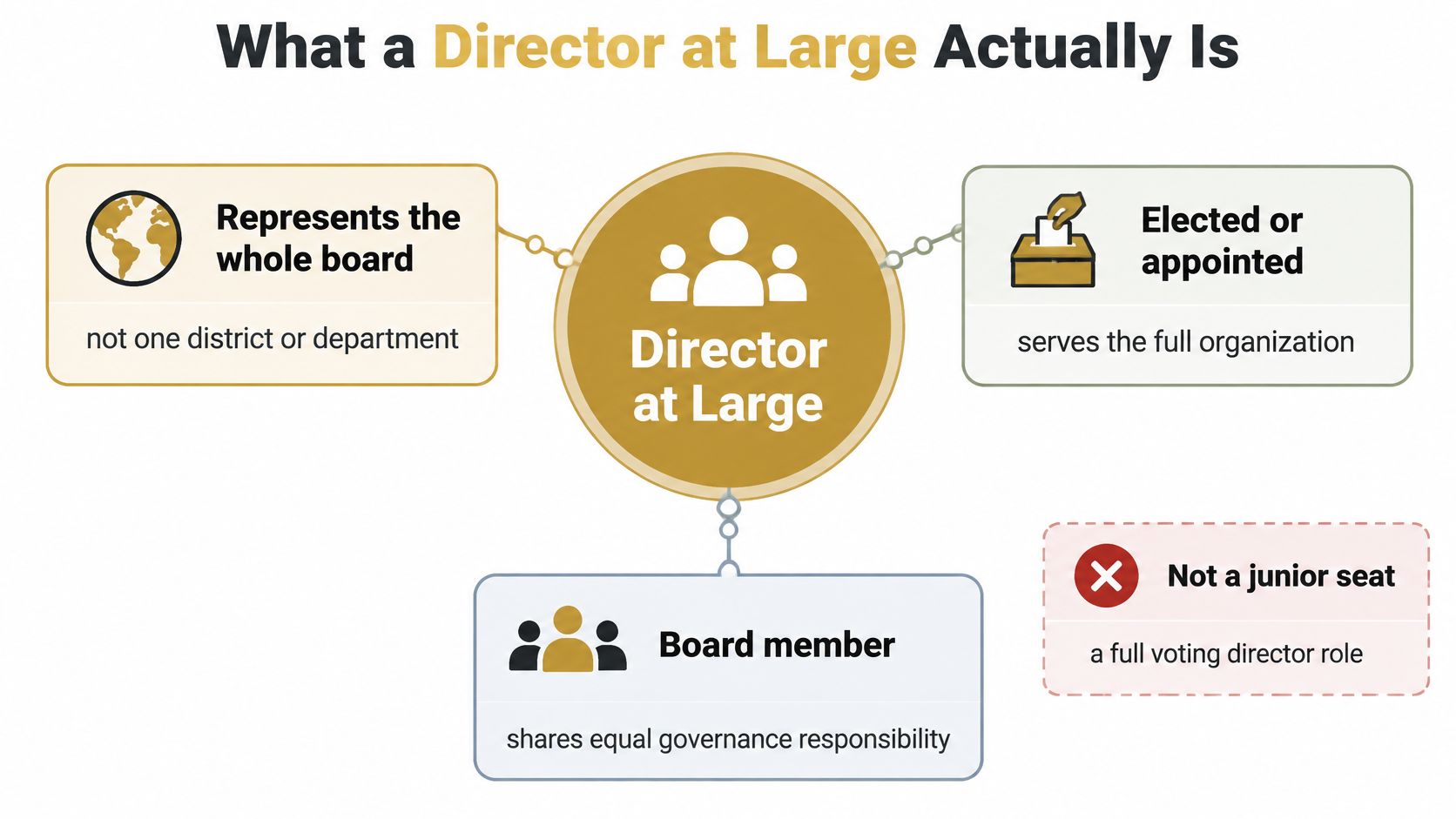
A seat, not a spare pair of hands
Consider a board discussing whether to expand into a new service area. An at-large director doesn't wait for an officer to assign an opinion. They examine the proposal, question assumptions, consider organizational consequences, and vote.
Nor should the absence of a portfolio turn the director into a floating operational assistant. Helping management with occasional expertise is different from becoming an unofficial executive.
Practical rule: Read “at large” as a description of representation, never as permission to contribute less.
The broader field of board of directors positions helps distinguish membership, officer responsibilities, and committee assignments. Those categories can overlap, but they answer different questions: whether you sit on the board, what formal office you hold, and where you perform detailed oversight work.
The simplest explanation is this: an at-large director is a full board member whose mandate isn't confined to a designated constituency or officer function.
How At-Large Directors Differ from Constituency Directors
The most useful comparison separates how someone reaches the board from how they must exercise judgment once there. A constituency may choose a director, but that doesn't automatically authorize the director to favor that constituency at the organization's expense.
The precise obligations depend on the applicable legal framework and governing documents. Treat the following as a practical comparison, not a substitute for reading the organization's rules.
At-Large Directors Compared with Other Board Roles
| Seat Type | Who They Represent | Voting Rights | Typical Purpose |
|---|---|---|---|
| At-large director | The organization broadly, without a designated constituency portfolio | Full board vote | Add organization-wide judgment or a needed perspective |
| Constituency-elected director | Selected through a shareholder group, district, chapter, or membership class | Usually a full board vote, subject to governing rules | Bring knowledge of a defined constituency into board deliberations |
| Officer director | The organization, with an additional named office | Board vote when also a director | Carry chair, secretary, treasurer, or other designated responsibilities |
| Advisory or emeritus member | Depends on the advisory mandate or honorary appointment | May have no board vote | Provide expertise, continuity, or counsel without necessarily holding a director's seat |
An at-large appointment might come through an organization-wide election or an appointing body. What matters is that the director isn't occupying a seat reserved for a particular chapter, investor group, or district.
A constituency-elected director contributes knowledge that other directors may lack. For example, a regional representative can explain how a proposed membership policy would affect local chapters. That insight improves deliberation, but the board must still examine the organization-wide consequences.
Where the distinctions matter
Suppose a regional chapter wants the association to retain an expensive service that few other members use. The regional director can make the chapter's case. The at-large director should test that case against mission, resources, fairness, and alternatives, rather than act as another regional advocate.
An officer director differs for another reason: the person holds an office with defined responsibilities. The chair's meeting leadership or the secretary's recordkeeping role doesn't make other directors subordinate voters.
An adviser or emeritus member may offer excellent counsel without holding decision-making authority. Before accepting such a title, establish whether it creates actual board membership.
- Check the appointment route. Who elects, appoints, renews, or removes the person?
- Check the mandate. What constituency, if any, is attached to the seat?
- Check the decision rights. Can the person vote, and on which matters?
A board role fit checklist can organize those questions before you apply. The practical attraction of an at-large seat is flexibility: the board can seek a missing perspective without attaching it to an existing constituency.
Core Responsibilities and Limits of Authority
A director at large works through the board, not above it or beside it. That distinction becomes important when an experienced executive joins and instinctively starts solving problems personally.
The director should scrutinize strategy, financial stewardship, risk, confidentiality, and conflicts. But the executive habit of giving instructions must give way to a governance habit: ask, test, deliberate, decide collectively, and monitor.
Collective authority versus individual action
| Board-level contribution | Action requiring separate authorization |
|---|---|
| Challenge the assumptions behind a proposed contract | Sign the contract for the organization |
| Assess management's spending proposal | Commit expenditure personally |
| Request clearer reporting through agreed channels | Direct employees outside an authorized arrangement |
| Recommend a policy change | Announce that the policy has changed before approval |
The governing documents and any express board delegation determine the details. Without that authority, a director generally can't bind the organization merely because they hold a board seat.
The ability to influence a decision is not the same as permission to implement it.
A useful example is a director who identifies a weakness in purchasing controls. The governance response is to raise the issue, seek an appropriate review, and ensure management addresses it. Personally taking over procurement can blur accountability and leave employees unsure whose instructions govern.
The committee-liaison function
An at-large director may also connect committee work to the full board. A committee liaison should explain the decision needed, material risks, unresolved questions, and implications for the organization, rather than repeat meeting minutes.
Before accepting, clarify the practical support behind that responsibility:
- Information access. Establish how you obtain papers, management explanations, and committee reports.
- Protection arrangements. Review applicable indemnification provisions and directors' insurance.
- Performance expectations. Ask how preparation, participation, judgment, and committee contribution are assessed.
The time commitment deserves equal scrutiny. NACD's 2025 boardroom reporting describes annual independent-director commitments rising from under 250 hours a decade earlier to nearly 300 hours, with 74% of directors reporting more agenda topics and 73% reporting more issues to monitor.
Those figures concern independent directors, not a distinct at-large category, but they provide relevant workload context. Use a board time commitment calculator to test your availability against preparation, meetings, committee work, and unexpected events, not just the published calendar.
How Board Composition Shaped the At-Large Role
The history of board independence helps explain why a seat without a narrow portfolio can be valuable. It doesn't establish a universal origin for the title “director at large,” but it does explain the governance expectations surrounding modern board service.
The timeline below connects governance reform with the growing importance of organization-wide challenge and complementary capabilities.
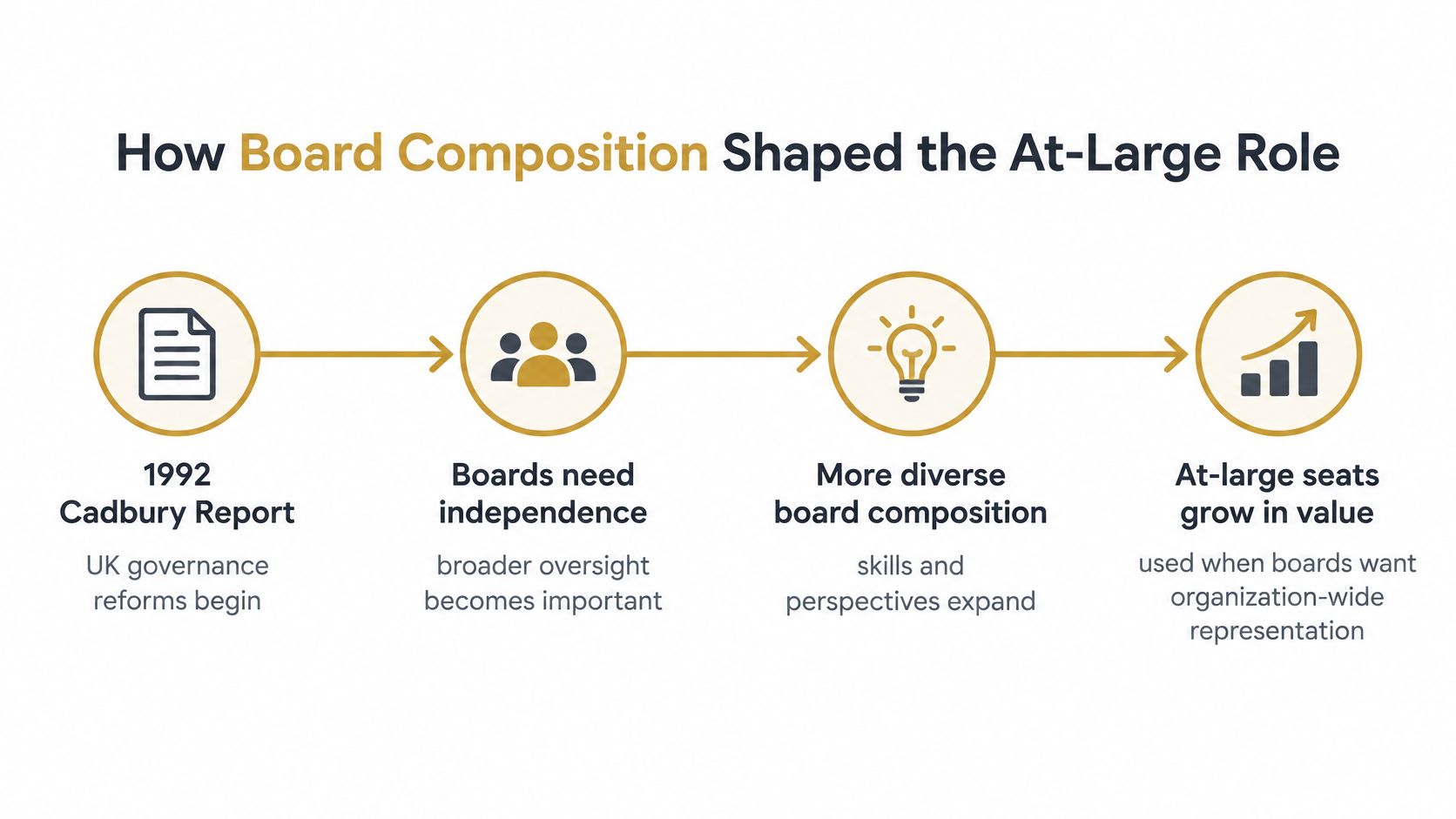
From independence to a balanced board
The 1992 Cadbury Report, developed after corporate failures and scandals, helped establish the importance of non-executive directors capable of challenging management. The subsequent UK governance framework evolved through the Combined Code and Corporate Governance Code, as described in the Financial Reporting Council's corporate-governance overview.
Independence assessment came to consider relationships that could compromise judgment, including recent employment, business ties, additional remuneration, close family connections, cross-directorships, significant-shareholder representation, and extended service. The important lesson is that independence requires examination, not inference from a title.
At large and independent answer different questions. An at-large director can have relationships that affect independence. An independent director can hold a committee or officer role.
Why composition changes the opportunity
Boards also need relevant knowledge. Independence without the ability to understand the business won't produce informed challenge; deep company knowledge without sufficient objectivity can create a different weakness.
A 2023 institutional board-composition study reported independent representation of 42.7%, up from 26.7% in 2015, within its measured population. That finding isn't a global benchmark, but it illustrates how substantially the desired mix can change.
For an at-large candidate, the useful inference is practical:
- Identify the missing capability. Audit, technology, regulation, or stakeholder oversight may deserve attention.
- Connect it to board decisions. Explain which questions you would help directors evaluate.
- Test independence separately. A useful skill doesn't remove a conflict.
This accompanying video offers another way to consider the governance context.
The at-large seat can provide room for that capability without creating a new constituency entitlement. Its value comes from what the director adds to deliberations, not from leaving the portfolio undefined.
Real-World Examples of Directors at Large
The following scenarios are illustrative, not accounts of named appointments. In each setting, the governing documents would determine the actual title, election process, powers, and duties.
Different organizational settings make the same broad mandate easier to recognize.
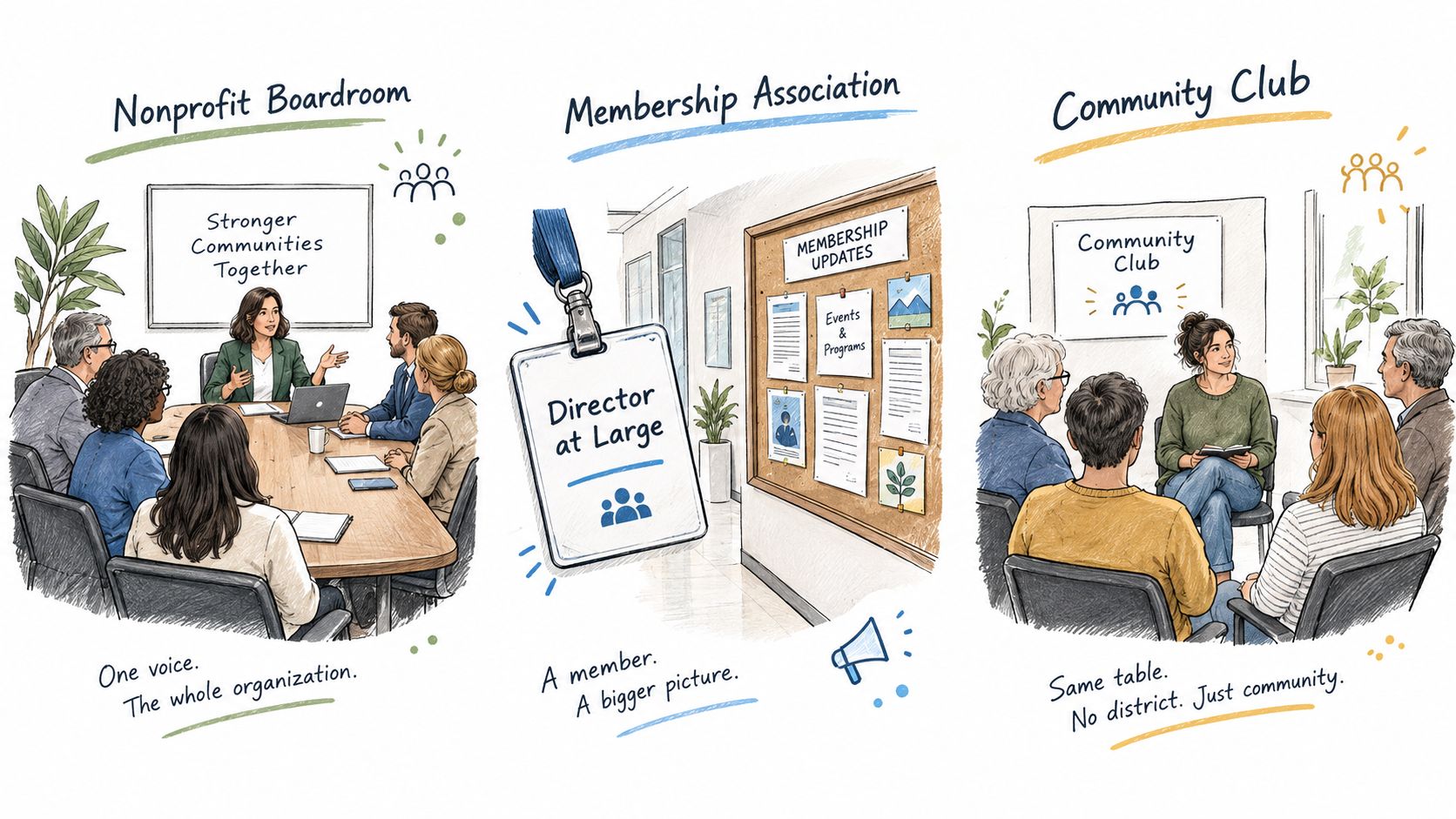
Corporate and nonprofit decisions
A company's board has experienced commercial directors but limited familiarity with technology risk. It considers an at-large candidate who can evaluate management's reporting on cybersecurity, investment priorities, and operational resilience. The candidate's task wouldn't be to become the outsourced technology chief.
What makes the mandate different: technical knowledge must improve enterprise decisions, not create a private departmental brief.
In a membership association, regional chapters elect their own representatives while the full membership elects an at-large director. The board must decide whether to fund local events or a shared member service. The at-large director tests the options against benefits across the membership.
What makes the mandate different: the director has no reserved chapter interest to advance.
Community and foundation decisions
On a homeowners' association or condominium board, an at-large director might liaise with an architectural committee. If a proposed rule creates maintenance costs, the director brings that financial implication to the board instead of treating design approval as an isolated issue.
What makes the mandate different: the liaison connects specialized work to the community's wider obligations.
A university or hospital foundation could appoint an at-large trustee while other trustees arrive through alumni, donor, or institutional relationships. When a donor-backed proposal would require continuing expenditure, the at-large trustee examines mission alignment and sustainability alongside fundraising appeal.
What makes the mandate different: the trustee weighs the institution's needs without treating a particular donor's preference as decisive.
A specialist earns the board's confidence by connecting their expertise to decisions everyone must own.
Across these scenarios, the useful candidate isn't merely someone who knows a subject. It's someone who can explain its significance, listen to competing considerations, and help colleagues reach a defensible decision.
Candidates exploring paid board positions should therefore investigate the specific mandate rather than infer compensation, workload, or authority from the title. Similar labels can conceal very different appointment terms.
How to Position Yourself for an At-Large Seat
A nomination committee isn't choosing only the most accomplished executive. It's deciding whose contribution best complements the people already around the table.
Ofwat's governance principles provide a concrete benchmark: appointments should follow a formal, rigorous, and transparent process, consider the board's balance of skills, experience, independence, and company knowledge, and be led by a nomination committee with a majority of independent non-executive directors. That is a framework-specific requirement, not a universal rule for every organization.
The preparation process should reflect that whole-board assessment.
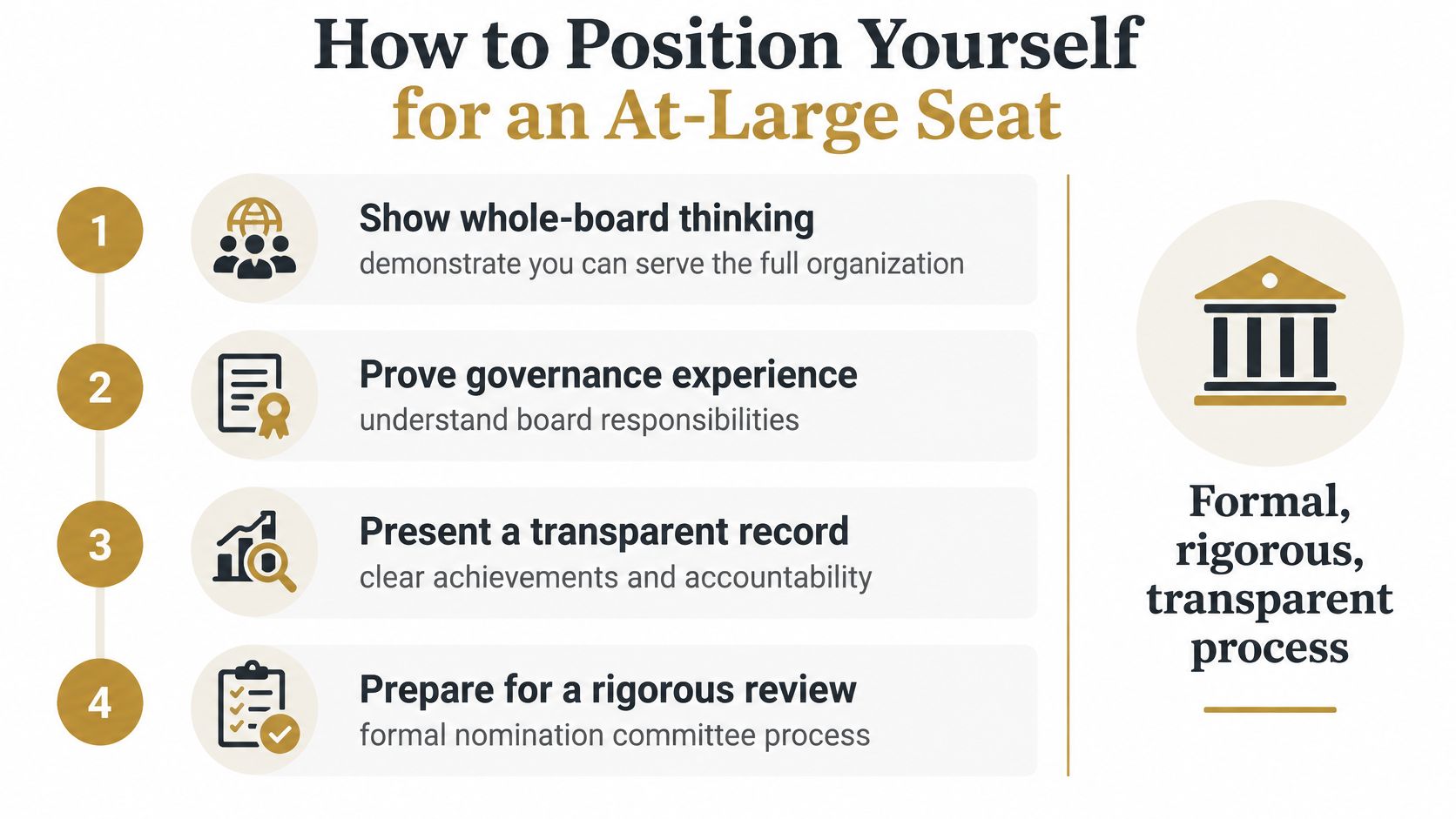
Translate achievement into oversight evidence
An executive CV may emphasize what you personally delivered. A director application must also show how you evaluate other people's proposals, manage disagreement, and maintain accountability.
Prepare evidence that answers these questions:
- Collective judgment. When did you help a group improve a decision rather than secure approval for your own?
- Escalation. How did you recognize an issue that required higher-level attention, and what information did you provide?
- Policy formation. Can you show how you helped establish a durable decision rule rather than solve an isolated problem?
- Governance boundaries. When did you hold management accountable without taking over its work?
- Composition fit. Which identifiable gap would your experience address?
Where you have reliable figures from your own record, quantify the scope of the governance problem. Don't substitute an impressive operating result for evidence of judgment.
Prepare for a continuing commitment
NACD's 2024 Russell 3000 review reported an average director age of 61 and average board tenure of seven years; chairs averaged 13 years as directors and seven years as chair. These are descriptive figures, not eligibility criteria.
They do underline that an appointment belongs within a longer governance career. Think about continuing education, future committee responsibilities, and the time you can sustain, rather than treating the first appointment as a completed objective.
Use the board readiness assessment to organize your preparation. Then write a short proposition explaining the board's apparent gap, the evidence you bring, and how your contribution would strengthen collective oversight.
Key Takeaways and Your Next Step
"At large" describes the scope of your accountability, not the weight of your vote. The seat carries the same voting power as every other seat at the table, exercised across the whole organization rather than on behalf of one constituency. Candidates who read the title as a lighter or honorary role walk into interviews with the wrong posture, and nomination committees notice quickly.
Three distinctions are worth keeping in view. The voting mandate is substantive, so treat the appointment as a real governance position. Individual authority has boundaries, so act through collective deliberation unless a specific delegation says otherwise. And fit requires evidence, because committees select for judgment across the enterprise, not expertise in a single silo.
Turn understanding into a targeted search
Before pursuing an opportunity, write a short account of the contribution you intend to make. Name the organizational issues you understand, the oversight evidence you can point to, and the conditions under which you could serve well.
Then test each opening against that account. A recognizable name or an appealing title means little if the mandate is vague, the expected contribution sits outside your experience, or the workload is more than you can sustain. Committees evaluating at-large candidates are asking a specific question: can this person exercise judgment over everything the board oversees? Your materials should answer it directly.
The goal is a credible case for the seats where your judgment fits, not availability for anything.
How our placement process works
SeatSignal offers Done-For-You Board Placement: our team handpicks relevant open board roles and prepares a director-grade application customized for each opportunity. You review the roles we surface, approve the materials we draft, and send every application in your own name. We are not a search firm, so we do not represent you to boards or negotiate on your behalf.
Every plan includes:
- Human-checked opportunities. Hand-picked board roles reviewed by a person, plus pre-public seat matching across every sector.
- Relationship support. Warm-path introductions when available.
- Board-specific application materials. A director-grade packet for each board: customized CV, cover letter, fit memo, and independence note.
- Targeted preparation. Interview preparation built around that specific board, with a placement team reviewing what reaches you.
Preparation is where our role ends and the decision begins. Boards, nomination committees, and recruiters make every appointment decision; our job is to make sure your record arrives as a clear, board-specific case rather than a generic executive CV.
"The generous mentorship is exactly the type of high-level support SeatSignal delivers to those pursuing impactful, paid board roles," says Rebecca Cawood, Non-Executive Director and Chair at UNE Life Pty Ltd.
If you're pursuing an at-large seat, visit SeatSignal to turn your executive experience into a targeted case for whole-board service.
Want a paid board role, done for you?
One handpicked, verified open board role every week, with a director-grade packet tailored for it.
Get Started