Directors Position Description: What to Include in 2026

A director can have impressive credentials and still be the wrong person for the board: in 2025, 55% of directors said at least one colleague should be replaced, the highest level in the survey's history, according to PwC's Annual Corporate Directors Survey. Seniority alone doesn't establish fit. A useful directors position description explains the decisions the seat involves, the evidence a candidate needs, and the limits of their authority.
Table of Contents
- What a Directors Position Description Sets Out
- Core Responsibilities Every Director Description Should Name
- Where Oversight Ends and Management Begins
- Qualifications and Evidence by Committee Role
- Time Commitment and Ongoing Expectations
- How to Write a Director Position Description
- Confirm the Fit Before You Apply
What a Directors Position Description Sets Out
A directors position description is a governance and oversight mandate, not an operational management job. Its purpose is to explain how a board member contributes to collective decisions and holds management accountable, rather than directing employees' daily work.
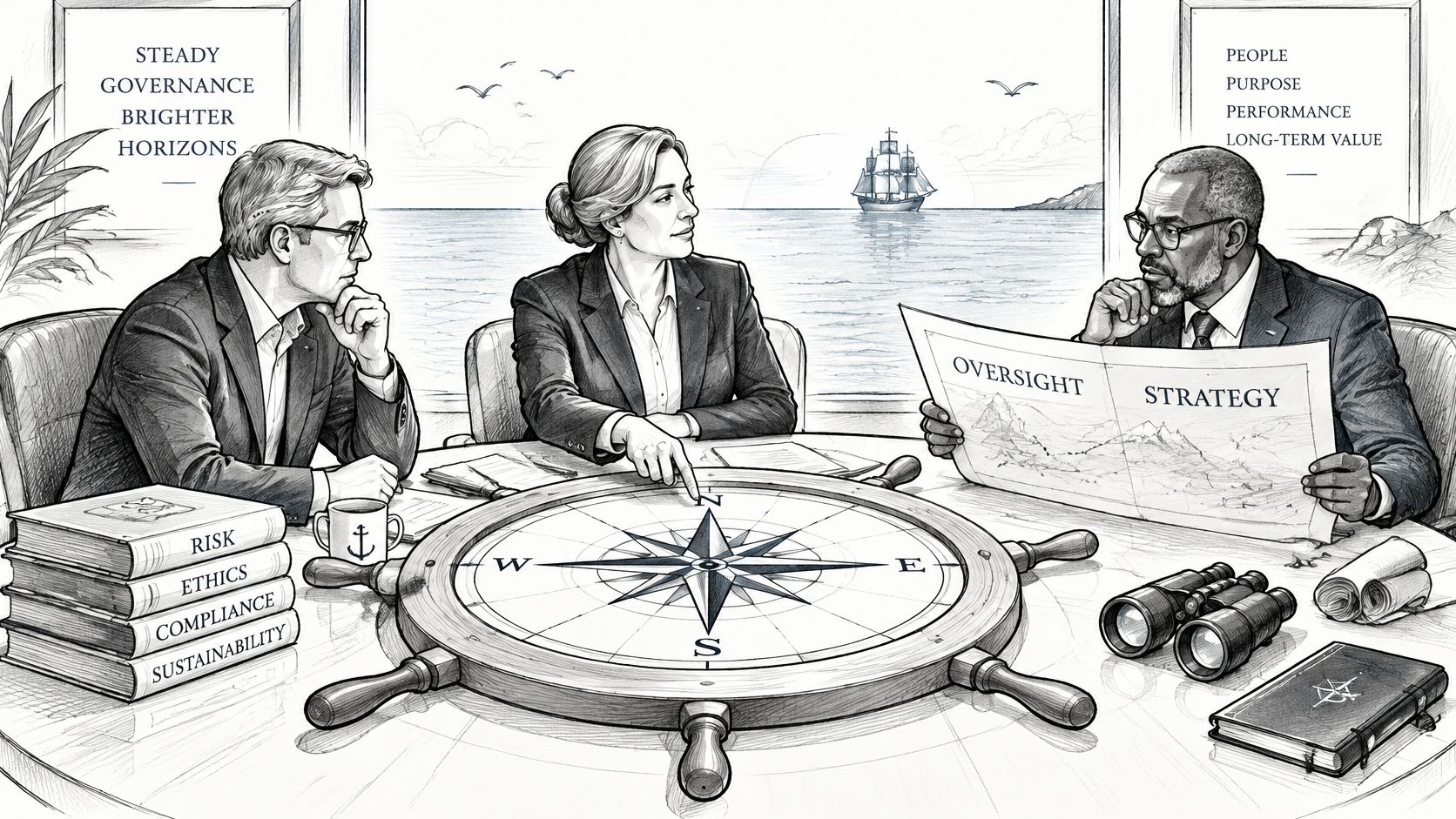
Think of the board as a ship's steering committee. It agrees the course, checks progress, and challenges whether the vessel has sufficient resources and safeguards. The crew runs the engine room; the committee doesn't assign every task below deck.
That distinction is reflected in the G20/OECD Principles of Corporate Governance 2023, which identify strategy, policies, performance assessment, financial oversight, management monitoring, conflicts of interest, and risk and legal compliance as core board responsibilities.
The visual captures the board's directional role.
Define the seat rather than the candidate's prestige
A useful description names the oversight areas assigned to the seat, expected committee work, independence requirements, and preparation obligations. It also explains the CEO's responsibility for execution. An executive director may have management duties through a separate employment role, but those shouldn't be confused with their responsibilities as a board member.
Governance codes provide a baseline. Local company law, the organisation's constitution, and applicable listing rules determine the precise legal duties and appointment conditions.
When comparing board of directors positions, look beyond the sector and title. Establish whether the opportunity is a statutory directorship, an advisory appointment, or an executive job with director in its title.
A credible description should answer these questions:
- Role coverage: What must the director oversee, challenge, and decide?
- Candidate qualifications: What evidence demonstrates readiness for this particular seat?
- Practical demands: What will the appointment require in time, preparation, and judgment?
Core Responsibilities Every Director Description Should Name
Core director responsibilities and what the description should specify
| Responsibility area | What the board does | What the description should specify |
|---|---|---|
| Strategy and purpose | Sets the company's purpose, values and long-term strategy | Board-reserved strategy decisions, planning cycle, strategy sessions per year |
| Major decisions and transactions | Approves acquisitions, divestitures, capital expenditure and annual budgets | Approval thresholds and the transactions that require full-board sign-off |
| Performance monitoring | Reviews financial and non-financial results against plan | Scorecards, reporting frequency and the metrics the director must review |
| Financial reporting and controls | Oversees financial statements, audit and internal control systems | Audit committee duties, reporting lines to external auditors, control reviews |
| Risk and compliance | Maintains prudent risk controls and oversight of legal, tax, data and safety obligations | Risk committee scope, risk categories covered, compliance oversight allocated to the director |
| Executive succession and evaluation | Selects, monitors, rewards and replaces senior executives, including the CEO | Nomination or remuneration committee role, succession planning responsibilities |
| Conflicts and ethics | Manages conflicts of interest and sets ethical conduct standards | Disclosure duties, recusal rules and the process for handling conflicts |
Use this table as a drafting checklist, not a substitute for the organisation's governing documents. Populate the final column with actual decisions, documents, and reporting arrangements. Don't invent meeting frequencies or approval limits just to make the description look complete.
Turn responsibilities into observable work
For strategy, name the planning process and the decisions directors approve. For performance, identify the board pack's financial results, operating measures, and non-financial indicators. A director should understand whether they'll examine customer concentration, workforce retention, service quality, or another measure tied to the company's priorities.
Major transactions need equally clear treatment. Identify the schedule of matters reserved for the board and where the candidate can review approval thresholds. Management should know when it can proceed under delegated authority and when it needs a board decision.
Financial reporting and controls require more than budget familiarity. Describe access to external auditors, how significant control weaknesses reach directors, and which committee scrutinises remediation. In risk and compliance, allocate oversight without suggesting that an individual director personally operates every compliance process.
The UK Corporate Governance Code 2024 organises responsibilities into five areas: board leadership and company purpose; division of responsibilities; composition, succession and evaluation; audit, risk and internal control; and remuneration. It operates on a comply-or-explain basis, making it a useful structure for checking that a description addresses governance rather than merely executive experience.
Include people decisions and ethical conduct
Executive evaluation, succession, and remuneration should have identifiable owners and processes. State whether the director contributes through nomination work, incentive review, CEO evaluation, or emergency succession planning.
Ethics also needs practical wording. Explain how directors disclose interests, when they leave a discussion, and how the board records its handling of a conflict.
Drafting rule: Replace vague participation language with the decision, report, or review the director will actually undertake.
A description that merely says the director contributes to strategy doesn't explain what candidates must be capable of doing.
Where Oversight Ends and Management Begins
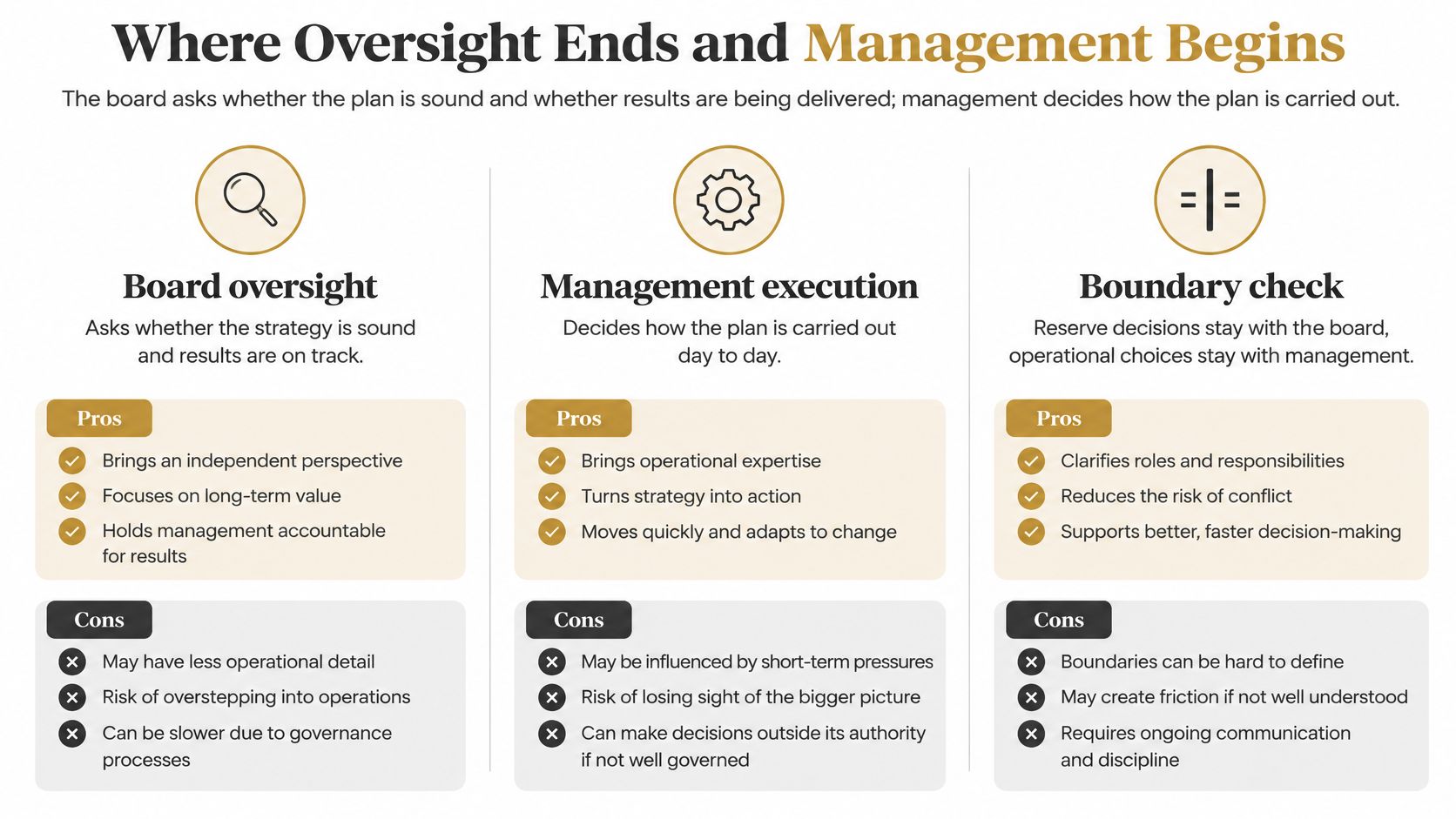
More involvement isn't always better governance. In a 2025 survey of more than 500 senior executives, 32% believed directors were overstepping their roles, according to PwC's Board Effectiveness Survey. A description should therefore make the boundary visible before anyone joins.
The basic test is straightforward: the board asks whether management's plan is sound and whether results are being delivered. Management decides how to carry out the approved plan.
Use this distinction when reviewing the seat's authority.
Put boundary tools in writing
- Reserved decisions: Identify matters requiring board approval, such as a strategic change or major transaction. An individual director shouldn't imply they can approve a matter that belongs to the board collectively.
- Escalation routes: Explain whom directors contact about a failed control, suspected misconduct, a conflict, or a concern involving the CEO. Include an alternative route when the usual contact is implicated.
- Committee scope: State whether the committee investigates, reviews, recommends, or decides under delegated authority. Audit committee members may examine detailed external audit findings, while other directors receive the committee's report and remain responsible for informed board decisions.
The Financial Reporting Council's governance guidance supports a clear division between board leadership and executive management, alongside defined responsibilities for strategy, resources, performance, and risk controls.
Recognise operational interference
Say a technology director spots delays in a cybersecurity programme. Asking management about exposure, milestones, and independent assurance is oversight. Telling the department head which supplier to appoint, without delegated authority, crosses into management.
That instruction creates competing reporting lines. The CEO remains accountable for delivery but no longer controls all the decisions affecting it.
Expertise gives a director better questions. It doesn't automatically give them authority to issue instructions.
The description should permit informed challenge and appropriate access to information without establishing a parallel management structure. Emergency intervention should follow an authorised process, not a director's personal preference.
For another way to consider the distinction between directing and managing, use the following video.
Qualifications and Evidence by Committee Role
Audit committee requirements provide a clear example of why a director specification must distinguish eligibility from desirable experience. Financial confidence alone isn't enough: the candidate must meet the relevant independence and competence requirements, then demonstrate readiness for the committee's actual work.
Baseline requirements and evidence by committee case
| Committee or case | Baseline requirement | Evidence to ask for |
|---|---|---|
| Audit committee, U.S.-listed company | NYSE audit-committee rules require at least 3 members, all independent and financially literate, with at least one possessing accounting or related financial-management expertise | Named audit committee service, financial reporting oversight, accounting or finance credential |
| Audit committee, U.K. or other markets | Independence and financial literacy as set by local code and listing rules | Financial statement fluency, independence declarations, local code compliance knowledge |
| Remuneration committee | Independent non-executive membership under common governance codes, subject to the applicable framework | Experience designing incentives, pay-for-performance review, remuneration disclosure |
| Risk committee | Independence plus risk oversight competence, assessed against the applicable charter and rules | Enterprise risk, cyber or regulatory oversight experience, documented risk governance |
| Nomination or succession role | Judgment on board composition and executive succession | Experience evaluating senior leaders, succession planning, board evaluation |
| First-time director | No prior board seat required unless the particular appointment specification requires it | Governance training, documented board preparation, evidence of oversight in management roles |
The NYSE framework also requires a formal written committee charter approved by the board and reviewed annually. Candidates should read the charter rather than assume that every audit seat carries identical responsibilities.
Ask for evidence rather than adjectives
A claim of a strong financial background gives selectors little to verify. Naming responsibility for financial reporting, describing an internal-control review, or identifying a relevant accounting credential gives them something concrete to assess.
Separate required qualifications from preferred sector expertise. A healthcare board might require audit competence for the available seat while preferring healthcare experience. Treating every preference as mandatory can exclude someone who fills the board's more urgent gap.
Testable criteria should cover how candidates question assumptions, interpret financial and risk information, evaluate senior leaders, protect confidentiality, and handle competing stakeholder interests. Relationship disclosures should address commercial, family, investment, and advisory connections that could impair independence.
Translate non-board experience honestly
A first-time candidate can demonstrate readiness through governance education, documented preparation, and management experience relevant to oversight. They shouldn't rename operational achievements as board service.
For example, a finance leader can explain how they presented control deficiencies to a committee and supported independent scrutiny. That demonstrates board-relevant exposure without claiming they held the committee's authority.
Use the Board CV Grader to examine whether your application makes those distinctions clear. Our work is built around first-time directors, C-suite executives, portfolio directors, finance/audit/risk leaders, exiting founders, and nonprofit/community leaders. The evidence standard still needs to match the seat, regardless of the candidate's starting point.
Time Commitment and Ongoing Expectations
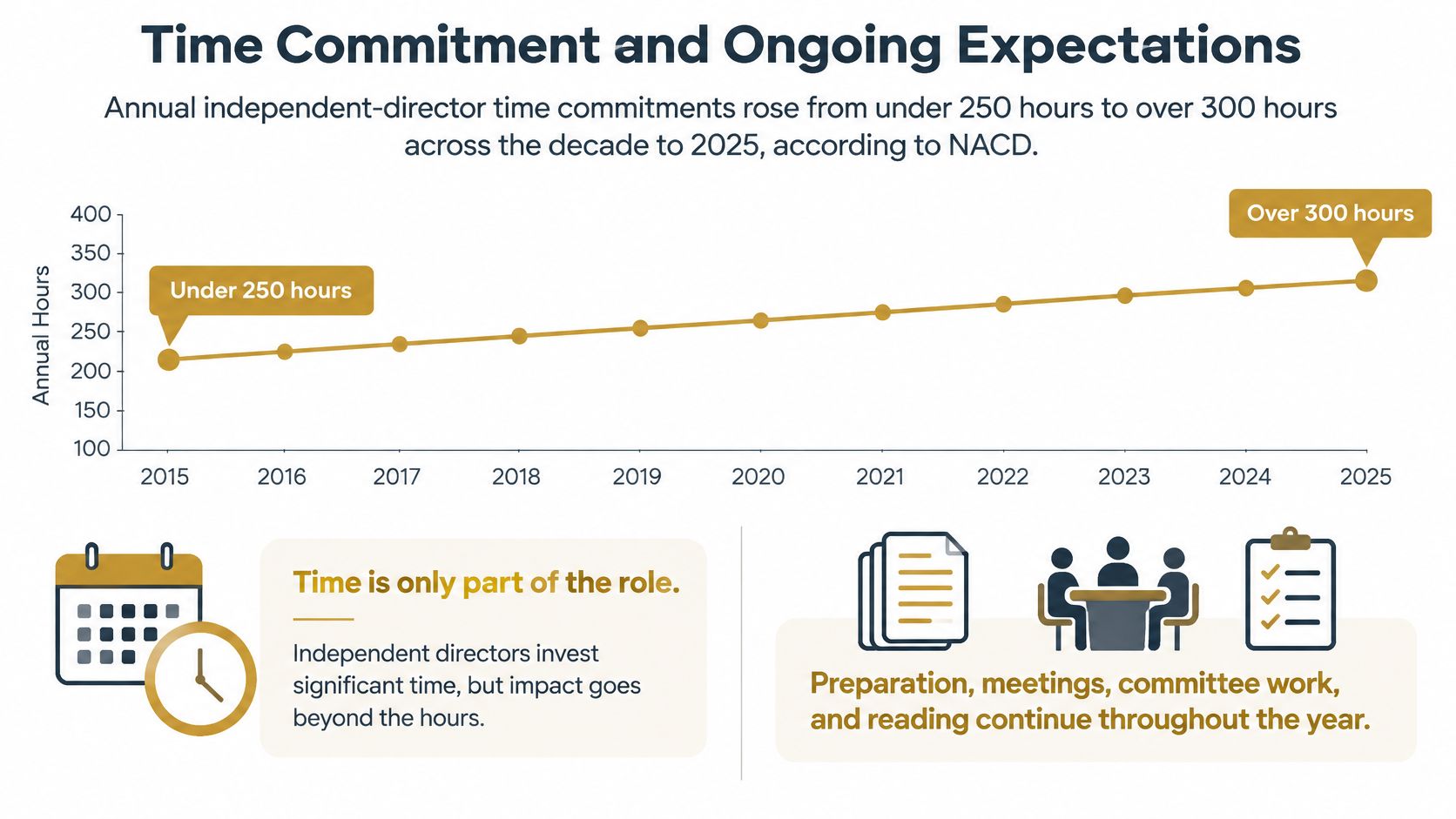
In 2025, annual independent-director time commitments had increased from fewer than 250 hours to more than 300 hours over the preceding decade, according to the National Association of Corporate Directors. That workload isn't limited to the hours spent around the boardroom table.
The timeline illustrates the direction of the commitment.
Make the workload estimable
A description should separate the activities candidates must schedule:
- Board meetings: State the planned meeting count, duration, location, and attendance expectations.
- Committee work: Identify additional meetings, chair responsibilities, and specialist reviews.
- Preparation: Explain when board packs arrive and the reading window before decisions.
- Visits and education: Include site visits, induction, and continuing governance learning.
- Urgent matters: Describe crisis availability and the expected response time for unscheduled requests.
Use the organisation's actual calendar and reporting arrangements. A generic statement about sufficient availability won't help a candidate identify clashes with an executive role or an existing portfolio.
The Board Time Commitment Calculator can help assemble those line items. Leave capacity for exceptional work rather than treating the normal calendar as the maximum possible commitment.
State the continuing obligations and financial terms
Include participation in annual board evaluations, continuing education, and updated interest declarations. Directors also need to know how preparation and attendance are assessed, and when the role description will be reviewed.
Compensation belongs in the expectations, not in a late-stage conversation. State whether the appointment involves a cash retainer, equity, an honorarium, or unpaid service, together with meeting or committee fees and travel reimbursement.
Explain who recommends and approves director pay, including whether the remuneration committee has a role. Identify indemnification arrangements and directors' and officers' insurance cover, with access to the relevant terms.
Before accepting: Compare the full workload with the compensation and protections, not just the headline fee.
A description that conceals preparation or crisis demands invites mismatched appointments and early resignations. Clear terms let candidates decide whether they can serve responsibly.
How to Write a Director Position Description
Begin with the board's documented needs, not the departing director's biography. Use the strategy, skills matrix, committee charters, and board evaluation findings to establish what the next appointment should contribute.
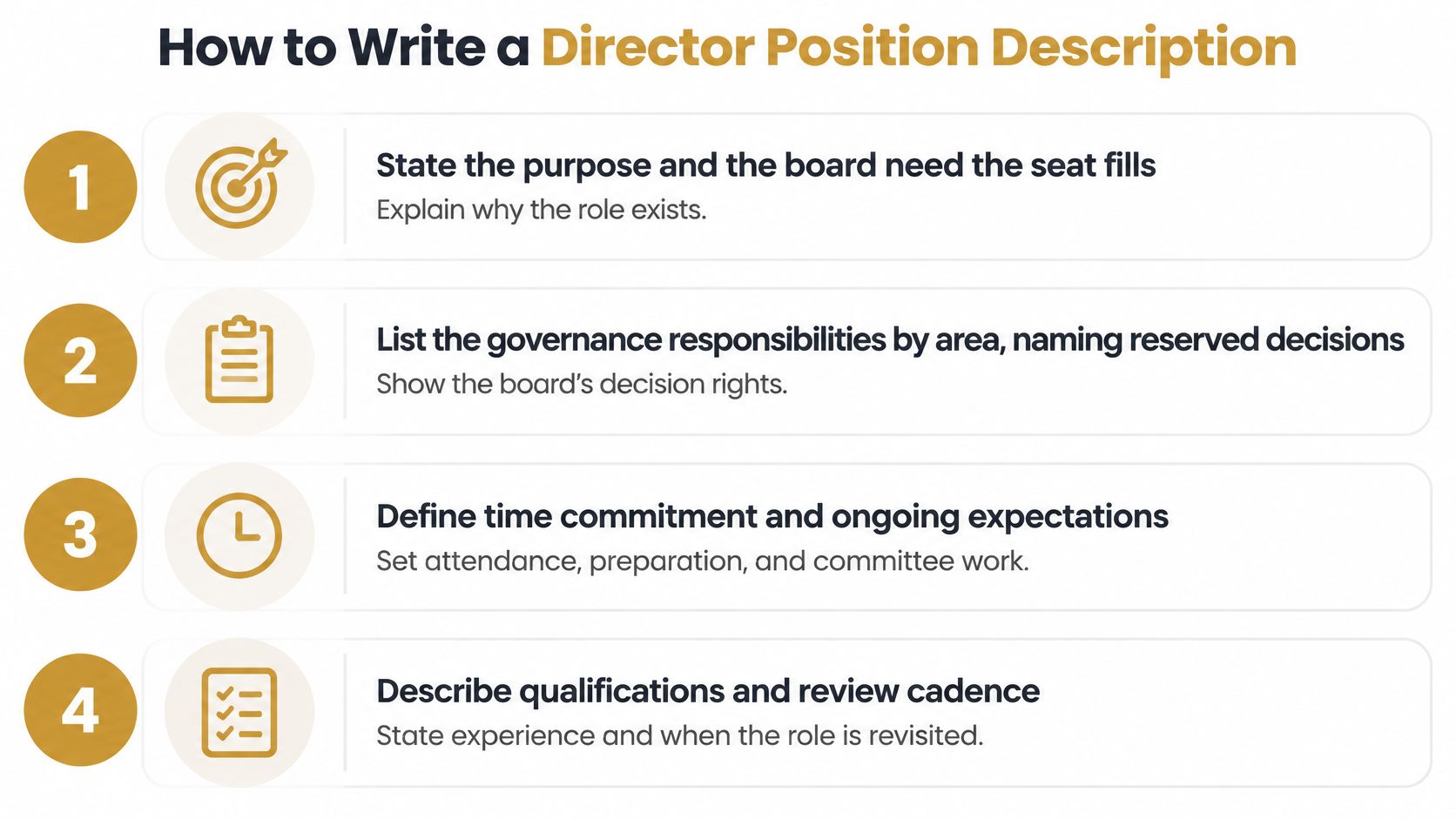
The checklist gives a compact view of the drafting process.
Draft the mandate and assessment criteria
State the purpose and board need. Explain the capability gap the seat fills, such as financial scrutiny during expansion or stronger technology-risk oversight. A common mistake is listing industry experience without explaining why the board needs it.
Name governance responsibilities and reserved decisions. Tie each duty to the relevant approval, review, or challenge. Don't copy an executive job description and replace management verbs with oversight verbs.
Define committee roles and committee time. Identify expected membership, whether chairing is involved, and the associated work. Leaving committee allocation unspecified can change the practical appointment after the candidate has agreed to it.
Set required qualifications and accepted evidence. For each criterion, name what selectors will examine, such as credentials, committee records, references, or a structured interview example. Avoid using prestigious titles as a substitute for demonstrable competence.
Complete the appointment conditions
State independence and disclosure requirements. Explain the applicable standard and the relationships candidates must declare. A general promise to act ethically won't establish whether a relationship disqualifies someone.
Itemise the time commitment. Build the estimate from the organisation's scheduled activities and continuing obligations. Don't publish only meeting attendance while omitting preparation and exceptional demands.
Describe escalation and management relationships. Name the authorised contact routes, access arrangements, and limits on individual action. Avoid creating direct reporting lines from department heads to a non-executive director.
Write down compensation terms. Specify paid, unpaid, equity-based, or honorarium-based service and the relevant fees, expenses, and protections. Don't leave candidates to negotiate around unstated assumptions.
Use the Board Role Fit Checklist to test the draft from the applicant's perspective. Could a suitable candidate understand what evidence to submit, what conditions to check, and what work they're accepting?
The final test is whether selectors can map the description to a skills matrix. Each requirement should trace to a documented need and an assessment method. If selectors can't distinguish candidates using the wording, tighten it before publishing.
Confirm the Fit Before You Apply
A persuasive description can still describe the wrong appointment for you. Read it the way a selector reads a skills matrix: each requirement should trace to a documented board need, and the document should show where oversight ends and management begins. Then run four checks before investing in an application.
- Match responsibilities to evidence. Attach a specific example, credential, or record to each material requirement. If the description expects audit committee experience you cannot demonstrate, that is a gap to close or a reason to skip the seat.
- Check where the authority line falls. Look for language that assigns operational decisions to management and oversight questions to directors. A description that asks a non-executive to run a function directly signals a confused role, and stepping across that boundary creates liability rather than impact.
- Test independence and your calendar together. Compare the disclosure conditions against your employment, investments, and advisory work, then place the stated time commitment, including preparation and travel, beside your existing obligations.
- Confirm compensation and accountability in writing. Establish the payment basis, expenses, and protections before treating the opportunity as a target.
Investigate the board as well as the role
The Board Offer Due Diligence Checklist walks through what the description leaves unanswered. Review the organisation's financial position, governance documents, committee charter, and reasons for the vacancy. Ask about unresolved audit findings, disputes, and the quality of information directors receive.
A candidate's questions also test the chair. A board that resists reasonable due diligence is telling you something about how it treats informed challenge once you join.
Prepare for the specific appointment
Once the fit test passes, SeatSignal is a practical next step. Our team hand-picks relevant open board roles, prepares a director-grade application packet for each one, and rehearses interview questions specific to that board, with the aim of helping you land a paid board seat.
Open positions come from live openings and pre-public seats across sectors. Every role is real and named, and we check that it is open before it reaches you.
For each approved board, the packet contains a director-grade CV, a cover letter aligned with the board charter and the gap it fills, a fit memo, and an independence attestation. We map the warmest route in so you approach through a name rather than cold, and interview preparation rehearses the questions that board's chair is most likely to ask.
You review every draft and send applications in your own name. No outcome is guaranteed, and you remain responsible for due diligence and the final decision to serve.
SeatSignal connects the requirements in a director position description to hand-picked opportunities, application materials prepared for each board, and interview rehearsal for each committee. Visit SeatSignal to turn your governance evidence into a focused search for a suitable board seat.
Want a paid board role, done for you?
One handpicked, verified open board role every week, with a director-grade packet tailored for it.
Get Started