E Board Positions: Duties, Meetings, and Opportunity Fit
A retired operating executive accepts an invitation to join a company's board. Instead of a printed binder arriving before the meeting, the director receives a notification to review confidential materials in a secure portal. The format feels convenient, but it also raises practical questions: How should the director protect those materials? What does effective participation look like in a virtual meeting? And does the candidate's experience fit the board's actual needs?
Table of Contents
- What Electronic Board Positions Are and Why They Matter
- Core Duties of an Electronic Board Seat
- Meeting Formats and Board Portal Controls
- How Board Vacancies Open and Who Gets Considered
- Assessing Whether an Opportunity Fits Your Experience
- Comparing Routes to an E-Board Seat
- Taking Your Next Step Toward a Board Seat
What Electronic Board Positions Are and Why They Matter

Electronic board positions, sometimes called e-board positions, are director seats where governance work relies on digital tools. Directors may review documents in a board portal, attend virtual or hybrid meetings, and communicate through electronic channels rather than relying on printed packs and in-person sessions alone.
The digital format changes how information reaches directors, but it doesn't erase the responsibilities attached to a board seat. A director still needs to prepare, exercise independent judgment, ask questions, protect the organization's interests, and follow through on board and committee work. The screen may change; the underlying duties don't.
The practical difference is that directors must pay attention to the conditions under which board work happens. A director might review a sensitive acquisition proposal on a tablet while traveling, join a virtual risk committee meeting from a home office, then receive a revised document through the portal. Each step brings questions about preparation, access, confidentiality, and whether the director has enough context to challenge management.
Why the digital format matters
Digital access can make it easier for directors to review materials and participate from different locations. It can also create more ways for confidential information to be exposed, such as an unsecured device, a misdirected file, or a document retained after a director leaves the board.
Time commitments can feel different, too. Virtual participation may reduce travel, but it still takes disciplined reading, reliable availability, and active engagement. A director who joins a meeting while distracted or hasn't reviewed the materials can't contribute effectively just because the meeting is online.
When evaluating e board positions, look beyond the meeting format. Ask how the organization distributes materials, handles questions between meetings, protects board communications, and expects directors to participate. Those details help you understand whether the role fits your judgment, expertise, and working habits before you accept the invitation.
Core Duties of an Electronic Board Seat
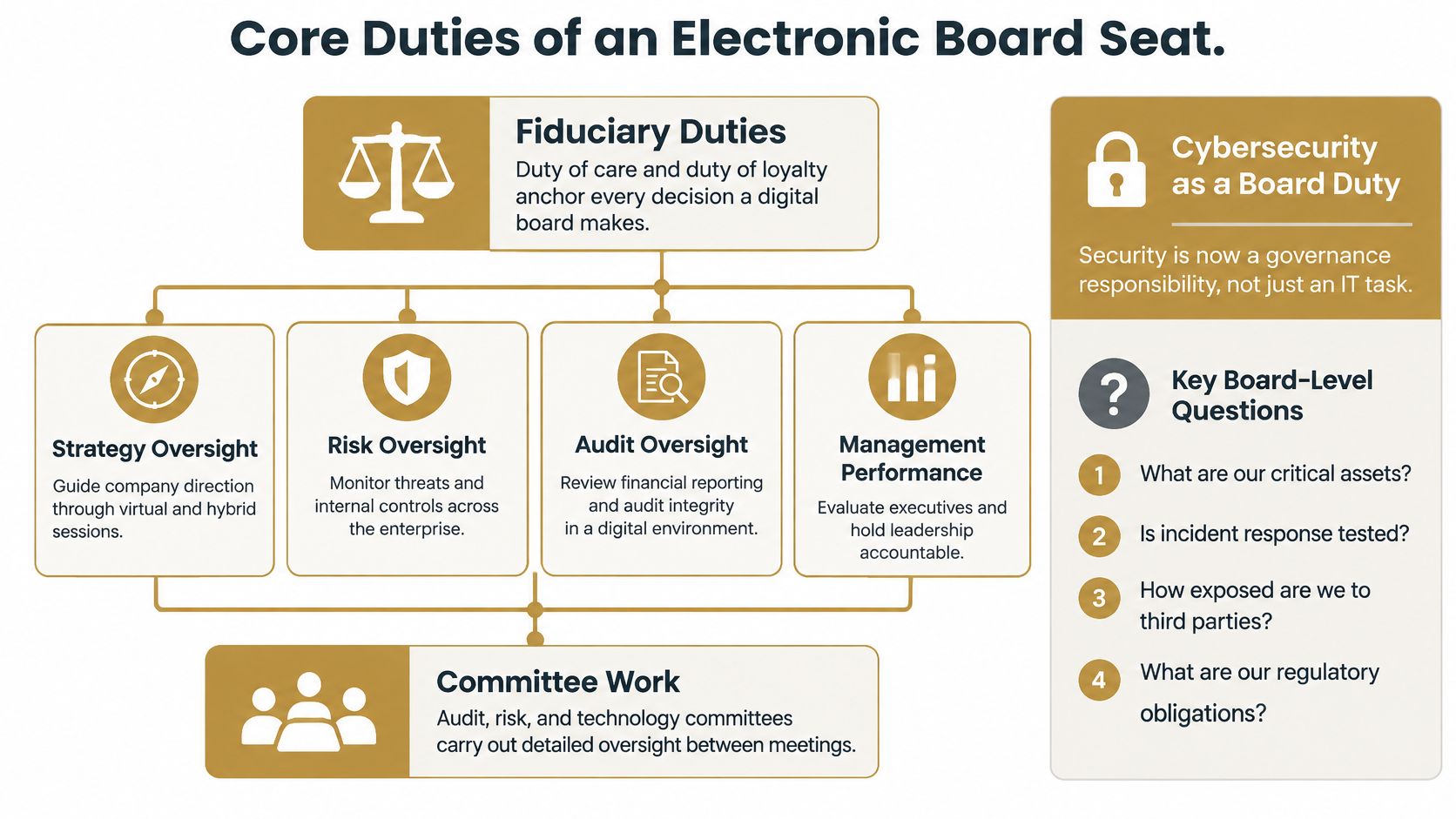
Digital tools affect how directors work, not what they owe the organization. The responsibilities start with fiduciary duties and extend through oversight of the company's strategy, risks, financial reporting, and leadership.
Start with fiduciary duties
A director's duty of care means taking the time to understand material decisions and asking for clarification when the information is incomplete or unclear. The duty of loyalty means acting in the organization's interests, managing conflicts appropriately, and treating confidential board information responsibly. A portal can deliver materials securely, but it can't make a director attentive or independent.
From there, directors oversee the company's direction and the way management executes it. They consider whether the strategy is sound, whether risks are understood, whether financial reporting and controls deserve scrutiny, and whether executives are accountable for results. Committee work gives directors a closer look at particular areas, such as audit, risk, or technology.
For candidates exploring paid board positions, the key is to show how their experience supports a board responsibility, rather than list senior job titles.
Treat cybersecurity as governance
Cybersecurity isn't only a technical department's concern. A University of St Andrews study found that board commitment to cybersecurity governance is positively associated with the extent of corporate cybersecurity disclosure. The relationship is stronger where boards include IT expertise, dedicated IT committees, and formal cybersecurity policies, as described in the research on cybersecurity disclosure and board commitment.
A director doesn't need to manage security operations to oversee cyber risk. The job is to ask whether management can explain the business exposure, the controls in place, and the decisions that require board attention. Useful questions include:
- Critical assets: Which systems and information are most important to the business?
- Incident readiness: Has management tested its response to a serious security incident?
- Third-party exposure: How does the company monitor risks introduced by vendors and other partners?
- Regulatory obligations: Which security-related requirements apply, and who is accountable for meeting them?
The distinction matters when you present your background. Describe the governance outcomes you've influenced, such as resilience investment, risk appetite, or regulatory readiness, rather than suggesting you've performed technical tasks you haven't owned.
Meeting Formats and Board Portal Controls

A virtual meeting asks you to participate through a screen. A hybrid meeting asks you to contribute alongside directors in the room without letting the remote seat become an afterthought. In both formats, your preparation still starts before the meeting: review the materials, identify unclear assumptions, and decide which questions need a discussion rather than an email.
Some board work happens in advance, through document review and written questions. That can make meetings more focused, but only when directors have time to read the materials and know how to raise concerns. If you're weighing whether a role's schedule is manageable alongside your other commitments, a board time commitment calculator can help structure that assessment.
A portal is a tool, not a guarantee
A survey of more than 350 directors at publicly traded companies found that 74% used external board portals. The survey report also recommended that boards define acceptable devices, communication methods, competencies, and practices, and use annual training and periodic audits of director behavior. Those recommendations appear in the report on board portals and convenience risks.
Portal adoption alone doesn't protect confidential information. The board needs clear rules and controls that cover how people access materials, what happens to documents over time, and who can see them. A director evaluating the system should ask whether access is authenticated, permissions are reviewed, and audit logs can show who accessed or changed materials.
Questions to ask about controls
Look for practical procedures, not just assurances that the portal is secure. The board should have rules for approved devices, document retention, secure distribution, and the handling of lost devices or departing directors. It should also know how administrators' privileges are controlled and how a suspected incident gets escalated.
Training matters because directors' habits are part of the control environment. Ask how the organization trains directors to use the portal, avoid uncontrolled copies, and communicate securely. Good governance also means checking whether electronic communication has become so frequent that directors can no longer distinguish urgent board matters from routine updates.
How Board Vacancies Open and Who Gets Considered
Public board openings can appear scarce because they are scarce. In the 2024 U.S. proxy year, 58% of S&P 500 boards appointed at least one new director, and the average was 0.83 new directors per board, according to the 2024 U.S. Spencer Stuart Board Index highlights. In other words, most boards did not add a director that year.
Board service also tends to last for years. Directors on France's CAC 40 and SBF 120 boards had an average tenure of 5.6 years in 2024, according to the same source. That means a vacancy may emerge through planned refreshment, retirement, resignation, or a change in the skills and experience the board needs, rather than through a continuous public hiring process.
Look for timing signals
A public listing is one visible point in a longer cycle. A board may discuss succession or refreshment before it advertises a seat. If you only watch public postings, you can miss opportunities that are being explored behind the scenes or are expected to open later.
The board's needs also shape when and how it recruits. Directors may be considered for a particular committee, or to address a gap in independence, sector knowledge, or board composition. That's different from a broad search for someone with an impressive executive biography.
When you learn about a potential seat, ask what prompted the search and what the board needs the incoming director to do. Is the board preparing for a planned departure? Does it need expertise for a committee? Is the role intended to address a specific capability or composition gap? The answers help you judge whether your experience matches the opportunity and whether the timing is realistic.
Practical rule: Ask when the board expects the seat to open, not only whether it's advertised today.
Assessing Whether an Opportunity Fits Your Experience
A board role is a fit when your evidence answers a need the board has. Before applying, learn which committee the seat supports, what expertise directors are seeking, and how the board's existing composition affects the search. A strong executive record matters, but it doesn't automatically demonstrate that you can contribute in a specific governance role.
The 2025 NACD Trends and Priorities Survey found that 67% of respondents preferred specific expertise over general business leadership when filling the next seat. That preference is a reason to be precise about what you've done and how it prepares you to oversee a board-level issue.
Test your fit against the board's needs
Start with the work, not the job title. If the board needs an audit committee member, identify your relevant experience with financial reporting, controls, or audit oversight. If the need is in risk or technology, describe what you've overseen and how you've challenged management.
A practical assessment can include these questions:
- Committee fit: Which committee could you credibly serve on, and what relevant experience supports that claim?
- Evidence: What decisions, controls, or outcomes have you overseen that relate to the board's priorities?
- Composition gap: What does the board appear to need that its current directors don't already bring?
- Role conditions: Do the company's size, listing status, and expected time commitment suit your background and availability?
- Limits: Where does your knowledge stop, and what would you need to learn before offering a sound view?
A board role fit checklist can help you organize these questions before you commit to an application.
Show technology judgment without overstating it
You don't need to claim you're an AI engineer to demonstrate technology relevance. Experience setting technology risk appetite, overseeing a transformation, managing data governance, or challenging management's investment assumptions may be relevant, if you can explain your actual role clearly.
Separate operational exposure from oversight capability. Operational exposure means you've worked with a technology or transformation initiative. Oversight capability means you can assess the business case, probe the risks and controls, and hold management accountable without implying that you personally built or secured the system.
That distinction helps a board understand both what you bring and where your expertise ends. If an opportunity depends on technical depth you don't have, say so. A candid account of your strengths is more useful than an inflated list of digital keywords.
Comparing Routes to an E-Board Seat
A first-time e-board candidate can face four doors into the same boardroom: a public posting, a search firm, an introduction, or a placement program. The choice is practical. Electronic board work runs through portals, remote papers, and cyber risk reporting, so the stronger route is the one that lets you show evidence for those duties rather than repeat digital buzzwords.
| Route | How It Works | What It Requires |
|---|---|---|
| Advertised vacancy | You apply to a public posting or formal process. | A tailored application and clear evidence that you meet the stated needs. |
| Executive search firm | A recruiter identifies and assesses candidates for a board search. | Relevant experience, strong governance materials, and access to the search process. |
| Personal network | A director or trusted contact introduces you or helps you understand the board's needs. | Relationship-building, informed outreach, and respect for formal selection processes. |
| Structured placement support | A service helps identify opportunities and prepare board-specific materials. | Clear candidate evidence, review of proposed matches, and your own due diligence. |
Personal networks still play a major role in board appointments, even as 46% of boards said they use executive search firms for a more structured and diverse process, according to the 2025 Global Board Survey. That tension does not make formal processes meaningless. A structured search may still depend on trusted networks surfacing candidates whose experience can be tested.
Build relationships without asking for a shortcut
Relationship mapping means learning who serves on the board, which committee owns the issue you know, and whether you share professional history or a mutual contact. Solicitation is asking someone to secure you a seat or bypass the board's process. A thoughtful introduction can help a chair or search firm understand your fit, while independent assessment still decides the appointment.
For first-time directors, the sharper question is who can explain the board's needs and carry your evidence to the right person. That keeps outreach relevant and low pressure. It also forces a better test: if a cyber committee oversees portal controls, incident reporting, or data governance, your contact should be able to point your proof toward that mandate.
A structured placement option can combine opportunity research with application preparation. SeatSignal is a subscription placement program that researches board opportunities and prepares governance-formatted director CVs, role-specific cover letters, committee fit memos, and independence notes. Candidates review and send their own materials, so judge the service by how well it matches your evidence to committee needs.
The subscription terms are two months at $297, six months at $742.50, or one year at $1,188. SeatSignal charges no recruitment fees or retainers and doesn't claim to replace formal governance qualifications. Compare the differences between placement support and executive search firms before deciding which route suits your search.
Use the walkthrough below to inspect the workflow: how opportunities are queued, how drafts are assembled, and where you approve what gets sent.
Taking Your Next Step Toward a Board Seat
Before you contact a chair, recruiter, or placement service, take an honest inventory of your evidence. List the board-level decisions you've influenced, the committees you could credibly support, and the composition gaps your experience might address. Then compare that inventory with a specific role rather than sending the same executive biography to every opportunity.
If you're evaluating a placement program, ask how it checks opportunity fit, whether confirmed vacancies are separated from forecast openings, and whether you review and approve application materials before sending them yourself. A board CV grader can help you inspect whether your experience is presented in governance-relevant terms.
Read the service details carefully before signing up. Appointments, interviews, income, and completing a placement within 60 days aren't guaranteed. You remain responsible for your decisions and due diligence.
SeatSignal helps candidates identify board opportunities, prepare director-grade application materials, and get ready for board-specific interviews. If you're exploring e board positions, review how the program matches experience to committee and composition needs at SeatSignal.
Want a paid board role, done for you?
One handpicked, verified open board role every week, with a director-grade packet tailored for it.
Get Started