Executive Board Committee Explained: Role and Differences
If a control fails, does the executive risk committee answer for fixing it, or does the audit committee answer for not challenging management? Knowing which committees exist won't answer that question. A prospective director needs to understand who operates the control, who independently reviews it, and who has authority to intervene.
Table of Contents
- Board and Management Committees Compared
- How Executive Board Committees Work
- The Core Committees Boards Set Up
- Audit Rules and Who Qualifies for a Seat
- Where Risk, Cyber and AI Oversight Sit
- Confirm Your Fit Before Pursuing a Committee Seat
Board and Management Committees Compared
An executive board committee is a group of directors, usually non-executives, to which the full board delegates oversight work; a management committee is a group of executives that runs the business. The term can also mean a board committee that includes executive directors and holds delegated authority between board meetings. Its decisions remain subject to full-board accountability. The rest of this article uses the term for committees of non-executive directors.
Board committees versus management committees
| Criterion | Executive board committee | Management committee |
|---|---|---|
| Members | Non-executive and independent directors | Executives such as CFO, COO and CRO |
| Authority | Delegated by the full board under a written charter | Delegated by the CEO or executive team |
| Reports to | Full board | CEO or executive leadership |
| Core purpose | Independent oversight of management | Coordinate execution and operational control |
| Independence rules | Required for audit members in many markets | No independence test |
| Typical examples | Audit, nomination, remuneration | Executive risk, disclosure, operations review |
The confusing rows are authority and reporting line. A management committee may have substantial spending authority without having any independent oversight role. Conversely, a board committee may scrutinize an operational decision without being authorized to run the operation itself.
Follow the accountability chain
Apply this ordered test when a control fails:
- Identify the operator. Which executive owns the control, and who must deliver remediation?
- Identify the challenger. Which independent directors can question the executive and demand supporting evidence?
- Locate decision rights. Can the committee require action within its mandate, or must it recommend a decision to the full board?
- Trace unresolved disagreement. Who receives an escalation if management rejects the committee's concerns?
Don't assume that every board committee can overrule management on every matter. Its charter and the board's reserved powers determine whether it decides, recommends, or escalates.
Say a CFO sits on an executive risk committee and reports progress on a financial control. The audit committee reviews that control independently, questions the CFO directly, and seeks assurance that remediation worked. The CFO owns execution; the audit committee answers for the quality of its oversight.
A person can sometimes serve on both board and management bodies in different capacities, where eligibility rules permit. That doesn't make the bodies interchangeable, and attendance at an audit meeting doesn't make an executive an audit committee member.
When reviewing board of directors positions, check which governance pages describe the board's committees and which describe the executive team's. The committee's name is less revealing than its membership, mandate, and reporting line.
How Executive Board Committees Work
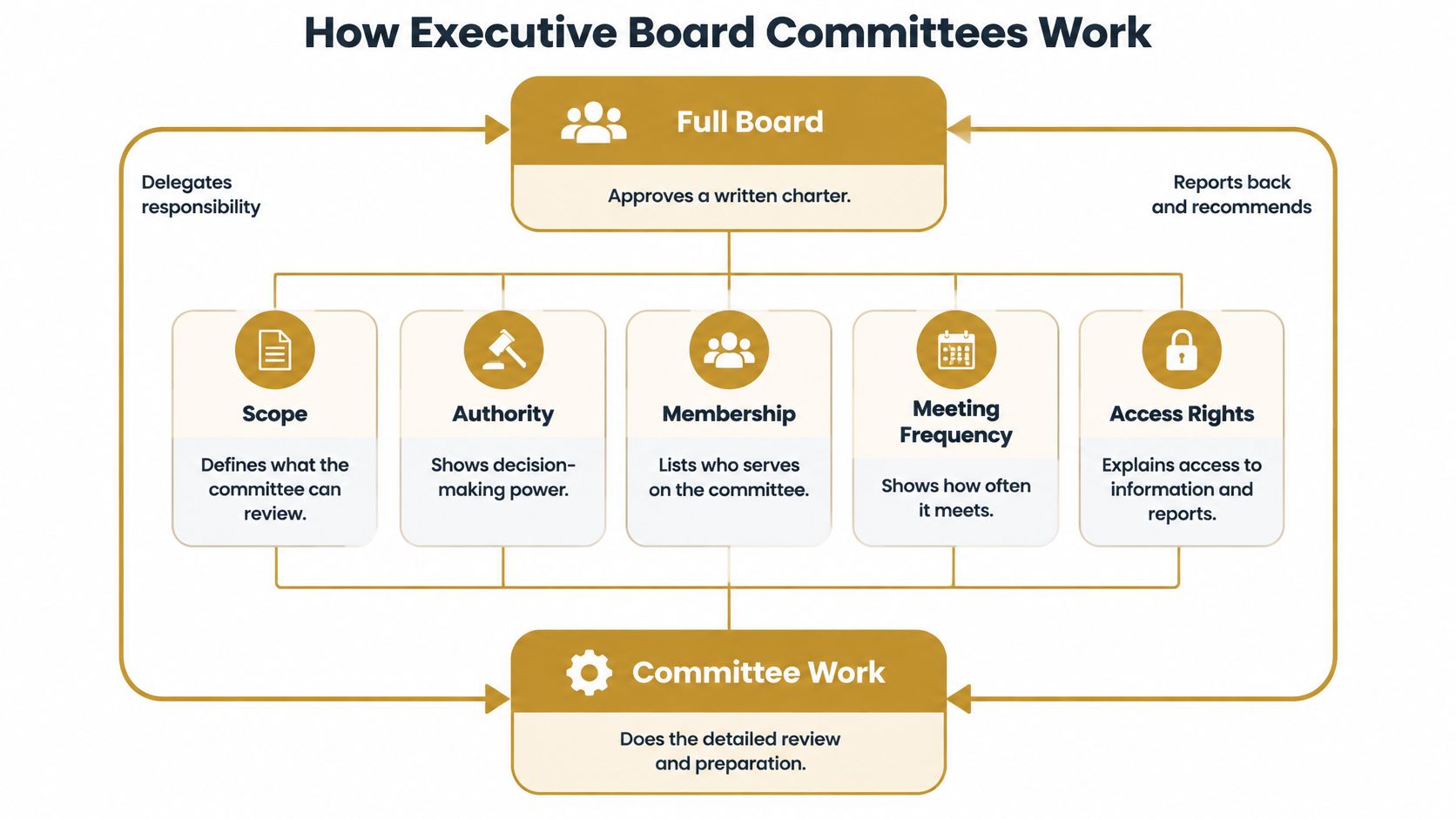
Delegation works as a loop, not a handoff that lets the board stop paying attention. The committee investigates matters in depth, but the full board retains accountability for its governance responsibilities.
The delegation loop should be visible in the committee's documentation.
From charter to board action
- The board approves the charter. It sets scope, authority, membership, meeting frequency, and access rights. Directors should distinguish matters the committee can decide from matters reserved for the board.
- The committee performs detailed review. Members examine papers, question executives, and seek independent assurance. Their job isn't to receive management presentations.
- The committee reports its conclusions. Its report should identify findings, unresolved concerns, decisions made under delegation, and recommendations requiring board approval.
- The board responds and follows through. Directors consider the implications for strategy, resources, and other committees. Outstanding actions return to the committee for follow-up.
The G20/OECD Principles of Corporate Governance identify audit as the core specialist committee for financial disclosure, internal controls, and audit matters, supported by a clear mandate, auditor access, management challenge, and reporting to the board. They also support internal audit reporting to an independent audit committee and the committee managing the external-auditor relationship.
That access matters because directors need evidence that hasn't been filtered solely through the executives whose work they're reviewing. A committee should be able to hear concerns, test explanations, and request further investigation.
Make cross-committee escalation usable
Say a technology committee learns that a cyber incident may compromise financial information. A workable charter would require escalation to audit within a defined incident-reporting window, followed by a report to the full board at its next meeting, or sooner if urgency requires.
The report should explain the business consequence, not merely announce that another committee has been informed. Directors need to know whether financial reporting, business continuity, or a strategic commitment may be affected.
Charter check: Look for scope, authority to challenge, auditor access, and a reporting line. If any is missing, ask why before accepting the seat.
Use the Board Time Commitment Calculator to assess the preparation and follow-up this process demands, rather than counting scheduled meetings alone.
The Core Committees Boards Set Up
Audit, nomination, and remuneration form the traditional core. The table separates those established functions from additional risk and technology mandates that a board may delegate.
Core board committees: mandate and status
| Committee | Main mandate | Mandatory or encouraged | Typical chair |
|---|---|---|---|
| Audit | Financial reporting, internal controls, external auditor oversight | The most widely mandated; required for listed companies in most major markets | Independent non-executive director |
| Nomination | Director selection and board succession | More often encouraged under governance codes than required by statute | Independent non-executive director |
| Remuneration | Executive pay and incentive alignment | More often encouraged under governance codes than required by statute | Independent non-executive director |
| Risk | Enterprise and cyber risk, where delegated | Set by each board charter, subject to applicable sector rules | Non-executive director with risk background |
| Technology | AI, data and digital strategy oversight | Set by each board charter | Director with technology background |
Status varies by market, so treat these descriptions as the common pattern rather than a universal rule. The typical chairs are practical composition profiles, not substitutes for checking the governance code a company follows.
Why audit receives different treatment
Audit oversight connects directly to statutory reporting, external-auditor accountability, internal controls, and investor protection. Regulators therefore have a stronger reason to prescribe an independent structure rather than leave its creation entirely to board discretion.
Nomination and remuneration involve different judgments. Nomination committees consider the capabilities the board needs, director selection, and succession. Remuneration committees assess executive pay and whether incentives support the company's objectives without encouraging inappropriate behavior.
Governance codes can address those judgments through comply-or-explain arrangements. Under that approach, a company explains departures from the code rather than treating every recommendation as an identical statutory obligation. A charter works like a job description for the committee: it tells you what the group exists to do, and anything outside it needs a conscious decision about ownership.
Additional committees need deliberate boundaries
Risk and technology committees can give directors more time for specialist questions. They shouldn't become places where the rest of the board sends subjects it finds difficult.
Consider a company operating a large data platform. A technology committee might review digital investment and system architecture, while audit considers the reliability of information used in financial reporting. The board needs a clear boundary when the same platform creates both strategic opportunity and control exposure.
A committee without a clear boundary can duplicate another committee's work while leaving the difficult decision unowned.
Read a vacancy through an ordered test
A committee title tells you the topic, not the accountability. Three questions, asked in order, reveal what the seat involves:
- Who owns it? Identify which committee's charter covers the risk or decision at stake. If two charters overlap, note where the boundary sits.
- Who answers when it fails? When a control in that scope breaks down, which committee reports the failure to the board and carries the follow-up?
- Who can overrule management? Determine whether the committee can act on its findings, require information, or only recommend that the full board intervene.
Applied to a vacancy, this test exposes mismatches a job title hides. A technology background may fit the strategic mandate but not the committee's actual assurance needs; an audit background may fit reporting oversight without covering digital strategy.
Compare the company's committee list with the governance code it says it follows. Note any committee that appears without an accessible charter, and request the document before treating the role description as complete.
Audit Rules and Who Qualifies for a Seat
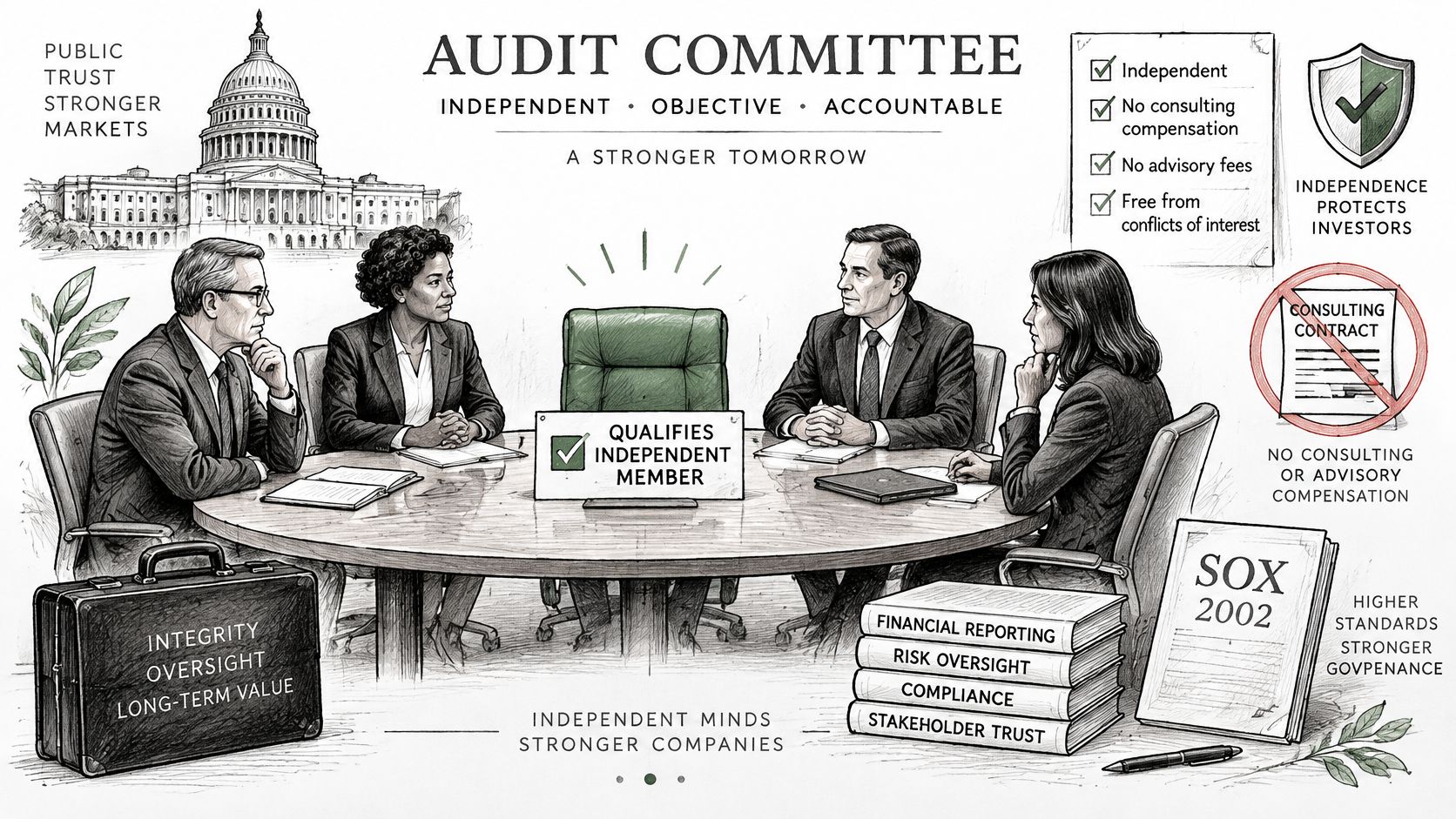
In the United States, the Sarbanes-Oxley Act of 2002 marked a major change: subsequent SEC audit committee rules required independence, generally prohibited consulting or advisory compensation beyond board service, excluded affiliated persons, and made the committee responsible for appointing, compensating, retaining, and overseeing the registered accounting firm. Those rules also established direct auditor reporting and committee pre-approval of audit and permitted non-audit services.
The distinction between expertise and independence is central to this role.
Apply the eligibility tests in order
Board eligibility comes first. Under the SEC's listed-company audit committee standards, each audit committee member must be a board member and independent under applicable standards; companies must also identify their designated financial expert and disclose whether that person is independent. Being invited to advise the committee isn't equivalent to eligibility for membership.
Check independence before credentials. Review employment, affiliations, consulting arrangements, and relationships with management. A technically excellent candidate can still be ineligible because of a financial or personal connection.
Establish financial literacy. Members need to understand the statements and the questions behind them. Reading a management dashboard isn't the same as evaluating accounting judgments and control weaknesses.
Assess financial expertise separately. The financial-expert definition reproduced in an SEC-filed audit committee charter includes understanding accounting principles, evaluating estimates, accruals and reserves, and experience with financial statements of comparable complexity. Relevant supervised work can support the assessment, but a title alone doesn't establish qualification.
Test committee-specific judgment. Ask whether the candidate can challenge an auditor, interpret a significant control deficiency, and distinguish an acceptable explanation from an unresolved reporting concern.
Check the market-specific requirements
The UK Corporate Governance Code 2024 calls for at least three independent non-executive directors, or two for smaller companies, excludes the board chair from audit committee membership, and requires at least one member with recent and relevant financial experience. These are UK code provisions, not a global eligibility checklist.
The NYSE rulemaking published by the SEC sets out at least three independent directors, financial literacy for all members or its acquisition within a reasonable period, and accounting or related financial-management expertise for at least one member. It also describes three-year cooling-off restrictions following relevant employment, including specified immediate-family employment relationships.
Because listing requirements and exceptions need careful application, candidates should have the company secretary or counsel confirm the operative rules for the issuer. A general governance qualification doesn't resolve a company-specific independence question.
Use the following discussion alongside the eligibility checklist.
Judge the evidence rather than the title
A CFO candidate may demonstrate strong financial competence but still fail the independence assessment for the company concerned. A former CFO who continues receiving paid consulting fees from that issuer after retirement would fail the relevant audit independence restriction, even if their accounting knowledge remains excellent.
For interview preparation, assemble examples of reporting judgments, control remediation, auditor disagreements, and how you supervised complex work. The Board Readiness Assessment can help organize that evidence, but it doesn't determine legal eligibility.
Map each material risk to a named director capability. A cyber specialist doesn't replace required financial competence, and an accounting expert shouldn't automatically be treated as qualified to challenge every technology risk.
Where Risk, Cyber and AI Oversight Sit
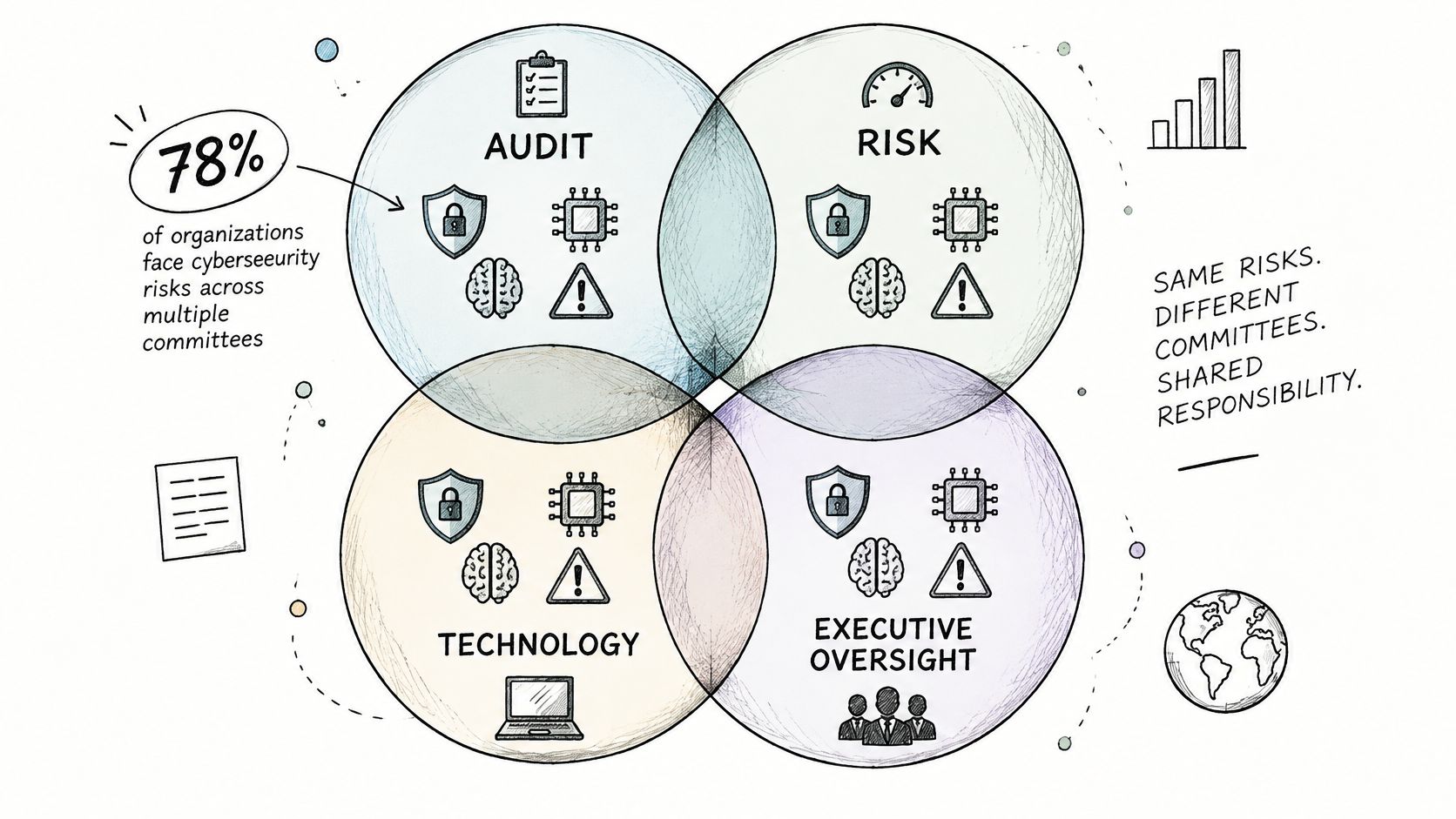
Audit, risk, technology, and executive committees can all list cyber or AI in their mandates. Adding another committee won't resolve that overlap unless directors specify who decides, who challenges, and who escalates.
Who oversees cyber, AI and enterprise risk
The company-level cyber and AI measures below appear in EY's audit committee priorities report; the audit committee priority measures appear in the Russell Reynolds governance study summary.
| Measure | Share |
|---|---|
| Surveyed companies placing cybersecurity oversight with the audit committee | 78% |
| Surveyed companies including AI risk within board risk oversight | 48%, up from 16% the prior year |
| Surveyed audit committee members ranking enterprise risk management as their top priority | 39% |
| Surveyed audit committee members placing cybersecurity among their top three priorities | 87% |
The final measures describe audit committee members' priorities, not the proportion of all companies assigning those responsibilities. The populations shouldn't be treated as interchangeable.
Shared subject matter still requires distinct responsibilities.
Design the handoffs, not just the boxes
An emerging model separates a management-level enterprise risk committee coordinating execution from an executive risk committee handling delegated matters, while cybersecurity reporting reaches the board audit committee quarterly. Management coordination still doesn't replace independent scrutiny.
Use the risk and technology rows in the core committee table as starting mandates, then specify the handoffs:
- Decision rights. Identify who approves AI deployment, accepts residual risk, and can require suspension.
- Escalation triggers. Include AI model failures, third-party cyber exposure, privacy breaches, and unreliable data.
- Reporting cadence. Separate routine dashboards from urgent incident notification.
- Board visibility. Name the route for risks that affect strategy or exceed agreed tolerance.
Say a business unit deploys an AI tool using sensitive customer information. Its charter-based process should require escalation to the risk committee within a specified number of days, technology review of the system, and audit involvement if reporting controls are affected.
For directors pursuing cybersecurity board opportunities, useful evidence includes decisions about exposure, investment, and escalation, not just familiarity with security products.
Design test: Every material risk needs an operational owner, an independent oversight owner, and a defined point at which the full board sees it.
Specialization helps only if directors retain enough shared understanding to connect those decisions.
Confirm Your Fit Before Pursuing a Committee Seat
A committee seat can look senior on paper and still be a poor fit. A title may get you into the room; the charter decides what you are accountable for once you sit down. Run a practical fit review against the actual company rather than a generic director profile.
Run a personal due diligence routine
Work through four checks in order:
Read the charter critically. Mark the scope, challenge authority, reporting line, and auditor access. Turn omissions into questions for the chair rather than assumptions in your application.
Screen your recent relationships. Apply the eligibility sequence to employment history, consulting fees, affiliations, and family ties to management. Resolve potential conflicts before presenting yourself as independent.
Apply the control-failure test. For each named risk, ask who answers first when a control fails, who can overrule management, and when the full board sees the issue. Then match evidence to that path: for audit, show financial reporting and controls; for risk or technology, show how you challenged a proposal, escalated exposure, or changed a decision without taking over management's job.
Count your commitments carefully. Include preparation, follow-up, unexpected incidents, and competing demands across current seats. A director who can attend meetings but cannot investigate concerns is not offering enough capacity.
The Board Role Fit Checklist gives you a structure for recording that assessment. Use it to separate capability you can evidence from an interest you still need to build.
Get preparation support without outsourcing judgment
SeatSignal's Done-For-You Board Placement program hand-picks relevant open board roles checked by a person, then prepares a director-grade packet for each opportunity: customized CV, cover letter, fit memo, and independence note. The placement team runs each stage while you review what they find, approve what they draft, and send applications in your own name. Materials can also be prepared for a board role you find outside SeatSignal's inventory.
Interview preparation rehearses against the questions that board's chair is likely to ask, drawn from the role, the committee, and the gaps found in that boardroom. It cannot decide fit for you. Test whether the mandate, independence requirements, and workload suit your evidence and your calendar.
SeatSignal has a refund policy and a results disclaimer. Boards, nomination committees, and recruiters make appointment decisions, and no appointment is guaranteed.
Pursue seats where your evidence matches the charter. If you cannot explain what you would challenge, why your judgment is relevant, and when you would escalate, strengthen that evidence before applying.
SeatSignal offers hand-picked board opportunities, role-specific director applications, and interview preparation built around the committee's actual responsibilities. Visit SeatSignal to explore support for targeting seats where your experience meets the board's oversight needs.
Want a paid board role, done for you?
One handpicked, verified open board role every week, with a director-grade packet tailored for it.
Get Started