Executive Committee Member: Role, Authority and Duties

You're reviewing a board opportunity, and the title says “executive committee member.” The name sounds familiar, but it doesn't tell you what you'd be allowed to decide, what you'd need to report to the full board, or whether the committee owns risks that cross other committees' boundaries. Those details matter more than the title.
At board level, the role is best understood as a delegated decision gate: a small group that can help the board move faster, but only within powers the board has granted. Knowing where that authority begins and ends is the first step in deciding whether the seat fits you.
Table of Contents
- What an Executive Committee Member Does and Where the Role Sits
- How Much Authority the Committee Holds Between Meetings
- How to Challenge Decisions Before They Reach the Board
- Qualifications Committees Check Before They Appoint You
- Who Owns Cybersecurity, Privacy and Other Overlapping Risks
- Decide Whether to Pursue an Executive Committee Seat
What an Executive Committee Member Does and Where the Role Sits
When a board cannot wait for its next scheduled meeting, an executive committee may handle a matter the board has delegated to it. The committee is made up of directors, works within the organization's governing rules, and remains accountable to the full board.
The full board retains overall responsibility. An executive committee works like a pit crew: it can respond quickly within its assigned remit, then report its actions to the larger group. Its authority depends on the board's rules, not on the committee's name.
The role's core duties
An executive committee often advises the CEO on strategic and operating issues, oversees performance against agreed objectives, helps set those objectives, and participates in CEO recruitment when asked. Its work may also include succession planning and written reporting to the full board.
The remit differs from that of an audit committee, which focuses on financial reporting, controls, and external audit, or a compensation committee, which focuses on executive pay and human-capital oversight. An executive committee is not a standard board requirement. In the 2023 Global Board Governance Survey, conducted by Protiviti, Broadridge, and BoardProspects, 13% of respondents' organizations reported having one, compared with 35% reporting compensation and benefits committees and 35% reporting corporate governance and nominating committees. The survey collected responses from 1,006 board members and C-suite executives, as reported in the 2023 Global Board Governance Survey.
| Board body | Core mandate | Acts between meetings | Typical composition |
|---|---|---|---|
| Full board | Sets strategy and approves matters reserved to all directors | No, decisions are made at board meetings | All directors |
| Executive committee | Acts for the board within delegated powers and advises the CEO | Yes, within delegated powers | A small group of directors |
| Audit committee | Financial reporting, internal controls, and external audit | Limited, according to its mandate | Directors with relevant financial oversight experience |
| Compensation committee | Executive pay and human-capital oversight | Limited, according to its mandate | Directors with relevant pay and oversight experience |
Nike's governance guidelines list an executive committee among its standing board committees. Prudential states that its executive committee may exercise corporate powers between board meetings, except for matters reserved to the full board. These examples show why the committee's written remit matters more than its title.
Search results may also refer to a management executive committee, which is distinct from a board committee. For example, Capgemini's 2025 Integrated Annual Report reports on the composition of its Executive Committee. This article concerns board-level roles. Readers exploring director opportunities can review board of directors positions.
Start by reading the board or committee charter. Check that the committee exists, what it is called, and which responsibilities the board has assigned to it.
How Much Authority the Committee Holds Between Meetings
An executive committee's authority is delegated, not automatic. Being a member doesn't give you every power held by the full board. The committee may act only within the authority explicitly granted by the board and bounded by the charter, bylaws, formal mandate, and documented decision rights.
Those boundaries prevent a small group from taking over decisions reserved for all directors. Before you vote or endorse a recommendation, sort the agenda item into one of three categories: a decision the committee may approve, a recommendation requiring the full board's approval, or an information item that calls for monitoring but no decision. The American Bar Association's guidance on executive committees emphasizes the importance of making those decision rights clear.
A CEO succession example
Suppose the CEO plans to retire. The committee might be authorized to approve a search timetable and oversee the process. But if the final appointment is reserved to the full board, the committee should present a recommendation rather than announce its own choice.
| Decision category | Who decides | What the member does |
|---|---|---|
| Matters the charter delegates to the committee | Executive committee | Vote, then confirm the decision is minuted |
| Recommendations on matters reserved for the board | Full board | Present a recommendation with a supporting decision paper |
| Items for monitoring only | No decision taken | Review, ask questions and record concerns |
| Matters reserved by bylaws or law | Full board | Escalate the matter and do not approve it |
A delegation-of-authority matrix should make the boundaries usable in real meetings. It should state approval thresholds, escalation triggers, conflicts procedures, meeting cadence, and reporting requirements, so members aren't left to infer who holds the decision.
Practical rule: If you can't tell whether the committee's answer is binding or advisory, pause the vote and clarify the mandate.
For urgent decisions made between meetings, check whether the rules require full-board ratification and minutes. That preserves speed without creating an accountability gap. The authority to act as a committee doesn't reduce a member's personal fiduciary duties of care and loyalty. Before accepting the workload, estimate the time needed for meetings, reading, and follow-up with the board time commitment calculator.
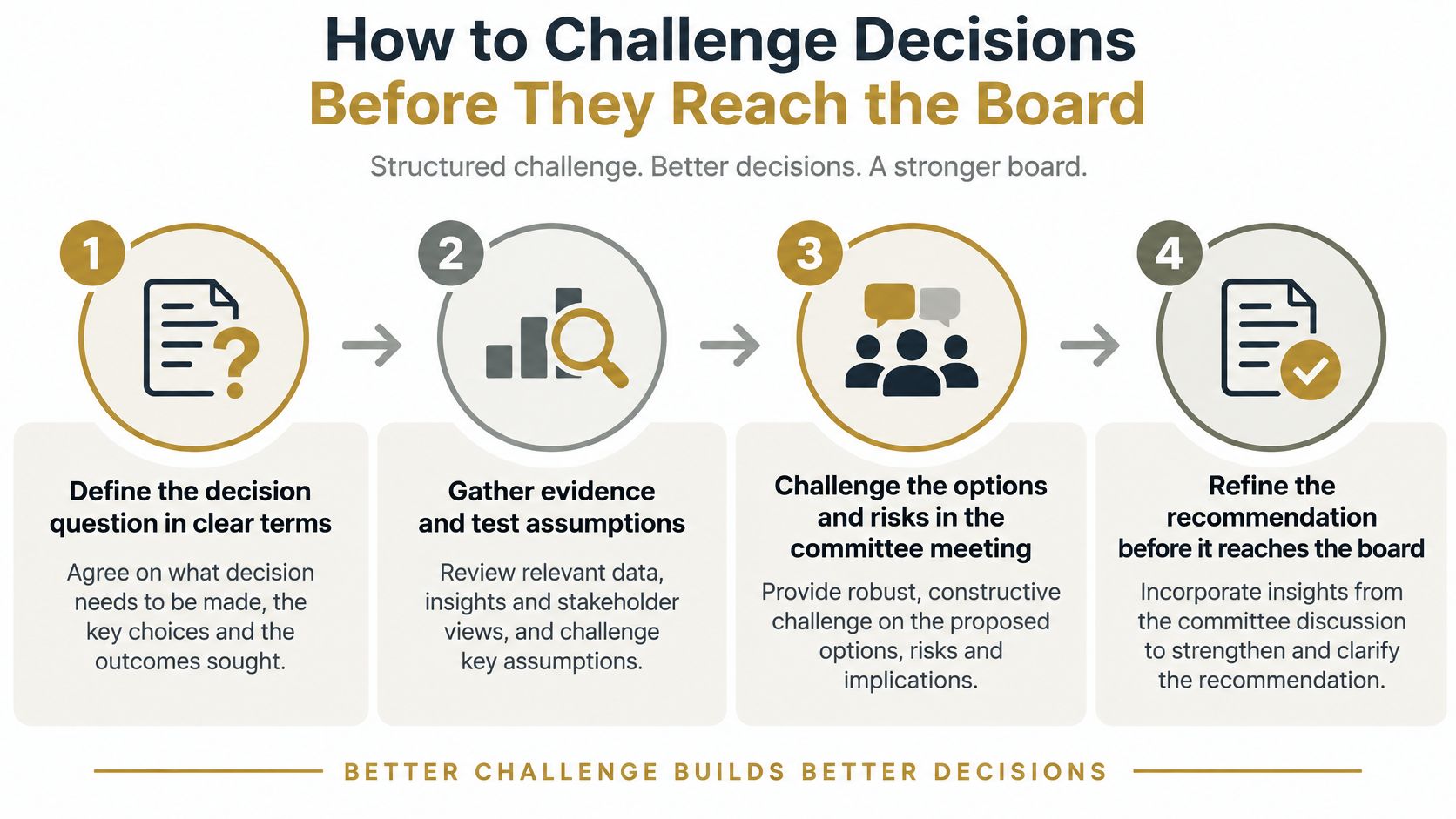
How to Challenge Decisions Before They Reach the Board
An executive committee adds value through structured challenge before the board meeting, not informal influence behind closed doors. Research on board decision processes found that stronger boards concentrated substantive conflict and option testing at committee level. After committees vetted alternatives and challenged assumptions, the full board reached consensus more readily, according to the research on board decision processes.
Use a repeatable process:
- Define the question in one sentence. State the decision the board must make, so the analysis doesn't drift into a general update.
- Agree on evaluation criteria before reviewing management's preferred option. This helps members compare choices consistently. If criteria are set after a preferred choice appears, they can unintentionally favor it.
- Request analysis of at least two competing options. Comparing alternatives tests whether the proposal is the best available choice. Asking for options only after management has chosen one defeats the purpose.
- Test downside and implementation risks. Ask what could go wrong, who would implement the decision, and how outcomes change across sensitivity ranges.
- Require a decision paper that shows its workings. It should identify assumptions, dissenting views, and management's proposed controls, rather than presenting a conclusion without its evidence.
- Send the board a transparent recommendation. Explain the supporting evidence and remaining trade-offs; don't make a predetermined conclusion look inevitable.
- Set measurable post-decision milestones. Track whether implementation matches the plan and whether results align with the assumptions behind the decision.
This approach is especially useful for strategy, capital allocation, acquisitions, technology risk, and executive succession. Committee members may bring specialized knowledge, but their expertise doesn't replace the full board's collective responsibility.
Measure whether the process improves decision quality by tracking decision-cycle time, the share of recommendations returned for inadequate analysis, post-approval variance against assumptions, and whether dissent is recorded and resolved. These measures help distinguish active oversight from attending meetings.
Qualifications Committees Check Before They Appoint You
Seniority alone doesn't show that you're ready for a specific committee. Appointment decisions should match a candidate's evidence to the committee's defined requirements.
The SEC's audit-committee financial-expert rule offers a clear example. A qualifying candidate must understand GAAP and financial statements, assess how accounting principles apply to estimates, accruals, and reserves, and have experience preparing, auditing, analyzing, or evaluating financial statements with complexity broadly comparable to the company's, or actively supervising people who do. The candidate must also understand internal controls, financial-reporting procedures, and audit-committee functions, as set out in the SEC rule.
Recognized career paths include service as a principal financial officer, principal accounting officer, controller, public accountant, or auditor. Active supervision of those professionals can also count. Translate your career into specific proof of financial reporting, controls, and audit oversight rather than relying on a broad executive biography.
| Committee or role | Evidence the candidate must show | Source of requirement |
|---|---|---|
| Audit committee financial expert | Understands GAAP and financial statements, accounting estimates and internal controls, with comparable preparation or audit experience | SEC audit-committee financial-expert rule |
| Audit committee independence | Independence assessment showing majority independence where required | OECD 2021 Corporate Governance Factbook: required in 58% of jurisdictions |
| Remuneration committee independence | Independence assessment for pay oversight | OECD 2021 Corporate Governance Factbook: recommended in 72% of jurisdictions |
| Executive committee | Broad enterprise judgment, CEO-facing experience and ability to operate within delegated authority | Governance guidance on executive committee practice |
Independence is another qualification to assess, not a label to assume. The OECD's 2021 Corporate Governance Factbook, covering 50 jurisdictions, found that nearly 90% require an independent audit committee. It also found that 58% require at least a majority of audit-committee members to be independent, while another 26% recommend that structure through governance codes. Full or majority independence is recommended for nomination committees in 64% of jurisdictions and remuneration committees in 72%.
List your evidence line by line against the table and flag any gap before applying. A board CV grader can help you assess whether your experience is clearly expressed in director-ready terms.
Who Owns Cybersecurity, Privacy and Other Overlapping Risks
Two cooks each assume the other is watching the oven. Nobody does. Boards can create the same problem when several committees touch cybersecurity, privacy, artificial intelligence, or supply-chain risk without naming who owns the decision and who must escalate it.
Adding another subject-matter expert isn't always the fix. The deeper weakness may be an unclear allocation of authority. In a KPMG audit committee survey, 90% of audit committees had primary or significant responsibility for cybersecurity and 73% for data privacy. Audit committees also commonly oversee enterprise risk management, legal and regulatory compliance, and data governance. Yet only 16% of surveyed U.S. audit-committee members said their boards were reallocating risk responsibilities among committees.

For each risk, establish whether a committee member is the designated owner, a contributor, or an escalation point. A technology or finance executive may be asked to take informal ownership because of their background, even when they lack the authority, information access, or time to do the job properly.
| Risk area | Reported audit committee role | Member action |
|---|---|---|
| Cybersecurity | 90% have primary or significant responsibility | Confirm the named owner in the charter |
| Data privacy | 73% have primary or significant responsibility | Check the escalation route to the full board |
| Enterprise risk management | Commonly overseen by audit committees | Map overlap with the executive committee |
| Legal and regulatory compliance | Commonly overseen by audit committees | Confirm the minute trail for challenge |
| Artificial intelligence | No specific audit-committee share reported | Confirm which committee owns it |
| Supply-chain risk | No specific audit-committee share reported | Confirm which committee owns it |
Build a responsibility map by listing each overlapping risk, naming the owning committee, recording the owner in the charter, placing the issue on the agenda, minuting the challenge put to management, and reviewing the allocation during the annual evaluation. Executives assessing technology-related board roles can also explore cybersecurity board opportunities.
Decide Whether to Pursue an Executive Committee Seat
An executive committee seat can suit a director who is ready to help handle delegated decisions between full-board meetings. Before pursuing one, test your readiness against the role's mandate and your capacity.
- Have you made CEO-facing or cross-functional decisions with real consequences?
- Can you show evidence against the committee's stated requirements?
- Do you have time for between-meeting work and committee reading?
- Can you demonstrate independence where the committee requires it?
- Are you willing to be the named owner of an overlapping risk?
If an answer is uncertain, clarify the committee's authority and identify what evidence or capacity you still need. A title alone does not establish that you have the authority, expertise, or time the role requires.
SeatSignal handpicks relevant board roles, prepares director-grade application materials suited to each opportunity, and provides board-specific interview preparation. Its placement team runs each stage: you review the opportunities, approve the materials, and send applications in your own name. SeatSignal does not apply on your behalf.
Boards, nomination committees, and recruiters make appointment decisions, so no placement program can guarantee an appointment. SeatSignal has a refund policy and a results disclaimer. Before choosing a role or provider, compare the role's requirements with your experience and capacity using the board role fit checklist.
If you are ready to pursue an executive committee seat, visit SeatSignal to learn about its board placement program.
Want a paid board role, done for you?
One handpicked, verified open board role every week, with a director-grade packet tailored for it.
Get Started