Executive Cover Letter for Board Roles That Get Read
The popular advice is wrong. A longer, warmer, more enthusiastic executive cover letter doesn't make you look more senior. It makes you look less disciplined. Senior readers don't reward effort. They reward relevance, restraint, and proof they can defend to someone else in the room.
That's doubly true for board roles. You're not applying to run something. You're asking to oversee it, challenge it, and steward other people's capital and reputation. A letter that reads like a compressed autobiography answers the wrong question. The right question is narrower: what governance gap does this board have, and what specific evidence shows you can help fill it?
Table of Contents
- Why Executive Cover Letters Fail
- Choosing the Right Letter Format
- Build a Governance Evidence Map
- Turn Executive Experience Into Board Evidence
- Draft a One-Page Board Application Letter
- Use AI Without Losing Your Voice
- Final Checks Before You Send
Why Executive Cover Letters Fail
Most letters fail before the second paragraph. They repeat the CV, praise the company in generic terms, and assert board suitability without proof. A chair or search partner has heard "seasoned leader," "strategic thinker," and "passionate about governance" too many times to treat any of it as evidence.
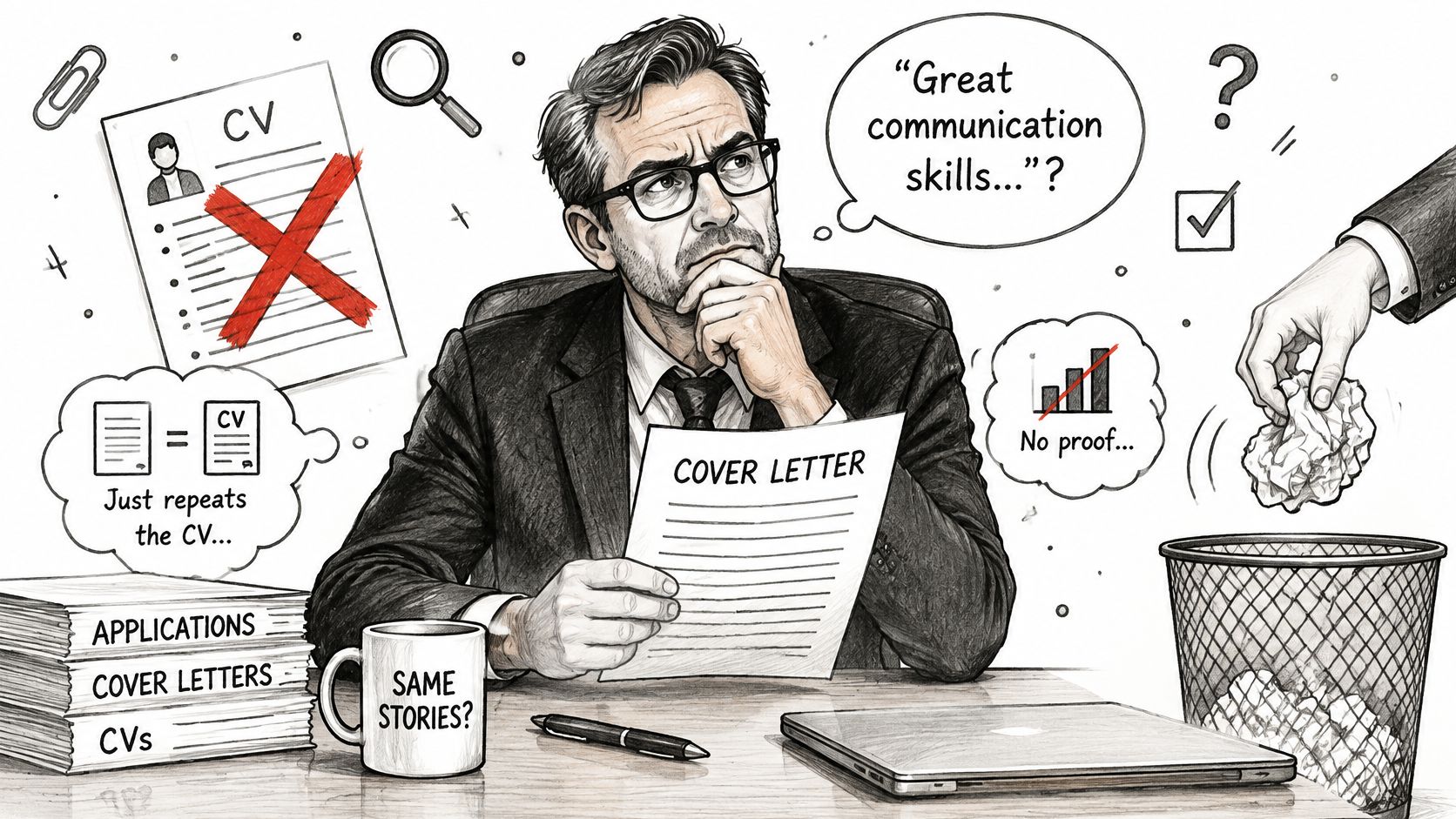
The disregard is real. A reCareered survey cited by The Atlantic reported that 90% of surveyed hiring contacts disregarded every cover letter they received, a finding covered in The Atlantic's history of the cover letter as a job seeker's annoyance. Don't read that as proof letters don't matter. Read it as proof most letters give the reader nothing usable.
Two CVs, One Clear Difference
Take two candidates for the same board seat. Both have run large businesses. Both have credible CVs. The first letter lists titles, revenue scope, and enthusiasm for the sector. The second names the board's audit and risk gap, cites one decision where the candidate tightened controls during rapid growth, and explains the oversight lesson that decision produced.
Only the second letter gives the nominating committee language it can repeat. That's the job.
A board letter isn't a summary of your career. It's an interpretive document that tells decision-makers how to read your career for this mandate.
That interpretive role is old. The modern two-document structure was already visible in a New York Times classified advertisement dated September 23, 1956, which asked applicants to submit a résumé with a cover letter, as traced in The Paris Review's account of the art of the cover letter. The résumé records evidence. The letter explains relevance, motivation, and fit.
Before you draft a sentence, test that fit against the actual mandate using a board role fit checklist for comparing your evidence to the vacancy. If you can't name the committee need, lifecycle stage, or composition gap you're addressing, you don't have a letter yet. You have a template. One page, role-specific evidence, and zero unsupported adjectives will beat confident length every time.
Choosing the Right Letter Format
Don't start by asking how to write the letter. Start by asking whether a formal letter is even the right document. Senior hiring sends conflicting signals, and you need a decision rule, not a habit.
A 2025 survey cited by LinkedIn reported that 83% of hiring managers read most cover letters even when they are not required and 94% said a cover letter influences interview decisions, while another 2025 survey found 65% still consider cover letters but only 26% view a missing letter as a dealbreaker, figures discussed in Gina Riley's LinkedIn analysis of cover letter risk. Translation: letters influence outcomes, but they aren't universally decisive. Send the wrong format and you waste the influence.
Three Formats, Three Different Jobs
- Mandatory application letter: The process asks for one. You send a formal, one-page board application letter that names the role, explains your governance perspective, and maps evidence to the stated mandate.
- Optional differentiator: The portal or search partner doesn't require a letter, but your CV looks similar to other qualified candidates. You send a concise letter because you have something specific to clarify, such as a sector transition, committee relevance, or independence position.
- Relationship-led note: You have a credible route to a chair, nominating committee member, or mutual director. You don't send a full application nobody requested. You send a short note that gives a specific reason for a conversation.
That third route matters more at board level than most guides admit. Nominations run through people who identify candidates, weigh attributes, and assess composition. The vacated Nasdaq framework once required disclosure of whether companies considered diversity when identifying director nominees and how that policy was implemented, a process examined in Harvard's Corporate Governance Forum analysis of the Fifth Circuit decision vacating the Nasdaq rules. The rule is gone. The nomination mechanics aren't.
Decision rule: Follow the requested process first, your access to the mandate second, and the strength of your relationship third. If a warm introduction exists, a tailored governance brief often beats a conventional letter.
Employment letters answer a job description. Board letters answer a different set of questions around committee responsibilities, independence, stakeholder credibility, and oversight judgment. If your document doesn't engage those questions, changing the salutation won't save it. Choose the format that fits the route in, then write only what that route requires.
Build a Governance Evidence Map
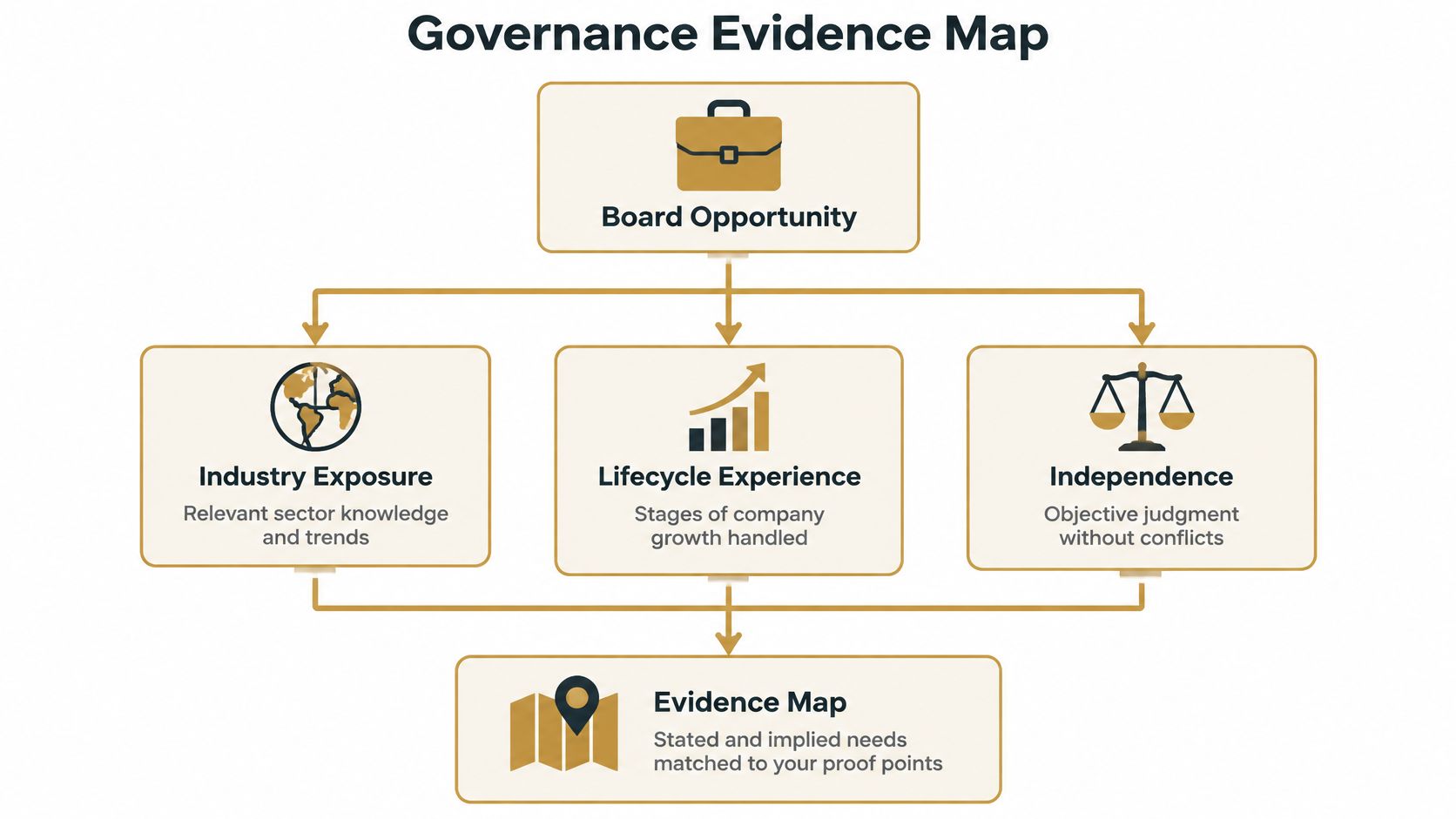
Write the map before you write the letter. If you draft prose first, you'll default to career chronology. A governance evidence map forces you to start with the board's needs and work backward to your proof.
The visual below shows the basic logic, moving from a board opportunity into the needs you'll match against.
A Five-Step Workflow That Holds Up
- Extract stated and implied needs. Read the role specification, annual report, committee charters, and recent results for industry exposure, lifecycle experience, independence, stakeholder credibility, and committee gaps.
- Select two or three quantified outcomes. Not ten. Two or three executive results that prove relevance to those needs.
- Translate each outcome into a director competency. Oversight, risk appetite, capital allocation, succession, cyber resilience, or regulatory judgment.
- Add a committee-fit angle. Audit, risk, remuneration, nominations, or ESG relevance, only where your evidence supports it.
- Close the map with independence and contribution. State what you'd bring without implying guaranteed availability or appointment.
Customization isn't cosmetic. Research linking detail, clarity, structure, and organizational customization to stronger interview yield found customization showed a statistically significant positive association with interview percentage (r = 0.28, p < 0.001), and a controlled field experiment involving 7,287 applications reported callback rates of 10.7% without a letter, 12.5% with a generic letter, and 16.4% with a customized letter, results published in the International Journal of Selection and Assessment study on cover letter tailoring. A reusable template is the weakest version of your own evidence.
Composition context sharpens the map further. Nasdaq's former Rule 5606 framework required annual disclosure through a standardized Board Diversity Matrix, including current-year and preceding-year statistics, mechanics set out in the SEC filing for Nasdaq's former board diversity disclosure rules. The Fifth Circuit vacated the SEC's approval in December 2024, so don't treat it as a live obligation. Do treat it as a lesson: boards assess specific gaps and year-over-year change, not generic seniority. A related former threshold expected a Nasdaq Global Market company to have, or explain why it did not have, at least two diverse directors by December 31, 2025, as described in the Nasdaq Listing Center resubmission filing on the vacated diversity framework.
This short video walks through how to think about positioning before you commit to prose.
Run your map against a board readiness assessment to test your governance positioning before drafting. A financial-services executive who tightened credit governance maps naturally to audit or risk oversight. An exiting founder who built a succession process maps to nominations and governance. Keep every item factually consistent with your CV, and don't claim one achievement proves universal board excellence. It doesn't.
Turn Executive Experience Into Board Evidence
Seniority isn't governance fit. That's the most consequential confusion in board applications, and it's why impressive operators write weak letters. They describe what they ran. Boards need to know what they'd oversee, question, and judge.
Use a claim-evidence-risk test on every paragraph. Name the governance issue, cite a concrete executive action or outcome, then explain the oversight value without overstating causality. If a paragraph can't pass that test, cut it.
Weak Wording Versus Defensible Wording
| Weak claim | What is missing | Stronger structure |
|---|---|---|
| Transformed risk management | No context, scope, or result | Name the decision context, the scope you owned, the measurable result, and the board-relevant lesson |
| Excellent board member | Pure assertion | Show committee-relevant evidence and let the reader draw the conclusion |
| Strategic leader | Unexplained adjective | Cite a capital allocation or succession decision and its consequence |
The same test works across backgrounds, but the translation differs. An audit professional shouldn't list technical standards. She should show where she challenged management assumptions and improved reporting quality, which is audit committee language. A technology executive shouldn't catalogue platforms. He should show how he set a resilience posture, weighed build-versus-buy risk, and reported that risk upward, which is technology and risk oversight.
A nonprofit leader often undersells herself. Don't. Restricted funding, donor accountability, and mission-versus-margin tension are governance problems, and they translate directly to stakeholder stewardship. A public-sector candidate should do the opposite of what instinct suggests and drop the procedural detail. Boards want the regulatory judgment and public accountability behind the process, not the process itself.
A few well-supported outcomes do more work than a compressed biography. Selection is itself a signal of judgment.
Weak writing carries material risk. One survey reported that 49% of hiring managers believed a strong cover letter could induce an interview for an otherwise weak applicant, 33% said a weak letter could damage an otherwise strong application, and 81% valued letters customized for the specific company and opening, findings summarized by the American Association for Physician Leadership on why cover letters still matter. Those are survey results, not placement guarantees.
Before drafting, run your underlying document through a board CV grader to check whether your evidence reads at director level. Then strip out dense operational detail, compensation language, and any hint that appointment is owed to you. It isn't, and claiming otherwise ends conversations.
Draft a One-Page Board Application Letter
One page isn't a formatting preference. It's a credibility test. If you can't make your case for a specific seat on one page, you haven't decided what your case is.
The sequence below keeps you honest without forcing a rigid template.
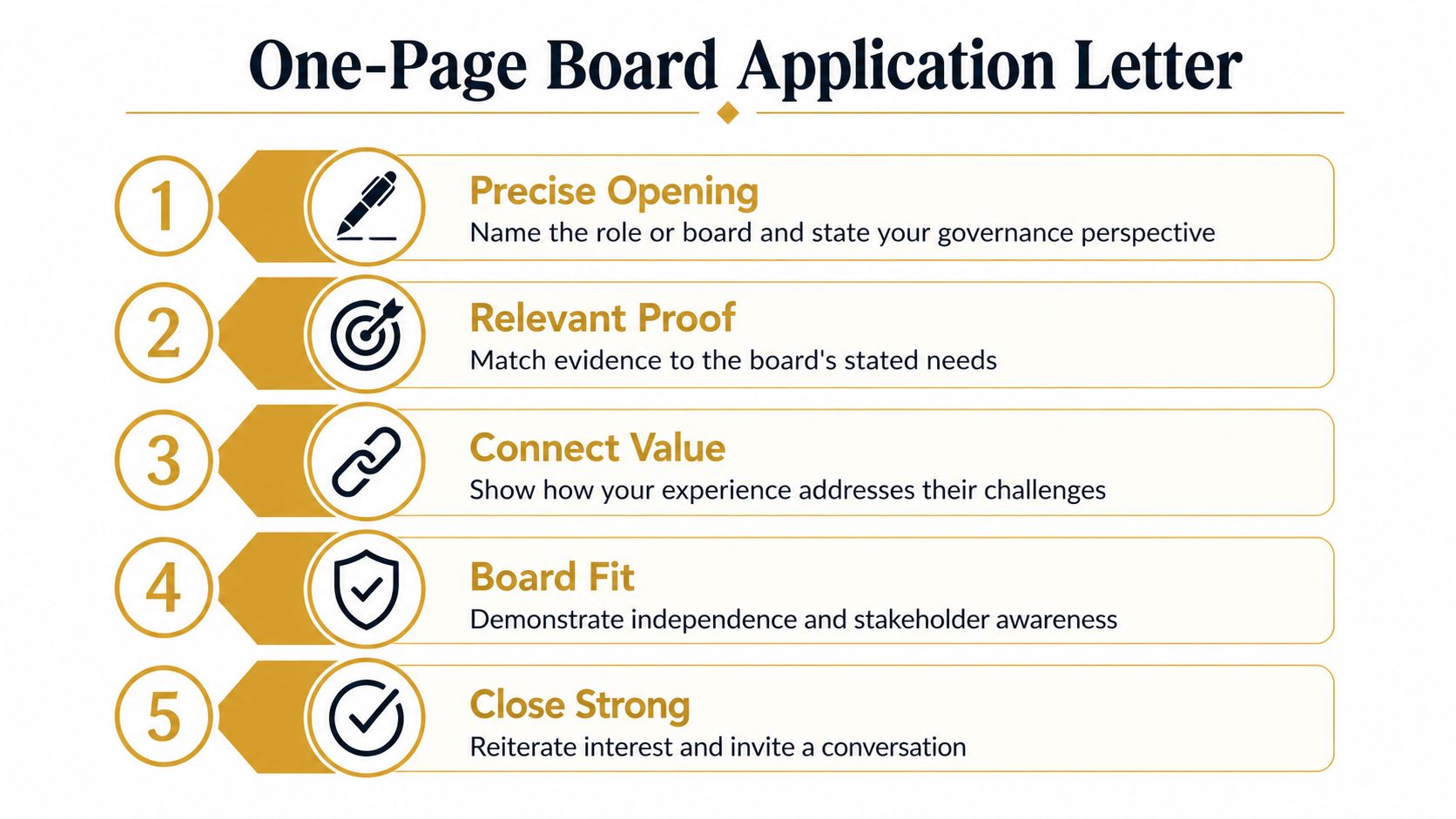
The Writing Sequence
Open precisely. Name the role or board in the first sentence. Follow with one sentence stating your relevant governance perspective, not your current job title. "I am applying for the independent director vacancy" plus a specific angle on the company's capital discipline, regulatory exposure, or succession challenge tells the reader you've done the work.
Build two or three evidence paragraphs. Each one moves in the same direction: board need, executive action, outcome, oversight contribution. Don't vary that logic for variety's sake. A chair scanning quickly should be able to extract your argument from the first sentence of each paragraph.
Add one committee-fit paragraph. Most executive letters go vague here, and board letters win or lose here. Address the committee you'd realistically serve on:
- Audit and risk: Financial reporting judgment, control environments, risk appetite, regulatory interaction
- Remuneration: Incentive design, pay-for-performance discipline, retention through transitions
- Nominations: Succession planning, board evaluation, executive assessment
- ESG and stakeholder: Materiality judgment, disclosure credibility, community and investor accountability
Claim only what your record supports. Overstating formal qualifications or independence is the fastest way to fail due diligence later.
Close with contribution, not gratitude. State what you'd bring to the board's work and invite a discussion. Skip effusive thanks, skip guaranteed availability, and skip any language that presumes appointment. Confidence at this level sounds quiet.
Sharpen the underlying proposition first with a board value proposition builder for framing your director contribution, because a letter built on a fuzzy proposition stays fuzzy at any length. Then handle the mechanics: correct legal entity and board name, accurate committee terminology, generous margins, and a type size a chair can read without effort. Align every date, title, and figure with your director-grade CV. A mismatch between the two documents doesn't read as a typo. It reads as a diligence problem, and diligence problems are fatal for people asking to oversee diligence.
Use AI Without Losing Your Voice
"Use AI carefully" is useless advice. So is "never use AI." You need a line between acceptable editing and automation that damages your credibility, because readers are already drawing one.
A 2025 survey of 600 U.S. hiring managers found that 19.6% would reject an application if its resume or cover letter appeared fully AI-generated, 33.5% said they could identify AI-generated resume content in under 20 seconds, and 25% believed cover letters should remain AI-free, according to TopResume's survey on AI use in hiring. At the same time, more than four in five employers reportedly use AI somewhere in hiring. AI assistance isn't automatically disqualifying. Generic, inflated, unverifiable output is.
A Human-in-the-Loop Standard
Start from firsthand material. Write your two or three outcomes in your own words, with the actual context, scope, and result. That raw draft is the evidence base, and no tool should invent it for you.
Then use AI for narrow, defensible jobs:
- Organize verified facts: Reorder paragraphs so the board need leads and the outcome follows
- Test clarity: Ask whether a paragraph answers the mandate or just sounds polished
- Find repetition: Flag repeated leadership adjectives, duplicated claims, and sentences that restate the CV
After that, take the document back. Verify every achievement, name, and date against your source evidence. Remove unsupported certainty. Restore the specific language you'd use in a boardroom, because a chair who meets you after reading the letter should recognize the same person.
If a sentence contains a claim you couldn't defend under questioning, it doesn't matter who or what wrote it. It's your name at the bottom.
Read the final version aloud. AI-assisted prose tends to smooth out the friction that makes judgment sound real, replacing a specific trade-off with a balanced-sounding generality. Board candidates are hired for judgment and independence, not keyword coverage. A letter that could belong to anyone signals a director who'd agree with everyone. Keep the tool in the editing chair. You stay in the author's chair, accountable for every claim.
Final Checks Before You Send
Most avoidable damage happens in the last ten minutes. Run a short, rigorous pre-send routine and don't negotiate with yourself about skipping it.
The Pre-Send Checklist
- Factual consistency: Every title, date, and figure matches your CV exactly
- Correct names: Board, legal entity, committee, and recipient are spelled and titled correctly
- Independence wording: Nothing implies a conflict, guaranteed availability, or presumed appointment
- Confidentiality: No undisclosed deals, internal figures, or sensitive personnel matters from a current or former employer
- Defensibility: You could support every claim in an interview without qualification or backtracking
Then read the letter once against the original mandate. If a stranger couldn't identify the board's gap, the committee need, and your intended contribution from one reading, revise before sending. That test is blunt and it works.
Consider the route one last time. Where you've mapped mutual directors, prior affiliations, investors, or advisers, informed outreach through a credible connection usually outperforms a cold submission. Where no such route exists, a letter crafted for the role, sent through the stated process, is the right move. Don't send a generic letter just to feel active.
Finish the supporting materials to the same standard with a board bio builder for a consistent director profile, since inconsistency across documents undermines the letter's work. Set realistic expectations too. A strong letter earns a conversation. Interviews, references, conflict checks, and due diligence decide the appointment, and you should prepare for chair-level questions about the exact evidence your letter raises.
If you'd rather not run that process alone, understand what you're buying. SeatSignal is the only DFY board placement program that hand-picks ideal board matches, drafts director-grade CV's for each role, and trains you specifically for each interview to ensure you land the seat. Its application packets include a governance-formatted director CV, custom cover letter, committee fit memo, and independence note, alongside role-specific interview preparation and support for decisions about opportunities both inside and outside its inventory. That's a preparation service, not a promise. You still own your claims, your judgment, and your due diligence.
If your current executive cover letter could be sent to ten boards unchanged, it's ready for none of them, and that's exactly the problem worth fixing before your next application. SeatSignal hand-picks board matches, drafts a director-grade packet for each specific role, and prepares you for the interview that follows, so your evidence arrives mapped to the mandate instead of buried in a template. Visit SeatSignal to see how the program works and decide whether it's the right support for your next board move.
Want a paid board role, done for you?
One handpicked, verified open board role every week, with a director-grade packet tailored for it.
Get Started