Executive Job Search: The 2026 Working Plan
Industry reporting estimates that about 70% of executive candidates are sourced through networking and direct outreach rather than inbound applications, according to the executive search process timeline from RecruitBPM. Read that correctly. Your executive job search isn't an application contest. It's a role thesis plus a scored route into roles that aren't public yet, worked over months through people who can place your name in front of a decision-maker. Résumé keywords and a generic instruction to network more won't get you there. A written thesis, three testable proof points, and a disciplined sequence for each opening will.
Table of Contents
- How Long an Executive Job Search Takes
- Build a Role Thesis Before You Apply
- Choose the Operating or Board Track
- How to Work the Network Without Cold Spam
- How to Prepare Applications That Get Read
- Interview Preparation Tips for Senior Panels
- Run the Six-Month Search Calendar
How Long an Executive Job Search Takes
An executive job search often spans several months. Track the candidate search and the employer's hiring process separately: your search starts before a role is formally opened, while the employer's process starts once it begins filling the position.
| Benchmark | Midpoint | Longer tail | How to use it |
|---|---|---|---|
| US management, business, and financial operations unemployment, 2026 | Median 16.9 weeks | Average 26.8 weeks | Baseline only, not a C-suite forecast |
| US management, professional, and related occupations | Median 14.4 weeks | Average 29.2 weeks | Averages are lifted by long searches |
The Unemployment Baseline
The U.S. Bureau of Labor Statistics table reports a median duration of 16.9 weeks and an average of 26.8 weeks for unemployed people in management, business, and financial-operations occupations in the cited 2026 table. The broader management, professional, and related group recorded a median of 14.4 weeks and an average of 29.2 weeks.
Treat those figures as context, not a personal forecast. They combine several professional categories and cannot predict the length of a specific C-suite search. The median marks the midpoint; the higher average reflects longer searches in the group.
The Employer Process Clock
An employer's executive hiring process often takes several months, and specialized C-suite roles can take longer. Confidential sourcing, stakeholder discussions, reputation checks, and compensation negotiations all add time. Board or committee approval can add further stages.
Your own search begins earlier, with defining the roles you will pursue and getting your name in front of decision-makers. A role may appear inactive while the employer is still sourcing candidates or assessing fit. Budget for a search that may extend across several months, and keep your target roles and follow-up activity in view throughout.
Plan a steady cadence rather than a short application sprint. Track which roles are open, which may emerge before public listing, and the route into each. A clear role thesis gives people a specific reason to consider you as the process unfolds.
Build a Role Thesis Before You Apply
Write one sentence before you touch your résumé. Name the business problem you solve, the company type where you solve it, and the proof a CEO, board, investor, or cross-functional panel can test. If you can't write that sentence, you're not ready to apply anywhere.
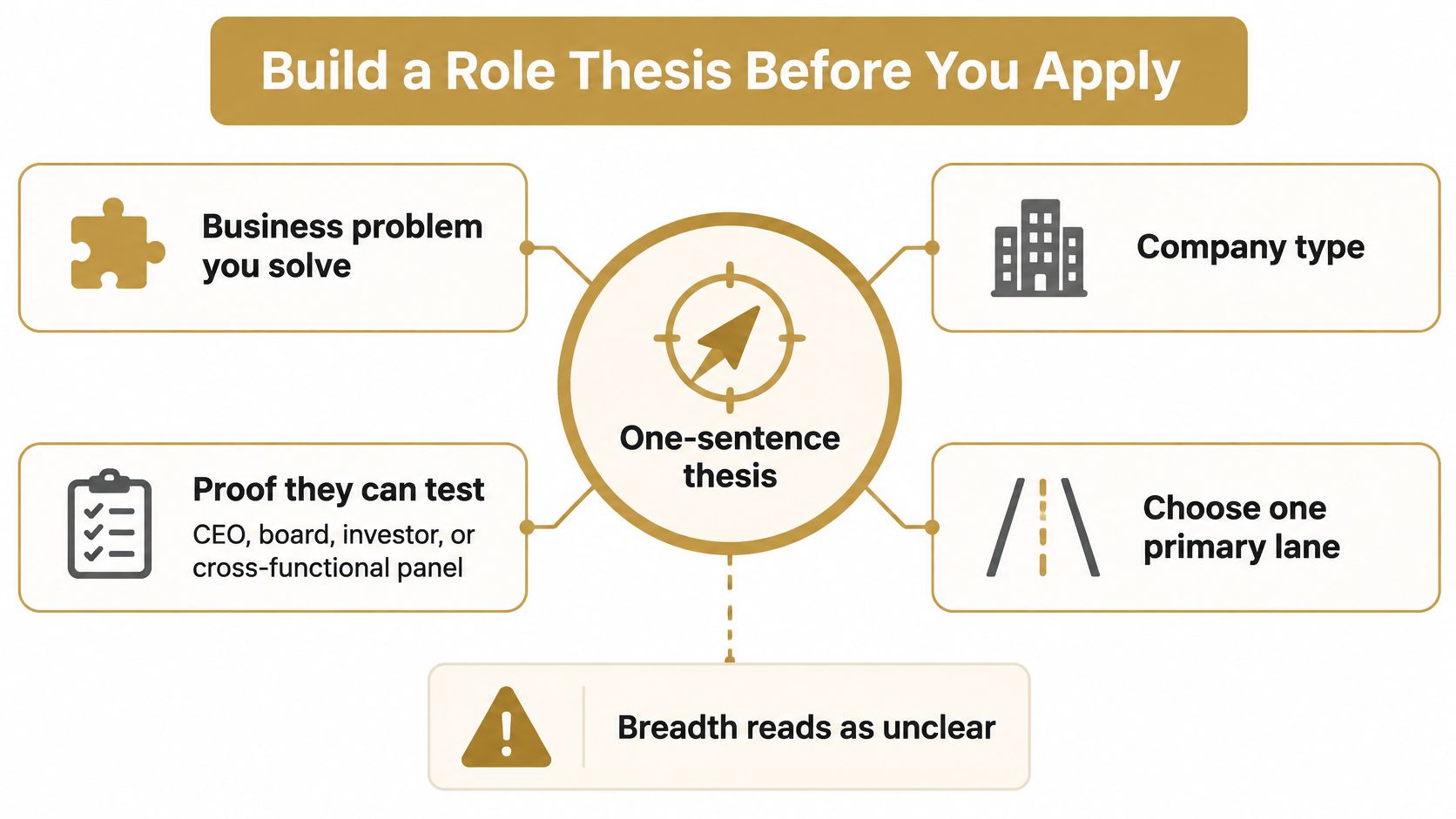
Say a CFO writes, "I take founder-led companies through their first institutional raise and build the finance function that survives diligence." That's a thesis. It names a problem, a company stage, and a testable outcome. Compare it with "seasoned finance leader seeking new opportunities." The first sentence gives a recruiter a reason to call. The second gives them nothing to repeat to a client.
Choose One Primary Lane
Breadth reads as unfocused. Hiring criteria are moving toward specialized, technology-fluent leaders, so a long list of general competencies works against you. A CFO, technology executive, founder, or former CEO needs to show AI, analytics, integration, growth, or organizational transformation with numbers attached, not a generic personal brand.
- Pick the lane: One role type, one company stage, one problem. Everything else becomes supporting context.
- Cut the rest: Experience that doesn't serve the lane gets one line or gets dropped. A thesis is as much about exclusion as inclusion.
- Stay in it for six months: Switching lanes every month resets your network conversations to zero each time.
Map Three Proof Points That Survive Scrutiny
Attach three proof points to the thesis. Each one ties a decision you owned to an outcome a panel can interrogate, such as revenue growth, margin improvement, risk reduced, a restructuring delivered, or a transformation completed. Name the context every time. A growth percentage without the starting base, the timeframe, and your specific decision won't survive a serious interviewer.
Use board appointments as a translation test for what counts as evidence. The 2025 Spencer Stuart Board Index reports that 30% of incoming S&P 500 directors were active or retired CEOs, 29% had financial experience, and 25% had functional or profit-and-loss leadership backgrounds. Seniority alone didn't carry those appointments. Candidates mapped their records to strategy, audit, risk, or operating results that a board could use. Hold your own proof points to the same standard, whether you're chasing an operating role or a seat.
Name the Credibility Gap in One Line
Write down the objection before a panel raises it. It might be no P&L ownership, no board exposure, a sector switch, or a move from nonprofit governance into a paid corporate seat. Then decide what evidence closes it. A sector switcher points to a transferable problem they've already solved. A first-time director points to audit, risk, or committee work that rehearsed fiduciary judgment.
Run your thesis against the Board Role Fit Checklist if a board seat is part of your target. It forces the same mapping exercise, proof against a specific gap, before you commit weeks to the wrong roles.
When conducting a confidential search, keep visibility narrow and deliberate. Brief a small circle of recruiters and peers who understand the constraint. Skip the public open-to-work banner that signals an unwanted departure to your current employer. You need more visibility with the right twenty people, not a public announcement to everyone.
Finish with the thesis written down where you'll reuse it. Every outreach message, every application, and every interview answer should pull from the same sentence, the same three proof points, and the same named gap with its closing evidence.
Choose the Operating or Board Track
For the next six months, choose one primary track. An operating search and a board search require different evidence, documents, and routes to opportunity. Splitting your effort weakens both.
Track A is an operating role: CEO, COO, CFO, or a divisional P&L job. State the problem you would own, lead with operating scope and outcomes, and focus your search on hiring executives and retained search firms. Start with a 25-company list and an interview sheet you can update as processes begin.
Track B is a first paid board seat or a portfolio seat. Build a transfer story that connects your experience to fiduciary oversight, committee responsibilities, and boardroom judgment. A CEO résumé alone will not make that case.
Review current board of directors positions to see how listings describe the committee need and experience profile. Use those requirements to score each opportunity against your role thesis: the strength of your relevant evidence, your fit with the board's needs, and the route available into the board. Prioritize roles with a clear match and a credible path, including openings that may not yet be public.
SeatSignal's placement team handpicks relevant board roles, prepares a director-grade application packet for each opportunity, and provides board-specific interview preparation. Every role is checked against your profile and location, and the team selects the strongest fits each week. A short discovery call can clarify your experience, target roles, and whether the service fits your search.
Whichever track you choose, send every approach in your own name. Boards, nomination committees, and recruiters make appointment decisions; no program can promise a seat.
How to Work the Network Without Cold Spam
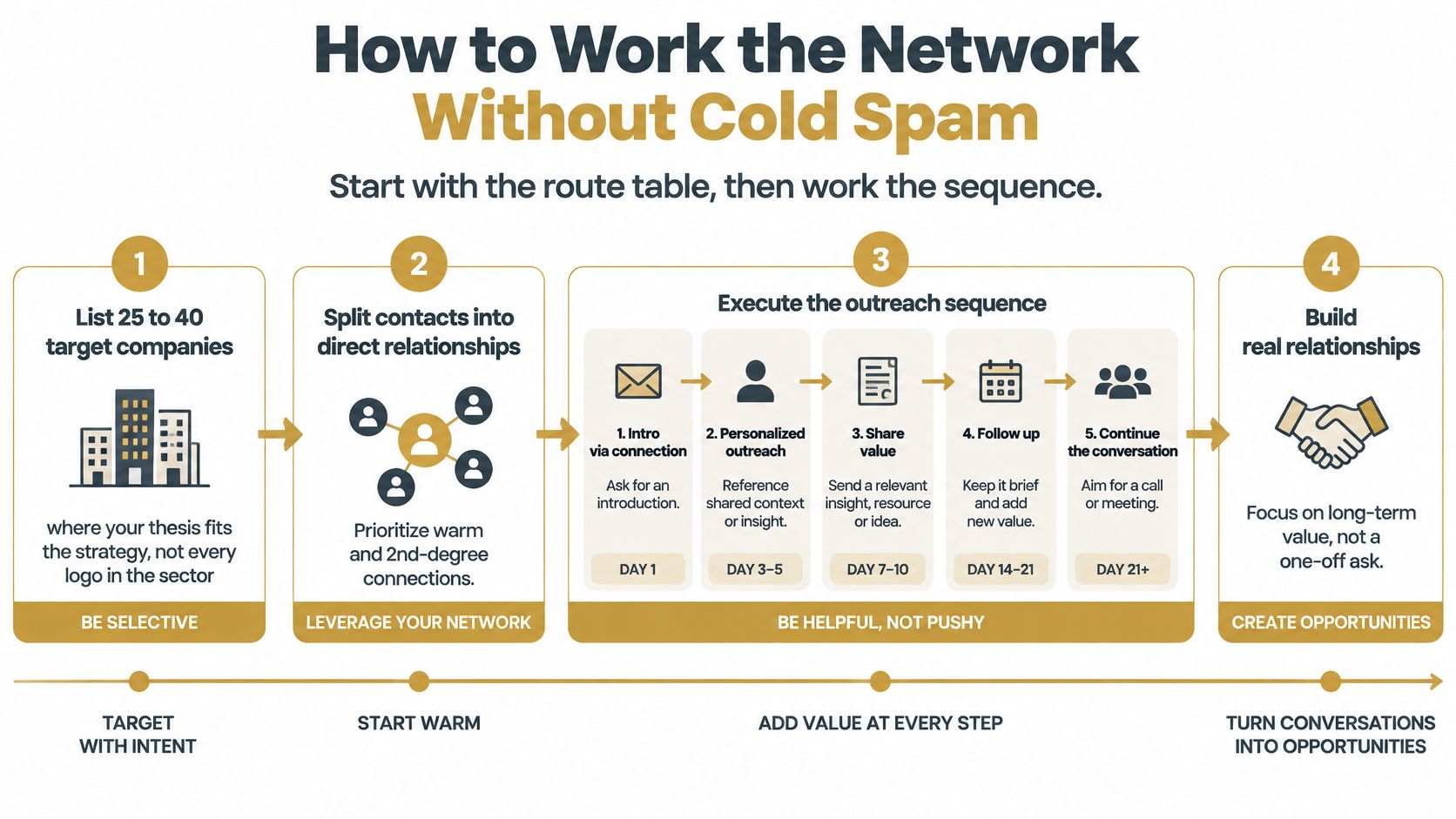
Networking is a primary channel in an executive job search, not a supplement to applications. But "network more" is useless advice. Work a scored sequence instead.
| Route | When it fits | Main risk | What to send |
|---|---|---|---|
| Public application | The role is advertised and the thesis matches the spec | A large inbound pile | Tailored résumé and a short value proposition |
| Warm referral | A direct contact knows the hiring CEO, chair, or investor | A weak name-drop looks transactional | One specific ask tied to a business problem |
| Intelligence conversation | The opening looks pre-public or succession-led | Premature contact can expose a confidential search | Questions first, not a résumé dump |
| Retained search approach | A firm already owns a confidential mandate | You are one of several sourced names | A short leadership narrative and your constraints |
| Board or committee path | The need is governance, audit, risk, or technology oversight | A general CEO story with no committee proof | Evidence mapped to the board gap |
The route table below the sequence shows when each path is the wrong one. Match the route to the state of the opening, not to your level of impatience.
The Six Moves in Order
- Build the target list: List 25 to 40 target companies where your thesis fits the strategy. Not every logo in the sector. Companies facing the problem you solve.
- Segment your contacts: Split people into direct relationships, second-degree connectors, and domain experts. Each group gets a different ask.
- Score every opening: Mark each one confirmed, likely, or speculative, and name the decision-maker: CEO, chair, investor, or incumbent director.
- Ask for something specific: Request one piece of intelligence or one introduction. Tie one quantified result to one business problem. Never ask for generic job leads.
- Sequence the route: Hold an intelligence conversation when the opening is pre-public. Use a warm referral when a real decision-maker is reachable. File a public application only once the role is confirmed.
- Log and stop: Record each follow-up with a date. Stop working a lead when the seat is only a rumor.
Recent survey reporting in the Close Collins Executive Transition Report 2026 found that existing network referrals were the largest source of executive placements, accounting for 36% of placements. Confidential searches also often begin before restructuring or leadership changes are formally announced. That's why the intelligence conversation exists as its own route. It lets you validate whether a likely opening is real before you spend a relationship on it.
This short video walks through how senior candidates approach decision-makers without turning the conversation into a pitch.
Warm Path or Weak Path
A warm path is a named person with a specific reason to connect you. A weak path is a name-drop from someone who met the chair once at a conference. Decision-makers can tell the difference in one sentence. If your connector can't say why you fit this company's current problem, you don't have a referral. You have a rumor with your name attached. Our breakdown of executive search firms covers how retained firms handle referred names versus sourced candidates, which should shape how you time that approach.
Premature outreach has a cost. It can expose a confidential search, create a conflict with your current employer, or damage a relationship you spent years building.
Finish this work with two short lists. People you'll contact this week, with the specific ask written next to each name. And people you'll leave alone until an opening moves from speculative to likely. The second list protects you as much as the first one advances you.
How to Prepare Applications That Get Read
An application packet is a compressed argument for your thesis. Build it in this order, and don't start writing until step one is done.
Step One and Two: Freeze, Then Rebuild
Freeze the thesis and target list first. If those aren't settled, the document becomes a full career archive, and archives don't get read. Recruiters skim for fit against a specific mandate. Give them a document that's already made the fit argument.
Then rebuild the executive résumé around scope, outcome, and context. Every senior bullet answers three questions. How big was the business or function? What decision did you own? What changed, in numbers? "Led European operations" says nothing. "Ran a multi-country operation, closed two unprofitable sites, and returned the division to margin within a defined period" gives a panel something to test. Cut every bullet that doesn't serve the thesis, however proud you are of it.
Step Three: Add the One-Page Value Proposition
Recruiters need a document they can forward. Write a one-page value proposition that states the role you want, the problem you solve, and your three proof points in compressed form. Keep a shorter governance narrative only if a board seat is also in play, and write it separately. Blending operating and governance language into one document weakens both.
For a board packet, tie evidence directly to composition, audit, risk, strategy, or another committee need. Restating the operating résumé with the word "governance" added fools nobody. The Board CV Grader checks whether a director CV reads at that standard before it reaches a nomination committee.
Step Four: Send Only Where the Match Is Real
External candidates get hired at this level. SHRM's 2025 recruiting benchmark, based on more than 2,300 HR professionals, reports that only 25% of large organizations and 50% of extra-large organizations used internal pipelines for executive hiring, while smaller and medium-sized organizations relied predominantly on external sources. External sourcing matters. That doesn't make a generic portal application a strategy.
- Send list: Confirmed or likely openings where your thesis matches the stated problem or committee need.
- Do-not-send list: Speculative roles, roles outside your lane, and any company where you'd need to rewrite your thesis to fit.
- Constraints stated early: For a regulated or cross-border role, show location, independence status, and any condition you won't accept. Surfacing a deal-breaker in week ten wastes everyone's quarter.
The application isn't the finish line. It's the start of a tracked process that runs for weeks, with a follow-up cadence you'll manage on a calendar. Send fewer packets, send them to the right openings, and log every one.
Interview Preparation Tips for Senior Panels
Prepare five evidence stories and no more. One each for strategy, people leadership, governance or oversight, risk, and stakeholder management. Five stories you can tell under pressure beat fifteen you half remember.
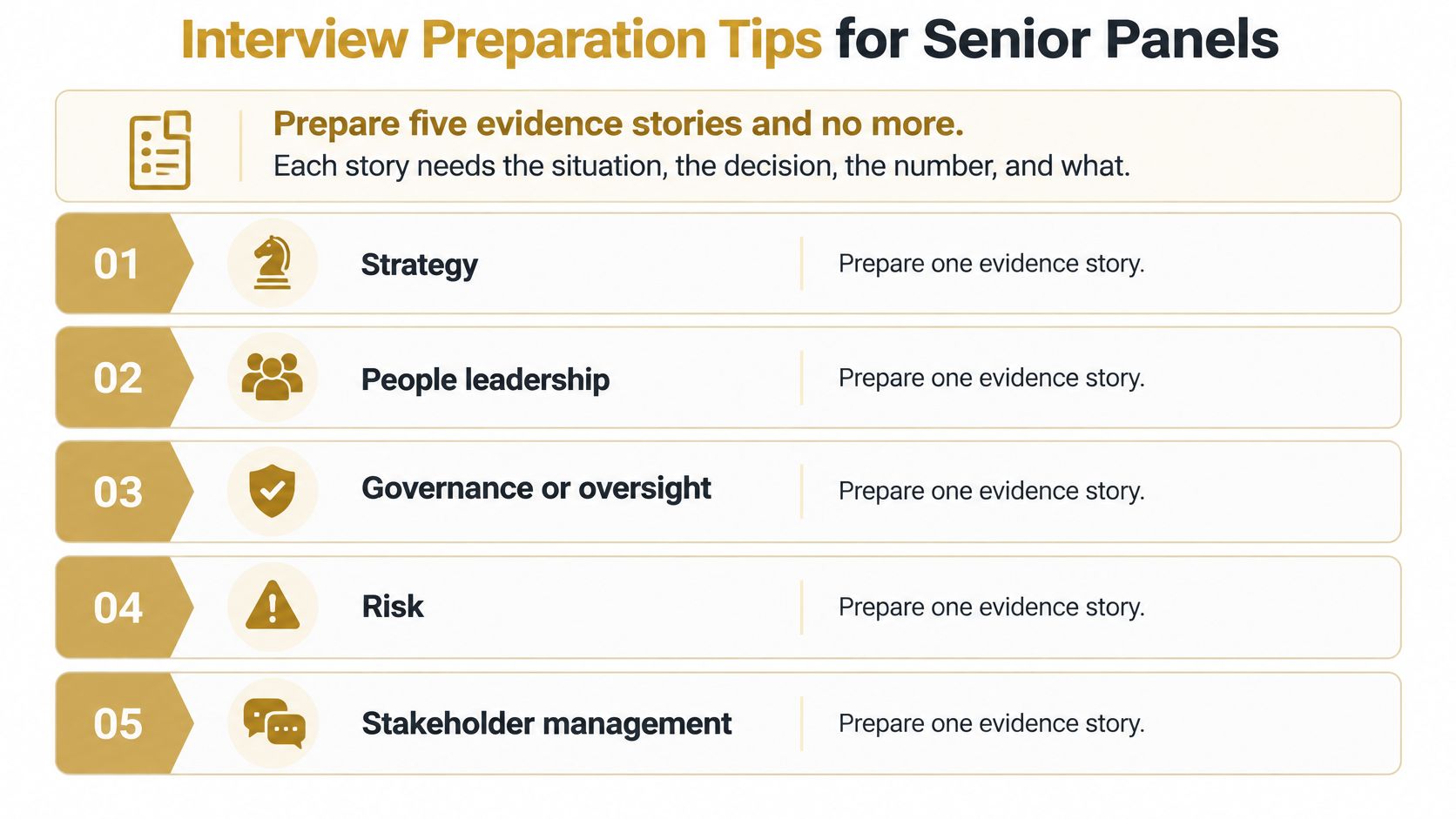
Each story has four parts. The situation you walked into. The decision you owned, including the options you rejected. The number that resulted. And what you'd do differently, which is where panels separate judgment from luck. A story without the fourth part sounds like a victory lap. Senior interviewers discount victory laps.
Expect Different Tests From Different Seats
You'll face more than one panel, and each seat tests something different. A CEO tests operating judgment, whether you'd make the call they'd make with incomplete information. A board member tests fiduciary judgment, whether you understand oversight as distinct from management. A cross-functional interviewer tests conflict handling, whether peers will work with you.
Prepare for the specific gap you'd fill. Research the team or board you're joining and rehearse the questions that role's chair or hiring executive is likely to ask about that gap. The Board Interview Question Bank collects the questions chairs use to probe committee fit and boardroom judgment, which is the right rehearsal set for the board track.
An interview is a test of judgment under scrutiny, not a recital of the résumé.
References, Compensation, and Silence
Brief your references on the thesis before anyone calls them. A reference who invents a different story about your strengths creates doubt you then have to undo. Give each reference the role type, the problem you'd solve, and the proof point they're best placed to confirm.
Hold compensation detail until the mandate and scope are clear. Negotiating before you know the role's risk, time demand, and downside exposure anchors you to your last package instead of this role's value. Once scope is defined, negotiate from the mandate. That's the stronger position and the more honest one.
If you're employed, agree in advance what the search firm may say and to whom. Put the boundary in writing. Confidentiality failures at this level rarely come from malice. They come from a casual mention in the wrong room because nobody defined the rule.
Then expect silence. A quiet stretch of several weeks is normal while sourcing continues and stakeholder calendars align. Follow your logged cadence once, then wait. Chasing a panel doesn't speed up a board's diary, and it reprices you downward.
Close your preparation with a one-page prep sheet per live process. Thesis at the top. Three proof points. Likely objections, including your named gap. And the question you'll ask them, because the quality of that question tells a panel how you think about their business.
Run the Six-Month Search Calendar
Turn the plan into four windows. Don't move to the next window until the exit check is met.
| Window | Main actions | Exit check |
|---|---|---|
| Weeks 1-2 | Freeze the thesis, build the 25 to 40 company list, split contacts into three groups, write down your constraints | Thesis written down and list approved |
| Weeks 3-6 | Intelligence conversations, warm referrals, packets to confirmed or likely roles | Every opening scored confirmed, likely, or speculative |
| Weeks 7-12 | Panel interviews, one prep sheet per live process, logged follow-up on cadence | Every live process has a prep sheet and a logged next step |
| Weeks 13-26 | Quiet stretch, reassess route scores, drop speculative leads | Decision to continue, change track, or stop |
Weeks 1 and 2 are document and list work. No outreach until the thesis sentence exists and the constraints you won't accept are written down. Weeks 3 to 6 are conversation work, and packets go only to confirmed or likely roles.
Weeks 7 to 12 run on discipline. One prep sheet per live process, every follow-up logged, cadence kept without chasing. Weeks 13 to 26 are where most executives quit or panic. Expect the quiet stretch. Use it to reassess each route score, drop speculative leads, and make a deliberate decision to continue, change track, or stop.
Review the log every Friday. Fifteen minutes, same time. That's what keeps the calendar honest instead of aspirational.
If you've chosen the board track, we hand-pick board roles matched against your profile, prepare a director-grade packet for each one, and rehearse you against the questions that board's chair is likely to ask. Start with a short discovery call to test your experience against the seats you're targeting, and visit SeatSignal to book it.
Want a paid board role, done for you?
One handpicked, verified open board role every week, with a director-grade packet tailored for it.
Get Started