Executive Non Executive Director Roles in 2026

The usual advice is that executives manage and non-executives oversee. That's a useful definition, but a poor test of board readiness. A successful operator can still become an ineffective director if they treat the boardroom as another management meeting.
For anyone comparing executive and non-executive director roles, the harder questions concern independence, behaviour and capacity. Can you challenge a decision without taking it over? Can you remain objective about people you know? And can you make yourself available when the company needs more than a scheduled meeting?
Table of Contents
- Why Boards Separate These Two Directors
- Executive and Non-Executive Directors Side by Side
- Independence Tests That Decide Who Qualifies
- Time Commitment from Meetings to Crises
- Behaviours That Prove Oversight Not Management
- Choose the Seat That Fits Your Situation and Capacity
Why Boards Separate These Two Directors
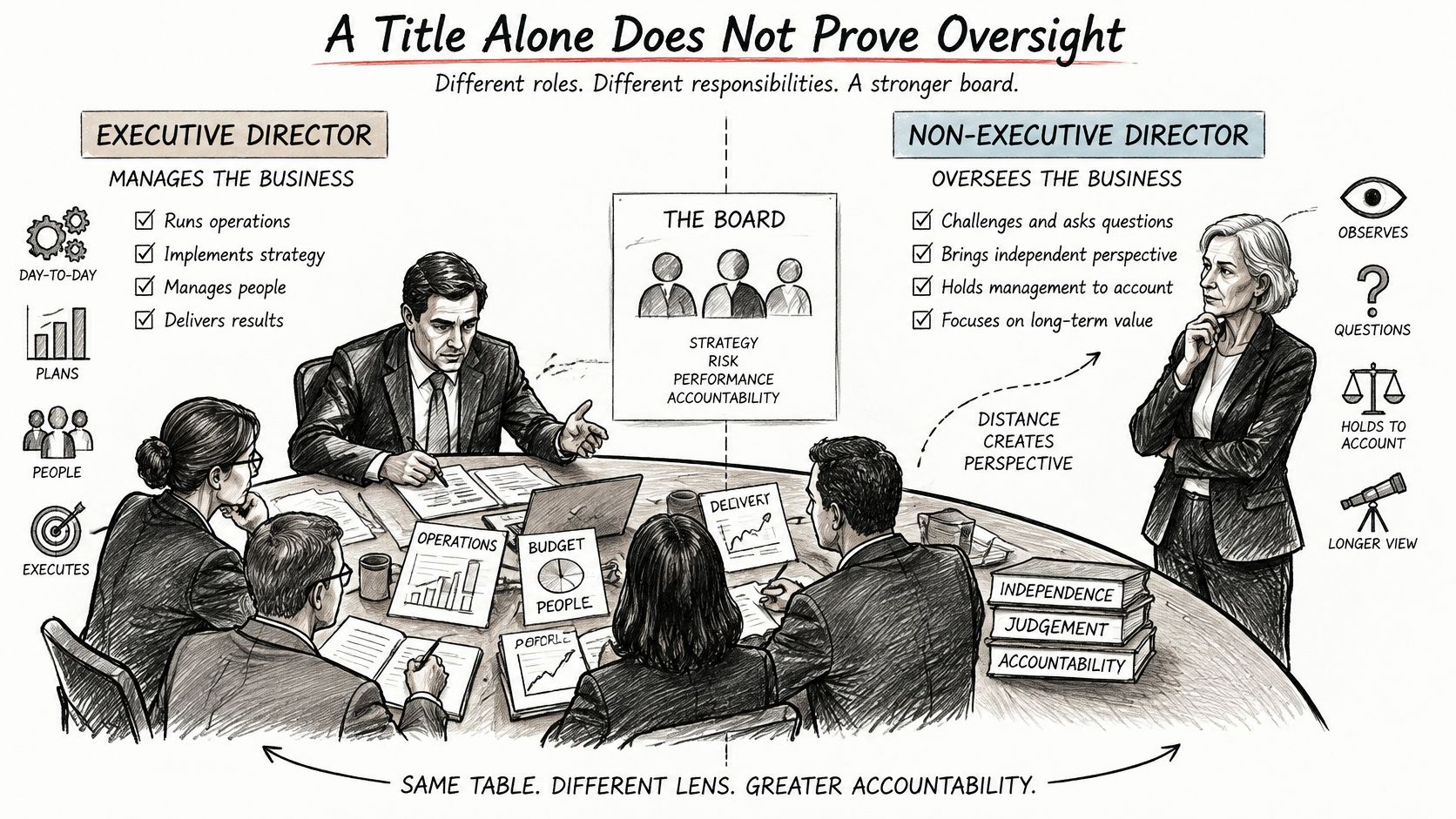
The job title is the easy test. Say a company proposes buying a competitor. Its executive finance director builds the financing plan, directs due diligence and takes responsibility for delivery. A non-executive director tests the assumptions, questions the downside and decides whether management has justified the proposal.
Both contribute to strategy. They contribute from different positions.
An executive director sits inside management, with authority to run the business or a function. A non-executive director, often shortened to NED, stands outside that operating line. Their appointment gives them a governance role, not another executive job.
The distinction is visible in who prepares a proposal, who challenges it and who implements the decision.
Independence is a hiring requirement
This isn't just a UK or US convention. The OECD's 2025 Corporate Governance Factbook reports that 21 jurisdictions impose a legal, regulatory or stock-exchange requirement for independent directors, while 9 additional jurisdictions combine a mandatory minimum with a stronger voluntary recommendation.
For a nomination committee, that changes the search. Senior operating experience isn't enough if the candidate can't provide objective scrutiny.
The committee must distinguish between:
- Knowledge of the business, which helps a director understand management's proposals.
- Distance from management, which helps them assess those proposals without protecting an employment relationship.
- Freedom from competing interests, which matters when financial, family or controlling-shareholder ties could influence judgment.
Non-executives are particularly valuable where the board must assess audit findings, risk, remuneration or nominations without allowing the people affected to dominate the decision.
A candidate therefore needs more than an impressive career history. They need evidence that they can use that history without becoming an unofficial executive. The practical comparison turns on function, independence, time and contribution, not seniority alone.
Executive and Non-Executive Directors Side by Side
An executive director runs the business and sits on the management side of the board. A non-executive director stands outside management to supervise, challenge and judge.
Executive director versus non-executive director
| Criterion | Executive director | Non-executive director |
|---|---|---|
| Place in the company | Inside management, with authority to run the business | Outside management, appointed to supervise and challenge |
| Core responsibilities | Strategy execution, operations and functional results | Oversight of strategy and performance, risk, succession and board effectiveness |
| Employment | Officer or employee | Not an employee in the NED role; rewarded by director fees, not an executive package |
| Independence | Not independent of management | An independent NED must be free of relationships that impair objective judgment |
| UK Code board balance | Counts on the management side | At least half the board, excluding the chair, should be independent non-executives |
| Time shape | Full-time operating role | Part-time, sized to complexity, committees and crises rather than a fixed meeting count |
| Contribution evidence | Operating outcomes such as growth, transformation, capital allocation and crisis delivery | Oversight outcomes such as audit scrutiny, risk escalation, succession, committee work and constructive challenge |
For companies within its scope, the UK Corporate Governance Code 2024 says at least half the board, excluding the chair, should consist of non-executive directors whom the board considers independent.
Notice the qualification: non-executive doesn't automatically mean independent. A director can sit outside management while still having relationships that prevent the board from classifying them as independent.
Pay describes the appointment, not its difficulty
Executive directors receive compensation for their management job. NED compensation pays for the directorship and associated responsibilities, rather than an executive employment package.
As a scale benchmark, the Harvard Law School Forum on Corporate Governance's 2025 U.S. Board Index reports that average U.S. public-company director pay increased 3% to $336,352, consisting of 59% stock awards and 36% cash. That's a public-company benchmark, not a promise of compensation for a first appointment.
Compare an offer's responsibilities with its remuneration. A substantial retainer doesn't tell you whether the committee workload, travel or exposure is manageable.
Separate delivery from oversight
A nomination committee needs to understand what you personally contributed. Delivering a restructuring as chief executive is different from challenging restructuring assumptions as a board member.
Research involving 40 in-depth director interviews, published through Regent's University London, found that conduct and relationships between executive and non-executive directors materially shape board effectiveness. Formal structure and independence enable good governance, but don't prove it.
When reviewing board of directors positions, identify which evidence the appointment requires. An executive search asks whether you can deliver the plan; a non-executive search asks whether you can assess the plan and hold its owners accountable.
Both roles owe duties to the company. The distinction is function and independence, not permission for a non-executive to apply a lighter standard of care.
Independence Tests That Decide Who Qualifies
Independence is a factual assessment, not a personality trait. Being willing to disagree doesn't erase a commercial relationship, recent employment or a close family connection.
The modern framework owes much to the Cadbury Committee, whose report and governance code were published in December 1992, as described in the Financial Reporting Council's Cadbury anniversary address. It helped move non-executives from an ambiguous advisory position toward formal expectations of challenge and accountability.
Run the relationship checks before applying
The UK Code identifies circumstances that may impair independence. These require disclosure and board assessment, rather than a candidate declaring themselves objective without further evaluation.
What can impair director independence
| Test | What breaks it | Rule |
|---|---|---|
| Recent employment | Employed by the company in the previous five years | UK Code |
| Material business relationship | Material relationship in the previous three years | UK Code |
| Extra pay | Remuneration beyond director fees | UK Code |
| Family ties | Close family ties with advisers or senior employees | UK Code |
| Significant shareholder | Represents a significant shareholder | UK Code |
| Long tenure | Board service exceeding nine years | UK Code; familiarity risk |
| Audit committee fees | Consulting, advisory or other compensatory fees from the issuer, outside permitted board or committee pay | SEC audit-committee independence test |
| Audit committee affiliate | Affiliated person of the issuer or any subsidiary | SEC audit-committee independence test |
The UK Code's employment, business-relationship and tenure benchmarks are five years, three years and more than nine years, respectively; it also calls for an independent non-executive to serve as senior independent director.
Independence can weaken through familiarity. A director who started with sufficient distance may become less willing to question established colleagues.
Don't treat the table as permission to hide a relationship that falls outside a stated period. Explain its substance, continuing financial consequences and any remaining influence.
Committee eligibility can be stricter
For U.S. listed audit committees, the SEC's audit-committee independence framework requires each member to be an independent board member and addresses both additional compensatory fees and affiliate status. Technical expertise doesn't cancel those restrictions.
That distinction matters for a former consultant pursuing an audit seat. Their financial knowledge may be excellent, but the engagement and compensation arrangements still need checking. Don't assume audit, risk and finance committees all have identical eligibility rules.
The G20/OECD Principles of Corporate Governance 2023 emphasise objective judgment in areas including remuneration, succession, control changes and related-party transactions, precisely where competing interests can distort decisions.
Before applying, assemble a relationship record covering cooling-off periods, fees, family ties, shareholding and tenure. Use a board offer due diligence checklist to turn that record into questions for the chair and company secretary, rather than discovering an eligibility problem after interviews.
Time Commitment from Meetings to Crises
Non-executive time benchmarks
| Setting | Benchmark | What changes it |
|---|---|---|
| Typical UK non-executive, historical governance evidence | About 15–30 days a year | Company complexity and regulatory intensity |
| European bank non-executives, average | 28 days a year | Supervisory intensity |
| Banks with assets above €100 billion | 53 days a year | Balance-sheet scale |
| Banks with assets below €2 billion | 30 days a year | Smaller scale doesn't remove governance demands |
| Non-executive with no committee | About 15.7 days a year | Plenary board work without committee membership |
| Non-executive serving on a committee | Around 30 days a year | Additional meetings and committee preparation |
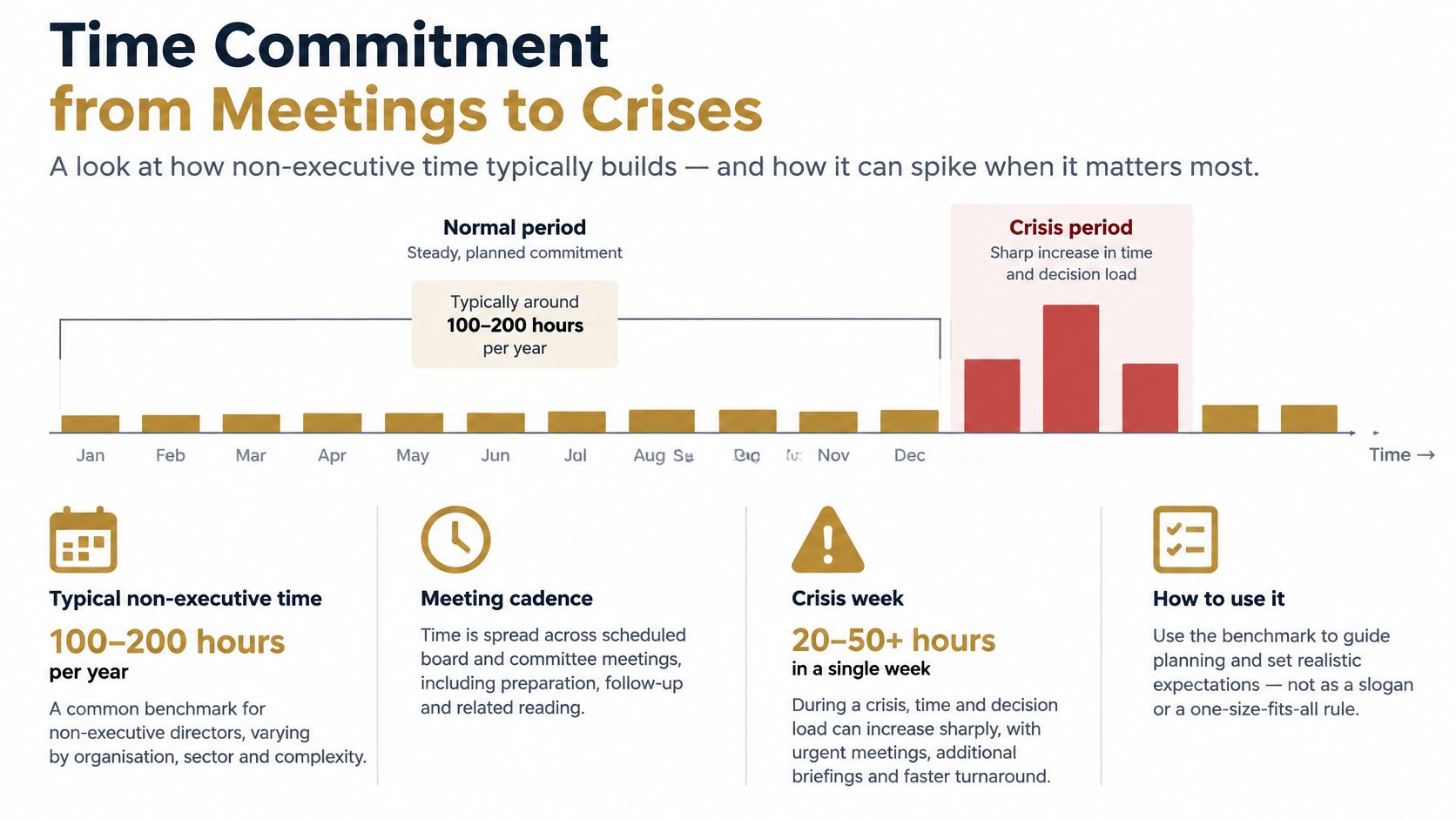
The European Central Bank's banking-supervision discussion places historical UK commitments at about 15–30 days annually, reports a European banking average of 28 days, and compares 53 days at banks above €100 billion in assets with 30 days at banks below €2 billion; earlier committee benchmarking compares about 15.7 days without committee membership with around 30 days with it.
These are setting-specific planning benchmarks, not a universal allowance. A smaller company undergoing an investigation can demand more immediate attention than a larger company during a settled period.
The important distinction is between scheduled work and availability when plans change.
Build a personal workload count
Start with the actual calendar, not the headline number of board meetings. Include:
- Plenary meetings: Attendance, travel and follow-up.
- Reading and preparation: Papers, financial statements and questions submitted before meetings.
- Committee work: Separate packs, adviser discussions and reporting deadlines.
- Stakeholder engagement: Agreed meetings with investors, employees or other relevant groups.
- Training: Induction, sector learning and regulatory updates.
- Exceptional events: A bid, investigation, leadership departure or liquidity crisis.
Put those commitments beside your executive calendar and existing directorships. A board time commitment calculator can help organise the estimate, but the chair must clarify the company's actual expectations.
Ask when papers arrive, which committees you'll join and whether urgent meetings tend to require travel. Identify clashes around reporting, budget approval and remuneration decisions before accepting.
Test the difficult week
An executive directorship isn't contained within a NED day allowance. It's the operating job, with board responsibilities added to it.
For a serving executive considering an external appointment, availability must therefore include employer approval and practical cover. A portfolio director needs the same realism about simultaneous demands across companies.
Capacity rule: If you can't meet the crisis week, the seat is too many, even if you can attend every scheduled meeting.
A credible candidate states how urgent risk matters, workload peaks and conflicts will be handled. Promising unlimited availability is less convincing than showing a workable arrangement.
Behaviours That Prove Oversight Not Management
In PwC and The Conference Board's 2025 survey of more than 500 executives, 32% believed directors were overstepping their roles, twice the prior year's level; nearly half of executives identified international business and AI as major risks, compared with 9% and 10% of directors, respectively.
Those findings expose a practical problem. Directors can intrude into management while still failing to engage with the risks executives consider most important.
The role boundary depends on behaviour, not the wording on an appointment letter.
Challenge the proposal without taking over
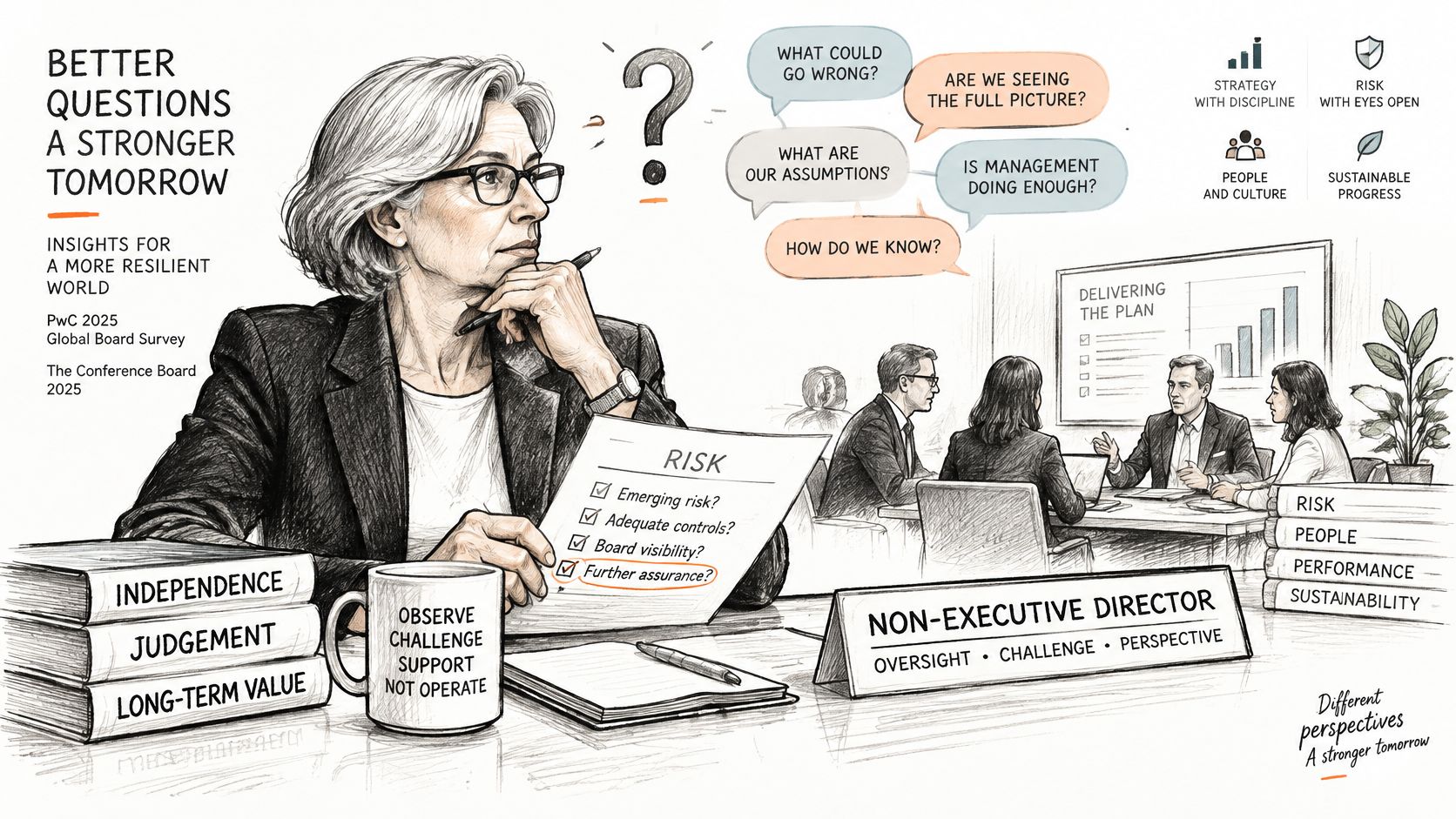
A serving executive needs to demonstrate challenge through questions, rather than management instructions.
Say management proposes a new pricing model. A useful NED asks which customer assumptions were tested, what would invalidate the forecast and when the board should reconsider. They don't redesign the price list in the meeting and instruct the sales director to implement it.
The test isn't whether the director has a better operational idea. It's whether they help the board reach an informed decision while leaving accountable executives responsible for delivery.
Show restraint where influence is easiest
Conflicts require action. Declare the interest, follow the agreed recusal process and stay out of the decision where required. Don't use board information to steer a former team or support another commercial interest.
Information access isn't operating authority. Seek adequate papers, site visits and access to the auditor through agreed governance arrangements. Don't turn those information channels into permission to hire staff, set prices or direct employees.
Operating expertise can sharpen challenge, but unchecked familiarity with management weakens oversight. Executive experience isn't automatically a governance advantage.
Use the following video alongside a candid review of how you handle boardroom boundaries.
Produce evidence a committee can assess
Committee evidence should explain the issue, your intervention and the governance outcome. You might describe identifying an unsupported audit assumption, escalating an unresolved risk or challenging succession arrangements.
Keep confidential material confidential. You don't need to circulate minutes to explain your contribution, and you shouldn't imply sole credit for a collective decision.
Before writing an application, separate your record into operating outcomes and oversight outcomes. Use a board readiness assessment to identify where your evidence supports independent governance and where you still rely on an executive track record.
Choose the Seat That Fits Your Situation and Capacity
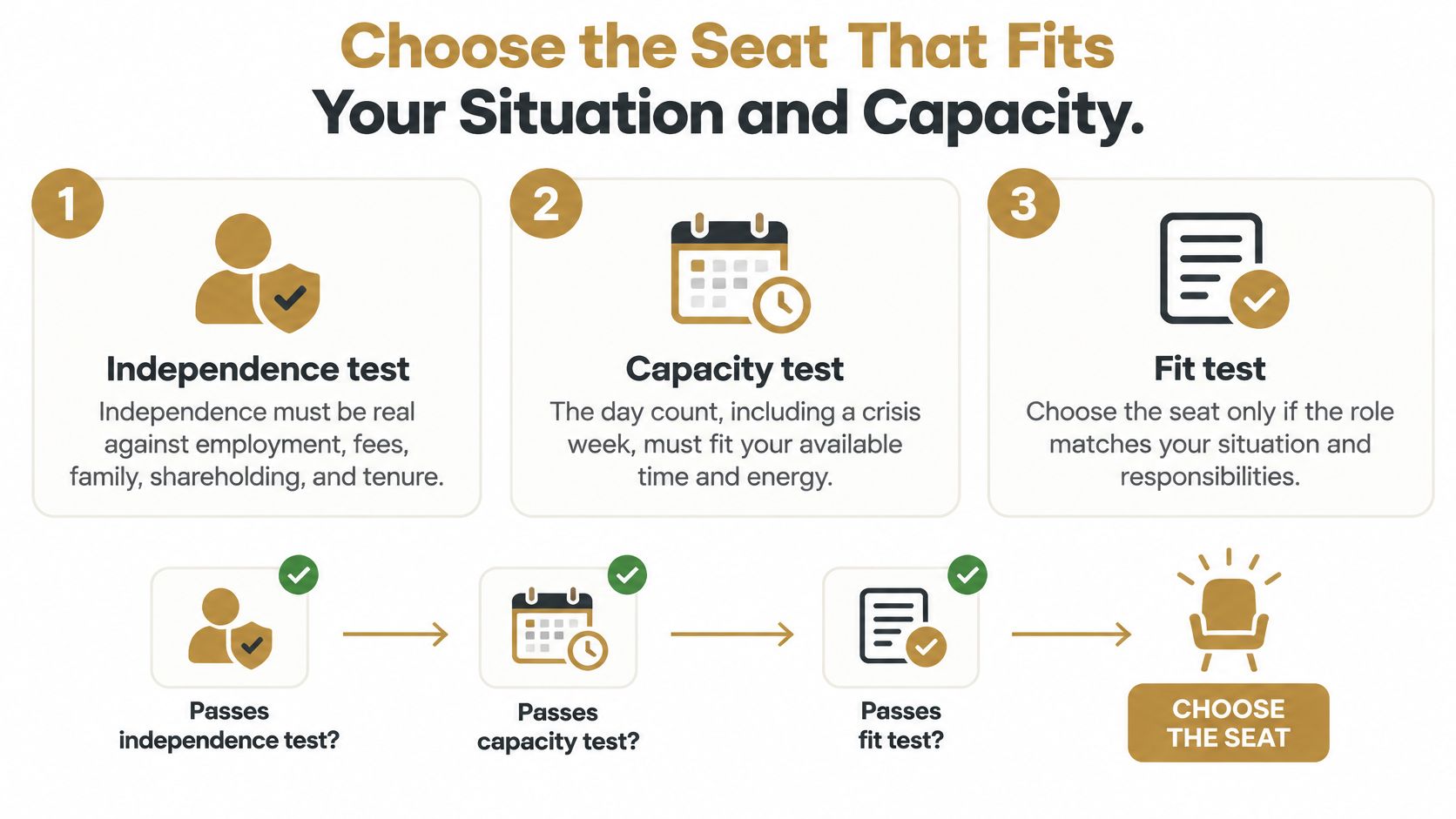
A board title does not prove that a seat suits you. Start with three tests: can you meet the independence requirements, give the role enough time, and show how your judgment will contribute? A nomination committee weighs the evidence behind each answer, not just your executive title.
The right choice also depends on the company's governance structure and the authority attached to the role. A CEO joining their own company's board serves as an executive director; an external non-executive director must exercise oversight without taking on day-to-day management.
Which director seat fits the situation
| Situation | Better fit | Why |
|---|---|---|
| Chief executive of this company | Executive director | The board needs the person who holds operating authority |
| US listed audit committee | Independent non-executive | Prohibited consulting fees or affiliate status can block eligibility |
| Founder recently exited from the same company | Non-executive elsewhere, subject to checking continuing ties | Recent employment and shareholding can impair independence at the old company |
| Several paid boards already held | Another non-executive seat only if crisis capacity remains | Preparation and emergency availability matter more than the number of retainers |
| CEO and chair combined | Separate chair, often a non-executive | Separating leadership and oversight can strengthen accountability |
| Two-tier market | Executives on the management board, non-executives on the supervisory board | Management and supervision sit in separate governance bodies |
Apply the decision to the actual appointment, not just its title.
Interpret the situation, not just the label
A sitting CEO should distinguish a board seat connected to their executive employment from an external NED appointment. In the first, the director holds operating authority. In the second, the director must contribute oversight without directing employees or managing the business.
For a CFO pursuing audit work, financial fluency is only the starting point. The role also calls for eligibility, confidence challenging management and the ability to assess reporting without becoming an additional finance executive.
An exiting founder should check continuing shareholding, advisory arrangements and personal influence at the former company. Leaving employment alone may not resolve independence concerns. A role elsewhere may be a better fit, subject to cross-company interests and ongoing obligations.
Nonprofit and community leaders can make their experience relevant by showing how they handled controls, executive accountability, resources and succession. They should also be candid about gaps in commercial or sector knowledge.
Check the governance architecture
Board structures differ across markets. The OECD comparison in NACD boardroom benchmarking material identifies 24 jurisdictions favouring one-tier boards, seven favouring two-tier boards and 18 permitting both. The same material reports that 76% require or encourage separating CEO and chair roles, up from 44% in 2014, and that annual independent-director commitment has risen from under 250 hours to more than 300 hours over the last decade.
In a one-tier structure, executive and non-executive directors sit on the same board. In a two-tier structure, management and supervisory responsibilities belong to separate bodies. Confirm which body you would join, what it decides and how it receives information.
Titles alone do not tell you where authority sits. Read the charter, committee terms and appointment documents before deciding whether the role fits your experience.
More seats can weaken your case
There is no universal number of board seats that suits everyone. A committee-heavy appointment during a transformation may demand more time than several stable roles with limited travel.
A nomination committee may question a crowded portfolio if you cannot explain how you will prepare, respond to urgent issues and manage overlapping commercial interests. More appointments can weaken your credibility when the time available does not match the responsibilities.
Use an over-boarding checker to organise your assessment, then consider:
- Calendar collisions: Reporting cycles, committee peaks and executive responsibilities.
- Travel exposure: Whether urgent attendance is practical, not merely possible.
- Connected interests: Customers, competitors, investors and advisers shared across appointments.
- Personal resilience: The energy needed to read carefully and challenge thoughtfully under sustained pressure.
One committee-heavy role you can prepare for properly is a stronger proposition than several appointments you can only attend.
Turn a suitable seat into a credible application
A first external NED role may suit a sitting C-suite executive, a CFO moving toward audit and risk, an exiting founder or an experienced nonprofit director. A credible application explains why that particular board needs your judgment, not just why you want a portfolio career.
SeatSignal's Done-For-You Board Placement program hand-picks relevant open board roles and prepares director-grade applications matched to each opportunity, with board-specific interview preparation. The program is built for first-time directors, C-suite executives, portfolio directors, finance, audit and risk leaders, exiting founders, and nonprofit and community leaders.
You review and approve the materials, then send applications in your own name. SeatSignal has a refund policy and results disclaimer; boards, nomination committees and recruiters make appointment decisions.
Placement support does not replace governance qualifications or your own due diligence. Accept a role only when its responsibilities, relationships and workload make sense for you.
SeatSignal offers hand-picked board opportunities, director-grade applications and board-specific interview preparation to help you present executive experience as governance value. Visit SeatSignal to explore support for a board search built around your independence, capacity and fit.
Want a paid board role, done for you?
One handpicked, verified open board role every week, with a director-grade packet tailored for it.
Get Started