Executive Resume Writing Service: A 2026 Guide

The most popular advice about hiring an executive resume writing service starts with beating screening software. That's the wrong starting point. Your first question should be whether the writer can connect your actual leadership record to a specific hiring need, without changing the facts or overstating your authority.
For a board candidate, that means something more demanding than a polished career history. The document needs to explain which gap you can fill, what evidence supports that claim, and whether the same story holds up when a search partner checks your public record.
Table of Contents
- What an Executive Resume Writing Service Actually Delivers
- Mapping One Career Goal into Governance Evidence
- Keeping the Resume Consistent with Public Records
- How to Judge a Service Against Your Target Role
- Prices Guarantees and When a Full Program Fits
- Choose the Service That Matches the Seat
What an Executive Resume Writing Service Actually Delivers
The repeated claim that 75% of resumes are rejected by applicant-tracking systems before a human sees them has no documented research basis: eSkill's account of ATS rejection claims traces it to Preptel marketing around 2012, notes that the company reportedly closed in 2013 without publishing supporting research, and describes later interviews with 25 U.S. recruiters across more than 10 platforms, of whom 92% reportedly said their systems didn't automatically reject resumes based on formatting or content-match scores. Ranking, sorting, and filtering aren't the same as universal automatic rejection.
Software still matters. But a credible service sells an interviewed rewrite of your profile, responsibilities, and outcomes, directed at a particular reader: a recruiter, search partner, or nominating committee. You're paying for the writer's ability to identify relevant evidence and explain its significance, not just rearrange your chronology.
The difference should be visible on the page.

Buy interpretation, not decoration
Think of the resume as a map legend. It doesn't replace the terrain of your career. It tells a stranger which evidence to read first and how to interpret it.
A useful engagement should produce:
- A focused profile: The opening identifies your target contribution rather than calling you a visionary leader.
- Clear responsibility: The reader can distinguish the business you ran from the decisions you advised on.
- Defensible outcomes: Achievements explain what changed and what you personally contributed.
- Usable files: Text extracts cleanly, dates stay legible, and the document remains editable.
Use our free Board CV Grader to identify weaknesses worth discussing before commissioning a rewrite. Treat its feedback as a diagnostic, not a prediction of appointment.
The standard is accurate parsing, consistent titles and dates, and leadership proof aligned to the target role. No writer can promise a universal screening pass.
Mapping One Career Goal into Governance Evidence
Start with the board's missing capability, then examine your career for proof. For each proposed governance claim, establish scope, decision authority, measurable outcome, stakeholder level, and oversight relevance before deciding how to phrase it.
That method fits how boards evaluate composition. NACD's board skills matrix guidance recommends identifying capability gaps, defining the candidate specification, and evaluating candidates against agreed criteria. Seniority alone doesn't tell a nominating committee whether you meet those criteria.
Five fields every governance claim should show
| Field | What it answers | Weak line | Board-readable version |
|---|---|---|---|
| Scope | How large was the arena? | Led transformation | Enterprise program across a regulated business unit |
| Decision authority | What could the person actually decide? | Supported the CEO | Owned the capital case presented to the board |
| Measurable outcome | What changed, in numbers? | Improved performance | Cut control exceptions and restated the risk appetite |
| Stakeholder level | Who relied on the judgment? | Worked with stakeholders | Reported to the audit committee and external auditor |
| Oversight relevance | Which board job does this serve? | Strong leader | Shows audit, risk, or succession oversight, not another operating title |
These are rewrite patterns, not achievements to copy. The outcome example still needs a verified measure, and any reference to risk appetite must distinguish recommending a change from formally approving it. Never assign yourself authority that belonged to the board.
Connect delivery to oversight
The Financial Reporting Council's Corporate Governance Code guidance treats a skills matrix as a way to identify appointment needs and connects succession planning to sudden departures, orderly replacement, and longer-term strategy. Its emphasis on merit, objective selection, and collective capability gives the writer a practical task: make your evidence assessable against the seat, not merely impressive in isolation.
Choose only competencies you can substantiate. These might include audit or risk oversight, capital allocation, regulatory exposure, strategy supervision, CEO succession, cybersecurity, ESG, or industry expertise. A long keyword list isn't a substitute for explaining a consequential decision.
The need is specific: the GNDI future-of-board-governance summary reports insufficient expertise in cyber-risk among 55% of directors and digital innovation among 54%, with 45% viewing specific-skill appointments as a key future change, and separately cites PwC's finding that only 32% of executives believe their boards have the right mix of skills. Those findings support identifying an actual capability gap rather than assuming every accomplished executive fits every board.
An executive CV proves operational delivery. A director CV shows governance relevance, independence, and contribution to board composition.
Translate different careers without inflating them
For a CFO, closing the books efficiently is operating evidence. Audit-committee relevance comes from financial reporting oversight, internal-control remediation, enterprise risk, investor communication, acquisition diligence, or regulatory interaction. Explain what you presented, what judgment the committee required, and what changed after scrutiny.
A technology leader needs a different translation. Say you launched a platform in a regulated business. Instead of listing delivery milestones alone, explain the cyber exposure, investment trade-offs, assurance arrangements, and board decision the launch required. Distinguish owning the implementation from challenging its risks.
A founder must show more than ownership. Describe how you handled conflicts, accepted independent challenge, separated personal interests from company interests, or supported succession. If you held a formal directorship, label it accurately; if you didn't, don't turn founder status into an invented board appointment.
For a nonprofit or public-sector leader, mission delivery can support evidence of fiduciary judgment, resource stewardship, stakeholder accountability, and committee contribution. Keep the institutional context clear. Responsibility for public funds or charitable resources shouldn't be repackaged as experience on a paid listed-company board.
First-time directors need particular care because a senior title can conceal missing oversight language. Our Board Readiness Assessment can help organize the evidence before you decide which seats to pursue.
Apply a final editing test: if a sentence could sit unchanged on an application for your current operating role, it probably isn't board-ready yet. Add the oversight relevance, not an inflated title.
Keeping the Resume Consistent with Public Records
A search tool may find you before you apply. Metaintro's coverage of executive hiring describes AI-assisted sourcing, resume parsing, ranking, and early qualification, with human review often following software-assisted prioritization. Your public professional information therefore belongs inside the writing engagement, not outside it.
An executive resume writing service should reconcile employer names, titles, dates, and scope across your resume, LinkedIn profile, board biographies, company-director records, and speaking biographies. A discrepancy isn't automatically misconduct, but an unexplained discrepancy gives a search analyst another problem to resolve.
Your documents should make verification straightforward.

Keep complex careers accurate and searchable
Semantic discoverability means describing expertise in language both a person and a search tool can recognize. Use the actual discipline, such as financial reporting, human capital, cybersecurity, or regulated infrastructure. Then explain judgment and context in complete sentences rather than repeating disconnected keywords.
Beating an ATS isn't the main objective. Make leadership evidence machine-readable without flattening the career into misleading labels.
A founder with several entities should distinguish the parent company, operating subsidiaries, and overlapping appointments. Someone whose professional name has changed can add a consistent former-name reference where appropriate. An interim executive should label the appointment as interim and preserve its actual dates rather than stretching an adjacent permanent role to hide an apparent gap.
Run this consistency pass before approving the final draft:
- Titles: Preserve the official title, adding a plain-language scope explanation where necessary.
- Dates: Reconcile appointment, employment, and departure dates without pretending they're interchangeable.
- Board names: Use the correct legal entity and distinguish directorships from advisory positions.
- Value proposition: Keep the central expertise consistent, even when each document emphasizes a different application.
Our free Board Bio Builder can help prepare the biography alongside the CV. SeatSignal also offers the Board Time Commitment Calculator, Over-Boarding Checker, Board Cover Letter Outline, Board Interview Question Bank, Board Offer Due Diligence Checklist, Board Fee Calculator, and Board Value Proposition Builder.
Tools can organize the comparison. A human still needs to resolve conflicts, particularly where legal appointments, employment relationships, and public descriptions tell different but legitimate parts of the story.
How to Judge a Service Against Your Target Role
Weak versus strong executive resume writing service
| Check | Weak service | Strong service | Why it matters |
|---|---|---|---|
| Career goal | One executive template for every client | Names the seat, committee, or market first | Boards and search firms hire against a gap |
| Evidence | Adjectives such as transformational | Scope, authority, outcome, stakeholders, oversight | A chair cannot score a slogan |
| Screening claim | Guarantees the document will pass any screen | Parsing, clear dates, and true keywords | Screening promises aren't evidence of fit |
| Public footprint | Resume only | Aligns resume, LinkedIn, board bio, and director records | Public information can inform sourcing |
| Document type | Same CV for an operating job and a board | Separate director CV when the goal is governance | Operating delivery isn't board readiness |
| After the draft | File handoff and generic tips | Rehearsal on that role, committee, and known gaps | The interview tests judgment, not formatting |
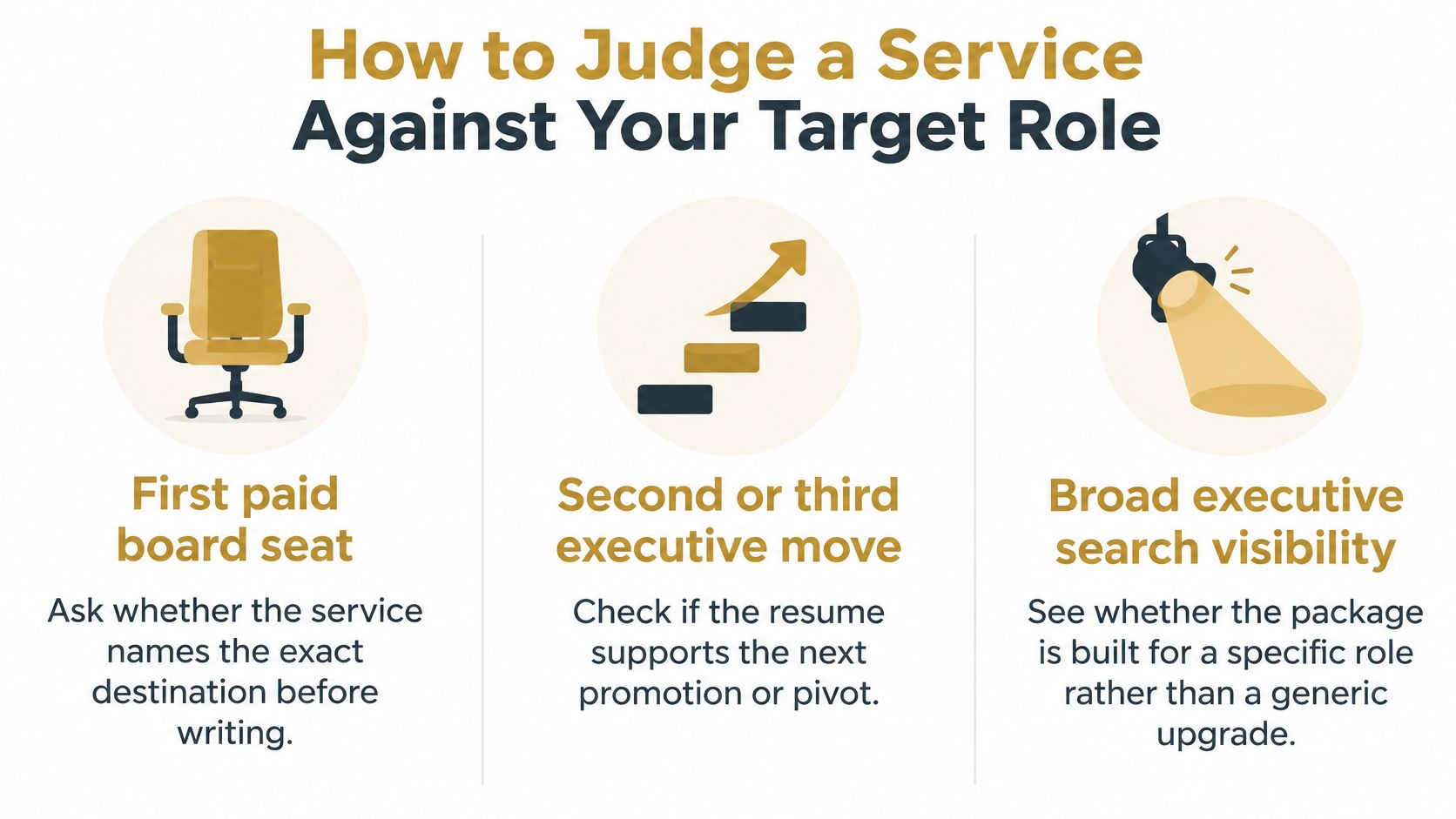
Name the destination before comparing packages: a first paid board seat, another portfolio appointment, a move from unpaid to paid governance, a new market, or an operating-role promotion. Our Board Role Fit Checklist helps make that destination explicit.
Different destinations require different evidence. A service that cannot tell you which gap your first page is meant to fill is selling formatting, not positioning.
Test the expertise behind the opening profile
Boards increasingly recruit against a defined capability gap rather than general leadership credentials. Your first page should therefore separate baseline executive competence from the specific strength that makes you relevant to this seat.
For finance candidates, controllership alone doesn't establish audit-committee readiness. Look for evidence of reporting oversight, controls, enterprise risk, investor communication, M&A diligence, or regulatory contact. Apply the same discipline to technology, human capital, cyber, and ESG profiles.
Before purchasing, request an anonymized before-and-after rewrite connecting an operating achievement to a named board gap. Establish who writes and edits the packet and whether that person has supported or served on a board. For a nonlinear career, insist that sharper positioning doesn't come at the expense of accurate titles.
The interview is another useful test of the package's specificity.
Know when you're comparing different products
Our Done-For-You Board Placement program goes beyond a document. We handpick relevant open roles and turn your real experience into a role-specific application through four stages: early seat signals, warm-path mapping, a director-grade packet, and interview preparation.
Our application materials are AI-generated drafts based on the information you provide. The placement team runs the process; you review and edit the materials, approve the drafts, and send applications in your own name.
Discard any provider that can't identify the gap its proposed first page is intended to fill. Elegant prose isn't enough if nobody can explain why that board should consider you.
Prices Guarantees and When a Full Program Fits
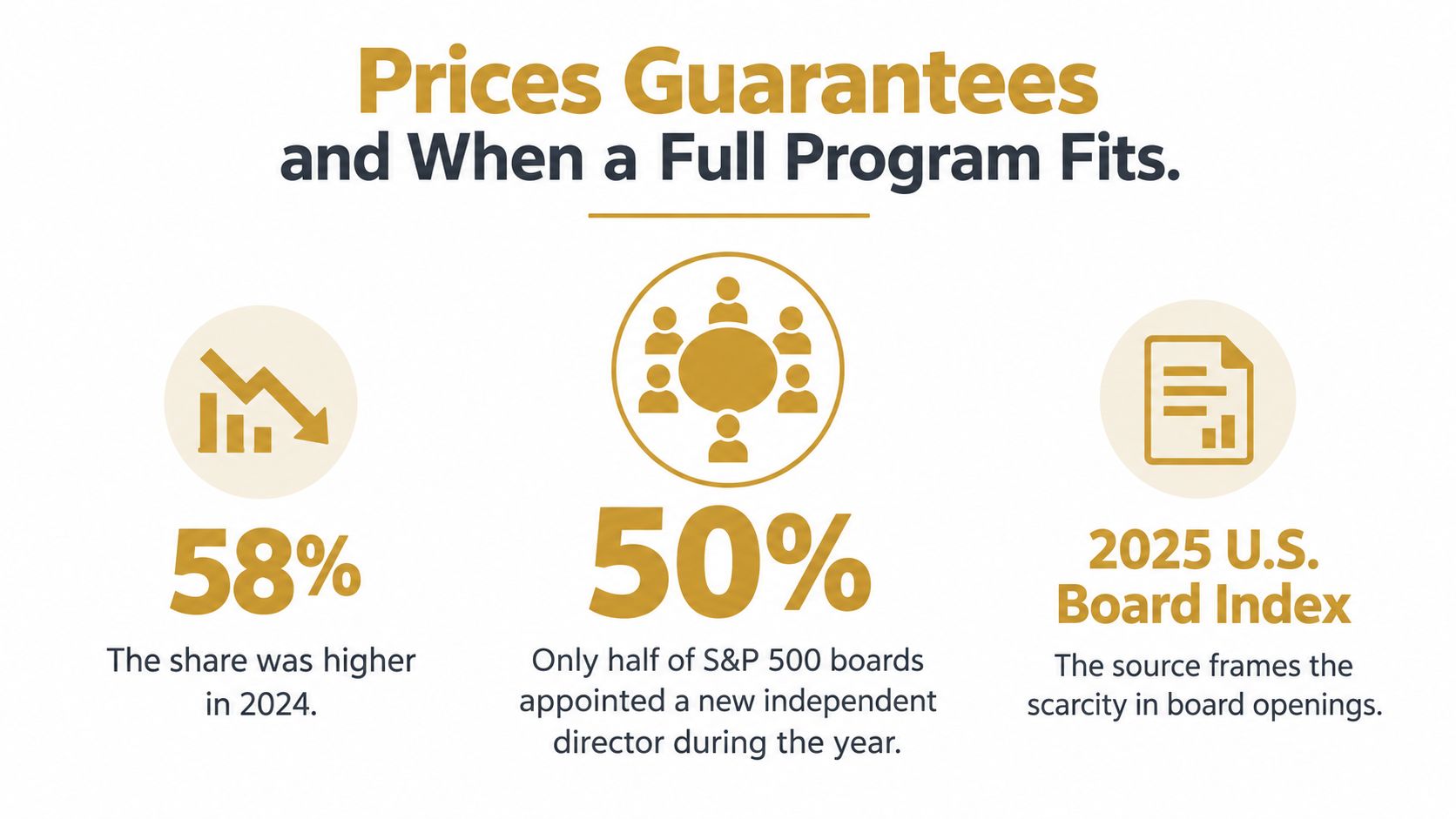
Openings on large boards are limited, and no amount of polishing changes that. Many seats never reach a public listing, and a board may add only one new independent director in a given year. A stronger document cannot create a seat that does not exist. Scarcity should shape what you buy.
A one-off writing engagement makes sense when you already have a live vacancy, understand the selection criteria, and need help presenting your evidence. A broader program fits a different problem: surfacing potential openings before they post, judging which ones match a gap your operating proof can fill, preparing a separate application for each, and rehearsing for the questions a specific chair is likely to ask.
You are choosing between buying a file and buying coordinated search preparation.
Compare the subscription with the work you need
SeatSignal subscription plans
| Plan | Price | Note |
|---|---|---|
| Two months | $297 | Single two-month term |
| Six months | $742.50 | Discounted six-month term |
| One year | $1,188 | Four months free; saves $594 versus six two-month payments; about $3.25 a day |
Every plan includes the same placement program after checkout and onboarding; the terms differ only in length and effective daily cost. You can compare them on our subscription pricing page.
Included support covers:
- Opportunity selection: Every role is checked against your profile and location by a person, and only the strongest fit is handpicked for you each week, with pre-public seat matching across every sector.
- Relationship routes: Warm-path introductions when a real, suitable connection exists.
- Application preparation: A governance-formatted CV, cover letter, committee fit memo, and independence note for each board, including roles you find outside our inventory.
- Interview work: Board-specific preparation and a placement team reviewing what reaches you.
Confirmed vacancies and forecast openings are labelled separately. A forecast carries a confidence grade and an estimated opening window, so it signals a possible opening rather than a vacant seat. Treat it as a reason to prepare your packet early, not a reason to count on an appointment.
Separate service commitments from outcomes
There's no recruitment fee or retainer. Appointments, interviews, matches, income, and landing a seat within the program's 60-day aim are not guaranteed. Read every service commitment as a description of work performed, not a promise that a nomination committee will select you.
You remain responsible for your own decisions and due diligence. Before accepting an appointment, examine the organization's finances, liabilities, insurance, conflicts, expected workload, and committee responsibilities. A paid seat can still be a poor choice if its risks or demands do not fit your circumstances.
Choose the Service That Matches the Seat
The right service depends on the decision the document has to survive.
For another operating role, choose a writer who can make scope and outcomes clear for that job: budget held, teams led, revenue or risk moved, and the authority you exercised. The engagement should produce defensible claims, accurate public-profile alignment, and an editable document. Reject a package whose central argument is an ATS score or a guaranteed software pass.
For a board or committee appointment, ask for proof that the draft maps your operating record to one board's gap and stays consistent with what a nomination committee can verify elsewhere. Get the target gap in writing: the committee need, board mix, or mandate the packet addresses. Set the document boundary too: a director-grade CV separates governance-relevant experience from formal directorships instead of inflating titles. For interview work, rehearse the questions that chair is likely to ask, based on the role, committee, and gaps found in that boardroom.
SeatSignal's Done-For-You Board Placement program follows that model. Each role is checked against your profile and location, only the strongest fit is handpicked each week, and the team drafts a director-grade CV, cover letter, fit memo, and independence note for that specific board. Interview preparation rehearses the likely chair questions, though no appointment is guaranteed. You approve each draft and send it in your own name.
Start concrete: run the five-field evidence test on your current CV, then do the public-record consistency pass. Mark unsupported claims, unclear authority, and mismatched dates before paying anyone to improve wording.
Then book a short discovery call to compare your experience, target roles, and program fit. Pre-public preparation means the packet is ready before the listing goes live, so use the call to test whether that timing suits your search.
A resume opens the evaluation. It does not appoint anyone.
SeatSignal combines board-opportunity matching, role-specific director applications, and interview preparation in a subscription-based placement program. Visit SeatSignal to book a short discovery call about your experience, the seats you want, and whether you need a standalone rewrite or coordinated board-search support.
Want a paid board role, done for you?
One handpicked, verified open board role every week, with a director-grade packet tailored for it.
Get Started