Executives in Transition: Board Career Guide
Leaving an executive role doesn't return you to the start of your career. It puts you at a fork where your old title stops opening doors by itself, and where the next door may not be another operating job at all. Many executives in transition discover that problem within weeks. They know how to run a division, answer to a board, and carry a result. They don't yet know how they're judged when they want oversight work instead of staff, budget, and a corner office.
That's the shift this guide explains in plain language. You'll first choose a primary path, then, if that path is governance, you'll learn how to translate operating achievement into board evidence tied to one committee gap, one trusted route in, and one credible story about a decision you influenced without line authority.
Table of Contents
- Why So Many Senior Leaders Are Between Roles
- Career Paths After an Executive Role
- From Operator Fluency to Board Evidence
- Skills Boards Recruit and Keywords They Ignore
- Four Executives and the Seats They Could Earn
- Choose One Seat and Prepare for It
Why So Many Senior Leaders Are Between Roles
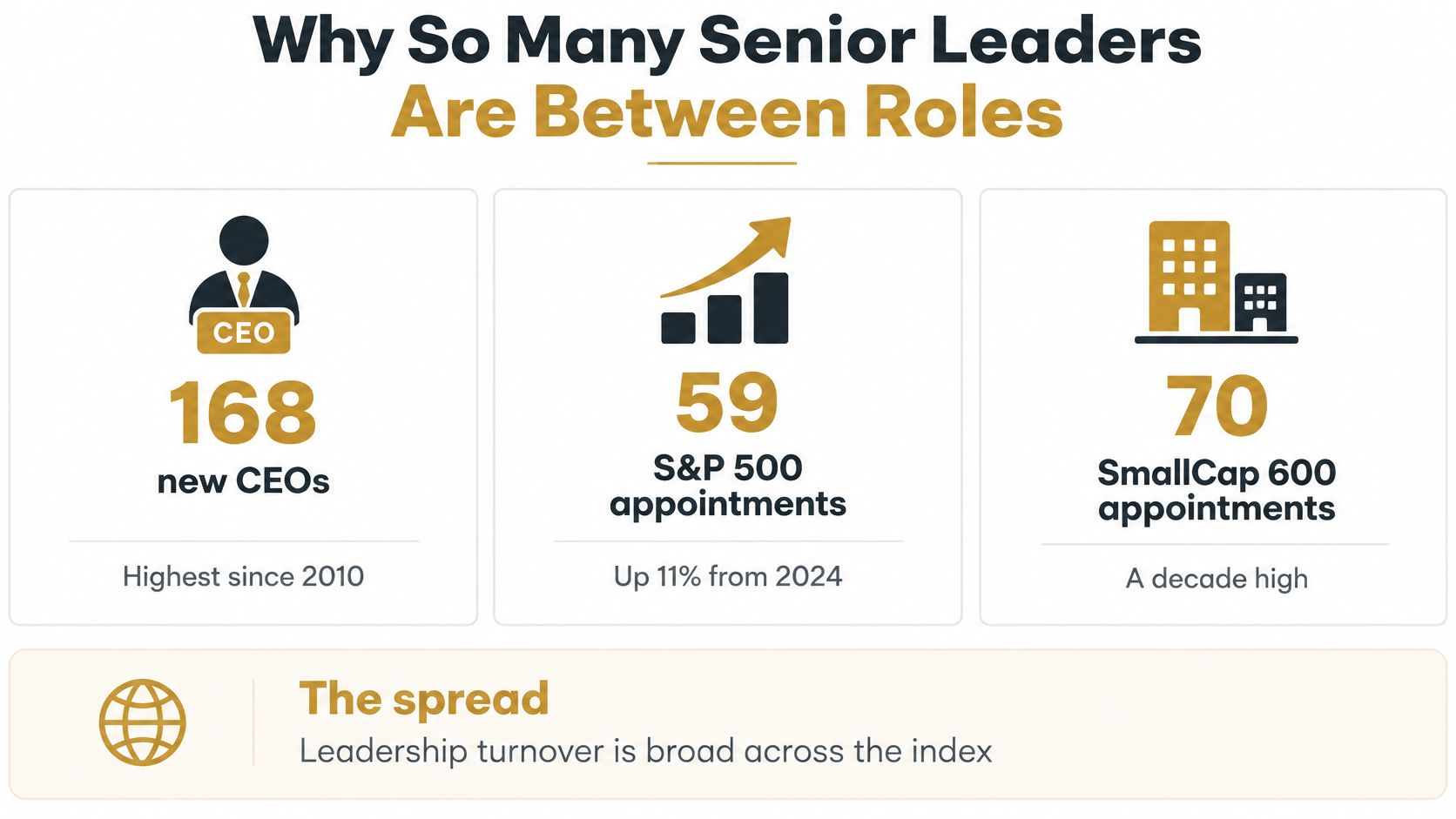
In 2025, 168 new chief executive officers were appointed across the S&P 1500, the highest total since 2010, according to the Spencer Stuart 2025 S&P 1500 CEO transitions report. That included 59 S&P 500 companies appointing a new CEO, an 11% increase from 2024, and 70 SmallCap 600 companies naming new CEOs, the highest number in a decade. Technology, media, and telecommunications saw transitions rise from 18 in 2024 to 33 in 2025, an increase of approximately 83%, while healthcare rose 21% and financial services rose 15%.
The turnover is broad across company size and sector:
Outside the Operating System
Think of succession as a relay race. Inside the company, the baton passes cleanly from one runner to the next. Outside it, the departing executive leaves the track. The authority, staff, information flow, and daily identity stay with the role, not with the person.
That loss of operating context explains why transition feels abrupt even when it's planned. A former CEO still has judgment. She no longer has a management team waiting each Monday. A CFO still understands controls. He no longer controls the close calendar.
Who This Guide Fits and What Choice Comes First
This guide serves first-time directors, sitting portfolio directors, CFOs and audit or risk leaders, exited founders, technology and cyber executives, operators and HR leaders, and nonprofit directors seeking a first paid corporate seat. They differ in background, but they face the same first decision.
Return to an operating role, take interim or advisory work as a bridge, or build a paid non-executive portfolio. Don't pursue all three with one generic story.
If governance is your primary path, your task isn't to look senior. It's to convert enterprise experience into clearly defined governance capabilities, such as audit, risk, technology, transformation, or succession expertise, that a board can place against a current oversight need. The path comparison that follows helps you make that call before you spend months polishing materials for the wrong destination.
Career Paths After an Executive Role
Start with the comparison, then check each row against your own appetite for authority, time, income timing, and conflicts.
Career options for executives in transition
| Path | Authority you keep | What the market tests | Main constraint | Fits best when |
|---|---|---|---|---|
| Return to an operating C-suite role | Full management authority | P&L results, sector fit, leadership under a board | Fewer open seats after a high-turnover CEO year | You still want to run a business |
| Paid non-executive portfolio | Oversight without operational control | Committee gap, independence, judgment under uncertainty | Few openings, 0.8 new directors per S&P 500 board in 2025 | You can contribute without a staff |
| Interim or fractional executive | Temporary management mandate | Speed, turnaround, and a defined end date | Income is lumpy and the work stays managerial | You need near-term income and a project |
| Advisory or consulting retainer | Expert advice, no fiduciary seat | A narrow problem the client will pay to solve | Conflicts if you later seek that company's board | Your expertise has a clear buyer |
| Investor or operating-partner role | Influence through ownership or a fund | Value creation, capital allocation, transformation | Time commitment and a commercial mandate | You want investor-side work more than a portfolio |
Operating and Board Paths
A return to an operating C-suite role keeps full management authority and usually pays through salary, incentive compensation, and equity. It's the right primary path if you still want a P&L, direct reports, and one employer. The test is harsh and specific. You'll be judged on sector fit, what you delivered under a board, and whether your leadership style fits the next company's stage. Don't treat this as a holding pattern while you chase boards. Search firms spot divided intent quickly, and references hear it too.
A paid non-executive portfolio gives you influence without running the company. Pay commonly takes the form of a cash retainer, equity, or both, depending on the company and market, and it may arrive on a different schedule than executive compensation. Board opportunities are scarce. The Spencer Stuart US Board Index summary reports that in 2025, only 50% of S&P 500 companies appointed a new independent director, down from 58% in 2024, while average turnover was just 0.8 new directors per board. The same summary says 99% of boards conducted evaluations and 80% disclosed a director-skills matrix. So a generic leadership biography loses to a candidate who fills a named gap. Before you browse live board of directors positions, decide whether you can prepare, attend committee meetings and site visits, and contribute without a staff.
Bridge Work and Investor Work
Interim or fractional executive work can bridge income because a company pays for immediate management capacity, often by day, month, or project fee. It keeps your operating muscles active. It doesn't by itself create director evidence, because you're still executing management tasks under someone else's mandate. Use it deliberately. Pick assignments with a defined end date, disclose them clearly to boards you approach, and track any independence issues that arise if the interim client later becomes a board target.
An advisory or consulting retainer monetizes expertise quickly, usually through a monthly retainer or project fee. It also creates the fastest conflict trap. If you advise a company, its competitors, a major supplier, or a fund with holdings in your target sector, a chair may question your independence. Before you sign, ask what's confidential, whether the work is recurring, whether equity is involved, and whether you'd need to resign the retainer before joining a related board. Money earned this quarter can block a seat next year.
Investor, private-equity, or operating-partner roles reward value creation, capital allocation, and transformation proof. Pay may combine fees, carry, co-investment rights, or equity-linked upside rather than a simple retainer. A fund may also expect hands-on time inside portfolio companies, diligence sprints, and commercial accountability. That overlap with management can be energizing. It can also run straight into over-boarding limits, fund conflicts, and independence rules if you later want a public-company seat in the same ecosystem.
A nonprofit or public-sector board can be a useful bridge. It can show committee discipline, stewardship, and stakeholder judgment. It's not a direct substitute for a paid corporate seat, and you shouldn't present it as one. Compensation may be an honorarium, expense reimbursement, or nothing at all, and the mission, public scrutiny, and stakeholder politics differ from a listed boardroom.
Write down one primary path and one bridge path. Then ask a chair, search contact, or sponsor for expected hours in writing before you commit. Ask about preparation, committee load, travel, site visits, ad hoc calls in a crisis, and when compensation is paid or vests. A single committee seat, especially audit, risk, or remuneration, can carry far more work than the title suggests.
From Operator Fluency to Board Evidence
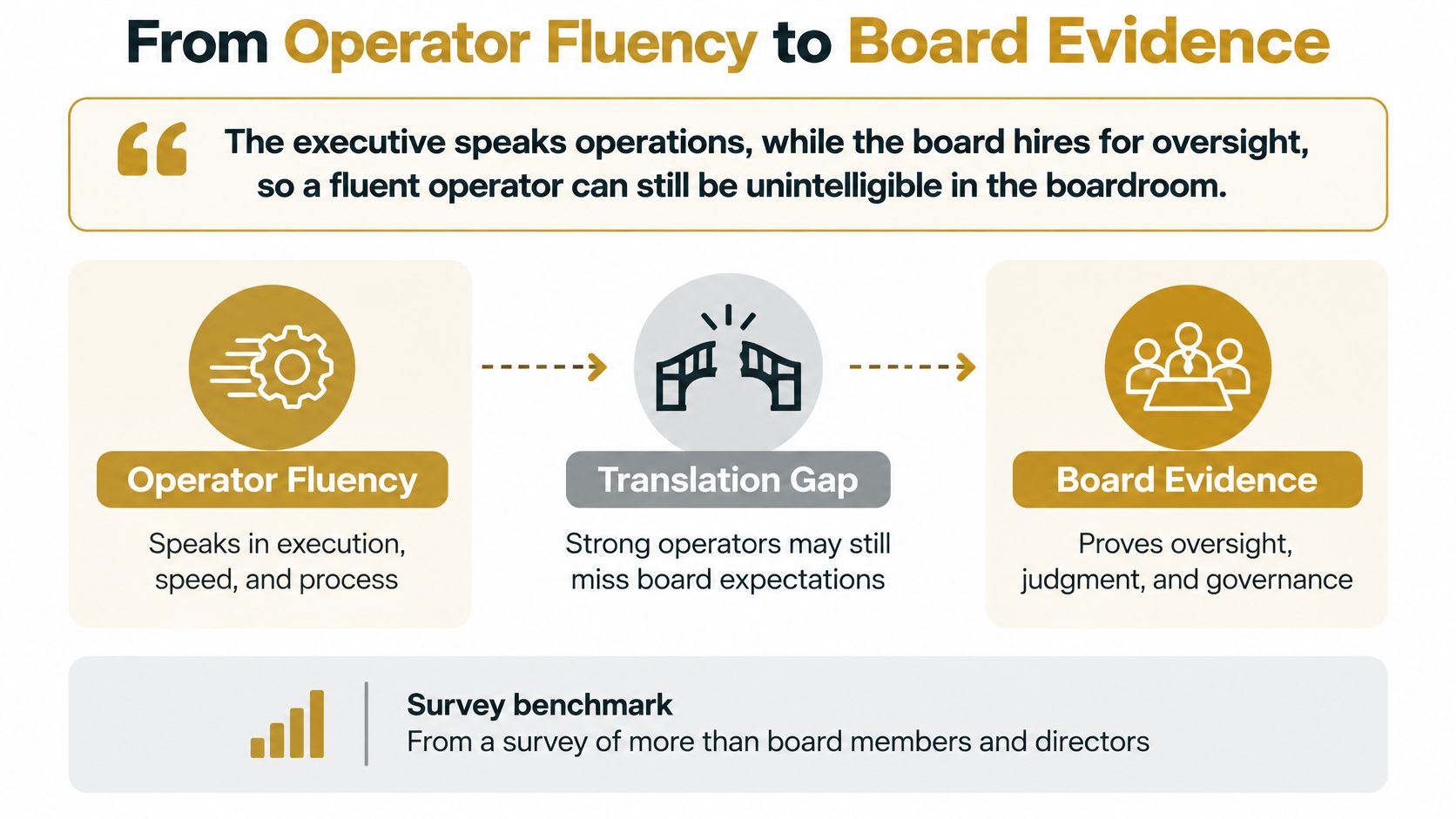
A chief operating officer can be fluent in execution and still sound foreign in a boardroom. The executive speaks operations; the board hires for oversight. Same career, different grammar.
The gap is linguistic. Operators talk about execution, speed, deadlines, systems, and teams. Boards listen for risk appetite, materiality, assurance, succession, capital discipline, and whether management can be trusted to deliver without the director stepping into the job.
The gap looks like this:
The Four-Beat Chain
Seniority misleads first-time candidates because the market reads experience through an access filter. In a survey of more than 2,000 professionals, the ESADE Centre for Corporate Governance survey summary found that the strongest backgrounds for board entry included senior management experience at 19%, business-transformation experience at 18.4%, and prior CEO service at 17.9%. Access, however, was most often attributed to recommendations from investors or shareholders at 32.2%, existing directors or the chair at 29.5%, and CEOs or senior management at 18%.
Read those numbers as a chain, not as trivia. Background creates credibility. Credibility must become a governance story. A governance story needs a warm route through a name the board already trusts. That route only converts when your evidence maps to a committee need. Break any link and the application stalls, even when the CV looks impressive.
ESADE also identifies strategy, sector expertise, and risk management as especially valuable knowledge domains. What separates board-ready executives from successful operators is integrity, stakeholder trust, independent judgment, and the ability to contribute during complex decisions.
Practical rule: Don't ask, "How do I sound more senior?" Ask, "What oversight decision would this board trust me to help make?"
Three Translations That Work
Say you led a cost-out program as an operating executive. In operator language, you'd stress savings, headcount changes, vendor consolidation, and milestones. In board language, that same work becomes risk appetite and management accountability. You explain which costs you refused to cut because controls or safety would weaken. You describe the indicators you'd expect a board to monitor, the point at which efficiency becomes fragility, and how management should report exceptions before they become surprises. The achievement is the same. The evidence is oversight.
Now take a cyber incident. Weak translation says, "I implemented the new platform and closed the incident quickly." Strong translation says, "I required management to report residual risk against an agreed appetite and escalated the exception." Better still, you explain what the board should have asked before the incident. What was the third-party exposure? Which resilience metrics mattered? How did the company decide what was material enough to disclose, escalate, or insure? You show you can review management assurance without pretending you'd personally run the security operations center.
CEO succession offers a third translation. Operators often describe a successor they personally groomed, as if talent development were only a management achievement. A board candidate frames succession as talent oversight. You show how you assessed readiness across more than one candidate, how incentives shaped behavior, how gaps were tested, and how the board protected continuity if the CEO left suddenly. The shift is from "I picked good people" to "I helped build a system that didn't depend on one person, including me."
That's the test for executives in transition. Can you talk about value, risk, and talent without reaching for the manager's keyboard?
Before you rewrite your own stories, watch how experienced directors describe that boundary between oversight and management:
The Experience Catch-22
First-time candidates hit a loop. Boards want directors who have already served on boards, and first-time candidates cannot show prior public-company service without a first seat. The barrier is getting harder. The Heidrick & Struggles Board Monitor US 2026 report reports that in 2025, 74% of Fortune 500 seats filled went to people with prior public-company board experience, the second-highest share recorded since 2011.
A first seat is still possible. The label "board-ready" does nothing by itself. You need substitute evidence of oversight behavior that a chair can evaluate with confidence. Useful substitutes include:
- Committee work: Audit, risk, governance, or remuneration committee work where you reviewed management rather than producing the underlying work yourself.
- Nonprofit governance: Board or committee service where you handled conflicts, scarce resources, stakeholder accountability, and a formal agenda and minutes.
- Crisis oversight: A product recall, regulatory inquiry, restructuring, or cyber event where you challenged assumptions under time pressure and documented decisions.
- Investor exposure: Board presentations, lender discussions, activist engagement preparation, or shareholder Q&A where you explained enterprise risk without defensiveness.
- Documented enterprise-risk decisions: A capital allocation choice, market exit, control remediation, or succession decision where downside, alternatives, and triggers for reversal were explicit.
- A clear boundary: A moment when you advised, challenged, or escalated but didn't take over the manager's role.
The UK pattern shows the destination after entry, not the entry ticket itself. The 2025 UK Spencer Stuart Board Index reported that 74% of newly appointed chairs and non-executive directors had a portfolio career, meaning they held only non-executive board roles, and among those new directors, 68% already held at least one other listed-company directorship. Portfolio careers accumulate. Your first move is to earn one credible seat, not to imitate someone holding four.
Build a Five-Story Inventory
Start by rewriting one achievement as an oversight decision made without holding the pen. Use this sentence frame. "The issue was enterprise-level. I questioned management on X. The risk or trade-off was Y. The decision changed because Z. I knew where my role stopped because management retained execution."
Then build a five-story inventory before any application goes out. Pick one named gap from the target board's skills matrix, such as audit depth, technology oversight, or succession coverage, and attach the strongest story to it. Tie each story to one committee where possible:
- Strategy and capital: A growth, exit, acquisition, or allocation decision you challenged at enterprise level.
- Audit and controls: A control weakness, reporting judgment, or assurance gap you escalated despite pressure to move faster.
- Risk and resilience: A cyber, safety, regulatory, supply chain, or liquidity exposure you helped quantify against appetite.
- People and succession: A CEO, executive pipeline, incentive, or culture risk you treated as a governance issue, not an HR task.
- Stakeholders and integrity: A regulator, investor, customer, community, or employee issue where trust was at stake and independence mattered.
If one story only proves you executed well, rewrite it or replace it. If a story depends entirely on your job title, it won't travel. A useful audit is to run your current materials through a board CV grader and mark every sentence that describes implementation rather than oversight. Keep the operational success. Translate it into judgment exercised in a collective setting, with incomplete information, and without operational authority.
That distinction also protects you. Subject-matter expertise can mislead a board if it isn't paired with enterprise judgment and independence. The deepest technical expert in the room can still be the wrong director if she narrows every debate to her function, defends a former employer, or treats management as a team she's there to rescue.
Skills Boards Recruit and Keywords They Ignore
Boards don't recruit buzzwords. They recruit to fill gaps in the room they already have. The chair-survey benchmark is the cleanest way to see what that means right now.
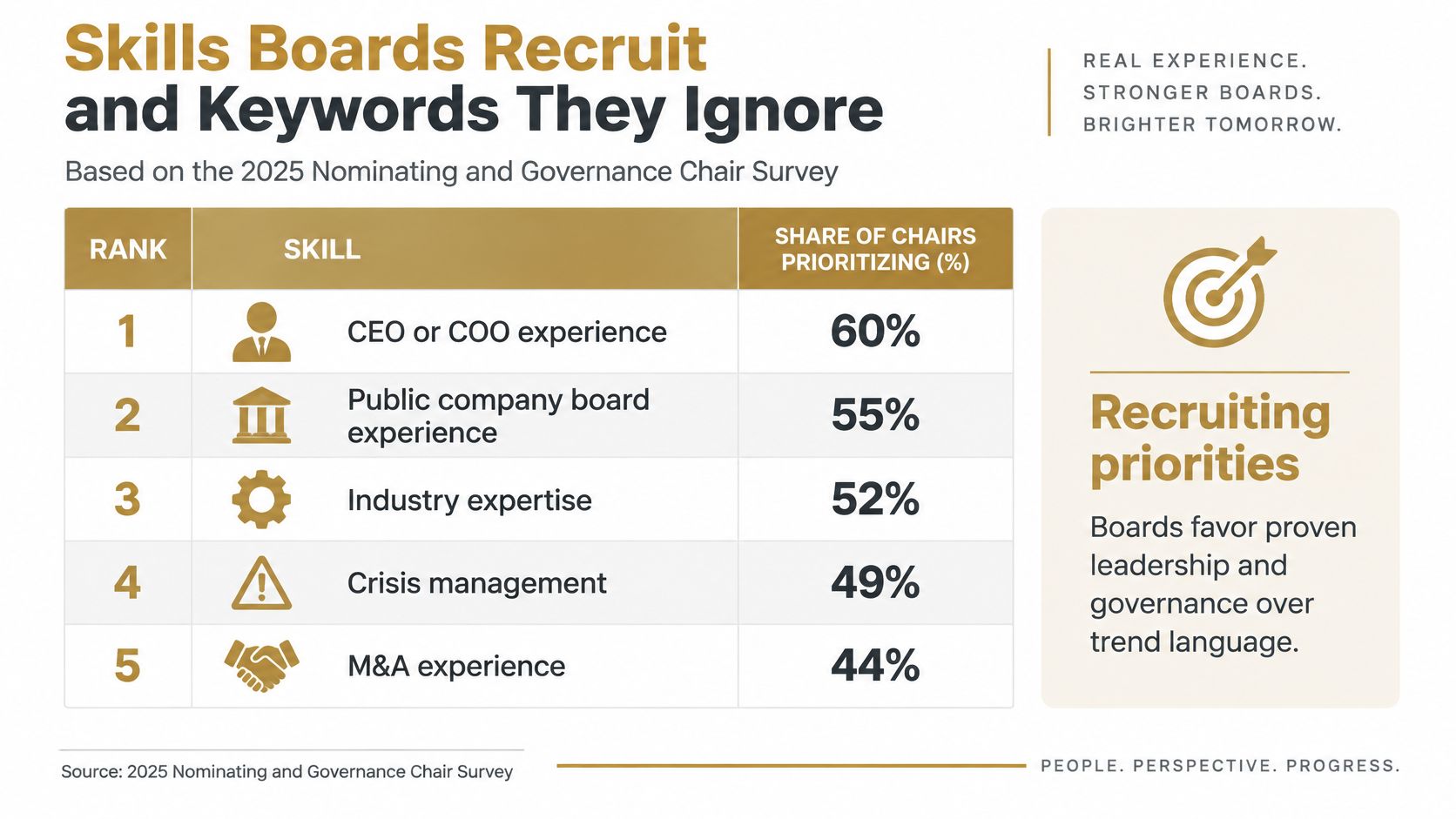
2025 nominating and governance chair recruiting priorities
| Skill signal | 2025 share | 2024 share |
|---|---|---|
| CEO or COO experience | 60% | 51% |
| Digital and technology experience | 51% | 42% |
| Artificial intelligence (among digital-priority chairs) | 33% | No 2024 figure reported |
| Big data or analytics (among digital-priority chairs) | 25% | No 2024 figure reported |
| Cybersecurity (among digital-priority chairs) | 20% | No 2024 figure reported |
| Global experience | 31% | No 2024 figure reported |
| Regulatory and government experience | 14% | No 2024 figure reported |
What the Ranking Actually Says
In a 2025 survey of nominating and governance chairs, the Spencer Stuart Nominating and Governance Chair Survey 2025 found that CEO or COO experience was the top recruiting profile at 60%, up from 51% in 2024. Digital and technology experience ranked second at 51%, up from 42%. Among respondents prioritizing digital and technology expertise, 33% specified artificial intelligence, 25% big data or data analytics, and 20% cybersecurity. Global experience ranked third at 31%, while regulatory and government experience reached 14%.
Scarcity, not fashion, creates opportunity. The Deloitte board composition and capabilities analysis reports that in Fortune 100 companies, only just under 6% of current directors have held senior technology leadership roles, despite technology experience being a top recruitment priority for 51% of nominating and governance committee chairs. It also reports that information security appears among the least common director skill sets, at 20%, while new directors are more likely than incumbents to report risk-management experience, 70% versus 60%.
That gap helps technology, cybersecurity, and transformation executives, but only if they convert technical depth into board judgment. A new technology title can backfire. Without independence and restraint, you look like a manager who'll reach for the keyboard.
Convert the Title Into Oversight Questions
A technology executive should speak to cyber-risk appetite, data governance, resilience metrics, third-party exposure, and management accountability. Don't center the tools you deployed. Center the questions you'd ask about materiality, recovery time, assurance quality, and when management must escalate.
A CFO should show how financial, regulatory, and scenario analysis changes a board decision. Reporting performance isn't enough. Explain how you'd test assumptions behind forecasts, capital returns, impairment judgments, and control remediation.
An international operator should show geopolitical and cross-border oversight. Talk about sanctions exposure, subsidiary governance, local regulatory demands, currency and supply concentration, and how headquarters gets reliable assurance from distant units.
A human-capital leader should present succession, incentives, and culture as enterprise risk. The useful story isn't a talent program launch. It's how pay design, leadership depth, conduct failures, or attrition in critical roles alter strategy execution.
Close this exercise with a three-column personal matrix. Column one is capability. Column two is committee it serves. Column three is one decision you influenced without operational authority. If you can't complete column three, you have a keyword, not a value proposition. A board value proposition builder can help you force that third column into plain language before you approach anyone.
Four Executives and the Seats They Could Earn
Composite scenarios make the method easier to see than theory. Each executive below starts with strong experience. Each one fails in a predictable way if they lead with title alone.
The Healthcare CFO
Say a CFO leaves a listed healthcare company after a CEO change. She targets an audit committee chair gap at a related but non-competing company. The wrong move is a generic executive CV listing ERP systems implemented, teams led, and transactions closed. The right move is narrower. She names one committee, audit. She names one composition gap, financial reporting judgment during a period of regulatory scrutiny and reimbursement pressure. She brings one warm route through a former audit partner now serving as a director elsewhere. Her first story isn't a systems go-live. It's a control failure she escalated to the board when management preferred to fix it internally, paired with scenario analysis and investor communication that protected credibility.
The Chief Information Security Officer
Say a CISO wants a risk or technology committee seat where information security is scarce. The wrong move is keyword stuffing. AI, zero trust, cloud, and cyber appear in every paragraph, but no oversight question appears anywhere. The right move is to talk about risk appetite, materiality, and third-party exposure. He explains how he distinguished an operational incident from an enterprise event, how he'd test whether management reporting matched actual resilience, and what he'd want in a board pack after a supplier breach. He also states the boundary clearly. He wouldn't direct the response team. He'd ensure the board knew who owned decisions, what had been assured externally, and which thresholds triggered disclosure and escalation.
The Exited Founder
Say a founder exits a growth company and wants a board role at another scaling business. The wrong move is a cold letter that leads with valuation, exit proceeds, and personal operating war stories. Chairs hear a second CEO auditioning for control. The right move is to prove he can challenge a sitting CEO rather than resume operating. He targets one growth-stage seat, uses an investor contact as the warm route, and tells one story about letting his own management team make a decision he initially opposed after the board tested the strategic logic and downside. Independence and succession are the tests here. Can he support a CEO in public, challenge in private, and accept a collective decision?
Comparing routes into those conversations matters too, especially when you're weighing a placement program against executive search firms and who owns the relationship with the chair.
The Nonprofit Chair
Say a nonprofit chair with deep community governance wants a first paid corporate seat. The wrong move is claiming equivalence. She doesn't have public-company board experience, and pretending otherwise damages trust. The right move is honest mapping. She chooses a company whose skills matrix shows stakeholder, community, workforce, or governance process gaps. She shows committee discipline through budgets approved under scarcity, conflicts managed transparently, a difficult executive director succession, and accountability to funders and beneficiaries who didn't always agree. She asks a corporate director who served beside her in the nonprofit setting to make the introduction. The story she puts first is a decision where mission pressure collided with financial reality, and she protected long-term solvency without taking over management's job.
One precise seat is a better target than fifty undifferentiated applications. Precise doesn't mean snobbish. It means one committee, one composition gap, one warm route, one decision made without operational authority.
Appointments are selective, and portfolios usually accumulate over time. Which persona is closest to you? Which single story would you put first if a chair gave you ninety seconds?
Choose One Seat and Prepare for It
Commitment beats coverage at this stage. Lock one primary path from the comparison table and stop revisiting it every time a new listing appears. If it isn't a board, run a bounded search instead: three target roles, one income bridge, and a 90-day plan with weekly outreach, applications, and references ready.
If it is a board, your unit of work is one named seat type, one committee, and five oversight stories. Each story should show a decision you made or influenced without operational authority, because that is what a chair is buying.
The Five-Step Sequence
- Set your boundaries. Write down the sectors, geographies, and role types you will and won't take, including paid, unpaid, equity, or honorarium terms and any conflicts that rule out a sector.
- Pick the right gap. Choose the committee gap your evidence supports, not the committee that sounds most prestigious.
- Find a warm route. Identify an investor, chair, director, former colleague, or trusted adviser who can introduce your governance story credibly.
- Build for that board. Prepare a director-grade packet fitted to that board's charter, composition, and committee mandate, not a generic executive profile.
- Rehearse the interview. Practice against the questions that chair is likely to ask about the role, the committee, and the board's gaps, including independence, time, and how you'll challenge the CEO.
Run the board role fit checklist before you invest weeks in a packet. If the committee, time load, conflicts, or sector logic don't line up, walk away early and keep your credibility intact.
A done-for-you program can run this sequence with you. SeatSignal's placement team hand-picks relevant open board roles, maps the warmest route into each board, drafts a director-grade packet (a customized CV, cover letter, fit memo, and independence note) for that specific board, and prepares you for the questions that chair is likely to ask. You review what they find, approve what they draft, and send applications in your own name.
The program is built for first-time directors, C-suite executives, portfolio directors, finance, audit, and risk leaders, exiting founders, and nonprofit and community leaders. No appointment or interview outcome is guaranteed, and you keep the decisions and the due diligence. That is how serious candidates stay independent, credible, and in control of their own reputation.
If governance is your primary path, a generic CV sent into a selective board market wastes the reputation you spent a career building. Visit SeatSignal to see how the team hand-picks board matches, maps your warmest route in, drafts a director-grade packet for each role, and prepares you for the specific chair, committee, and composition gap in front of you.
Want a paid board role, done for you?
One handpicked, verified open board role every week, with a director-grade packet tailored for it.
Get Started