Fiduciary Duty of Directors: The Seven Duties Explained
You're reviewing a board pack the night before your first meeting, and a proposal looks profitable but thin on detail. Management wants a quick yes, another director has a link to the supplier, and you're not sure how hard you're supposed to push. That moment is where fiduciary duty of directors stops being a legal phrase and becomes a practical test of whose interest you're serving, how informed you are, and what you can prove later.
Table of Contents
- What Fiduciary Duty Means for Every Director
- The Seven Statutory Duties at a Glance
- Promoting the Company's Success Under Section 172
- Care, Skill and Diligence Under Section 174
- Conflicts and Benefits in Real Board Scenarios
- Board Oversight When Risks Outrun Expertise
- What Happens When a Director Breaches a Duty
- How Duties Shift Across Borders and Near Insolvency
- Check Your Duties Before You Accept a Seat
What Fiduciary Duty Means for Every Director
A director must act in the company's interest rather than their own, using the judgment and care the role demands. That's the plain answer. The word fiduciary comes from the Latin fides, meaning trust, because a director holds power over assets and decisions they don't personally own.
Think of a steward holding keys to a house owned by others. You may open any door, hire repairs, or refuse a risky tenant, but only for the owners' purpose. A trustee managing money for beneficiaries works the same way, and so does a director managing a company for its members as a whole.

Two Strands That Work Together
Loyalty means no self-dealing, no misused power, and no secret benefit from your position. Care means you make informed, diligent decisions instead of nodding through papers you haven't read. You need both, because an honest director can still fail through inattention, and a diligent director can still fail through a conflict.
The duty is owed to the company itself, not to the shareholder, founder, or fund that appointed you. That distinction matters for nominee directors, who can listen to their appointer but can't vote as instructed.
A bad commercial outcome doesn't by itself prove a breach. A weak process can. If you didn't ask for missing information, test assumptions, or declare an interest, a later reviewer has little evidence that you discharged your duty, even if your intentions were good.
Most major jurisdictions use similar frameworks, though the wording and enforcement differ. The UK Companies Act 2006 is a useful reference point because it restated common-law and equitable rules in statutory form, giving directors a numbered list to work from.
Three-question self-test: Whose interest does this serve? Was I properly informed? Have I declared anything I should?
Run those questions before any vote. If you can't answer the second one clearly, use a structured check such as our Board Readiness Assessment to identify gaps in preparation before they become gaps in the boardroom.
The Seven Statutory Duties at a Glance
| Statutory section | Duty | What it requires in practice |
|---|---|---|
| Section 171 | Act within powers | Use powers only for their proper purpose, not to achieve an unrelated aim such as blocking a takeover |
| Section 172 | Promote the company's success | Act in good faith for the benefit of members as a whole, weighing six stated considerations |
| Section 173 | Exercise independent judgment | Evaluate advice and proposals yourself rather than deferring to management or a dominant shareholder |
| Section 174 | Exercise reasonable care, skill and diligence | Meet the standard of a reasonably diligent person with your own knowledge and experience |
| Section 175 | Avoid conflicts of interest | Avoid situations where your interests could conflict with the company's, and seek authorisation where needed |
| Section 176 | Refuse unauthorised third-party benefits | Do not accept benefits from third parties because of your role as a director |
| Section 177 | Declare interests in proposed transactions | Declare any interest in a proposed transaction or arrangement to the other directors before it is decided |
The Companies Act 2006 Chapter 2 on directors' general duties received Royal Assent on 8 November 2006 and came into force primarily on 1 October 2007, with sections 171 to 177 identifying the seven duties above. Section 170 bases them on common-law rules and equitable principles, replaces those rules for duties owed to the company, and generally applies the same consequences on breach. Section 174 is the exception in classification, because care, skill, and diligence isn't treated as fiduciary in the same way.
Matching a Decision to a Duty
- Section 171: Issuing shares mainly to block a takeover, rather than to raise capital, uses a power for an improper purpose.
- Section 172: Approving a price cut without weighing long-term customer effects or employee impact doesn't show good-faith promotion of success.
- Section 173: Voting with a dominant shareholder every time, without testing the proposal, isn't independent judgment.
- Section 174: Approving accounts you haven't read fails the diligence expected of the role.
- Section 175: Using inside knowledge to bid personally for a company asset creates a direct conflict.
- Section 176: Accepting generous hospitality from a supplier during a tender engages the third-party benefits rule.
- Section 177: Declaring your interest in a contract before the board votes, and having it minuted, meets the disclosure duty.
The list isn't limited to theft or self-dealing. It governs purpose, independence, competence, conflicts, benefits, and disclosure. Before acting, identify which duty a decision touches and check that row. Candidates exploring board of directors positions should do the same mapping for any role they consider.
Promoting the Company's Success Under Section 172
Section 172 asks you to act in good faith in the way you consider most likely to promote the company's success for the benefit of its members as a whole. Under section 172 of the Companies Act 2006, you must have regard to six considerations, and the duty is subject to laws or rules requiring you to consider or act in creditors' interests in particular circumstances.
The Six Considerations
- Long-term consequences: What does this decision do beyond the next quarter?
- Employees' interests: How are jobs, skills, and morale affected?
- Supplier and customer relationships: Will key partners still trust and supply you?
- Community and environment: What's the operational impact outside the factory gate?
- Reputation for high standards: Does this protect the company's standing for proper business conduct?
- Fairness between members: Are you treating shareholders even-handedly?
This isn't a licence to maximise short-term returns at any cost. It's also not a box-ticking exercise. The parliamentary explanatory notes to the Companies Act 2006 state that deciding what promotes success is a matter for the director's good-faith judgment, but directors can't merely pay lip service to the section 172 factors and often must take action to comply.
A Plant Closure Worked Through
Say a board weighs closing an ageing plant. The finance case favours closure, but the board also tests workforce effects, including retraining and redundancy terms, and community impact in a town where the plant is a major employer. Directors ask whether suppliers tied to that site can serve another location, and whether customers face disruption during the move.
The board then considers reputation. A rushed closure with poor communication could damage hiring elsewhere, while a phased closure with honest notice protects trust. Members still benefit over time if costs fall and production moves to a safer, more efficient site, but the minutes need to show that reasoning.
Document the factors you weighed, the information you relied on, and why the chosen option serves members over time. That record turns a subjective judgment into an evidenced one.
Care, Skill and Diligence Under Section 174
Section 174 sets a two-part test. The objective part asks what a reasonably diligent person would do with the general knowledge, skill, and experience reasonably expected of someone performing that directorial function. The subjective part then adds what you know.
Under section 174 in the enacted Companies Act 2006, a director with specialist finance, technology, legal, or sector expertise may be judged against a higher practical baseline for matters within that expertise. A chartered accountant on the audit committee, for example, is expected to spot more in the financial statements than a marketing director on the same committee. Both, however, must meet basic standards of attention.
Inexperience doesn't excuse inattention. Saying you were new, busy, or reliant on colleagues won't lower the objective floor for the role you've accepted.
Five Diligence Habits That Show in the Record
- Read board packs before meetings and note questions, so challenge happens in the room, not after the vote.
- Challenge figures that move without explanation, because unexplained movement is often where risk hides.
- Attend committee sessions that matter to your seat, since absence weakens both knowledge and evidence of care. Our Board Time Commitment Calculator helps you test whether that attendance is realistic.
- Request independent advice on technical matters outside your expertise, then evaluate that advice rather than copying it.
- Record what you asked and what you received, including gaps you flagged and answers management gave.
Diligence is visible in the record as much as in the work. If your questions aren't captured, a later reader may assume they were never asked.
Conflicts and Benefits in Real Board Scenarios
Conflicts rarely arrive labelled as conflicts. They arrive as convenient suppliers, friendly hospitality, or pressure from someone who helped you get the seat. The GOV.UK Director Information Hub on general duties frames fiduciary duty as an integrated standard, requiring directors to act within powers, in good faith, independently, and with reasonable care, while documenting declared interests, recusals, advice, and why the chosen option promotes the company's interests.
Four Scenarios and the Required Action
You sit on a key supplier's board and your company is renewing that contract. Declare the interest before discussion starts and usually abstain from the vote. Staying silent, then voting for renewal, lets a personal role shape a company decision.
A customer offers you a hospitality package during contract talks. Decline it or disclose it under company policy. Section 176 targets benefits accepted because of your role as a director, so timing during live negotiations makes acceptance especially hard to defend.
You're a nominee director pressed to vote with your appointing shareholder. Your duty runs to the company, not the appointer. Hear their view, then evaluate the proposal on its merits for members as a whole and record your reasoning.
Management recommends an advisory firm where you previously worked. Test the recommendation independently. Ask about alternatives, fees, assumptions, and foreseeable risks, and declare the prior connection so colleagues can judge your challenge fairly.
Advice can inform a decision, but it can't replace your own evaluation. That applies to management, external advisers, and dominant shareholders alike.
The Disclosure Routine
- Declare early and in writing: Do it before debate, not after a colleague raises it.
- Recuse where required: Leave the vote, and sometimes the room, when your interest could influence others.
- Minute the declaration and outcome: The record should show what was declared, who decided, and what happened next.
Board Oversight When Risks Outrun Expertise
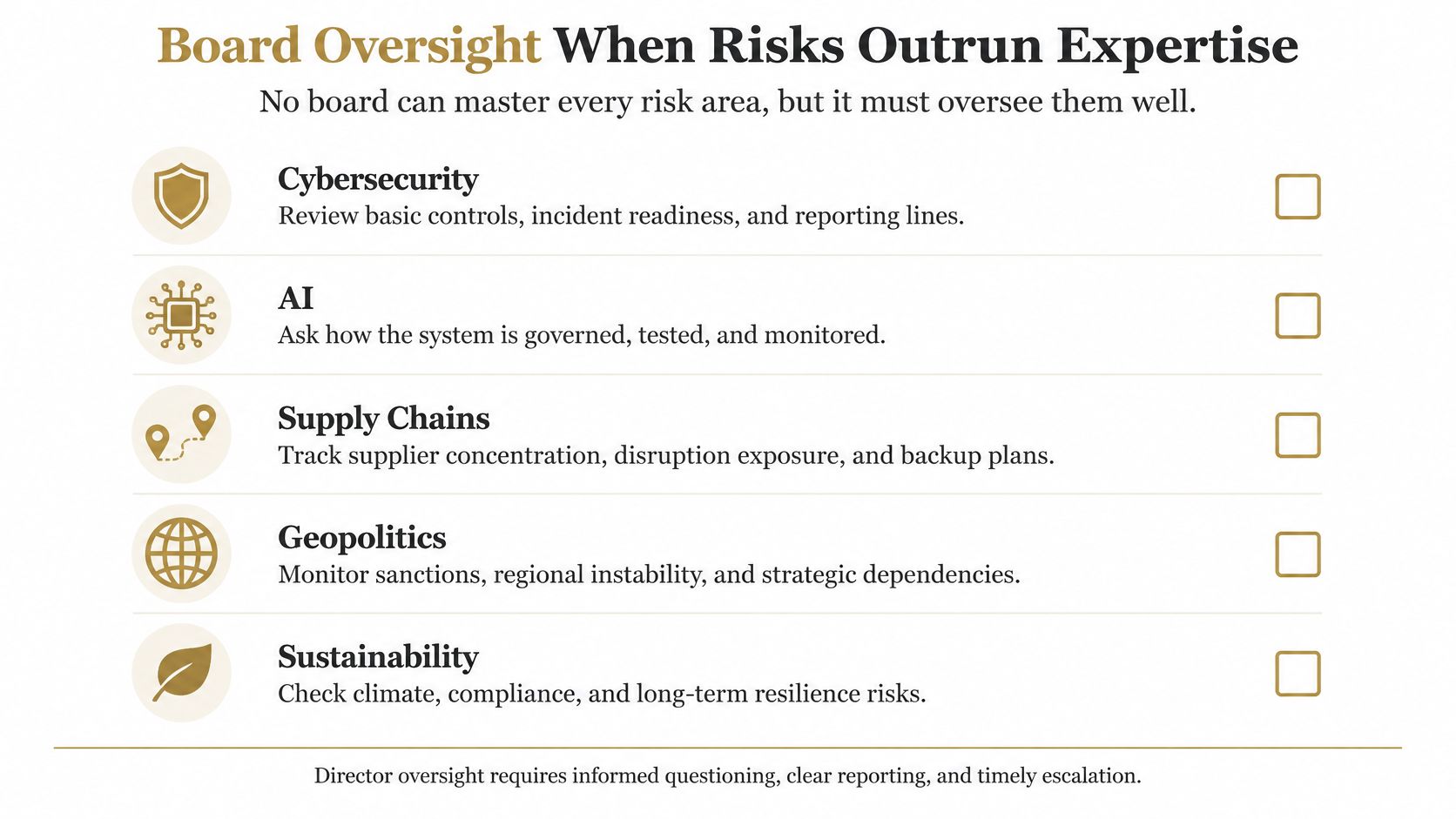
No board can be expert in cybersecurity, AI, supply chains, geopolitics, and sustainability at once. Directors must oversee all of them anyway. The question isn't whether you personally master each field, it's whether you've built a process that surfaces problems early enough to act.
The visual below summarises the risk areas boards most often need structured oversight for, even when no director is a specialist in them.
The workload evidence shows why this is difficult. The KPMG Directors Quarterly for July 2025 reports that audit committees have major responsibility for legal/regulatory compliance (73%) and data governance (53%), yet only 16% of surveyed boards said they were reallocating risk oversight among committees despite workload concerns. Delaware's Caremark standard generally requires a sustained or systematic oversight failure for liability, but courts have allowed claims where directors allegedly failed in bad faith to understand and oversee core business risks.
The following video walks through how oversight duties apply when a board faces risks outside its direct expertise.
Three Questions That Set Your Threshold
What information is enough? When does reliance on management become unreasonable? What should minutes record? Answer them with habits agreed in advance, not improvised during a crisis. Define escalation triggers, require risk dashboards tied to board-approved tolerances, track follow-up actions to closure, and record dissenting views. Before accepting a committee seat, our Board Role Fit Checklist can help you test whether the assignment matches your expertise and capacity.
Records Checklist
- Declared interests and recusals
- Information requested and received
- Advice taken, with its limits
- Dissenting views
- Risk scenarios and escalation triggers applied
- Follow-up actions tracked to closure
- The reason the chosen option serves members over time
Practical rule: Defensible oversight is proven before an outcome is known, through the information you demanded and the escalation you triggered.
Continuous oversight also matters between meetings. The G20/OECD Principles of Corporate Governance expect boards to provide strategic guidance, monitor management, oversee risk systems, and ensure compliance across areas including digital security, data privacy, and health and safety.
What Happens When a Director Breaches a Duty
A board decision can be defensible at the time and still lead to a claim if a director breached a duty. The consequences depend on the conduct and the loss involved.
Main Consequences
- Civil claims: The company may seek compensation for loss caused by a breach. After insolvency begins, a liquidator or administrator may pursue a claim on the company's behalf. A director who profits from self-dealing may also have to account for that profit.
- Disqualification: Where conduct shows unfitness, a UK court may disqualify a director under the Company Directors Disqualification Act 1986.
- Relief: Under section 1157 of the Companies Act 2006, a court may relieve a director from liability if the director acted reasonably and, considering the circumstances, ought fairly to be excused.
- Insurance and indemnity limits: Section 232 of the Companies Act 2006 voids provisions that exempt a director from liability to the company for negligence, default, breach of duty, or breach of trust. Section 234 sets limits on company indemnities, including restrictions on covering criminal fines.
Read the directors' and officers' insurance wording and any indemnity deed before accepting a seat. Check exclusions, coverage limits, and who controls the defence. These documents affect how a claim is handled, but they do not remove the director's duty to act properly.
How Duties Shift Across Borders and Near Insolvency
| Jurisdiction | Whose interests lead | What widens or shifts the duty |
|---|---|---|
| United Kingdom | Members as a whole, with creditor interests where the law requires | Laws or rules requiring creditor consideration in particular circumstances, such as near insolvency |
| China | Company and minority shareholders, with other interested parties | Revised company law expressly elaborates loyalty and diligence and requires reasonable-business-person conduct |
| India | Company, with accountability debated as shifting earlier | Insolvency risk becoming probable, according to commentary rather than settled law |
| Delaware, United States | Corporation and stockholders, through oversight duties | Sustained or systematic oversight failure, or bad-faith failure to oversee core business risks |
The core question is whose interest becomes decisive when shareholders, creditors, employees, and other stakeholders pull in different directions. A Chambers comparative practice guide on corporate governance shows divergence, including China's revised framework directing public-company directors to consider minority shareholders and other interested parties, UK debate after Sequana over when creditor interests become central before insolvency, and Indian commentary questioning whether accountability should shift earlier when insolvency becomes probable.
Status also matters. Board observers generally don't owe the same fiduciary duties as directors, which affects confidentiality, conflicts, information access, and liability. Don't assume an observer seat carries director duties, or that it carries none of the practical risk.
Your Decision Map
- Which entity is owed the duty? Name the company, not the group in general.
- Who may sue? Identify whether it's the company, members, or an insolvency office-holder.
- When must creditor interests be considered? Pin down the trigger in the governing law.
- Does a nominee owe duties to the appointer? In the UK model, the duty runs to the company.
- What changes after a restructuring warning? Expect closer scrutiny of payments, asset sales, and new commitments.
Check the articles of association and governing jurisdiction before accepting any cross-border, subsidiary, startup, or private-company seat.
Check Your Duties Before You Accept a Seat
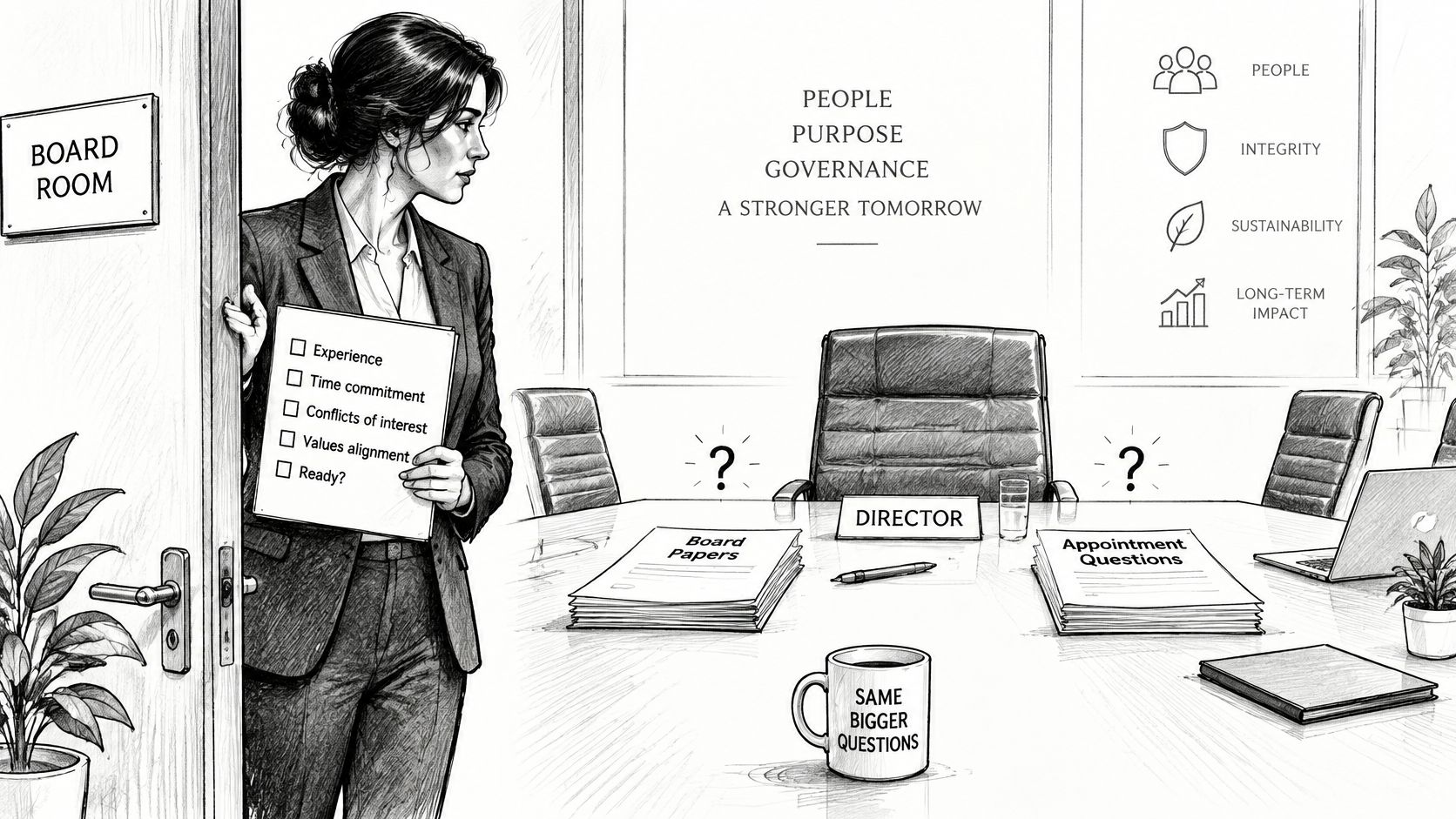
Before accepting a board seat, ask whether you will have the time, information, and independence to meet your duties in practice. Read the company's documents and ask direct questions rather than relying on assumptions. The Companies Act 2006 contents and general duties chapter sets out duties including those under sections 172 and 174, alongside provisions relevant to creditor interests in particular circumstances.
A candidate who checks these matters before appointment is assessing whether the responsibilities are manageable, not whether the role sounds attractive.
Five Questions to Ask First
- Does the board's expertise match its risk profile? Identify gaps you may be expected to address.
- What committee responsibilities and reporting lines come with the seat? Ask how much time they are likely to require.
- Can you access independent advisers, and who pays for them?
- What insurance and indemnities are in place, and what do they exclude?
- Could your existing appointments create conflicts that you must declare?
Work through those questions with the Board Offer Due Diligence Checklist, alongside checks on the relevant entity, jurisdiction, and creditor-interest triggers.
SeatSignal's placement team handpicks relevant open board roles, prepares director-grade applications customized for each opportunity, and provides board-specific interview preparation. Each application can include a board CV, customized cover letter, fit memo, and independence note. Members approve and send their own approaches. SeatSignal does not represent members to boards or negotiate on their behalf, and members remain responsible for their own decisions and due diligence.
If you are preparing for a board seat, SeatSignal can help you find relevant open roles and prepare focused application materials and interview preparation. Start your search with SeatSignal, then apply the duty checks in this guide before sending an approach.
Want a paid board role, done for you?
One handpicked, verified open board role every week, with a director-grade packet tailored for it.
Get Started