Founder Exit Strategy: How to Protect Your Value
A buyer has asked for a conversation, your leadership team wants more authority, and you're still approving decisions nobody else will touch. You'd like to leave eventually. You just haven't decided whether leaving means selling the company, handing over the keys, or finally doing work that doesn't require being available all the time.
That's where a useful founder exit strategy starts. Not with a valuation target, but with a harder question: what must change so the company can succeed without you, and you can succeed without running it?
Table of Contents
- The Moment Every Founder Eventually Faces
- What a Founder Exit Strategy Really Means
- The Four Exit Paths and Where Each One Breaks
- Building a Company That Can Run Without You
- The Identity Problem Nobody Mentions
- Turning Founder Wins Into Board Evidence
- How to Choose Your Next Role After the Deal Closes
- A Working Plan You Can Start This Quarter
The Moment Every Founder Eventually Faces
Sometimes the signal is exhaustion. Sometimes it's a capable executive asking for room to lead. Sometimes you realize you're more interested in the company's next strategic decision than its next operating meeting.
Don't confuse that realization with a decision to sell. Treat it as permission to start planning deliberately, while you still have choices.
Your first job is to separate dissatisfaction with your current role from dissatisfaction with ownership. You might need a successor CEO rather than a buyer. You might want liquidity without a complete departure, or a clean break rather than a prestigious title that keeps you emotionally on call.
Separate the decisions before negotiating
Write down your answers to these questions before discussing terms:
- Personal security: What financial outcome would let you make your next career decision without pressure?
- Company continuity: Which commitments to employees, customers, and family matter to you?
- Future involvement: Do you want decision-making authority, an advisory contribution, or distance?
- Identity: What work would still feel meaningful if you couldn't introduce yourself as the CEO?
These aren't soft questions. Your answers determine which offers deserve attention and which transition obligations you should reject.
Leadership continuity deserves equal weight. A global STEP survey cited by Harvard Business Review found that as many as 70% of family-business CEOs had no succession plan. Don't assume your successor will emerge just because you've decided you're ready.
Practical rule: Don't negotiate your departure until you can describe both the company you're leaving behind and the working life you're moving toward.
Bring your board, relevant owners, and professional advisers into that conversation early. Ask them where their objectives differ from yours, especially on timing, control, and acceptable outcomes.
You don't need perfect agreement immediately. You need to discover disagreements before a buyer or family successor discovers them for you.
What a Founder Exit Strategy Really Means
A founder exit strategy is a program for protecting transferable business value while arranging a change in ownership, executive responsibility, or both. It also needs a personal transition plan, because a signed agreement won't decide what you're useful for afterward.
Acquisition statistics make the distinction between an exit and a good outcome unavoidable. A 2025 analysis covering approximately 15,000 venture-funded company exits from August 2002 through June 2024 found acquisitions accounted for 64%, shutdowns for 32%, and IPOs for 4%; unprofitable acquisitions and shutdowns together left 58% without a positive financial outcome for founders and investors.
Those figures describe venture-funded companies, not every founder-owned business. The practical lesson still matters: being acquired isn't proof that you've protected your value.
Distinguish the transaction from the result
Use these categories carefully:
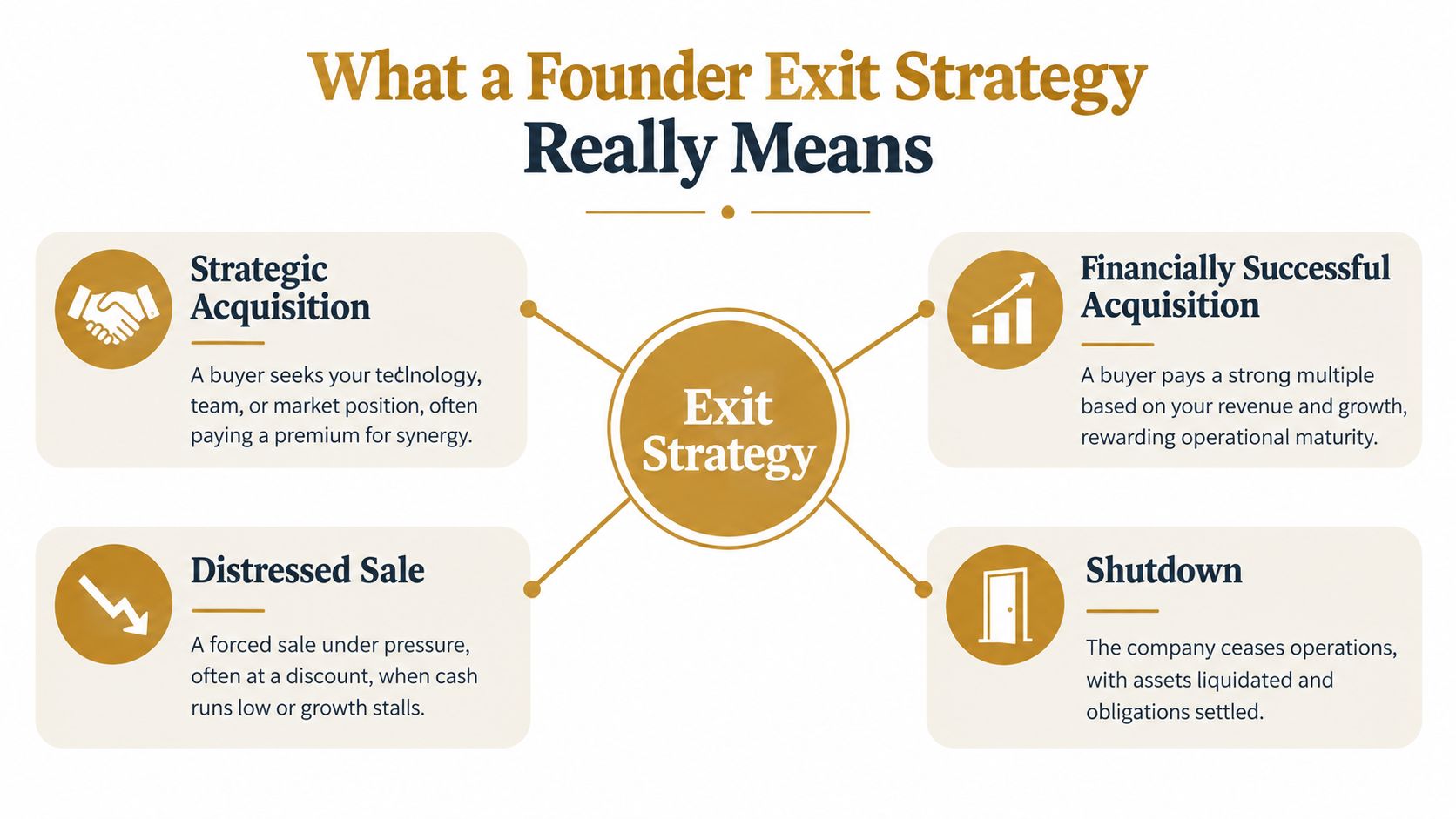
- Strategic acquisition: Evaluate why this buyer wants the business and whether that rationale survives scrutiny.
- Financially successful acquisition: Judge the outcome by what owners receive and the obligations they retain, not the announcement.
- Distressed sale: Recognize when pressure has narrowed your choices. Don't present necessity to yourself as preference.
- Shutdown: Consider an orderly conclusion when continued operation or transfer no longer offers a defensible path.
These distinctions are useful, but they aren't mutually exclusive. A strategic buyer can participate in a financially disappointing transaction.
The diagram provides a working vocabulary for those different outcomes.
Keep separate plans for the business transition and the founder's next role. The company plan should establish what another owner or leader can reliably take over. Your personal plan should establish how much income, responsibility, and influence you want.
Don't let an attractive board title compensate for weak economics. Equally, don't accept a strong headline price without understanding whether the agreement requires you to keep doing the job you're trying to leave.
The Four Exit Paths and Where Each One Breaks
Choose an exit path by testing constraints, not by ranking prestige. Acquisition, an initial public offering, internal transfer, and shutdown solve different problems. None deserves to be your default just because another founder chose it.
Preparation is the immediate issue for many owners. A 2025 small-business survey reported that 79% had no exit plan, while 47% had considered a third-party sale and 46% had considered transferring the business to family. Considering an option isn't the same as making it executable.
Founder Exit Paths Compared
| Path | Typical Outcome | Best Fit | Common Failure |
|---|---|---|---|
| Acquisition | Negotiated proceeds and continuing obligations; no universal payout benchmark | Founders seeking an ownership transfer with an identifiable buyer | Attractive price paired with unacceptable dependence on future performance |
| Initial public offering | Public-market valuation, not necessarily an immediate personal departure | Founders whose company and ambitions justify this route | Treating a financing milestone as an escape from leadership |
| Internal or family transfer | Negotiated ownership and leadership handover; liquidity depends on the arrangement | Founders prioritizing continuity or gradual withdrawal | Naming a successor without granting real authority |
| Orderly shutdown | Closure rather than a going-concern sale; owner recovery is uncertain | Owners without a viable continuation or transfer path | Waiting until there aren't enough resources to close responsibly |
For payout context, the venture-exit analysis above found approximately 80% of acquired startups sold for less than $50 million, while more than 80% of IPOs had pre-money valuations above $150 million. These are transaction-scale observations, not promises about founder take-home proceeds.
Define your fallback before choosing your favorite
Set explicit decision triggers: minimum acceptable liquidity, tolerable earn-out exposure, buyer financing requirements, and employee outcomes you won't trade away. For an internal transfer, test the successor's willingness and authority separately from their family relationship or tenure.
Retaining partial ownership may fit better than complete withdrawal. But calculate the ongoing responsibility before committing, particularly if you also want external board work. Use the board time commitment calculator to challenge an overfull future calendar.
If your preferred path fails, know whether you'll pause, pursue an internal transition, or close. A fallback you can execute is more useful than an optimistic valuation target.
Building a Company That Can Run Without You
Your most persuasive exit document isn't a presentation. It's evidence that the leadership team can deliver without your intervention.
Alchemy Leadership Lab's succession guidance describes founder dependency as a risk that can affect valuation, upfront consideration, earn-outs, and transition requirements. The practical response is a multi-year transfer of relationships, knowledge, and decision rights, not a hurried documentation exercise before diligence.
Start with the decisions only you make
This quarter, record where work stops until you intervene. Include customer escalations, pricing exceptions, hiring approvals, supplier negotiations, and informal decisions nobody has thought to document.
Assign an accountable owner to each dependency. Give that person the information, authority, and escalation boundaries to act. Delegation without those elements just creates another person who has to ask you.
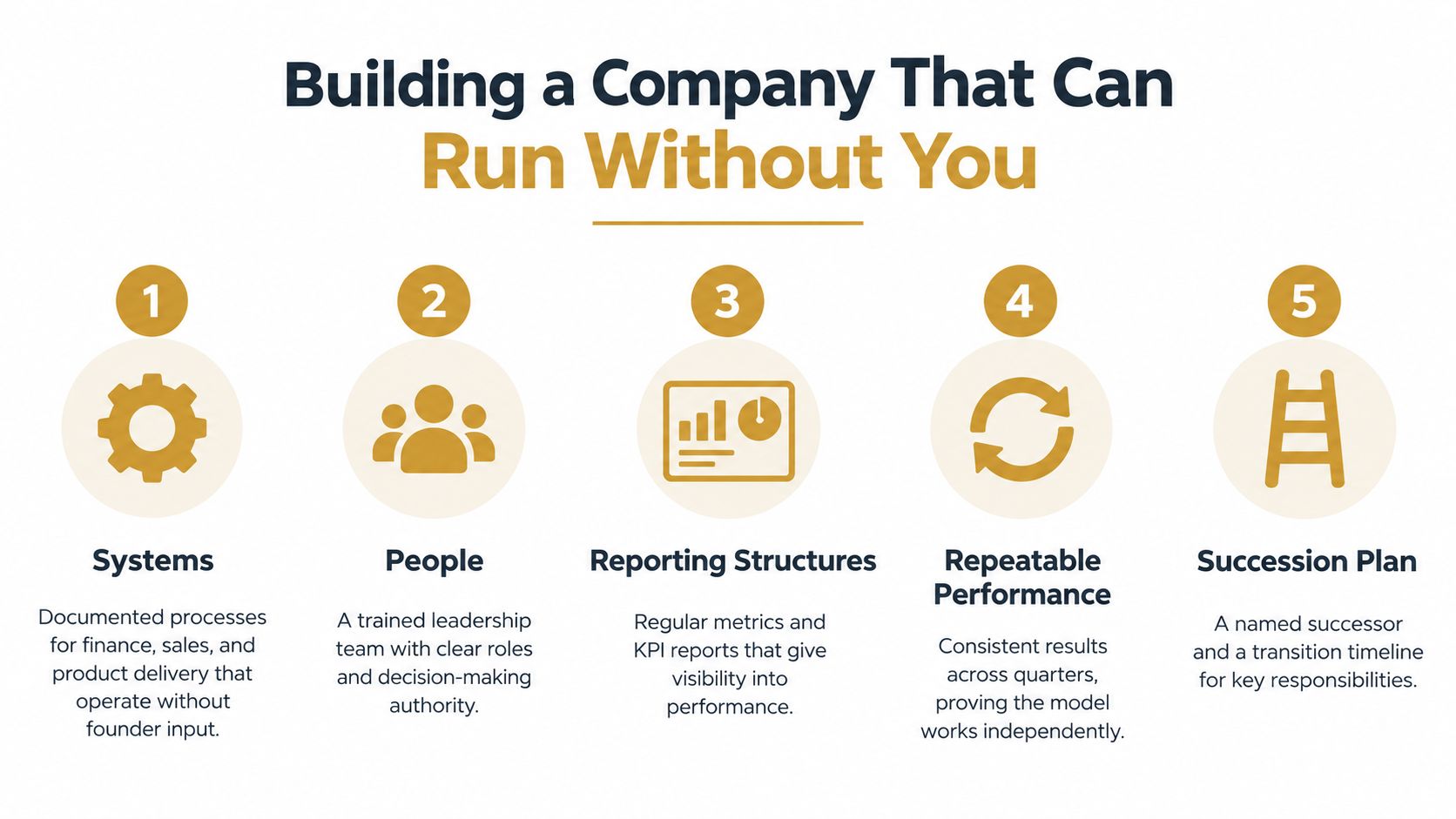
Use the following visual to check whether you've addressed the operating structure, not merely named a successor.
Test the handover under real conditions
Schedule founder-absent operating periods. Do not rescue every difficult decision through private messages. Review what happened afterward, including what the team handled well and where authority remained ambiguous.
Ask the board to monitor unresolved dependencies alongside commercial performance. A strong sales result doesn't prove transferability if you personally secured the contract and remain the customer's only trusted contact.
Before discussing transition commitments with a buyer, check:
- Customer ownership: Senior relationships extend beyond you, with clear account responsibility.
- Operating knowledge: Critical procedures explain exceptions and judgment calls, not just routine tasks.
- Leadership readiness: Executives have made consequential decisions without founder approval.
- Control visibility: Financial and operating reporting exposes problems without relying on your intuition.
- Escalation discipline: The team knows which matters require executive action and which belong with the board.
These controls won't eliminate negotiation risk. They give you evidence for challenging unnecessary retention obligations.
If a buyer insists you remain indispensable, ask precisely which responsibilities justify that requirement. Then compare the answer with the operating evidence rather than accepting an open-ended promise to help.
The Identity Problem Nobody Mentions
A successful exit can create a governance problem: you still know everyone, hold financial interests, and receive calls that should go to the new CEO. Your usefulness can become the reason nobody lets go.
The choice isn't only between disappearing and remaining in charge.

Continuing involvement isn't unusual in every setting. A study of nonprofit founder transitions found that 45% of boards created an ongoing founder role, compared with 31% pursuing an amicable clean break. That's nonprofit evidence, not an estimate for commercial exits, but it demonstrates that departure needn't mean total disengagement.
Stay useful without remaining in control
A non-executive chair role may suit you if you can support the successor, lead governance discussions, and resist issuing operating instructions. An advisory role may be more appropriate when your contribution is specific expertise rather than formal oversight.
Choose a clean break when you can't accept decisions being made differently, or when employees keep treating you as the authority. Don't ask the successor to establish credibility while you maintain a parallel chain of command.
Your successor hasn't taken over if everyone still checks whether you agree.
Document your remit, access to employees, reporting relationship, and end conditions. Disclose continuing financial interests and relationships, and ask the board to assess independence rather than assuming a non-executive title establishes it.
Use the board value proposition builder to articulate a contribution that doesn't depend on being the former boss.
Keep the distinction between contribution and control in mind when considering your next role.
Agree how you'll respond when a former direct report calls for help. A useful answer redirects the decision to the current executive while preserving the relationship. An unhelpful answer solves the problem privately and leaves the successor accountable for a decision they never made.
Turning Founder Wins Into Board Evidence
A founder CV explains what you built. A director CV must explain the judgment you can contribute when someone else is responsible for execution. Your exit is the start of a governance career, and boards will assess you the way they assess any candidate: on evidence.
A documented board recruitment framework includes defining competencies, specifying the role, screening applicants, gathering executive input, and interviewing candidates. Prepare for that evaluation rather than relying on reputation or a compelling company story.
Translate accomplishments into decisions
Start with an operating achievement, then identify the underlying governance question. Don't invent metrics to make it impressive. Use evidence you can substantiate.
| Operating experience | Board-relevant evidence |
|---|---|
| Entering a new market | How you evaluated strategic fit, investment exposure, and conditions for withdrawal |
| Replacing a senior leader | How you assessed succession risk, leadership requirements, and continuity |
| Managing a difficult customer loss | How you challenged concentration exposure and monitored the response |
| Completing an acquisition | How you tested assumptions, considered alternatives, and evaluated integration accountability |
Prepare a short case for each relevant experience: the situation, the competing choices, your judgment, and what you learned. Distinguish what you personally decided from what the team delivered. Watch the trap of being too useful to let go. If your strongest evidence is that everyone still needed you, a board will hear that the company never learned to run without you. Frame each win so it shows judgment that survived your absence.
Build an application for the actual vacancy
Your application packet should connect your evidence to the board's priorities. Include a director-grade CV, a concise committee-fit explanation, and a clear independence note. Use the board CV grader to identify where your materials still read like an executive job application.
A placement program is one route alongside director networks, search firms, and direct applications.
SeatSignal is a done-for-you board placement program that matches members to suitable board roles, prepares custom director-grade CVs for each vacancy, and rehearses candidates for role-specific interviews. That describes the program's purpose, not a guarantee of appointment, interviews, or income; the board makes the hiring decision.
Whichever route you choose, rehearse disagreement, not just biography. Explain how you'd challenge management, recognize an evidence gap, or support a decision you initially opposed. A polished career narrative can't substitute for demonstrating that you understand the boundary between oversight and execution.
How to Choose Your Next Role After the Deal Closes
Consider a hypothetical founder whose sale is complete, whose successor is capable, and whose transition obligations are defined. They want meaningful work but aren't sure whether they want another operating job.
Don't start by collecting opportunities. Start by deciding what an ordinary working week should contain.
Test the role against the life you want
A board portfolio fits someone who enjoys strategic challenge, preparation, and collective judgment without daily authority. For the first post-exit year, define progress as building a credible, selective candidacy rather than accumulating titles. Review board of directors positions against your evidence, availability, and financial interests.
A chair or advisory role with the acquired business fits someone whose contribution remains valuable and whose relationship with the successor is sound. A sensible year-end objective is fewer requests for intervention and clearer executive ownership, not permanent reliance on the founder.
Another operating role fits someone who still wants to build, recruit, and decide. Be honest about that preference. Taking a directorship as a substitute for running a company is unfair to both the board and yourself.
Genuine retirement fits someone who wants freedom from professional obligations. You don't need to manufacture a governance career to make an exit respectable.
Give yourself permission to choose narrowly
For this hypothetical founder, the right answer depends on what they miss. If they miss developing leaders and debating investment choices, governance deserves exploration. If they miss setting the product roadmap and directing execution, another operating role may be the more honest choice.
Boundary test: Would you still want the role if management listened carefully, considered your advice, and chose another course?
If the answer is no, don't rush toward a board appointment. Consider investing, philanthropy, or a bounded advisory engagement while you clarify what you want.
For founders who do want governance, structured matching, application preparation, and role-specific rehearsal offer an alternative to another cycle of untargeted outreach. Keep the search selective enough that you're choosing a responsibility, not merely replacing a lost identity.
A Working Plan You Can Start This Quarter
Don't turn exit planning into a project that waits for uninterrupted time. Assign owners, produce decision documents, and review evidence with your board and advisers.
Keep the company transition and your personal future on separate agendas. A business can be ready for new leadership before you're ready for a new identity. Your readiness shouldn't become an undisclosed condition of the successor's authority.
Your first 30 days
- Write the decision memo: State your preferred exit route, fallback, minimum acceptable liquidity, and commitments you want to preserve.
- Map the dependencies: Ask executives where decisions, relationships, and approvals still stop with you.
- Establish a personal baseline: Complete the board readiness assessment and identify evidence gaps before pursuing vacancies.
These are proposed planning deadlines, not a promise that exit readiness can be achieved within a quarter.
By 60 days
Give accountable executives ownership of the highest-priority handover work. Agree what evidence will demonstrate progress and which unresolved issues require board attention.
Ask your transaction, legal, and tax advisers to test your preferred route against the company's actual position. Separately, draft your post-exit role boundaries, including what you won't do, whom you'll report to, and how continuing financial interests will be handled.
By 90 days
- Review demonstrated progress: Compare actual delegated decisions with the authority you intended to transfer.
- Challenge the preferred route: Decide whether to proceed, improve readiness, or activate the fallback.
- Prepare governance evidence: Develop substantiated examples tied to specific board needs, not a generic founder biography.
- Choose the search method: Decide whether networks, search firms, direct applications, or a done-for-you placement program fit your needs.
Finish the quarter with a decision, even if that decision is to delay a transaction. Delay is defensible when you've named the work that will improve your options and assigned someone to deliver it.
The objective isn't to make yourself irrelevant. It's to stop making the company's future and your own dependent on holding the same job.
SeatSignal offers board opportunity matching, director-grade application materials, and role-specific interview preparation for founders preparing to move into governance. Visit SeatSignal to explore a structured search for a board role that fits your experience, availability, and post-exit ambitions.
Want a paid board role, done for you?
One handpicked, verified open board role every week, with a director-grade packet tailored for it.
Get Started