How Do You Get on Board of Directors: A Practical Path

In the 2025 NACD Trends and Priorities Survey, 67% of directors said they would favor a candidate with specific expertise over one with general business leadership experience, and industry-specific expertise was the most frequently sought capability at 42% (NACD's 2025 governance outlook). That finding reframes the search. Boards aren't shopping for the most senior person available; they're filling a named gap.
So how do you get on board of directors? Not by broadcasting availability, and not by polishing a résumé until it shines at everyone. The candidates who get appointments read the board's disclosed weakness first, then arrive with evidence that answers it, through a person the board already trusts.
The work splits into four parts: reading the board's gap, translating your executive record into oversight evidence, choosing the route that fits your record, and clearing the independence test before anyone asks.
Table of Contents
- Why Board Seats Are Scarce and When They Open
- How to Pursue an Appointment Step by Step
- Turn Executive Experience Into Board Evidence
- Board Entry Routes Compared and Which Fits You
- Find Openings Before They Are Listed
- Independence Rules That Can Rule You Out
- Pick Your First Target Board and Act
Why Board Seats Are Scarce and When They Open
The market is thinner than the volume of board advice suggests. Spencer Stuart's 2025 US Board Index counted 374 new independent directors appointed at S&P 500 companies in 2025, an 8% decline on the previous year and the lowest total since 2016.
The concentration matters more than the total. Only 50% of S&P 500 boards appointed at least one new independent director, down from 58% in 2024, and the average board added 0.8 new directors. Half of the largest boards in the market made no addition at all.
That pattern kills the volume approach. A board doesn't post a vacancy and wait for the best résumé; it fills a slot when a specific gap becomes urgent, and those gaps open around a handful of triggers:
- A retirement or tenure limit. A director hitting a term cap creates a dated vacancy the nominating committee has to plan around, often a year ahead.
- A change in a director's employment. A new executive role can disturb independence or capacity, and the seat comes back into play.
- A new committee requirement. Audit, risk, cybersecurity, remuneration or technology oversight can demand expertise the current board doesn't carry.
- A strategic event. A cross-border acquisition, a material cyber incident or a new regulatory regime pushes a board into a mid-cycle search.
- A disclosed skills gap. The skills matrix in the annual proxy shows exactly what the board says it's missing.
The question to hold onto: not "which boards are hiring" but "which board has a gap my record closes, and what makes that gap urgent this year".
Those 2025 figures describe S&P 500 boards only. Private companies, nonprofits, family-owned businesses and smaller public companies run different timetables, often faster and far less formal, but the logic holds: they move when a need becomes documented.
How to Pursue an Appointment Step by Step
A handful of people decide a board appointment: the chair, the lead independent director, the nominating committee, and sometimes a search consultant working to a mandate. You don't control their decision. You control whether your name arrives with a specific reason attached. The sequence below mirrors the four moves a structured placement program runs: surface the seat early, map warm connections, build a director-grade packet, and prepare for the interview.
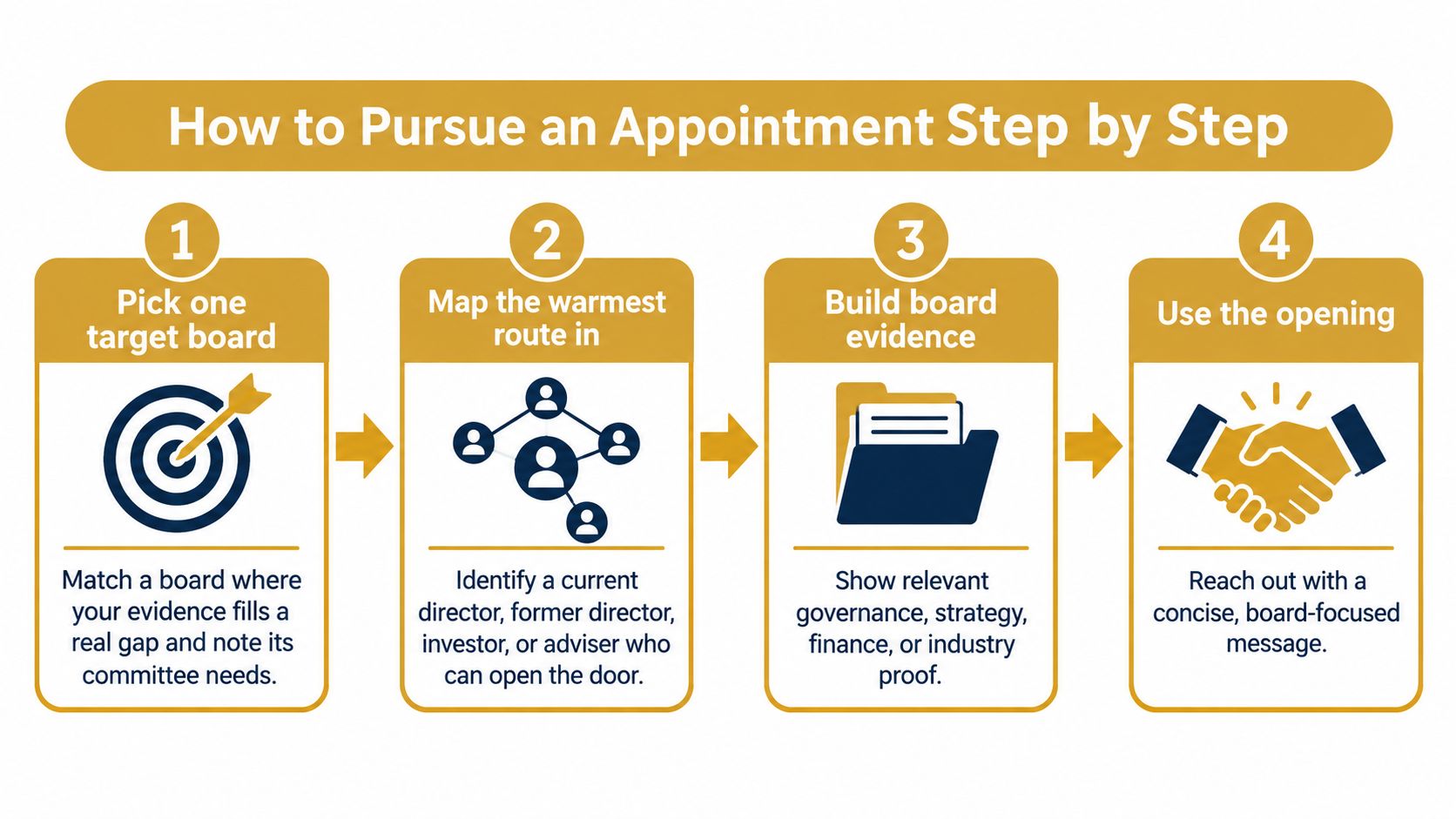
- Pick one target board and record its committee needs. Read the skills matrix, the committee charters and the last two proxy statements, then name the single gap your record proves you can fill. The common mistake is building a list of ten boards and one generic story for all of them.
- Map the warmest route in. List current directors, former directors, investors and advisers who could introduce you, and check that the introducer can state your fit in one sentence. Asking a contact for "any board openings" wastes the relationship; asking for an introduction to the audit chair because of the control remediation you led gives them something to say.
- Build a board-grade application packet. That means a governance-formatted board CV, a cover letter, a committee fit memo and an independence note. Governance codes treat board competence as collective, listing accounting or finance, business or management experience, industry knowledge, strategic planning and customer-based experience among the competencies that must be represented across the board (ECGI corporate governance code). Your packet should show which of those you carry and which committee you'd strengthen.
- Send a short, role-specific message to the chair, the lead independent director or a nominating committee member, with the gap and the evidence in the first three lines. A six-page résumé attached to a cold email with no clear ask is the standard failure.
- Rehearse the interview the chair will run. Prepare answers on the committee you'd join, the board's disclosed weaknesses, the difference between oversight and management, and a decision you got wrong. General leadership stories answer none of those questions.
- Follow up within a week with a brief note that resolves anything you answered poorly, plus one piece of thinking about the board's agenda. It signals that you treat the seat as work, not as a prize.
- Accept that the decision belongs to them. Boards, nomination committees and recruiters make the appointment, and the parallel search should keep running until something is confirmed in writing.
What good looks like: a chair who can repeat your fit to another director in one sentence, without opening your CV.
Before you begin, run the board readiness assessment so you know whether your evidence, your network and your independence position are ready, rather than assuming they are.
Turn Executive Experience Into Board Evidence
Begin with the board's gap, not your career. Most large companies now publish the capability list they recruit against: Spencer Stuart's 2023 US Board Index found that 68% of S&P 500 companies disclosed a director skills matrix in 2023, up from 38% in 2020. That disclosure is your specification sheet. Read it, then decide which line your record can defend under questioning.

What the First-Time Director Numbers Say
Newcomers do get in, but they're a minority. First-time directors accounted for 31% of incoming independent directors at S&P 500 boards in 2025, meaning roughly two-thirds of new appointments went to people with prior board experience (Spencer Stuart's 2025 sector data). The sector split shows where the doors are: first-time directors were 41% of incoming independent directors on information technology boards, against 26% in healthcare and 27% in both consumer and industrial companies.
The lesson isn't "become a technologist". It's that a board short of scarce, current expertise will take a first-timer who can oversee it, while a board already crowded with general management experience won't.
Translate Each Achievement With Three Questions
Take any accomplishment from your executive career and interrogate it. What oversight decision did I make or influence? What risk did I judge, and how? Which committee would own that conversation? A former CFO who says "I ran finance" gets nowhere. The same person saying "I presented the remediation plan for a material weakness to the audit committee every quarter until it closed" is answering an item already on the agenda.
One caveat catches senior people repeatedly. Oversight is not execution. The board approves and challenges; management delivers. Explaining how you'd run the company is the fastest way to look unprepared for the seat you're asking for.
| Board need | Evidence to show | Weak evidence to avoid |
|---|---|---|
| Audit or finance | Signed-off financial statements, direct work with audit committees, remediation of control weaknesses | A CFO title with no committee-facing work |
| Cybersecurity or technology | Oversight of an incident response, approval of security investment, regular reporting to a board | Technical certifications with no governance role |
| Risk | Built an enterprise risk register, presented risk appetite to a board or committee | Generic mention of risk management |
| Remuneration | Designed incentive plans and worked with compensation committees or advisers | Participation in a bonus scheme |
| Strategy or industry | Led a market entry, acquisition or transformation and measured the results | Years of industry tenure with no decisions to show |
| International operations | Ran regulated operations across jurisdictions with accountability for results | Foreign assignments without profit-and-loss responsibility |
During onboarding we ask members for their sectors, expertise, committee interests, board readiness, and whether they're open to paid, unpaid, equity or honorarium roles, because those answers decide which boards are worth approaching at all.
Run your translated evidence through the board CV grader to check whether it reads as oversight experience or as a job application. These figures describe 2025 S&P 500 appointments: they show where openings exist, not a promise that one belongs to you.
Board Entry Routes Compared and Which Fits You
Five routes produce most first appointments, and they behave very differently. Most candidates need two running at once, one for credibility and one for income.
| Route | How the seat starts | Best fit for | Main trade-off |
|---|---|---|---|
| Public vacancy listing | Company or search firm advertises the seat | Candidates with clearly matching committee skills | Competitive, with many applicants |
| Search firm or recruiter | Recruiter shortlists candidates for a documented need | Senior executives with clear governance evidence | Slow, and access depends on the recruiter's mandate |
| Warm referral | Introduction from a current director, adviser or investor | Candidates with a credible shared connection | Depends on relationship quality and timing |
| Advisory board or committee seat | Appointed to an advisory or committee role first | Candidates building a board track record | Time-limited and often unpaid |
| Nonprofit or public-sector board | Volunteer or appointed seat | Candidates new to formal governance | Usually unpaid, but builds credentials |
How to Choose Between Them
Three questions settle it. How much formal governance experience can you document today? How much time can you give to meetings, reading and committee work? Do you need the seat to pay, or can you build credentials first?
The answers point somewhere specific. Someone with a decade of audit committee exposure and an uncluttered independence position should work referrals and search mandates, not refresh vacancy boards. A first-timer with deep sector knowledge but no governance record gets more traction from an advisory or nonprofit seat, and keeps the paid search running alongside it.
If you're weighing a recruiter-led approach, it helps to understand how search firm placements compare with other routes: access depends on whether your profile matches a live mandate, and no amount of chasing creates a mandate that doesn't exist.
Rule of thumb: build credibility where it's cheap and visible, then compete for the paid seat with that record in hand.
Four signs a route is a poor fit:
- The seat demands skills you can't document under questioning, not just claim on a CV.
- The timeline collides with your current employment, especially if you still run a company the board does business with.
- The only route in runs through a connection you don't have and can't build before the vacancy closes.
- You're applying for prestige, not for a committee where you could contribute from the first meeting.
Find Openings Before They Are Listed
Boards advertise some seats and fill far more through people. ECGI's governance code is explicit that a candidate for a non-executive board position may be sought through an open advertisement or through an external consultant providing board-recruitment services. Treat every board on your list as potentially open, and watch for the conditions that precede a search.
| Signal | What it suggests | Where to check |
|---|---|---|
| Director retirement or tenure limit | A seat may open within months | Annual proxy statement and board biographies |
| New committee or disclosed skills gap | The board needs a specific expertise | Company skills matrix and governance pages |
| Director changes executive job | Independence or capacity may change | Press releases and company filings |
| New independent director appointed | A recent seat was filled, and the board may refresh again | Form 8-K filings and company news |
| Ownership change or shareholder activism | A board refresh is more likely | Proxy filings and shareholder news |
Turn a Signal Into a Specific Approach
For each target board, build a relationship map: current directors, former directors, major investors, senior executives, advisers and shared professional affiliations. The map tells you which route is realistic, and it often shows that the board is closer than the vacancy page suggests. Then run three tracks in parallel: confidential relationship work, monitoring of filings and anticipated turnover, and selective applications backed by a committee-fit memo.
Technology is a live example. Cybersecurity was identified as the second most in-demand board skill in BDO's 2025 board survey, yet 13% of directors and 12% of management teams reported lacking the appropriate skills or experience to oversee emerging technology and cybersecurity (BDO's 2025 board survey). A board that has just disclosed a technology or cyber gap is a target with a reason to reply.
Warm introductions beat cold applications, but only when the introduction is specific. "I'd like you to meet a former COO" is noise. "This is the person who ran the payments platform through two regulator audits and could chair your risk committee" is a decision.
That's the packet we prepare for members: a director-grade CV, a cover letter matched to the board's charter and gap, a fit memo and an independence attestation, plus a map of the warmest route in, so the approach arrives through a name rather than cold.
Where a signal has already become a confirmed vacancy, start from our board of directors positions list instead of rebuilding the search on your own.
Independence Rules That Can Rule You Out
Candidates spend months on positioning, then discover a rule that disqualifies them. The sharpest is the waiting period: under one set of corporate governance rules, a former employee generally cannot qualify as independent until five years after employment ends (ECGI governance code on corporate governance). If you left the company recently, that door stays shut no matter how well you interview.
The same rules require listed companies to have a majority of independent directors, and require the board to affirmatively determine that a director has no material relationship with the company. Independence isn't a form you sign at the end; it's an eligibility test the board has to be able to defend to shareholders.
Run this check before you approach anyone:
- Employment history with the company, its major customers and its suppliers, with dates.
- Consulting, advisory or professional fees paid to you or your firm.
- Financial relationships, including loans, guarantees and material shareholdings.
- Family ties to executives or directors.
- Interlocking relationships, where you serve alongside a company executive on another board.
- Outside commitments that limit capacity or create a competing loyalty.
Then write the independence note: each relationship, why it does or doesn't create a conflict, and how it would be managed if you were appointed. Expect the interview to test it, usually as some version of "walk me through any relationship you have with the company".
Working rule: if a relationship would need to be disclosed in a proxy statement, assume the board will ask. Explain it first, in writing, and the question stops being a risk.
Pick Your First Target Board and Act
The workable answer to “how do you get on board of directors” is narrow: one board, one documented gap, one route in, one independence position you can defend. Choose a single target this month. Apply a four-part test: the board has a stated or observable gap, your evidence maps to that gap, a credible warm path reaches someone who influences nominations, and your relationships would survive proxy-style scrutiny. If one part fails, park that board.
Score the fit before you polish the story. Use the board role fit checklist to compare your evidence against the charter, committee needs and composition, then write the independence note for that board only: each relationship, why it does or does not create a conflict, and how you would manage it.
Expect pace, not promises. Boards move on refresh cycles, forecast vacancies can slip, and appointment decisions sit with boards, nomination committees and recruiters. A serious search compresses preparation and targeting; it cannot guarantee an interview, a seat or income.
SeatSignal is a done-for-you board placement program: hand-picked board roles checked by a person, pre-public seat matching, warm-path introductions when available, a director-grade packet for each board, and interview preparation against the questions that board's chair is likely to ask. Members approve and send their own materials and run their own due diligence.
This week, produce one page for one board: the gap, your matching evidence, the warmest route, and the independence note.
The gap between an executive record and a board-ready application is usually translation. SeatSignal handles that part with hand-picked matches, a packet adapted to each board's charter and gap, and rehearsal built around that chair's likely questions. To run the search with a placement team, visit SeatSignal and start with a free readiness check.
Want a paid board role, done for you?
One handpicked, verified open board role every week, with a director-grade packet tailored for it.
Get Started