How to Get on a Corporate Board in 2026

Nasdaq's board-diversity framework, as filed with the SEC, generally expected listed companies to have, or explain why they didn't have, two diverse directors, typically one who identifies as female and one who identifies as an underrepresented minority or LGBTQ+ person, with boards of five or fewer members able to satisfy the objective with one diverse director or an explanation. Read the mechanics and you see what makes a board create a seat: a documented composition gap, a deadline, and a shortlist drawn from people the directors already know.
That's the lens worth borrowing. Learning how to get on a corporate board is mostly learning to be the answer to one specific, disclosed problem, delivered through a person the board already trusts. A longer résumé doesn't move you up that list. A narrower claim does.
Seats are scarce, turnover is slow, and most appointments never reach a public posting. Plan accordingly.
Table of Contents
- How Few Corporate Board Seats Actually Open
- Check Board Readiness Before You Search
- Target the Seat and Ask for a Warm Introduction
- Write the Director Packet That Gets Read
- Handle the Interview and the Seat Check
- Move Before the Vacancy Goes Public
How Few Corporate Board Seats Actually Open
Start with the arithmetic. In 2024, S&P 500 companies appointed 406 new directors, a figure equal to just 7.7% of the 5,289 directors serving on those boards, according to the 2024 U.S. Board Index. Fewer than one seat in thirteen turned over across the largest listed companies in the market.
| Measure | 2024 figure | Context |
|---|---|---|
| New directors appointed | 406 | 7.7% of 5,289 directors serving |
| Boards that added at least one director | 58% | Average added 0.83 directors |
| Active or retired CEOs | 30% | Share of new directors |
| Financial backgrounds | 29% | Share of new directors |
| Diverse executives | 58% | Up from 39% in 2014 |
| Women | 42% | Up from 30% a decade earlier |
| Underrepresented minorities | 26% | Up from 12% in 2014 |
Only 58% of S&P 500 boards appointed at least one new director that year, and the average board added 0.83 directors. Put plainly, four boards in ten added nobody. If a company never answered your approach, that's usually the reason: no vacancy, no search, and no conversation for you to join.
Where the Seats Actually Appeared
The wider market tells the same story. In 2025, 1,063 Russell 3000 companies made at least one director appointment, totaling 1,715 appointed directors, according to NACD's 2025 Inside the Public Company Boardroom. That's roughly a third of the companies in that index adding anyone at all in a year. This is the entire playing field.
Sector pockets run warmer. Technology-industry boards added 137 new outside directors in 2025, up from 123 in 2024, with more appointments of directors carrying private-equity, academic and consulting backgrounds, per the 2025 U.S. Technology Board Index. Boards are also buying narrow skills rather than general gravitas: in a 2024 Spencer Stuart director pulse survey, respondents reported adding about 1,100 directors with specialized skills over the preceding three years, with 30% adding a digital or technology specialist and 23% adding a cybersecurity expert.
What boards paid for in the 2024 class was operating authority and financial fluency: 30% of new directors were active or retired CEOs and 29% had financial backgrounds. Diversity moved from talking point to selection criterion, with 58% of 2024 appointments going to diverse executives, against 39% in 2014.
The practical read: pick a sector and a single committee gap you can fill, then shortlist perhaps a dozen companies where a retirement, a new risk, or a missing skill makes an opening plausible. The gaps worth naming are specific.
- Audit and financial reporting, where you can speak to controls, estimates and disclosure judgment from experience, not from adjacency
- Cyber and technology risk, where you owned the risk register rather than the product roadmap
- Transformation and integration, where you oversaw a deal, a carve-out or a system replacement through to a measured result
- Regulated-market and international oversight, where you answered to a regulator or ran a multi-country operation
- Human capital and succession, where you set executive pay and defended it to a committee
Check Board Readiness Before You Search
Board readiness is a specific gap you can name, evidence and oversee at committee level. Candidates who skip this check burn their outreach on boards that were never going to call back. Work through six checks before you write a target list. Fail any one of them and the search can wait, because a premature campaign spends relationships you will need in a year's time.
A readiness self-assessment produces a filed list of what you can defend in a room full of directors. Treat it that way.
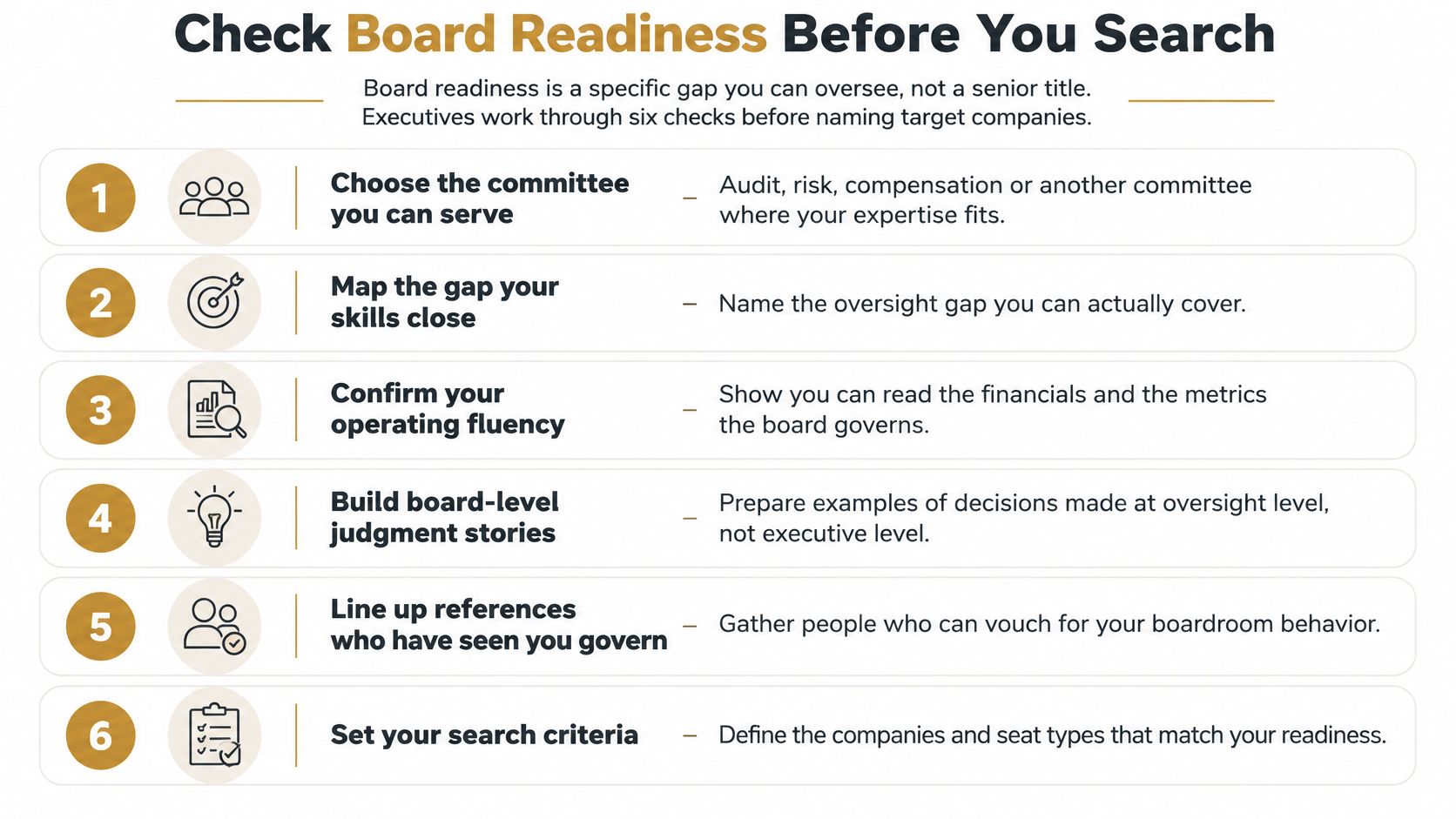
The Six Checks, in Order
1. Choose the committee you can serve. Audit, risk, compensation, nominating or technology. Base the choice on work you have personally overseen, not work you sat near. A CFO who has presented to an audit committee can serve on one. A technology executive who has never owned a control environment has homework to do first.
2. Build a one-page skills matrix. Cover industry expertise, audit and finance, risk, technology, cybersecurity, M&A, regulation, international markets and stakeholder oversight. Rate each row and leave the empty ones visible. The empty rows tell you what not to claim in an interview.
3. Write three proof points per claimed capability. A material transaction you led, a regulatory or crisis event you oversaw, a control improvement you can measure. Use numbers where you have them: findings closed, incidents avoided, exposure reduced, a deal that cleared a regulator on the date you promised.
4. Mark your independence problems now. Recent employment at the company or its auditor, customer or supplier dependence, family ties to management and interlocking directorships all get tested. Disclose them early and in writing rather than letting a chair discover them in diligence.
5. Put a number on your time. State a realistic monthly hour budget and name the unpaid roles you would resign if a paid seat appeared. Directors who can't answer the time question leave shortlists fast, because a chair reads hesitation as a future scheduling problem.
6. Stop if you only have responsibilities. A page that lists P&L scope, headcount and geographies is an executive résumé. A board page lists oversight, challenge and judgment. If you can't produce the second, you're not ready, and no volume of outreach fixes it.
The market rewards the specific claim. In the 2026 U.S. Spencer Stuart Board Index, industry-specific expertise was the most frequently selected priority for new directors at 42%. That describes what boards prefer, not your odds of appointment. Nobody publishes a reliable conversion rate, and anyone quoting one is guessing.
The pass test: a chair can repeat your committee story to another director in one sentence. A fail is an executive bio with the word governance dropped into the summary line.
Run the free Board Readiness Assessment before you spend a quarter on outreach. A low score is cheaper to fix now than after a chair has already passed on you.
Target the Seat and Ask for a Warm Introduction
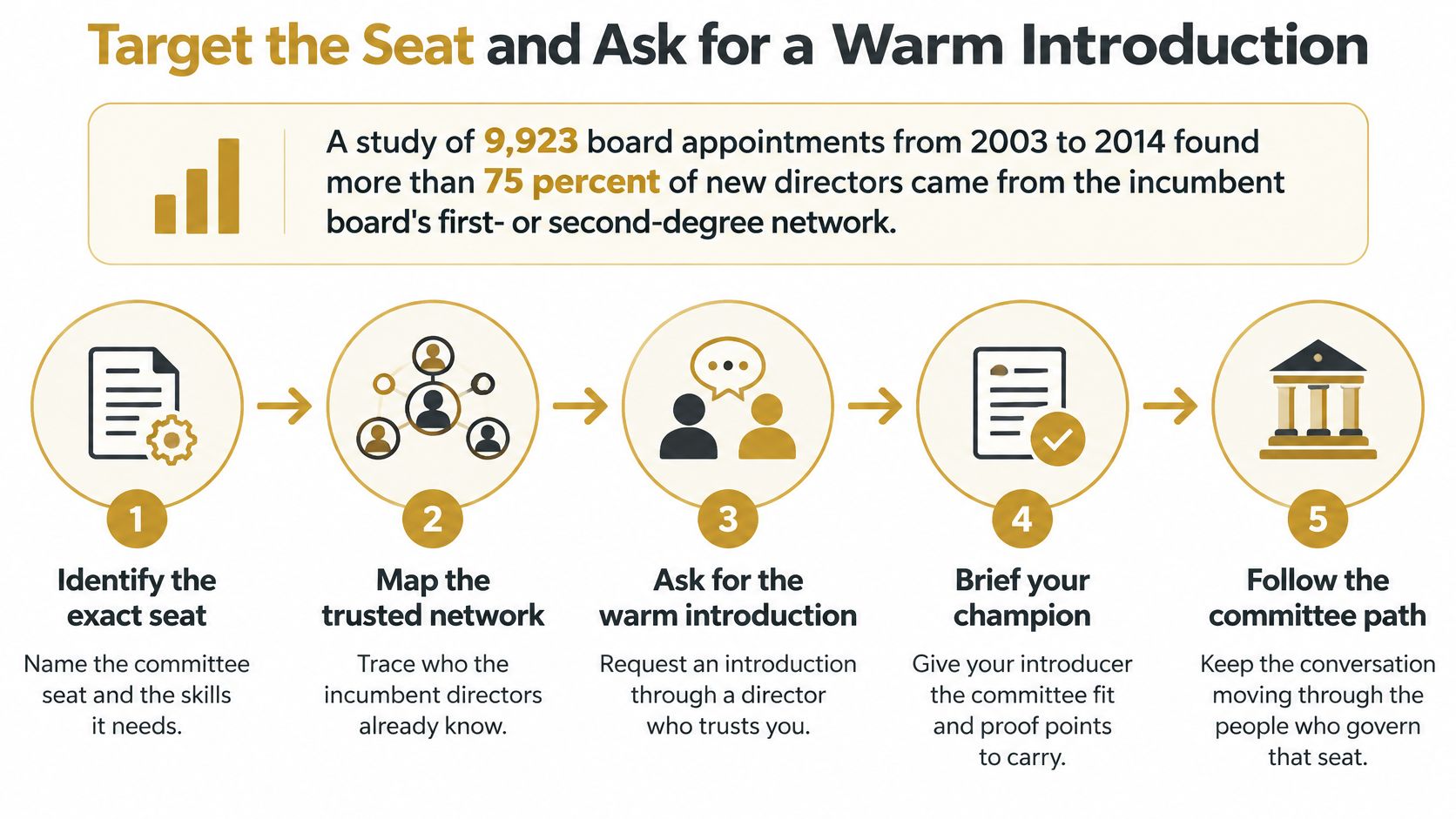
Ask who took the last open seat on any board and the answer is rarely "the strongest applicant." It is someone a sitting director already knew, or knew of. A study of 9,923 board appointments made between 2003 and 2014 found that more than 75% of new directors were selected from the incumbent board's first- or second-degree network, according to Harvard's analysis of director appointments. Among S&P 500 companies, 94% of director nominees were connected to an incumbent director at one or two degrees, even though connected people made up only 26% of the directors in the database.
That is the uncomfortable math. The pool of connected candidates is small, and it wins nearly every seat. An executive relying on public applications is competing outside the channel appointments move through.
So treat the search for what it is: finding one documented gap in a board's composition and reaching it through a person that board already trusts.
| Measure | Figure | What it means |
|---|---|---|
| Appointments studied | 9,923 | Made from 2003 to 2014 |
| New directors from the incumbent board's first- or second-degree network | More than 75% | Main sourcing channel |
| S&P 500 nominees from that network | 94% | Connected people were only 26% of tracked directors |
| Average board's first- or second-degree reach | About 18% | Share of the wider talent pool |
| Typical board's first-degree link | Just over 0.5% | Share of listed directors |
Four moves turn that math into an introduction.
Map the board's actual reach. The same analysis puts an average board's first- or second-degree reach at roughly 18% of the broader talent pool, with a typical board holding a first-degree connection to just over 0.5% of listed directors. Start from the committee gap you fill and work backwards to the people inside that thin slice. Adding a thousand names to a contact list does nothing.
Tie every note to a named need. "I'd value being kept in mind" earns a polite delete. Anchor the message to something specific: a stated strategic priority, a committee requirement, or an expected retirement, and say which one you are addressing. Chairs can usually tell a targeted note from a template at a glance.
Ask for one named introduction. Name the director you want to meet, and give the introducer three lines they can forward: who you are, the oversight problem you have already handled, and why that board needs it this year. An introducer who has to write the rationale themselves will not send it.
Use adjacent boards as evidence. If you have never held a corporate seat, nonprofit, private-company, advisory and industry-association roles give you governance evidence and trusted referrals. Treat them as the entry point, not a consolation prize.
Here's a short walkthrough of how warm routes and committee fit work in practice.
Practical rule: one credible introducer beats fifty cold approaches, and most candidates can name five people who could make an introduction if they thought for ten minutes.
If you're deciding between a search firm and a direct approach, understand what executive search firms actually do for candidates before you build a strategy around one. Most are retained by the board, not by you, and their shortlist usually starts with a name someone gave them.
Write the Director Packet That Gets Read
Boards are hiring against a confessed gap. Only 32% of executives believe their boards have the right mix of skills, and 21% of directors report their boards lack the necessary expertise for current challenges, according to PwC's 2025 Annual Corporate Directors Survey. Globally, AI and digitalization were the top priority for an additional director for 25% of surveyed board members, alongside cyber risk, data privacy and succession planning.
The trap is assuming that demand makes you the hire. It doesn't. Only 6% of newly appointed directors in a recent U.S. Fortune 500 analysis had previously served as a CTO, CIO, CDO or chief AI officer, per the same survey. Boards aren't shopping for titles. They're shopping for someone who can challenge management on a risk the board doesn't understand and hold the committee line while doing it.

So the packet answers a narrower question than your résumé does: what would you oversee, and how would a chair know?
The Four Documents Worth Preparing
A governance CV of about two pages. Lead with oversight results, not scope. Three or four lines per role, each one a decision or a control outcome, then committee experience and current board roles. Cut the awards section entirely.
A cover letter written to that board's charter and missing skill. One page. It names the gap in their disclosure, the committee you'd sit on, and the two proof points that map to it.
A one-page committee-fit memo. Map three proof points to the risks the board discloses: a regulator, a cyber incident, a failed acquisition, a succession question. Directors read this document closely because it does their thinking for them.
An independence note. State conflicts, related-party ties and time capacity in plain language. Volunteering a conflict costs you nothing at this stage and a great deal later.
What Each Background Should Show
- CFOs and finance leaders: reporting judgment, control environment, audit committee dynamics, and how you handled a disagreement with an external auditor.
- Founders and former CEOs: capital allocation, CEO succession, board-management boundaries, and evidence you can be a director rather than the operator in the room.
- Technology and cyber leaders: risk challenge, not a product roadmap. Name the risk you refused to accept, what you told the board, and what changed afterwards.
- Nonprofit and public-sector directors: stakeholder oversight, public accountability, and a concrete plan for learning the paid-board rhythm of quarterly cycles, compensation committees and disclosure deadlines.
Disclose a real gap instead of borrowing a skill you've never overseen. "I haven't chaired an audit committee; here's the two-year plan and the continuing education I've started" is credible and testable. Claiming cyber fluency from a vendor relationship is not, and directors will test it in the first ten minutes.
If you'd rather not build the four documents from scratch, director packet preparation follows exactly this structure for each board you pursue.
Handle the Interview and the Seat Check
Treat the chair's interview as a working session on the committee you named. The chair has usually read your CV before you arrive, so walk in ready for three tests: the questions you'd put to management, the metric you'd refuse to wave through, and the point where you'd dissent in a closed session.
Rehearse against this board's disclosed composition gaps rather than a generic list of director interview questions.
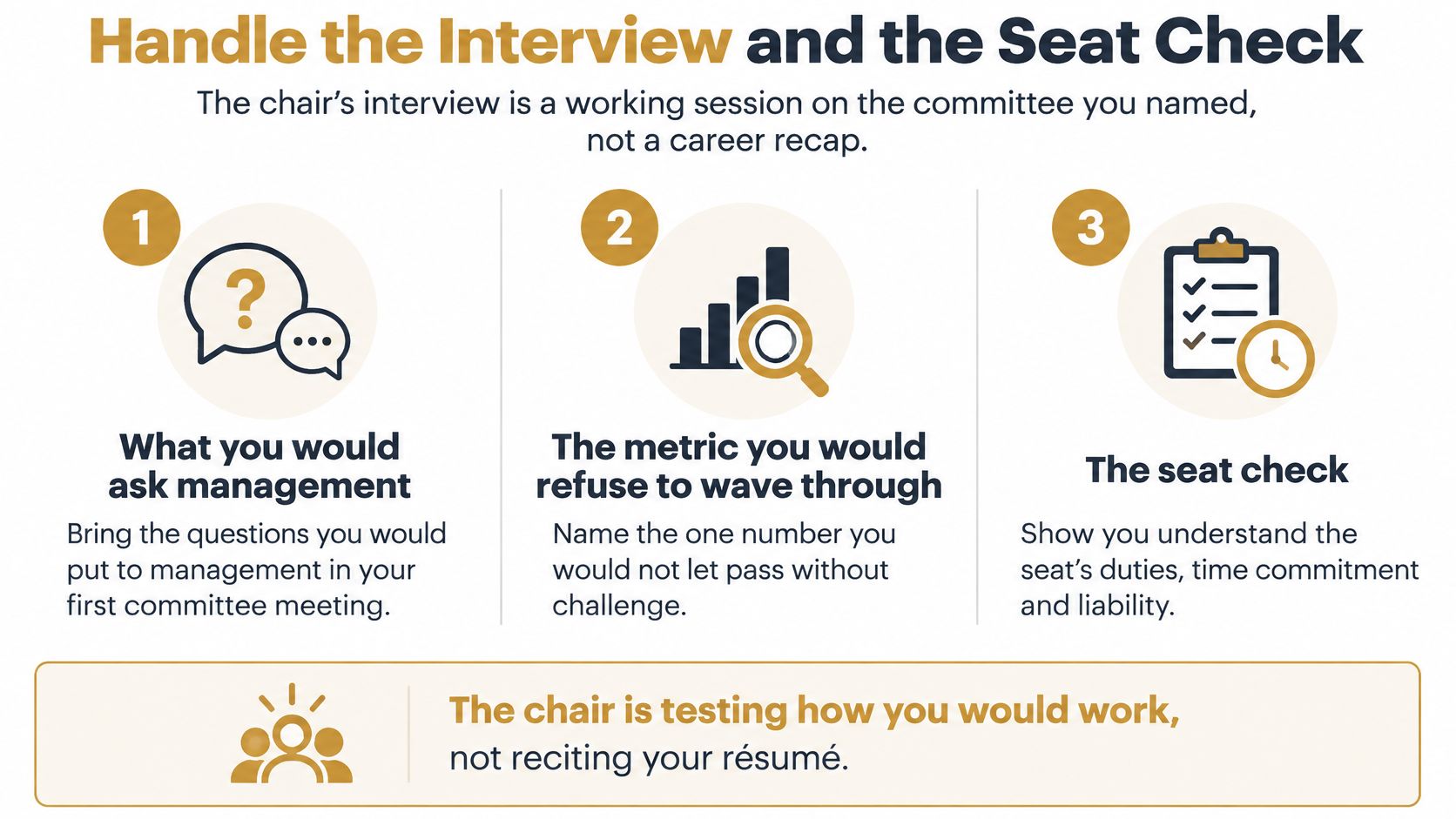
What you would ask management. Bring four or five questions you'd ask in your first committee meeting. A cyber director asks how the incident-response plan was last tested and who signed off on it. An audit chair candidate asks how the company challenges its own impairment assumptions. Specific questions prove you've read the disclosures.
The metric you would refuse to wave through. Every useful director has one, so say yours out loud: a revenue recognition policy, a covenant headroom number, a safety incident rate, a customer concentration disclosure. The answer tells the chair whether you'll hold your ground in a contested room.
Where you would dissent. Describe a real disagreement from a board or executive session, how you raised it, and what happened next. Directors who claim they've never been in the minority sound either inexperienced or untruthful.
Each answer should land as oversight evidence. The chair is weighing the judgment you'd bring to the next contested decision, and a replay of operating wins doesn't supply it.
Then comes time. Annual independent-director commitment has climbed from under 250 hours to more than 300 over the past decade, according to Spencer Stuart's director recruitment guidance. Say the number back and name what you'd drop. Six full working weeks a year is a second job, and a chair can tell within minutes whether you've priced that in.
The Seat Check Before You Accept
Plenty of boards concede that composition review slips behind competing priorities, so the gap the seat was opened to fill may never have been tested against the board's actual risks. Assume the checking is yours to finish.
Before you accept, cover what the interview didn't. Read the litigation footnote and the risk factors in the latest filings. Ask how cyber exposure is reported upward and whether the D&O cover was renewed at current limits. Check liquidity and covenant headroom, count the regulatory load the committee carries, and confirm your independence on both sides: the board's definition and the client, supplier and co-director ties on yours. Then weigh the committee workload against the fee, because chairing a contested audit committee is a different job from sitting on a quiet one.
A quiet interview or a fast offer is the moment to finish diligence, not to stop doing it.
The questions you choose to ask matter more than the answers you rehearse, and the seat check matters more than both. Board interview preparation rehearses you against the questions that board's chair is most likely to ask, drawn from the role, the committee and the gaps identified in that boardroom.
Move Before the Vacancy Goes Public
The count moved the wrong way. S&P 500 companies appointed 374 new independent directors in 2025, an 8% decline from the prior year and the lowest total since 2016, according to the 2025 U.S. Board Index. Only 50% of S&P 500 boards added a new independent director, and average turnover ran to 0.8 new directors per board.
Wait for a public advert and you join a smaller queue, later, with less information than everyone already in the room. Work the process in the order seats get filled instead.
SeatSignal's done-for-you placement program flags board seats before they are publicly posted, hand-picks live roles that fit the member, and prepares director-grade application packets with warm introductions where a route exists. Confirmed vacancies and forecast openings are labelled separately, so a forecast seat carries a confidence grade and an estimated window rather than reading like a live listing.
The program runs in four steps: surface the seat early, map the warm connections that get you inside, build a director-grade application packet, and prepare you for the interview. The packet covers a CV, a cover letter aligned with that board's charter and composition gap, a fit memo and an independence attestation. The warm route matters as much as the documents, because it puts your name in front of the board through a person rather than a portal. Interview preparation rehearses the questions that board's chair is most likely to ask, drawn from the role, the committee and the gaps found in that boardroom.
Pre-public board intelligence is the part that changes your timing.
You still approve and send every document yourself. Nomination committees and recruiters make the appointment decision, and no route guarantees one. If your six checks pass and you can name the committee gap you fill, start the targeted search now rather than after the posting goes up.
SeatSignal runs the search with you: pre-public seat matching, a warm route in where one exists, and a director-grade packet plus interview rehearsal for each board you pursue. If a paid board seat is the goal for 2026, start with the openings nobody has advertised yet, while there's still room to shape the shortlist. Visit SeatSignal to see the seats currently in play.
Want a paid board role, done for you?
One handpicked, verified open board role every week, with a director-grade packet tailored for it.
Get Started