Insurance Board of Directors: Roles and Responsibilities
You're preparing for your first insurance-board interview. You've led a business, challenged financial forecasts, and made difficult investment decisions, but the interview materials keep returning to capital, reserving, and policyholder obligations. Generic director guides haven't helped you explain what you would do when an insurer's growth plans collide with its risk limits.
The useful starting point isn't another list of fiduciary duties. It's understanding what an insurance board of directors must question, what evidence directors should receive, and how your experience prepares you to challenge management without taking over management's job.
Table of Contents
- What an Insurance Board Actually Does Day to Day
- The Regulatory Framework Every Director Should Understand
- The Five Core Responsibilities Every Insurance Board Holds
- Working With Control Functions and Committees Without Losing Accountability
- AI Oversight and the Questions Every Director Should Ask
- Skills Matrix, Independence, and the Time Commitment Trap
- Landing the Seat With a Targeted Board Placement Program
- Practical Checklist and Common Director Questions
What an Insurance Board Actually Does Day to Day
You're sitting in a quarterly risk committee meeting. In this hypothetical example, management recommends expanding an underwriting portfolio, the finance director supports the business case, and the risk report identifies uncertainty about claims assumptions. The board's task isn't to rewrite the underwriting model. It's to decide whether management has demonstrated that the proposed expansion fits the insurer's approved boundaries.
A director reviewing the papers should be looking for decisions, not information.

Turn a report into a board decision
For interview preparation, work through the imagined proposal using questions like these:
- Understand the exposure. Which assumptions matter most, and what happens if management is wrong?
- Identify the authority. Is management operating within an existing mandate, or asking directors to approve a material change?
- Request independent challenge. What concerns did the relevant control functions raise, and how were those concerns resolved?
- Define the follow-through. What reporting would directors need after approval, and what would trigger reconsideration?
Those questions help distinguish oversight from execution. An executive might explain how to deliver the expansion. A director should also explain the conditions under which the insurer should delay, narrow, or reject it.
Practical rule: Prepare to describe a decision you challenged, the evidence you requested, and how you checked what happened afterward.
Translate executive experience into oversight evidence
Your strongest evidence may come from approving capital allocation, questioning model assumptions, overseeing remediation, or handling a customer-impacting failure. Explain your role accurately. Don't turn operational responsibility into a claim that you exercised independent board oversight.
When assessing insurance board opportunities, examine the actual committee remit rather than relying on the director title. A risk committee vacancy and an audit committee vacancy may call for different evidence, even within the same insurer.
You don't need to arrive knowing every technical answer. You do need to recognize when the board lacks enough information to make a defensible decision. That's a more credible starting point than pretending broad executive experience automatically covers insurance risk, AI, cyber, or committee workload.
The Regulatory Framework Every Director Should Understand
Insurance governance makes more sense when you treat regulation as overlapping layers, not a collection of interchangeable acronyms. Start with the legal entity you would serve, identify its supervisor, and establish which group-level expectations also affect it.
Begin with the domestic regulator
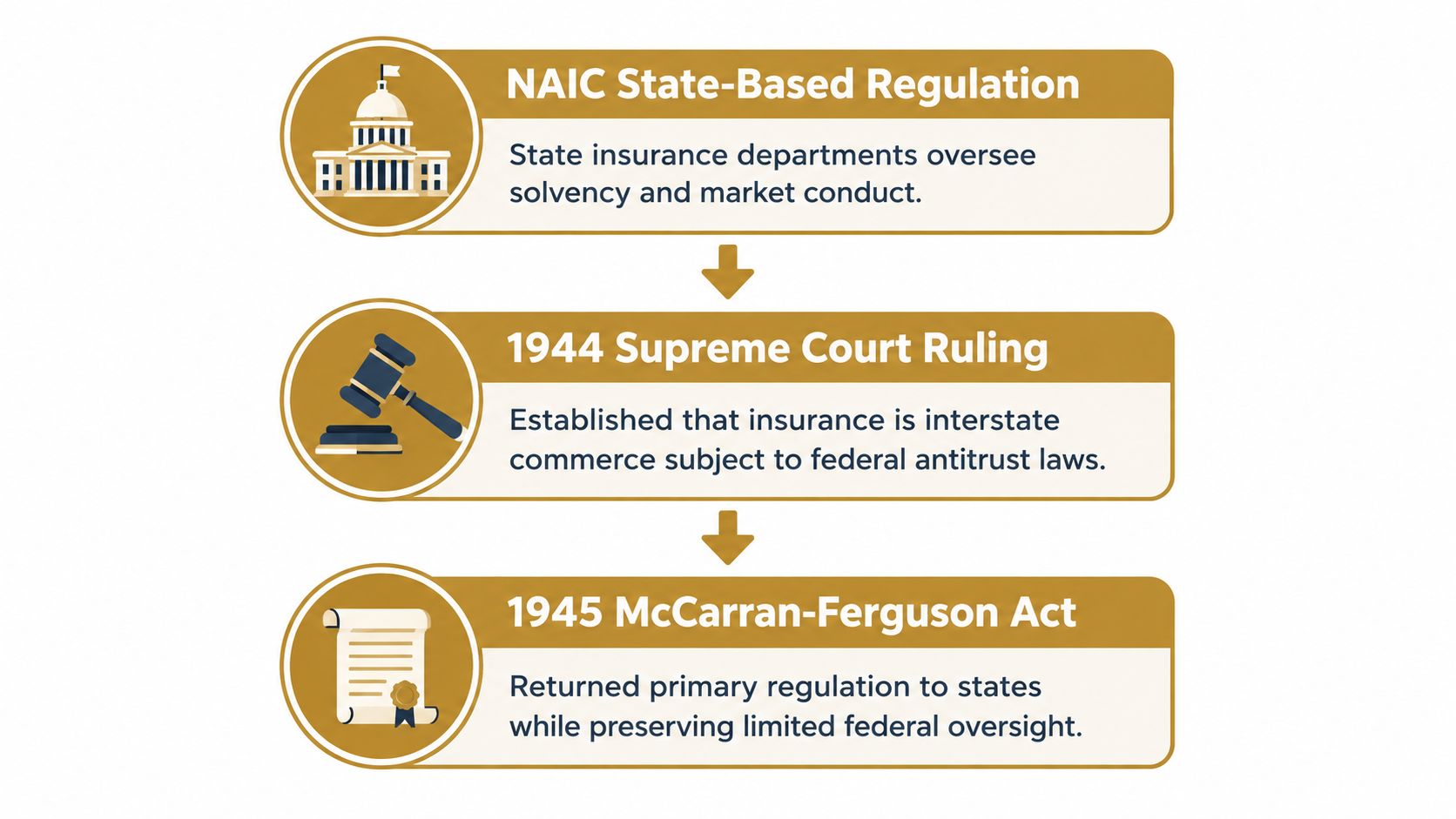
In the United States, the first meeting of the National Convention of Insurance Commissioners, later renamed the National Association of Insurance Commissioners, took place in May 1871. The Supreme Court treated insurance as interstate commerce in 1944, Congress preserved the primary role of state regulation through the 1945 McCarran-Ferguson Act, and the NAIC adopted its Financial Regulation Standards and Accreditation Program in 1989, milestones described in this history of state insurance regulation.
The practical lesson is that an insurer's board operates within a supervisory framework concerned with solvency, policyholder protection, and market conduct, not shareholder returns alone. A candidate should therefore ask which state regulator leads oversight and how the insurer manages regulatory commitments.
The historical relationships are illustrated below.
Add international and European expectations
The International Association of Insurance Supervisors, or IAIS, provides an international supervisory framework. For candidates, its relevance is the connection between board decisions, risk controls, and supervisory expectations. It shouldn't be mistaken for a replacement for domestic law.
In the European Union, Solvency II places ultimate responsibility for regulatory compliance and an effective governance structure with the insurer's board. Specialized committees can support that work, but delegation doesn't remove the board's responsibility, as explained in this guide to Solvency II governance.
EIOPA, the European Insurance and Occupational Pensions Authority, provides governance guidance within that European framework. Separately, OECD insurer-governance guidance emphasizes board direction, effective governance, sound risk culture, and monitoring management's execution.
Before an interview, establish:
- Entity scope. Are you joining an operating insurer, a holding company, or another group entity?
- Supervisory scope. Which regulator will scrutinize its governance decisions?
- Decision scope. Which matters belong locally, and which require group involvement?
A framework's name is less useful than knowing how it changes your decisions. Ask for the governance map, regulatory reporting calendar, and outstanding supervisory actions before assuming that experience in another jurisdiction transfers unchanged.
The Five Core Responsibilities Every Insurance Board Holds
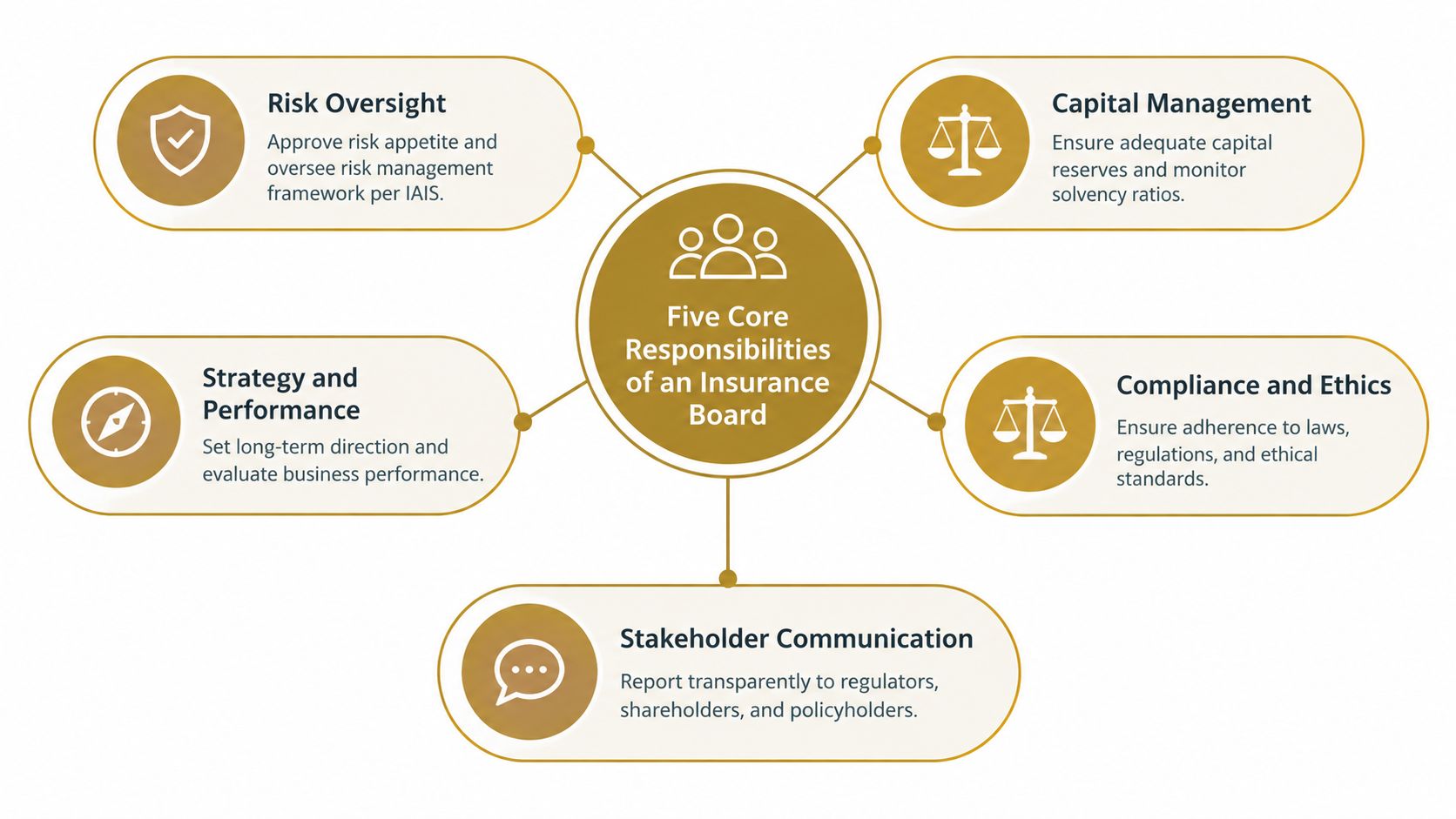
An insurance board's work can be organized into five connected responsibilities. This is a practical preparation framework, not a substitute for the insurer's legal obligations or committee mandates.
The diagram provides a broad view of the board's remit.
Risk oversight and capital stewardship
Risk oversight starts with boundaries. The IAIS Insurance Core Principles and ComFrame require boards to oversee risk-management and internal-control systems and their effectiveness. The framework also addresses appropriate risk review and board approval for significant new activities or products that introduce new or increased exposures.
The cause-and-effect relationship matters. Weak limits or incomplete reporting can allow underwriting, investment, liquidity, cyber, or operational exposures to accumulate without timely challenge. Clear tolerances and escalation requirements give directors a documented basis for stopping or modifying risk-taking.
Capital and solvency stewardship requires more than accepting a favorable headline position. Directors should question assumptions, stress scenarios, and proposed management actions. EIOPA's discussion of enterprise risk management and ORSA describes an active board role in the Own Risk and Solvency Assessment and using its results in strategic decisions.
A useful interview example would explain how you challenged a downside scenario and changed an investment or growth decision.
Policyholders, reporting, and strategy
The remaining responsibilities connect prudential discipline to business decisions:
- Policyholder and market-conduct protection. Ask how management detects problems in claims handling, product suitability, and customer outcomes. For a hypothetical claims backlog, request evidence about affected customers, causes, remediation ownership, and unresolved exceptions.
- Compliance and reporting. Under the NAIC Corporate Governance Annual Disclosure framework, insurers or their groups submit confidential governance disclosures annually by June 1, covering governance structure, board and committee practices, senior-management oversight, and critical-risk processes.
- Strategy and shareholder return. Challenge whether the proposed strategy remains credible after allowing for capital needs, operating constraints, and policyholder obligations. Commercial ambition doesn't replace those considerations.
The NAIC model regulation also requires a CEO or corporate-secretary attestation that stated governance practices have been implemented and that the disclosure has reached the board or appropriate committee, to the signer's best knowledge and belief. The model regulation's attestation requirements make the connection between management certification and board review explicit.
Use a board-readiness assessment to identify where you have evidence and where you need further preparation. For each responsibility, name a decision, the information you examined, and your contribution.
For additional viewing alongside these responsibilities:
Working With Control Functions and Committees Without Losing Accountability
A committee chart tells you who has been assigned a topic. It doesn't tell you whether directors receive candid information, understand unresolved concerns, or follow remediation through to completion.
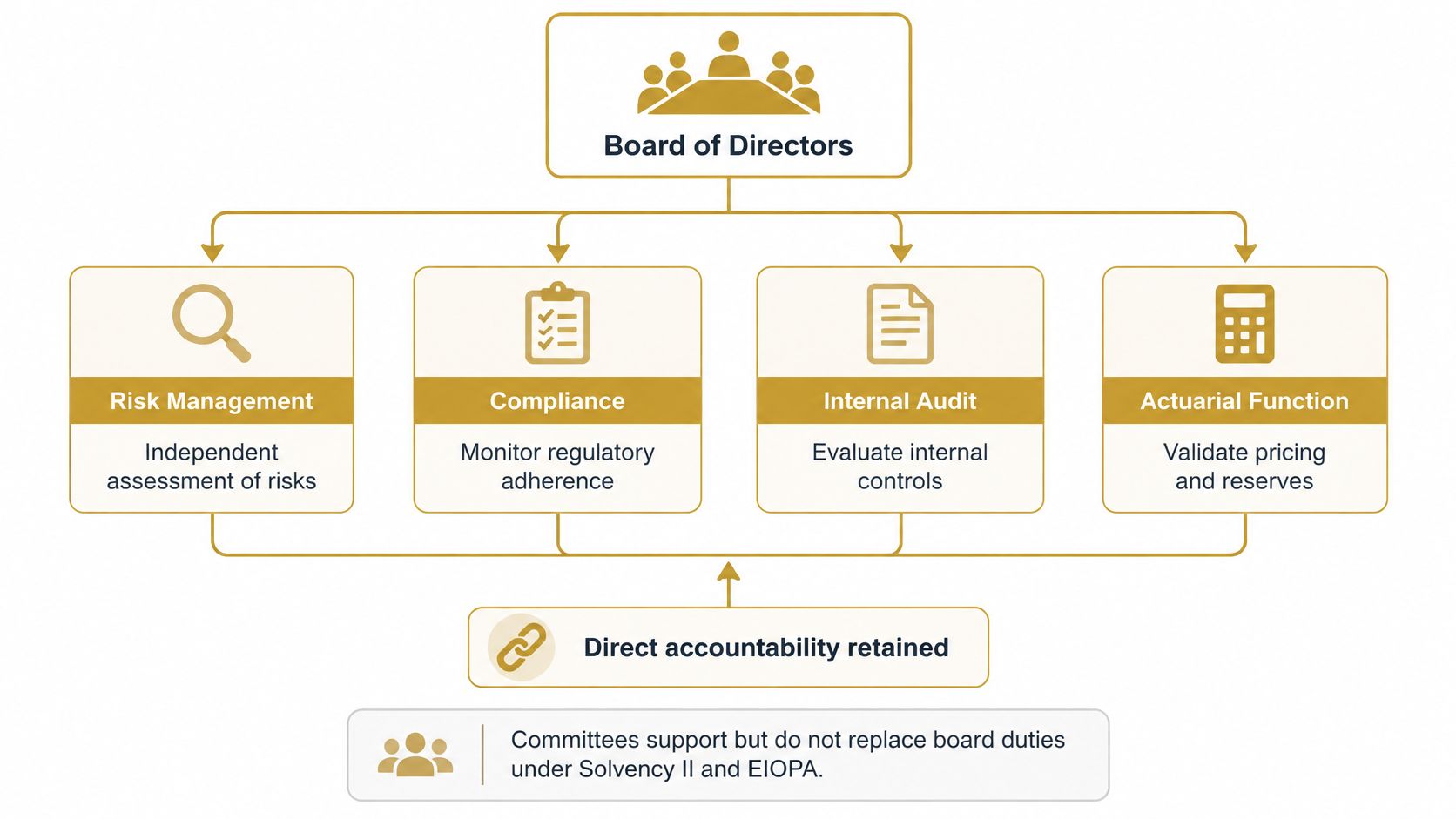
Under EIOPA's system-of-governance guidance, the board is responsible for the effectiveness of risk management, setting risk appetite and tolerance limits, and approving major risk strategies and policies. Directors are expected to request relevant information and challenge it when necessary.
The reporting relationships should support that behavior.
Test the information path
The key control functions are risk management, compliance, internal audit, and actuarial. They provide different perspectives, so a polished management presentation shouldn't be treated as a substitute for their reporting.
EIOPA describes a risk function that monitors the risk profile, reports exposures, identifies emerging risks, and advises the board. Its effectiveness depends on operational independence, adequate resources, and direct access to directors.
Translate those expectations into evidence requests:
| Ask to review | What you're testing |
|---|---|
| Control-function reporting arrangements | Whether concerns can reach directors without management filtering |
| Anonymized examples of escalated issues | Whether the escalation process works in practice |
| The remediation register | Whether material issues have owners, deadlines, and closure evidence |
| Committee terms of reference | Whether responsibility is missing, duplicated, or unclear |
| Function resource assessments | Whether the promised oversight is realistically supported |
Don't stop at whether a report exists. Ask what directors did when a function disagreed with management and how the disagreement was resolved.
A control function's access to the board matters most when its message is inconvenient.
Show where your experience adds value
Consider a hypothetical product proposal involving new pricing assumptions and an external technology provider. The actuarial function may question assumptions, risk management may examine aggregate exposure, compliance may raise customer-treatment concerns, and internal audit may later assess the relevant controls.
A candidate doesn't need to claim expertise across every function. Instead, map your background to the insurer's actual gaps: actuarial judgment, enterprise risk, investments, cyber, conduct, or audit.
If your experience is investment oversight, explain how you questioned concentration or liquidity assumptions. If it's cyber, explain how you assessed recovery evidence and management accountability. The distinction is important: knowing the subject is useful, but demonstrating how you challenge, escalate, and verify is stronger evidence of board contribution.
AI Oversight and the Questions Every Director Should Ask
AI expertise alone isn't enough for an insurance board seat. A director may understand model development yet still struggle to evaluate how an error affects claims decisions, reserving assumptions, regulatory reporting, or policyholder treatment.
The IAIS announcement accompanying its 2025 Global Insurance Market Report identifies expanding AI and generative-AI use across underwriting, pricing, and claims, alongside model-governance, transparency, cyber, operational, bias, and third-party-concentration risks. The board-level question isn't whether the technology works. It's whether the insurer can explain, control, and respond to its consequences.
Request an evidence package, not a demonstration
For a hypothetical AI-assisted claims system, I would recommend asking management for the following before approving a material deployment:
- Documented purpose. What decisions does the system support, and which decisions must remain with people?
- Data provenance. Where did the data originate, what limitations are known, and who approved its use?
- Validation. What testing was performed independently of the development team, including difficult or unusual cases?
- Explainability. Can the insurer explain a consequential outcome to a customer, reviewer, or regulator?
- Human override. Who can intervene, suspend use, or reverse an outcome, and are those controls tested?
- Outcome monitoring. How will management detect discriminatory results, deteriorating performance, or unexpected behavior?
- Incident escalation. What circumstances trigger notification to control functions and directors?
- Vendor accountability. What evidence, change notifications, audit access, and exit options does the insurer obtain?
These are recommended evidence requests, not a claim that every jurisdiction mandates an identical approval checklist. Their purpose is to make management's assurances testable.
Follow the insurance consequences
Suppose the claims system performs well on routine cases but struggles with unusual documentation. Directors should ask who reviews exceptions, whether customers can challenge decisions, and whether management can identify affected cases after an error.
For underwriting or pricing models, the equivalent discussion should include how errors might alter portfolio assumptions or risk selection. For fraud detection, ask how management distinguishes a useful warning from an unsupported adverse customer decision.
Approval test: If management can't explain how the insurer would detect, contain, and correct a material model failure, the board lacks a complete decision package.
Finally, identify the lead committee, supporting committees, and reporting route to the full board. Technology, actuarial, compliance, and customer-protection concerns shouldn't become separate conversations with nobody responsible for the combined exposure.
Skills Matrix, Independence, and the Time Commitment Trap
Financial experience is valuable, but it doesn't establish collective fitness for every insurance-board decision. The 2025 Global Directors' and Officers' Survey described stronger respondent confidence in financial-performance monitoring and strategy than in innovation and transformation, cybersecurity, and data privacy. Treat that qualitative contrast as a prompt to test capability, not as an assessment of the insurer you're considering.
Insurance-specific research also supports examining composition carefully. A meta-analysis of insurance-board characteristics identified 28 studies and 113 statistical coefficients, with positive relationships generally prevailing for board size and outside-director representation, although strength and significance varied. That's evidence of association, not proof that enlarging a board or adding an outsider causes better performance.
Build a matrix around decisions
A useful skills matrix starts with the insurer's strategy and exposures. It shouldn't award expertise merely because a biography contains a familiar title.
| Capability to assess | Evidence to seek |
|---|---|
| Actuarial and insurance expertise | Experience challenging pricing, reserving, or insurance assumptions |
| Reinsurance and enterprise risk | Understanding of risk transfer, dependencies, and aggregate exposure |
| Climate exposure | Experience evaluating relevant scenarios and business implications |
| Cyber and AI | Evidence of overseeing controls, incidents, models, or recovery decisions |
| Conduct and regulatory change | Experience challenging customer outcomes and implementation plans |
Distinguish between someone who can contribute, someone who can lead sustained challenge, and someone who needs development. Then test the matrix against upcoming decisions, rather than recycling the previous recruitment specification.
Independence is more than a label
Examine industry, investor, and commercial relationships before accepting a role. Ask whether a connection could constrain your judgment, create repeated conflicts, or prevent meaningful participation in the committee you're expected to serve.
A practical independence review should cover:
- Economic ties. Material relationships with investors, suppliers, advisers, or counterparties.
- Personal and professional ties. Relationships that could make challenge difficult.
- Process safeguards. Disclosure, assessment, recusal, and documentation arrangements.
Apply the relevant jurisdiction's requirements rather than assuming every relationship has the same consequence.
Time deserves equally direct scrutiny. Ask for average hours, committee assignments, preparation expectations, training demands, and the workload during incidents or regulatory remediation. Request the meeting calendar and ask how chairs coordinate overlapping topics.
Use a board time-commitment calculator to test normal and stressed workloads. A seat isn't a good fit if you can attend scheduled meetings but can't provide the attention required when circumstances change.
Landing the Seat With a Targeted Board Placement Program
A finance executive pursuing a risk committee seat wastes months if the search starts with the same executive CV sent to every opening. Serious preparation starts with suitable insurers, continues through evidence of capital and risk challenge, and finishes with rehearsal around the committee's actual decisions.
SeatSignal is a done-for-you board placement program: its team hand-picks board matches, drafts a director-grade CV for each role, and prepares you for each interview around that committee's decisions. That describes the program's objective, not a promise of appointment.
Connect the search to committee fit
SeatSignal's placement team reviews opportunities for fit and quality. Pre-public opportunity signals, confidence grades, and estimated opening windows help candidates investigate potential openings, while confirmed vacancies and forecast openings remain separately labeled.
The preparation process connects executive experience to governance responsibilities through:
- Director-grade application packets. A bespoke CV, cover letter, committee fit memo, and independence note.
- Relationship mapping. Shared boards, mutual connections, and professional history that may support warm-path introductions when suitable connections exist.
- Role-specific interview training. Preparation around committee responsibilities, likely chair questions, and gaps in board composition.
Members approve and send their materials themselves. The program supports their search; it doesn't replace their judgment.
Understand the subscription and its limits
SeatSignal lists subscriptions of two months at $297, six months at $742.50, or one year at $1,188, with the same placement program included in every plan and work beginning after checkout and onboarding, as described in its board placement program information.
Coverage spans the United States, United Kingdom, Ireland, European Union, Canada, Australia, New Zealand, and Singapore. Candidates exploring board of directors positions should still assess jurisdiction, committee expectations, and personal readiness independently.
Appointments, interviews, matches, income, and completion within 60 days are not guaranteed, as stated in the program terms above. Members remain responsible for their decisions and due diligence.
Practical Checklist and Common Director Questions
Prepare examples covering risk appetite, ORSA, disclosure, control-function independence, AI accountability, and your skills-matrix contribution.
Questions to settle before accepting
- How often does the board meet? Request its calendar, committee schedule, and expectations for unscheduled work.
- Does committee work count? Present the oversight decisions you contributed to, distinguishing formal governance from management participation.
- What does the NAIC attestation require? Management certification of implemented practices and confirmation that the disclosure reached the board or appropriate committee.
- Can a non-insurance executive serve? Assess the specific role's eligibility requirements, transferable expertise, and insurance-learning needs.
Use the board-offer due-diligence checklist, then choose a question and prepare a concrete example before speaking to a search partner.
SeatSignal helps you identify relevant insurance-board opportunities, translate your experience into director-grade materials, and prepare for the specific committee interview. Visit SeatSignal to explore a targeted search built around the governance contribution you can demonstrate.
Want a paid board role, done for you?
One handpicked, verified open board role every week, with a director-grade packet tailored for it.
Get Started