Non Exec Director: Role, Duties and Qualifications

Independent directors now spend above 300 hours a year, up from below 250 hours a decade ago, and UK directors report that as much as 70% of a non exec director role can happen outside formal board meetings. A non-executive director is a board member who is not part of the company's management, does not run daily operations, and oversees executives and challenges their decisions.
You're probably holding an approach from a chair, or drafting one of your own, while a full-time job still owns your calendar. The letter talks about four meetings and a fixed fee. It says little about the pack you read on Sunday, the committee that meets in between, or the supplier contract that could knock out your independence. The decision isn't whether the title sounds senior. It's whether your relationships and your other commitments still leave room for real challenge.
Table of Contents
- What a Non-Executive Director Is and Is Not
- Core Duties That Define the Role
- Independence Tests That Decide Who Qualifies
- How Much Time a Non-Executive Seat Really Takes
- Qualifications Boards Look For in a Candidate
- Three Board Seats Showing the Role in Action
- Confirm the Seat Fits Before You Say Yes
What a Non-Executive Director Is and Is Not
Think of a non-executive director as the independent safety inspector on a construction site. The inspector doesn't lay bricks or pour concrete. The inspector can question the drawings, demand test results, and stop the job when something looks unsafe. Executives build. The non-executive checks the build, in the company's interest, not the project manager's pride.
Three ideas that cause bad appointments
People mix this office up with three other jobs, and each mix-up is expensive.
A part-time executive. You don't step in to run a function when the executive team is busy. If you start directing staff, you've left oversight and walked into management.
A figurehead. A few dinners a year isn't the job. Committees, packs, and crises fill the gaps between meetings, which is why the time row below isn't a light diary.
A paid advisor. An advisor can be hired and fired for a view. A director holds office and owes fiduciary duties to the company as a whole, including shareholders as a body, not to the person who made the introduction.
| Factor | Executive director | Non-executive director |
|---|---|---|
| Main job | Runs a business function and executes strategy | Oversees management and challenges the strategy |
| Daily involvement | Full-time, inside operations | Periodic, outside daily operations |
| Typical time | Full working week or more | Part-time, but often above 300 hours a year once committees and preparation are counted |
| Pay | Salary, bonus and often equity | Fixed fee, sometimes shares, usually no operational bonus |
| Accountability | Responsible for results day to day | Shares board responsibility for oversight and disclosure decisions |
| Employment status | Employee of the company | Office holder with fiduciary duties, not an employee |
You share legal responsibility with the executive directors for what the board decides and what it discloses. Part-time doesn't mean low liability. Treat any board of directors positions conversation as a serious appointment, and ask what you would be accountable for before you ask what the fee is.
The part-time label describes your diary, not the weight of the decisions you sign.
Core Duties That Define the Role
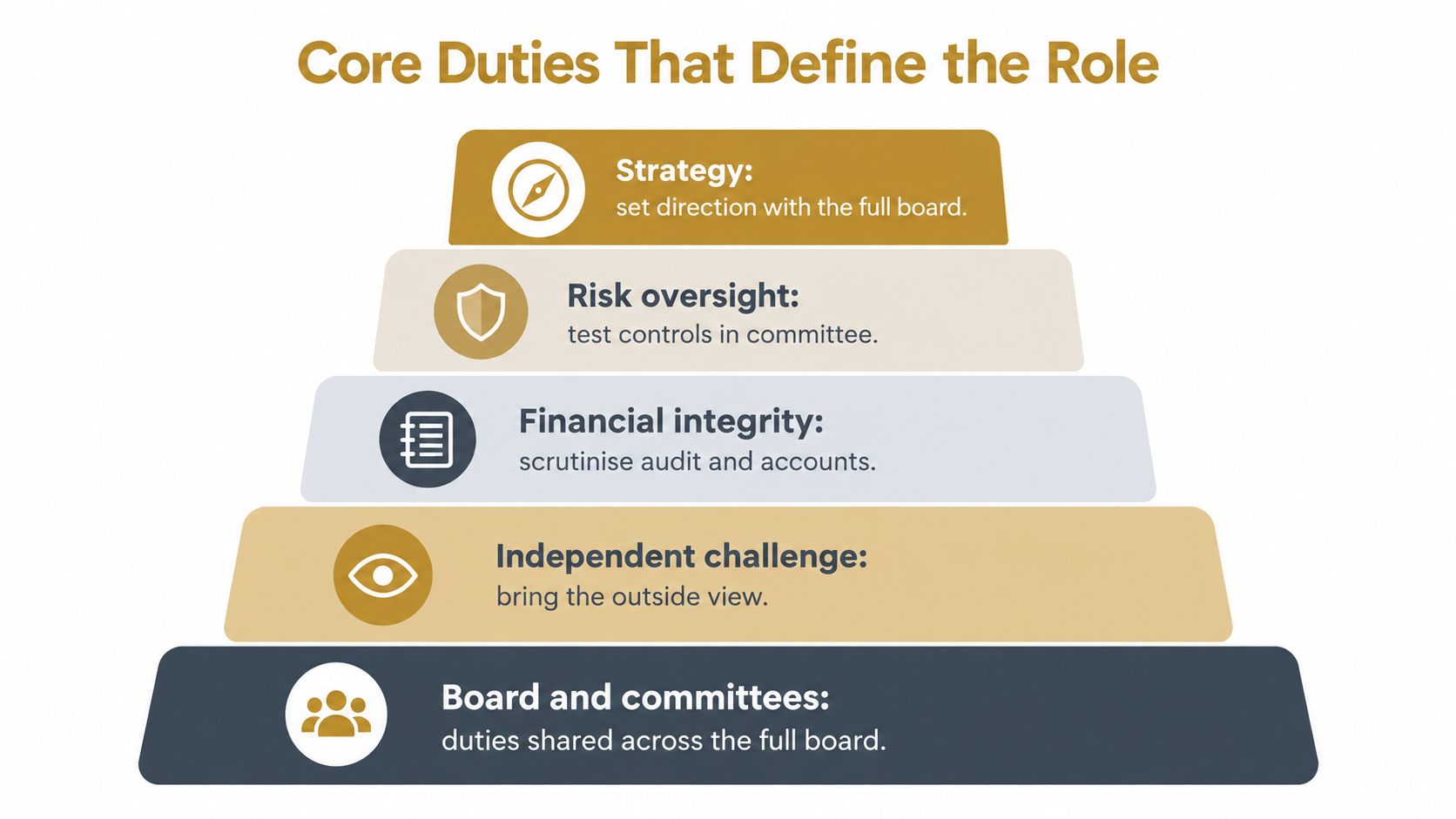
Duties sit with the full board, then get worked through in committees. Non-executives supply the independent view inside that shared work. Picture the job as a stack. Strategy is at the top. Succession is at the base. You don't own every layer alone, but you're expected to test each one.
The G20/OECD Principles of Corporate Governance 2023 say a board must be capable of objective, independent judgment. They tie that independence to three functions: monitoring management performance, preventing conflicts of interest, and balancing competing demands on the company. They also say a sufficient number of directors, and of key committee members, should be independent of management.
Where independent judgment is tested hardest
The same principles single out financial and other corporate reporting, related-party transactions, and the nomination and remuneration of directors and senior executives. Conflict-sensitive committees should meet a minimum independence threshold, or be made up entirely of independent members. In some jurisdictions an independent non-executive should chair them. After Enron and WorldCom, the US Sarbanes-Oxley Act of 2002 pushed listed audit committees toward fully independent membership, with at least one financial expert where the rules require it. That pattern spread through codes and investor expectations. Independence stopped being a courtesy title.
Here's how the stack usually splits in practice.
Strategy. The full board sets direction. You challenge the plan executives propose, including the assumptions they hope nobody opens.
Performance. The board monitors results against agreed targets. You ask why a miss is a one-off and not a pattern.
Risk and controls. A risk committee, where one exists, tests whether controls match the risks the strategy creates.
Financial integrity. The audit committee protects the reporting. A member might ask why revenue recognition changed before the external auditor had given a view, and why the minutes don't record the debate. That question is the job.
Pay. The remuneration committee sets executive reward so incentives don't fight the strategy.
Succession and composition. The nomination committee shapes who joins, who chairs, and whether the board still has the skills the strategy needs.
Committee fit is a concrete test of suitability, not a generic badge. Which committee you can honestly serve is a qualifications question, covered later. Don't claim all six layers on a first application.
Independence Tests That Decide Who Qualifies
A title doesn't make you independent. Independence is a control. Under the UK Corporate Governance Code 2024, the board should identify which non-executives it considers independent and should assess relationships that could impair, or appear to impair, objective judgment. It should write down why. A perceived conflict can shake investor confidence even when no actual conflict exists.
The OECD assessment methodology puts the same idea as a practical test. Independent directors shouldn't be employed by the company or its affiliates, and shouldn't be closely tied through significant economic, family, or other links. Boards should place enough independent directors on reporting integrity, related-party review, and nomination and pay.
Look-back windows that catch hidden dependence
The UK indicators aren't vibes. They have clocks. The test is whether you still depend on the company, operationally, commercially, financially, or through pay, in the eyes of investors as well as in your own.
| Relationship | Look-back window | Why it matters |
|---|---|---|
| Employment by the company or group | Previous five years | Blurs the line between oversight and management |
| Material business relationship | Previous three years | Creates commercial dependence on the company |
| Pay beyond the director's fee | Current | Ties income to the company's results |
| Incentive scheme participation | Current | Creates a personal stake in short-term outcomes |
| Company pension scheme membership | Current | Creates a financial link to the company |
Walk the rows before you apply. Employment inside five years means you may still think like management. A material contract inside three years means the company is still a customer or a client. Extra pay, incentives, or a company pension means your personal finances move with results you're supposed to judge coolly.
Independence isn't fixed on day one. The ASX Corporate Governance Principles define an independent director as a non-executive free from any interest, position, or relationship that could materially influence, or reasonably be seen to influence, judgment and the duty to the entity as a whole. If those interests change, you tell the board or nomination committee at the earliest opportunity. The board reassesses each non-executive regularly. Disclosure and conflict monitoring stay live, especially on audit, risk, nomination, and remuneration committees.
Prepare a short independence note. Cover material relationships, prior employment, significant shareholdings, advisory work, and family or reciprocal board links. Then say how you would declare and manage a conflict. A former supplier executive who also holds shares should disclose both. The board then decides whether that person can sit on remuneration, or should leave the room when supplier terms are discussed.
If the note is hard to write, the seat is probably the wrong one, or the wrong committee.
A board readiness assessment is a useful private rehearsal for that note. It won't clear you. The board still has to.
How Much Time a Non-Executive Seat Really Takes
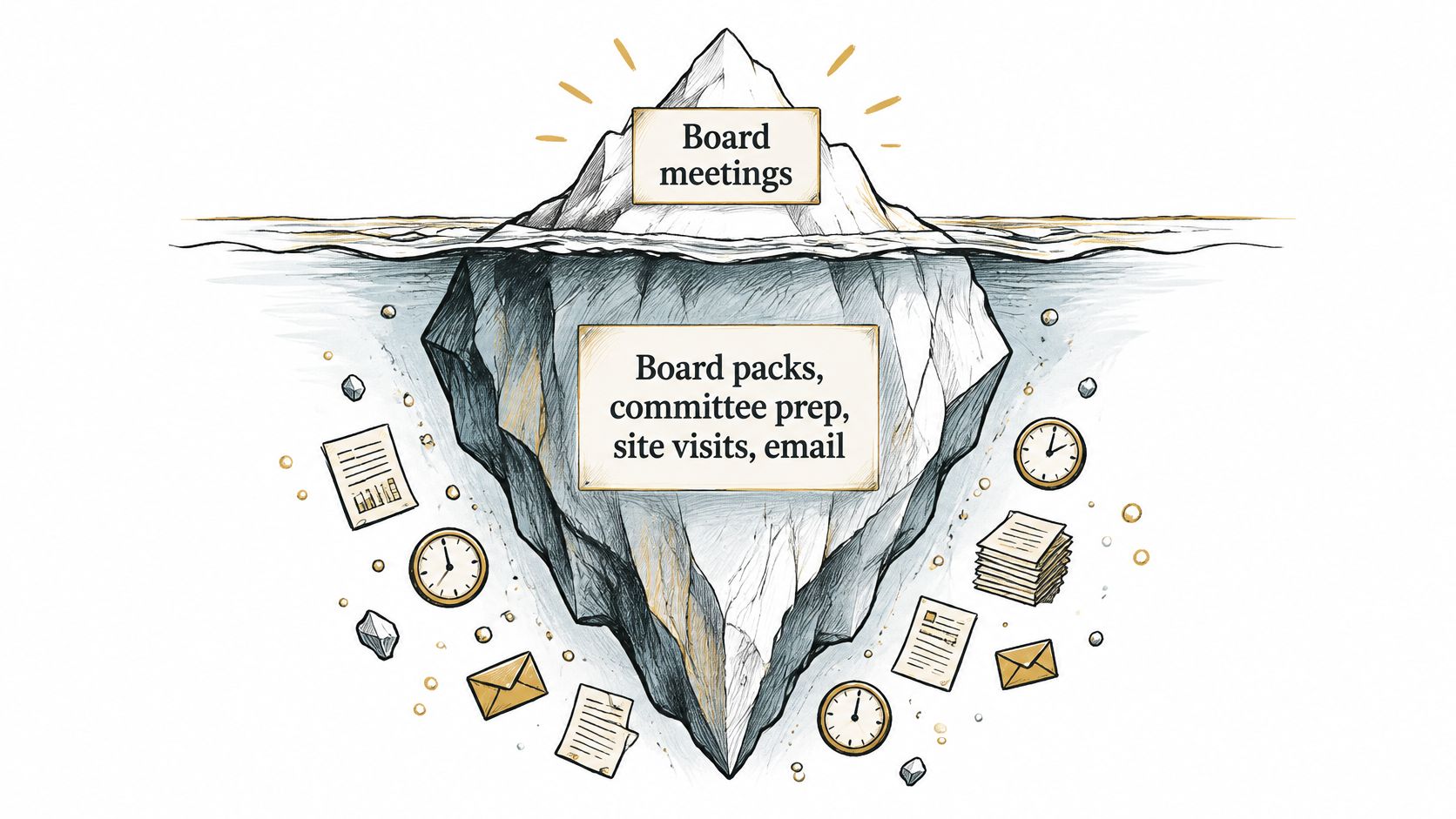
A first seat rarely fails because the board meets too often. It fails because the candidate prices the visible meetings and ignores the work that keeps them defensible: reading, checking, calling, travelling, thinking, and being reachable when the plan breaks.
What sits below the waterline
Directors in the UK and elsewhere often describe formal meetings as only part of the job, with a large share of the contribution happening between them. Reported workloads have also drifted upward as reporting, cyber risk, regulation, and stakeholder pressure have grown. Treat any neat annual-hour figure as a starting point, not a quote you can rely on.
Board packs. The pre-reading sent before each meeting. You read the whole pack, including the appendix management hopes stays unread.
Committee preparation. Audit and risk packs can run longer than the main board pack, and the questions are narrower and harder.
People, not slides. One-to-ones with the chair, chief executive, auditors, and committee chairs are where concerns surface early.
Induction and places. Site visits, customer days, and travel rarely appear in the fee letter.
Filings and rules. Some duties cannot be delegated because your name sits on the board.
Crises. An investigation, cyber incident, refinancing, or leadership exit can compress weeks into days.
Independence has a time cost too. If your employer, clients, shareholdings, or family links touch the agenda, you may need to disclose, step out, or miss the decision entirely. A seat that looks light on paper can become heavy once recusals and conflict checks are counted.
Before you accept, ask plain questions. How many board and committee meetings does this seat carry? How many hours did the last incumbent log in a normal year and in a bad one? How often has this board faced a genuine crisis? What travel and induction are expected in year one? How many other boards do the chair and executives already serve?
Over-boarding means holding so many seats that challenge becomes polite because attention runs out. Count the hours you can truthfully give across every board, paid and unpaid, not the hours in the advert. A board time commitment calculator forces that sum onto one page before you say yes.
A short walk-through of how boards use the time between meetings is worth fifteen minutes before you negotiate a start date.
Qualifications Boards Look For in a Candidate
The first appointment has become harder, not easier, for people who only bring an operating biography. The 2025 UK Board Index reported that first-time non-executive appointments fell to 21%, down from 44% in 2022. Among newly appointed chairs and non-executives, 74% had portfolio careers and 68% already held another listed-company directorship. Networking and a strong executive CV aren't useless. They're no longer enough in many listed processes, because boards are hiring people who already know how a board argues.
What can stand in for a prior seat
You can still build a verifiable case without pretending you've chaired a listed audit committee. Separate four kinds of experience on the CV so nothing is overstated. Executive work is running the business. Advisory work is a view without the vote. Nonprofit or trustee work is governance, often unpaid, with its own duties. Fiduciary board work is the office you're now seeking. Don't let one heading blur into another.
Baseline expectations still apply on almost every board. Sound judgment and integrity. A calendar that matches the actual hours. Financial literacy sufficient to read accounts and ask about them. A working sense of board dynamics, including when to press and when to stop. Formal governance education, such as a director-institute course, helps you show you've studied the office rather than only the industry.
The same Board Index captured a skills gap you can use without overstating your case. 45% of directors said their boards spend too little time on innovation, 42% said the same about cybersecurity, and only about 40% were confident management had the skills and resources to address those areas. A narrow, checkable contribution in technology, cyber, audit, or risk is more credible than a generic "strategic leader" pitch.
| Board or committee | Expertise boards look for | Evidence to show |
|---|---|---|
| Audit committee | Financial reporting, internal controls, audit oversight | Finance or audit background and financial-expert status where the listing rules require it |
| Risk committee | Enterprise risk, cyber resilience, regulation | Risk-management roles and documented incident-response experience |
| Remuneration committee | Pay design, incentives, talent retention | Reward design or compensation leadership with measurable results |
| Nomination committee | Succession, board composition, diversity | Board-succession work or nominee evaluation experience |
| Nonprofit or public-sector board | Mission oversight, funding, stakeholder duties | Trustee or governance service with sector leadership |
| Technology or cyber seat | Technology strategy, cyber resilience | A verifiable security or digital leadership record |
Match one row, not all six. A board CV grader will show whether a reader can see that match in the first half page, or whether the document still reads like an executive biography with a new heading.
Three Board Seats Showing the Role in Action
These three seats are hypothetical. Each one turns on a check, not on charm.

Elena and a recent audit client
Elena, a former external audit partner, is offered an audit committee seat at a listed company her old firm audited until recently. The problem is the look-back, not her technical skill. The nomination committee tests prior employment and business-relationship clocks. She writes an independence note, discloses the history, and explains how she would leave the room on audit-firm matters. The board then decides whether the seat can be called independent. Skill doesn't override the clock.
Tom and a diary that breaks
Tom is a sitting chief executive with two listed boards already, and a third invitation arrives. A cyber incident at his day job wipes out two weeks. He can't get answers back to the chair in time. The check is capacity, not status. He declines the listed seat, totals his real commitments, and offers to take a smaller nonprofit seat he can actually serve. Superficial challenge would have been worse than a polite no.
Priya and a first paid board
Priya runs a foundation and wants a paid seat on a healthcare company board. She has no listed history, so a generic leadership story would fail the experience test. She builds the case around clinical risk oversight, incident governance training, and a director certificate. She asks the chair what the risk committee is worried about this year, then answers only that. The decision, if it comes, rests on a narrow fit she can prove.
Confirm the Seat Fits Before You Say Yes
Accepting a board seat works like signing a commercial lease: the offer looks settled long before you have priced what it will cost you. Say yes only when independence, time, committee fit, and portfolio capacity are confirmed in writing. If the seat needs hours you cannot give, or your relationships would force you out of the room at every meeting, decline or defer. A flattering invitation from the chair is not a control.
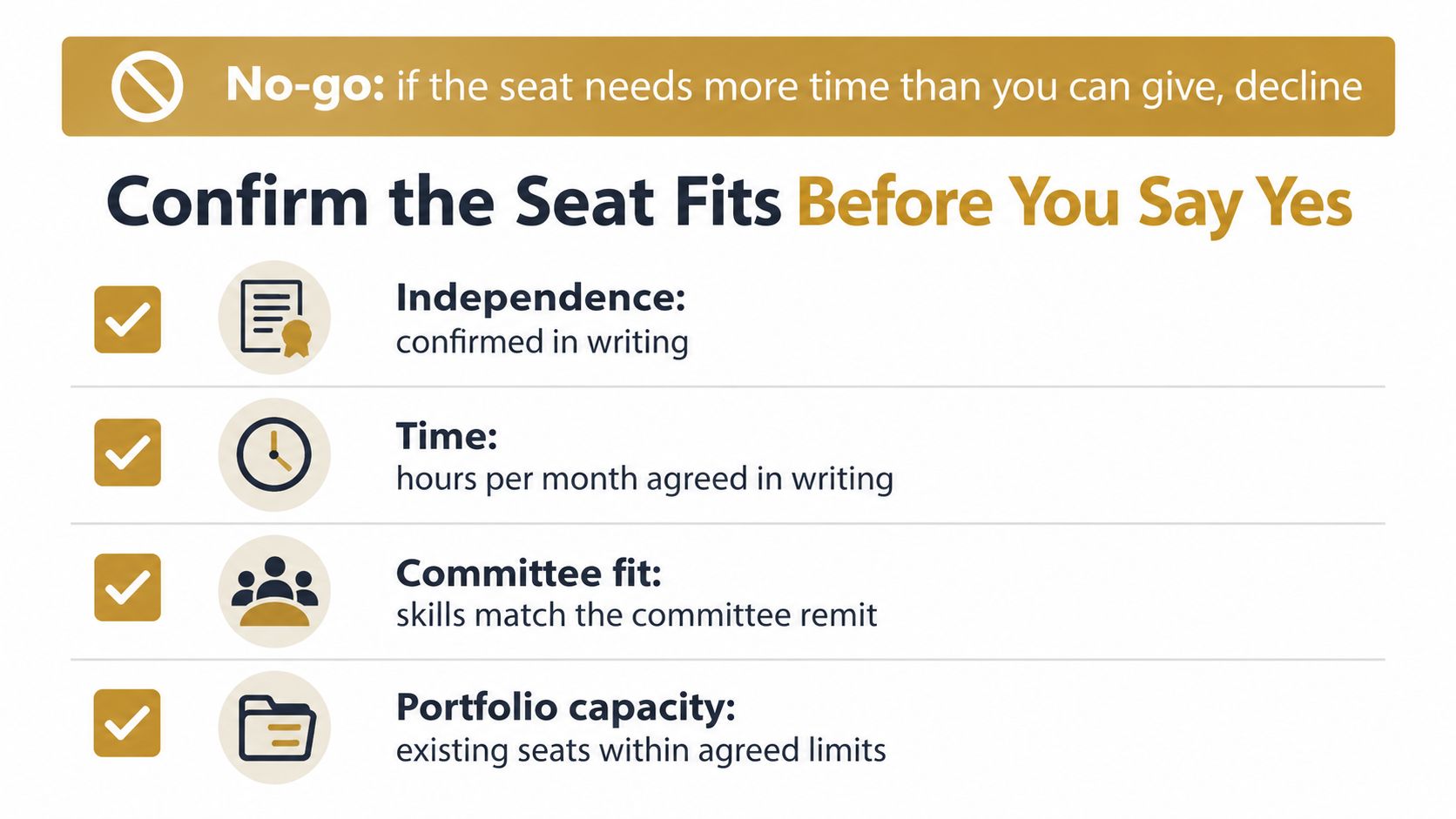
The earlier sections covered the judgment calls: who counts as independent, where the hidden hours sit, and how boards test candidates. This pass is the paperwork those judgments leave behind. Seven items deserve a written answer, because verbal assurances evaporate the moment a dispute starts.
- Independence, in writing. Your disclosure matches the tests, and the board's reasoning is recorded rather than implied.
- Time, against the working calendar. Meetings, committees, travel, and crisis expectations, measured against your real diary rather than the brochure average.
- Committee fit. Your evidence matches that committee's remit. A general claim of board readiness answers the wrong question.
- Fee, shares, and expenses. Know what is fixed, what is equity, and what you pay out of your own pocket to attend.
- Insurance and indemnity. Directors' and officers' cover, plus any gap between the policy and your personal risk.
- Charter and minutes. Read how this board argues in practice. The charter only states how it should.
- The people who appoint. Meet the chair and the nomination committee before you treat the seat as agreed.
One confusion worth clearing up: asking for these documents is due diligence, and boards expect it. A candidate who requests minutes and insurance certificates reads as careful, not difficult. A board offer due diligence checklist keeps those seven items from living only in your head.
SeatSignal's Done-For-You Board Placement covers the sourcing and paperwork side of this stage. The team hand-picks relevant open board roles, prepares a director-grade packet for each (a CV, a cover letter tied to the board charter and its gap, a fit memo, and an independence note), and provides board-specific interview preparation. You send every approach in your own name. SeatSignal does not apply for you, does not represent you to boards, and does not guarantee a seat, because appointment decisions sit with boards, nomination committees, and recruiters. The program carries a refund policy and a results disclaimer for that reason.
Draft the independence note and the time audit before you approach anyone. If either document looks thin, you are early enough to walk away clean. When you want a specific offer tested against your relationships and your real calendar, SeatSignal can prepare the papers while you make the call.
Want a paid board role, done for you?
One handpicked, verified open board role every week, with a director-grade packet tailored for it.
Get Started