Role of a Non Executive Chairperson: Duties Explained
The most repeated advice on board leadership is simple. Split the chair from the chief executive and oversight will follow. That advice is only half right. A non executive chairperson leads the board without running the business, but the title does not prove independence, and it does not prove the chair can change what the board sees, debates, or decides. The value sits in a written boundary, the skills used in the room, and evidence that ties do not steer the agenda.
Table of Contents
- Non-Executive vs Executive Chair Side by Side
- What a Non-Executive Chairperson Is Responsible For
- What Authority a Non-Executive Chairperson Holds
- Skills a Non-Executive Chairperson Needs
- Chair Structures and Independence Today
- How to Measure Whether the Chair Is Adding Value
- Three Boardroom Cases Where the Chair Role Changes
- Confirm the Chair Mandate Before You Accept a Seat
Non-Executive vs Executive Chair Side by Side
A non executive chairperson is a board leader who does not hold an executive management role. That person runs the boardroom, not the business, much as a conductor shapes a performance without playing an instrument.
The UK Corporate Governance Code 2018 treats the chair as the person responsible for the board's overall effectiveness. Non-executive directors supply independent challenge, strategic guidance, specialist advice, and accountability over management. The chair should show objective judgment, promote openness and debate, help directors work constructively, and see that members receive accurate, timely, and clear information. The split is meant to reduce the risk that a chief executive or management team dominates decisions. Non-executive directors also have a principal role in appointing and removing executive directors and in scrutinizing performance against agreed objectives. The chair is no longer only the person who opens the meeting.
| Feature | Non-executive chair | Executive chair | Combined CEO and chair |
|---|---|---|---|
| Part of management | No | Yes, holds a management role | Yes, runs the company |
| Main job | Board effectiveness, challenge and oversight | Board leadership plus management duties | Board leadership plus running the business |
| Involved in daily operations | No | Yes | Yes |
| Independence from management | Can be independent if tests are met | Generally not independent | Not independent |
| Typical concern | Whether independence is genuine | Blurred line between board and management | Concentration of power and information control |
The first row is the one people misread. Non-executive answers whether the chair sits inside management. Independence is a separate test, covered later. A former chief executive can be non-executive and still fail independence.
Say the board is weighing a large acquisition. A non-executive chair keeps time for challenge and does not brief the deal team. An executive chair may both steer the debate and shape the transaction. A combined chief executive and chair presents the deal and then chairs the vote on it.
A one-minute check works on almost any company. Find the chair in the board of directors positions listing, confirm whether that person is an employee, and see whether the company publishes a written chair role description.
What a Non-Executive Chairperson Is Responsible For
Five areas connect the job. None of them is "run the company."
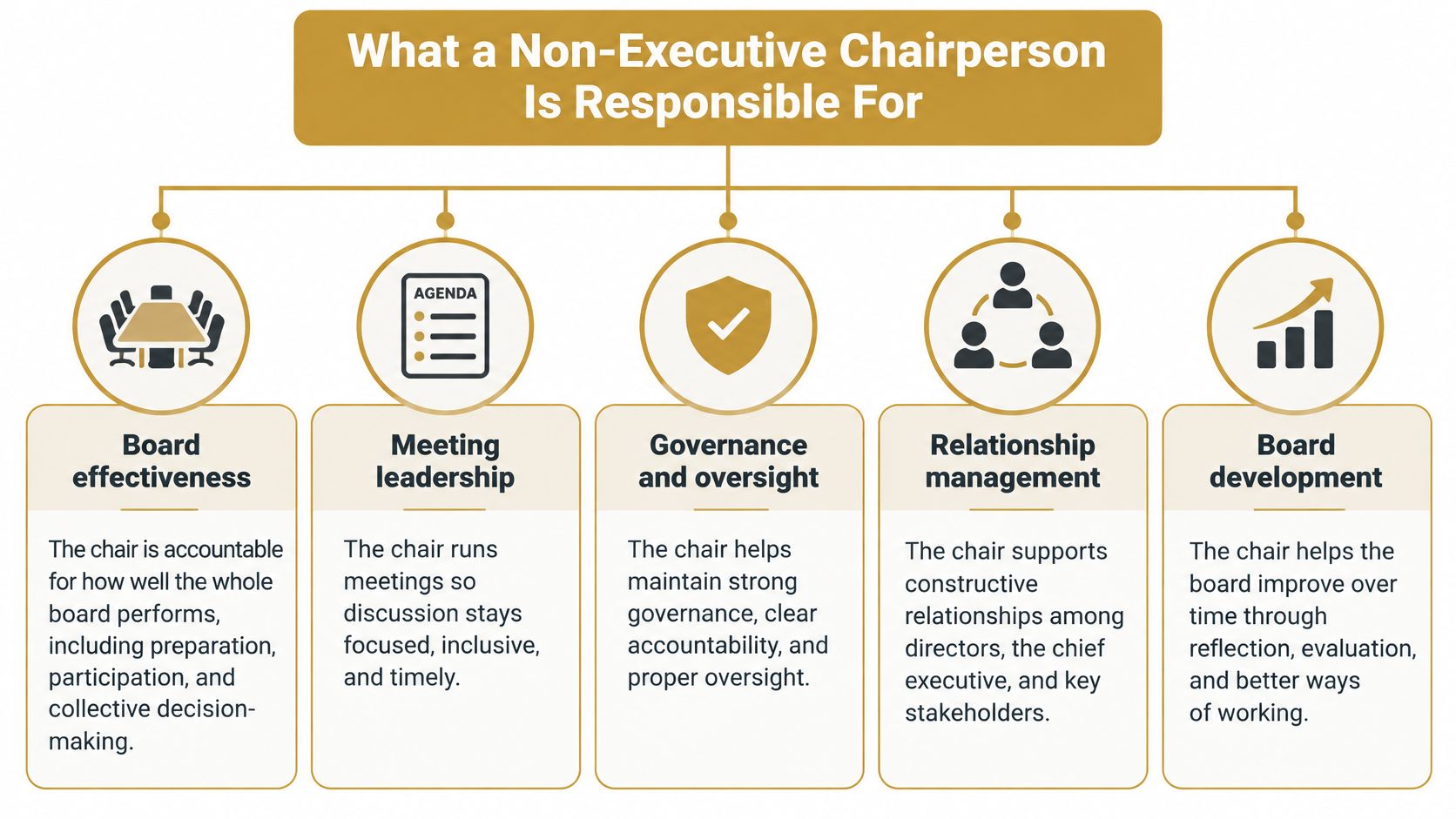
Board effectiveness
The chair is accountable for how well the whole board performs. Under the CMA board rules published by the UK government, that includes an annual board-effectiveness review, independent input at least every three years, and action on the findings. Ask before you accept a mandate: when was the last review, and which findings are still open?
Information
Directors can't challenge what they never receive. The same rules require the chair to see that members get accurate, timely, and sufficiently detailed information. Ask who can delay a paper, and what happens when a pack arrives the night before.
Meeting discipline
The chair sets the agenda, keeps debate open, and protects time for strategy rather than a tour of last quarter's slides. Financial Conduct Authority guidance expects members to attend, contribute, vote, and monitor performance reporting, and it expects the chairing function to help them get the information they need. Ask what share of the last three meetings was spent on decisions rather than updates.
A short walk-through of how chairs use that time is worth ten minutes before you read a role description.
People
The chair collates feedback on the chief executive's performance and reviews non-executive directors each year. Ask whether that feedback is written, and whether the chief executive sees it before the board does.
Oversight mechanics
The chair helps the board or committee meet often enough and makes sure members give the remit enough time, then leaves room for independent scrutiny of executive decisions. Ask how many meetings were added last year because the diary was too thin.
Practical rule: Read the written split among chair, chief executive, senior independent director, board, and committees before you talk about fees. If that document doesn't exist, the remit is still a conversation, not a job.
What Authority a Non-Executive Chairperson Holds
Authority is the set of decisions the chair can make, plus the limits that keep that person out of management.
Board-level control comes first. The chair leads meetings, shapes the agenda, and decides how time splits between challenge and reporting. That gives the chair influence. A weak agenda lets management narrate the quarter. A tight one forces a choice.
Information rights sit next to that. Making sure directors receive accurate, timely, and clear information is not clerical. It decides what the board is allowed to know before it votes.
People process is shared, not solo. The chair shapes how the board appoints, removes, and scrutinizes executive directors. The chair doesn't run the search, score the candidates alone, or deliver the termination.
Review closes the loop. The chair drives the annual effectiveness review and collects feedback on the chief executive. Those outputs only matter if the board acts on them.
The limits are just as sharp. The chair doesn't set operational strategy, direct staff, or take over executive decisions. The chief executive keeps executive authority. The UK Corporate Governance Code expects the chair to be independent on appointment, expects the chair and chief executive roles not to be held by the same individual, and expects a chief executive not to become chair of the same company. It also calls for written clarity on the responsibilities of the chair, chief executive, senior independent director, board, and committees.
Use one test. If a decision changes how the board works or what it knows, it sits with the chair. If it changes how the business runs, it belongs to management. The chair role description and the committee terms of reference are where those lines are drawn. Read both before you accept the seat.
Skills a Non-Executive Chairperson Needs
The title doesn't carry the skill. Five capabilities do, and a candidate should be able to point to evidence for each.
Objective judgment means separating evidence from advocacy when management presents a plan. The code expects that of the chair. A useful proof is a meeting where you asked for the assumption behind a forecast and the decision changed.
Facilitation is drawing out quieter directors, keeping debate open, and still reaching a decision in time. Directors rate board leaders highly when discussion is real and choices arrive on schedule. If every voice in your last board sounded like the chief executive, facilitation failed.
Relationship building keeps directors and the chief executive constructive without the chair sliding into management. You can coach the chief executive on how the board will hear a proposal. You shouldn't rewrite the proposal.
Information discipline is knowing what directors need, when, and in what form, then checking that it arrived. A late pack is a skill failure, not a diary problem.
Feedback and succession is the candid conversation most boards postpone. You should be able to describe a succession plan you helped design, including an emergency cover, not only a long list of external names.
A former chief executive often has the content knowledge and still lacks the restraint. The evidence boards should ask for is a changed decision, a reset agenda, or a succession plan, not a résumé of operational wins.
Before you pitch for the seat, run your evidence through a board readiness assessment and see which of the five you can show.
Chair Structures and Independence Today
Separation is mainstream in the United States. It is not the majority pattern, and "non-executive" is not the same word as "independent."
Among S&P 500 companies, the New York Stock Exchange's 2024 board-structure materials show that 39.8% had an independent chair in 2024, 41.2% kept a combined structure in which the current chief executive also served as chair, and 18.9% had a non-independent chair who was not the chief executive. The 2024 U.S. Board Index reported that independent chairs led 39% of U.S. public-company boards that year. In a 2024 survey of 101 U.S. public companies, Deloitte found that 16% had a non-executive chair, and that 23% of those companies had a formal description of the chair's role.
An independent chair meets the independence standards. A non-independent chair may sit outside management and still carry ties, often as a founder or former chief executive. A combined chair is the chief executive.
The Harvard Law School Forum on Corporate Governance reported that in 2025 more than 46% of Russell 3000 companies had an independent chair, while 20% had a chair who was non-independent but not the chief executive. In the S&P 500, independent chairs rose from 33% in 2020 to 39% in 2025, while chief-executive-and-chair arrangements still represented 42% of companies. 79% of S&P 500 companies that disclosed a policy in 2025 said the board kept flexibility to combine or separate the roles.
Nasdaq tests
Nasdaq listing standards require a majority-independent board and treat independence as a facts test, not a title.
| Situation | Effect on independence | Look-back period |
|---|---|---|
| Employed by the company as an employee or executive | Generally not independent | Within the previous three years |
| Immediate family member employed as an executive officer | Generally not independent | Within the previous three years |
| Someone residing in the director's home was an executive officer | Generally not independent | Within the previous three years |
| Served as interim chair, chief executive or other executive officer | Does not by itself disqualify | One year or less |
| Commercial, family or share-ownership ties not listed above | Board assesses case by case | No single look-back in the rule |
Boards that want the label to mean something should disclose tenure, prior employment, family and commercial ties, substantial share ownership, compensation, and informal influence. Separation alone doesn't guarantee oversight.
How to Measure Whether the Chair Is Adding Value
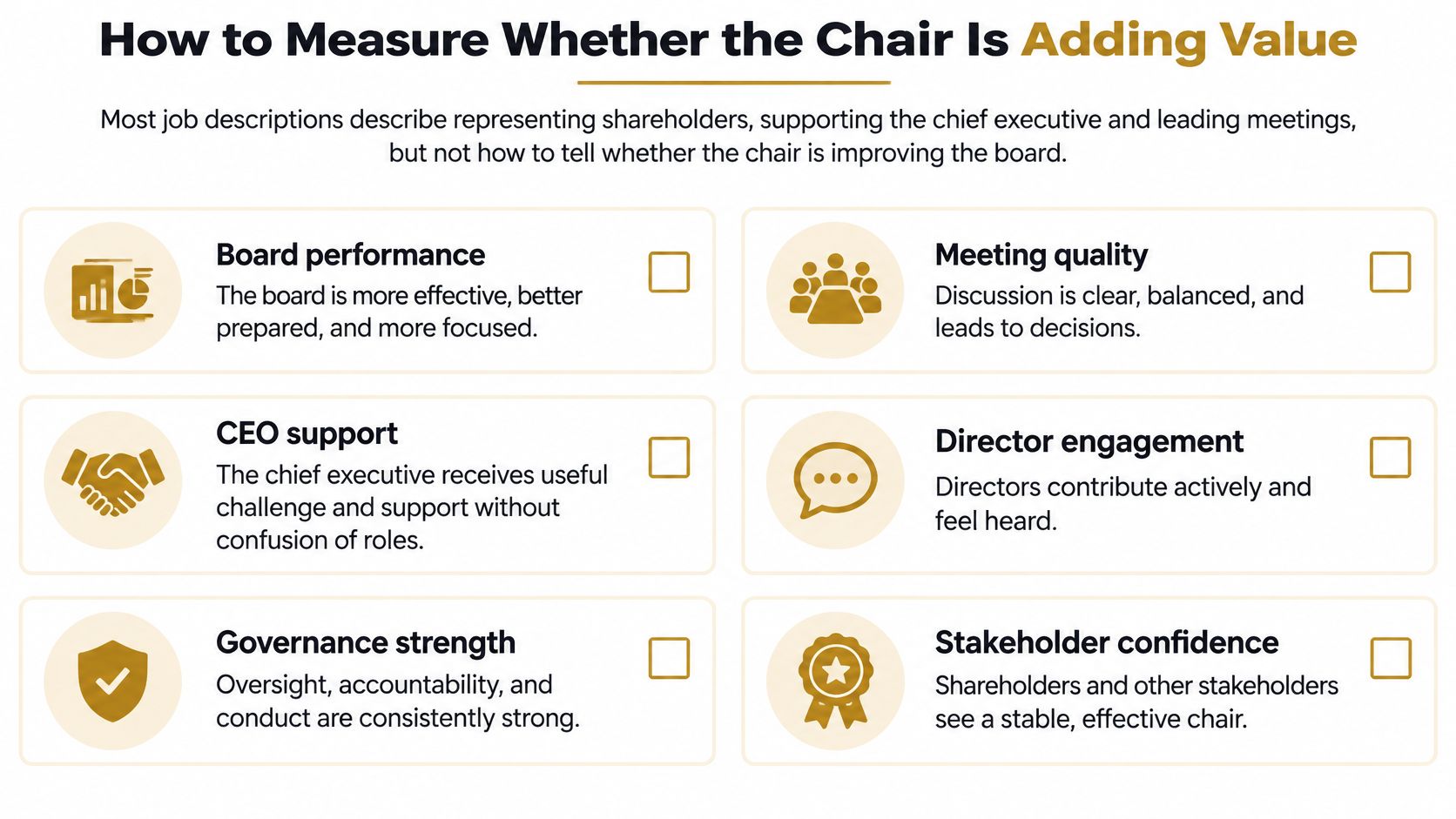
Most chair descriptions stop at three tasks: represent shareholders, support the chief executive, and lead meetings. None of those tells you whether challenge improved, papers arrived on time, or decisions got faster.
The 2026 U.S. Board Index highlights point to a sharper test. Directors at top-performing boards are significantly more likely to say their board leader fosters high-quality discussion and enables timely decisions. Succession is the weak spot: only 52% of board directors in a global leadership-monitoring study were confident their boards could design a successful C-suite succession strategy.
A checklist you can apply
- Agenda quality and inclusiveness. Several directors shape items, not only the chief executive.
- Time on strategy versus reporting. The minutes show decisions, not a slide tour.
- Documented challenge. A management assumption was tested and the record shows the result.
- Emergency succession readiness. A named cover exists and has been rehearsed.
- Committee coordination. The chair knows what audit, remuneration, and nomination will bring back.
- Director onboarding. A new director can explain the board's open issues within a month.
- Follow-through on evaluations. Last year's findings have owners and dates.
First 100 days, then year one
In the first 100 days a new chair should show an agenda reset and an information audit: what arrives, who writes it, and what is missing. By the end of year one the board should have finished an evaluation cycle and tested a succession plan, including the emergency cover.
A former chief executive or founder in the chair can steady a transition. The same continuity can soften challenge. Score the seven indicators against that risk, not against the person's reputation. A board time commitment calculator helps you see whether the diary can support that work.
Three Boardroom Cases Where the Chair Role Changes
The same title behaves differently once the boundary changes. Three plain cases show how.
The listed company that splits the roles
A listed company has one person as both chief executive and chair. Investors question whether anyone is really overseeing management. The board commissions an independent review, then appoints a non-executive chair with a written mandate that lists agenda rights, information rights, and what the chief executive still owns.
The appointment is the easy part. The written boundary is what stops the old habit, where the chief executive still sets the papers. A candidate should ask what the written split of responsibilities says.
The founder who stays in the room
A founder steps out of the chief executive job and becomes non-executive chair. Continuity helps customers and the new chief executive during the handover. It also creates a second, informal chain of command if directors still clear ideas with the founder before the meeting.
The board has to keep a clear route from the new chief executive onto the agenda. The question to ask is who controls that agenda when the founder disagrees.
The combined roles with a lead director
A company keeps the roles combined and appoints a strong independent lead director who can convene sessions of the outside directors. The OECD principles of corporate governance treat separation of chair and chief executive as good practice because it can improve the balance of power and accountability. Where the roles stay combined, an independent lead director with authority to convene or chair outside-director sessions is a possible structural substitute. It is not proof that independence exists.
Ask how the board reviews the chair, and whether that lead director's authority is written down. A board role fit checklist is a practical way to test the fit before you say yes.
The same title can be a real check on management or a courtesy seat. The boundary and the evidence decide which one you are joining.
Confirm the Chair Mandate Before You Accept a Seat
The decision is whether to accept a non-executive chair seat, or to walk away from a company whose chair role is still vague. Five checks settle it.
- Read the written chair role description and confirm where the chair's remit stops and the chief executive's begins.
- Apply the independence tests and ask the board for the disclosure list of ties, tenure, pay, and share ownership.
- Ask how the board evaluates the chair, and whether that review includes independent input.
- Confirm meeting frequency, the expected time, and the committees you would lead.
- Ask who sets the agenda and how information reaches directors before meetings.
If those answers are thin, the seat is not ready. For candidates who want a cleaner route in, the practical next step is a director-grade packet, a read on the board's composition gaps, and interview practice against the questions that chair is likely to ask. We are the only DFY board placement program that hand-picks ideal board matches, drafts director-grade CVs for each role, and trains you specifically for each interview to ensure you land the seat. SeatSignal is not a search firm and doesn't negotiate or send approaches for you. You send every approach in your own name, with a packet that includes a CV, a cover letter, a fit memo, and an independence note, aimed through a name rather than a cold letter. Use a board offer due diligence checklist before you sign.
If you are weighing a non-executive chair seat, SeatSignal hand-picks board roles, prepares a director-grade packet for each one, and rehearses you for that board's questions so the written mandate and the independence tests are clear before you accept. Start with the role in front of you and see how the boundary is drawn. Visit SeatSignal when you are ready to pursue the seat in your own name.
Want a paid board role, done for you?
One handpicked, verified open board role every week, with a director-grade packet tailored for it.
Get Started