How to Find Non Executive Directors Vacancies That Fit You

You've updated your CV, signed up for board alerts, and applied for roles that look well within your experience. Then nothing. The listings are thin, the feedback is thinner, and people with less impressive operating careers seem to know about opportunities you never saw.
The mistake is assuming that finding a paid board seat works like finding another executive job. Searching for non executive directors vacancies is an intelligence exercise before it's an application exercise. You need to know which boards have a genuine opening, which might develop one, and why the people making the appointment should consider you.
Table of Contents
- The Vacancy Arithmetic Behind Board Appointments
- Why Most Non Executive Directors Vacancies Never Get Advertised
- The Advertised Routes and How to Use Them Properly
- The Relationship-Led Search as a Real Discipline
- Reading the Opening Before You Apply
- Independence, Committees, and the Rules That Filter You Out
- Running a Stage-Gated Search and Application Pipeline
The Vacancy Arithmetic Behind Board Appointments
The vacancy arithmetic should change how you search. According to this analysis of Spencer Stuart's 2024 U.S. Board Index, the index recorded 406 new independent directors, averaging 0.83 per board; 58% of S&P 500 companies appointed someone, 42% didn't, and annual director turnover has stayed around 7% to 8% for 25 years.
That is fewer than one new independent director per board in the year studied. Scanning more job boards won't manufacture vacancies where incumbents remain in place.
Historical evidence points in the same direction. A Conference Board and ESGAUGE analysis covering 2,854 companies found that 50% of Russell 3000 companies and 43% of S&P 500 companies disclosed no board-composition change in 2018, while director tenure often reached 10 years or longer, as reported in Harvard's corporate-governance review.
Think in seats, not applications
An operating career trains you to measure a search through applications submitted and interviews secured. That metric misleads here. I recommend a different starting point: identify boards where you can explain a specific governance need, then work out whether the opening is confirmed or merely forecast.
For each target, establish:
- The potential opening: Is someone leaving, or are you inferring that a change might happen?
- The contribution required: What decision, risk, or committee responsibility would justify your appointment?
- The route to consideration: Who can credibly assess your suitability and introduce you to the relevant decision-maker?
- The evidence gap: What would stop the board from putting you on its shortlist?
Practical rule: Don't count a company as an opportunity until you can explain why it might need a director with your evidence.
Treat the illustration below as directional only.
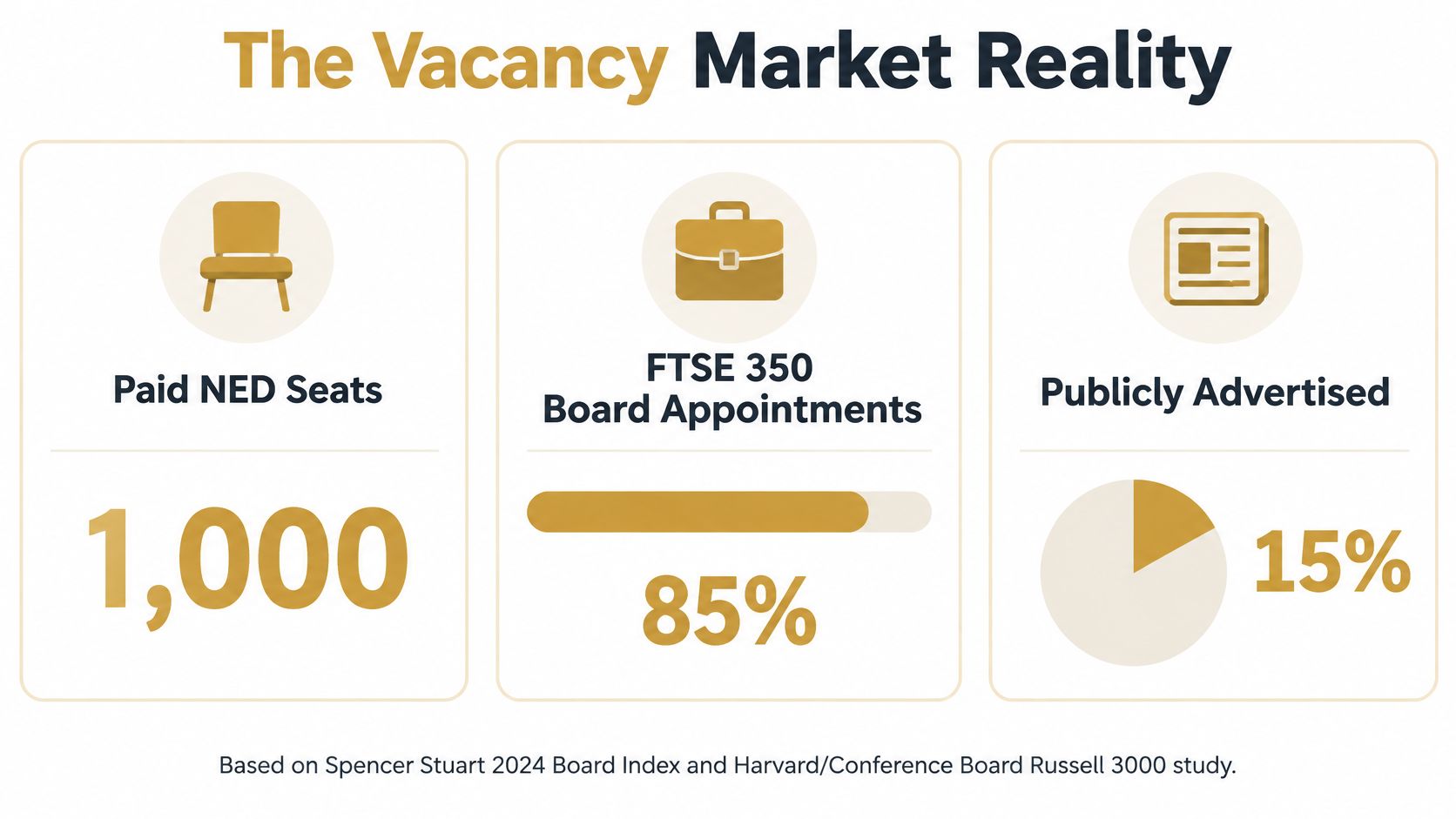
The numerical claims inside this graphic aren't substantiated by the cited studies. Don't use them to estimate the size of the paid NED market or the proportion advertised; the cited U.S. research establishes low turnover, not those advertising figures.
A disciplined search can still be ambitious. Ambition here means better intelligence, sharper positioning, and sustained pursuit of suitable seats, not indiscriminate submissions. Confirm the remuneration basis early. If your objective is a paid appointment, don't leave that requirement unstated until the final conversation.
Why Most Non Executive Directors Vacancies Never Get Advertised
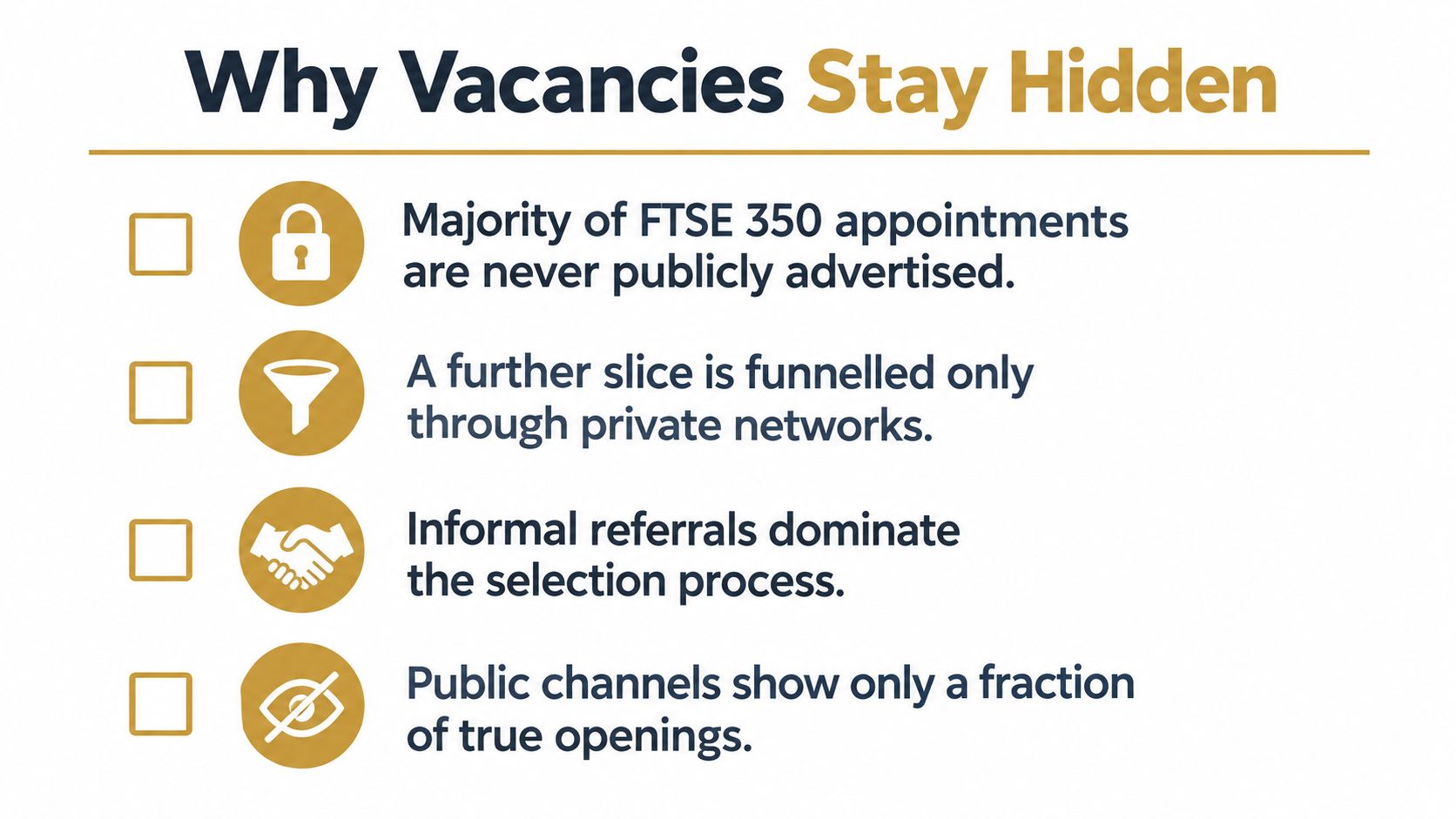
Your public-search results aren't a complete inventory of board opportunities. An Equality and Human Rights Commission review found that 55% of FTSE 350 companies didn't advertise board appointments, 29% publicised them only through executive-search firms, and 6% relied only on personal networks, according to its review of FTSE 350 appointment practices.
Those findings describe the population and period reviewed, not every board appointment today. Nevertheless, they explain why an advertised-only approach is structurally incomplete.
A nomination committee can explore succession with a search consultant or trusted directors before deciding whether to run a public process. Your task is to become relevant to that discussion without pretending a preliminary conversation means a seat is available.
Run separate confirmed and forecast tracks
Track A covers confirmed vacancies: a published brief, an announced departure with an acknowledged replacement process, or direct confirmation from someone authorised to discuss the search. Record the evidence, date, decision-maker, requirements, and application route.
Track B covers forecast openings: potential retirements, succession pressure, committee changes, or strategic developments that could prompt a board review. Record the hypothesis, supporting evidence, confidence assessment, likely timing window, and what would confirm or disprove it.
Don't turn an ageing biography into an invented retirement date. Don't call a possible committee reshuffle an active mandate.
The visibility problem is summarised below, although the graphic's claim that informal referrals dominate should be read as an illustration rather than a separately established finding.
Search firms belong in this system, but they aren't your personal placement agents. Use this comparison with executive-search firms to distinguish a board's recruitment mandate from candidate-side search support.
Maintain a year-round signal checklist:
- Departure disclosures: Announced resignations, retirements, or decisions not to seek re-election.
- Tenure and succession language: Evidence of refreshment planning, without assuming tenure alone triggers departure.
- Committee movement: Chair transitions, membership changes, or an unresolved capability gap.
- Strategic developments: Acquisitions, geographic expansion, restructuring, or a changed risk profile.
- Regulatory developments: Changes that warrant checking the board's composition and eligibility requirements.
The useful output isn't a longer company list. It's a set of testable vacancy hypotheses with an accountable next action.
The Advertised Routes and How to Use Them Properly
Keep the formal channels running. They provide dated briefs, explicit criteria, and an application route you can verify. They should be your baseline monitoring activity, not your entire board-search strategy.
Organise the channel stack so you can distinguish a genuine new opening from the same listing appearing repeatedly.

Match each channel to a task
| Channel | Use it for | Practical action |
|---|---|---|
| Executive-search firm alerts | Finding published mandates that fit your sector or committee experience | Send a concise governance proposition tied to the actual brief |
| Dedicated board portals | Monitoring structured role listings | Save searches by geography, sector, remuneration, and committee |
| UK Public Appointments website | Finding public-board competitions with stated criteria | Download the full candidate pack before drafting |
| Investor-relations pages | Checking official appointments and departures | Monitor governance announcements, not just financial releases |
| Annual reports | Understanding succession and committee composition | Compare current disclosures with the previous report |
| Proxy statements and charters | Researching director backgrounds and committee requirements | Read biographies alongside the relevant committee charter |
Don't expect the same response from each channel. A formal competition may provide an acknowledgement and outcome, whereas an exploratory note to a search consultant may produce no reply. An investor-relations announcement is intelligence, not an invitation to apply.
For portals, evaluate the workflow rather than assuming access equals suitability. A comparison with Nurole can help you separate listing access from application preparation and broader search support.
Read the documents behind the listing
A role headline rarely tells you enough. Look for the expected committee assignment, essential qualifications, location requirements, application deadline, and remuneration basis before investing in a supporting statement.
The SEC's discussion of corporate responsibility and audit committees explains why proxy disclosures and committee charters are useful research material: they reveal independence, financial-expertise, and governance expectations. Use those documents to investigate fit, not to infer a retirement that nobody has announced.
- Check provenance: Prefer the company's original brief over a reposted summary.
- Check freshness: Record when you last verified that applications remained open.
- Check completeness: Retrieve the candidate pack and committee responsibilities.
- Check ownership: Identify who handles clarification questions and submissions.
Apply when you can evidence the requirements. Don't submit merely because the company name appeals to you or the title sounds appropriately senior.
The Relationship-Led Search as a Real Discipline
“Network more” is poor advice. It gives you activity without a purpose. Your objective is to build a credible route to a particular board through people who understand its governance needs.
The experience barrier is real: 74% of seats filled in the 2025 U.S. appointment data went to people with prior public-company board experience, while PwC discusses boards' reliance on existing networks in its 2025 Annual Corporate Directors Survey. First-time candidates need a way for decision-makers to assess their judgment beyond an executive résumé.
Use a relationship map to make that assessment possible.
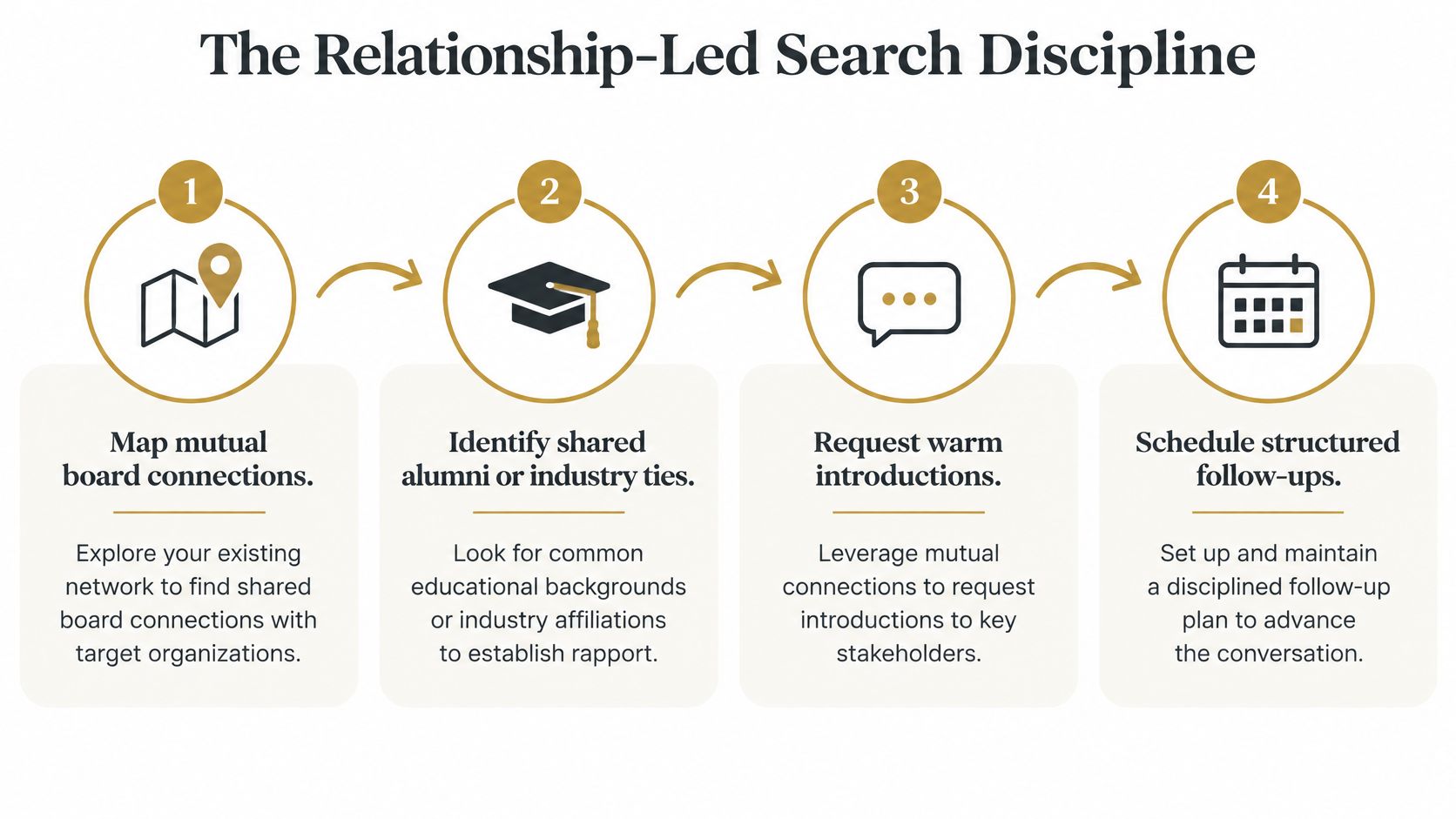
Find people who can assess your contribution
Start with mutual board connections, shared employers, alumni relationships, professional associations, and industry ties. Prioritise someone who has observed your judgment or understands the relevant committee, not someone with an impressive address book.
An audit-committee member can help test whether your controls experience translates into oversight credibility. A remuneration-committee veteran can challenge whether your executive-pay experience extends beyond negotiating your own package.
Ask for insight before asking for an introduction. A draft message could read:
I'm assessing whether my experience overseeing integration risk would be relevant to this board's current priorities. You know the sector and its governance challenges. Would you be willing to challenge my assessment before I approach anyone involved in succession?
That's an original outreach template, not a testimonial. Personalise it with evidence you can discuss without breaching confidentiality.
After the conversation, send a concise summary of what you learned and the contribution you could make. If the fit survives scrutiny, ask whether your contact would feel comfortable introducing you to the nomination chair or relevant committee member.
Make follow-up useful
Don't send repeated availability reminders. Follow up when you have a substantive reason: a relevant disclosure, a clarified governance proposition, or an agreed next step.
Choose events for the conversations they enable:
- Audit and risk briefings: Test your understanding of oversight priorities.
- Remuneration discussions: Explore incentives, succession, and executive accountability.
- Sector governance roundtables: Meet directors dealing with challenges you understand.
- Director-development sessions: Strengthen fiduciary knowledge and learn from board practitioners.
The accompanying video offers another perspective on building a board-search approach.
Relationships don't remove eligibility tests or guarantee selection. They create a route for someone to examine your suitability. That distinction keeps your outreach credible and prevents introductions from becoming demands for favours.
Reading the Opening Before You Apply
A planned succession seat isn't the same proposition as a specialist committee vacancy. Treating them alike produces generic applications and weak interviews.
The useful question is what problem the board is appointing someone to oversee, not which fashionable skills you can add to your profile. In NACD's 2025 survey, 67% of respondents said their board was more likely to seek specific expertise than general business leadership, and 42% identified industry-specific expertise, according to its analysis of board balancing acts.
Compare the opening types
| Opening type | What to investigate | Evidence to emphasise |
|---|---|---|
| Planned succession | Which responsibilities the departing director carries | Continuity of oversight, relevant judgment, and readiness for committee work |
| Term-driven refreshment | Whether the board is replacing an incumbent or changing its capability mix | A perspective that addresses the stated refreshment objective |
| Strategic board expansion | Why the proposed strategy warrants additional board capability | Oversight of comparable strategic decisions and their downside risks |
| Committee-specific gap | The committee's formal requirements and immediate priorities | Directly relevant expertise, independence, and eligibility |
For planned succession, ask what the board wants to preserve. For refreshment, ask what it wants to change. Expansion requires a convincing explanation of why your experience matters to the strategic transition, while a committee gap demands closer examination of formal credentials.
Competition and timing will depend on the actual process. Don't assume an expansion seat is easier or that a succession process begins only after a departure announcement.
Translate operating achievements into governance evidence
A technology executive might describe delivering a transformation programme. A board-ready account explains how they assessed investment assumptions, challenged dependencies, escalated risks, and recognised when management needed independent assurance.
A finance leader shouldn't stop at having managed reporting. They should explain how they evaluated controls, handled uncomfortable findings, and distinguished management confidence from reliable evidence.
Your strongest application explains how you judge decisions, not just how you deliver them.
For an AI-related opening, establish whether the board wants deep technical credentials or broader oversight capability. The latter still requires credible questions about data, implementation, regulation, accountability, and strategic trade-offs. Adding “AI” to your biography doesn't establish any of that.
Use the board role fit checklist to connect each essential requirement with a verifiable example. Where your evidence is adjacent rather than direct, say so and explain the transfer. Where an essential requirement is missing, don't disguise the gap with seniority.
Independence, Committees, and the Rules That Filter You Out
Check eligibility before polishing your application. A board may value your experience and still be unable to appoint you to the seat it needs to fill.
For companies applying the UK Corporate Governance Code 2024, at least half the board, excluding the chair, should comprise independent non-executive directors, and companies should identify which NEDs they consider independent in their annual reports, according to the Financial Reporting Council's Code. Read the company's own disclosures rather than assuming that a non-executive title establishes independence.
Governance Tests That Quietly Filter NED Applicants
| Governance Source | Core Rule | Evidence You Must Show |
|---|---|---|
| UK Corporate Governance Code | Board balance and disclosed independence assessment | Relevant employment, commercial, personal, and other relationships |
| Applicable exchange and securities requirements | Audit-committee independence and financial competence | Financial literacy, qualifying experience, and a complete interests declaration |
| Company committee charter | Company-specific membership and appointment conditions | Eligibility against the charter and evidence relevant to the committee |
| Published role specification | Essential role-specific restrictions | Any required domicile, availability, credentials, and absence of disqualifying conflicts |
For a Nasdaq audit-committee vacancy, the stated requirements include at least three independent members, financial-statement literacy, and no participation in preparing the company's financial statements during the previous three years; separate independence restrictions address advisory compensation and affiliation, as set out in the SEC-hosted governance requirements exhibit.
Don't confuse financial literacy with specialist accounting expertise. Determine what this particular committee needs and whether the board must designate someone with additional financial-expert credentials.
Read the approval mechanism
A vacancy isn't yours to claim because you meet the headline criteria. A public-company audit-committee charter illustrates how the board fills committee vacancies by majority vote, subject to membership requirements.
Read the annual report, proxy statement, and charter together. Identify the departing director's responsibilities, the qualifications of remaining members, and the requirements the replacement must satisfy.
- Declare relationships early: Include relevant consulting work, business interests, and connections.
- Test availability: Consider preparation, committee work, and demanding periods, not just scheduled meetings.
- Respect explicit restrictions: If an essential domicile or credential requirement excludes you, move on.
- Check portfolio capacity: Use the over-boarding checker as a prompt for a fuller workload assessment, not as legal clearance.
Screening principle: An attractive company isn't a suitable opportunity if you can't satisfy the seat's eligibility requirements.
Early disqualification is useful. It preserves time for boards where you can make a credible, appointable contribution.
Running a Stage-Gated Search and Application Pipeline
Run your search through decision gates, not an expanding folder of applications. Review the pipeline quarterly, but update each live opportunity when its evidence or status changes.
Public appointments demonstrate why patience needs structure: in 2022–23, only 7% of regulated UK appointments met the 90-day completion target after competition closing, and the average process took 203 days, according to reporting on the Public Accounts Committee's findings. That benchmark isn't a forecast for private-sector searches, but it's a reason not to interpret silence automatically as rejection.
Require evidence at each gate
- Qualification gate: Confirm fit, essential criteria, remuneration expectations, and the vacancy's status.
- Document gate: Approve the director-grade CV, supporting statement, committee fit memo, and independence note. Use the board CV grader to identify weaknesses before submission.
- Interview gate: Rehearse statutory duties, risk appetite, conflicts, and constructive challenge using the board's actual circumstances.
- Diligence gate: Review outside interests, reputation, time capacity, conflicts, and the organisation itself.
Track submission, sift, shortlist, interview, diligence, and appointment separately. Record elapsed time, the last substantive contact, and the agreed follow-up rather than repeatedly chasing without context.
Alongside self-directed searches, portals, and search-firm relationships, SeatSignal provides a subscription-based placement service. We're the only DFY board placement program that hand-picks ideal board matches, drafts director-grade CVs for each role, and trains you specifically for each interview to help you land the seat, consolidating search intelligence, application writing, and rehearsal.
That support is preparation, not a placement promise. Appointments, interviews, matches, income, and completion within 60 days aren't guaranteed, and members remain responsible for decisions and due diligence.
Visit SeatSignal if you want a placement team to identify suitable board opportunities, prepare role-specific application materials, and rehearse the interviews attached to them. Bring your target sectors, committee strengths, and current CV so your search starts with a clear governance proposition rather than another generic application.
Want a paid board role, done for you?
One handpicked, verified open board role every week, with a director-grade packet tailored for it.
Get Started