Open Board of Directors Positions: Where to Find Them

First-time non-executive appointments in the UK fell to 21% in 2025, less than half the level recorded in 2022, according to Spencer Stuart's chronicle of board governance trends. Read that as a supply signal rather than a diversity signal. Boards are filling seats from people they already know, and newcomers are getting a smaller share of a smaller pool.
That changes how you approach open board of directors positions. The listings you can search are the visible residue of a process that mostly runs through nomination committee conversations and planned retirements. Executives who get appointed treat discovery as research, not as a job application. Each channel fires at a different moment and rewards a different kind of candidate.
Table of Contents
- Where Open Board Seats Really Appear
- Telling a Real Opening From a Succession Process
- Matching Your Experience to a Board's Capability Gap
- Committee Credentials That Decide Eligibility
- Positioning for Emerging Skills and First-Time Seats
- Build Your Packet and Make the First Approach
Where Open Board Seats Really Appear
Boards expand in small increments. A board of nine that replaces a retiring audit chair creates one opening, not a hiring round, and most of that work is settled privately before anything is advertised. Scarcity here is structural, not cyclical.
The U.S. figures make the squeeze concrete. S&P 500 companies appointed 374 new independent directors in 2025, an 8% decline from the prior year and the lowest total since 2016, according to the Spencer Stuart U.S. Board Index. The same index reports that 99% of S&P 500 boards include at least one director from an underrepresented racial or ethnic group, and 58% use Rooney Rule-type policies. Representation work has changed who boards look for; it hasn't increased the number of vacancies.
Composition pressure shows in the long-run data too. Across listed companies in 49 jurisdictions tracked in the OECD Corporate Governance Factbook, women held 25.4% of board directorships in 2021, up from 14.7% in 2013. Jurisdictions with quotas can enforce them through warnings, fines, leaving seats vacant, voiding nominations or delisting, which turns representation targets into structured demand for specific candidates. Note the limit of the measure: the OECD counts occupied directorships, not vacancies or placements. It tells you the direction of the market, not where the next seat is.
Six channels, six different timings
| Channel | What it reveals | When it surfaces | Best for |
|---|---|---|---|
| Public company proxy statements and filings | Director nominations, resignations and board changes | At or near filing | Listed-company seats |
| Board and executive search firms | Named seats under an active mandate | Once a search is mandated | Senior executives with a track record |
| Director institute job boards (NACD, IoD, AICD) | Board seats at nonprofit and private companies | When the vacancy is advertised | First-time directors building credentials |
| Nomination committee calls for nominations | Member-organisation and nonprofit board openings | Fixed by the call deadline | Nonprofit, cooperative and public-sector boards |
| Professional networks and sponsor introductions | Seats not yet posted publicly | Often earliest, before any posting | Candidates with shared-board or mutual-connection ties |
| Pre-public seat signals | Vacancies expected before listing, with estimated windows | Forecast windows, graded for confidence | Members who can act before a listing goes live |
No single channel covers the market. Proxy filings are accurate but late. Search mandates are precise but narrow, and a firm working a mandate on Tuesday may be filling a role you never hear about. Institute job boards are the most accessible route for first-time directors because the deadlines are published and the applicant pool is smaller than people assume.
Search firms deserve a warning rather than a recommendation. Treating a retainer relationship as the whole market is the most common planning error, and it helps to understand how search mandates differ from direct board placement before you allocate your hours.
Practical rule: set alerts on at least three channels, then log every lead in one tracker with its source, the date it surfaced and its status. Comparing leads side by side is how you spot the ones that have quietly stopped moving.
Telling a Real Opening From a Succession Process
By the time a seat reaches a job board, the shortlist often exists. The UK Corporate Governance Code 2024 requires listed-company boards to maintain an effective succession plan for the board and senior management, run a formal, rigorous and transparent appointment process, and base appointments on merit and objective criteria. It also directs the nomination committee to oversee an orderly succession and develop a diverse pipeline of potential successors. That is a regulatory description of what candidates experience as a closed door.
So the work isn't finding listings. It's classifying what you've found, because a confirmed vacancy and a likely one demand completely different preparation.
The four signals, in order of certainty
- Confirmed vacancy. A director has resigned, a filing shows an open seat, or a call for nominations states the number of seats available. The window is short, measured in weeks. Drop everything else and write the packet.
- Forecast vacancy. Tenure, a planned retirement, a strategy change or a missing skill makes a seat likely inside a known window. Timing is measured in quarters. This is relationship work, not application work.
- Refreshment signal. The annual report or skills matrix says the board needs something it lacks, such as cyber oversight or audit depth. This is a mandate forming in public. Find out who chairs the nomination committee before you write a word.
- Process signal. A search mandate, a nomination announcement or a call for nominations shows selection is live. Speed matters more than polish, because long lists close fast and late entrants don't get read.
A forecast seat is a hypothesis, not a promise. It can be filled internally, deferred when a chief executive changes, or redefined after an acquisition. Track the likely replacement profile as well as the date, and test your assumption each time the company files.
This is why SeatSignal keeps two kinds of pre-public signal apart. One is an opening forecast for a specific seat with a grade and a likely window; the other is a high-departure-risk director flagged across every board they sit on. The first tells you where to prepare, the second tells you who is about to create the gap, and pre-public board intelligence depends on never confusing the two.
Short rule: act within days on a confirmed seat, and start building relationships long before a forecast one turns into a notification.
Matching Your Experience to a Board's Capability Gap
A board appoints a director to strengthen the group's ability to oversee its strategy, risks and decisions. The relevant question is not whether your résumé is impressive in general. It is whether you can show evidence for a capability the board needs and does not already have in sufficient depth.
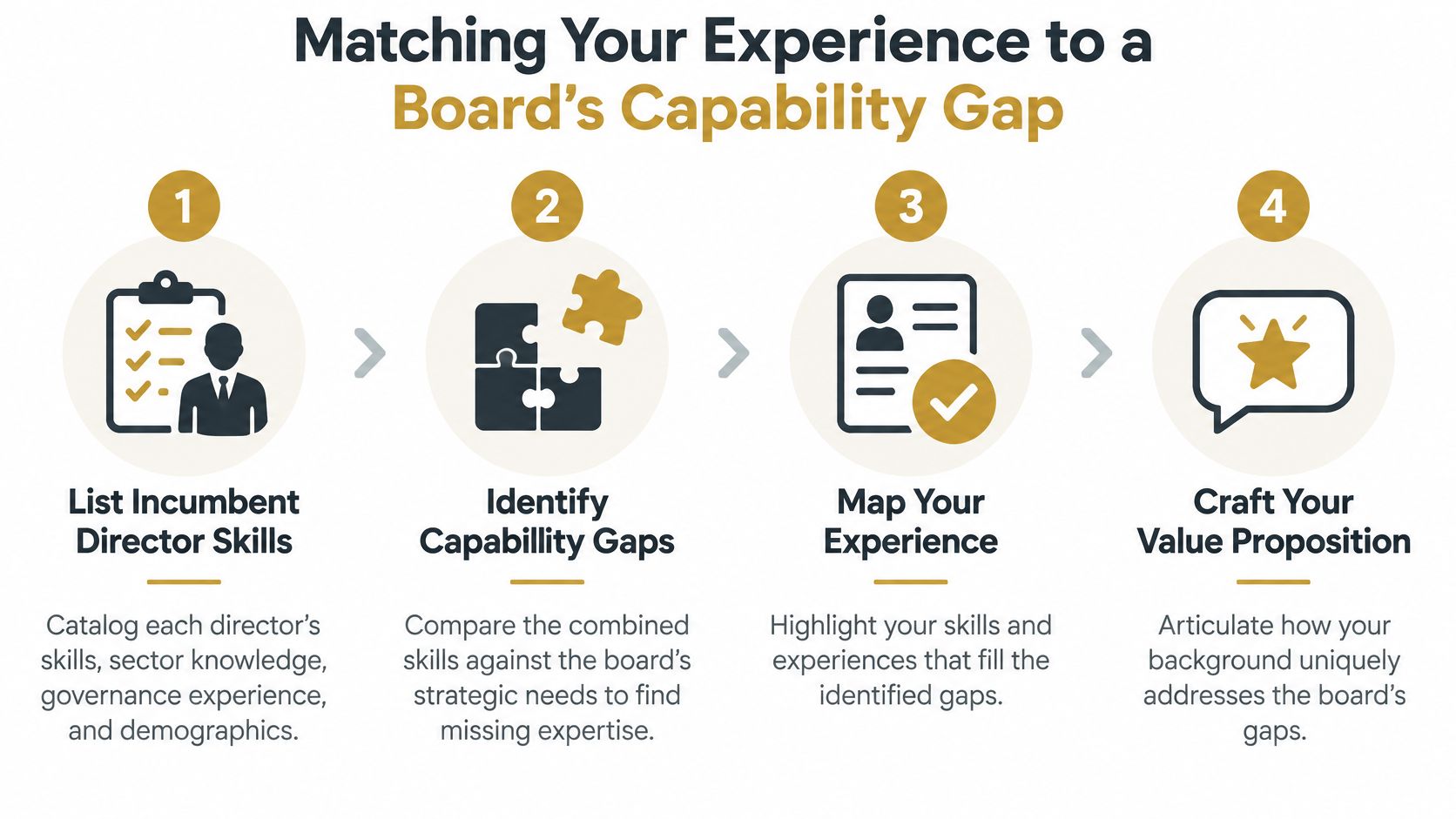
Work from the board's stated needs toward your evidence. Start with its current composition and committee responsibilities, then consider its strategy and future demands. The gap between current capability and what the board needs becomes the selection criteria. Use those criteria to decide which examples belong in your application and how to answer questions.
- Map the current board. Review each director's biography, tenure, committee membership and stated expertise in the latest annual report. Look for overlapping experience as well as missing capabilities. Several directors may have finance backgrounds, for example, while only one has led a major risk response.
- Identify what the board will need. Consider its strategy, regulatory exposure and disclosed succession plans. A company entering a regulated market may need different oversight expertise from one integrating an acquisition.
- Compare current and future requirements. A candidate's strongest skill is not automatically a board gap. If the board already has several directors with deep finance experience, another finance executive may need to show a distinct contribution, such as leading a remediation.
- Turn the gap into evidence questions. Ask what the board will need a director to have done. Could you show that you chaired an audit process, restructured a risk function, overseen remediation or reported to a regulator?
Rate every claim on a four-level evidence scale
| Level | Meaning | Evidence to show | Board role it supports |
|---|---|---|---|
| 1 | Familiarity | Briefings attended, board papers read | Background awareness across the full board |
| 2 | Practical experience | Projects led, a function run in the area | Contributing member on a committee |
| 3 | Advanced experience | Outcomes owned and reported to a board or regulator | Committee chair or lead director on the topic |
| 4 | Expert or recognised authority | Published work, certification, or major regulatory or crisis response led | Specialist seat where the gap is critical |
Rate the evidence, not the job title. A claim of expertise is stronger when supported by outcomes, scope of responsibility and reporting lines. Peer review and documents can expose where a CV's wording promises more than the candidate can substantiate in an interview. Include how many directors the board needs at each level: one director with advanced experience addresses a different need from several.
For example, a finance executive applying to a board with no director who has led remediation after an audit finding should describe the finding, the changes made, the reporting cadence with the regulator and what the audit committee reviewed. General seniority is less persuasive than clear evidence tied to the board's gap.
A former chief executive title is not the only route to a public-company board. In the 2022 proxy-year sample behind the Spencer Stuart U.S. Board Index, 74% of 395 newly appointed independent directors came from outside CEO, chair or vice-chair, COO and president roles, and 34% were joining their first public-company board.
Keep one profile document with your board CV, sectors, geographies, committee interests and the roles you will or will not accept. SeatSignal uses a director profile as the input for matching. Before applying, compare three candidate boards against the board role fit checklist, then rank them by how directly your evidence addresses each board's capability gap. The strongest match may not be the role with the most familiar title.
Committee Credentials That Decide Eligibility
Committee rules can disqualify a candidate before anyone reads their career. Under the NYSE Listed Company Manual, every audit-committee member must be financially literate or become financially literate within a reasonable period after appointment, and at least one member must have accounting or related financial-management expertise. Audit members also have to satisfy applicable NYSE and SEC independence requirements unless a specific exemption applies.
That combination rules people out. A finance leader who can't evidence financial literacy on paper, or who can't document independence from management, is not a candidate for that seat however strong the career behind it.
What each committee actually gates
| Requirement | Who it affects | Evidence to prepare |
|---|---|---|
| Every audit member financially literate, or becoming so within a reasonable period | Audit committee candidates | Financial statement reading and reporting experience |
| At least one audit member with accounting or financial-management expertise | Finance, audit and risk executives | Documented accounting or financial-management leadership |
| Independence under NYSE and SEC rules unless exempt | All audit committee candidates | Independence note covering affiliations and relationships |
| Committee charter sets the qualifications for other committees | Compensation, nominating and risk committee candidates | Charter-by-charter mapping of experience to each stated duty |
Read the charter before the annual report. Find the required qualifications, the expected workload and any named chair responsibilities, then check whether your experience maps directly onto the stated duties. Where it doesn't, you need a documented explanation rather than a hopeful sentence.
The independence note is where most finance candidates underprepare. It should list affiliations, past employment inside the group or its advisers, commercial relationships, family and personal ties, and any shareholding or option position. A clean note pre-empts the question a chair is already forming.
Three steps make this manageable. Pull the charter and the committee terms of reference. Map each requirement to one piece of evidence, with a date and a decision attached. Flag every gap that needs explanation, then write that explanation before an interviewer asks for it.
Check which rulebook governs the seat. A Nasdaq-listed or UK-listed board applies its own independence and committee rules, so name the code first and map evidence second. A first-time candidate who isn't yet financially literate can still meet the audit gate by documenting financial-reporting training or experience and a dated plan to close the gap.
A committee-specific application should be a yes or a no before it becomes a maybe. If you don't meet the gate, apply to a different seat.
Positioning for Emerging Skills and First-Time Seats
A board that says it wants AI expertise isn't offering a shortcut to a seat. It's describing an oversight gap it doesn't know how to fill, and the gap is narrower than the rhetoric suggests. A 2026 Conference Board analysis of board practices and composition found that only 3.3% of Russell 3000 independent directors and 5.4% of S&P 500 independent directors reported AI expertise, even as skills-matrix disclosure reached 47.8% and 81.1% of those indices.

Demand is real, which is what makes the gap interesting. In a global survey of 3,034 chairs and directors across 83 countries reported in the same analysis, 25% named AI and digitalization as the top skill priority for adding directors, with cyber risk and data privacy close behind.
What boards need from those seats is oversight judgement: model risk, data governance, regulatory exposure, cyber resilience and management accountability. They are not hiring an operating technology executive to run the stack. A candidate who talks about platforms loses to one who talks about the risk the board accepted and the metric it now reviews each quarter.
Three reframes that turn operating work into board evidence
A CISO who reported incidents to a risk committee. The evidence isn't the tooling. It's the reporting cadence, the dashboard the committee read, the tolerance decision it took, and the recovery time the board tracked afterwards.
A COO who ran a regulated compliance programme. Lead with the remediation timeline, the regulator relationship and the board papers that tracked progress. Standing up a programme matters less than what happened when a control failed and who was told.
A nonprofit treasurer who presented reserves to trustees. The proof is a reserve policy she recommended, the trade-off the trustees accepted, and the constraint she explained twice before it was understood. That's fiduciary work, and it reads as fiduciary work.
For a wider picture of how oversight conversations run in the boardroom, this is worth watching before you rehearse your own answers:
A chair will test every claim you make. Rate each one on the four-level scale before you use it, and be ready to name a decision you influenced rather than a system you bought. If you're unsure where your evidence sits, a structured board readiness assessment will show you the weakest claim before an interviewer finds it.
Build Your Packet and Make the First Approach
A packet is useful only if it reaches the right person while the seat is still open. Timing matters, but so does the test behind the application: does the board have a specific capability gap, and can your materials show evidence that addresses it?
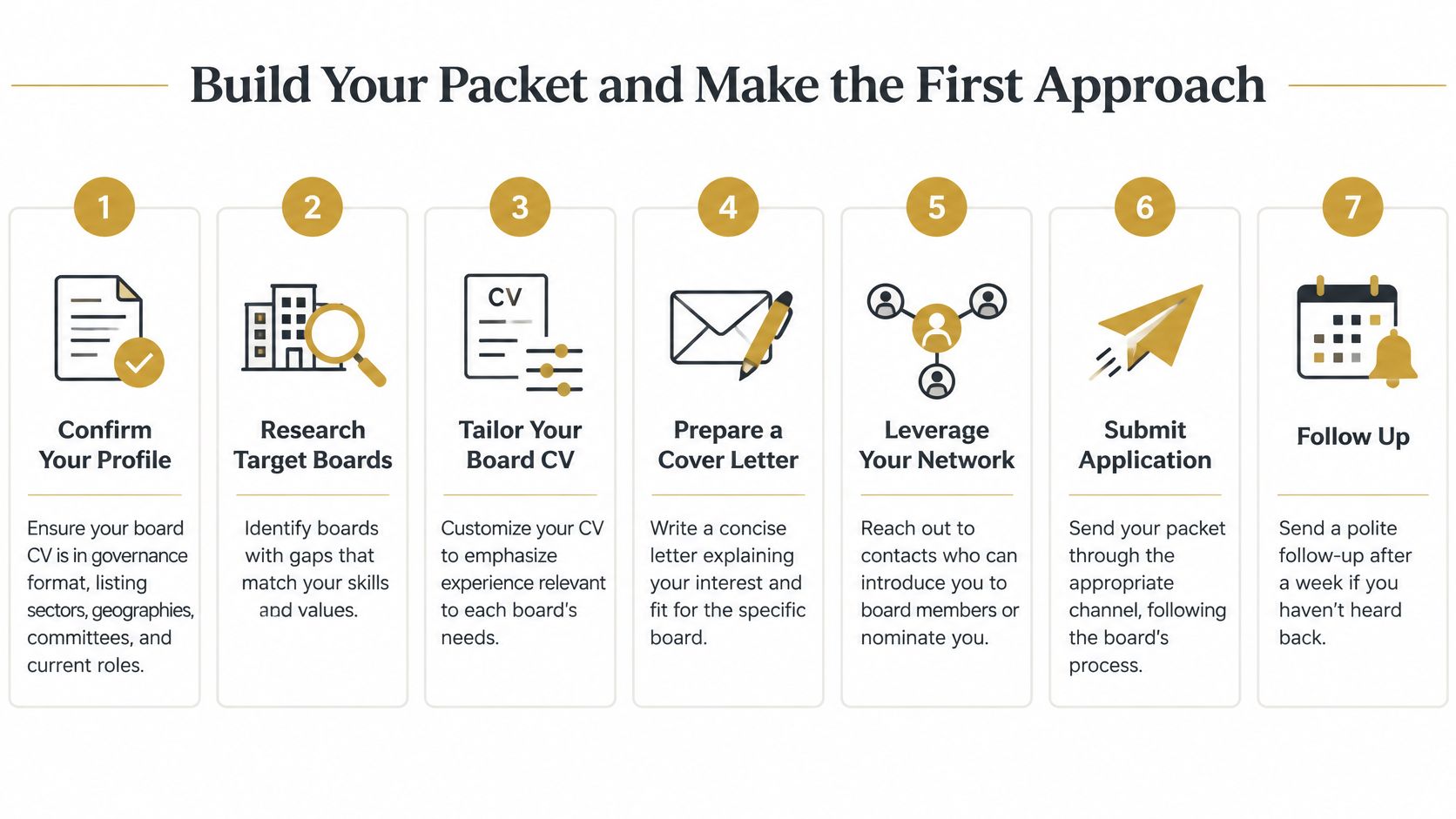
- Confirm your director profile. Keep your board CV, sectors, geographies and limits on the roles you will accept consistent. Remove operational detail that does not support a governance claim.
- Address one named gap. Tailor the cover letter to the board's stated needs. Show how your experience relates to the capability it seeks, rather than repeating your career history.
- Map committee fit. In a fit memo, connect your evidence to the committee's responsibilities. Mark what you have directly done and where your experience is adjacent.
- State independence clearly. Disclose relevant affiliations, past employment and commercial relationships in an independence note. The board must assess whether they affect your ability to serve.
- Find a route to the board. Map shared boards, mutual connections and common professional history. Ask for a warm introduction where a suitable connection exists; if you approach directly, make the message specific to the role.
- Prepare for the chair's questions. Rehearse on the role, committee responsibilities and gaps in the board's composition. Be ready to explain your judgement, independence and approach to constructive challenge with concrete evidence.
- Make a concise approach and follow the vacancy window. State why the role fits, attach the relevant materials and make one clear request. If the answer is “not yet,” ask what capability would change the assessment.
Prepare before a listing goes live when possible. The director CV, custom cover letter, fit memo and independence note can be ready in advance, so a public opening does not start the writing process from scratch.
Choose one board to pursue. Identify its capability gap, the evidence you can offer and a potential route to the board. Track the opening window and reassess if the seat closes or the board's needs change.
SeatSignal's Done-For-You Board Placement hand-picks relevant open board roles and prepares director-grade applications customized to each opportunity. Every plan includes human-checked roles, pre-public seat matching across sectors, warm-path introductions when available, a packet for each board, board-specific interview preparation and a placement team reviewing what reaches you. Plans cost $297 for two months, $742.50 for six months or $1,188 for one year. The director packet service includes a board CV, a cover letter written for each role, fit memo and independence note. SeatSignal has a refund policy and a results disclaimer. Boards, nomination committees and recruiters make appointment decisions.
If you want help with the search as well as the application, SeatSignal matches members to live and pre-public openings and prepares materials for them to review and send. During onboarding, members share their sectors, expertise, committee interests, readiness and preferences for paid, unpaid, equity or honorarium roles. Learn more at SeatSignal.
Want a paid board role, done for you?
One handpicked, verified open board role every week, with a director-grade packet tailored for it.
Get Started