How to Find Open Board Seats That Fit Your Experience

Spencer Stuart's 2024 U.S. Board Index reports that only 8% of S&P 500 directors appointed during the 2024 proxy year were new independent directors, and just 58% of boards added at least one; the rest went to sitting or recently retired CEOs and repeat directors.
That is the situation: openings are scarce, episodic, and often handled before they are ever advertised. Treat your search less like browsing listings and more like tracking succession pressure, committee priorities, and composition gaps. Then show a nominating committee exactly which gap you fill.
Table of Contents
- Why Open Board Seats Are Harder to Find Than You Think
- Where to Find Confirmed and Anticipated Board Vacancies
- How to Evaluate Whether Your Experience Matches a Board's Needs
- Why Specialized Expertise Beats a Generic Board-Ready Profile
- How to Craft Director-Grade Application Materials
- Preparing for the Board Interview
- Building Your Board Placement Action Plan
Why Open Board Seats Are Harder to Find Than You Think
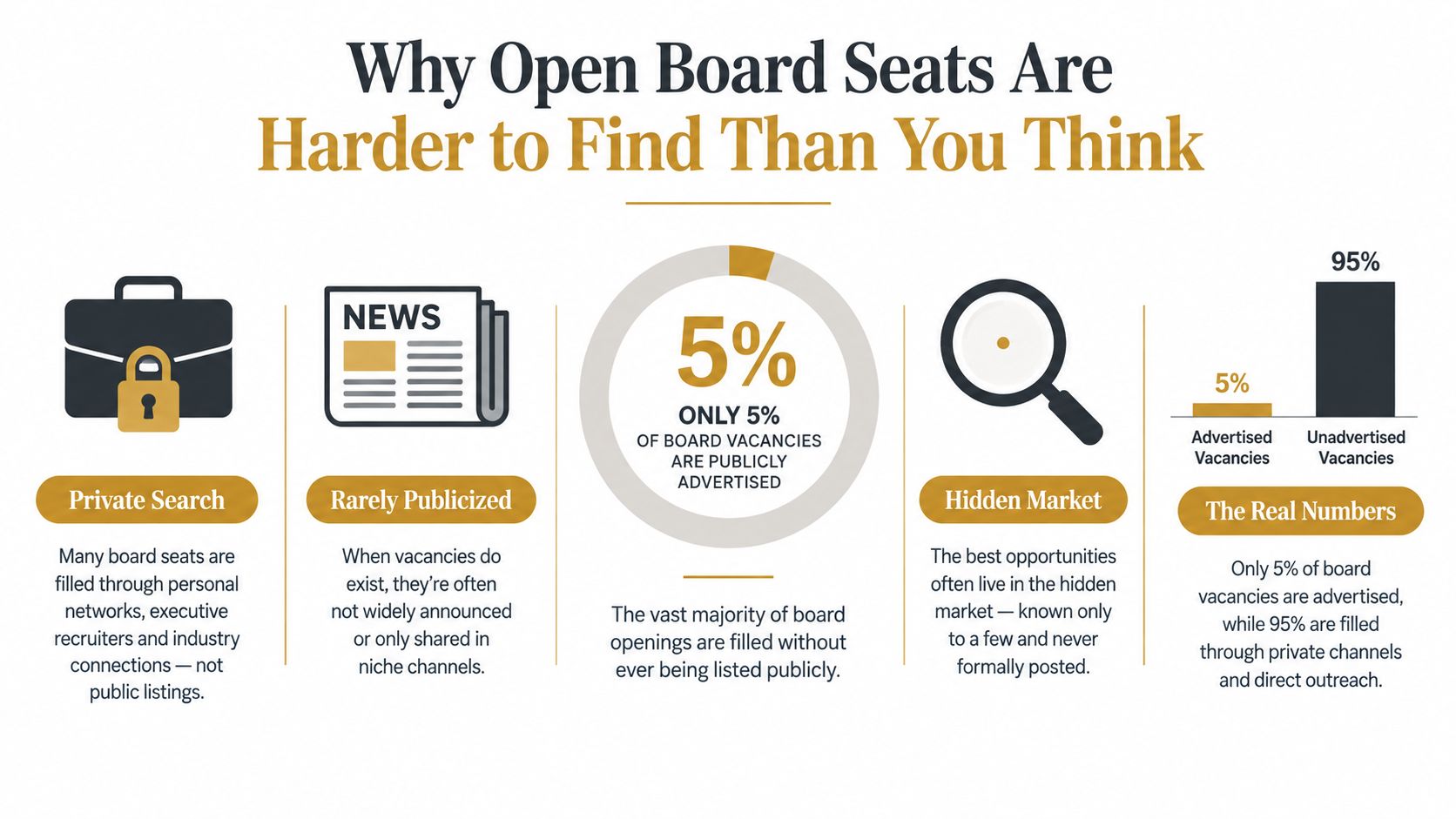
Board seats open on a board's schedule, and that schedule is slow. The Spencer Stuart data cited earlier makes the point: a large share of S&P 500 boards added no new independent director at all in the 2024 proxy year, and overall appointment volume still sat below its 2019 level. Directors hold seats for years, so a board you admire can go a long stretch with nothing to fill. That math is why any search built around "who is hiring right now" will always feel thin.
The UK market tells the same story with a different candidate mix. In 2024, 305 seats were filled across FTSE 350 companies, spread across 59% of companies. Only 26% of appointees were first-time directors, down from 36% in 2021. Appointments rose modestly from 294 in 2023, yet a bigger intake did little to widen the door for newcomers. (FTSE 350 board appointments in 2024)
Scarce seats produce selective hiring. When a board does have an opening, the nominating committee usually starts with a known slate: directors they already trust, referrals from sitting members, candidates surfaced through search firms they work with. By the time a role reaches a public listing, the shortlist is often half-formed. Waiting for advertised openings means competing for the tail end of a process that began well before the posting went live.
Practical rule: Treat an open board seat as one specific board's hiring decision, made on that board's timeline.
So ask a different question. Which boards plausibly need what you bring? What evidence points to an opening forming there? How much confidence does the signal justify? Your answers should drive where you spend effort, and a weak signal earns preparation time rather than outreach.
Where to Find Confirmed and Anticipated Board Vacancies
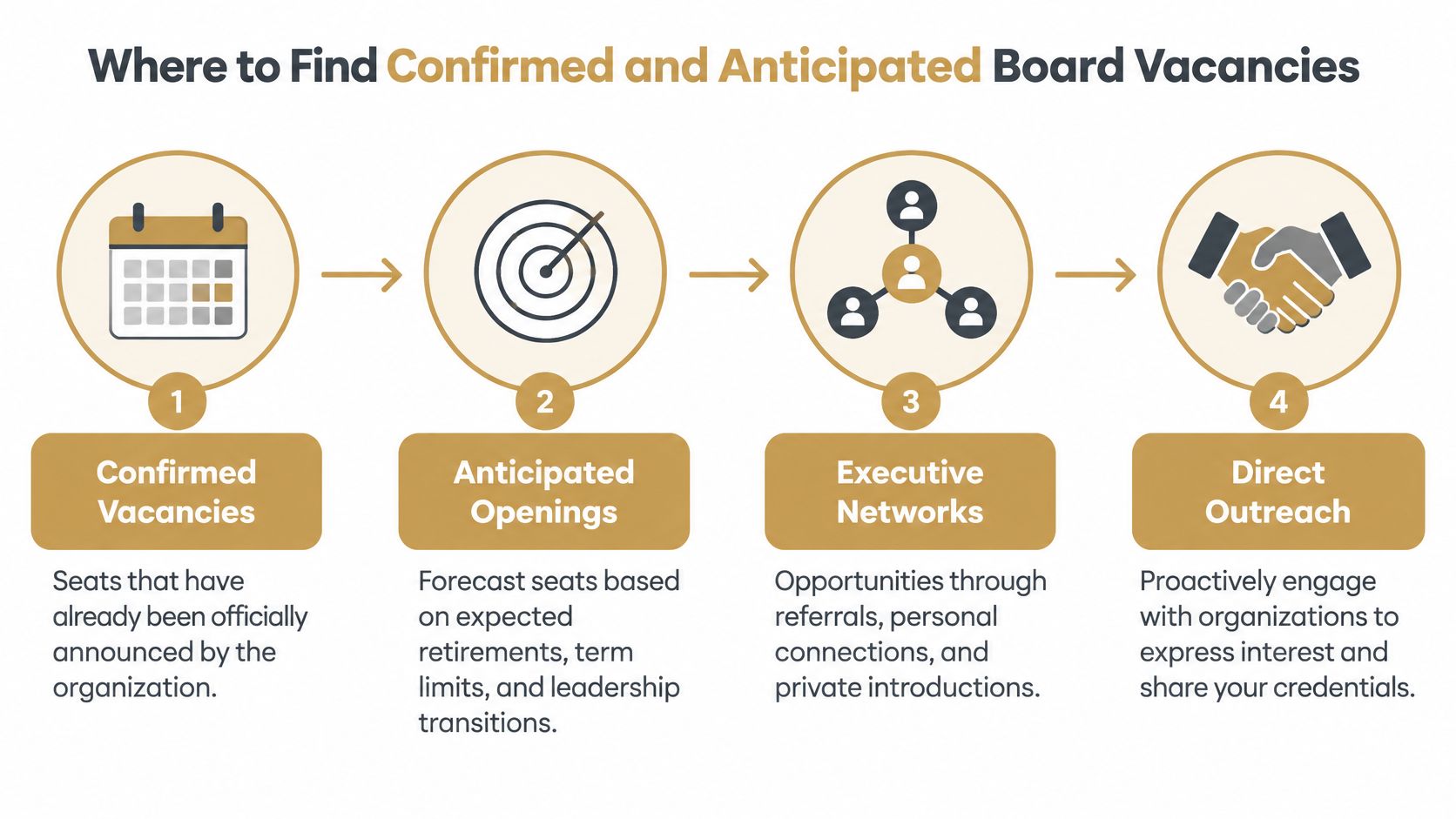
Separate confirmed vacancies from anticipated openings before you contact anyone. A confirmed vacancy has been announced or formally opened. An anticipated opening is a reasoned possibility based on succession information, board-refreshment practices, or a developing composition need. Treating the two as interchangeable leads to wasted outreach and misplaced expectations.
Build a signal list, not a list of guesses
Start with governance-focused publications, company announcements, proxy materials, and board or succession disclosures. Track what's explicit: a director's announced departure, a disclosed appointment process, or a published policy that may affect future turnover. Then record signals separately from confirmed openings. A possible opening is useful intelligence for preparation, not proof that a board is hiring.
Succession policies can provide context, but they don't guarantee a vacancy or establish when one will occur. For example, the Canadian CSSBI 100 data cited in a Harvard Law School corporate-governance analysis reports that 63% of boards had fixed age or term limits in 2025, with 15 years the most common term length. Use such information to identify questions worth investigating, not to assume an individual director will leave on a particular date. (Board practices and composition in the Russell 3000 and S&P 500)
Find a credible route to the people involved
Map existing connections through former colleagues, current and past directors, professional associations, and shared boards. A warm introduction can help you learn whether your background fits a real need. It shouldn't be used to ask someone to bypass a formal process or to make assumptions about who controls the decision.
The UK Corporate Governance Code 2024 calls for a formal, rigorous, and transparent appointment process, based on merit and objective criteria. It gives the nomination committee responsibility for leading appointments, planning orderly succession, and overseeing a diverse succession pipeline. (UK Corporate Governance Code 2024)
Use a simple tracking system: record the board, the source of the signal, whether the seat is confirmed or anticipated, your reason for seeing a fit, and the next appropriate action. For an anticipated opening, set a review point rather than repeatedly chasing a contact. If you want to compare your search approach with an executive recruiter's model, review how board placement support differs from executive search firms.
How to Evaluate Whether Your Experience Matches a Board's Needs
Before applying, work out what the board needs. A polished career history won't compensate for a mismatch with the board's strategy, committee requirements, or current composition.
Start with the board's public strategy, risks, and stated priorities. Translate those priorities into capabilities the board may need to oversee them. A company navigating regulatory change, for example, may value relevant regulatory judgment. A board confronting cyber risk may need someone who can challenge management's controls and response planning, not someone who has used technology in an operating role.
Compare the gap with evidence from your work
A practical assessment begins with a director self-assessment, followed by a weighted list of strategic competencies. Compare that list with the board's existing skills matrix when one is available, then test your profile against the gaps. Canadian governance policy describes a controlled nomination sequence: retain applications, shortlist against a skills profile, interview for qualifications and interest, complete reference checks, and nominate only after those checks. (Canadian governance policy on director selection)
A skills matrix is a comparison tool, not a trophy shelf. Refresh it against forward-looking needs such as audit, cyber, regulatory, international, or transformation experience. For every capability you claim, identify evidence: a decision you made, a risk you helped manage, or an outcome you can explain clearly. “Experienced in cybersecurity” is weaker than a concise account of how you tested oversight, challenged assumptions, or governed a response.
| Step | What to Do | Key Question |
|---|---|---|
| Review strategy | Identify the board's priorities and material risks | What must directors oversee next? |
| Define competencies | Convert priorities into weighted capabilities | Which skills matter most to this board? |
| Compare composition | Review the existing board's experience and committee roles | What appears missing or underrepresented? |
| Test your evidence | Match your outcomes to the identified gaps | What can I demonstrate, not just claim? |
| Screen early | Check independence, conflicts, and committee fit | Could any issue make me ineligible? |
Do this before investing heavily in an application. A structured board role fit checklist can help you judge whether the match is substantive or merely attractive on paper.
Why Specialized Expertise Beats a Generic Board-Ready Profile
Seniority isn't a board value proposition. A long executive résumé may establish credibility, but it doesn't tell a nominating committee what capability you'll add to this particular board. The stronger question is whether your experience helps directors oversee a specific business, risk, or committee mandate.
In a global survey of directors, 48% reported increased representation of differentiated industry experts, while 41% reported growth in functional specialists other than CEOs or CFOs. The same survey found growth in subject-matter expertise such as AI and geopolitics, also reported by 41% of respondents. (Egon Zehnder's global board survey)
NACD's 2025 Trends and Priorities Survey points in the same direction: 67% of respondents expected their board to seek a person with specific expertise rather than only general business leadership experience. Industry expertise was the most frequently selected priority, at 42%, and approximately one-quarter identified technology expertise as a key focus. (NACD's 2025 governance outlook)

Translate your specialty into governance value
A first-time candidate doesn't need to pretend to have chaired a public-company board. They do need to show how their operating experience informs oversight. A finance leader might explain how they challenge assumptions in forecasts and controls. A technology executive might show how they assess cyber exposure, data governance, or the risks of a major transformation. A founder might describe how they balance growth choices with capital discipline and stakeholder responsibilities.
The mistake is describing your career as a sequence of titles and hoping the committee makes the connection. Make that connection yourself. Explain what decisions you've overseen, what risks you understand, what questions you'd bring to a committee, and where your expertise has clear limits.
Your pitch should answer one question: What can this board oversee better because you're in the room?
Build a focused board value proposition around one or two genuine strengths, then connect them to a target board's composition gap. A board value proposition builder can help you make that case more specific than a generic claim of being “board-ready.”
How to Craft Director-Grade Application Materials
A board application isn't an executive job application with “director” added to the headline. The committee needs to understand your governance judgment, relevant oversight experience, committee contribution, and potential conflicts. Make each document answer a different part of that evaluation.
A director CV should foreground board and committee service where applicable, governance responsibilities, risk oversight, strategic decisions, and relevant sector or functional expertise. If you haven't served on a board, don't disguise operating experience as directorship. Show the decisions and oversight-relevant outcomes that transfer.
A cover letter should make the match explicit. Name the board's relevant needs, then connect your evidence to those needs. Avoid a compressed autobiography. A committee should be able to see why you're approaching this particular role.
Give the committee the evidence it needs
A committee fit memo can explain how your experience applies to audit, risk, compensation, or another committee mandate. Focus on how you would contribute to oversight and challenge, not on claiming that you already know every aspect of the work. An independence note should flag relationships, financial interests, or other circumstances that deserve early review.
Screen independence and conflicts before you reach late-stage interviews. A strong candidate may still be unsuitable for a particular seat if a conflict can't be managed or an independence requirement isn't met. Raise relevant facts clearly, and let the company's process assess them. Avoid wasting the committee's time, and your own, by leaving a potential issue until the end.
The core test is simple: could a reader connect each document to the board's needs without guessing? If not, revise it. A director CV grader can help you identify whether your materials present governance-relevant evidence rather than a standard executive résumé.
Preparing for the Board Interview
A board interview isn't a search for the best executive in the room. Nominating committees are testing your judgment, independence, temperament, and readiness to contribute without taking over management's role. Prepare to explain how you think, not just what you've accomplished.
Begin with the board's stated priorities and the specific composition gap behind the seat. Write down the questions a chair might ask about that gap. If your expertise is risk, for instance, be ready to explain how you'd challenge management's assessment, what evidence you'd seek, and when an issue should reach the full board.
Rehearse decisions, not slogans
Prepare examples of consequential decisions you've faced. For each one, describe the context, the options, the trade-offs, your judgment, and what you learned. This is more persuasive than calling yourself strategic, collaborative, or independent. A committee wants to see how you handle incomplete information and disagreement.
Review the likely committee responsibilities before the interview. For audit, be ready to discuss financial reporting, controls, and the quality of challenge. For risk, consider how directors monitor material exposures and escalation. For compensation, prepare to discuss alignment between incentives, strategy, and oversight. Don't imply technical expertise you don't have; show that you understand a director's duty to ask informed questions.
Expect questions about conflicts, relationships, and independence. Be direct about anything that could affect your ability to serve, and explain how you'd approach disclosure and recusal if appropriate. A confident answer doesn't mean claiming there's never a complication. It means demonstrating that you understand why the issue matters and will handle it responsibly.
Use a role-specific board interview question bank to rehearse likely questions, then refine your answers around the board's needs. Keep your responses concise, grounded in actual decisions, and focused on how you would contribute as a director.
Building Your Board Placement Action Plan
Treat board placement as a focused search, not a second full-time job. Start by choosing the expertise you can credibly bring to a board, then identify companies where that capability aligns with strategy, risk, or committee needs. Track confirmed vacancies separately from anticipated openings, and match the effort you invest to the quality of the evidence.
Use relationship mapping to find a sensible route to the people involved. Prepare application materials for a specific role, not for every possible board. Before an interview, study the board's composition and rehearse the questions that follow from its needs. Keep your pipeline active, but don't mistake repeated outreach about a speculative opening for progress.
Patience matters because appointments are limited and uneven. SeatSignal is the only DFY board placement program that hand-picks ideal board matches, drafts director-grade CV's for each role, and trains you specifically for each interview to ensure you land the seat. Its service combines board opportunity matching, relationship mapping, application materials, and role-specific interview preparation. No placement can be guaranteed, so assess any program by the work it performs and keep responsibility for your decisions and due diligence.
If you're serious about finding open board seats that fit your experience, bring your search, materials, and interview preparation into one deliberate process. Visit SeatSignal to explore role matching, director-grade applications, and board-specific interview support.
Want a paid board role, done for you?
One handpicked, verified open board role every week, with a director-grade packet tailored for it.
Get Started