Paid Advisory Board Positions: How to Land One
Stop treating your executive track record as a board qualification. Boards don't hire your last job title, they fill a specific gap in a skills matrix at a specific moment, often from a pipeline they built months earlier. If you're chasing paid advisory board positions by sending a polished executive résumé to public listings, you're competing late, cold, and on the wrong evidence. The candidates who get shortlisted target forecast openings, prove committee fit, and judge pay by risk, hours, and equity terms, not by the headline retainer.
Table of Contents
- Why Paid Advisory Board Positions Are Harder to Land Than They Look
- How to Find Paid Board Openings Before They Are Public
- What Paid Board Roles Actually Pay and How the Structure Works
- Advisory Board Work Versus Fiduciary Board Service
- Building Director-Grade Materials and Preparing for Board Interviews
- Due Diligence Before You Accept a Paid Board Seat
- Your Next Step Toward a Paid Board Seat
Why Paid Advisory Board Positions Are Harder to Land Than They Look
A strong C-suite record doesn't convert quickly into a paid seat. In the Russell 3000, newly elected directors represented only 8.6% of sitting directors in 2025, down from 13.3% in 2022, which means turnover, not talent supply, controls your odds. That's the constraint most first-time candidates miss.
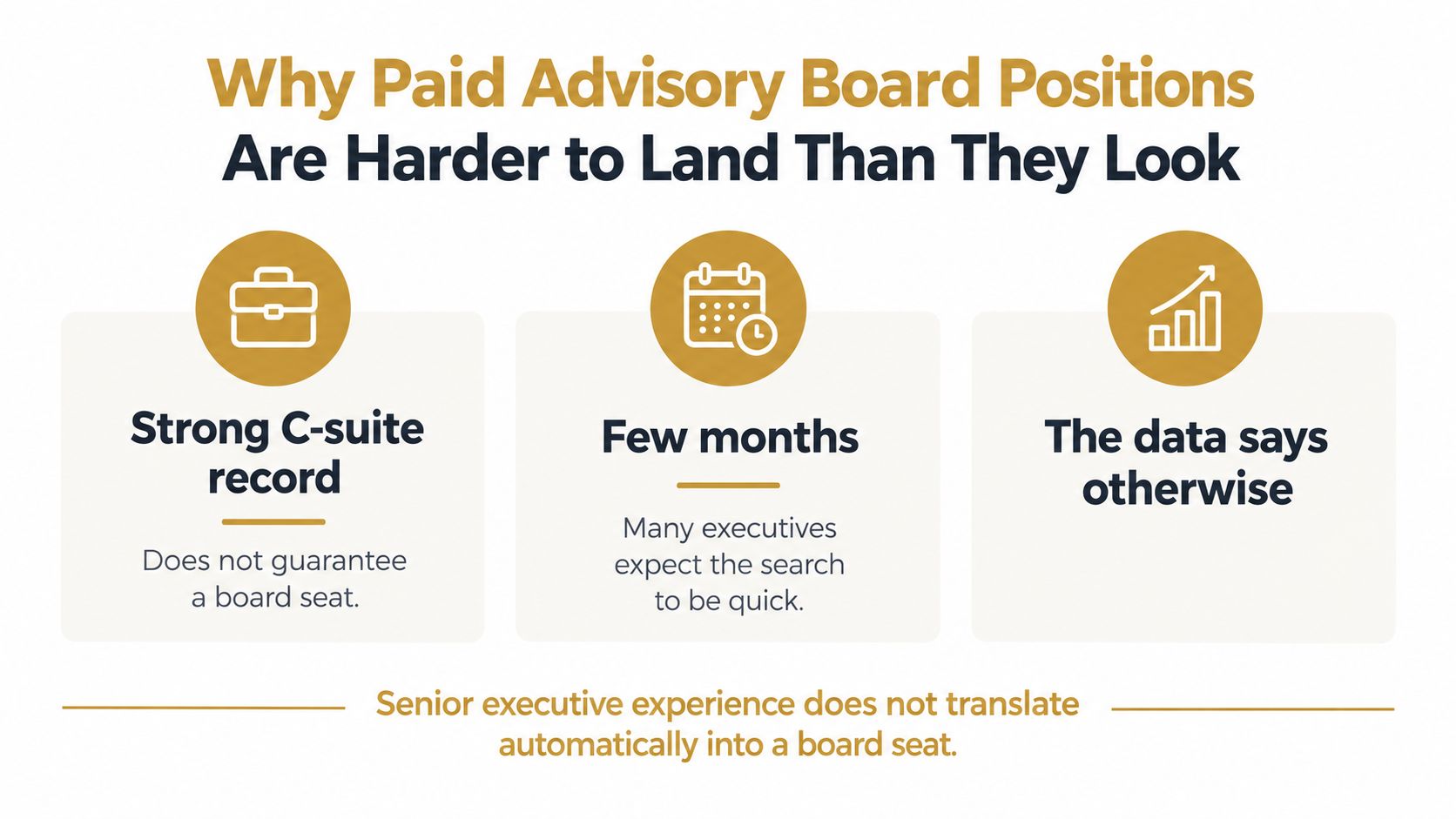
Boards protect continuity. Directors serve multi-year terms, chairs avoid unnecessary disruption, and nominating committees prefer candidates they've already discussed before a retirement or resignation forces action. A publicly visible vacancy often sits at the end of that process, not the start.
Credentials Are the Entry Ticket Not the Differentiator
Every credible shortlist contains accomplished operators. Committees then ask narrower questions. Can this person chair audit without management support, challenge a cyber plan, judge executive pay, or guide succession in this sector? If your materials answer with revenue growth and team size, you've proved management competence, not governance value.
Practical rule: If you can't name the board's capability gap in one sentence, you're not targeting, you're applying.
Your first change is therefore practical. Stop building a long list of impressive companies and build a short list where your evidence matches an identifiable need. Prioritize vacancy timing, committee fit, and a plausible route to a decision-maker. A smaller, better-timed pipeline beats broad outreach because board demand is episodic and highly specific.
Pay reinforces that selectivity. A seat can consume far more time during a transaction, investigation, leadership change, or activist campaign than its normal meeting calendar suggests. You need to assess probability of appointment and likely workload together before investing relationships and reputation in a pursuit. Treat the search as portfolio construction, not job hunting.
How to Find Paid Board Openings Before They Are Public
Find the vacancy before the announcement. Boards should review and update their skills matrix at least annually and monitor retirements, term limits, and leadership transitions, and you can read many of those same signals from outside the boardroom.
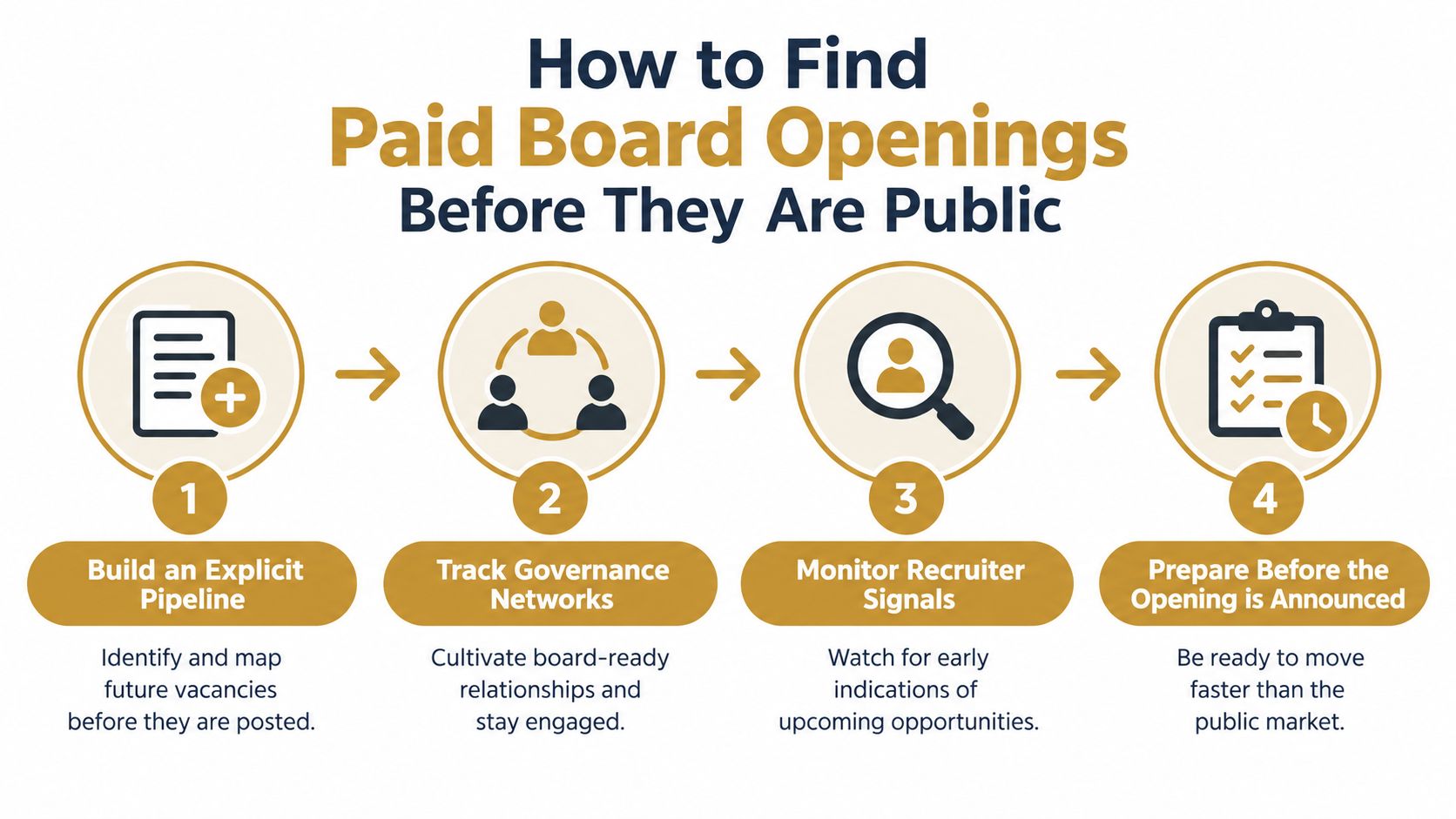
Proxy statements and annual reports show director age, tenure, committee membership, independence, attendance, and stated skills. Read them for succession pressure, not corporate trivia. A long-serving audit chair approaching a tenure limit, a new chief executive, or a board adding cyber expertise to its matrix tells you where demand may emerge.
Build Two Lists Not One
- Confirmed vacancies: A director has announced departure, a search is live, or the board has disclosed an expansion.
- Forecast openings: Tenure, retirement, committee rotation, shareholder pressure, or a new strategic priority suggests a future need.
- No current route: The company fits your background, but there's no timing signal and no credible introduction path.
That distinction stops you spending equal effort on live and imaginary opportunities. If you're weighing effort against building the system yourself, review our comparison of supported placement versus a DIY board search before committing months to manual tracking.
Warm paths matter because boards build pipelines through contacts, search firms, associations, service providers, and databases. Map shared boards, former employers, investors, advisers, and professional bodies against each target. Ask a mutual contact for a governance conversation, not a favor. Bring a specific view on the company's risk, market, or committee agenda, and make it easy for that person to describe why you belong in the board's future candidate pool.
Run this weekly. Update tenure signals, track committee changes, add one relevant relationship, and remove targets where the gap has closed. Discipline beats bursts of networking.
What Paid Board Roles Actually Pay and How the Structure Works
Major public-company directors usually receive a cash retainer plus equity, not meeting fees alone. The 2024 S&P 500 compensation snapshot put average total director compensation at $327,096, up 1.8% from $321,220 in 2023. Equity represented 58% of that package and cash represented 37% in the same snapshot, so ownership terms drive most of the value.
S&P 500 Director Compensation Components
| Component | 2024 Average | Share of Total |
|---|---|---|
| Cash compensation | Included in total package | 37% |
| Equity compensation | Included in total package | 58% |
| Average total compensation | $327,096 | 100% |
| Average annual independent director retainer | $144,077 | Not stated separately |
| Average targeted annual stock award | $190,489 | Not stated separately |
Those component figures come from the same 2024 snapshot cited above. Sector also changes the prize, since average compensation ranged from $300,909 in consumer companies to $377,668 in communication-services companies in that snapshot. Committee and leadership duties can add further responsibility, so compare the full assignment, not just board membership.
Private-company structures differ. In the 2025 private-company board compensation summary, 90% of surveyed organizations compensated directors and 77% used annual cash retainers. That survey also recorded an 18% increase in directors working more than 100 hours annually, which is why headline pay can conceal a weak hourly return.
Divide expected cash and realistically valued equity by realistic hours, including preparation, travel, calls, and crisis work. That's your economic comparison.
Ask when equity vests, whether it survives departure, how dilution works, when you can sell, and how tax is triggered. Illiquid shares in a private company aren't equivalent to listed stock awards, even if the paper values look similar. Use our board fee calculator to test retainer, equity, and workload assumptions side by side.
Stock options also deserve skepticism. They're far less common at large public boards than they once were, and any option-heavy offer needs a clear exercise price, valuation basis, and exit route. Cash certainty matters, especially when the business expects substantial unpaid judgment between meetings.
Advisory Board Work Versus Fiduciary Board Service
Don't confuse being asked for advice with being appointed to govern. An advisory board is usually consultative. Management or owners seek expertise, introductions, and market perspective, then decide whether to act. A fiduciary board carries formal oversight, duties of care and loyalty, recorded decisions, committee work, and personal liability exposure.
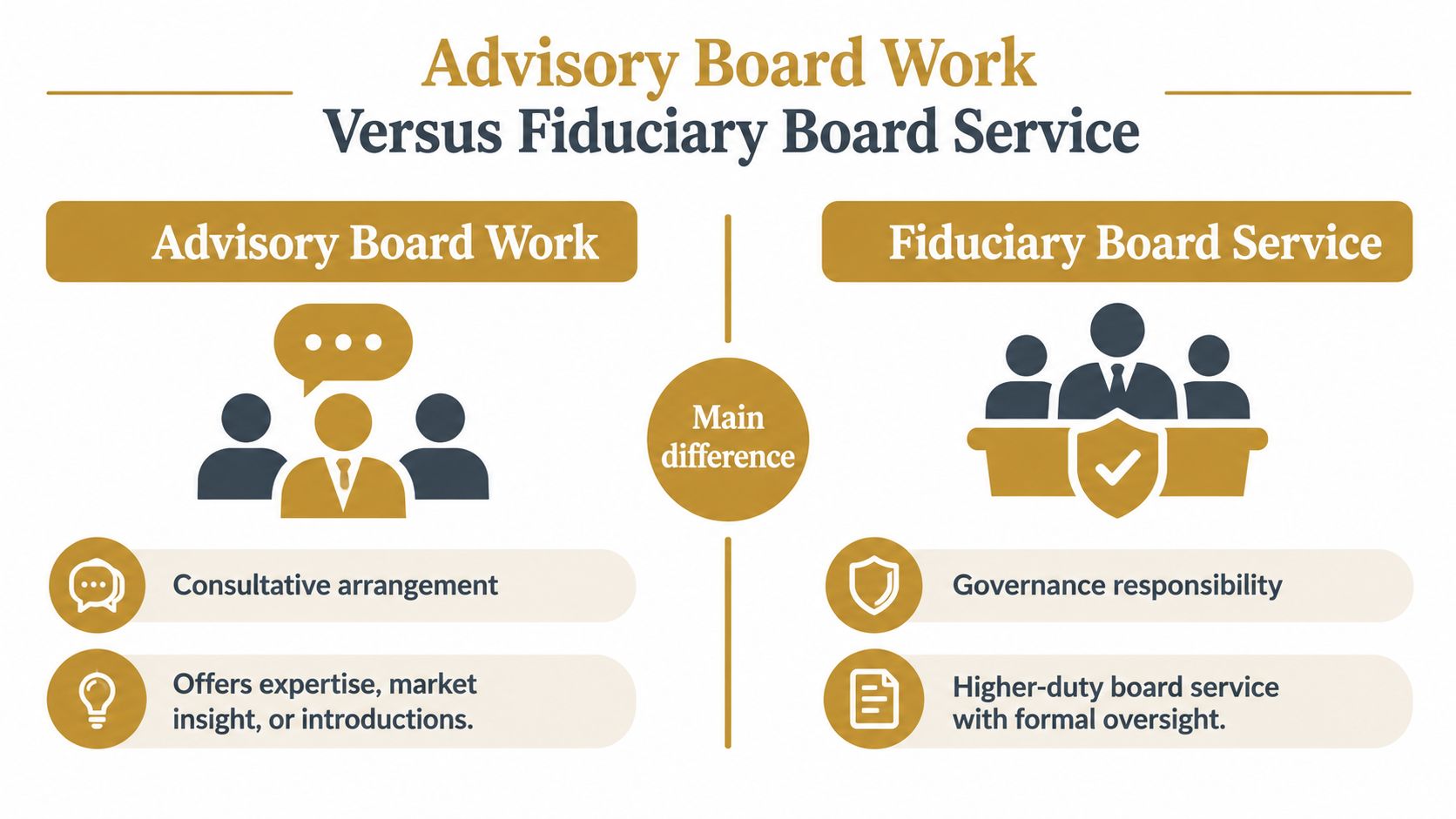
Ask who appoints you, whether you vote, which documents you'll sign, and whether the role appears in statutory filings. Ask who can remove you and what happens if you dissent. Vague answers usually mean the company wants credibility and access without giving you governance authority.
Choose Based on What You Need Next
- Take advisory work when you want sector exposure, a manageable commitment, or a relationship with founders and investors without fiduciary exposure.
- Pursue fiduciary service when you want recognized governance credentials, committee authority, and a portfolio other boards will respect.
- Reject either route when duties, indemnification, information access, or payment terms stay unclear after direct questions.
Advisory roles can be faster to secure and useful for exiting founders or operators entering a new sector. They rarely substitute for fiduciary experience when a listed-company nominating committee assesses readiness. The title on your biography matters less than the decisions, committees, and accountability attached to it.
Committee fit can outweigh a higher general fee. A demanding audit, risk, cyber, or remuneration seat that matches scarce expertise may position you better for future paid advisory board positions and fiduciary appointments than comfortable advisory work with no decision rights. Price isn't value if the role leaves your governance record unchanged.
Be blunt about your own tolerance. If you don't want regulatory scrutiny, difficult pay decisions, or crisis calls, choose advisory work. If you want a serious board portfolio, accept that fiduciary risk and preparation are the cost of credibility.
Building Director-Grade Materials and Preparing for Board Interviews
Your executive résumé is the wrong document. It leads with reporting lines and operating scale when a nominating committee needs evidence of judgment, independence, oversight, and committee contribution.

Build a board CV around board interaction, governance exposure, risk decisions, capital allocation, succession, regulated environments, and outcomes you influenced without direct line authority. NACD guidance also treats the board bio as a separate one-page account of achievements most relevant to board work. Keep it concise enough for a chair to scan between meetings.
Tailor Every Packet to One Board
- Director CV: Emphasize governance evidence and board-level keywords tied to the stated vacancy.
- Cover letter: Connect your experience to the board charter, strategy, and composition gap.
- Fit memo: Show which committee you can serve, what you'll challenge, and where your judgment adds value.
- Independence note: Address affiliations, compensation relationships, conflicts, and availability directly.
Preparation starts with the proxy statement, recent results, competitor moves, committee charters, and director biographies. Develop questions that show you understand the board's real agenda. Don't rehearse a career monologue.
Expect stages. Board recruitment commonly moves from initial nominating and governance committee interviews to deeper chair and chief executive discussions, then the full board. Early conversations test fit and independence. Later meetings test judgment under ambiguity, chemistry, dissent, and whether other directors want you in the room during a crisis.
Prepare short answers on a failed decision, a disagreement with management, an ethical conflict, and a risk you identified early. Use our board interview question bank to rehearse by committee and interviewer, then practice aloud. Chairs notice candidates who listen, answer precisely, and don't campaign like job applicants.
Due Diligence Before You Accept a Paid Board Seat
An offer isn't diligence. Before accepting, verify authority, protection, workload, and economics with documents, not assurances from an enthusiastic founder or chair.
Run the Offer Checks
- Role status: Confirm whether you're a fiduciary director or adviser, how you'll be appointed, and what voting rights apply.
- Committee duties: Read the charter, calendar, recent workload drivers, and expected preparation time.
- Protection: Review indemnification, D&O insurance limits, exclusions, advancement of defense costs, and survival after departure.
- Economics: Confirm payment timing, retainer conditions, equity vesting, dilution, tax events, sale restrictions, and exit treatment.
- Company risk: Examine finances, litigation, regulatory issues, related-party transactions, auditor concerns, and shareholder disputes.
Independence can decide committee eligibility. Under the SEC proposed Rule 10C-1 framework, compensation-committee independence considers compensation sources and affiliation with the issuer. Disclose relationships early and put your assessment in writing. A late independence surprise damages trust even when it doesn't disqualify you.
Never rely on a promise that insurance is “standard.” Read the policy summary, indemnity language, and carve-outs before signing.
Interview the board back. Meet the audit chair, general counsel, external auditor where appropriate, and at least one independent director without management present. Ask what issue consumes unexpected time and where directors disagree with the executive team.
Use our board offer due diligence checklist for every serious offer, including advisory roles tied to equity. Walk away if information is withheld, minutes look sanitized, or the company wants your name before answering basic protection questions. Boards and recruiters make appointment decisions, but you own the decision to accept.
Your Next Step Toward a Paid Board Seat
Make three decisions now. Choose target boards by timing and capability gap, choose fiduciary or advisory service by liability tolerance, and price each offer by certainty of payment, equity terms, and realistic hours. A seat that looks generous on paper can pay less per hour than a modest retainer once you count committee work and prep time.
Start with our board readiness assessment to identify the evidence, committee positioning, and gaps to fix first. If you would rather compress the work, our Done-For-You Board Placement hand-picks relevant open board roles and prepares a director-grade application for each opportunity. The packet includes a CV, a cover letter written to the board charter and gap, a fit memo, and an independence attestation, and the team maps the warmest route in so you reach the board through a name rather than cold. Interview preparation is built around the specific board in front of you.
The program is built for first-time directors, C-suite executives, portfolio directors, finance, audit and risk leaders, exiting founders, and nonprofit or community leaders, and it aims to land a paid board role within 60 days. Appointments, interviews, matches, income, and completion within that period are not guaranteed. You still need to verify each opportunity and make your own acceptance decision.
Stop applying cold for paid advisory board positions and start targeting boards where your expertise fills a documented gap. Visit SeatSignal to get hand-picked matches, a director-grade packet for each role, and interview preparation built around the specific board you want to join.
Want a paid board role, done for you?
One handpicked, verified open board role every week, with a director-grade packet tailored for it.
Get Started