Paid Board Positions: How to Find, Land and Vet Them

Roughly 85% of directors at U.S. public companies were independent by 2013, and 60% of boards had only one non-independent director, usually the chief executive, as MSCI's board composition research records. Independence became the price of entry rather than a differentiator, which means the thing that separates candidates is rarely the résumé.
A paid board seat is a recurring compensation package attached to legal duties, and it is usually filled through networks that never advertise. Three variables decide who gets one: who can vouch for you, whether you can name the exact gap you fill, and whether you understand what the seat pays and what it costs you to hold it.
Table of Contents
- Why Paid Board Seats Go to People Already in the Network
- Choosing Between Public, Private and Nonprofit Board Routes
- What Paid Board Seats Actually Pay
- Find and Score Paid Board Openings
- Turning Operating Experience Into Governance Evidence
- Getting in Front of Directors Before a Seat Is Posted
- Due Diligence Checklist Before You Accept a Seat
- Your Next Steps on Paid Board Positions
Why Paid Board Seats Go to People Already in the Network
Board seats are not awarded by application. A study of 9,923 board appointments, reported by Harvard Law School's corporate governance forum, found that more than 75% of new directors came from incumbent boards' first- or second-degree networks. At S&P 500 companies, 94% of nominees came from those connected pools, even though those individuals represented only 26% of tracked directors. Connected candidates were 35.8 to 41.1 percentage points more likely to obtain a seat than otherwise comparable candidates who weren't connected.
Read that as a market structure, not a scandal. Directors nominate people they can personally vouch for, because a director who misfires becomes the nominating committee's problem for the next six years. For a first-time director, an international candidate, or an executive whose relationships sit in one industry or one city, a cold application plus a generic director CV does almost nothing. The seat is decided well before the posting appears.
The three paid routes run on different networks. Public-company boards turn on who knows the sitting directors. Private-company boards turn on investors, founders and advisers. Nonprofit and public-sector boards turn on civic and professional affiliation. A candidate who maps all three as one undifferentiated "board search" wastes the quarter.
Answer three questions before you send anything.
- Network reach: can you name a person who knows a director on each target board, at one or two degrees of separation?
- Documented need: can you point to a skills gap, a committee requirement or a strategic risk the board has already disclosed?
- Clearance: can you pass the independence test and carry the meeting load without breaching your over-boarding limits?
Two yeses out of three is workable. Zero is a signal to spend the next quarter building access rather than firing off applications. Mapping those routes is the part candidates skip, which is why warm-path introductions do more for a candidacy than another CV rewrite.
Choosing Between Public, Private and Nonprofit Board Routes
The first real decision isn't which board, it's which route deserves your next 90 days.
Public-company boards are the most formal and the slowest. Committee seats are commonly filled by board appointment on the nominating committee's recommendation, so a warm path to a sitting director does most of the work, and the pay arrives mostly as equity. Private-company boards move faster and pay more like a salary: investor-backed and founder-led companies recruit directors from investor and adviser networks, and the retainer is a genuine annual cash figure.
Nonprofit and public-sector boards often pay an honorarium or nothing at all. They are not a consolation prize. They hand you committee experience and a public governance record, which is how most executives with no prior board service make themselves appointable to a paid corporate seat.
Apply three tests before you commit. Which route does your existing network touch most directly? Which route matches a governance gap you can document in writing? Which route does your income need justify?
Pick one route for the first 90 days and hold the other two as fallbacks. Running three routes at once produces three thin campaigns and no interviews. Run each candidate seat through the board role fit checklist before you invest writing time in it.
What Paid Board Seats Actually Pay
Compensation for a paid board position is a package, not a fee per meeting. The benchmarks below are the ones worth keeping at hand, and the third column matters as much as the second, because a cash retainer and an equity award are not the same money.
| Benchmark | Value | What It Includes | Year |
|---|---|---|---|
| Small-cap company, median total compensation | $210,000 | Cash retainers, meeting fees and equity | 2024 |
| Mid-cap company, median total compensation | $260,000 | Cash retainers, meeting fees and equity | 2024 |
| Large-cap company, median total compensation | $315,000 | Cash retainers, meeting fees and equity | 2024 |
| Average public-company director pay | $242,000 | Total annual pay, up 3% from prior year | 2024 |
| S&P 500 average director pay | $336,352 | 59% stock awards and 36% cash | 2025 |
| Private company median cash retainer | $38,800 | Annual cash retainer only | 2025 |
| Private company 75th-percentile cash retainer | $60,000 | Annual cash retainer only | 2025 |
The three size-banded rows come from FW Cook's 2024 Director Compensation Report. The same study found small-cap pay up 5.7% year over year, mid-cap up 2.3% and large-cap nearly flat at 0.3%, and it puts leadership premiums in hard numbers: 87% of lead directors received additional pay, with median lead-director retainers of $25,000 at small-cap companies, $32,500 at mid-cap and $40,000 at large-cap. Additional committee or leadership pay was entirely cash at 56% of companies and a mix of cash and equity at 36%. The $242,000 average appears in the 2024 Director Compensation Report from NACD and Pearl Meyer, a 3% increase on the prior year. For the 2025 S&P 500 benchmark of $336,352, with 59% paid through stock awards and 36% in cash, plus independent-chair premiums averaging $172,867, see Compensation Advisory Partners' board compensation survey. The same firm's 2025 private-company survey of 633 respondents found 90% paid directors something, yet only 77% provided an annual cash retainer, and total compensation rose 25% year over year. Private retainers were reported at a median of $38,800 with a 75th percentile of $60,000 in Private Company Director's 2025 survey.
Read the mix, not the headline. Liquidity, vesting, dilution, tax treatment, downside risk and workload all change what a package is worth. A $300,000 award of illiquid private stock that vests over four years with no exit in sight is not obviously better than a $90,000 cash retainer.
The question to ask the chair. How does the board set director pay against its peer group, and are committee premiums paid in cash or equity? That is a governance question, and it gets you the structure without making money the opening subject.
A higher headline package can be the worse seat if the role carries materially greater litigation, regulatory, cybersecurity or time exposure. Price the risk before you price the prestige. When an offer arrives, run the numbers through the board fee calculator so cash, equity and premiums land on one comparable basis.
Find and Score Paid Board Openings
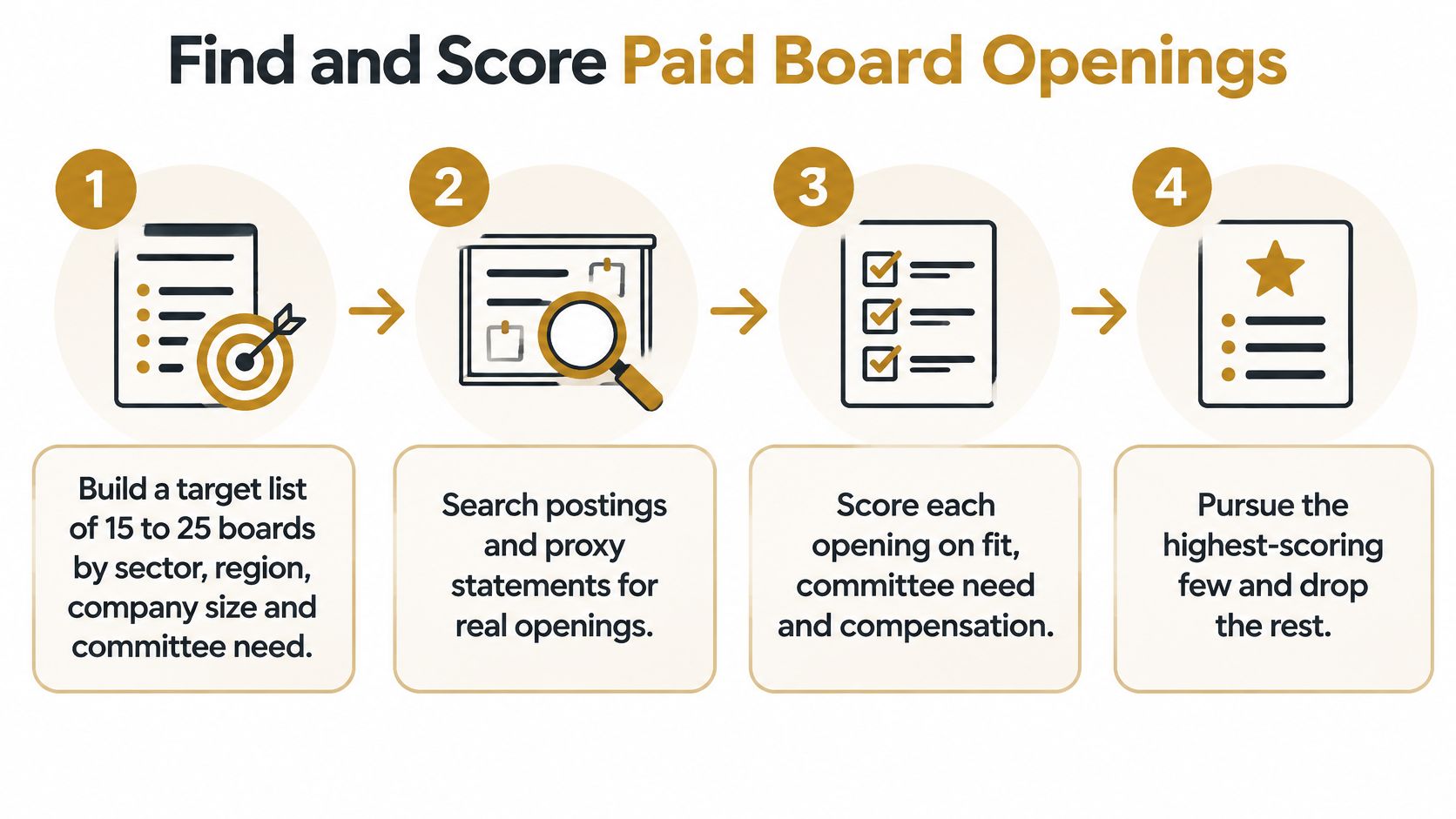
A public listing is often late evidence of an opening. Committee seats may be filled by board appointment on the nominating committee's recommendation, after directors have already shaped a shortlist. Treat sourcing as a pipeline with a scoring gate, not a hunt for the perfect listing.
Build a target list of 15 to 25 boards. Screen by sector, region, company size and committee need. Use each board's latest proxy statement and skills matrix to assess fit rather than building a list of famous directors. Job boards show only advertised roles, leaving out opportunities that take shape before a public notice.
Track director-refresh signals. Retirements, tenure limits, new committees and shifts in annual-report priorities can point to a future vacancy. Waiting for an announcement means entering after the board may already have identified potential candidates.
Monitor forecast vacancies as well as posted ones. A forecast is a lead, not a confirmed opening. Distinguish anticipated changes from established vacancies, then check the likely timing and whether the role is still open before investing in an application.
Score every opening from 1 to 5 on skills match, committee need, independence constraints, sector exposure, refresh timing and pay type. Record whether compensation is cash, equity, an honorarium or unpaid, then compare the package with the company's size and ownership structure. A high headline figure is not enough if the role's terms or fit are poor.
Cut conflicts early. Remove seats that clash with client relationships, supplier roles, investor obligations or existing board commitments. A conflict can block an appointment even when your skills match the vacancy.
Choose three to five openings to pursue in depth. For each, identify the board's likely need and the evidence in your experience that supports your candidacy. A focused case is more useful than a stack of generic applications.
Sourcing often stalls when candidates rely on public postings alone. SeatSignal's placement team handpicks relevant open board roles, checks them before they reach members, and prepares director-grade application materials fitted to each opportunity. Members can also get board placement support compared with executive search firms, whose role in a search is shaped by whom they represent.
Turning Operating Experience Into Governance Evidence

A board application should show how your experience answers a specific need in the boardroom. An executive résumé alone rarely makes that case.
Start with the gap, not the résumé
A board-composition gap analysis starts with the company's long-term strategy, assesses current directors' capabilities, identifies missing skills, defines a candidate specification, and screens candidates against it. NACD's director recruitment guidance describes this process.
Timing matters. Boards may assess their composition before a vacancy is advertised, so a candidate who can show a precise fit may be relevant earlier in the process. Recent S&P 500 appointment patterns also favor candidates with prior executive leadership or financial expertise. Lead with one differentiated board-level contribution, supported by evidence, rather than a career summary.
The CFO example, made concrete
For a finance executive pursuing an audit committee seat, broad claims about rigor are not enough. The application needs to connect experience to the committee's actual requirements. Nasdaq's audit committee rules require at least three members who meet applicable independence standards, have not participated in preparing the company's or a subsidiary's financial statements within the past three years, and can read and understand fundamental financial statements.
At least one member must have financial sophistication, typically through finance or accounting employment, an accounting certification, or comparable experience. SEC disclosure rules under Regulation S-K Item 407 recognize a designated audit-committee financial expert, which charters commonly require the board to name. A former CFO can map relevant experience to these criteria, but the application should state the standard and show evidence for each qualification.
Here is how that translation sounds in practice, with a candid view of where board candidates lose traction.
What to send
Four documents should carry the same clear account of the gap you can address:
- A one-page governance CV organized around oversight domains such as audit, risk, capital allocation, cybersecurity, regulated markets, and CEO succession.
- A cover letter tied to the board's stated priorities, using the skills-matrix language the company has published.
- A committee-fit memo identifying the committee you can serve on and the relevant standard you meet.
- An independence note listing relationships the board may need to assess, including advisory work, family ties, and cross-shareholdings.
Write the gap statement in one sentence you can defend in an interview. Name the specific deficiency, use the board's own vocabulary, and support the claim with concrete operating evidence.
Getting in Front of Directors Before a Seat Is Posted

Paid board appointments often begin before a role is public. Map the people who can connect your experience to a board's needs: former co-directors, portfolio executives, investors, advisers, alumni, and contacts from nonprofit or professional affiliations. A useful route may be one step removed from your closest circle.
The aim is to be known for a specific contribution before a vacancy appears. Start with a target board and identify its chair, nominating and governance committee members, and lead director. At a private company, include the founder or lead investor.
- Study the board's public record. Read its proxy statement, annual report, committee structure, skills matrix, and recent disclosures about strategic risks.
- Choose a credible introduction route. Ask for a short conversation about board priorities, not a seat.
- Make your case specific. Connect your governance evidence to a need the board has disclosed.
- Prepare for the first serious conversation. Rehearse questions about your availability, independence, and conflicts.
Track progress by stage, not by applications: introductions requested, introductions completed, conversations held, referrals received, interviews, and conversion by board segment. If 20 introduction requests produce two conversations, review how clearly your message connects your experience to the board's needs.
Ask for fifteen minutes to discuss the board's priorities, not a vacancy. Directors can respond to a thoughtful question; an immediate request for a job gives them little reason to continue the conversation.
Keep the relationship grounded in credible contribution. A director who introduces you is putting their judgment behind your suitability, so be clear about your independence, conflicts, and capacity to serve.
This week, identify two warm routes into your priority boards, draft two introduction requests, and set up a tracking sheet. Use each conversation to learn what the board needs, then refine your case before a role opens.
Due Diligence Checklist Before You Accept a Seat
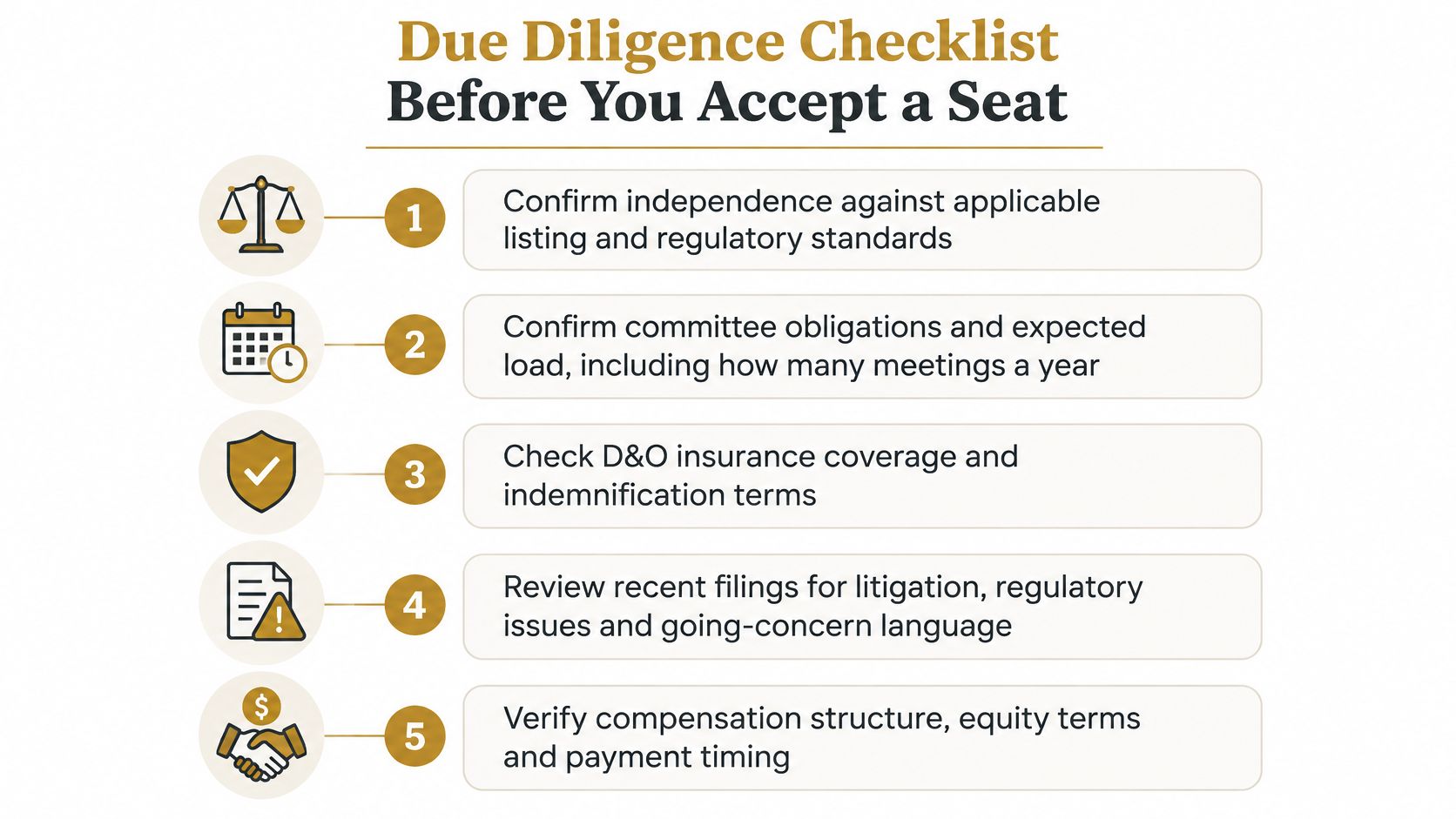
The offer is the point of maximum negotiating power and the point most candidates rush. Ask these as questions, and treat a vague answer as the answer.
Can you pass the independence test on paper? Not "mostly independent." Check the listing rules and the company's own definitions against every fee-paying relationship you have. A bad answer is a company secretary who hasn't checked, or an answer that depends on a consulting contract you haven't disclosed.
What is the time commitment? Ask how many board meetings a year, how many committee meetings, and what preparation each demands. A bad answer is "about the same as everyone else," because it usually means nobody has modeled your first year.
What exactly happens to the equity? Vesting schedule, cliff, liquidity event, dilution, and how awards are taxed. A bad answer is "we'll send the plan document later."
What protects you? Read the indemnification agreement yourself and confirm the D&O coverage limits and the period covered. A bad answer is "standard."
What conflicts would you be importing? Clients, suppliers, investors, competitors and other boards. Read the last two years of filings for litigation, regulatory matters and disclosed cybersecurity incidents, and ask who succeeds the chair or CEO and how the board handles disagreement in the room.
Put every unclear term in writing to the company secretary before you sign. Verbal assurances about indemnification or meeting load do not survive a change of chair.
Then apply a go or no-go rule with no exceptions: accept only when independence, available time, conflicts and indemnification all clear, and when you understand the full pay structure, cash, equity and premiums, down to the vesting dates. If one of those four fails, the seat is not worth the certification you'll sign. The board offer due diligence checklist will keep the questions in order when the conversation moves fast.
Your Next Steps on Paid Board Positions
Treat the next five days as a short campaign, not a guarantee of access. A board seat is often filled through relationships and timing, so each step should produce something you can use when a relevant opening appears.
- Day 1: Confirm the five strongest boards on your scored shortlist. Set aside targets that do not match your experience or committee fit.
- Day 2: Draft a one-page board bio and a concise statement connecting your experience to a gap on your top target.
- Day 3: Identify potential routes to directors at those boards. Write a specific introduction request for each person you plan to contact.
- Day 4: Create a tracking sheet with six columns: board, role, fit evidence, contact or route, next action, and status.
- Day 5: Write down the due diligence questions you would ask if an offer arrives. Keep them ready, but assess each seat on its own terms.
Then send one well-targeted introduction request. A relevant connection may help your name reach directors before a seat is posted, but it cannot guarantee an interview or appointment.
SeatSignal's Done-For-You Board Placement team handpicks relevant open roles, including pre-public opportunities, checks roles by a person, and prepares director-grade application packets for each opportunity. Warm-path introductions are available when suitable connections exist. The packet can also be prepared for board roles you find outside SeatSignal's inventory. Board-specific interview preparation is included, and boards, nomination committees and recruiters make appointment decisions. The program aims to land a paid board role within 60 days, but no appointment or income is guaranteed. SeatSignal has a refund policy and results disclaimer; you remain responsible for assessing whether a role is right for you.
SeatSignal is a subscription-based placement program for candidates who want help with sourcing and application preparation while retaining control of what they send. Review the program at SeatSignal and start by identifying the board where your experience offers the clearest evidence of fit.
Want a paid board role, done for you?
One handpicked, verified open board role every week, with a director-grade packet tailored for it.
Get Started