Paying Board of Directors: How Much Directors Earn in 2026
A paying board of directors seat can look lucrative until you divide the package by the hours behind it. U.S. public-company director compensation reached an average of $336,352 in 2025, a 3% increase from the prior year, according to the 2025 U.S. Spencer Stuart Board Index. That figure describes large listed companies, not most boards. You'll make better decisions by comparing organization type, pay structure, committee work, and realistic time, then calculating what the seat pays for each hour you're committing.
Table of Contents
- What Board Directors Earn by Organization Type
- How Board Pay Is Built From Retainers, Fees and Equity
- Committee Roles and Chair Premiums That Lift Pay
- Time Commitment and Effective Hourly Pay
- What Changes Pay From One Board to Another
- Terms to Confirm Before Accepting a Paid Seat
- Decide Whether a Paid Seat Fits Your Time and Risk
What Board Directors Earn by Organization Type
A seat at a large public company can carry a very different package from one at a private company, nonprofit, or public-sector board. Organization type, listing status, size, and ownership all affect the comparison. The headline figure for a major listed company is an upper anchor, not a typical offer across every board.
At large public companies, reported compensation comprised 59% stock awards and 36% cash. Stock awards may lose value and may not be available immediately, so check their vesting terms alongside the cash component. A private company may offer a lower retainer with a larger cash share, while private-company equity can be difficult to value without a public market price.
Compare Like With Like
Typical annual board pay by organization type
| Organization type | Typical annual pay | Pay mix or structure | Data basis |
|---|---|---|---|
| US public company (S&P 500 average) | $336,352 (2025) | 59% stock awards, 36% cash | Spencer Stuart 2025 US Board Index |
| Private company (median total pay) | $50,000 | Median cash retainer $40,000 | 2025 private-company director survey |
| Nonprofit board | $0 in most cases | Usually unpaid, sometimes an honorarium | Appointment terms set by the organization |
| Public-sector or advisory board | $0 to honorarium level | Unpaid service or a fixed honorarium | Terms set by the appointing authority |
The private-company figures come from the 2025 private-company director compensation survey results. The $50,000 median total includes more than the $40,000 median cash retainer, so the two figures are not interchangeable. A median also means half of the survey's reported totals were lower. Family-owned, early-stage, and smaller private firms can offer less than larger or investor-backed companies.
Nonprofit and public-sector seats are usually assessed on more than cash. Weigh mission, reputation, and governance experience against expenses, insurance, and the time involved. A guide to nonprofit board opportunities may help you consider the kinds of roles available, but the appointment terms determine what a specific seat pays.
A board seat is not a salary. Its annual figure compensates for oversight, judgment, availability, and legal responsibility, but says little about the effort required.
For any offer, record the data year, what the total includes, and what it leaves out, such as committee pay, equity value, meeting fees, travel, or tax treatment. That makes comparisons fairer: a cash retainer and a package containing stock are not the same kind of value.
How Board Pay Is Built From Retainers, Fees and Equity
Think of board pay as several payments stacked together. The annual cash retainer is like a standing subscription for being a director throughout the year. Meeting fees, where a board still uses them, are closer to pay-per-use charges. Equity is different again, because you're receiving a slice of the company's future value rather than guaranteed cash.
Ask for the package in this order so nothing gets buried inside a single total.
- Base annual cash retainer: The core fee for board membership, preparation, scheduled meetings, and ordinary availability.
- Meeting fees: Extra payments for attending board or committee meetings, although many boards fold expected meetings into retainers.
- Committee member retainers: Separate fees for service on audit, compensation, nomination, risk, or other committees.
- Committee chair premiums: Additional pay for setting agendas, leading work between meetings, and reporting to the full board.
- Chair or lead director premiums: Payments for leading the board or coordinating independent directors.
- Equity grants: Restricted stock, deferred stock units, shares, options, or private-company arrangements that may vest over time.
- Special role payments: Fees for transaction, investigation, succession, or other temporary committees with intense workloads.
One Hypothetical Package
This example is illustrative, not a benchmark. It shows why a quoted grant value and first-year annual value aren't the same thing.
Illustrative first-year director package (hypothetical)
| Component | Amount | Annual value |
|---|---|---|
| Base annual cash retainer | $60,000 | $60,000 |
| Audit committee chair retainer | $20,000 | $20,000 |
| Equity grant vesting over three years | $150,000 | $50,000 per year |
| Total annual package (hypothetical) | $230,000 over the vesting period | $130,000 |
The director receives $80,000 in annual cash fees in this example, plus equity with an annualized value of $50,000. Someone comparing only the $150,000 grant could overstate the yearly package, while someone counting only cash would miss part of its long-term value.
Three equity terms change what that value is worth to you. Vesting sets when you earn the shares or units. A lock-up restricts when you can sell or transfer them after vesting. A clawback lets the company recover value in defined circumstances, such as certain misconduct or restatements, depending on the governing plan and policy.
Indemnification and directors' and officers' insurance aren't pay, but they affect the seat's real value because they shape your protection if decisions are challenged. Before comparing two offers, request every line separately and test the cash and equity timing with the board fee calculator.
Committee Roles and Chair Premiums That Lift Pay
A committee title can add pay, but the title alone does not show whether the assignment is worthwhile. The work behind it matters: audit chairs may oversee financial reporting and controls, while compensation chairs scrutinize incentive design and explain pay decisions to investors.
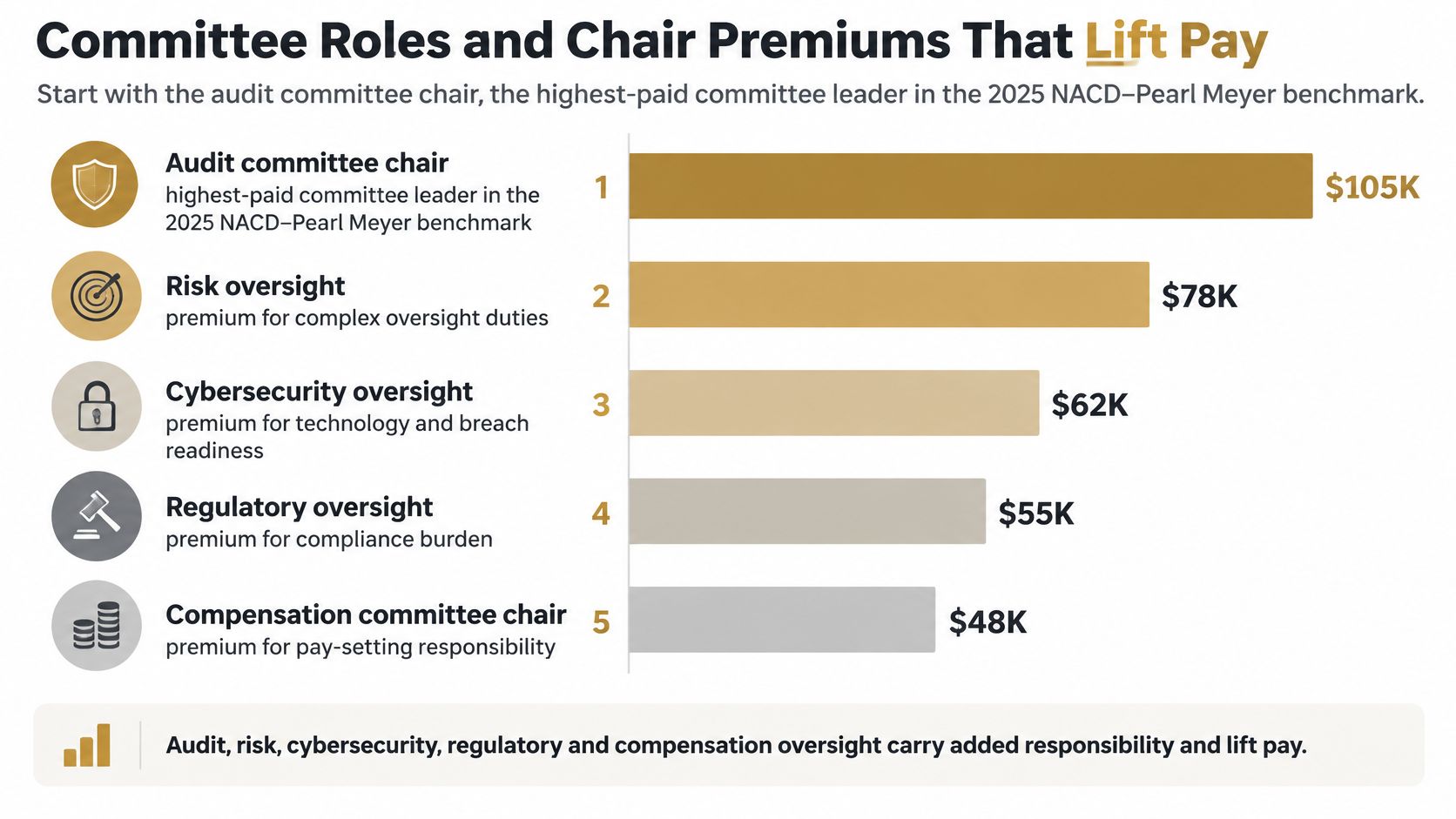
A benchmark of approximately 1,400 public companies across 24 industries found that audit committee chairs remained the highest-paid committee leaders, while median total director compensation increased 3% year over year, according to the 2025 NACD and Pearl Meyer report. In the same benchmark, compensation committee chair pay rose 29% from 2020 to 2025, compared with 11% for other committee chairs.
These differences reflect the nature of the oversight. Audit work can involve financial statements, internal controls, external auditors, accounting judgments, and investigations. Risk and cybersecurity oversight require directors to assess technical information and management preparedness. Compensation committees examine incentives and performance measures, often under investor scrutiny.
Compare the Premium With the Mandate
Committee and chair premiums by role
| Role | Premium or pay signal | Data context |
|---|---|---|
| Independent board chair | Higher compensation than a director without the chair role | Premium varies by company and mandate |
| Lead or presiding director | Additional compensation may apply | Premium varies by company and mandate |
| Audit committee chair | Highest-paid committee chair | NACD and Pearl Meyer 2025 benchmark |
| Compensation committee chair | Pay up 29%, 2020 to 2025 | Other committee chairs up 11% |
| Private-company committee chair | An additional retainer may apply | Practices vary by company |
The rows describe different settings, not directly comparable offers. Public-company chair roles and private-company committee assignments can differ in scale and workload. Treat any premium as compensation for a defined mandate, then ask what the role requires.
The video below adds context on how expanded board expectations are shaping director pay.
When applying, connect your experience to the committee's actual decisions. A CFO might describe controls remediation, reporting quality, audit relationships, or difficult estimates handled under pressure. A CISO could explain incident rehearsals, recovery priorities, third-party risk decisions, and how technical exposure was translated into clear choices. For compensation roles, show experience designing incentives and challenging measures that reward the wrong behavior.
Before accepting committee service, clarify which committee you would join, whether you would chair it, and what additional duties come with the assignment. A higher retainer can be poor value if preparation, management contact, and crisis exposure consume far more time than the premium compensates.
Time Commitment and Effective Hourly Pay
A retainer is like a sticker price. Effective hourly pay is the unit price, because it shows what you receive for the time the seat consumes. That distinction is the clearest way to compare a light advisory-heavy board with a regulated company facing a transaction, succession, investigation, or cyber incident.
In a 2025 survey of 633 private-company respondents, the 2025 Private Company Board of Director Compensation summary report found that 21% of directors spent more than 100 hours annually on board work and another 33% spent 51 to 100 hours. The survey also found that committee work typically added 10 to 20 hours. Scheduled meeting time is therefore only part of the commitment. Reading board packs, speaking with the chair, reviewing committee materials, travelling, and being reachable between meetings all belong in your estimate.
Run the Calculation
Effective hourly pay: Annual cash plus annualized equity value, divided by estimated annual board hours.
Use cash you're scheduled to receive and equity value spread over its vesting period. Don't treat a three-year grant as first-year pay. Then test two cases, one for ordinary operations and another for a crisis year. The board time commitment calculator gives you a structured way to record those assumptions before you accept.
Effective hourly pay on a $50,000 median package
| Annual board hours | Effective hourly pay | Note |
|---|---|---|
| Under 50 hours | Over $1,000 | Light, mostly scheduled meetings |
| 51 to 100 hours | $500 to $980 | Typical for a third of directors |
| Over 100 hours | Under $500 | Reported by 21% of directors |
| 115 hours (100 base plus 15 committee) | About $435 | Committee work adds 10 to 20 hours |
At 150 hours, the same $50,000 produces about $333 per hour. That may still be attractive, but it's a different proposition from $1,000 per hour at 50 hours. Equity risk, unpaid travel time, tax, and the work you must decline can reduce the value further.
Build your hours estimate from evidence rather than optimism. Ask for the next year's meeting calendar, typical board-pack length, committee assignments, site visits, strategy days, and the number of special calls during the past year. Ask what happened during the last major problem and who carried the extra work.
A crisis case should include urgent calls, document review, adviser sessions, management challenge, and follow-up decisions during an investigation, restatement, cyber incident, transaction, or CEO succession. If the retainer only works under the calm case, the seat is exposed. You're not predicting trouble, you're pricing the availability you're being asked to sell.
What Changes Pay From One Board to Another
Board independence now shapes appointments across most major markets. The OECD Corporate Governance Factbook 2025 reviewed 52 jurisdictions and found that all but Luxembourg and the Slovak Republic require or recommend a minimum number or ratio of independent directors. It also found 9 jurisdictions require at least one-third of the board to be independent, while in 20 jurisdictions the most common recommendation is at least 50%. Hungary, India, Korea, Portugal, South Africa, and the United States have binding requirements for independent directors to make up at least half of the board for some companies.
Six Drivers to Check
- Listing status: Listed companies face disclosure, investor, and committee requirements that usually increase oversight scope.
- Size and stage: Revenue, employee count, geographic spread, growth, and transaction plans affect information volume and decision risk.
- Ownership: Family owners, private equity sponsors, founders, and dispersed public shareholders set different expectations for access and challenge.
- Sector and regulation: Financial services, health, energy, and other regulated activities can demand specialist committees and more frequent reporting.
- Board type: Corporate, nonprofit, public-sector, subsidiary, and advisory boards carry different authority, duties, and pay practices.
- Missing expertise: Nearly 60% of new S&P 500 directors in the latest year brought technology, digital, or operational-transformation experience, according to a Directors and Boards analysis of boardroom trends, so scarce expertise can affect both demand and committee placement.
Three opening questions: Is the company listed, which committees need you, and how many independent directors does the board already have?
Those answers quickly show whether you're being recruited as a generalist, an independent officeholder, or a specialist who'll carry a defined oversight burden. They also tell you whether the pay discussion should focus on the base retainer or on committee and independence responsibilities.
Terms to Confirm Before Accepting a Paid Seat
A retainer is only part of the offer. Before accepting, get the appointment letter, committee charter, equity documents, insurance details, and expense policy in writing. A friendly conversation with the chair can clarify the terms, but written documents show what you are agreeing to.
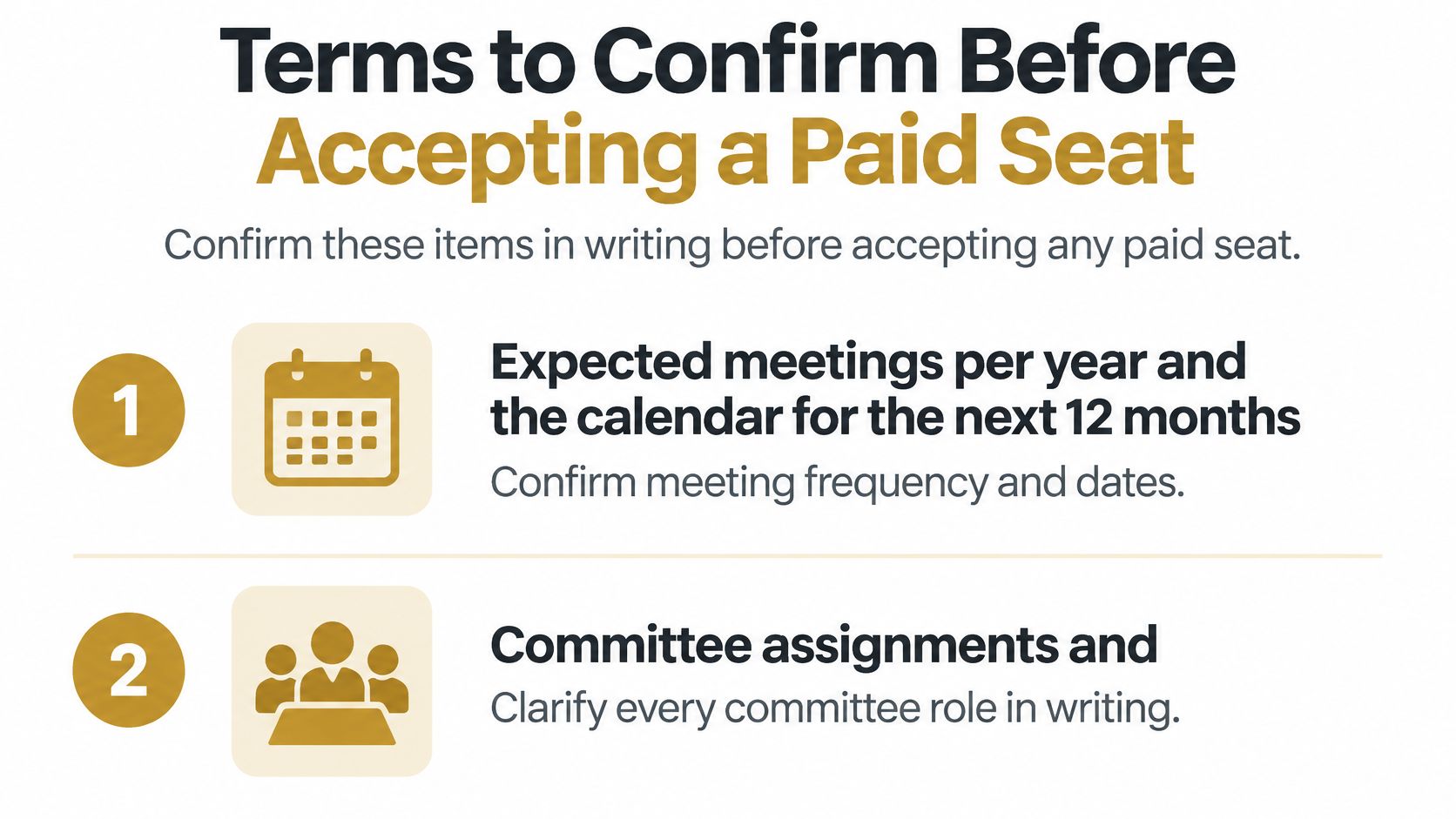
The checklist graphic highlights key terms to confirm before discussing finer details.
Your Written Checklist
- Meetings and calendar: Confirm expected meetings and the dates already set. This helps you see where preparation peaks, travel, and scheduling conflicts may arise.
- Committee assignments: Record each committee role and whether you will chair it. The title alone may not show the work or oversight responsibilities involved.
- Cash and equity split: Write down each part of the compensation and whether payment is prorated if you start mid-year. A headline total may not reflect what you receive in your first year.
- Vesting and restrictions: Confirm vesting dates, lock-up periods, forfeiture, and clawback terms. These determine when equity becomes yours and what conditions could affect it.
- Indemnification and insurance: Review the indemnification agreement and directors' and officers' insurance limits, exclusions, retention, and tail protection. Check how protection applies to claims arising during service and after you leave.
- Special calls and travel: Clarify expectations for urgent calls, crisis availability, site visits, and travel. These commitments can add hours beyond the scheduled meetings.
- Independence confirmation: Disclose relevant relationships, shareholdings, prior employment, and outside compensation. Ask the board to confirm in writing how your circumstances were assessed before you accept an audit or compensation committee seat. Exchange independence rules set a dollar limit on compensation received from the company, and the lookback period is defined in those rules.
- Expense reimbursement: Confirm which expenses are covered, how approval works, and when reimbursement is paid. Include travel, technology, and training costs in your estimate of the seat's net value.
Use the board offer due diligence checklist to keep the answers together. Have counsel review appointment, indemnification, equity, and tax terms when the exposure warrants it.
If a provider or search firm is involved, clarify who contacts the board and who negotiates. SeatSignal does not represent customers to boards or negotiate on their behalf; customers send every approach in their own name. That distinction helps you understand which conversations you will lead yourself.
Decide Whether a Paid Seat Fits Your Time and Risk
A retainer can look attractive until preparation, committee work, and a crisis stretch the hours behind it. Judge the seat by its effective hourly value, then weigh that figure against your opportunity cost, capacity, and the protections attached to the role. If the numbers only work in a quiet quarter, consider renegotiating or declining.
Opportunity cost depends on your circumstances. A retired executive may place more value on reputation and governance contribution, while a serving CFO may need to protect time for executive responsibilities and family. Neither choice is automatically right. The useful comparison is between the seat's likely demands and what those hours would otherwise require of you.
Your Next Step
Before pursuing a role, consider whether its mandate fits your expertise, interests, independence, and available time. The board role fit checklist can help you assess those factors. Then compare three potential seats using the hourly formula from this article, under both normal operations and a plausible crisis scenario.
SeatSignal's placement program hand-picks relevant board opportunities, prepares director-grade applications suited to each role, and provides board-specific interview preparation. A placement team reviews opportunities before they reach members. Every plan includes pre-public seat matching across sectors, warm-path introductions when available, and a director-grade packet for each board.
Choose a seat you would still consider worthwhile during its hardest plausible month, not only during its quietest quarter.
SeatSignal's support does not determine who appoints directors. Boards, nomination committees, and recruiters make those decisions. The program has a refund policy and a results disclaimer, and an appointment is not guaranteed. You remain responsible for assessing the organization, the board, compensation, and personal risk before accepting a seat.
Price the opportunity by its likely hours and risk, not by the retainer alone. Pursue roles where your experience fits a specific board need. If you use SeatSignal, its team prepares materials for you to review and send in your own name; it does not represent you to boards or negotiate on your behalf.
Want a paid board role, done for you?
One handpicked, verified open board role every week, with a director-grade packet tailored for it.
Get Started