Portfolio Career Explained: Roles, Boards and Trade-Offs

Nearly 69% of nominees across 9,801 director appointments from 2003 to 2014 came from directors' existing networks, and that pool represented only about 13% of the potential talent, according to a peer-reviewed study in the Review of Financial Studies. That finding reframes a portfolio career. The scarce asset isn't another title on a biography. It's a mix of roles you can see, staff, and defend when calendars and conflicts collide.
For a senior executive, the useful question isn't how many jobs you can list. It's which activities you chose on purpose, what each one is for, and what breaks if the main one stops.
Table of Contents
- What a Portfolio Career Means in Practice
- How Common Multiple Jobs Are Across Countries
- How Roles Fit Together in One Portfolio
- Board Seats Inside a Portfolio Career
- Capacity Limits When Several Board Seats Overlap
- Whether a Portfolio Career Improves Financial Security
- Three Portfolio Patterns Senior Professionals Use
- Confirm Your Next Step Before Adding Another Seat
What a Portfolio Career Means in Practice
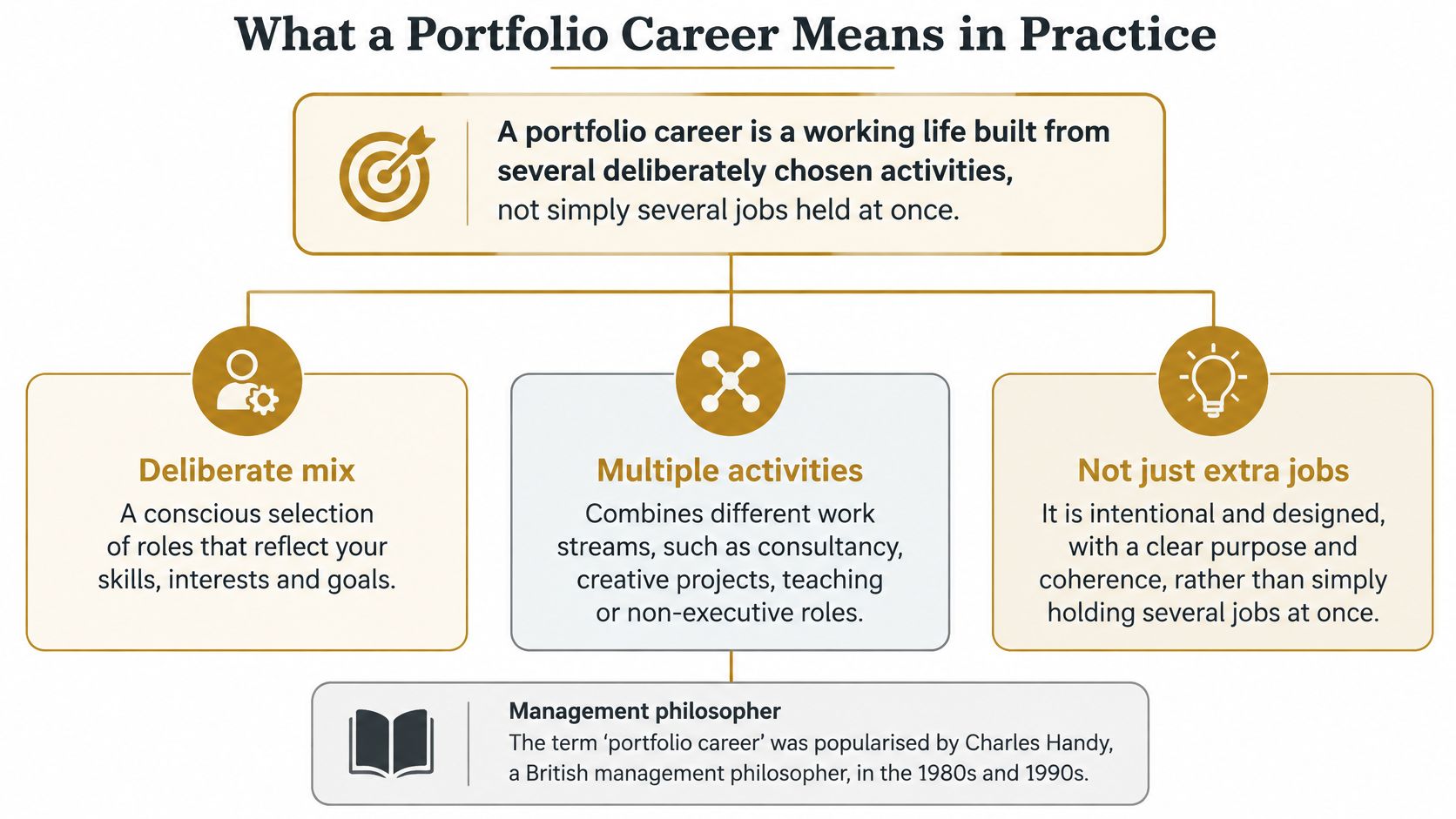
Say a finance director keeps a full-time role, sits on one audit committee, and teaches a short governance course each spring. That isn't "several jobs held at once." A portfolio career is a working life built from several deliberately chosen activities.
Management philosopher Charles Handy coined the term in 1989 in The Age of Unreason, as Musician & Company traces in its account of the idea. Handy used the investment-portfolio metaphor for a working life built from several activities rather than dependence on one employer. He challenged the postwar assumption that a successful career meant a long-term relationship with one organization. Diversification, in that framing, was a deliberate strategy for combining income, skills, autonomy, and meaning, not a response to unemployment or insecure work.
Treat the mix like a balanced fund. Each holding carries a different risk, return, and purpose. You don't buy every asset that clears a screen. You set weights, then change them when one holding crowds the rest.
What each holding is for
Most senior portfolios keep one anchor role and two or three satellite activities, not a stack of equal commitments.
| Activity | Typical Income Pattern | Main Purpose |
|---|---|---|
| Salaried executive role | Fixed monthly salary | Income stability and scale |
| Board or committee seat | Annual fee, often lumpy | Governance experience and influence |
| Advisory retainer | Monthly or project fee | Recurring revenue and pricing power |
| Freelance or consulting project | Per project, variable | Flexibility and new skills |
| Investing or equity income | Irregular, market-linked | Long-term wealth building |
| Voluntary or nonprofit leadership | Usually unpaid | Purpose and reputation |
Handy included salaried employment, consulting, freelance contracts, entrepreneurship, voluntary work, and personal projects. Through the 2010s, project-based work and digital tools made it easier to combine clients, employers, and roles across locations. The same design now fits senior professionals who pair executive work with advisory, teaching, investing, nonprofit, or board responsibilities. Each role can serve income, reputation, learning, influence, or long-term resilience. Two roles that only repeat the same purpose are a pile, not a portfolio.
Run this on your own week. List every current activity and label its main purpose as income, learning, reputation, or influence. If two activities share a label and neither pays reliably, one of them is decoration.
How Common Multiple Jobs Are Across Countries
Multiple-job holding is the one measurable indicator of portfolio activity, and it isn't rare. It still isn't the whole picture.
| Region | Measure | Figure | Period |
|---|---|---|---|
| Australia | Multiple job-holders | 986,400 people, 6.6% of employed | September 2024 |
| United States | Multiple jobholders | 8.431 million, 5.2% of employed aged 16 and over | 2024 annual average |
| European countries (average) | Share of workers with multiple jobs | About 4% | Recent European research |
| Nordic countries | Share of workers with multiple jobs | Roughly 6% to 12% | Recent European research |
| Finland | Share of overall labor force | About 6% | 2019 |
| Finland | Share of examined professionals | 11% with multiple income sources | One professional study |
In September 2024, Australia had 986,400 multiple job-holders, 6.6% of employed people, according to the Australian Bureau of Statistics. In 2024, the United States had an annual average of 8.431 million multiple jobholders, equal to 5.2% of employed people aged 16 and over, according to the U.S. Bureau of Labor Statistics.
European research published via Artivate reports an average share of workers holding multiple jobs of approximately 4% across European countries, with roughly 6% to 12% in Nordic countries. Finland shows the professional gap. About 6% of the overall labor force held multiple jobs in 2019, while 11% of the professionals examined in one study reported income from multiple sources.
What the count leaves out
Official figures understate this pattern because people move in and out of secondary work, pair short projects with a main role, or earn through activity that isn't classed as a second job. The statistic captures only the visible employment component. Consulting, board service, teaching, investment income, and voluntary leadership often sit outside it.
Artists, freelancers, seasonal workers, and independent professionals combined income sources long before platform work. Senior knowledge workers now assemble governance, advisory, operating, and entrepreneurial commitments on purpose. A headcount of second jobs can't tell you whether that assembly was designed.
Practical rule: A count of visible second jobs is a floor, not a measure of how portfolio-like a career really is.
How Roles Fit Together in One Portfolio
In a boundaryless career, value shifts from tenure inside one employer to capabilities you can carry and recombine. Research on portfolio and boundaryless careers treats multiple work assignments, mobility beyond one employing organization, and the continuing need to secure regular assignments as defining features. Income, reputation, and learning aren't parked with a single employer. The cost is a pipeline you have to keep filling.
Six measures, one scorecard
Score each role on revenue, strategic learning, reputation value, time load, conflicts, and future referral potential. Use a 1 to 5 scale. Read the pattern, not the average. A high fee with a high conflict score is not a win.
Say a former operations director holds three commitments.
- Advisory retainer: Revenue scores 5 and learning scores 2. It pays, and it has stopped teaching anything new.
- Audit committee seat: Reputation scores 4 and referrals score 5. Chairs in adjacent firms already ask who sits on that committee.
- Evening teaching post: Revenue scores 2 and recognition scores 4. It costs energy in the same week the board pack lands.
The retainer stays only if the price rises or the scope changes. The committee seat stays because it compounds credibility you can point to. Teaching stays for one more term if it produces a short case you can describe without a slide deck, then it goes. That is a drop decision, not a vibe.
Review the mix quarterly, and again at every new appointment. Don't treat each offer as additive. Each role should also feed the next through contacts, credibility, and a case you can cite in a chair conversation. A board role fit checklist is a clean way to test a new seat against those six measures before you say yes.
If a role doesn't create the next conversation, it is consuming the pipeline instead of refilling it.
Board Seats Inside a Portfolio Career
In the UK FTSE 350 research by the Equality and Human Rights Commission, only 2% of companies publicized non-executive appointments on corporate websites, in newspapers, or on social media. For executive director roles, the figure was 1%. The same research found that 55% of companies did not advertise board appointments, while 29% used executive search firms only and 6% relied only on personal networks.
Public listings therefore show only part of the market. A portfolio plan should distinguish a confirmed vacancy, with a named timetable and committee gap, from a possible future opening caused by retirement, a tenure limit, or a strategy change. Track forecast seats, but do not count them as income until they are open.
Networks raise the odds, not the match
A study of network-based board appointments found that social ties to someone on a board increased a candidate's probability of obtaining the seat by 35.8 to 41.1 percentage points, after controlling for firm, director, and fixed-effect differences. The study did not find a significant improvement in board diversity from these appointments. A warm introduction can improve access, but it does not establish fit with the board's composition, independence requirements, or committee needs.
Evidence of governance capability matters too. Queensland's audit of government-board appointments reported that only one-third of directors had completed a board-governance course, while noting the value of diverse qualifications and experience. A course is not the only way to show readiness: describe operating experience in governance terms, such as a control strengthened, a risk escalated, or a succession managed.
SeatSignal hand-picks relevant open board roles and prepares a director-grade application packet for each opportunity, with board-specific interview preparation. Its paid board positions can be considered alongside other routes into the market. The application should connect your experience to the board's needs, rather than read like an operating biography.
Capacity Limits When Several Board Seats Overlap
More titles don't mean more value. A long list of board seats can hide a workload that no longer fits the attention the work requires.
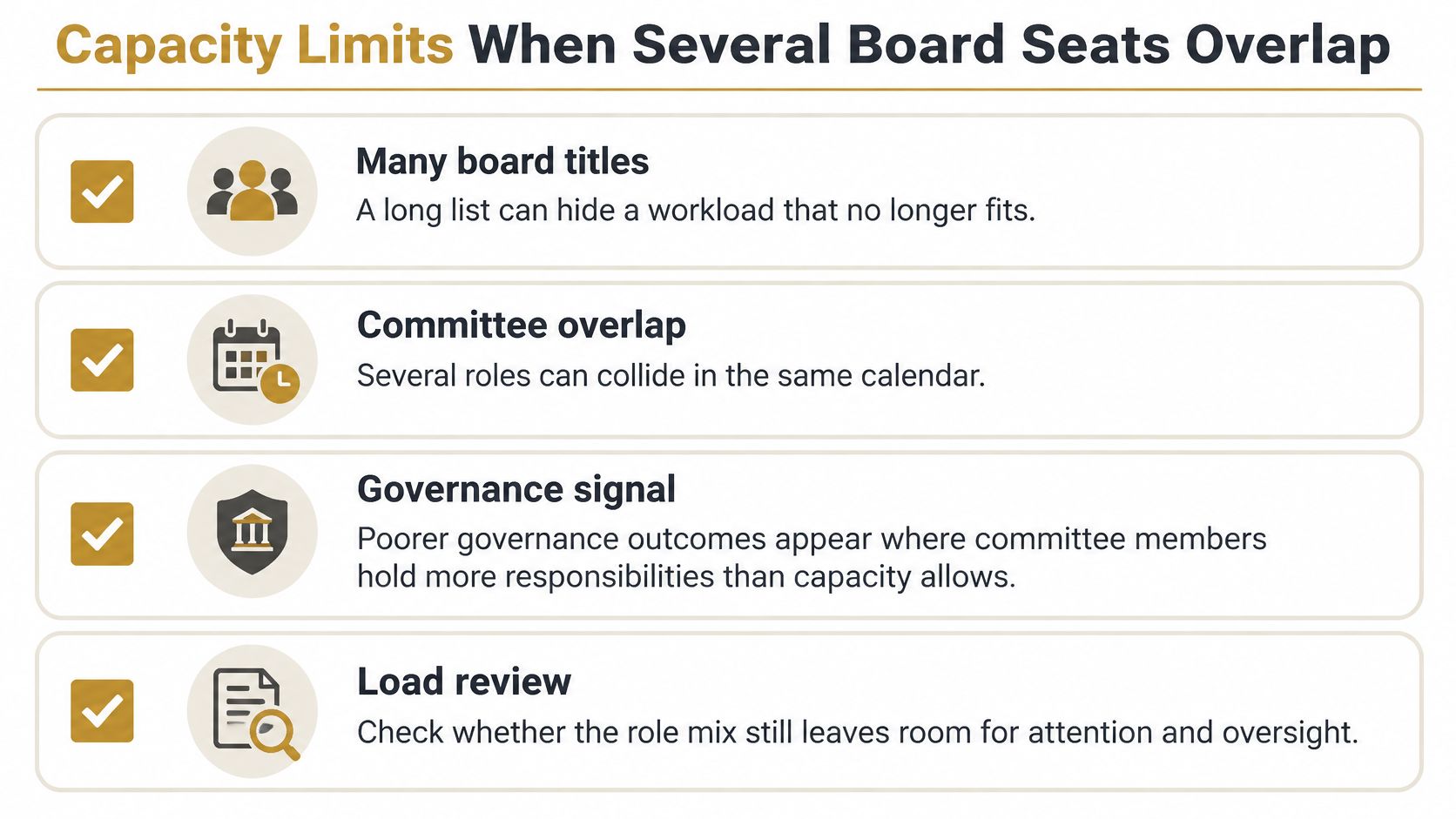
Recent governance research in the Journal of Management Studies finds poorer outcomes where committee members hold more simultaneous leadership or committee assignments, and better outcomes where committee assignments are more diversified. Extra leadership and committee roles create cognitive burdens. A broader spread of committee types can help directors sequence attention across governance tasks. The mechanism is workload interference. Preparation, fiduciary oversight, risk escalation, and committee-specific technical work compete for finite attention, especially when several roles peak together during transactions, crises, audits, or leadership succession.
An hours budget, not a diary of meeting dates
For each seat, estimate annual hours for preparation, attendance, committee work, stakeholder engagement, crisis response, and travel. Add them into one total. Then stress-test that total against the weeks when audit cycles, deals, crises, and succession all land at once. Meeting dates alone will lie to you, because the heavy work happens before the meeting and after a crisis starts.
Concentration risk sits beside the hours. Several companies in one sector, shared customers or suppliers, and similar committee mandates amplify conflicts and shrink the range of problems you can see freshly. A balanced mix across audit, risk, remuneration, technology, and nomination work is safer than three copies of the same committee.
- Seat cap: Write a maximum number of concurrent seats before the next offer arrives.
- Committee cap: Limit audit or risk exposure so technical work doesn't stack in the same month.
- Conflict register: Review it each year for customers, suppliers, and competing mandates.
- Decline rule: Turn down a seat when peak-season hours exceed the budget, even if the fee looks clean.
Separate the headline board count from actual hours and decision responsibility. Three light advisory councils aren't the same load as two audit committees in reporting season. A board time commitment calculator forces that split before you accept another pack.
Whether a Portfolio Career Improves Financial Security
Adding roles does not automatically make income safer. Extra work may reflect financial pressure; a deliberately designed portfolio uses different activities to balance income, opportunity, and capacity.

A 2025 Randstad India survey reported by News18 found that 16% of Gen Z respondents preferred one traditional full-time job, while 43% preferred combining full-time employment with a side hustle. That preference does not, by itself, show whether the mix is a planned career or a response to immediate financial need. The distinction matters: multiple income sources can spread dependence, but only if the work produces enough net income without exhausting the time and energy needed to sustain it.
Four tests before you call it security
Assess each activity on four measures: cash-flow reliability, strategic compounding, optionality, and energy cost. A board fee may add professional value, yet still contribute little near-term security if payment is irregular and the work takes substantial preparation.
Calculate net value in order. Start with gross fees, then subtract taxes, lost benefits, insurance, administration, travel, unpaid business development, and recovery time. What remains is the role's financial contribution. Prestige cannot cover those costs.
Then test the portfolio against a concrete financial threshold: if the anchor role disappeared, could the other activities cover essential costs for six months? For senior executives adding board or advisory work, status and revenue can diverge. A seat that does not help meet that threshold may still be worthwhile, but it should be treated as a development opportunity rather than financial protection.
For board work, compare the expected fee with the time commitment, then consider whether the seat strengthens future earning options or creates conflicts that limit other work. A board fee calculator helps put a lumpy annual fee beside the hours it consumes. Retain activities that build durable assets, such as pricing power, recurring revenue, intellectual property, or reputation; reconsider work that consumes scarce capacity without a comparable return.
The short film below illustrates how a stack of roles can look like freedom before its hidden costs are counted.
Three Portfolio Patterns Senior Professionals Use
| Pattern | Anchor Activity | Typical Mix | Main Risk |
|---|---|---|---|
| Anchor-and-satellite | Full-time executive role | One advisory retainer and one board seat | Anchor role ends and satellites cannot replace its income |
| Board-led | Paid non-executive seat | Two to four board or committee seats in complementary sectors | Overlapping hours peak together |
| Project-based | Interim or consulting work | Short projects plus one nonprofit board | Irregular income and unpaid business development |
Anchor-and-satellite suits a senior executive moving toward governance. The full-time role pays the household. One advisory retainer and one board seat, added later, build a governance record without pretending they replace the salary. The failure is simple. If the anchor ends, the satellites can't cover it, and a hurried search for paid seats starts from a weak position.
Board-led suits a serving director who already has one paid non-executive seat and wants a small set of others. Two to four seats in complementary sectors, plus a modest advisory practice, can work when the calendars don't crest together. The failure point is the diary, not the prestige of the logos. Complementary sectors reduce the chance that one industry shock hits every fee at once.
Project-based suits an exiting founder who isn't ready to lock into a permanent governance role. Short consulting or interim assignments, plus one nonprofit board, keep cash moving and test whether board work fits. The failure point is irregular income plus the unpaid weeks spent winning the next project. A nonprofit seat won't plug that gap.
Two shapes you can match
Say a former CFO joins one audit committee and consults to mid-market finance teams. Consulting is the anchor until a second paid seat can share the load. The email signature may already say "director." The pattern is still anchor-and-satellite.
Say an exiting founder takes two nonprofit boards and one year of interim operating work before seeking paid seats. The interim year is the anchor. The nonprofit seats are reputation, not rent. Dropping one nonprofit board wouldn't break the year. Dropping the interim work would.
Name the anchor, and name the activity you could drop without loss. If you can't name both, the pattern isn't chosen yet.
Confirm Your Next Step Before Adding Another Seat
Whether you add another role now comes down to four checks, in order. Stop at the first failure.
- Anchor cover. Confirm the anchor income can carry a six-month gap if the new seat pays late, or not at all, in year one.
- Hours. Score the proposed seat's annual hours against the capacity budget you already use. If peak season is already full, the answer is no.
- Conflicts. Check the company against every existing board for sector overlap, shared customers or suppliers, and a repeated committee mandate.
- Status. Mark the seat as a confirmed vacancy or a forecast opening, and write a realistic timing note beside it. Don't spend interview prep on a rumor.
A seat that fails the hours test in a quiet month will fail harder when reporting, a transaction, and a CEO search land together. Declining it protects the seats you already hold.
This week
Update your portfolio map with the candidate seat, its purpose label, and its conflict notes. Then prepare a governance-formatted CV that translates operating results into board evidence: the decision, the risk, and the outcome, not the size of the team you once ran.
Prospective clients can book a short discovery call to discuss their experience, the roles they want, and whether the service is a good fit. Members upload their board CV once in Profile so we know their sectors, regions, and pay preference, then save. No appointment, interview, match, income, or completion within 60 days is guaranteed, and members remain responsible for their own decisions and due diligence.
If you want a structured read on readiness before that conversation, use the board readiness assessment. Do one thing this week. Book the discovery call, or finish the portfolio map. Don't leave both for "after this quarter."
SeatSignal matches live and pre-public board opportunities to a director profile, then prepares role-specific application materials and interview prep so an extra seat stays inside a managed portfolio career. If you're weighing a first paid appointment or another seat beside the ones you already hold, start with fit, timing, and capacity rather than another cold application. Visit SeatSignal and book a short discovery call this week.
Want a paid board role, done for you?
One handpicked, verified open board role every week, with a director-grade packet tailored for it.
Get Started