Public Sector Executive Jobs: Where to Look and How to Win

Women hold a large share of public-service jobs, yet a much smaller share of senior managerial posts. That gap matters to executive candidates because each level of government sets its own hiring rules, pay structure, and decision-making process.
Treat public-sector hiring as several distinct markets, not one. Federal, state, local, and health institutions differ in authority, compensation, and how they assess candidates. Compare roles by the scope of decisions you would own, the resources available to deliver results, and the value of the full package. A weaker federal market can still leave strong executive opportunities elsewhere.
Table of Contents
- Where Public-Sector Executive Openings Are Growing
- Finding Executive Openings and Board Calls
- Checking Total Value and Board Pay Before You Apply
- How to Move Through a Merit Review Step by Step
- Showing Evidence That Scores Well on Diversity Criteria
- Confirm Your Next Move Before You Apply
Where Public-Sector Executive Openings Are Growing
Demand is real, but it's unevenly distributed. Federal hiring has become selective and concentrated in security, enforcement, modernization, technology, cybersecurity, data and national-security roles, while state and local governments remain the main hiring engine, according to a public-sector executive hiring report. Replacement demand sits on top of that, driven by retirements and persistent vacancies, particularly in education, public health, public safety and administration.
Here's the contrarian read. A weaker federal market doesn't mean weaker public-sector prospects overall. It usually means the same candidate should reposition toward state, municipal, health-system, infrastructure and public-safety employers, where service demand and succession pressure are stronger than at federal level. The same report notes that agencies struggle to find leaders who combine technical capability with the ability to operate in complex public environments, which is a hiring problem you can solve on their behalf.
Where the vacancy pressure actually sits
State and local agencies describe their own constraints plainly. 63% report staffing shortages and 35% have more than 10% of budgeted positions unfilled, according to a state and local HR trends survey.
Public-sector hiring pressures reported by state and local agencies
| Pressure | Share of agencies reporting |
|---|---|
| Staffing shortages | 63% |
| Struggle to find qualified candidates | 58% |
| Competitive salaries cited as a problem | 52% |
| Slow hiring or time-to-hire cited as a barrier | 48% |
| More than 10% of budgeted positions unfilled | 35% |
Read that table as a candidate, not as an applicant. Scarcity in your specialty improves your position: fewer qualified people per seat, more willingness to discuss a grade, a title, or an acting appointment. The same table explains why an attractive role can stall for half a year. Pay compression and slow procedures are structural, not personal, and no amount of interviewing skill fixes a budget line that doesn't exist.
The three-question filter I use before any application: which government level is hiring, which mission area funds this seat, and is the vacancy permanent or created by retirement or restructuring? A role that fails any of the three is a research task, not an application.
If your target is an appointed seat rather than an employed one, run the same filter against our government and public bodies board guide before you spend a weekend on paperwork.
Finding Executive Openings and Board Calls
The search is mechanical once you stop relying on aggregators. Senior federal roles sit on USAJOBS, and the window is short, so check the closing date before you read the duties. State and municipal executive vacancies appear on civil-service and government careers portals. Health systems and public-safety employers post on their own career pages, which means you search each employer directly and check those pages on a schedule.
Board seats need a different search entirely. Look for ministerial or government appointment notices, published calls for board vacancies, and appointment registers that show which bodies are filling seats and on what cycle. Those registers tell you more about real opportunity than any list of "board-ready" candidates.
For every opening you keep, record four facts before you spend time on it:
- Employer level: federal, state, municipal, health system, regulator, or appointed body.
- Mission area: the funded programme the role reports into, not the department name.
- Permanence: a substantive vacancy, a retirement replacement, or a restructure.
- Closing date: the first thing you check, not the last.
Then build a tracker with one saved search per employer level and review it weekly. Note which bodies post the same seat repeatedly. A body that re-advertises the same role every eighteen months has a retention problem, and that usually means either a difficult mandate or unclear authority. Both are worth knowing before you apply. You can run this alongside current board of directors positions if you're testing appointed and employed routes at the same time.
Checking Total Value and Board Pay Before You Apply
Score the offer before you write anything. Three weekends spent on a board application for a seat that pays nothing and meets quarterly is three weekends gone, and a director-level post accepted without asking whether the money is fixed by grade is a trap that runs for years. Both mistakes come from the same place: treating public service as a category rather than a package.
Total-value factors to compare across public-sector offers
| Factor | Question to ask | Why it matters |
|---|---|---|
| Base pay and pay-band flexibility | Is the grade fixed or negotiable? | Pay gaps can persist even as representation rises |
| Pension and benefits | What is the full package worth? | Changes the real value of the offer |
| Acting or permanent appointment | Is the role substantive or temporary? | Sets security of tenure |
| Reporting lines and political oversight | Who approves major decisions? | Limits the authority you can exercise |
| Budget and people authority | What budget and headcount do you control? | Measures the real scope of the role |
| Time-to-hire | How long from advert to start date? | Slow hiring delays income and planning |
Weight the first row and the fifth row most heavily. Pay-band flexibility determines whether the job is worth having, and budget plus headcount authority is the only honest measure of whether you're being hired to run something or to absorb accountability for it.
The paid-seat check
Board service is not a uniform executive pathway, and the data proves it. In Victoria, 82% of board members volunteered their time, excluding school-council members, and women made up 55% of members on major boards after the state set a 50% target in 2015 for new appointments, according to the Victorian Public Sector Commission board data. The same dataset separates major statutory boards from smaller committees, and you should too.
Scotland shows how much the entity type changes the opportunity. Women represented 36% of ministerially appointed, regulated public boards overall, with health boards and advisory non-departmental public bodies running above that average while public corporations recorded less than 20%, according to Scottish Government research on board representation. A health board seat and a small advisory committee seat are not the same job, and a broad claim of "board experience" persuades neither.
Before pursuing any seat, confirm four things: whether it is remunerated and how, whether it is a major statutory board or a smaller committee, whether the appointment is ministerial, and whether representation targets apply to the current intake. Compare the time commitment against the fee, then compare that against what the same hours would earn you elsewhere.
Practical rule: if you can't confirm the fee in writing before you apply, treat the seat as volunteer work and decide whether you'd still want it. Then run the numbers through our board fee calculator.
Where the money actually sits
Pay progression is separate from representation, and senior women still sit on the wrong side of the pay distribution. The Civil Service's median gender pay gap fell from 9.6% in 2023 to 8.5% in 2024, and the mean gap narrowed from 8.1% to 7.4%, yet women held only 47.6% of roles in the highest pay quartile, according to Civil Service Statistics 2024. Access to senior grades is improving; access to the top of the pay range isn't moving at the same speed.
Ask about pay-band placement, the starting point within the band, and when the next review happens. Ask whether an acting appointment carries an allowance. Ask what happens to your grade if a restructure moves your function. None of these questions are rude. They're the difference between a two-year detour and a career move.
How to Move Through a Merit Review Step by Step
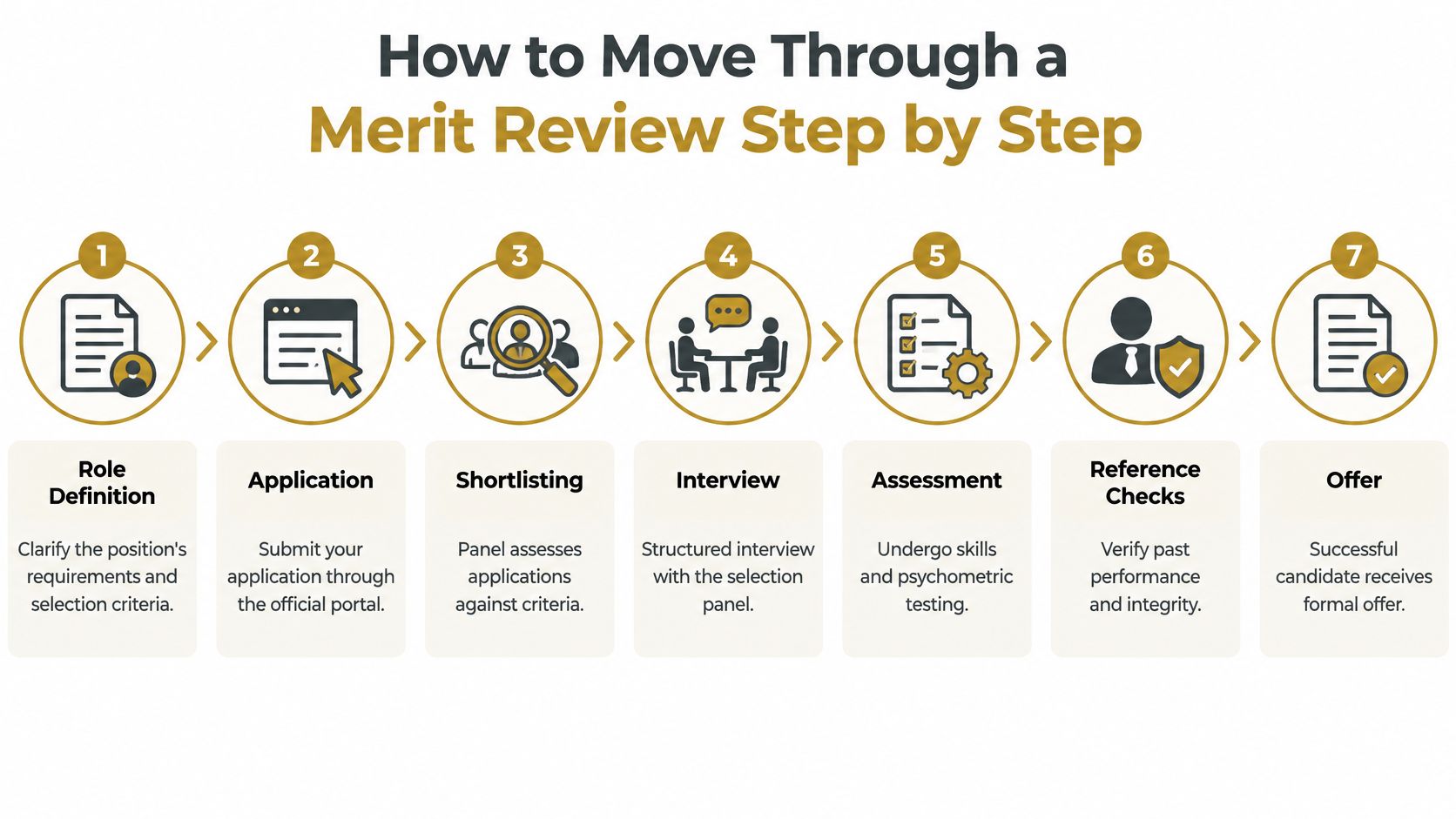
Seven stages separate an application from a public-sector executive appointment. The process rewards evidence against published criteria, and it can continue well after a panel has identified its preferred candidate. Treat each stage as a decision point, not as a formality.
The sequence runs from setting job-related executive, technical and leadership criteria through publication and minimum-qualification screening, panel rating, executive resources review, appointing-authority sign-off and final certification, as outlined in the Congressional Research Service briefing on the Senior Executive Service.
The seven stages, in order
- Match your evidence to the published criteria. Screening is tied to the criteria, not to your overall career story. Answer the stated questions directly, and make each example show the skill or result the panel is assessing.
- Check the closing date first. Announcements can have short application windows. Set your own deadline early enough to tailor the documents and submit before the final day.
- Prove you meet the minimum qualifications. State the relevant qualification clearly, with dates and supporting evidence. Seniority alone does not show that you meet a specific requirement.
- Prepare for competency-based scoring. Panels rate applicants against the competencies in the application pack. Strong evidence in one area will not make up for thin evidence elsewhere.
- Expect executive resources review. The panel's highest-ranked candidates may be recommended, rather than appointed. Write for readers who may not know your profession or agency.
- Wait for the appointing authority's decision. The panel does not make the final appointment. A positive interview is not an offer.
- Allow time for final certification and approvals. Executive core qualifications may require review by an OPM Qualifications Review Board. Eligibility, security and other approvals can also remain outstanding after a preferred candidate is identified.
Competitive selection rewards documented comparative evidence over relationships. Make your record easy to assess at every stage.
Rewrite one accomplishment before you apply
“Led transformation” gives a panel little to score. Replace it with a concrete account: reorganised benefits assessments across two regions to meet a statutory decision deadline, reduced the backlog from four months to six weeks, and documented the change for the agency's audit function.
That example names the work, the duty, the result and how the change was checked. Rewrite your six strongest accomplishments in the same way before you start the application.
Showing Evidence That Scores Well on Diversity Criteria
Appointment panels increasingly treat representation and stakeholder legitimacy as selection variables with scores attached, not as communications goals. A candidate who shows evidence of reaching underserved populations beats a candidate who asserts commitment to diversity, every time.
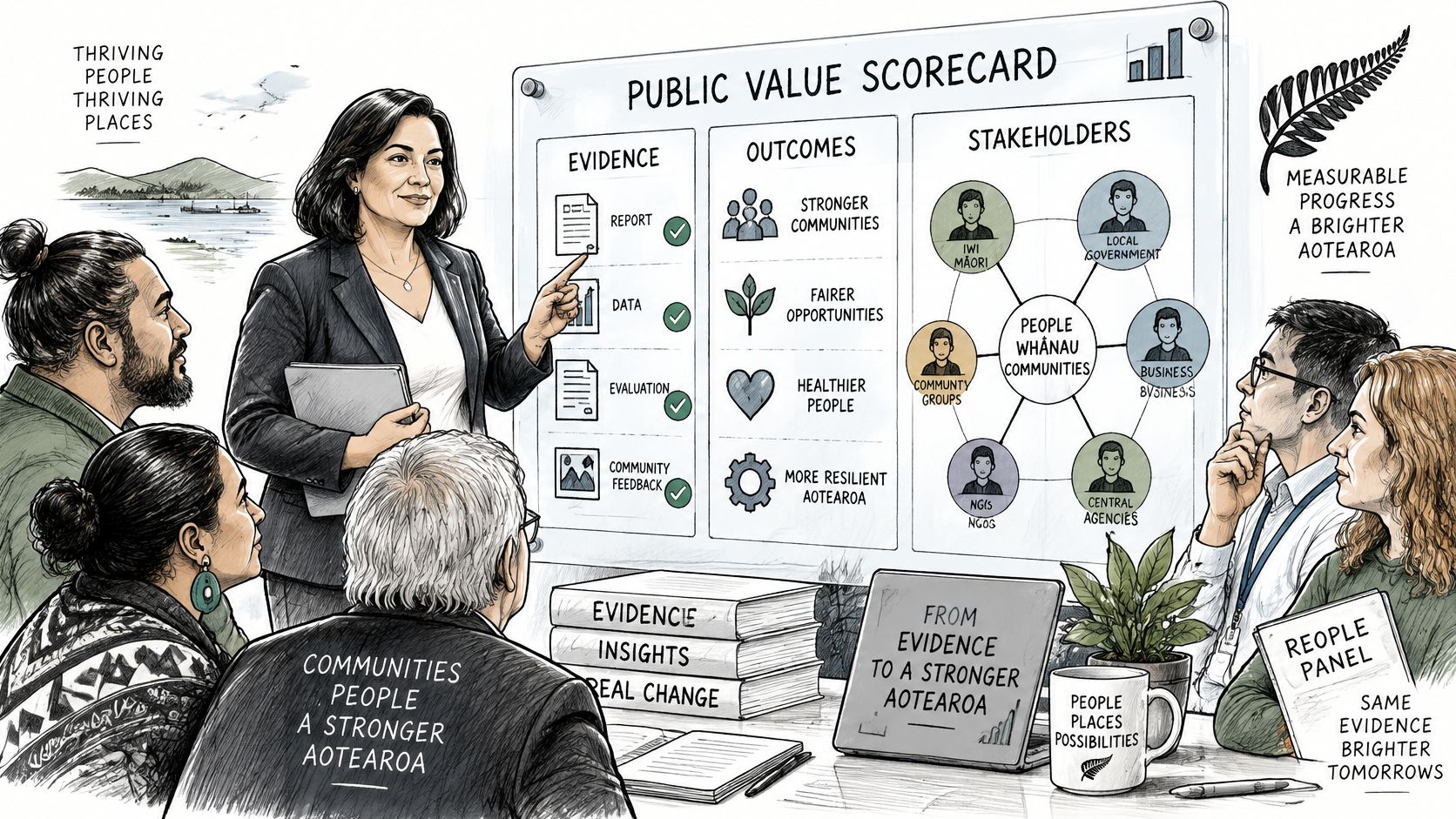
The benchmarks are concrete. Women held 52.1% of Cabinet-appointed public-sector board and committee positions in New Zealand as of 31 December 2024, the fifth consecutive year above 50%, down from 53.9% in 2023, with ethnicity information available for 98.7% of appointed members, according to the 2024 New Zealand public-sector board stocktake. Those figures cover ministerial appointments considered through Cabinet committees, not every board in the country, but they show how formal the representation brief has become.
What a composition gap looks like
Age and disability tell the sharper story. In a Welsh Government review, 56% of responding board members were aged 55 or older against 35% of the Welsh population in the 2021 Census, and 14% identified as disabled against 21% of the wider population, according to the Welsh public appointments diversity review. The same review found 8 of 29 responding bodies held no equality data on board members at all.
That's your opening. If you're under 45, or you have lived experience of disability, or you've run services for a community the board currently doesn't represent, say so with evidence rather than modesty.
The gap between what boards claim and what they do is wide. In a cross-government leadership survey, 96% of respondents said diversity of thought and experience mattered, yet 60% said their own leadership teams were insufficiently diverse, and only 23% measured the share of female applicants, according to reporting on the cross-government gender diversity findings. The same reporting notes that requiring at least two diverse candidates on each interview slate has, in some organisations, increased the hiring rate of diverse candidates by three to four times.
Three pitfalls sink otherwise strong applications:
- A single-token slate. Building one "diverse finalist" proves nothing about the appointment.
- Unstructured interviews. Free-form conversation rewards similarity, not capability.
- Measuring appointments only. Disparity usually starts at eligibility screening or shortlisting.
Prepare four pieces of evidence a panel can score consistently: inclusive service outcomes you can quantify, cross-community consultation you ran, an ethical decision you made and can defend, and results for affected populations. Grade your current CV against those four before you send it, using our board CV grader.
Then close the loop in one sentence of your cover letter: name the composition gap the body has, and state the evidence you bring to it. That single sentence does more than a paragraph about your commitment to inclusion.
Confirm Your Next Move Before You Apply
Before writing an application, choose one target employer level and score a live opening against the six factors. Check the pay band, budget authority, and people authority. If the role falls short on any of those, move on.
For a board seat, SeatSignal offers a Done-For-You Board Placement program. The team hand-picks relevant open roles and prepares director-grade applications suited to each opportunity. Use the board role fit checklist to assess whether a seat fits your experience and interests.
Board appointments depend on decisions by boards, nomination committees, and recruiters. SeatSignal prepares application materials and interview support, but does not guarantee interviews, appointments, or income. Confirm whether a role is paid and complete your own due diligence before applying.
If board service is your next move, review how the placement program works at SeatSignal.
Want a paid board role, done for you?
One handpicked, verified open board role every week, with a director-grade packet tailored for it.
Get Started