Regions Financial Board of Directors Explained
Regions Financial's 2025 board had 14 directors, with 13 independent under NYSE standards and John M. Turner Jr. the only non-independent director; the later 2026 proxy picture reported by Company Atlas shows 13 directors, including 12 independent. For anyone assessing the Regions Financial board of directors, the central question isn't whether independent directors dominate the headcount, but whether they can effectively challenge a chairman who also runs the company.
A director list won't answer that. Shareholder voting, committee responsibilities, lead-director authority, and evidence of current risk expertise provide a more useful test of governance than executive titles alone.
Table of Contents
- Regions Board Size and Independence
- Directors and Committee Seats
- How Shareholders Voted in 2025
- Chair CEO and Lead Director Power
- What Each Committee Oversees
- Skills Against the Next Risk Cycle
- Rules Every Director Must Meet
- Use This Board Picture Next
Regions Board Size and Independence
Independent directors held about 93 percent of the board seats in Regions' 2025 independence assessment, according to the Regions Financial 2025 proxy statement. The filing established a 14-member board effective at the annual meeting, identified 13 directors as independent under NYSE standards, and named John M. Turner Jr., chairman, president, and CEO, as the sole exception.
Regions Financial board snapshot
| Item | 2025 annual meeting | Later report (Company Atlas, 2026 proxy) | What it means |
|---|---|---|---|
| Board size | 14 directors | 13 directors | One fewer seat in the later report |
| Independent directors | 13 of 14, about 93 percent | 12 of 13 | A large independent majority in both reports |
| Non-independent director | John M. Turner Jr., chair, president and CEO | One non-independent seat; identity not reported | The sole named insider combined the chair and CEO roles |
The later headcount comes from Company Atlas's Regions Financial profile, which reports 13 directors, including 12 independent directors, based on the company's 2026 proxy. A smaller board changes committee workloads and coverage. It does not, by itself, show weaker independent oversight. Under the earlier filing, directors were elected to one-year terms running to the 2026 annual meeting, so the full slate faced shareholders annually.
What the snapshot establishes
Start with size. A change in headcount should trigger a review of which capabilities and committee workloads changed, rather than an automatic judgment about governance quality. Losing a seat matters differently if the departing director supplied scarce audit expertise than if the remaining directors offer comparable experience.
Next, consider independence. The table distinguishes a formal eligibility determination from an assessment of behavior. An independent director can qualify under listing standards without necessarily asking difficult questions, demanding better information, or resisting an attractive but poorly controlled strategy.
The management seat deserves separate attention. Combining executive and board leadership concentrates responsibility for running the business and guiding board discussion in the same person. Independent directors may still hold real influence under that arrangement, which makes their access to information and their control over deliberations the variable worth testing.
Committee independence is the more operational finding
The 2025 proxy reported fully independent Audit, Compensation and Human Resources, Nominating and Corporate Governance, Risk, and Technology committees. The fully independent committee structure is consequential because directors don't perform every oversight task in plenary meetings. They examine specialized issues through committees, then bring judgments and unresolved questions to the full board.
An independent majority can therefore operate through several distinct channels. Audit directors can question reporting judgments, risk directors can challenge proposed exposures, and compensation directors can examine whether incentives encourage conduct inconsistent with the bank's objectives.
Analyst's distinction: Independence establishes who can exercise oversight without a management affiliation. Effectiveness depends on what those directors ask, what information they receive, and what happens when they disagree.
For a prospective director, the snapshot should prompt a practical question: Which committee would need your judgment? A prestigious executive background falls short if it doesn't address a specific oversight responsibility. For an investor, the corresponding question is whether the company provides enough evidence to connect independent membership with meaningful challenge.
Neither question can be settled by counting seats alone.
Directors and Committee Seats
A useful roster separates confirmed identity, independence, and committee assignment. An executive biography can't be read as a committee seat.
| Director | Confirmed role | Independence status |
|---|---|---|
| John M. Turner Jr. | Chairman, president and CEO | Non-independent |
| Ruth Ann Marshall | Lead independent director | Independent |
| Roger W. Jenkins | Director, re-elected | Independent |
| Alison S. Rand | Director, re-elected | Independent |
| Ten remaining incumbents | Individual identities not reproduced in this roster | Independent under the determination excluding Turner |
Committee memberships aren't itemized in this snapshot. Confirm current assignments in the company's latest proxy statement before treating any director's background as evidence of a specific oversight role.
Verify assignments before interpreting influence
A finance executive might contribute to risk oversight. A technology executive might sharpen audit questioning. Neither possibility establishes an appointment, and the seat a director holds determines which information reaches them and which decisions they can challenge directly.
Before drawing conclusions from a roster, check three things:
- Membership. Separate committee members from committee chairs. A chair sets the agenda and controls which questions reach the table; a member works within it.
- Responsibility. Read the committee charter rather than inferring remit from the name. Two committees with similar titles can carry different authority.
- Capacity. Weigh the preparation and availability the assignment demands, including special sessions and crisis availability, not just the scheduled meetings.
The board time commitment calculator helps organize that capacity assessment before you pursue a role. Treat the result as a planning aid; the harder questions about meeting preparation, regulatory demands, and crisis availability still need direct answers from the board.
A seat on the roster establishes status. A seat on a committee establishes reach.
How Shareholders Voted in 2025
John M. Turner Jr. attracted 50,670,867 votes against his re-election, the largest dissent of any Regions director on the 2025 ballot. The 2025 annual meeting results filing records the full results and confirms that all 14 incumbent directors were elected for one-year terms expiring at the 2026 annual meeting, or until successors were elected and qualified.
2025 director election votes
| Director | Votes for | Votes against |
|---|---|---|
| Roger W. Jenkins | 693,848,800 | 2,443,541 |
| Alison S. Rand | 693,809,335 | 2,401,396 |
| Ruth Ann Marshall | 652,291,477 | 44,085,009 |
| John M. Turner Jr. | 643,724,362 | 50,670,867 |
Fourteen incumbents stood in total. The filing lists individual results for the entire slate, and the four directors above mark where support ran strongest and where it thinned.
Every listed director also had 104,174,978 broker non-votes, representing shares brokers didn't vote on the director-election proposal.
What an against vote can show
The pattern is sharper than the raw totals suggest. Turner and Marshall, the two directors who hold the board's leadership titles, each drew against tallies in the tens of millions, while Jenkins and Rand drew opposition in the low millions. That gap makes the leadership arrangement a reasonable subject for investor questions.
The filing doesn't explain individual shareholders' motives. It doesn't establish that opposition concerned combined leadership, a particular committee decision, compensation, or any director's personal performance.
Voting caution: An against vote identifies dissent. It doesn't identify the reason for that dissent.
The disciplined reading is narrower than a governance verdict. Shareholders elected every nominee, yet support was uneven across the slate, and the dissent concentrated on the chair-CEO and the lead independent director rather than spreading evenly across the board.
Annual elections give investors a recurring opportunity to register that distinction. For an analyst, the next useful evidence is company engagement disclosure and any explanation of governance changes, rather than speculation about what a particular voting institution intended.
Chair CEO and Lead Director Power
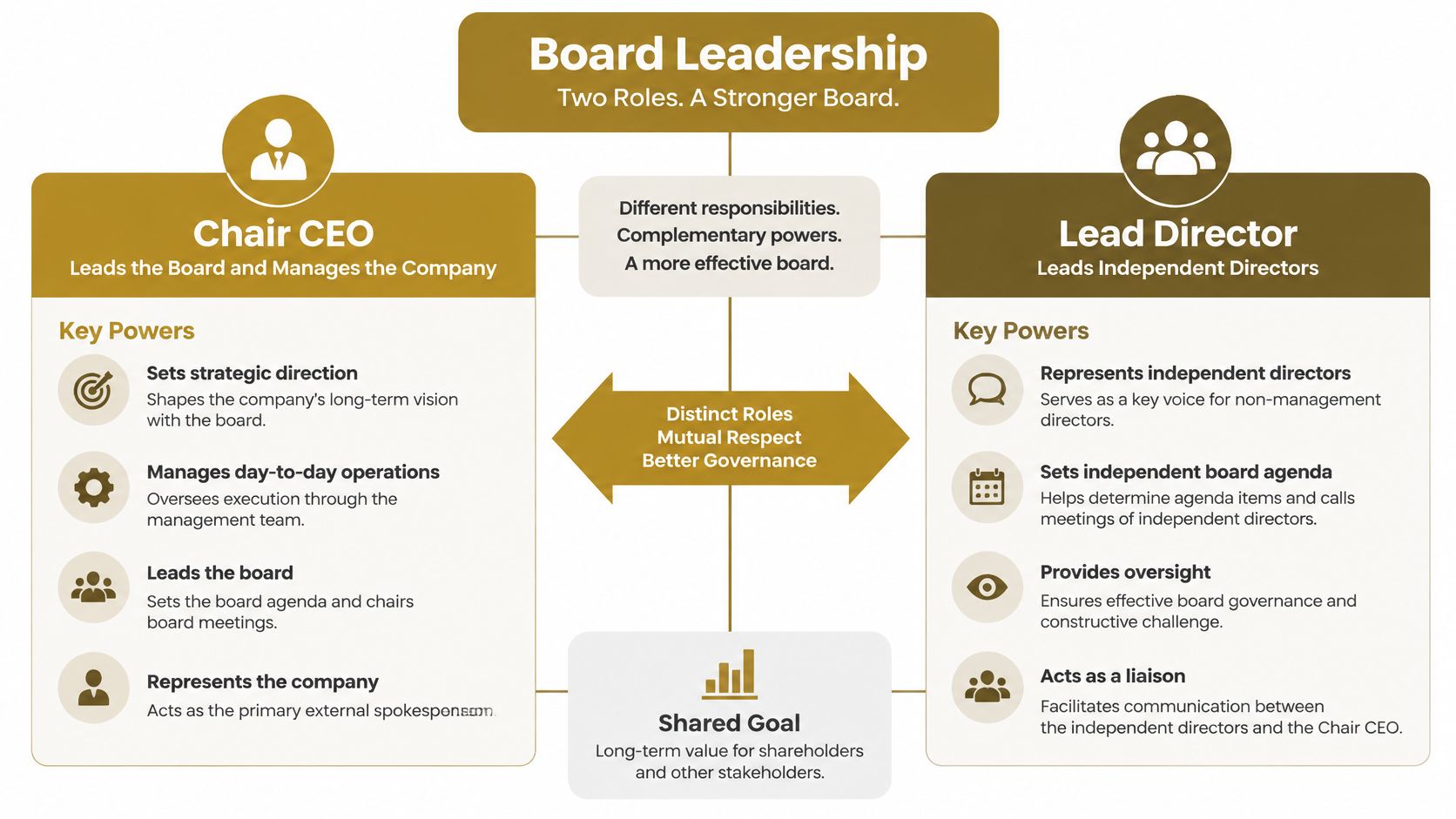
Titles alone don't establish the balance of power. The 2025 governance disclosure identifies Turner as chair and CEO, Marshall as lead independent director, and the board's view that this arrangement best served the company at that time.
The distinction between executive leadership and independent challenge is illustrated below.
A chair-CEO challenge checklist
These are powers to verify, not powers to assume from Marshall's title:
- Agenda-setting: Can the lead director shape meeting agendas and require additional information?
- Executive sessions: Can independent directors meet without management, and who can convene them?
- Succession oversight: Can they test the executive bench rather than only review management's preferred successor?
- CEO evaluation: Who controls the assessment of the executive who also chairs board meetings?
- Independent advice: Can directors obtain outside expertise without management approval?
These mechanisms matter when directors challenge liquidity assumptions, cybersecurity readiness, regulatory remediation, or capital allocation. Independent committees offer additional routes for scrutiny, but committee membership alone doesn't demonstrate how disagreements are resolved.
The leadership discussion below provides a further viewing resource.
For candidates comparing board of directors positions, ask how independent directors escalate unresolved concerns. A convincing answer describes authority, information access, and decision processes, not merely a collegial relationship with the CEO.
The test is practical: Can independent directors examine the CEO's judgment without depending on the CEO's permission?
What Each Committee Oversees
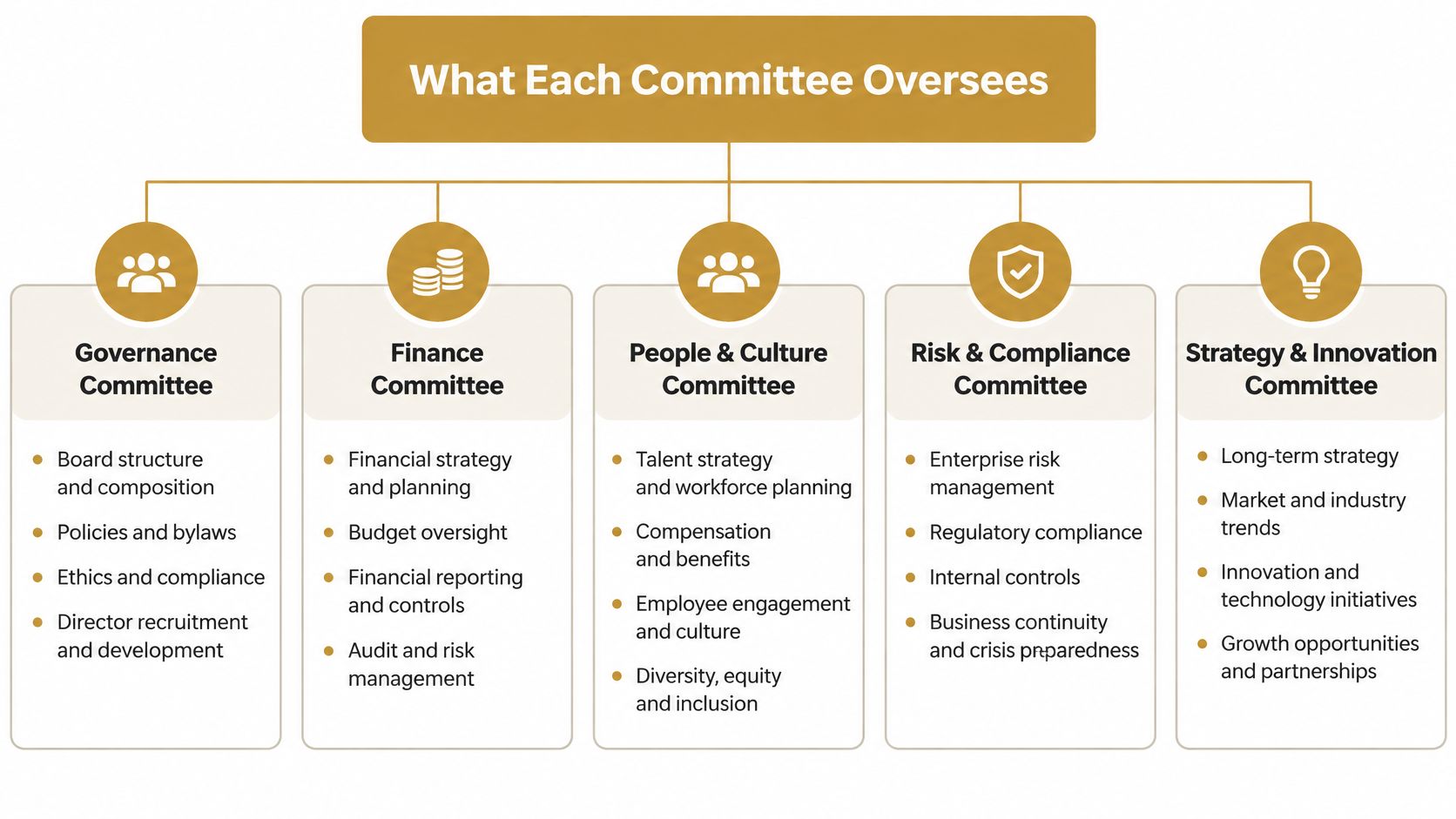
Think of the full board as the town square and the committees as workshops where directors examine detailed evidence. The important connection is the reporting route between them, because a specialized finding may have consequences beyond the committee that first examines it.
Regions' 2026 proxy statement describes a structure in which the Risk Committee annually approves the Risk Management Framework, including how the board and its committees establish risk-tolerance levels. It also assigns Audit oversight of internal controls over financial reporting, financial disclosure integrity, and legal and regulatory compliance, with committees regularly reporting to the full board.
The diagram provides a general illustration of committee-based oversight, rather than a substitute for Regions' actual committee names and charters.
Risk and Audit ask different questions
Risk examines what exposures the organization is prepared to accept and how directors should recognize unacceptable departures. A useful candidate discussion would connect proposed tolerances to observable indicators, escalation triggers, and management responses.
Say management proposes expanding a lending activity. The oversight question isn't whether projected returns look attractive. Directors should ask what deterioration would make the strategy unacceptable, how management would detect it, and who would authorize corrective action.
Audit approaches the same business through reporting and control integrity. Are the relevant balances supported? Do controls work as intended? Are significant judgments explained clearly enough for directors to challenge them?
That distinction matters for a finance candidate. Producing accurate accounts is operational experience; assessing whether management's reporting process deserves reliance is board-level oversight. The strongest application explains both the candidate's technical understanding and their ability to challenge the process without taking it over.
Other committees connect people, renewal, and technology
The remaining committee areas require different forms of judgment. Their precise boundaries should be checked against the applicable charters, especially where responsibilities overlap.
| Committee area | Concrete oversight job to examine | Candidate evidence to prepare |
|---|---|---|
| Compensation and Human Resources | Test whether executive incentives support the intended behavior | Examples of evaluating pay, performance measures, succession, or human-capital risk |
| Nominating and Corporate Governance | Assess board composition, renewal, and governance arrangements | Evidence of evaluating capability needs, independence, and succession |
| Technology | Challenge technology-related exposures and management's response | Experience overseeing cybersecurity, transformation controls, or technology dependencies |
Technology oversight, for example, shouldn't stop at asking whether a project is on budget. Directors can ask how management will preserve service continuity during implementation, validate security controls, and respond if a critical supplier fails.
Compensation scrutiny likewise isn't limited to judging the size of an award. A director can examine whether performance measures encourage durable results or reward behavior that creates difficult-to-observe risks.
Translate operating experience into oversight evidence
A candidate who says they managed a complex function hasn't yet explained how they'd contribute as a director. The missing evidence is their ability to assess management's reasoning, identify a weak control, and request a proportionate response.
Prepare a short case with the issue, management's proposal, the challenge you raised, the evidence considered, and the resulting decision. Keep the focus on judgment rather than claiming personal ownership of every operational outcome.
The committee map is straightforward: risk appetite at Risk, reporting integrity at Audit, pay at Compensation and Human Resources, board renewal at Nominating and Corporate Governance, and technology exposure at Technology.
Skills Against the Next Risk Cycle
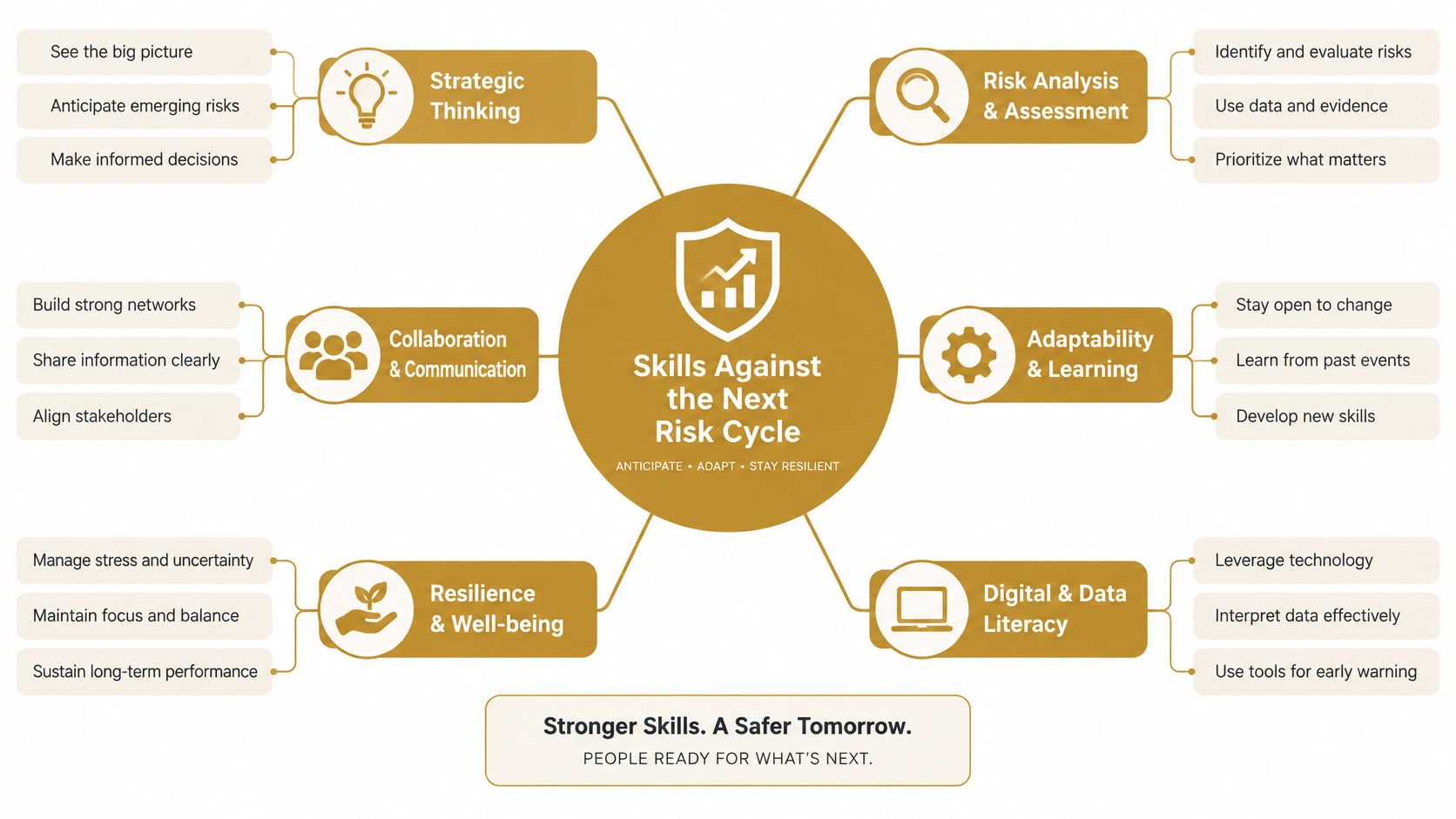
Regions' public director profiles identify backgrounds spanning utility leadership, cybersecurity and product privacy, energy and sustainability, insurance, payments, legal and compliance, automotive, and banking. Those backgrounds are starting points for evaluating capability, not proof that every emerging risk has a designated expert.
Director skills mapped to bank risks
| Risk area | Public director background | Committee home | Gap to verify |
|---|---|---|---|
| Credit, liquidity and risk appetite | Banking background | Risk | Recent risk-committee experience |
| Cybersecurity and third-party technology | Cybersecurity and product privacy | Technology | Third-party technology risk not named |
| Consumer and regulatory change | Legal, compliance and payments | Audit or Risk | Fast-moving financial regulation not named |
| Climate-related credit exposure | Energy and sustainability | Risk | Link to credit decisions not named |
| Operational resilience | Utility leadership and insurance | Risk or Technology | Evidence of controls oversight, not operations |
| Artificial intelligence governance | Not explicitly identified in the profile summary | Technology | Not evident in public profiles |
The committee homes above are an analytical fit map, not a statement of individual assignments. Financial reporting and capital-markets expertise would also warrant examination for Audit, while payments experience may support questions about fraud and digital identity.
The visual highlights broader capabilities that support risk judgment.
Read gaps as questions
Payments plus cybersecurity can support a more specific technology-oversight case than an undifferentiated banking résumé. Utility or insurance leadership supports an operational-resilience case only if the director can demonstrate relevant controls oversight.
An unnamed capability isn't a confirmed absence. Artificial intelligence governance, supplier dependencies, and changing regulation require verification beyond broad biography labels.
For executives targeting financial services boards, use a disciplined test: Name the risk, identify the committee, and distinguish current oversight expertise from a past industry affiliation.
Rules Every Director Must Meet
Regions' governance principles establish obligations, not merely desirable résumé characteristics. The Corporate Governance Principles require at least three board members and a majority satisfying NYSE and applicable legal independence requirements; they also set expectations for meeting participation, shareholder-meeting attendance, and committee reporting.
The same principles place management oversight with the board as a whole, acting on shareholders' behalf.
The board's duty is to oversee management on behalf of shareholders, not to become an extension of management.
Check eligibility before positioning your expertise
Independence is a formal assessment. A candidate's personal confidence that they can be objective doesn't replace examination under the applicable standards.
Prepare an accurate account of relevant relationships and commitments. Where a circumstance might raise a question, disclose it early enough for the company to evaluate it rather than trying to explain it after nomination discussions have advanced.
The practical sequence is simple:
- Establish eligibility: Identify relationships that require review under the company's independence process.
- Assess availability: Consider board, committee, shareholder, and unscheduled meeting demands.
- Document judgment: Prepare examples showing how you evaluate management rather than merely manage a function.
- Understand reporting: Ask how committee findings and unresolved concerns reach the full board.
A candidate who clears eligibility but lacks capacity isn't ready for the assignment. Conversely, an available executive without relevant judgment may still struggle to contribute.
Attendance means preparation and participation
The principles expect directors to attend and participate in all board and applicable committee meetings, as well as attend shareholder meetings. That expectation should shape a candidate's capacity assessment before they accept nomination.
Use the Over-Boarding Checker to organize existing commitments. Then test the practical realities yourself: competing meeting calendars, travel, preparation, and the possibility that multiple organizations need urgent attention at the same time.
Participation also requires reading across disciplines. A technology specialist can't treat financial reporting as someone else's concern, just as a finance specialist can't ignore operational dependencies because another director has cybersecurity experience.
Committee reporting prevents isolated oversight
Committee chairs must report meeting highlights to the full board at the next regularly scheduled board meeting. That requirement matters because a finding can extend beyond its original category.
A control weakness may affect financial reporting, customer outcomes, and technology remediation. Directors need enough shared information to judge those connections without assuming another committee has resolved them.
Before relying on a third-party roster, verify the principles governing minimum size, majority independence, attendance, and chair-to-board reporting. Those rules tell a candidate what the appointment demands, not just whether their biography appears to fit.
Use This Board Picture Next
The investor reading
Read the governance structure and the vote results as one file. Strong independence on paper can still leave open questions about who controls the agenda, while a contested election can raise a challenge without proving poor oversight.
The useful test is evidence of challenge. Ask how directors receive information, when they commission outside advice, how they evaluate the chair and chief executive, and where disagreement gets recorded or escalated. A specific answer names accountable decision makers and shows a repeatable process. A vague answer usually means the board picture is still incomplete.
The candidate reading
Turn the same review into a committee-specific evidence file. Name the decisions you could oversee, the management assumptions you know how to test, and the conditions that would make you insist on escalation. Tie each point to a board need already visible in composition, committee workload, or the next risk cycle.
Use the Board Offer Due Diligence Checklist before accepting an appointment. The right question is whether the role's responsibilities, information flow, and time demands match what you can deliver.
SeatSignal's Done-For-You Board Placement hand-picks board matches, prepares a director-grade CV for each role, and provides interview preparation specific to each board. The packet can include a cover letter customized to the board charter and gap, a fit memo, and an independence attestation, with the warmest available route mapped so outreach reaches a name rather than a cold inbox. Every plan includes human-checked roles, pre-public matching across sectors, board-specific interview preparation, placement-team review, and warm-path introductions when available.
That preparation does not decide the outcome. Boards, nomination committees, and recruiters make appointment decisions, and every approach goes out in your own name.
Start with the committee you could credibly serve and the evidence behind that claim. A focused oversight case carries more weight than a broad statement that you are ready for a board.
SeatSignal offers Done-For-You Board Placement that connects your experience to relevant opportunities and prepares polished director-grade applications and interviews. If this analysis has clarified your fit for audit, risk, technology, or another committee, visit SeatSignal to turn that evidence into a focused board search.
Want a paid board role, done for you?
One handpicked, verified open board role every week, with a director-grade packet tailored for it.
Get Started