Risk Committee Responsibilities: A Director's Guide
You're reviewing a board opportunity, and the chair asks whether you'd join the risk committee. The charter mentions cybersecurity, compliance, internal controls and emerging risks. The audit committee's charter covers much of the same ground, and nobody has explained who takes the lead when a serious incident crosses both mandates.
That's the question to settle before accepting. Risk committee responsibilities aren't just a list of subjects to monitor. They're a set of decision rights, information rights and escalation duties that should make clear who challenges management, who acts and who brings unresolved concerns to the board.
Table of Contents
- What a Risk Committee Is Responsible For
- Who Holds Which Risk Responsibility
- Where Risk Oversight Usually Sits
- Connecting Risk Oversight to Audit and Cyber Reporting
- Overseeing Fast-Moving Risks Without Running the Business
- What Risk Committee Members Are Expected to Do
- Confirm the Mandate Before You Accept a Seat
What a Risk Committee Is Responsible For
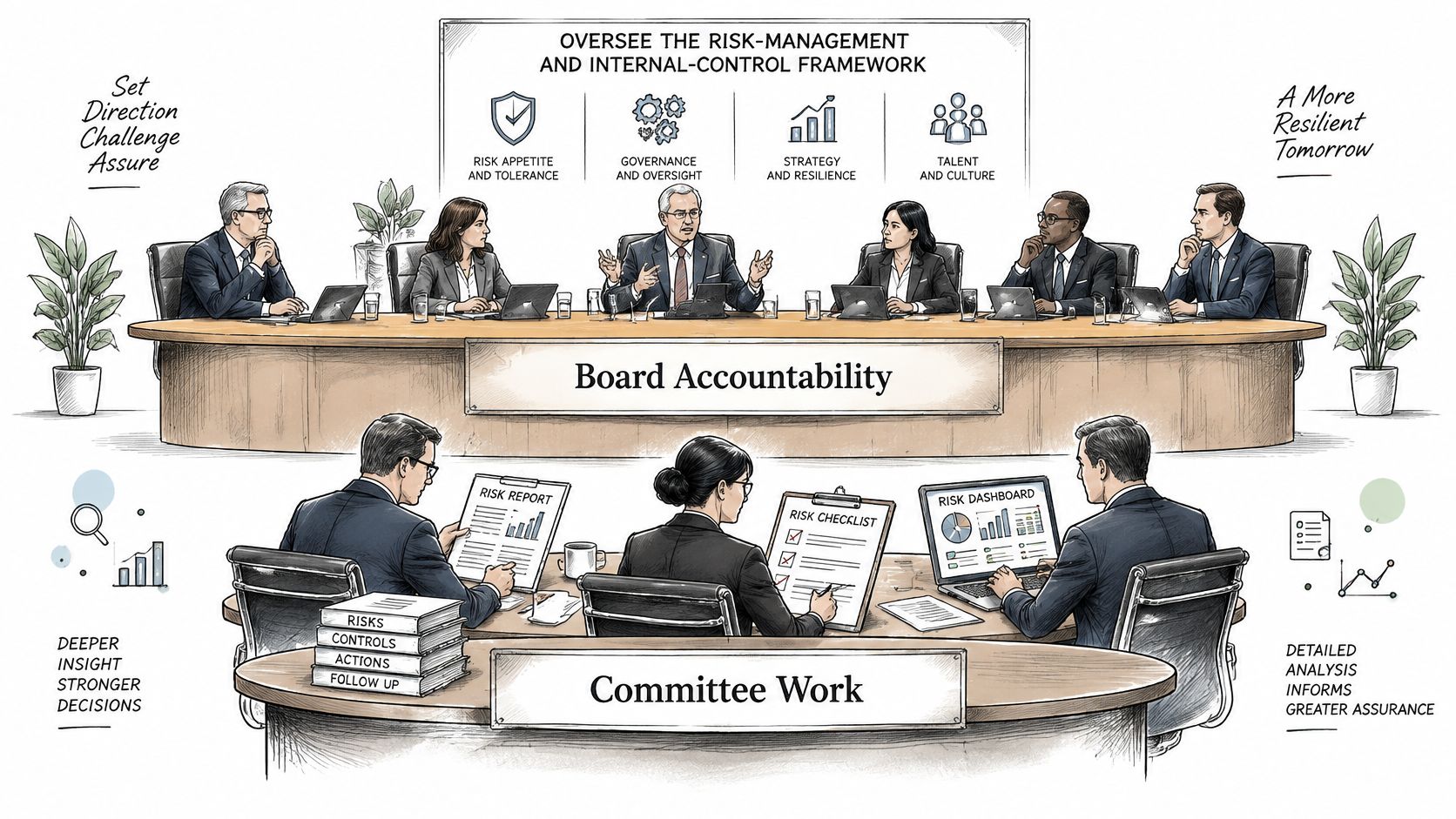
The full board retains ultimate accountability for the risk-management and internal-control framework. A risk committee performs the detailed oversight that helps directors exercise that responsibility. The captain stays responsible for the course even when a navigator reads the charts.
The Financial Reporting Council's governance framework allows a separate risk committee composed of independent non-executive directors to review internal financial controls and risk management, but delegation doesn't transfer accountability: the board must reach its own conclusions on committee recommendations.
Say a company plans to depend on an external provider for a business-critical service. Management assesses the provider and proposes controls. The risk committee challenges the exposure, tests the contingency arrangements and recommends whether the proposed dependence fits the company's appetite. It doesn't select the provider or run the service.
The distinction between board accountability and detailed committee work should be visible in the governance structure.
Test the charter against the core duties
A useful charter turns broad oversight language into work directors can verify:
- Risk appetite and tolerance. Approve or recommend the risks the organization is willing to accept, within the authority delegated by the board. Require management to translate that appetite into measurable thresholds, escalation triggers and delegated authorities. A statement that the company has little appetite for disruption needs an operational meaning, not just reassuring wording.
- Risk assessment. Challenge whether management regularly reassesses principal and emerging risks, including interactions between them. Dependence on a provider, for example, may create operational, cybersecurity and financial exposure simultaneously.
- Control monitoring. Examine evidence that relevant controls work, rather than accepting confirmation that policies exist. A documented recovery procedure isn't the same as a successful recovery test.
- Mitigation and remediation. Track corrective actions through closure, with named owners, deadlines and evidence of completion. Ask whether an overdue action leaves exposure outside appetite and who has authority to accept that position temporarily.
- Board reporting. Ensure material risks reach the full board, with clear recommendations and unresolved disagreements. Information rights should also allow relevant findings to reach audit and other committees.
Connect oversight to evidence and reporting
Under provisions 28 and 29 of the UK Corporate Governance Code 2024, the board should thoroughly assess emerging and principal risks, explain the assessment and mitigation in its annual report, monitor the framework and review its effectiveness at least annually, covering material financial, operational, reporting and compliance controls.
For the proposed service provider, that means the committee needs more than a procurement update. It needs evidence about dependencies, tested controls, remaining exposure and the consequences if management's assumptions prove wrong.
Charter test: What can the committee approve, what can it only review, and what must it escalate?
Those questions expose ambiguous verbs such as support, consider and oversee. Each should connect to a defined output, whether that's a recommendation, approval, challenge recorded in the minutes or notification to the board.
The recurring cycle is straightforward: identify risks, assess exposure, monitor controls, review effectiveness and report conclusions. A committee that receives a risk register but never tests those connections isn't getting enough evidence to perform its remit.
Who Holds Which Risk Responsibility
Allocation at a glance should distinguish decision-making, oversight and independent testing. The following model is a starting point for a charter, not a substitute for checking the organization's governing requirements.
Risk responsibilities by party
| Party | Owns | Does not own |
|---|---|---|
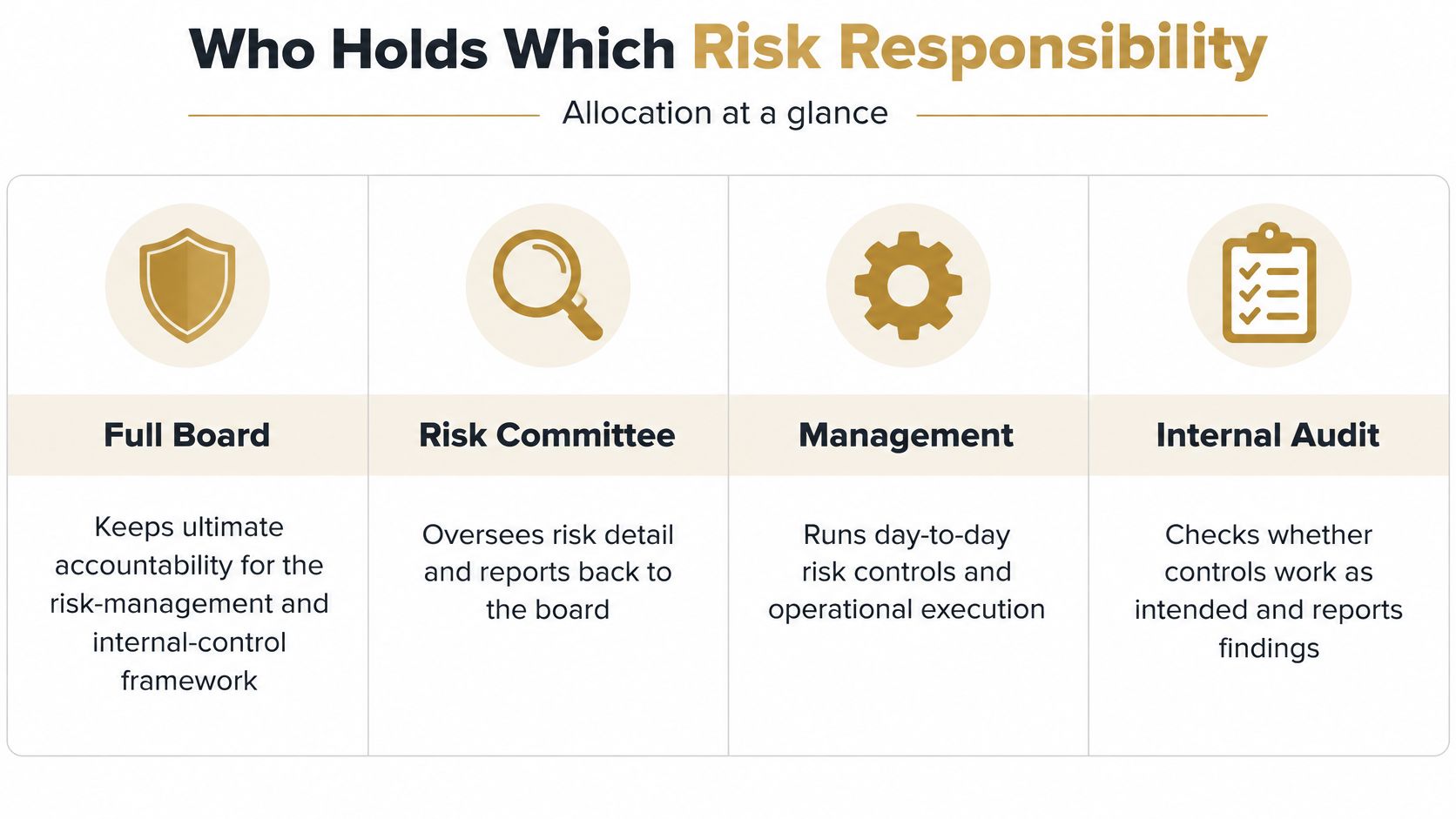
| Full board | Ultimate accountability for the risk and control framework; final conclusions on committee advice | Day-to-day risk decisions |
| Risk committee | Challenge on risk appetite, exposure, stress testing and remediation tracking | Running controls or setting operational limits |
| Audit committee | Financial reporting, internal controls and the audit plan | Strategic risk appetite decisions |
| Management and chief risk officer | Risk decisions, control operation and day-to-day risk reporting | Independent assurance on its own controls |
| Internal audit | Independent testing of controls and reporting of gaps | Setting risk appetite or owning controls |
The allocation can also be understood by separating the parties' main functions.
Settle overlap through decision rights
The difficult cases aren't neatly contained in a department. Consider an AI application that produces unreliable customer decisions: technology specialists may examine performance, compliance may assess obligations, audit may test controls, and the risk committee may challenge aggregate exposure.
The charter should identify the lead oversight committee, the operational risk owner and the route for resolving disagreement. Management should set operating limits within approved appetite and delegated authority; the risk committee challenges whether those limits adequately constrain exposure.
The FRC's corporate governance guidance calls for explicit roles, responsibilities and authorities, supported by reporting from management, internal audit, external audit and other appropriate functions. Directors shouldn't rely solely on management's embedded monitoring.
Before an incident, settle these practical questions:
- Decision authority. Who can authorize continued operation, suspend an activity or accept temporary exposure?
- First notification. Which executive and committee chair receive the initial breach report, and who notifies other relevant bodies?
- Materiality review. Which committee challenges management's classification, with legal and disclosure specialists involved where appropriate?
- Disagreement. Who brings conflicting committee conclusions to the full board?
For a complementary discussion of board governance, use the video below.
When comparing board of directors positions, examine the interfaces around the proposed committee, not merely its title. If a material risk has no named owner, the charter is incomplete and the board should resolve the gap before an incident forces the decision.
Where Risk Oversight Usually Sits
A dedicated risk committee isn't the default home for every risk. In the 2024 Audit Committee Practices survey summarized by the Harvard Law School Forum on Corporate Governance, respondents assigned oversight as follows.
Who holds risk oversight, by risk area
| Risk area | Audit committee | Full board | Dedicated risk committee |
|---|---|---|---|
| Enterprise risk management | 47% | 35% | 15% |
| Cybersecurity, all respondents | 58% | 25% | Not stated in the cited summary |
| Cybersecurity, financial-services companies | 38% | Not stated in the cited summary | 26% |
Unstated cells aren't zero, and the listed categories shouldn't be treated as an exhaustive allocation. The practical finding is that directors can't infer responsibility from a committee name or assume that another company uses the same arrangement.
The same Harvard Forum summary describes a separate 2024 survey of more than 700 UK audit-committee members and chairs: 82% believed the full board oversaw mission-critical risks, while audit committees reported responsibility for legal and regulatory compliance at 80%, data governance at 70%, cybersecurity and information technology at 62%, and enterprise-risk-management systems and processes at 61%. These figures describe different questions and survey populations, not a single interchangeable benchmark.
Read the workload behind the title
A board may reserve strategic discussion of a risk while asking a committee to examine the supporting systems. That can be sensible. The difficulty comes when directors assume that strategic discussion also includes detailed testing, or that a committee's technical review settles the strategic decision.
For example, the audit committee might review evidence that cybersecurity controls operated effectively. The full board might decide whether a digital expansion creates an acceptable dependence on shared infrastructure. Those are related judgments, but they require different information.
A committee's title tells you where to start your questions. Its agenda and minutes tell you where the work actually sits.
Before accepting a seat, compare the charter with the annual agenda, management reporting calendar and recent minutes. Look for subjects repeatedly deferred, discussions with no conclusion and risks routed between committees without a clear recipient.
Use the Board Role Fit Checklist to organize the comparison between the role and your experience. A finance background may support strong control challenge, but it doesn't automatically prepare a director to assess technology concentration or operational recovery assumptions.
The conclusion isn't that every board needs another committee. It's that the written allocation must match the actual workload, with enough time and expertise assigned to the committee doing the work.
Connecting Risk Oversight to Audit and Cyber Reporting
A material risk can appear in several reports without anyone assembling a complete view. Compliance may confirm that a policy exists, internal audit may identify weak implementation, and management may still report the overall exposure as acceptable.
The risk committee should connect those findings through an assurance map. The G20/OECD Principles of Corporate Governance connect oversight of disclosure, internal controls, audit matters and risk-management systems, while recognizing that committee structures differ by jurisdiction and organization.
Map the evidence behind each material risk
An annual assurance map should show the contribution of management controls, compliance testing, internal audit, external audit and specialist reviews. It should also distinguish what each provider tested from what directors might assume it tested.
| Assurance-map field | What directors should be able to establish |
|---|---|
| Accountable owner | Who answers for the exposure and corrective action |
| Defined controls | What prevents, detects or contains the risk |
| Key risk indicators | What signals deterioration or an appetite breach |
| Assurance evidence | Who tested what, with what findings and limitations |
| Board reporting decision | What requires escalation, recommendation or approval |
Say a company relies on a payment-processing platform. An external audit opinion shouldn't be treated as proof that the company can recover from a prolonged outage. Directors should ask which recovery arrangements were tested, under what conditions and whether unresolved findings affect the company's exposure assessment.
The committee should challenge assurance gaps, duplicated testing and unsupported assertions. Direct access to the chief risk officer and internal auditor helps directors understand whether the apparent agreement in a board pack conceals different underlying conclusions.
Apply the cyber disclosure test
For U.S. public companies, SEC Regulation S-K Item 106 requires annual-report disclosure of cybersecurity risk-management processes, if any; material effects or reasonably likely material effects; management's role and relevant expertise; and board oversight, including the responsible committee where applicable and how it receives information.
The rule doesn't prescribe a single committee structure. It does require companies to explain a governance process that directors should recognize from practice.
Ask who receives a breach notification first, then confirm that the charter and incident protocol give the same answer. Technology oversight may address systems architecture and investment, while risk oversight examines exposure and resilience; the reporting route must connect them without delaying necessary action.
Traceability is the standard: a material exposure should connect to an owner, controls, indicators, assurance evidence and a board-level reporting decision.
Overseeing Fast-Moving Risks Without Running the Business
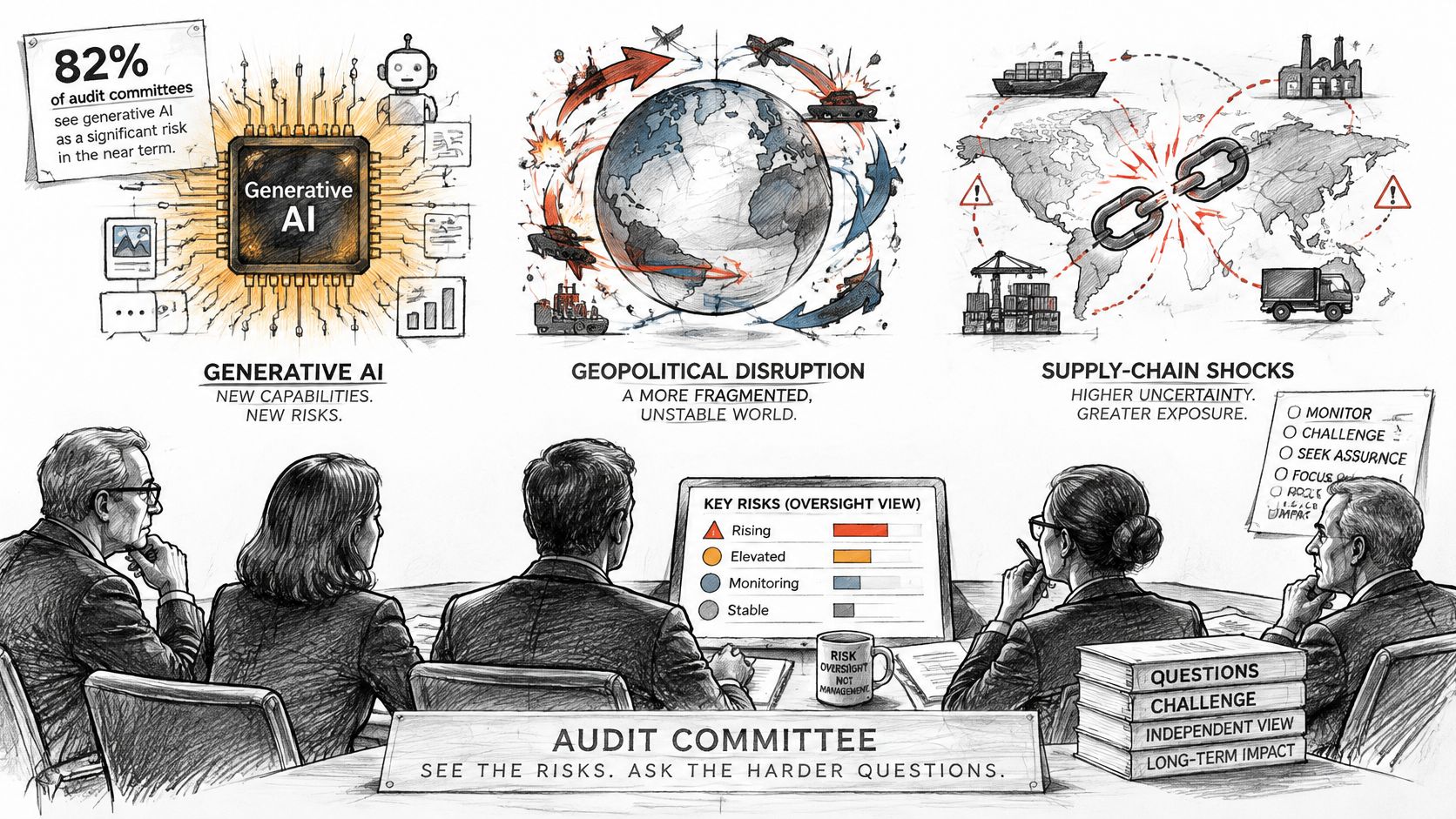
Discussing an emerging risk isn't the same as overseeing it effectively. In KPMG's audit committee survey, 82% of audit committees reported significant generative AI discussions and 78% had at least some GenAI oversight, while respondents identified geopolitical risk as a potential oversight gap at 36% and supply-chain risk at 28%.
The committee's job isn't to predict every disruption or review every operational choice. It's to test whether management can detect, contain, communicate and recover when assumptions fail.
These topics require challenge across technical and business disciplines.
Replace activity reports with forward-looking evidence
A useful dashboard combines leading indicators, scenario analysis, concentration measures, control-testing results, appetite breaches and overdue remediation. It should distinguish measured exposure from areas where management has weak information.
For AI, that might mean changes in error patterns, human-review exceptions and dependence on an external model provider. For supply chains, directors could examine supplier concentration, alternative sourcing readiness and the assumptions behind recovery estimates.
Management should explain uncertainty rather than hide it behind a reassuring status label. Ask who remains accountable for automated decisions, what data limitations affect the assessment and which conditions would invalidate the current conclusion.
Ask questions that test preparedness
Use questions specific enough to produce evidence:
- Before losses appear. Which leading indicator would trigger escalation, who monitors it, and what action follows a breach?
- When assumptions shift. How does management retest its assessment if model performance deteriorates, a supplier becomes unavailable or geographic concentration increases?
- At board level. What concise information lets directors challenge the conclusion without reviewing individual operating decisions?
Say management presents an alternative supplier as its contingency. The committee should ask whether the alternative is qualified, has usable capacity and depends on the same vulnerable infrastructure. Directors shouldn't negotiate the supply contract themselves.
Oversight boundary: Require evidence that the contingency can work. Don't become the team responsible for executing it.
Prospective members can use the Board Readiness Assessment to identify where they need further preparation. The relevant skill isn't knowing every technical detail; it's recognizing an unsupported assumption and asking for an answer management can substantiate.
What Risk Committee Members Are Expected to Do
Knowing the charter is only the starting point. Members must be able to interpret the evidence, prepare for discussion and challenge management without taking over its responsibilities.
Build competence and protect independence
Assess your understanding of the company's risk types candidly. As a practical composition check, the committee should include someone capable of interpreting technology, data and financial-exposure reports, while avoiding dependence on a single specialist.
Check the applicable independence requirements and disclose relationships that could affect judgment. Ties to management, advisers or vendors whose risks the committee reviews deserve attention before appointment, not only when a vote arises.
- Competence. Request targeted briefings where you can't yet test management's assumptions. Don't confuse unfamiliar terminology with an adequate explanation.
- Independence. Disclose conflicts promptly and follow the organization's process for managing participation.
- Preparation. Read the pack, compare changes in exposure and follow unresolved actions between meetings.
Challenge evidence and maintain discipline
The OECD's governance guidance for state-owned enterprises treats risk systems as integral to organizational objectives and emphasizes regular monitoring, reassessment and adaptation. A member's questions should therefore connect risk reporting to what the organization is trying to achieve.
Ask why controls failed, whether remediation addresses the cause and what evidence supports closure. Press on missing assurance and unnecessary duplication, and ensure unresolved concerns or dissent are accurately recorded.
Respect information rights and confidentiality. Don't privately direct employees or retain material concerns inside the committee when the board needs to act.
Use the Board Time Commitment Calculator to account for preparation, follow-up and exceptional incidents, not just scheduled meetings. Ask the chair how many meetings the committee holds each year and how often it meets without management present.
Confirm the Mandate Before You Accept a Seat
Appointment due diligence is an evidence check. A well-written charter is necessary, but it does not prove that directors receive useful information or that management responds to challenge. Before you accept, put three documents side by side: the committee charter, the latest assurance map, and a small selection of recent material-risk decisions. Ask for the relevant minutes where access permits, then trace what management reported, what directors questioned, who decided and whether the resulting actions were completed.
The boundary problem is the one most often missed. A single risk can touch audit, cyber, remuneration and nomination at once. The charter should state which committee owns the first look, which owns ongoing oversight, and how a handoff is recorded. If two committees both "oversee cyber risk" without a split, ask who sets the agenda, who receives the escalation and who reports to the full board. That answer belongs in the charter, not in a private understanding between chairs.
Use the Board Offer Due Diligence Checklist to record unresolved points:
- Notification route. Do the charter and incident procedures identify the same first recipients?
- Materiality challenge. Is responsibility for reviewing classification explicit?
- Decision evidence. Do minutes demonstrate challenge and conclusions rather than presentations alone?
- Access. Can members obtain the assurance and specialist advice their remit requires?
For readers pursuing paid board seats, SeatSignal's placement program hand-picks relevant board matches, drafts director-grade CVs for each role, and prepares you for each board's interview. Its placement team runs each stage, while you review opportunities, approve and fact-check materials, and send applications in your own name. Appointments are not guaranteed; boards, nomination committees and recruiters make the decision. You remain responsible for your own decisions and due diligence, and examples are illustrative rather than predictions of your outcome.
Accept the seat only when the charter and the evidence agree. If they do not, ask the chair to resolve the discrepancy before you commit.
SeatSignal offers human-checked board matching, customized director application materials and board-specific interview preparation to help you assess and pursue suitable committee roles. Visit SeatSignal to explore support for your board search, and bring the same charter-and-evidence discipline to every opportunity you consider.
Want a paid board role, done for you?
One handpicked, verified open board role every week, with a director-grade packet tailored for it.
Get Started