Target Corp Board of Directors: Members and Committees
All but one of Target's director nominees in its recent proxy were classified as independent. That single exception reframes how you should read the Target Corp Board of Directors. This isn't mainly a roster of names. It's a structure that separates executive authority from committee oversight, assigns each major risk to a specific committee, and reserves operating responsibility for management.
Read it that way and different questions become useful. Who counters the executive chair. Which independence test governs a committee seat rather than a board seat alone. Where a cyber incident goes after management contains it. Which backgrounds fill which oversight gaps. Those answers matter more to a prospective director than a biography list, because committees are where scrutiny happens, evidence gets tested, and weak explanations get sent back.
Table of Contents
- Who Leads Target's Board Today
- How Independent the Board Is and Which Seats the Test Governs
- The Four Board Committees and What Each Oversees
- How Cyber and Data Risk Escalate to the Board
- Director Backgrounds and How Seats Are Filled
- Check Target's Board Filings Before You Approach It
Who Leads Target's Board Today
Three titles now divide authority at the top of Target's board, and the 2025 annual report director and management roster records how the split happened. Brian C. Cornell served as chair and chief executive officer from August 2014 through January 2026, then became executive chair beginning in February 2026. Michael J. Fiddelke became chief executive officer as part of that same February 2026 leadership change, and Christine A. Leahy was identified as lead independent director.
Target Board Leadership Roles From 2025 to 2026
| Role | Holder | Status and what it means |
|---|---|---|
| Executive chair | Brian C. Cornell | Chair and CEO from August 2014 to January 2026; executive chair from February 2026 |
| Chief executive officer | Michael J. Fiddelke | Became CEO as part of the February 2026 leadership change |
| Lead independent director | Christine A. Leahy | Formal counterweight to the executive chair; required when the chair is not independent |
The table shows separation without full separation. Cornell no longer holds the CEO title, but he has not left the boardroom or become an independent chair. Fiddelke runs the company and also sits on the board, so two executives speak in the room on any question that reaches a vote.
Leahy's role carries the counterweight. A lead independent director gives the independent directors a named leader who can shape agendas, chair sessions without executives present, and challenge how an issue is framed before it reaches a vote. When an executive chair remains after stepping down as CEO, that leader is the mechanism that keeps board leadership and executive leadership from collapsing into one conversation.
A split title only improves oversight if the independent leader can set terms for discussion, not merely attend discussions executives have already framed.
Read the structure by committee and the split becomes practical. Cornell and Fiddelke are the two executives in this arrangement. Every other director sits on the independent side of the line, which lets committee work, executive sessions, and succession discussion proceed without management controlling the room, and it means an escalating risk lands in a committee chaired by an independent director rather than in a room the executive chair convenes on his own terms.
For a candidate reading retail board opportunities, that is the test worth applying. Ask who can convene independent directors, who leads when executives leave the room, and who owns follow-up after a difficult session.
Board leadership roles move with transitions and stale web pages trail them. Check the company's current proxy statement for the latest titles before citing any of the three above.
How Independent the Board Is and Which Seats the Test Governs
Target's headline independence figure is unusually clean. The 2025 proxy statement lists 12 director nominees, with 11 of 12, or approximately 91.7%, classified as independent, and every director other than the chief executive classified that way. Target's governance rules require a majority-independent board. The company goes well past a bare majority in that nominee count, at least on paper.
Don't stop at that percentage. Independence at board level and independence for a specific committee aren't identical tests, and confusing them is where otherwise credible candidates misjudge their eligibility.
Target Board Size and Independence Figures by Source
| Measure | Figure | Source and date | Note |
|---|---|---|---|
| Director nominees | 12 | 2025 proxy statement | All incumbent directors nominated for re-election |
| Independent nominees | 11 of 12 (about 91.7%) | 2025 proxy statement | Every director except the chief executive classified as independent |
| Board roster | 15 members | 2025 annual report | Includes Cornell and Fiddelke as the two executives |
| Independent roster members | 13 | 2025 annual report | Under the company's stated independence standards |
Those counts don't reconcile neatly, and you shouldn't force them to. One figure counts nominees for election in a proxy statement. The other counts people on a published roster in annual report materials. They may reflect different dates, different points in a leadership transition, or different presentation choices. The materials available here don't explain the gap for you.
That's a useful warning for any board research. If you're quoting board size in a cover letter, interview, or investment note, pull the nominee list and roster from the same year's filings and state which one you're using. A precise sounding percentage built on mismatched denominators is worse than no percentage at all.
The Stricter Committee Test
Committee eligibility is narrower. Target's governance guidelines require the Audit & Risk, Governance & Sustainability, and Compensation & Human Capital Management committees to be composed exclusively of directors who satisfy NYSE independence requirements under Target's governance guidelines. The board annually reviews directors' relationships with the company and affirmatively determines independence, and a material relationship disqualifies that status.
Say you're a former retail CFO who's cleared a general board analysis because you don't work for Target and don't report to its CEO. You could still fail the audit committee test if your firm earns significant fees from Target, if you've advised one of its major suppliers on terms that affect Target, or if a banking relationship creates a material interest in decisions you'd oversee. The question isn't whether you're personally impartial. It's whether the relationship would compromise, or appear to compromise, the committee's independent judgment.
That distinction changes how you prepare. Substantive competence gets you considered. Structural eligibility determines where you can serve.
Checks to Run Before You Approach
- Prior dealings with Target: List consulting, supply, property, banking, audit, legal, and charitable relationships involving you or organizations you control.
- Supplier and lender exposure: Check whether your current employers or portfolio companies depend on Target commercially in a way that could be treated as material.
- Family and employment ties: Identify close relatives working for Target, its auditor, or senior management, plus any recent employment connections.
- Past compensation arrangements: Document advisory fees, retainers, severance links, or incentive relationships that could be read as economic dependence.
- Other board load: Use an over-boarding checker to test whether your existing commitments leave credible time for committee work, not just board meetings.
Run those checks committee by committee. A relationship that doesn't bar board service may still bar the seat you want, and discovering that after a warm introduction wastes the introduction.
The Four Board Committees and What Each Oversees
Target's board charters name four standing committees: Audit & Risk, Compensation & Human Capital Management, Governance & Sustainability, and Infrastructure & Finance. The board committees and charters page lists them, and every committee member is classified as an independent director. That structure matters less as a roster than as an accountability map. For each major risk, the useful questions are which committee holds primary oversight, which directors bring the relevant experience, and where management retains operating responsibility.
Target Board Committees and Their Oversight
| Committee | Primary oversight | Membership rule |
|---|---|---|
| Audit & Risk | Financial reporting, internal controls, information security, cybersecurity and data privacy | Members must meet NYSE independence requirements |
| Compensation & Human Capital Management | Executive compensation and human capital matters | Members must meet NYSE independence requirements |
| Governance & Sustainability | Board and committee structure, candidate identification, sustainability | Members must meet NYSE independence requirements |
| Infrastructure & Finance | Infrastructure and finance matters | All members are independent directors |
Read the table as a risk-routing device, not a directory.
Audit & Risk is the control center. Financial reporting quality, internal controls, and cyber and data privacy oversight converge there because they are all questions about whether management's systems can be trusted and tested. A director on this committee does not run the audit or patch systems. That director challenges evidence, asks what failed, and decides whether remediation is real.
Compensation & Human Capital Management covers executive pay and workforce matters. That is a broader remit than setting the CEO's bonus. Pay structures shape risk taking, retention, succession depth, and conduct. If incentives reward short-term sales while labor relations deteriorate, that tension belongs on this committee's agenda.
Governance & Sustainability reviews board and committee structure, recommends committee chairs, and identifies board candidates. It also carries sustainability oversight, which puts board composition and longer-term corporate commitments in the same room. The pairing matters. A board that lacks relevant expertise cannot credibly oversee the commitments it approves.
Infrastructure & Finance is the fourth standing committee. Its title points to capital, infrastructure, and finance questions. The published charter is where to test exact authority, decision rights, reporting lines, and any thresholds before relying on the committee in an application or interview.
Practical rule: A director biography tells you what someone has done. A committee charter tells you what the board expects that person to challenge now.
Overlap is normal. Several directors serve on more than one committee, so the same person may hear a risk in one setting and its financial consequence in another. That can improve continuity, but it also concentrates workload and perspective. When you map a board, note repeated memberships. They reveal trusted directors, potential bottlenecks, and areas where fresh expertise might add value.
Management keeps operating responsibility throughout. Committees oversee supply chain resilience, labor relations, capital allocation, succession, and sustainability, but executives run stores, negotiate contracts, allocate staff, and deliver projects. If you blur that line in an interview, experienced directors will notice. Board language is oversight, challenge, assurance, and accountability. Operating language belongs to management.
Use the map in sequence. Name the risk, identify the committee with primary oversight, read its charter, then look for directors whose experience matches the work. That order stops you from pitching generic retail expertise to a committee that needs audit evidence, incentive design, or governance judgment.
How Cyber and Data Risk Escalate to the Board
The flow below shows the escalation route from operational response to board oversight.
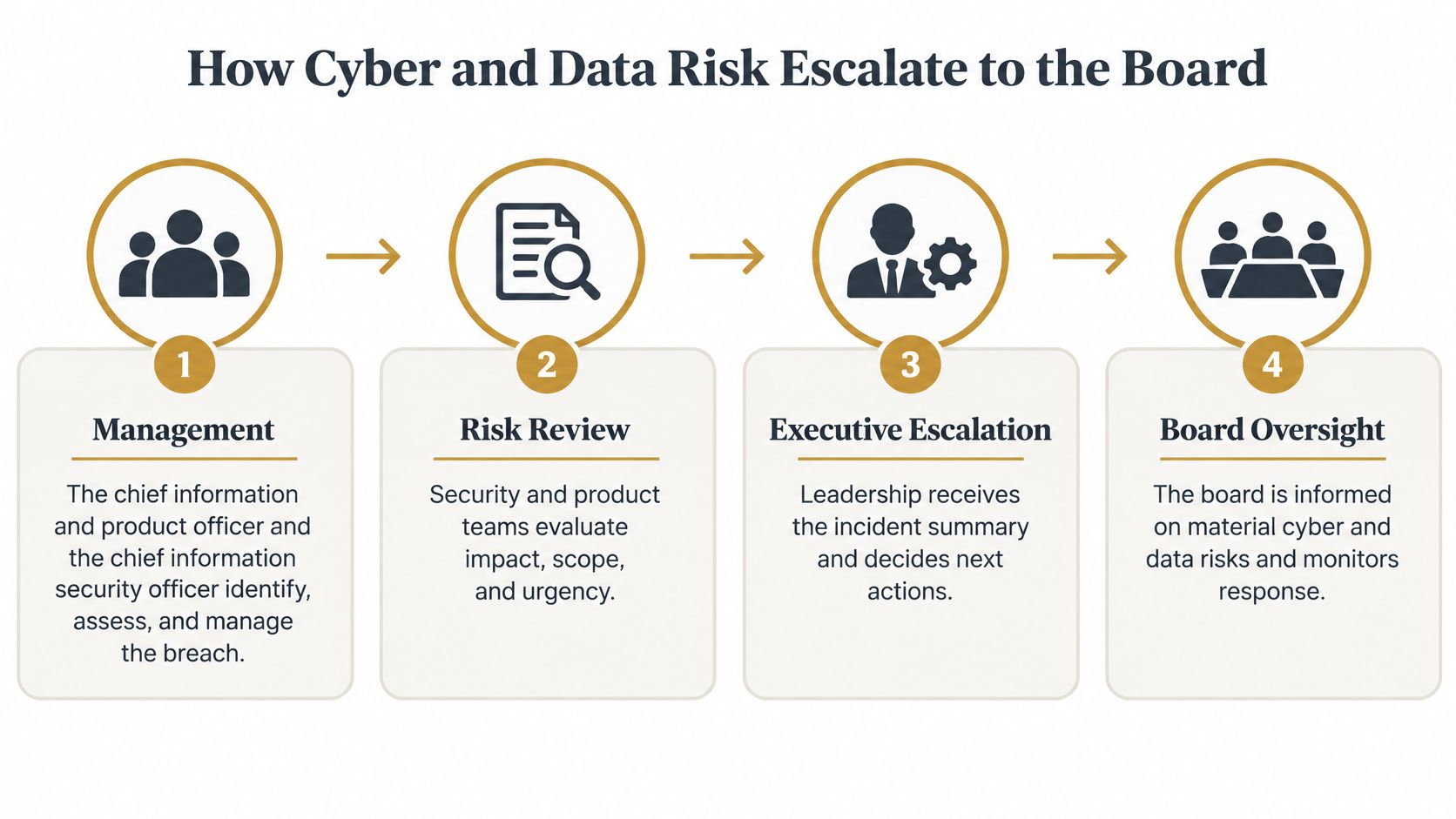
Say Target discovers unauthorized access affecting customer data. The first decisions aren't board decisions. Management contains the incident, preserves evidence, assesses exposure, and starts legal and regulatory analysis. Target's 2024 annual report assigns primary oversight of information security, cybersecurity, and data privacy to the Audit & Risk Committee, while the full board retains oversight within the enterprise-wide risk framework, and management's chief information and product officer, chief information security officer, and other risk and compliance leaders identify, assess, and manage these risks and report to the committee and/or full board.
Step One Is Management Ownership
The chief information and product officer and chief information security officer own the operational picture with other risk and compliance leaders. They identify, assess, and manage the exposure day to day. In a breach, that means establishing scope, affected systems, data categories, containment status, third party involvement, and whether controls failed or were bypassed. Speed matters, but so does a record the committee can test later.
Step Two Is Committee Scrutiny
The incident and control gaps then go to Audit & Risk. Committee members shouldn't ask for a forensic monologue. They should ask what management knows, what it doesn't know yet, which controls were supposed to prevent or detect the event, what testing said before the incident, and which vendors or internal handoffs widened the exposure. They also need remediation owners, dates, and evidence standards.
The short briefing below is useful background before you compare that committee role with your own experience.
Step Three Is Board Accountability
The full board decides strategic significance. Does the incident threaten customer trust, digital growth, regulatory standing, insurance, capital priorities, or executive credibility. Directors don't need to out engineer the security team. They need to judge whether management's risk appetite, investment, and disclosure posture match the exposure.
That separation protects all three levels. Management can't mark its own homework without committee scrutiny. The committee can't turn oversight into operations. The board can't claim surprise if reporting lines were clear and warnings reached it.
For candidates interested in cybersecurity board roles, general technology familiarity isn't enough. Bring evidence of cyber-risk metrics, incident-response governance, data-privacy controls, internal-control testing, and third-party risk management. Show you can translate technical exposure into financial and reputational consequences a full board can act on.
When you read Target's risk disclosures, match each risk to its tier. Operational owner, committee oversight, board accountability. If you can't place a risk in that chain, you haven't found the accountability yet.
Director Backgrounds and How Seats Are Filled
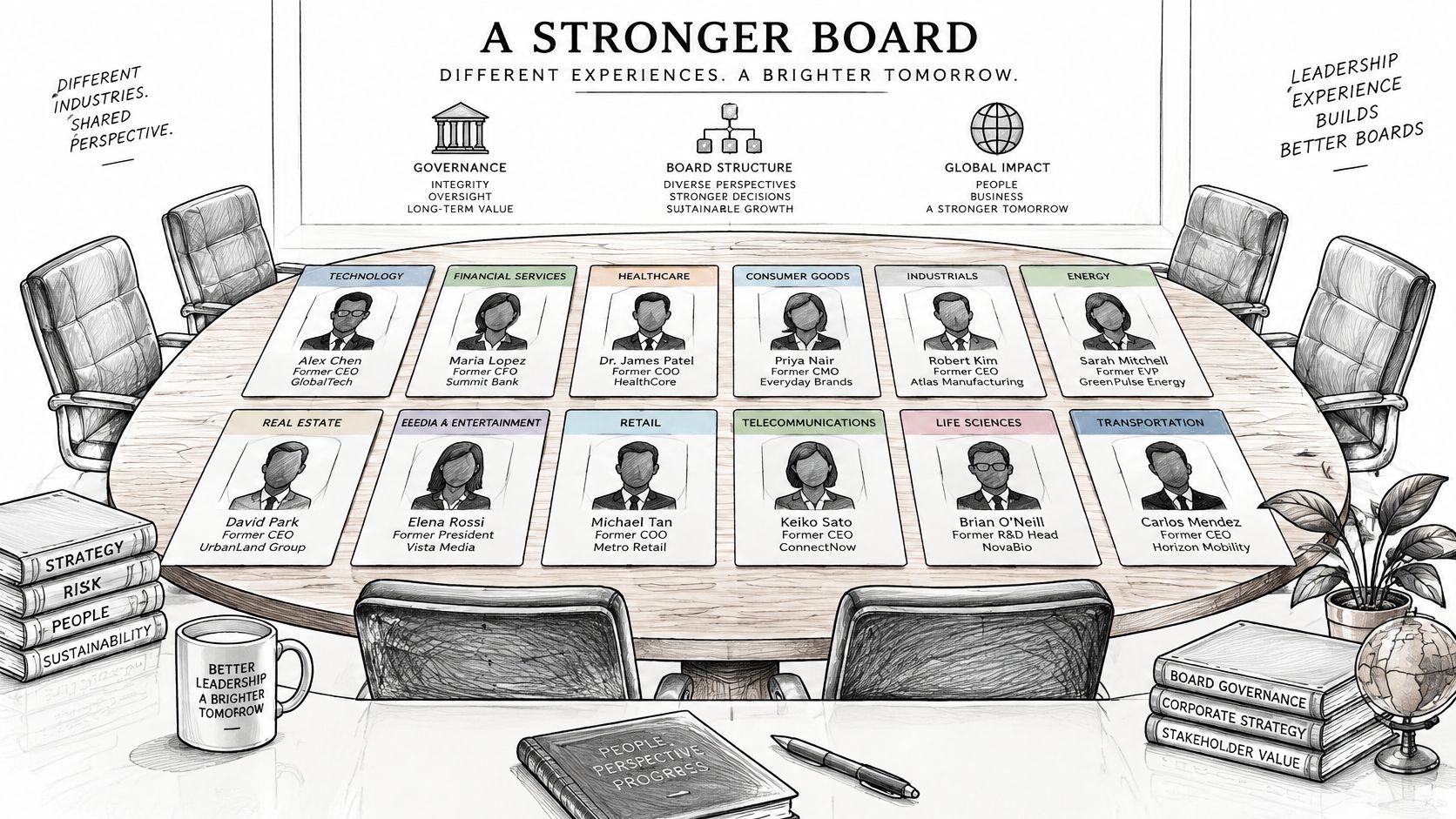
The image is conceptual. The evidence sits in the operating record behind each seat.
Director Background Sectors and Likely Expertise
| Background to look for | Expertise theme | Board problem it helps oversee |
|---|---|---|
| Consumer and retail operations | Store, brand, and channel leadership | Customer trust, demand shifts, and brand risk |
| Healthcare and pharmacy | Regulated healthcare, insurance, and distribution | Healthcare exposure, reimbursement, and compliance |
| Logistics and supply chain | Network, sourcing, and distribution | Supply-chain resilience and service continuity |
| Technology and digital | IT solutions and digital transformation | Data, cyber, and technology investment |
| Finance and capital markets | Audit, capital allocation, and controls | Financial reporting and capital priorities |
| Industrial and operating leadership | Large-scale operations and cost discipline | Execution, productivity, and operating risk |
Read the proxy for the pattern, not just the logos. The question is whether Target's disclosed mix covers senior public-company leadership across consumer, retail, healthcare, logistics, technology, finance, and risk. That range fits a retailer overseeing stores, digital commerce, supply chains, healthcare-adjacent exposure, brands, capital, and data. Narrow functional brilliance without large company operating judgment looks less aligned with that profile.
The committee level is where background becomes accountability. Consumer and brand risk needs directors who have run customer-facing operations. Financial reporting and capital allocation need audit and finance experience. Human capital and incentives need executives who have managed large workforces and succession. Technology and data need operators who have governed IT investment and third-party risk. Management keeps operating responsibility; the committee tests whether management's evidence is complete.
Don't attach individual names to committee seats from memory. Use the current proxy for the confirmed director, biography, independence status, and committee assignment. Secondary profiles often lag retirements and committee rotations.
Board composition disclosure changes with each proxy. The latest filing is the most reliable current record for gender, race, ethnicity, tenure, and the skills matrix. Older figures describe a past board.
Selection is internal. The Governance & Sustainability Committee has a formal role in identifying and selecting appropriate board candidates and organizing the structure, responsibilities, and performance of the board and its committees. The full board appoints committee members and chairs and may remove them at its discretion.
That means a public application doesn't create a vacancy or a right to consideration. You need to show how your background fills a need the board has identified through its own governance process, and you need eligibility for the committee where that need sits. Readers comparing board of directors positions should therefore start with the gap, not with their résumé headline. Fit is specific. A logistics operator, audit chair, and human capital leader may all be credible directors, but they solve different board problems.
Check Target's Board Filings Before You Approach It
Approach the Target Corp Board of Directors through filings, charters, and your own eligibility record, in that order.
- Pull the latest proxy statement: Confirm the nominee list, independence determinations, committee assignments, and current leadership roles. Note the filing date on every figure you use.
- Read the relevant committee charter: Match your expertise to a committee's actual mandate. Confirm the Infrastructure & Finance mandate directly rather than inferring it from its title.
- Run your independence check: Test relationships with Target, its suppliers, lenders, auditor, executives, and close family against the committee-level NYSE standard. Write down borderline items instead of explaining them away.
- Map experience to an identified need: Connect specific decisions you have overseen to the committee's work, then decide whether an approach is credible. Use a board offer due diligence checklist before you invest political capital in an introduction.
Step four is where many strong executives weaken their case. They describe everything they have run. A nomination committee needs something narrower. Which oversight gap do you close, what evidence proves it, which committee benefits first, and what conflicts have you already cleared? Add the directors whose backgrounds match that risk and the executive who carries operating responsibility. That three-part map shows the board you understand its accountability structure, not just its names.
SeatSignal's Done-For-You Board Placement has its team hand-pick relevant open board roles, prepare director-grade applications suited to each opportunity, and run board-specific interview preparation. The director-grade packet includes a CV, cover letter aligned with the board charter and gap, fit memo, independence attestation, and a warm-path route so the approach arrives through a name rather than cold.
The limits are explicit. SeatSignal is not a search firm and does not represent customers to boards or negotiate on their behalf. Every approach goes out in the customer's own name. Boards, nomination committees, and recruiters make appointment decisions, and SeatSignal maintains a refund policy and results disclaimer, so results are not guaranteed.
That division suits a company like Target. You cannot outsource credibility, independence, or the final conversation. You can outsource the disciplined work of finding the right gap, translating executive experience into governance evidence, and preparing for the questions a chair is likely to ask. Do the filing checks first, so the preparation rests on the board Target has now, not on a stale summary.
If you are targeting a board with Target's level of committee scrutiny, bring a packet built around its charter, independence test, and actual composition gap rather than a generic executive CV. Visit SeatSignal to have its team hand-pick suitable board matches, prepare director-grade materials, and rehearse you for the specific interview.
Want a paid board role, done for you?
One handpicked, verified open board role every week, with a director-grade packet tailored for it.
Get Started