What Makes a Good Board Member: Qualities That Earn a Seat
An impressive executive title can hurt you in a board interview. Chairs meet successful operators every week, and many can't make the shift from running a business to overseeing one. They intervene too quickly, challenge too late, or bring expertise the board already has in surplus. What makes a good board member isn't prestige. It's whether your judgment helps a group of independent people reach better decisions than management or any single director would reach alone.
That distinction should shape everything you prepare. Don't lead with the size of the budget you once controlled. Lead with the assumptions you tested, the risks you surfaced, and the governance gap your appointment would close.
Table of Contents
- The Core Qualities That Define an Effective Director
- Matching Your Expertise to the Board's Gaps
- Independence and Conflicts You Must Be Ready to Explain
- Behaviors That Separate High-Performing Boards
- What Board Service Demands After Appointment
- Good Board Members at Work in Two Common Cases
- Confirm Your Fit Before You Accept a Seat
The Core Qualities That Define an Effective Director
An effective board member turns relevant experience into independent, disciplined oversight of management and makes the whole board better at deciding. That's the direct answer. Everything else is evidence for it.
Start with the duties those qualities must serve. The G20/OECD Principles of Corporate Governance 2023 identify the board's central work as reviewing corporate strategy, risk policy, annual budgets and business plans, along with major capital expenditure, acquisitions and divestitures. Directors also set performance objectives, monitor implementation and financial results, select and oversee key executives, and supervise succession planning. A quality matters only when it improves one of those duties.
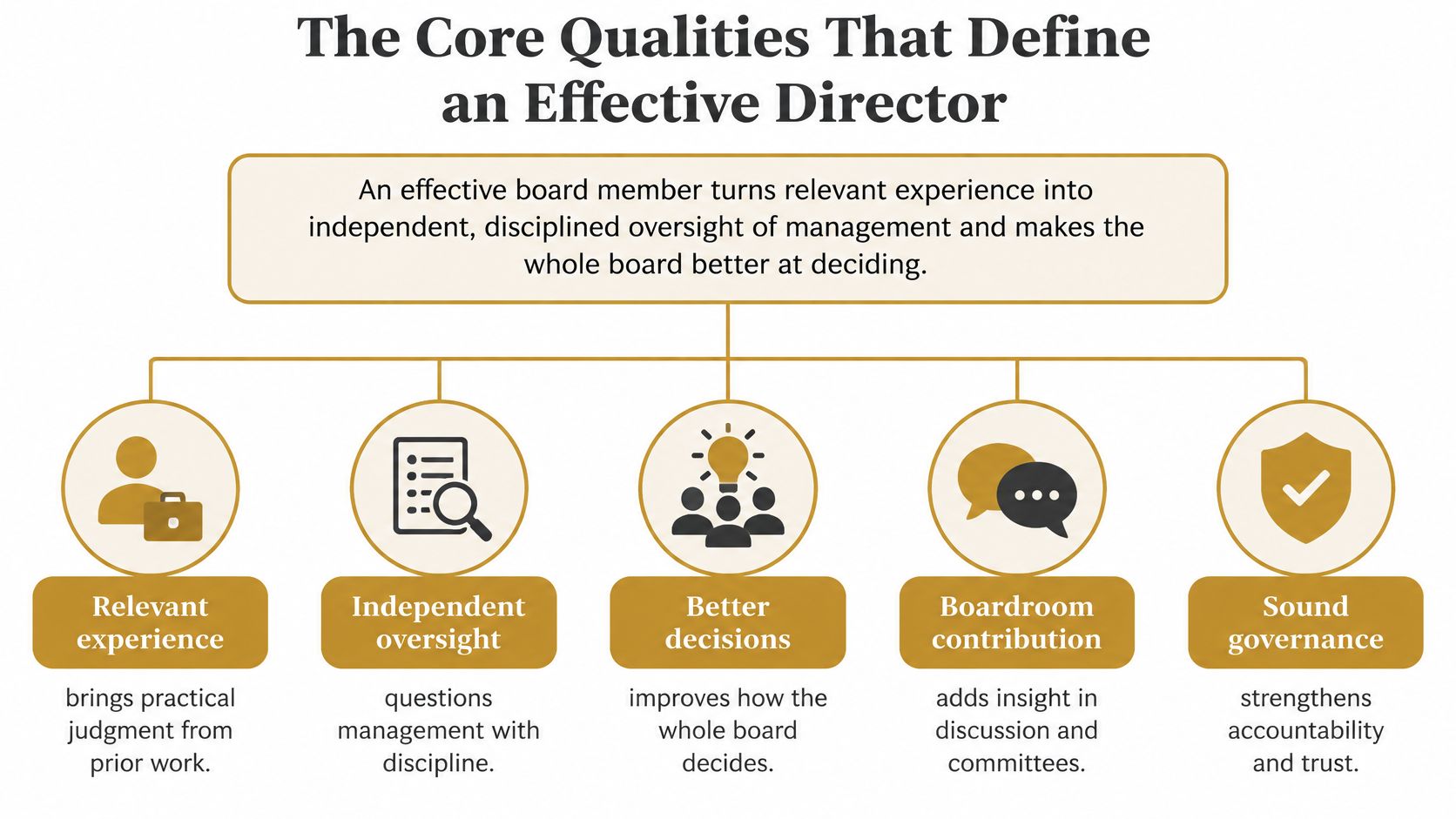
Five qualities in boardroom terms
Strategic judgment comes first because directors keep ranking it first. In the 2024 IESE Business School survey of 120 board directors across 26 countries, 95% rated the ability to define and execute corporate strategy as a top board competency. In practice, that means testing whether the plan's assumptions survive weaker demand, higher costs, and delayed benefits.
Financial and audit literacy means you can interrogate reported results and the controls behind them, not merely read a profit and loss account. Risk oversight means you identify what could damage the company, set escalation thresholds, and check that management acts before a risk becomes a crisis. Independence means no relationship, shareholding, or outside loyalty controls your vote. Constructive challenge means you can disagree clearly without turning scrutiny into a contest with the CEO.
Core board qualities and how to evidence them
| Quality | What it looks like in the boardroom | How to show it |
|---|---|---|
| Strategic judgment | Challenges assumptions in the business plan and annual budget | Cite a strategy decision you tested with data |
| Financial and audit literacy | Reads financial reporting and internal controls critically | Name audit or capital allocation oversight you have done |
| Risk oversight | Surfaces emerging risks and sets escalation thresholds | Show risk committee or crisis decision experience |
| Independence | Discloses conflicts early and protects independent judgment | Document outside roles, shareholdings and committee seats |
| Constructive challenge | Asks hard questions without undermining the chair or CEO | Give one example of dissent handled well and documented |
Use the table as a CV audit. If a career claim doesn't connect to a boardroom action, rewrite it until it does. Our board readiness assessment gives you a structured starting point for that check.
Self-test: Does your presence improve the quality of decisions, or only your attendance record?
If you can't answer with a specific decision you improved, you aren't ready to describe yourself as board ready. Prepare that evidence before you pursue the seat.
Matching Your Expertise to the Board's Gaps
Boards don't need another prominent name. They need the right collective capability for the decisions ahead.
The image below captures the practical task. You're not proving that you're generally accomplished. You're showing where your capability completes a board that has identifiable gaps.
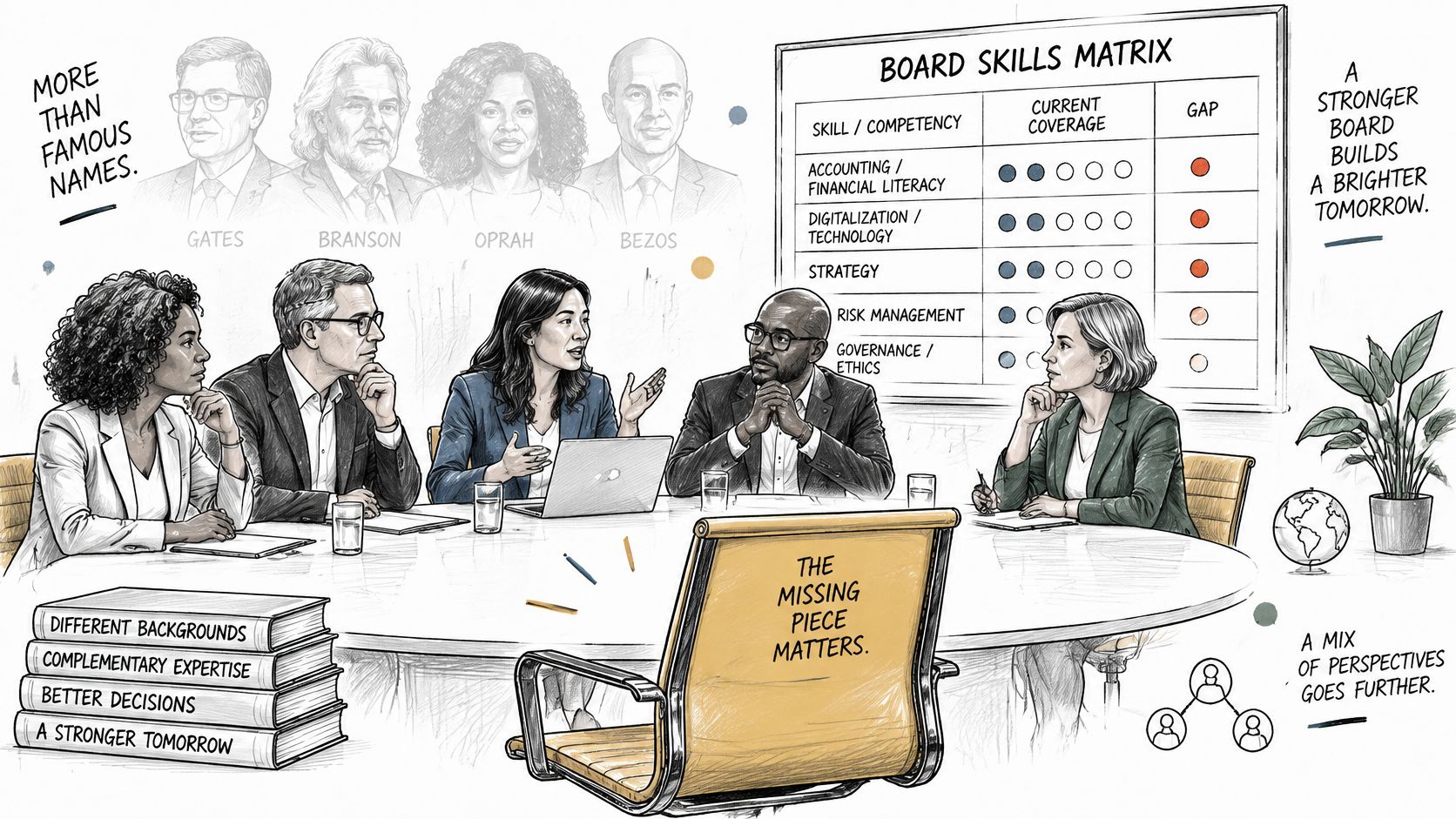
The OECD guidance on board composition states that boards need an appropriate mix of knowledge, competencies, experience, and expertise, rather than a collection of prominent individuals. Many boards express that mix through a skills matrix covering accounting, digitalisation, sustainability, risk management, sector expertise, strategy, and customer or market knowledge.
Risk is a clear current priority. Deloitte's 2025 analysis found that 70% of newly appointed directors had risk-management skills, compared with 60% of incumbent directors. Don't copy that signal blindly. It shows boards are buying future oversight needs, not collecting familiar executive backgrounds.
Build a one page gap map
- Read the available skills matrix or latest board evaluation. Note which capabilities are concentrated in one director and which are absent entirely.
- Check committee mandates and named strategic risks. An audit committee vacancy and a technology committee vacancy require different evidence, even at the same company.
- Name two gaps you close and one you cannot fill. Honesty about the third gap makes the first two claims credible.
- Write your fit in one sentence and prepare one interview example. Say exactly what decision your experience would improve, then prove it with an action, a result, and your role in both.
An experienced audit chair can strengthen financial reporting oversight. A cybersecurity executive can improve the board's challenge of technology risk. Neither adds value by reciting specialist knowledge. Each must translate that knowledge into questions, thresholds, and decisions the full board can use.
Diverse backgrounds help only when directors test assumptions and integrate conflicting evidence. A different perspective that stays silent doesn't reduce groupthink. Use our board role fit checklist to turn your review into the finished output you need before any board conversation, a one page gap map.
Independence and Conflicts You Must Be Ready to Explain
Independence depends on whether you can exercise sound judgment despite your interests and relationships. A nomination committee will examine the details, not just your declaration. Disclose potential conflicts early. A late disclosure can look like concealment, even when it began as poor organisation.
Run a five step conflicts check
- Map your relevant roles and interests. List board seats, employers, advisory work, investments, and companies where you hold influence.
- Flag significant shareholdings and relationship ties. Include connections to suppliers, clients, competitors, and former employers.
- Decide what to disclose and when. Raise material matters before the first interview, while the committee can assess them fairly.
- Set confidentiality rules. Explain how you will protect information obtained through one board from use in another.
- Test outside influence. Be ready to show that an investor, employer, client, or fellow director cannot override your judgment.
The UK Corporate Governance Code 2024 says boards should identify and manage conflicts, including those arising from significant shareholdings, and ensure third-party influence does not override independent judgment. It also addresses the chair's independence at appointment and separation of the chair and chief executive roles.
For US audit candidates, understand the SEC-defined audit committee financial expert designation and the independence standard in Section 301 of the Sarbanes-Oxley Act. Check the current rules before your interview. If the role requires the designation, state whether you meet it and give specific evidence of the experience behind your answer.
Prepare for likely follow-up questions with the board interview question bank. Then summarise your roles, interests, potential conflicts, and safeguards in a one-page conflicts statement. Specific disclosure gives the committee something concrete to assess. Saying only “I'm independent” does not.
Behaviors That Separate High-Performing Boards
A board's expertise matters only when directors use it to improve decisions. Strong directors test weak assumptions, challenge proposals without turning disagreement personal, and help the board reach a reasoned conclusion.
Global research covering more than 1,000 directors across 45 countries identifies constructive challenge, chair leadership, and the ability to turn expertise into collective decisions as characteristics of high-performing boards. Skills alone do not create that culture. Directors must put their expertise to work in the room.
Challenge without becoming the problem
Challenge the argument, not the person. Ask what would have to be true for a proposal to fail, which downside scenarios management has modelled, and who owns the corrective action. This keeps scrutiny focused on evidence and accountability.
Raise serious concerns with the chair before the meeting when possible. That gives management a fair chance to provide missing evidence, while preserving your ability to state a firm view in the room.
Match the question to the setting. A committee may need detailed questions about controls; the full board needs to understand the decision's implications. Give the chair early warning, make a clear request of the CEO, and explain your reasoning so other directors can test it.
Strong and weak director behavior compared
| Behavior | Strong director | Weak director |
|---|---|---|
| Handling disagreement | States dissent with evidence and records it | Stays silent, then objects after the decision |
| Meeting preparation | Reads the papers and frames questions in advance | Relies on the chair's summary |
| Working with the chair | Raises concerns privately before the committee | Goes public or bypasses the chair |
| Building consensus | Tests positions, then commits to the decision | Blocks decisions or agrees without challenge |
| Self-evaluation | Requests individual feedback and sets measurable goals | Assumes attendance equals contribution |
Consensus does not require private agreement from every director. It requires testing the proposal, recording material dissent where appropriate, and committing to the decision once taken. Repeatedly attacking the decision afterward weakens the board's authority and its ability to work with management.
Before accepting a seat, ask the chair how dissent is handled and request a recent example.
A vague answer is revealing. If the chair cannot describe a decision improved by director challenge, your expertise may be decorative there.
What Board Service Demands After Appointment
Treat board service as a demanding fiduciary job, because that's what it is. The appointment letter is the beginning of the obligation, not the reward for your executive career.
The National Association of Corporate Directors benchmark reports that annual independent-director time commitments have risen from below 250 hours to above 300 hours over the past decade, and PwC findings cited alongside that workload picture show that 55% of directors said at least one colleague should be replaced, 78% said board assessments fail to capture the full picture, and nearly three-quarters reported that boards skip individual reviews. Those findings expose an uncomfortable truth. Boards know weak contribution exists, but many don't measure it well.
Test your capacity before you sign
- Estimate the full hours. Count board meetings, committee preparation, site visits, calls with the chair, continuing education, and crisis availability.
- Count your existing seats and obligations. Each additional role increases conflict risk and reduces the time you can give when several boards face problems at once.
- Set two or three measurable contribution goals. Track papers read before each meeting, substantive questions raised, site visits completed, or committee actions followed through.
- Request an individual review after year one. Ask the chair where your contribution changed a decision and where it fell short.
Use our board time commitment calculator to make the estimate concrete rather than optimistic. Don't rely on the published meeting calendar alone. Serious preparation and unscheduled issues consume the hours candidates forget to count.
A weak contributor can face removal, and you shouldn't assume assessment applies only to colleagues. Review your own preparation, challenge, and follow through with the same severity you'd apply to management.
Capacity rule: If you can't name the hours, you can't yet accept the seat.
Availability is part of competence. A brilliant director who arrives unprepared or disappears during a crisis isn't a good board member.
Good Board Members at Work in Two Common Cases
The two cases below are illustrative composites, not named individuals. Their value lies in the sequence of actions. Each director makes a quality visible through preparation, disclosure, and follow through.
The comparison image introduces the contrast between an audit focused director and a strategy focused director working with a CEO.
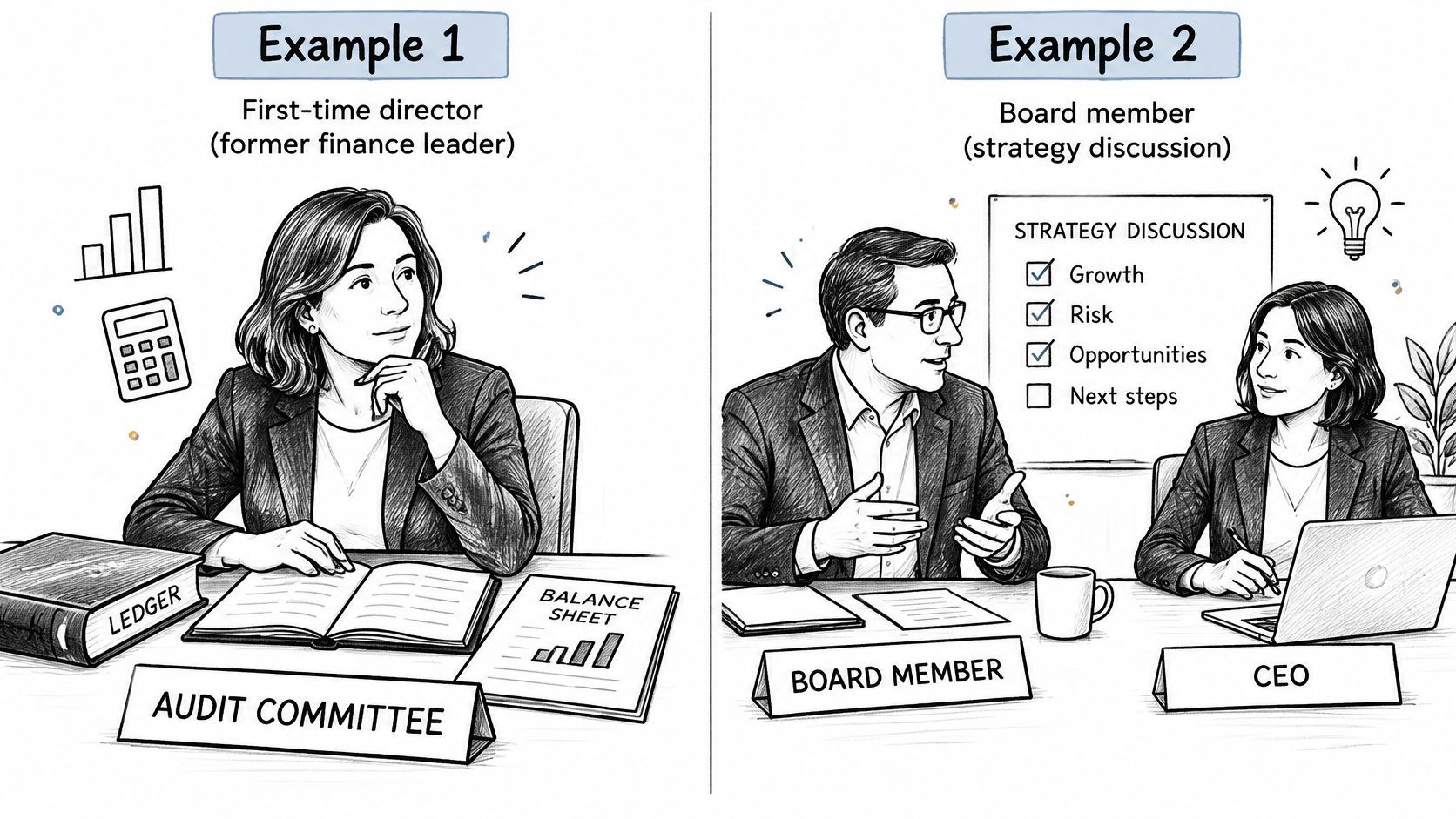
Case one on the audit committee
A first time director and former finance leader joins a listed company's audit committee. Before her first meeting, she reads the external auditor's management letter instead of relying on the committee summary. She asks the finance director to explain three control weaknesses, including who owns each remedy and when it will be closed.
She records the responses in her notes so she can test progress at the next meeting. She also declares an earlier consulting relationship with one supplier before anyone asks. That early disclosure doesn't weaken her position. It makes her independence visible and lets the chair manage any affected discussion.
Case two on succession and strategy
A serving director moves from a corporate role to a nonprofit board and concentrates on succession planning. He challenges the chief executive's three year plan by asking for downside scenarios, trigger points, and the leadership capacity required if growth falls short. His questions alter the milestones but don't become a campaign against the plan.
Once the board decides, he backs the decision and tracks the agreed milestones. He also presses for an updated succession slate so the strategy doesn't depend on one executive remaining in post.
The video below offers another way to think through the conduct expected once you're in the room.
Both directors share the same pattern. They bring specific evidence, disclose issues early, challenge before the decision, and commit after it. Neither hides behind seniority or treats board membership as commentary from the sidelines.
Your practical lesson is simple. Choose actions for your first ninety days that make each claimed quality observable. Read the difficult paper, ask for the missing control evidence, disclose the relationship, and follow the decision through.
Confirm Your Fit Before You Accept a Seat
An offer is a decision, not a prize. Before you accept, put the evidence of fit, independence, and capacity in one place and use it to test the role.
Your five-part decision packet
- Attach the gap map. Name two board needs your experience addresses and one that falls outside your expertise. Support each claim with evidence.
- Attach the conflicts statement. List relevant roles, shareholdings, supplier or client relationships, and how you will protect confidential information.
- Attach the capacity note. Set out the expected workload, your existing board commitments, and measurable goals for your first year.
- Add your director CV and cover letter. Connect your experience to the board's needs and committee duties. State your fit clearly and support it with an interview example.
- Rehearse difficult moments. Practise explaining a conflict, challenging a proposal, and supporting the board's decision after discussion.
Use the board offer due diligence checklist to identify unanswered questions. Ask about committee workload, board evaluation, succession, and the quality of board papers. A board's response to reasonable questions is itself evidence about its governance.
SeatSignal handpicks relevant open board roles, prepares director-grade application packets, and offers interview preparation specific to each opportunity. The packet can include a board CV, cover letter, fit memo, and independence note. The team can also rehearse questions the chair is likely to ask, based on the role, committee responsibilities, and gaps in the board's composition. Use that support to strengthen your own judgment, not replace it. Appointment decisions belong to the board and its nomination committee, and no placement is guaranteed.
Before you accept, make sure you can explain what the board needs, what you will contribute, and what could limit your independence or capacity. SeatSignal can help you prepare applications and interview for roles; the decision to accept remains yours.
Want a paid board role, done for you?
One handpicked, verified open board role every week, with a director-grade packet tailored for it.
Get Started